

Osmoregulation is a biological process by which an organism regulates water and dissolved solutes in the body fluids to maintain a suitable internal osmotic condition. Both water and solute concentration are regulated.
This osmotic balance affects the movement of water across cells and helps in maintaining an appropriate cell volume. When the osmotic condition changes excessively, cells may swell or shrink.
Osmosis is the movement of water across a selectively permeable membrane due to differences in water and solute concentration. It is not same as osmoregulation. Osmoregulation is the wider physiological regulation of water and solute balance within the organism, and it forms a part of homeostasis.
In some organisms, internal osmotic conditions are regulated relatively independently of the surrounding medium. In others, the osmotic concentration of body fluids changes more closely with the external environment.
How Osmoregulation Works
Osmoregulation is carried out by changing the movement of water and dissolved solutes across selectively permeable membranes. During this process, a change in internal osmotic condition is sensed and the movement or retention of water and solutes is adjusted. It may occur at the membrane of a single cell. In multicellular organisms, specialized tissues and organs are also involved.
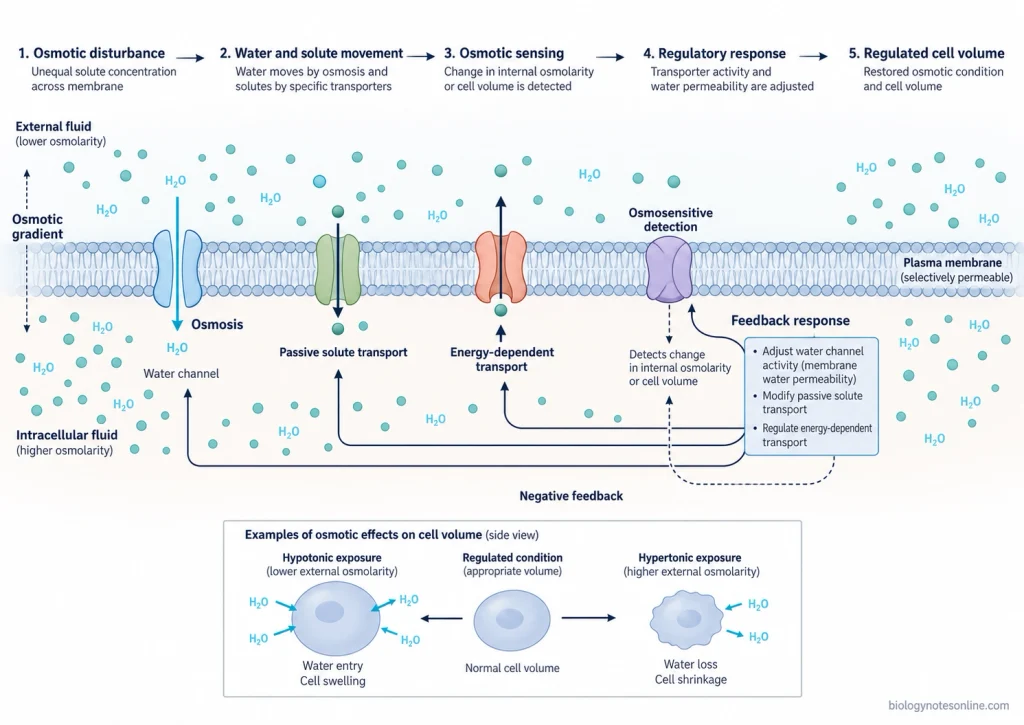
- A difference in osmotically active solute concentration between two fluid compartments creates an osmotic gradient. Water moves through the selectively permeable membrane by osmosis, generally towards the side having higher effective solute concentration. Cell volume can change during this movement.
- Ions and several other solutes do not freely move through the lipid part of membrane. Channels and carrier proteins allow movement of particular solutes down their electrochemical gradient. Some ions are moved in the opposite direction also. For this, active transport and cellular energy are required.
- Water movement is mainly a passive process. The distribution of ions and other solutes can be changed by the cell, which changes the osmotic gradient across its membrane. Water then moves according to this gradient. Water channels provide another pathway for rapid water movement.
- When internal osmotic condition changes, osmosensitive mechanisms detect the change. In many multicellular animals, specialized osmoreceptors respond to changes in extracellular fluid. The information is passed to physiological control systems.
- The physiological response is controlled mainly by feedback. Transport activity and membrane permeability may be changed, while water and ions can be retained or moved out depending on the disturbance. In negative feedback, the response acts against the original change in the regulated osmotic condition.
- In a single cell, these movements take place directly across the plasma membrane. Multicellular organisms also have specialized epithelial tissues and osmoregulatory organs. Here, several membrane transport processes operate together for exchange of water and ions between body fluids and the surrounding environment.
Types of Osmoregulation
Osmoregulation is divided into two main types, based on how an organism maintains its internal osmotic environment. Some organisms regulate it strictly, while some simply follow the surroundings.
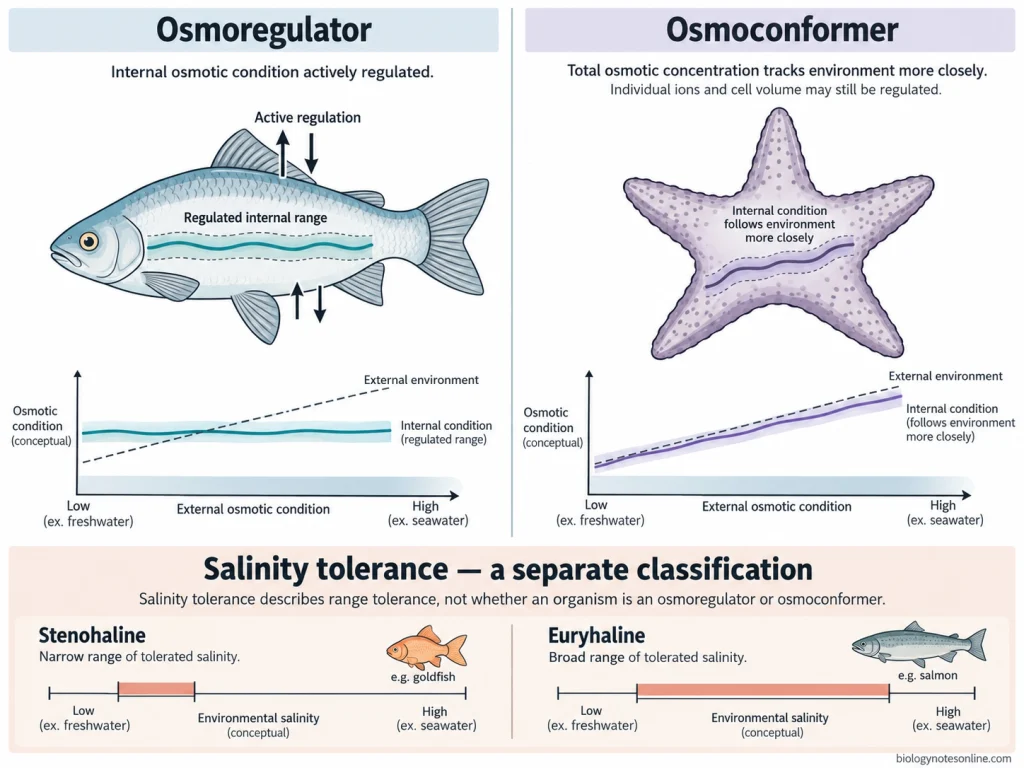
- Osmoregulators- These organisms tightly regulate the body osmolarity, and it always stays constant. Salt concentrations are actively controlled, despite the salt concentrations present in the outside environment. They are more common in the animal kingdom. An example is the freshwater fish. Such a fish does not drink much water, because fresh water is hypotonic to its body fluids. It passes a lot of very dilute urine. Electrolyte balance is achieved by the active transport of salts through the gills.
- Osmoconformers- The body osmolarity is matched to the surrounding environment, either actively or passively. Most marine invertebrates are osmoconformers, although their ionic composition may be different from that of seawater. Their body fluid concentrations simply conform to the changes in seawater concentration. Sharks are a special case here. The blood of sharks contains large concentrations of urea, along with trimethylamine oxide (TMAO). Isotonicity with the sea is achieved by storing this urea, and TMAO stabilizes the proteins in the presence of such high urea levels. A rectal gland is also present in sharks for salt secretion.
Organisms are also separated by their salinity tolerance. This gives two more categories.
- Stenohaline- Organisms that survive only within a narrow range of salinity (goldfish). About 90 percent of the bony fish are restricted to either freshwater or seawater. They are incapable of osmotic regulation in the opposite environment. Most freshwater organisms are stenohaline, and the same applies to most marine organisms.
- Euryhaline- These organisms tolerate a relatively wide range of salinity (salmon, molly). Salmon spends part of its life in fresh water and part in sea water. In the marine environment the fish drinks sea water, and the excess salts are excreted through the gills and urine.
Why Osmoregulation Is Important
Osmoregulation is required for maintaining the water and solute content of cells and body fluids within a suitable range. Some of the important functions are as follows-
- Cell volume- Water movement directly changes the volume of a cell. Excess entry of water causes swelling. When too much water goes out, the cell shrinks and becomes dehydrated.
- Protection from osmotic damage- In a hypotonic condition, excessive water may enter into the cell, whereas water is lost during a hypertonic condition. If this osmotic stress remains for a longer period, normal cell functions can be affected and the cell may also die.
- Ion balance- Sodium (Na⁺), potassium (K⁺), chloride (Cl⁻) and other ions are maintained at useful concentrations inside and outside the cells. These concentrations cannot simply change with every movement of water. Ion channels, transporters and pumps control their distribution.
- Enzyme and protein function- A proper water content and ionic condition is required for many biochemical reactions. Large changes in intracellular ions or cellular hydration can interfere with enzyme activity. Protein function can also be affected.
- Membrane function- Excessive swelling increases tension on the plasma membrane. Cell shrinkage, on the other hand, changes the physical condition of membrane and intracellular space. Membrane channels and transport proteins take part during restoration of cell volume.
- Homeostasis- Water, dissolved solutes and cell volume are kept within controlled limits by osmoregulation. It is a part of homeostasis.
Osmoregulation in Humans
In humans, osmoregulation mainly involves the hypothalamus, antidiuretic hormone (ADH) or vasopressin, and the kidneys. The hypothalamus detects change in the osmotic condition of blood. Kidneys control how much water is retained or lost from the body. Thirst is also involved.
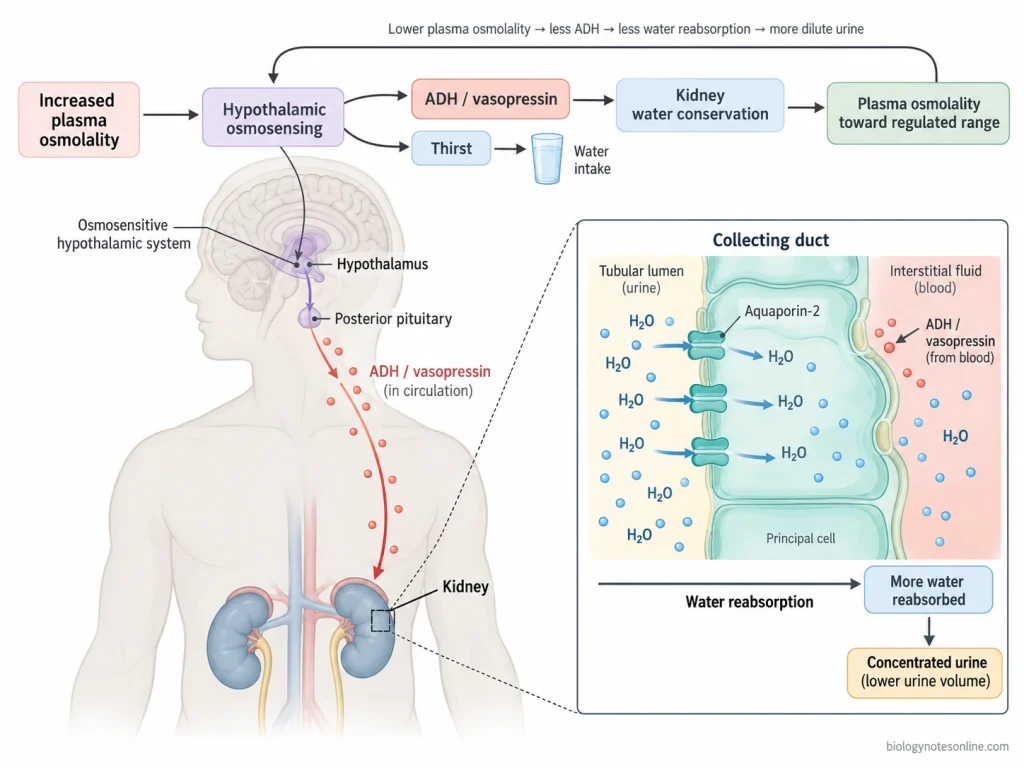
- Osmoreceptors are present in the hypothalamus. They detect changes in the osmolality of blood plasma. When the plasma becomes more concentrated, these receptors are stimulated.
- Increased plasma osmolality also produces thirst. More water is then taken into the body by drinking.
- ADH is produced in the hypothalamus and released from the posterior pituitary gland. Its release increases when plasma osmolality rises or the body is short of water. ADH reaches the kidneys through blood.
- The kidneys are the major organs which control water loss from the body. More water can be retained when required. When water is present in excess, a greater amount can be passed out.
- Each kidney contains a large number of nephrons. Water and solutes are handled along different parts of nephron, while the later parts and collecting ducts are involved in controlling the final amount of water retained.
- In the presence of ADH, the collecting ducts become more permeable to water. More water is reabsorbed and returned to blood. Water passes through aquaporin water channels. Less water is lost in urine and the urine becomes more concentrated.
- When plasma osmolality decreases, less ADH is released. Water reabsorption in the kidneys also decreases. A larger amount of dilute urine is passed.
Osmoregulation in Fish
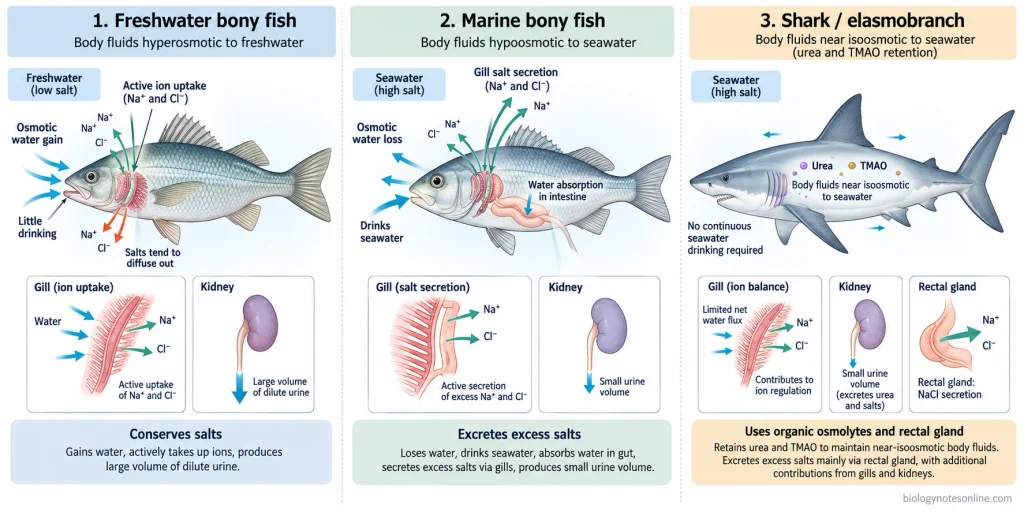
Fish osmoregulation depends mainly on the salinity of surrounding water. Freshwater fish and marine bony fish face opposite osmotic problems, while sharks and other elasmobranchs use a different urea-based strategy.
Freshwater Fish
- Freshwater fish live in a medium which is more dilute than their body fluids. Water enters into the body by osmosis. Salts tend to move out through the gills and other permeable surfaces.
- They do not drink much water. The excess water is removed by producing large amount of dilute urine.
- Lost salts are replaced by active uptake of ions through the gills. Sodium chloride (NaCl) is taken from the surrounding water, and salts are also obtained from food. The gills are very important here.
- The kidney removes extra water but helps in conserving salts. This prevents the body fluids from becoming too dilute.
Marine Bony Fish
- Marine bony fish live in seawater, which is more concentrated than their body fluids. Water is lost from the body by osmosis. Salts enter into the body from seawater.
- These fish drink seawater to replace the lost water. Water is absorbed in the intestine.
- Drinking seawater also brings salts into the body. The excess salts are mainly excreted through the gills. Special ion-transporting cells in the gill epithelium take part in this salt removal.
- The kidney produces only small amount of urine, because water has to be conserved. Some salts are also removed through urine.
Sharks and Other Elasmobranchs
- Sharks, rays and skates are elasmobranchs. They do not regulate water and salts in the same way as marine bony fish.
- Their body fluids contain high amount of urea. Trimethylamine oxide (TMAO) is also present, which protects proteins from the harmful effect of high urea. Because of these solutes, the body fluids become nearly isoosmotic or slightly hyperosmotic to seawater.
- Water loss is therefore reduced. Sharks do not need to drink seawater continuously like marine bony fish.
- Extra salts are removed mainly by the rectal gland. The rectal gland secretes concentrated salt solution, especially sodium chloride (NaCl). Gills and kidneys are also involved in ion and urea balance.
Osmoregulation in Marine Invertebrates
- Many marine invertebrates are osmoconformers, where the total osmotic concentration of body fluid remains nearly similar to the surrounding seawater. The internal concentration changes along with the external medium. A large osmotic gradient is generally not maintained.
- In starfish and other echinoderms, the coelomic fluid is generally isosmotic or slightly hyperosmotic to normal seawater. When external salinity changes, the osmotic concentration of coelomic fluid also changes with it, although the change may not occur immediately. Some sea stars can keep up a temporary osmotic difference for several hours.
- Jellyfish and many other marine cnidarians also show osmoconformation. Their body fluids remain close to seawater in total osmotic concentration. Strong regulation of whole-body osmotic concentration against the seawater is less required.
- Osmoconformation, however, does not indicate that these animals have no physiological regulation at all. The cells still regulate cell volume, individual ions and different organic osmolytes. During exposure to dilute seawater, organic osmolytes can be released or their concentration is reduced. Excessive entry of water and swelling of the cells are restricted by these changes.
- Free amino acids form important organic osmolytes in many marine invertebrates. Echinoderms mainly use free amino acids for intracellular osmotic adjustment. In some cnidarians including jellyfish, methylamines and other related organic compounds also occur.
- The capacity for osmoconformation varies between different marine invertebrates. Some can tolerate considerable changes of salinity. Others are restricted to a narrow salinity range. At low salinity, certain osmoconformers may temporarily maintain an extracellular osmotic gradient or undergo partial hyperosmotic regulation instead of immediately following the osmotic concentration of seawater.
Osmoregulation in Plants
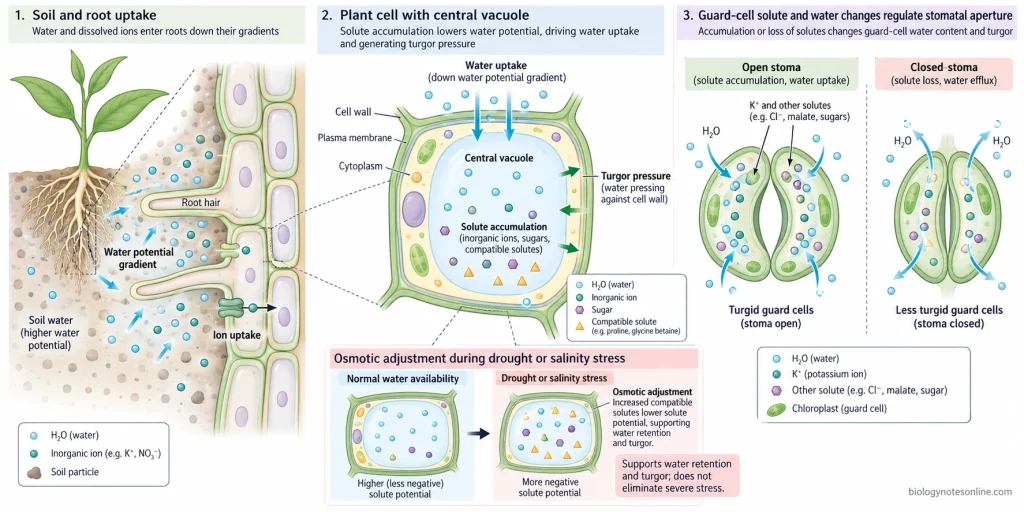
- Osmoregulation in plants is the regulation of water and dissolved solutes within the plant cells.
- Water is taken up by the roots when the water potential of root cells is lower than the surrounding soil. Water moves from higher water potential to lower water potential.
- The water potential of a plant cell can be changed by changing its solute concentration. Accumulation of more solutes makes the solute potential more negative. Water then enters into the cell by osmosis.
- Water entering the plant cell develops pressure against the cell wall. This is referred to as turgor pressure. It keeps the cells firm.
- Ions are taken up by root cells with the help of membrane transport proteins. Different ions are then transported across the plasma membrane, which regulates the solute concentration of the cells.
- Potassium ions (K⁺) and other solutes accumulate in the guard cells during stomatal opening. Water enters the guard cells. They become turgid and the stomatal pore opens.
- During stomatal closing, ions move out from the guard cells and water also moves out. The turgor pressure decreases. The stomatal pore becomes narrow or closes.
- The central vacuole stores water, inorganic ions, sugars, organic acids and other dissolved solutes. Ions can be accumulated in the vacuole without allowing their excessive concentration in the cytoplasm.
- During drought or salinity stress, plant cells accumulate soluble sugars, amino acids and other compatible solutes. This is referred to as osmotic adjustment.
- Osmotic adjustment makes the internal solute potential more negative and allows the cells to retain or take up water under low water-potential conditions. Cell turgor can be maintained even when soil water becomes limited.
- Root growth and stomatal function may be partly maintained by osmotic adjustment during water stress. It does not prevent the effects of severe or prolonged water deficiency for unlimited time.
Osmoregulation in Unicellular Organisms
Amoeba and Other Freshwater Protists
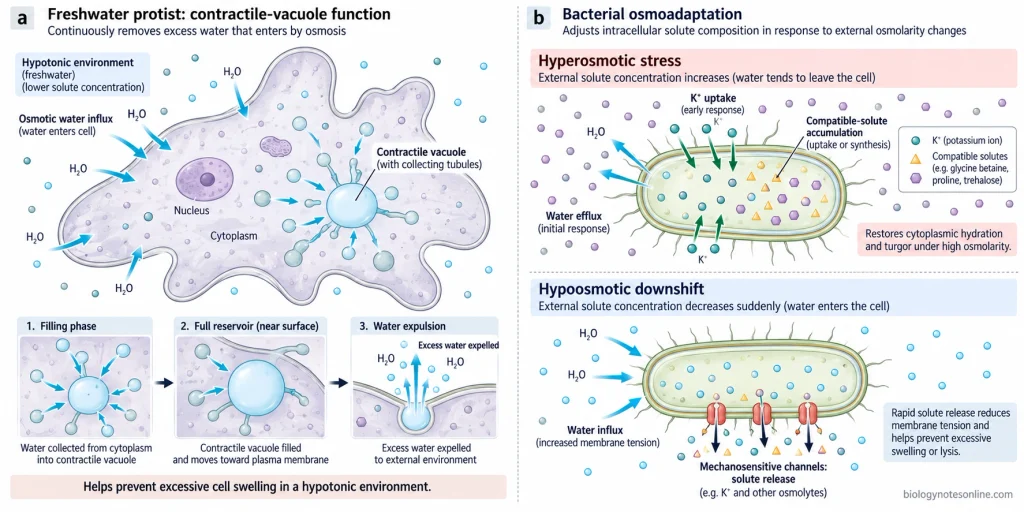
- Freshwater protists such as Amoeba live in a hypotonic environment. The concentration of dissolved solutes inside the cell is higher than that of the surrounding freshwater, so water continuously enters into the cell by osmosis.
- Excess water is collected in the contractile vacuole. The vacuole gradually fills up and then releases the water outside the cell.
- This process takes place repeatedly. Without proper contractile vacuole activity, excess water accumulates in the cytoplasm, the cell swells and may finally lyse.
- Contractile vacuoles are found in many freshwater amoebae, ciliates, flagellates and other protists that lack a rigid cell wall. Their activity generally increases under more hypotonic conditions.
- Water does not simply enter the contractile vacuole as an empty chamber. Ion and proton transport across the vacuolar system produces osmotic gradients, and water is then accumulated into the vacuole before its discharge.
Osmoregulation in Bacteria
- Bacteria regulate their internal osmotic condition mainly by controlling ions and small organic solutes rather than using contractile vacuoles.
- When the external osmolarity increases, water tends to leave the bacterial cell. K⁺ is commonly taken up rapidly during the early response. Compatible solutes are then accumulated by transport or synthesis.
- Glycine betaine, proline and trehalose are some of the common compatible solutes. They can accumulate in high concentration without strongly interfering with normal cellular functions.
- During a sudden decrease in external osmolarity, water enters the bacterial cell and increases turgor pressure. Ions and compatible solutes can be released, while mechanosensitive channels provide a rapid route for solute loss during strong hypoosmotic stress.
Osmoregulation at a Glance
| Organism/Group | Osmotic problem | Major mechanism | Important point |
|---|---|---|---|
| Freshwater protists (Amoeba) | Water continuously enters the cell by osmosis | Contractile vacuole collects and removes excess water | Prevents excessive swelling and cell lysis |
| Bacteria | Water enters or leaves with changes in external osmolarity | Ion transport and accumulation or release of compatible solutes | K⁺, glycine betaine, proline and trehalose may be involved |
| Plants | Water loss, salinity and changes in cellular water potential | Water uptake, ion transport, stomatal regulation and osmotic adjustment | Turgor is maintained by controlling water and solute concentration |
| Plant vacuole | Excess ions and changing cellular solute concentration | Water and solutes are stored inside the vacuole | Helps in maintaining solute balance and cell turgor |
| Guard cells | Regulation of water loss through stomata | Ion movement changes guard-cell water content and turgor | High turgor opens stomata. Low turgor closes them |
| Marine invertebrates | Body fluids are exposed to seawater of similar osmotic concentration | Many are osmoconformers | Body-fluid osmotic concentration remains close to seawater |
| Starfish | Changes in seawater salinity affect body fluids | Coelomic fluid largely follows seawater osmotic concentration | Strong whole-body osmotic regulation is limited |
| Jellyfish | Internal osmotic concentration remains close to seawater | Osmoconformation and cellular osmolyte regulation | Osmoconformation does not mean complete absence of physiological regulation |
| Cells under osmotic stress | Water may be lost when external water potential decreases | Compatible solutes are accumulated | Solutes lower internal osmotic potential and help retain water |
References
- Barrett, N. J., Harper, E. M., & Peck, L. S. (2024). The impact of acute low salinity stress on Antarctic echinoderms. Proceedings of the Royal Society B: Biological Sciences, 291(2031), 20241038. https://doi.org/10.1098/rspb.2024.1038
- Basu, S., Ramegowda, V., Kumar, A., & Pereira, A. (2016). Plant adaptation to drought stress. F1000Research, 5, 1554. https://doi.org/10.12688/f1000research.7678.1
- Beauzamy, L., Nakayama, N., & Boudaoud, A. (2014). Flowers under pressure: Ins and outs of turgor regulation in development. Annals of Botany, 114(7), 1517–1533. https://doi.org/10.1093/aob/mcu187
- Docampo, R., Jimenez, V., Lander, N., Li, Z.-H., & Niyogi, S. (2013). New insights into the roles of acidocalcisomes and the contractile vacuole complex in osmoregulation in protists. International Review of Cell and Molecular Biology, 305, 69–113. https://doi.org/10.1016/B978-0-12-407695-2.00002-0
- Dreyer, I., Hernández-Rojas, N., Bolua-Hernández, Y., Tapia-Castillo, V. de los A., Astola-Mariscal, S. Z., Díaz-Pico, E., Mérida-Quesada, F., Vergara-Valladares, F., Arrey-Salas, O., Rubio-Meléndez, M. E., Riedelsberger, J., & Michard, E. (2024). Homeostats: The hidden rulers of ion homeostasis in plants. Quantitative Plant Biology, 5, e8. https://doi.org/10.1017/qpb.2024.8
- Du, F., Edwards, K., Shen, Z., Sun, B., De Lozanne, A., Briggs, S., & Firtel, R. A. (2008). Regulation of contractile vacuole formation and activity in Dictyostelium. The EMBO Journal, 27(15), 2064–2076. https://doi.org/10.1038/emboj.2008.131
- Javot, H., & Maurel, C. (2002). The role of aquaporins in root water uptake. Annals of Botany, 90(3), 301–313. https://doi.org/10.1093/aob/mcf199
- Jiang, Y.-T., Yang, L.-H., Ferjani, A., & Lin, W.-H. (2021). Multiple functions of the vacuole in plant growth and fruit quality. Molecular Horticulture, 1, 4. https://doi.org/10.1186/s43897-021-00008-7
- Osakabe, Y., Osakabe, K., Shinozaki, K., & Tran, L.-S. P. (2014). Response of plants to water stress. Frontiers in Plant Science, 5, 86. https://doi.org/10.3389/fpls.2014.00086
- Podbielski, I., Hiebenthal, C., Hajati, M.-C., Bock, C., Bleich, M., & Melzner, F. (2022). Capacity for cellular osmoregulation defines critical salinity of marine invertebrates at low salinity. Frontiers in Marine Science, 9, 898364. https://doi.org/10.3389/fmars.2022.898364
- Poolman, B. (2023). Physicochemical homeostasis in bacteria. FEMS Microbiology Reviews, 47(4), fuad033. https://doi.org/10.1093/femsre/fuad033
- Zarrella, T. M., & Bai, G. (2021). The many roles of the bacterial second messenger cyclic di-AMP in adapting to stress cues. Journal of Bacteriology, 203(1), e00348-20. https://doi.org/10.1128/JB.00348-20