

Cell compartmentalization is the organization of cellular space into distinct regions or compartments, where particular biochemical processes can take place under controlled local conditions.
In eukaryotic cells, this organization is especially developed through membrane-bound organelles that form functionally specialized spaces separate from the cytosol. A cellular compartment is not just a physical subdivision. It provides a particular “microenvironment” containing specific enzymes, metabolites and other molecules needed for its cellular function.
The selectively permeable membrane of a compartment controls the movement and accumulation of different molecules, and can maintain concentration gradients between the compartment and surrounding cytosol. This allows suitable local conditions to be set up for specialized reactions. Compartmentalization can separate incompatible biochemical reactions, concentrate enzymes and substrates at a particular site, restrict reactive intermediates, and provide tighter regulation of metabolic processes. These arrangements also allow cellular reactions to take place more efficiently without all processes occurring together in the same cytosolic environment. Cellular spatial organization is not exclusive to eukaryotic cells.
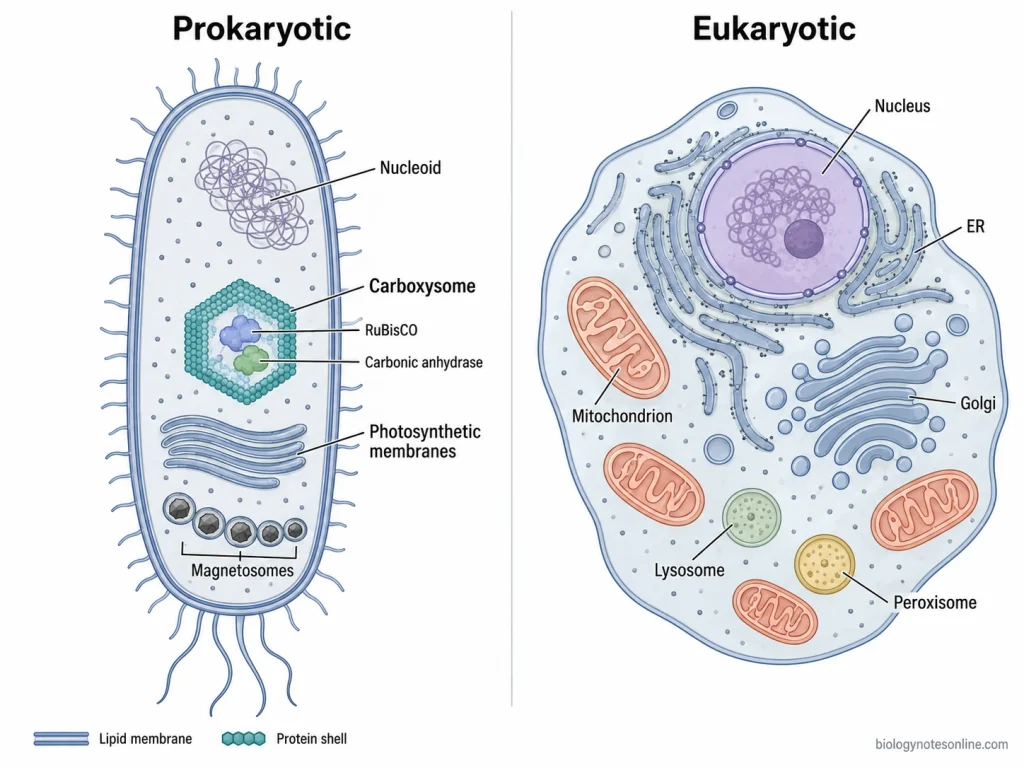
Prokaryotic cells also contain different forms of intracellular organization and specialized compartments, although they generally do not possess the extensive membrane-bound organelle system characteristic of eukaryotic cells.
How Cell Compartmentalization Works
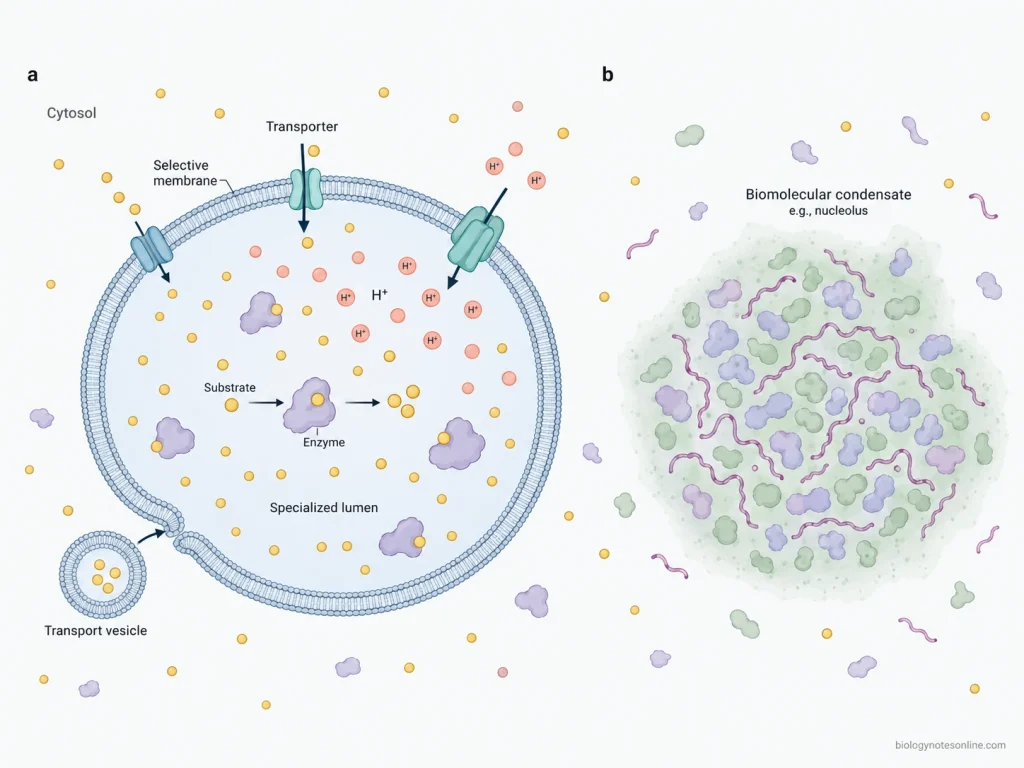
- The lipid bilayer forms the physical boundary around many cellular compartments. Most ions and polar molecules cannot pass freely through this membrane. The contents present inside the compartment are separated from the surrounding cytosol.
- Movement through these membranes is controlled by specific membrane proteins. Some channels allow particular ions to move through the membrane, whereas carrier proteins and transporters carry selected molecules from one side to another. Molecules can move along their concentration gradient. Movement against the gradient requires energy directly or can be coupled with movement of another substance.
- Different concentration of ions and metabolites can be maintained on the two sides of a membrane because their free movement is restricted and specific pumps continuously move them when required. Hydrogen ion (H⁺) pumps, for example, accumulate H⁺ inside lysosomes producing an acidic condition, and ion movement can also set up an electrochemical gradient across the membrane.
- Enzymes are also localized into particular cellular compartments. Specific proteins are transported to the organelle where they have to function. They are not distributed equally throughout the whole cell. The group of enzymes present in a compartment determines many of the reactions that can take place there, together with the local chemical conditions.
- Substrates and metabolites are brought into the required compartment with the help of specific transporters. These molecules can accumulate near their enzymes, increasing the local concentration of the substances needed for a reaction. In some cases, different enzymes of a pathway are positioned close to one another. The metabolic intermediates then have a shorter distance to move.
- Cellular compartments are separated, but exchange of materials still takes place between them. Transport vesicles bud off from one membrane containing selected proteins, lipids or soluble materials and then fuse with another particular membrane. The contents are released into the target compartment.
- A membrane is not present around every functionally separated cellular region. Enzyme complexes and biomolecular condensates can gather particular enzymes, proteins and substrates within a restricted region of the cell. This produces a local “microenvironment” without being completely surrounded by a lipid membrane.
Importance of Cell Compartmentalization
- Separation of reactions- Different metabolic reactions can be kept in different parts of the cell. Reactions which require different conditions, or may interfere with each other, are therefore separated.
- Concentration of enzymes and substrates- Enzymes required for a pathway are localized in a particular compartment along with their substrates and other molecules. Their local concentration becomes high. The biochemical reactions can proceed without these components being distributed throughout the whole cytosol.
- Different chemical environments- Cellular compartments can maintain their own conditions such as pH, ion concentration and metabolite composition. A condition suitable for one group of reactions may not be suitable for another.
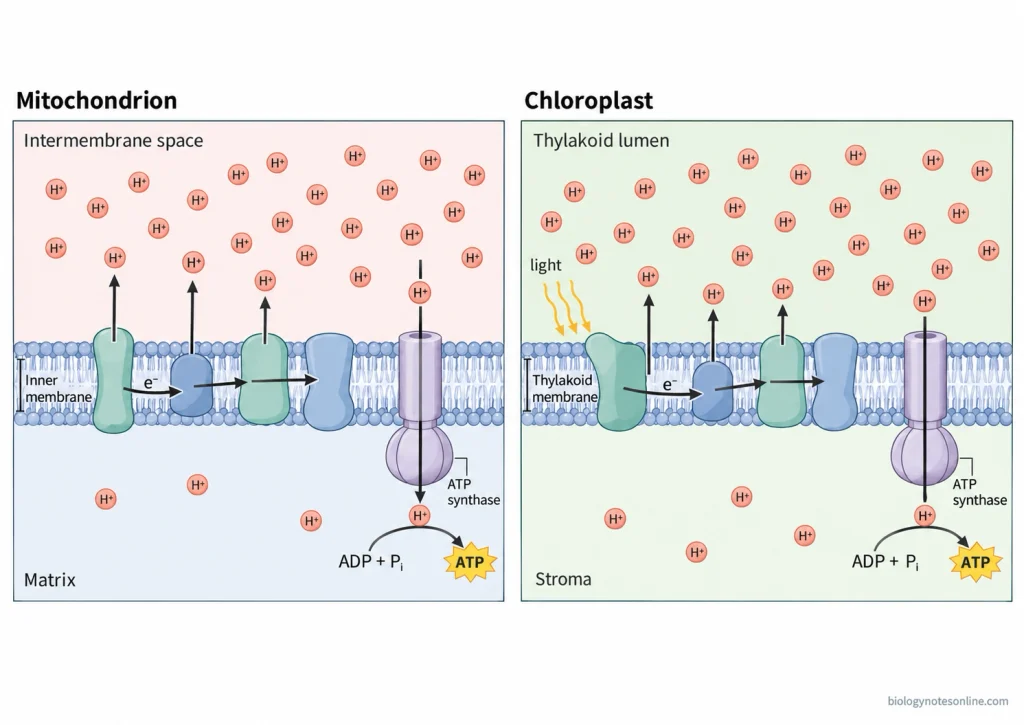
- Energy production- Membrane compartmentalization is required for the formation of ion gradients. In mitochondria and chloroplasts, movement of H⁺ across a membrane produces a gradient which is coupled with the synthesis of adenosine triphosphate (ATP).
- Protection of the cell- Some reactive compounds and destructive enzymes are confined within particular compartments. Lysosomal digestive enzymes, for example, are kept separated from most cellular components, while other specialized compartments contain enzymes involved in oxidative reactions.
- Control of metabolism- Movement of metabolites from one compartment to another can be controlled by specific membrane transport proteins. Metabolic pathways can also be regulated by changing the availability of metabolites within a compartment.
- Specialized cellular functions- Different organelles contain different sets of proteins and enzymes. Due to this, one cell can perform many specialized processes at the same time in separate cellular regions.
- Large cell organization- Eukaryotic cells are much larger than most prokaryotic cells. Internal compartments provide additional membrane surfaces and distribute different activities inside the cell, rather than depending only on the plasma membrane for membrane-associated functions.
Examples of Cell Compartmentalization
- Nucleus- The nucleus forms a separate compartment containing most of the cell’s genetic material. It is enclosed by the nuclear envelope, and movement of larger molecules between nucleus and cytosol takes place through nuclear pore complexes.
- Endoplasmic reticulum- The endoplasmic reticulum (ER) forms an extensive membrane-enclosed space in the cytoplasm. Many proteins enter the ER during their synthesis. Lipid synthesis and storage of Ca²⁺ also occurs in this compartment.
- Golgi apparatus- It consists of stacks of membrane compartments called Golgi cisternae. Proteins and lipids coming from the ER are received here, modified and then sent to different destinations.
- Mitochondria– Mitochondria are membrane-enclosed compartments used for cellular energy production. They are surrounded by two membranes. Most of the adenosine triphosphate (ATP) required for cellular activities is generated through processes associated with this compartment.
- Lysosomes– Digestive enzymes are kept inside the lysosomal compartment. These enzymes break down macromolecules, material brought into the cell and old intracellular components.
- Peroxisomes- These are small membrane-bound compartments containing enzymes for different oxidative reactions. The reactions are kept separated from the surrounding cytosol.
- Chloroplasts– Chloroplasts are a specialized type of plastid present in plant cells. They form another major membrane compartment and are involved in photosynthetic energy conversion. Chloroplasts are surrounded by a double membrane and also contain an internal membrane system.
- Nucleolus– The nucleolus is an example where cellular compartmentalization occurs without a surrounding lipid membrane. Proteins and nucleic acids become concentrated into this region, forming a biomolecular condensate involved in ribosome biogenesis.
- Bacterial microcompartments- Compartmentalization is also found in bacteria. Bacterial microcompartments contain metabolic enzymes enclosed by a selectively permeable protein shell rather than a lipid membrane. Carboxysomes are one such example, where enzymes involved in carbon dioxide fixation are brought together inside the compartment.
Cell Compartmentalization in Prokaryotic Cells
- Compartmentalization is not restricted only to eukaryotic cells. Prokaryotic cells do not have the extensive system of classical membrane-bound organelles, but different reactions and cell components can still remain at particular regions. The cell interior is not completely uniform.
- The plasma membrane itself can have specialized regions. Certain proteins and lipids collect at one part of the membrane and particular cellular activities occur there.
- Internal membranes are found in some prokaryotes. In cyanobacteria and other photosynthetic bacteria, photosynthetic proteins are arranged on these membranes. Photosynthetic reactions take place here.
- Bacterial microcompartments are surrounded by a protein shell, not by lipid membrane. A group of metabolic enzymes may be packed inside the same compartment. Substrates and products move through the shell.
- Carboxysomes are one example of such protein-based compartment. They are present in cyanobacteria and some other autotrophic bacteria. Ribulose-1,5-bisphosphate carboxylase/oxygenase (RuBisCO) and carbonic anhydrase occur inside the carboxysome.
- Some bacterial microcompartments contain enzymes used for breakdown of particular organic compounds. Reactive or volatile intermediates can remain inside the shell during these reactions.
- Compartmentalization can also occur without forming a closed compartment. Protein complexes and other cellular structures may be localized at the cell poles or at selected positions along the cell. They are not distributed randomly throughout the cytoplasm.
- Magnetosomes are membrane-bounded compartments of magnetotactic bacteria. Magnetic mineral particles are present inside them. Magnetosomes are usually arranged as chains.
Prokaryotic vs. Eukaryotic Compartmentalization
| Feature | Prokaryotic Cells | Eukaryotic Cells |
|---|---|---|
| Extent of compartmentalization | Compartmentalization is present, but generally less extensive. Particular reactions, proteins and cell structures may remain localized at selected regions. | Compartmentalization is highly developed. A large part of the cell is divided into separate intracellular compartments or organelles. |
| Membrane-bound organelles | The classical system of nucleus, endoplasmic reticulum and Golgi apparatus is absent. Some prokaryotes still possess specialized membrane-bounded structures. | Different membrane-bound organelles are present, such as nucleus, endoplasmic reticulum, Golgi apparatus, mitochondria, lysosomes and peroxisomes. |
| Compartment boundary | The boundary may be a lipid membrane or a protein shell. Some organization also occurs without making a completely enclosed compartment. | Most classical organelles are enclosed by one or more lipid-bilayer membranes. The membrane separates their internal contents from cytosol. |
| Metabolic reactions | A particular metabolic pathway may be packed inside a bacterial microcompartment. The enzymes remain together. | Different metabolic activities take place in different organelles. Mitochondria, lysosomes and peroxisomes contain different sets of enzymes and reactions. |
| Protein-based compartments | Well developed in many bacteria. Carboxysomes and other bacterial microcompartments contain an enzyme core covered by a selectively permeable protein shell. | Membrane-enclosed organelles form the major compartment system, although non-membrane cellular regions also occur. |
| Internal membranes | Internal membranes occur in some groups, including photosynthetic membrane systems and specialized bacterial organelles. They are not present as one common extensive endomembrane system in prokaryotes. | An extensive internal membrane system is present. The endoplasmic reticulum, Golgi apparatus and other membrane compartments divide the cytoplasm into different regions. |
| Examples | Carboxysomes, other bacterial microcompartments, photosynthetic membranes and magnetosomes. | Nucleus, mitochondria, endoplasmic reticulum, Golgi apparatus, lysosomes, peroxisomes, and chloroplasts in plants and algae. |
Cell Compartmentalization and Metabolism
Metabolic pathways do not occur as one mixed group of reactions throughout the cell. Particular enzymes are kept in particular compartments, and the substrates or intermediates used by these enzymes are also present there. In mitochondria, for example, many reactions of oxidative metabolism are separated from reactions occurring in the cytosol.
A compartment can also maintain its own chemical condition. The concentration of ions and metabolites may be different from that of the surrounding cytosol, and transport proteins control their movement through the membrane. Different pH and ion conditions can be maintained in this way.
Metabolic pathways have many branch points where the same metabolite may enter different reactions. Localization of enzymes keeps some of these pathways apart and also controls where a metabolite will be available. Enzymes of the same pathway may even remain close together, which can affect movement of intermediates from one reaction to the next.
Membranes are also used for making electrochemical gradients. During oxidative phosphorylation in mitochondria, H⁺ is moved across the inner mitochondrial membrane and the gradient is then used for adenosine triphosphate (ATP) synthesis. Chloroplasts use membrane separation in a similar way during photosynthesis.
Other compartments have their own metabolic reactions. Peroxisomes contain enzymes for several oxidative reactions, lysosomes contain hydrolytic enzymes, while bacterial microcompartments can collect enzymes of a particular pathway inside a protein shell.
Cell Compartmentalization at a Glance
| Point | Quick Summary |
|---|---|
| Meaning | Organization of the cell into separate compartments, where particular cellular processes take place. |
| Main boundary | Most eukaryotic compartments are surrounded by selectively permeable lipid membranes. |
| Major occurrence | Highly developed in eukaryotic cells, mainly through membrane-bound organelles. |
| Prokaryotic cells | Prokaryotes also show compartmentalization. Protein shells, specialized membrane regions and some internal membrane structures are present in different groups. |
| Main purpose | Keeps particular reactions and cellular components within selected regions of the cell. |
| Enzymes | Specific enzymes can remain concentrated inside a particular compartment. |
| Metabolites | Substrates, products and metabolic intermediates may be maintained at different concentrations in different compartments. |
| Local conditions | Compartments can maintain different pH, ion concentration and chemical conditions. |
| Transport | Entry and exit of molecules are controlled by membrane proteins or other selective boundaries. |
| Metabolic separation | Reactions requiring different conditions can occur separately inside the same cell. |
| Gradients | Membranes can maintain ion and electrochemical gradients, such as H⁺ gradients used in energy production. |
| Eukaryotic examples | Nucleus, endoplasmic reticulum, Golgi apparatus, mitochondria, lysosomes, peroxisomes and chloroplasts. |
| Non-membrane example | Nucleolus is a cellular compartment without a surrounding lipid membrane. |
| Prokaryotic examples | Carboxysomes, bacterial microcompartments, photosynthetic membranes and magnetosomes. |
| Metabolism | Compartmentalization places enzymes, substrates and suitable reaction conditions together in the same cellular region. |
References
- Alberts, B., Johnson, A., Lewis, J., Raff, M., Roberts, K., & Walter, P. (2002). Molecular biology of the cell (4th ed.). Garland Science. https://www.ncbi.nlm.nih.gov/books/NBK21054/
- Banani, S. F., Lee, H. O., Hyman, A. A., & Rosen, M. K. (2017). Biomolecular condensates: Organizers of cellular biochemistry. Nature Reviews Molecular Cell Biology, 18(5), 285–298. https://doi.org/10.1038/nrm.2017.7
- Bar-Peled, L., & Kory, N. (2022). Principles and functions of metabolic compartmentalization. Nature Metabolism, 4(10), 1232–1244. https://doi.org/10.1038/s42255-022-00645-2
- Chowdhury, C., Sinha, S., Chun, S., Yeates, T. O., & Bobik, T. A. (2014). Diverse bacterial microcompartment organelles. Microbiology and Molecular Biology Reviews, 78(3), 438–468. https://doi.org/10.1128/MMBR.00009-14
- Cooper, G. M. (2000). The cell: A molecular approach (2nd ed.). Sinauer Associates. https://www.ncbi.nlm.nih.gov/books/NBK9839/
- Cornejo, E., Abreu, N., & Komeili, A. (2014). Compartmentalization and organelle formation in bacteria. Current Opinion in Cell Biology, 26, 132–138. https://doi.org/10.1016/j.ceb.2013.12.007
- Kerfeld, C. A., Aussignargues, C., Zarzycki, J., Cai, F., & Sutter, M. (2018). Bacterial microcompartments. Nature Reviews Microbiology, 16(5), 277–290. https://doi.org/10.1038/nrmicro.2018.10
- Lopez, D., & Koch, G. (2017). Exploring functional membrane microdomains in bacteria: An overview. Current Opinion in Microbiology, 36, 76–84. https://doi.org/10.1016/j.mib.2017.02.001
- Murat, D., Byrne, M., & Komeili, A. (2010). Cell biology of prokaryotic organelles. Cold Spring Harbor Perspectives in Biology, 2(10), a000422. https://doi.org/10.1101/cshperspect.a000422
- Ra, Y., & Komeili, A. (2025). Organizing organelles: Bacterial strategies for localizing intracellular compartments. Current Opinion in Microbiology, 86, 102614. https://doi.org/10.1016/j.mib.2025.102614
- Schmitt, D. L., & An, S. (2017). Spatial organization of metabolic enzyme complexes in cells. Biochemistry, 56(25), 3184–3196. https://doi.org/10.1021/acs.biochem.7b00249
- Wheeler, R. J., & Hyman, A. A. (2018). Controlling compartmentalization by non-membrane-bound organelles. Philosophical Transactions of the Royal Society B: Biological Sciences, 373(1747), 20170193. https://doi.org/10.1098/rstb.2017.0193
- Yeates, T. O., Crowley, C. S., & Tanaka, S. (2010). Bacterial microcompartment organelles: Protein shell structure and evolution. Annual Review of Biophysics, 39, 185–205. https://doi.org/10.1146/annurev.biophys.093008.131418