

Secretion is a biological process by which cells or glands produce and release substances into the body fluids or surrounding environment. The term “secretion” also refers to the substance released during this process, whereas the substances produced are called secretions.
Secretion takes place in individual cells as well as in specialized glands. In glands, the secretory cells are arranged together for the production and release of specific substances. These cells produce different substances according to their functions. In human physiology and medical terms, secretion includes the release of substances such as hormones, enzymes, and mucus, which are involved in chemical signalling, digestion, and protection. The functions of these secretions vary depending upon the organism, tissue and the substance involved.
Process of Secretion
The process of protein secretion involves the synthesis, modification, transportation, and release of proteins from the cells. The steps involved in this process are as follows-
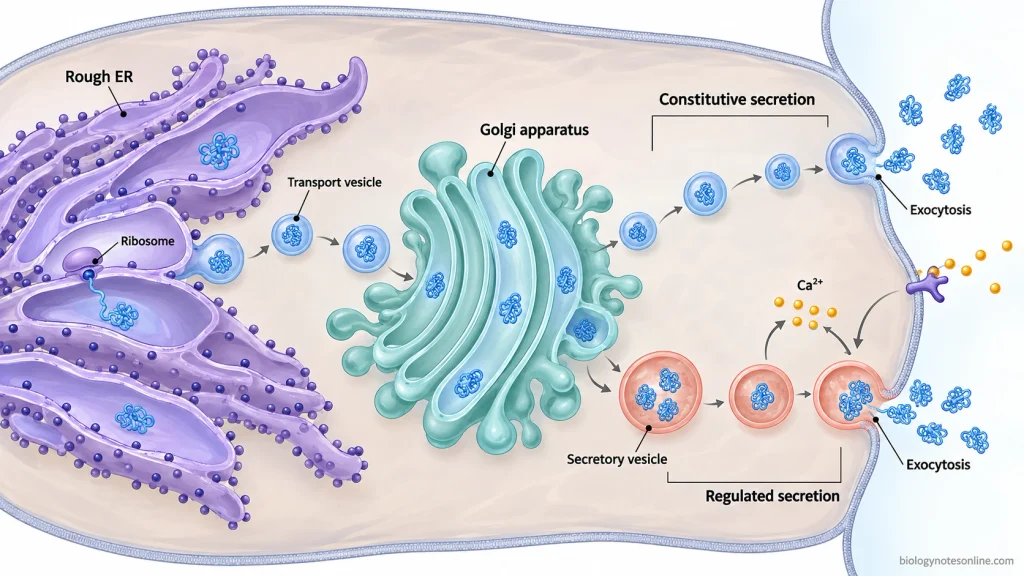
- The secretion of proteins begins with the synthesis of polypeptide chains by ribosomes. A signal sequence present in the growing polypeptide directs the ribosome towards the rough endoplasmic reticulum (RER). During synthesis, the protein enters the ER.
- Inside the endoplasmic reticulum, the newly formed proteins undergo folding and certain modifications. These proteins are then packed into transport vesicles and transferred to the Golgi apparatus.
- The Golgi apparatus receives the proteins from the ER. The proteins pass through different compartments of the Golgi apparatus, where they undergo further modifications. During this process, the carbohydrate groups of some proteins are also modified.
- In the trans-Golgi network, proteins are sorted and packed into secretory vesicles. Some proteins are continuously transported towards the cell surface. Others are stored in the secretory vesicles until a specific signal is received.
- The secretory vesicles move towards the plasma membrane, where the vesicle membrane fuses with the cell membrane and releases its contents outside the cell. This process is referred to as exocytosis.
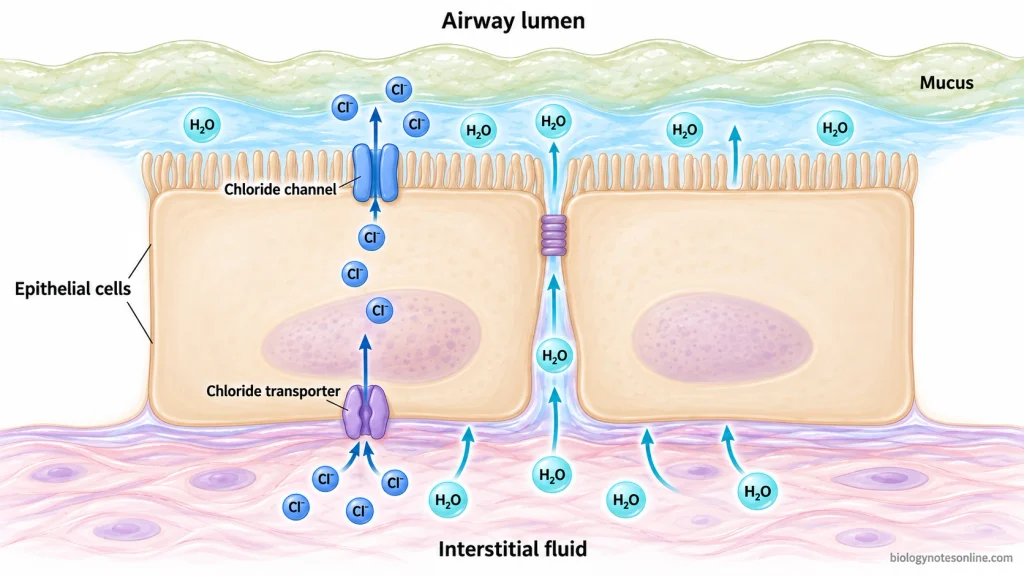
- The secretion of ions and water is different from protein secretion. Ions such as chloride (Cl⁻) are transported across the cell membrane through specific ion channels and transporters. Water moves along the osmotic gradient through water channels or between the epithelial cells.
- Other secretory substances are released by different pathways depending upon their chemical nature. For example, steroid hormones are synthesized from cholesterol and can diffuse through the plasma membrane instead of being released by vesicular exocytosis.
Regulation of Secretion
The secretion of different substances is regulated by several mechanisms depending upon the type of secretory cells and their functions. The following are the mechanisms involved in regulation of secretion-
- Constitutive and Regulated Secretion- In constitutive secretion, proteins are continuously released from the cells without requiring any specific signal. Regulated secretion occurs in cells where the substances are stored inside secretory vesicles. These substances are released only when the cells receive a specific signal.
- Hormonal and Chemical Regulation- Hormones and neurotransmitters are involved in controlling the secretion of many specialized cells. They bind to specific receptors present on the cell membrane and activate different signalling pathways inside the cell. Depending upon the signals received, the secretion may be increased or inhibited.
- Intracellular Regulation- In many secretory cells, stimulation increases the intracellular concentration of calcium ions (Ca²⁺). The increased calcium concentration causes the secretory vesicles to fuse with the plasma membrane, releasing their stored substances by exocytosis. In certain cells, cyclic AMP (cAMP) is also involved in controlling the secretory activity.
- Nervous Regulation- The nervous system controls the secretory activity of several glands. In salivary glands, parasympathetic nerves release acetylcholine, which stimulates the production of saliva. Sympathetic nerves also influence the release of salivary proteins.
- Feedback Regulation- The secretion of one endocrine gland may be controlled by hormones released from another gland. For example, thyroid-stimulating hormone (TSH) from the pituitary gland stimulates the secretion of thyroid hormones. When the thyroid hormone level increases, further hormone release from the hypothalamus and pituitary gland is inhibited. This is referred to as negative feedback regulation.
- Regulation of Ion and Water Secretion- Specific ion channels and transporters present in epithelial cells are involved in controlling the secretion of ions and water. Signals involving calcium ions and cAMP can activate the channels responsible for chloride (Cl⁻) secretion. Water moves along the osmotic gradient formed by the movement of ions.
Types of Secretion
Secretion is classified into different types based on the destination of secreted substances and the mechanism of their release from the cells.
Based on the destination
Based on the destination of secreted substances, secretion is of the following types-
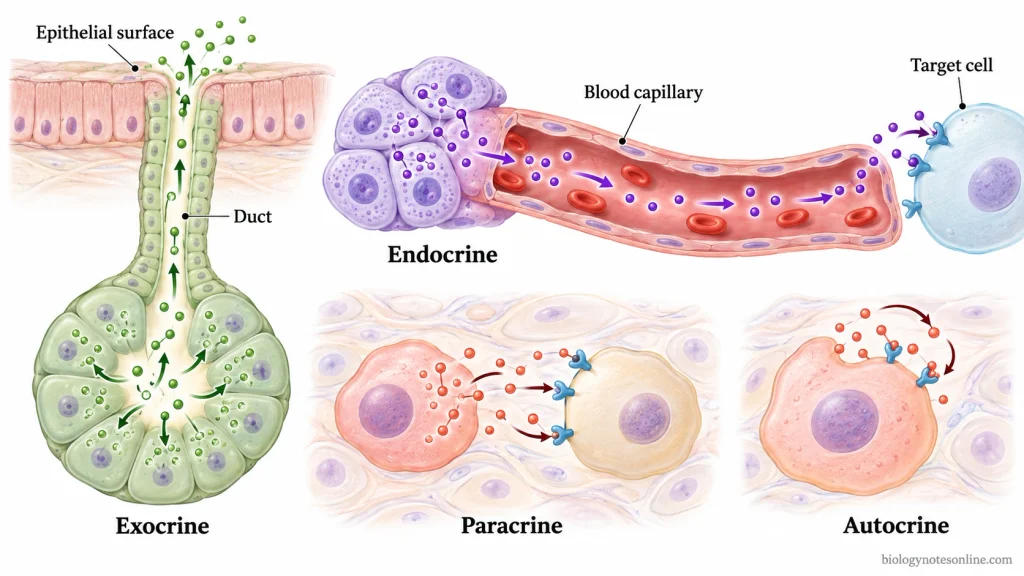
- Exocrine Secretion– Exocrine glands release their secretions onto epithelial surfaces or into body cavities, generally through ducts. The secretory products include saliva, sweat, and digestive enzymes. Salivary glands, sweat glands, and exocrine pancreas are some examples of exocrine glands.
- Endocrine Secretion- These are ductless glands. The hormones produced by the endocrine glands are released into the surrounding tissue fluid, from where they enter the bloodstream. The blood carries these hormones to their specific target cells or organs. Examples include thyroid and pituitary glands.
- Paracrine and Autocrine Secretion- In paracrine secretion, the substances released from the cells act on nearby cells. It is involved in local cellular communication. In the case of autocrine secretion, the released substances act on the same cell that produces them.
Based on the mechanism of release
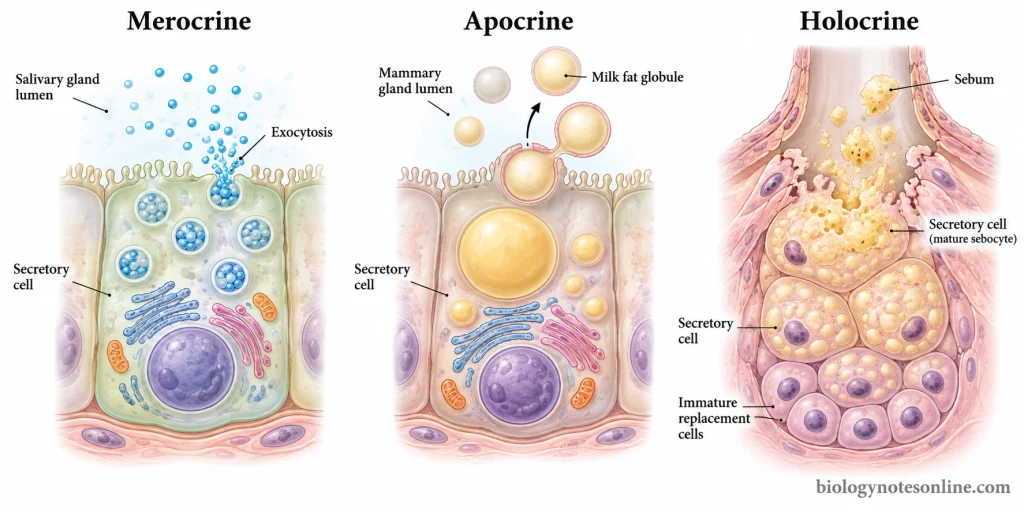
Based on the mechanism of release, the exocrine secretion is further divided into three types-
- Merocrine Secretion– It is the most common type of exocrine secretion. The secretory products are stored inside vesicles, which fuse with the plasma membrane and release their contents outside the cell. This process is known as exocytosis. The secretory cell remains intact during this process. Examples include salivary glands and eccrine sweat glands.
- Apocrine Secretion- In this type, the secretory substances accumulate near the apical region of the cell. During secretion, a portion of the apical cytoplasm along with the plasma membrane breaks off and is released with the secretory product. The remaining cell continues its function. Secretion of milk fat droplets by the mammary glands is an example.
- Holocrine Secretion- The secretory products accumulate inside the cell, which eventually breaks down and releases its entire contents. The whole secretory cell is destroyed during this process. New cells are formed to replace the destroyed cells. This type of secretion occurs in the sebaceous glands of the skin, which produce sebum.
Examples of Secretion
Different cells and glands produce various secretions depending upon their functions. Some of the common examples of secretion in humans and plants are as follows-
- Salivary Secretion- Salivary glands produce saliva, which is released into the oral cavity through salivary ducts. It consists mainly of water along with mucus and digestive enzymes such as salivary amylase.
- Sweat Secretion- The sweat glands present in the skin produce sweat containing mainly water and salts. The sweat is released onto the skin surface through sweat ducts.
- Mucus Secretion- Goblet cells are specialized secretory cells found in the epithelial lining of the respiratory tract. These cells produce mucus, which is released directly onto the epithelial surface.
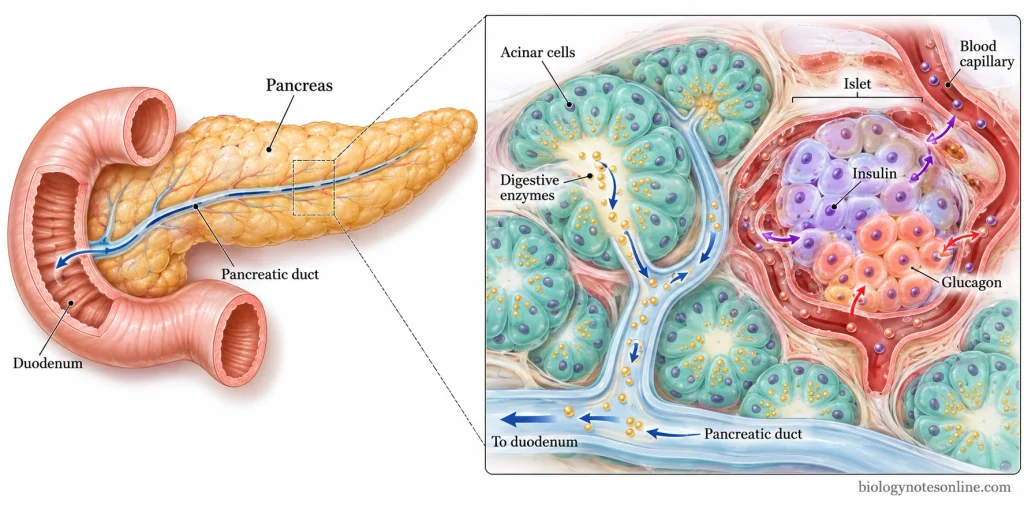
- Pancreatic Secretion- The pancreas performs both exocrine and endocrine secretion. In exocrine secretion, the pancreatic acinar cells produce digestive enzymes, which are carried through the pancreatic ducts into the duodenum. The endocrine portion consists of specialized cells arranged in the islets of Langerhans. These cells release hormones such as insulin and glucagon into the bloodstream.
- Thyroid Secretion- The thyroid gland is a ductless endocrine gland that produces hormones such as thyroxine (T4) and triiodothyronine (T3). These hormones are released into the bloodstream.
- Nectar Secretion- In flowering plants, specialized secretory structures called nectaries produce a sugar-rich liquid known as nectar. The nectar is released from the nectaries and is available to visiting insects and other animals.
The functions of these secretions are given in the following table.
| Secretions | Physiological Functions |
|---|---|
| Saliva | Moistens food and initiates the digestion of starch with the help of salivary amylase. |
| Sweat | Helps in regulating body temperature by evaporation of water from the skin surface. |
| Mucus | Traps dust, microorganisms, and other foreign particles entering the respiratory tract. |
| Pancreatic Digestive Enzymes | Break down carbohydrates, proteins, and fats during digestion in the small intestine. |
| Pancreatic Hormones | Insulin lowers blood glucose levels, whereas glucagon increases blood glucose levels. |
| Thyroid Hormones | Regulate the basal metabolic rate and influence the metabolism of different body cells. |
| Nectar | Provides food to pollinating animals and helps in attracting them to the flowers for pollination. |
Importance of Secretion
Some of the important functions of secretion are as follows-
- Digestion- Salivary amylase is released into the mouth for the breakdown of starch. Pancreatic enzymes are used for the digestion of carbohydrates, proteins and fats in the small intestine. The pancreas also secretes bicarbonate to neutralize the acidic contents.
- Hormonal Regulation- Hormones from the endocrine glands enter into the bloodstream and are carried to their specific target cells. The pancreatic hormones, insulin and glucagon, are involved in the regulation of blood glucose level.
- Protection- Mucus forms a protective layer over the epithelial surfaces. In the respiratory tract, it traps dust, microorganisms and other foreign particles. These are removed with the help of cilia. Some secretions also contain antimicrobial substances.
- Lubrication- Saliva moistens the food for swallowing, while mucus secreted by intestinal cells reduces friction during the movement of intestinal contents.
- Temperature Regulation- More sweat is released from the sweat glands when body temperature increases. The sweat evaporates from the skin surface, removing heat.
- Water and Ion Movement- In respiratory epithelial cells, chloride ions (Cl⁻) are released through specific membrane channels. Water moves along the osmotic gradient formed by the movement of ions. It keeps the mucus hydrated.
- Reproduction in Plants- The nectaries of flowering plants secrete a sugar-rich substance called nectar. It attracts pollinating animals. These animals transfer pollen during their visits.
Secretion At a Glance
| Features | Description |
|---|---|
| Definition | Secretion is a biological process by which cells or glands produce and release substances. |
| Secretions | The substances released by secretory cells or glands, such as hormones, enzymes, mucus and sweat. |
| Site | Individual secretory cells and specialized glands. |
| Process | Protein synthesis in ribosomes, modification in the ER and Golgi apparatus, packaging into secretory vesicles and release by exocytosis. |
| Regulation | Controlled by nervous and hormonal signals, intracellular calcium ions (Ca²⁺), cAMP and feedback mechanisms. |
| Types Based on Destination | Exocrine, endocrine, paracrine and autocrine secretion. |
| Types Based on Release Mechanism | Merocrine, apocrine and holocrine secretion. |
| Exocrine Secretion | Secretions are released onto epithelial surfaces or into body cavities, generally through ducts. |
| Endocrine Secretion | Hormones are released into the surrounding tissue fluid and enter the bloodstream. |
| Merocrine Secretion | Secretory products are released by exocytosis without destruction of the cell. |
| Apocrine Secretion | A portion of the apical cytoplasm and plasma membrane is released along with the secretory product. |
| Holocrine Secretion | The entire secretory cell breaks down to release its contents. |
| Examples | Saliva, sweat, mucus, digestive enzymes and hormones. |
| Pancreatic Secretion | Exocrine pancreas releases digestive enzymes into the duodenum, whereas endocrine pancreas releases hormones into the bloodstream. |
| Importance | Digestion, hormonal regulation, protection, lubrication, temperature regulation and water-ion movement. |
| Secretion in Plants | Nectaries produce nectar, which attracts pollinating animals. |
References
- Alberts, B., Johnson, A., Lewis, J., Raff, M., Roberts, K., & Walter, P. (2002). Molecular biology of the cell (4th ed.). Garland Science. https://www.ncbi.nlm.nih.gov/books/NBK21054/
- Betts, J. G., Young, K. A., Wise, J. A., Johnson, E., Poe, B., Kruse, D. H., Korol, O., Johnson, J. E., Womble, M., & DeSaix, P. (2013). Anatomy and physiology. OpenStax. https://openstax.org/books/anatomy-and-physiology/pages/1-introduction
- Betts, J. G., Young, K. A., Wise, J. A., Johnson, E., Poe, B., Kruse, D. H., Korol, O., Johnson, J. E., Womble, M., & DeSaix, P. (2022). Anatomy and physiology (2nd ed.). OpenStax. https://openstax.org/books/anatomy-and-physiology-2e/pages/1-introduction
- Clark, M. A., Douglas, M., & Choi, J. (2018). Biology (2nd ed.). OpenStax. https://openstax.org/books/biology-2e/pages/1-introduction
- Concepcion, A. R., & Feske, S. (2017). Regulation of epithelial ion transport in exocrine glands by store-operated Ca²⁺ entry. Cell Calcium, 63, 53–59. https://doi.org/10.1016/j.ceca.2016.12.004
- Cooper, G. M. (2000). The cell: A molecular approach (2nd ed.). Sinauer Associates. https://www.ncbi.nlm.nih.gov/books/NBK9839/
- Frizzell, R. A., & Hanrahan, J. W. (2012). Physiology of epithelial chloride and fluid secretion. Cold Spring Harbor Perspectives in Medicine, 2(6), Article a009563. https://doi.org/10.1101/cshperspect.a009563
- Liao, I. T., Gong, Y., Kramer, E. M., & Nikolov, L. A. (2025). The developmental basis of floral nectary diversity and evolution. New Phytologist, 246(6), 2462–2477. https://doi.org/10.1111/nph.70141
- Messenger, S. W., Falkowski, M. A., & Groblewski, G. E. (2014). Ca²⁺-regulated secretory granule exocytosis in pancreatic and parotid acinar cells. Cell Calcium, 55(6), 369–375. https://doi.org/10.1016/j.ceca.2014.03.003
- Nussey, S., & Whitehead, S. (2001). Endocrinology: An integrated approach. BIOS Scientific Publishers. https://www.ncbi.nlm.nih.gov/books/NBK22/
- Pandol, S. J. (2010). The exocrine pancreas. Morgan & Claypool Life Sciences. https://www.ncbi.nlm.nih.gov/books/NBK54128/
- Proctor, G. B., & Carpenter, G. H. (2007). Regulation of salivary gland function by autonomic nerves. Autonomic Neuroscience, 133(1), 3–18. https://doi.org/10.1016/j.autneu.2006.10.006
- Roy, R., Schmitt, A. J., Thomas, J. B., & Carter, C. J. (2017). Review: Nectar biology: From molecules to ecosystems. Plant Science, 262, 148–164. https://doi.org/10.1016/j.plantsci.2017.04.012