

Immune response is a protective response of body against harmful foreign agents. It is done by physical barriers, immune cells and chemical signals. It helps to maintain normal health of body.
The main function of immune response is to identify and destroy pathogens, foreign toxins and abnormal cells. It also removes damaged cells from body. For this, immune system can distinguish between own body tissue and foreign substances.
This ability is called recognition of self and non-self. Self means own normal body cells. Non-self means foreign particles like bacteria, virus, fungi, toxins and other antigens.
The immune response works mainly by two systems. These are innate immune response and adaptive immune response. Both systems work together for protection of body.
Innate immune response is the first line of defence. It is immediate and non-specific type of response. It includes skin, mucous membrane, phagocytic cells and other rapid cellular reactions. It acts within minutes to hours.
Adaptive immune response starts when pathogen crosses the first defence. It is specific type of immune response. It takes more time to develop, generally days. It is mainly carried out by B cells and T cells.
B cells produce antibodies against specific antigen. T cells help in killing infected cells and regulating other immune cells. In this response, particular pathogen is recognized and destroyed.
The important feature of adaptive immunity is formation of immunological memory. Due to this memory, body can give faster and stronger response during second exposure of same pathogen. This is referred to as secondary immune response.
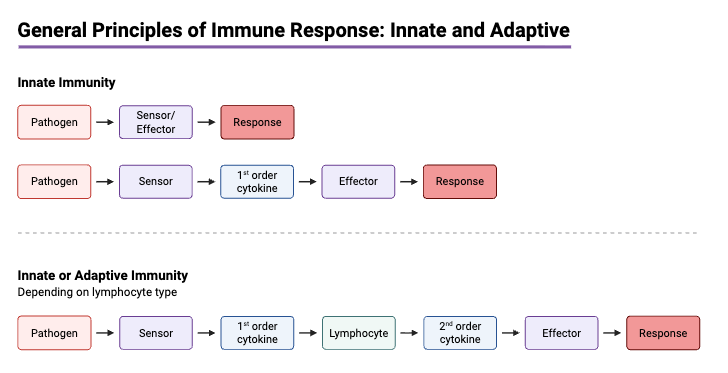
Types of Immune Response
The following are the types of immune response–
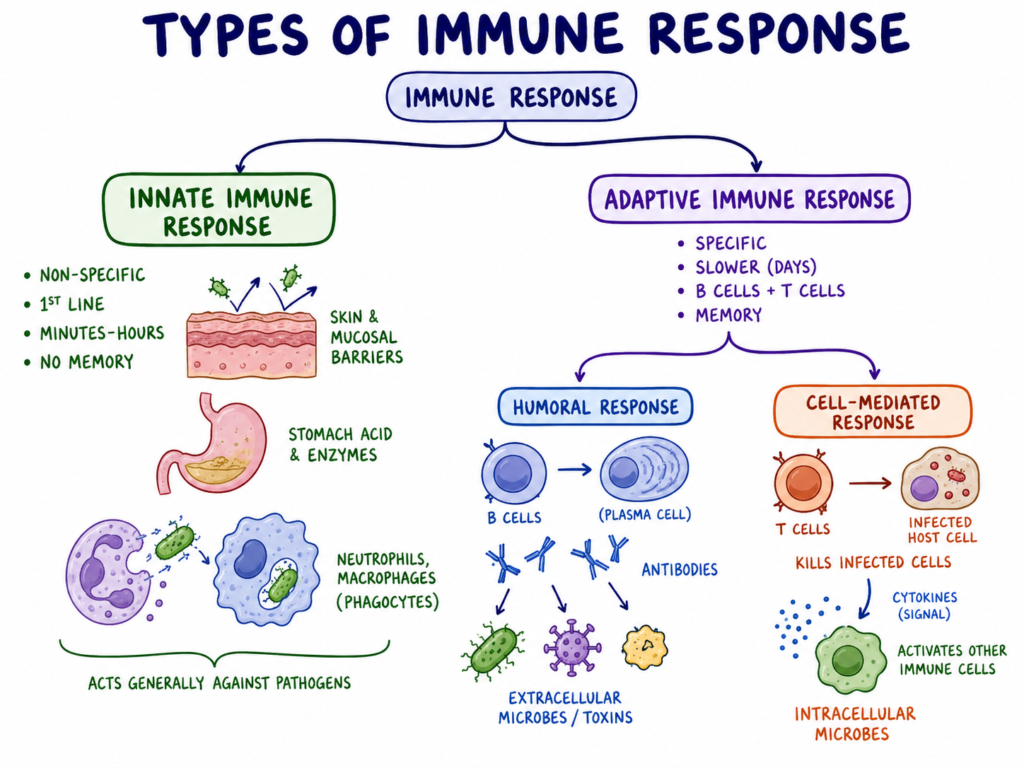
1. Innate Immune Response
Innate immune response is also called non-specific immunity. It is the first line of defence of body. It acts very quickly, within minutes to hours.
It includes skin, mucous membrane, stomach acid, enzymes and different immune cells. The important cells are neutrophils, macrophages and other phagocytic cells. These cells attack the pathogens in general way.
This response does not identify any specific antigen. It also does not produce long lasting immunological memory.
2. Adaptive Immune Response
Adaptive immune response is also called specific immunity. It is delayed type of response and takes days to develop. It acts against specific antigen.
This response is carried out mainly by B lymphocytes and T lymphocytes. It produces strong and specific response against the pathogen. It also forms immunological memory, so second response becomes faster and stronger.
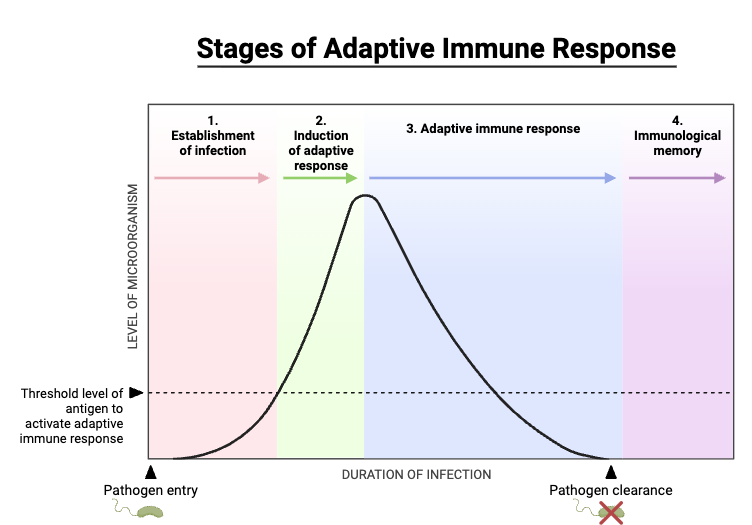
The adaptive immune response is of two types-
a. Humoral Immune Response
Humoral immune response is antibody mediated immune response. It is carried out by B lymphocytes or B cells.
In this response, B cells produce specific antibodies. These antibodies are released in blood and body fluids. They neutralize extracellular viruses, bacteria, microbes and toxins.
b. Cell-Mediated Immune Response
Cell-mediated immune response is carried out by T lymphocytes or T cells. It acts against foreign antigens present inside the host cells.
In this response, T cells directly destroy infected cells. Some T cells also release chemical signals which activate other immune cells. This helps in removal of intracellular microbes and infected body cells.
Mechanism of Innate Immunity
- In the first step, body try to prevent entry of pathogen by skin and mucous membrane. These act as physical barriers. Chemical barriers like stomach acid, antimicrobial peptides and lysozyme of tears and saliva also destroy or inhibit the microbes.
- When pathogen crosses these barriers, it enters into tissue. Then the local immune cells present in tissue become active. This starts the internal innate immune response.
- In this step, macrophages, dendritic cells and other resident cells recognize the pathogen by Pattern Recognition Receptors (PRRs). These receptors identify common microbial structure called Pathogen Associated Molecular Patterns (PAMPs). They also identify damaged cell signals called Damage Associated Molecular Patterns (DAMPs).
- After recognition, the immune cells start signalling reaction inside the cell. Sometimes inflammasome is activated. Then inflammatory substances like histamine, leukotrienes and cytokines are released.
- These inflammatory substances produce inflammation at infected area. Blood vessels become dilated and more permeable. So blood flow increases and immune cells can come out from blood to the infected tissue.
- In this step, immune cells are attracted towards the infected site. This movement is called chemotaxis. Neutrophils come first, then monocytes come and change into macrophages.
- After reaching the site, neutrophils, macrophages and dendritic cells engulf the pathogens. The pathogen is taken inside a vesicle called phagosome. Then phagosome joins with lysosome.
- In this step, the engulfed microbe is destroyed. Digestive enzymes, reactive oxygen species (ROS) and nitric oxide kill the pathogen inside the cell.
- At the same time, complement proteins present in blood become activated. They bind to pathogen surface and mark it for easy phagocytosis. This is called opsonization. Some complement proteins also make pores in pathogen membrane and cause lysis.
- During this process, coagulation cascade may also start. It forms fibrin clot around the infected area. This clot traps microbes and prevents the spreading of infection to other tissues.
Mechanism of Adaptive Immunity
The following are the steps of Adaptive immune response–
- In the first step, the pathogen is taken up by antigen presenting cells (APCs). The main APCs are dendritic cells and macrophages. They break the pathogen into small peptide fragments and show these fragments on their surface by Major Histocompatibility Complex (MHC) molecules.
- After this, naive T lymphocytes recognize the antigen present on the APCs. They use T-cell receptors (TCRs) for this recognition. This step is important because only the specific T cell which can bind the antigen becomes activated.
- In this step, helper T cells (CD4+) recognize antigen shown with MHC class II molecules. After proper costimulatory signal, they become activated. Then they release cytokines, which control and increase other immune reactions.
- In this step, cytotoxic T cells (CD8+) recognize antigen shown with MHC class I molecules. These antigens are mostly from intracellular pathogens like virus infected cells. After activation, these cells become ready to destroy infected host cells.
- At the same time, B lymphocytes also bind the specific antigen by their surface receptor. The B cell takes the antigen inside, process it and show it on its surface by MHC class II molecule. Then activated helper T cell binds with the B cell and gives activating signals.
- During this process, helper T cell gives costimulatory signals like CD40 binding and releases interleukins like IL-4 and IL-13. These signals fully activate the B cell. Without this help, strong antibody response is not formed properly.
- After full activation, the selected T cells and B cells multiply very rapidly. This is called clonal expansion. Many similar cells are formed from one specific lymphocyte which recognized the same antigen.
- In this step, activated B cells undergo isotype class switching and become plasma cells. These plasma cells produce large amount of specific antibodies. The antibodies may be IgM, IgG, IgA or IgE according to type of response.
- Now the pathogen is eliminated by immune effector actions. Antibodies bind with extracellular pathogens and toxins. They neutralize them, mark them for phagocytosis by opsonization and also activate complement system.
- In this step, activated cytotoxic T cells bind with infected or abnormal body cells. They release toxic proteins like perforin and granzymes. Perforin makes pores and granzymes enter into cell, which causes death of infected cell.
- After the pathogen is removed, most activated lymphocytes die slowly. But some B cells and T cells remain in body as memory cells. These cells live for long time and keep the memory of same antigen.
- During second entry of same pathogen, these memory cells respond very quickly. The response becomes faster, stronger and more specific than the first response. This is called secondary immune response.
Factors that Influence the Immune Responses
The following are the factors that influence the immune response–
- Stress– Stress has effect on immune response. Short time stress may increase movement of white blood cells for some time. But chronic stress is harmful. High cortisol level suppress adaptive immunity. It decrease antibody production and also reduce T cells and Natural Killer (NK) cells.
- Sleep– Sleep is needed for normal working of immune system. Good sleep support T cell activation, Natural Killer cell activity and cytokine production. It also help in formation of immunological memory. Long time less sleep increases inflammatory cytokines in body.
- Nutrition– Nutrition is important for immunity. Vitamin D, Vitamin C, zinc, magnesium and selenium are needed for cell repair and control of oxidative stress. Poor diet weakens body barrier like gut lining. It may increase chronic inflammation.
- Gut microbiome– Gut microbiome means useful microbes present in intestine. These microbes continuously interact with immune system. They form short-chain fatty acids (SCFAs) from dietary fibres. These maintain epithelial barrier and support regulatory T cells.
- Age– Age changes the immune response. In premature infants, immune system is still not fully mature. So immune response may be weak. In old age, immune system slowly becomes weak. This is called immunosenescence. Shrinking of thymus gland reduce new naive T cells formation.
- Genetics– Genetics also affect immune response. Human Leukocyte Antigen (HLA) genes control antigen presentation. Different persons have different HLA type. So their response to same pathogen or vaccine may not be same. It also influence risk of autoimmune diseases.
Functions of Immune Response
The following are the functions of immune response–
- Homeostasis– Immune response helps to maintain internal balance of body. It continuously checks harmful substances in body. It identify and remove them, so normal health is maintained.
- Protection– Immune response protect body from infection. Skin, mucous membrane, stomach acid and enzymes act as first defence. They stop entry of pathogens into body.
- Recognition– Immune system can distinguish between self and non-self. Self means own healthy body tissues. Non-self means foreign substances like microbes and toxins. This helps immune system to attack foreign particles without damaging normal body cells.
- Pathogen removal– When pathogen enters into body, immune response becomes active. Neutrophils, macrophages, antibodies and other chemical substances act on it. They neutralize, engulf and destroy bacteria, viruses, fungi and other foreign agents.
- Toxin removal– Immune response also removes foreign toxins. B cells produce specific antibodies. These antibodies bind with toxins and make them inactive.
- Abnormal cell clearing– Immune response checks the body cells continuously. It removes damaged cells, ageing cells and abnormal cells. It also helps to destroy tumor cells before they spread more.
- Memory formation– Adaptive immune response form memory cells after first exposure of pathogen. These cells remain in body for long time. During second entry of same pathogen, response become faster and stronger.
- Coordination– Innate immune response gives early signal to other immune cells. It produces cytokines and process antigen. This helps to activate adaptive immune response properly.
Examples of Immune Response
The following are the examples of immune response–
- Bacterial infection– In bacterial infection, neutrophils and macrophages are mainly involved. They identify the invading bacteria, engulf them and destroy by digestive enzymes and reactive oxygen species (ROS). This is phagocytic type of response.
- Virus infected cell– In viral infection, cytotoxic T cells (CD8+ T cells) act on the infected host cells. They recognize the cell in which virus is present. Then perforin and granzymes are released. The infected cell is killed and multiplication of virus is stopped.
- Toxin neutralization– In this response, B lymphocytes form specific antibodies. These antibodies circulate in blood and body fluid. They bind with harmful toxins like tetanus toxin and diphtheria toxin. The toxin becomes inactive.
- Vaccination– In vaccination, harmless antigen is introduced into body. Adaptive immune response is produced against this antigen. Antibodies and memory cells are formed. So, during next entry of same pathogen, response is rapid and strong.
- Allergy– Allergic reaction is an excessive immune response against harmless antigen. These antigens may be pollen, pet dander, peanut or insect venom. Mast cells release histamine. It produces allergic rhinitis, asthma, urticaria and sometimes anaphylaxis.
- Autoimmune disease– In autoimmune disease, immune system attacks own body tissue. It cannot distinguish properly between self and non-self. In Type I Diabetes, pancreatic islet cells are attacked. In Hashimoto’s thyroiditis, thyroid gland is attacked. In Rheumatic fever, heart valves are damaged.
- Pregnancy tolerance– During pregnancy, maternal immune response is locally suppressed. Fetus is partly foreign to mother body. But it is not rejected by immune system. This is a special controlled immune response.
References
- Age-related thymic involution: Mechanistic insights and rejuvenating … (n.d.).
- Alberts, B., Johnson, A., Lewis, J., Raff, M., Roberts, K., & Walter, P. (2002). Chapter 24: The Adaptive Immune System. In Molecular Biology of the Cell (4th ed.). Garland Science.
- Abbas, M., & Goldin, J. (2025). Type I Hypersensitivity Reaction. In StatPearls. StatPearls Publishing.
- Aristizábal, B., & González, Á. (2013). Chapter 2: Innate immune system. In J. M. Anaya, Y. Shoenfeld, A. Rojas-Villarraga, et al. (Eds.), Autoimmunity: From Bench to Bedside. El Rosario University Press.
- Calder, P. C., Ortega, E. F., Meydani, S. N., Adkins, Y., Stephensen, C. B., Thompson, B., & Zwickey, H. (2022). Nutrition, Immunosenescence, and Infectious Disease: An Overview of the Scientific Evidence on Micronutrients and on Modulation of the Gut Microbiota. Advances in Nutrition, 13(5), S1-S26.
- Caragea, A. M., Bohiltea, L. C., Constantinescu, A. E., Constantinescu, I., & Ursu, R.-I. (2025). Perspective Chapter: Decoding the Complexity of HLA Genes – The Heart of Modern Immunogenetics. In R. T. Maia, P. T. Felix, & M. D. A. Campos (Eds.), Advances and Trends in Population Genetics Studies. IntechOpen.
- Chaplin, D. D. (2010). Overview of the Immune Response. Journal of Allergy and Clinical Immunology, 125(2 Suppl 2), S3–S23.
- Chronic Inflammation: How Stress, Diet, and Sleep Impact Your Immune System. (n.d.).
- Contributions of Age-Related Thymic Involution to Immunosenescence and Inflammaging. (n.d.). PubMed Central (PMC).
- Cusick, M. F., Libbey, J. E., & Fujinami, R. S. (2011). Molecular Mimicry as a Mechanism of Autoimmune Disease. Clinical Reviews in Allergy & Immunology, 42(1), 102–111.
- Gut microbiome–micronutrient interaction: The key to controlling the bioavailability of minerals and vitamins? (n.d.). PubMed Central (PMC).
- Immunology of Stress: A Review Article. (n.d.). PubMed Central (PMC).
- Immunosenescence: emerging challenges for an ageing population. (n.d.). PubMed Central (PMC).
- Institute of Medicine (US) Board on Health Promotion and Disease Prevention. (1997). Immune Response to Vaccine Antigens. In Vaccine Safety Forum: Summaries of Two Workshops. National Academies Press (US).
- Intestinal microbiota as a route for micronutrient bioavailability. (n.d.). PubMed Central (PMC).
- Introduction to the Immune Response. (n.d.). PubMed Central (PMC).
- Khan Academy. (n.d.). Types of immune responses: Innate and adaptive, humoral vs. cell-mediated [Video].
- Kim, S. Y., Park, J. W., Shin, J., Lee, J.-A., Leem, S.-H., Jo, M. G., Choi, M. Y., Choi, W. S., Min, K. Y., Noh, G., Bae, S.-J., Choi, Y. H., & Kim, H. S. (2026). Pluviatolide Attenuates Type I Hypersensitivity through Regulation of Mast Cell Activation. Biomolecules & Therapeutics, 34(2), 413-422.
- Molecular Architecture of the Human Immune Response: Mechanics, Systemic Modulators, and Pathological Deviations. (n.d.).
- Nambudripad, R. (n.d.). 🪞Molecular Mimicry: A Trigger for Autoimmune Diseases! #shorts #autoimmunediseases [Video]. YouTube.
- Nuzest. (2026, April 9). How Stress Influences Immunity and Sleep – and Everyday Ways to Support Balance. Nuzest.
- Nutrition, Gut Microbiota, and Epigenetics in the Modulation of … (n.d.).
- Polymorphism in clinical immunology – From HLA typing to immunogenetic profiling. (n.d.). PubMed Central (PMC).
- Sleep and immune function. (n.d.). PubMed Central (PMC).
- SomaLogic. (2026). Molecular Mimicry: Linking Infection to Autoimmunity [White paper].
- The Effect of HLA Polymorphism on Immune Response to SARS … (n.d.). PubMed Central (PMC).
- The Influence of Sleep and Diet on Human Peripheral Immunity and Chronic Health Conditions. (n.d.). PubMed Central (PMC).
- The role of the thymus in immunosenescence: lessons from the study of thymectomized individuals. (n.d.). ResearchGate.
- Thymic involution and rising disease incidence with age. (n.d.). PNAS.
- Vitamin D and the Host-Gut Microbiome: A Brief Overview. (n.d.). PubMed Central (PMC).
- Wikipedia contributors. (2025). Type I hypersensitivity. In Wikipedia, The Free Encyclopedia.
- Wildner, G., & Diedrichs-Möhring, M. (2020). Molecular Mimicry and Uveitis. Frontiers in Immunology, 11, 580636.
great work, I enjoyed reading