

Immunoglobulin A (IgA) is a type of antibody which is produced by plasma cells. It is mainly present in external secretion of body. It gives first protection in mucosal surface.
It is found in saliva, tears, breast milk, respiratory tract secretion, gastrointestinal tract secretion and genitourinary tract secretion. So IgA is the major antibody of mucosal immunity.
IgA is present in two forms. One is monomeric IgA and it is present in blood serum. Another is polymeric IgA, mostly dimer form and it is present on mucosal surface as secretory IgA.
Secretory IgA is used to protect mucous membrane from invading pathogens. It neutralizes viruses and bacterial toxins. It also prevents the attachment of microorganisms with epithelial cells.
This antibody does not directly destroy the antigen in many cases. It acts like a barrier. It prevents foreign substance from entering into blood stream and helps in removal through secretion.
In humans, IgA is divided into two subclasses, IgA1 and IgA2. IgA1 forms about 85% of serum IgA. It is useful in recognizing protein antigen.
But IgA1 has long hinge region. This hinge region can be split by bacterial proteases. So it may be deactivated by some bacteria.
IgA2 is mainly found in mucosal secretion. It has no such weak hinge region like IgA1. So it is resistant to bacterial proteases.
Discovery and Historical Background of IgA
- In 1965, Secretory Component (SC) was discovered by Tomasi and colleagues. It helped in understanding IgA in mucosal secretion.
- In 1967-1968, IgA nephropathy (IgAN) was first described by Jean Berger. He was a general pathologist in Paris. It was also called Berger’s disease. In this disease, mesangial IgA deposits and activated C3 complement fragments are present.
- In 1970, Halpern and Koshland described J-chain in secretory IgA. It is a new subunit. It links IgA monomers together.
- In 1980, mesangial deposition of IgA in IgA nephropathy was found to be selective. It contains mainly IgA1 subclass. IgA2 is not mainly involved.
- In 1980, Keith Mostov and colleagues discovered membrane-bound form of Secretory Component (SC). SC was found as a proteolytic fragment of transmembrane precursor. This precursor is called polymeric immunoglobulin receptor (pIgR).
- In 1981, Per Brandtzaeg showed Secretory Component (SC) as plasma membrane receptor on epithelial cells. It transports polymeric IgA and IgM across mucosal barrier.
- In 1998, Hiki et al. first described under-galactosylation of IgA1 molecule. It was found as main abnormality in IgA nephropathy. It also acts as autoantigen driver.
- In 2009, Oxford Classification of IgA nephropathy was introduced. It made a standard histopathologic scoring system. This system is called MEST score and used for renal outcome and disease progression.
Normal Serum Levels of IgA
| Age group | Normal serum IgA level |
|---|---|
| Average general concentration | 2-4 mg/mL or about 3 mg/mL |
| Adults (>18 years) | 85-499 mg/dL |
| Adolescents (16-17.9 years) | 57-274 mg/dL |
| Adolescents (14-15.9 years) | 50-263 mg/dL |
| Adolescents (12-13.9 years) | 43-252 mg/dL |
| Children (10-11.9 years) | 35-241 mg/dL |
| Children (7-9.9 years) | 27-227 mg/dL |
| Children (4-6.9 years) | 16-210 mg/dL |
| Toddlers (1-3.9 years) | 5-194 mg/dL |
Structure of IgA
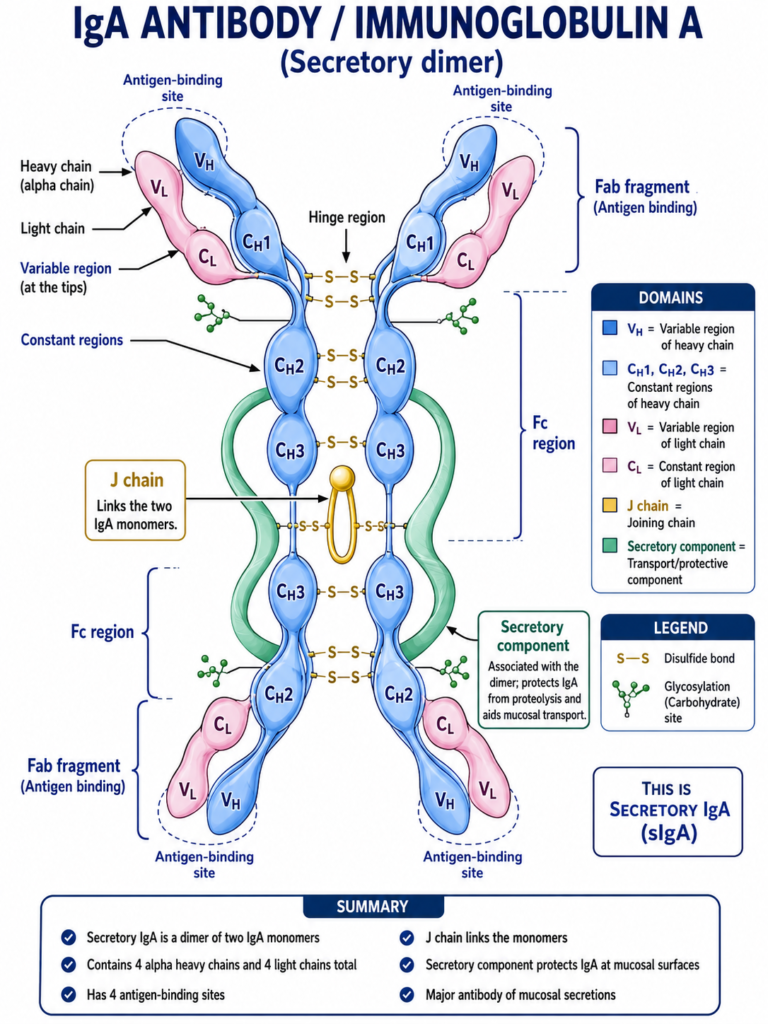
- IgA has a basic monomeric structure. It is made up of four polypeptide chains, two similar heavy alpha (α) chains and two similar light chains. The light chain may be kappa (κ) or lambda (λ) type.
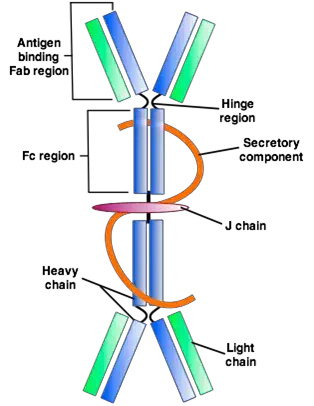
- The chains of IgA are arranged into two Fab regions and one Fc region. Fab region is antigen binding part. Fc region is constant part. These regions are separated by a flexible hinge region.
- The heavy chain of IgA contains four globular domains. These are one variable domain and three constant domains, CH1, CH2 and CH3. The light chain contains two domains, one variable and one constant domain.
- In blood, IgA is mostly present as monomer. In mucosal tissue, IgA is mostly present as dimer. Two IgA monomers are joined tail to tail by a J-chain.
- J-chain is about 15 kDa protein. It attaches with heavy chain tailpiece by disulfide bonds. The tailpiece is present at the end of heavy chain and helps in joining of IgA monomers.
- In mucosal secretion, dimeric IgA contains Secretory Component (SC). It is a 70-80 kDa glycoprotein. It is attached with dimeric IgA during transport through epithelial cell.
- Secretory Component (SC) surrounds the Fc region and J-chain. It protects IgA from digestive enzymes and microbial enzymes. So secretory IgA becomes stable in mucosal secretion.
- IgA has two subclasses, IgA1 and IgA2. IgA1 has long hinge region with 13 amino acid. It gives more flexibility but it can be cut by bacterial proteases.
- IgA2 has no same long hinge region. It is shorter than IgA1 in hinge part. It is more resistant to bacterial enzymes and mainly found in mucosal secretion.
- IgA is highly glycosylated antibody. Complex carbohydrate chains or glycans are present on the molecule. These glycans project outside from protein backbone and give negative charge and hydrophilic nature.
Molecular Characteristics of IgA
- IgA is a glycoprotein antibody. It is made up of two same heavy alpha (α) chains and two same light chains. The light chain may be kappa (κ) or lambda (λ).
- The alpha heavy chain has molecular weight about 55-58 kDa. It contains about 470 amino acids. It is folded into one variable domain VH and three constant domains, CH1, CH2 and CH3.
- In blood stream, IgA is mainly present as monomer. The molecular weight of monomeric IgA is about 160 kDa. In mucosal secretion, it is mostly dimer or polymer and its molecular weight is about 320-385 kDa.
- The dimeric IgA is joined tail to tail by J-chain. J-chain is a 15 kDa polypeptide and has 137 amino acids. It joins with 18 amino acid C-terminal tailpiece of heavy chain by disulfide bond.
- Secretory IgA (sIgA) contains one extra part called Secretory Component (SC). It is about 70-80 kDa polypeptide. It wraps around Fc region and gives protection from host and microbial proteases.
- The two subclasses of IgA show difference in hinge region. This hinge region is present between CH1 and CH2 domain. IgA1 has long 13 amino acid hinge region, rich in proline, serine and threonine and it gives flexibility but it can be cut by bacterial proteases.
- IgA2 does not have this long hinge segment. So it is shorter in this region. It is more resistant to bacterial cleavage and more stable in mucosal secretion.
- IgA is heavily glycosylated molecule. Carbohydrates form about 10% of total weight of IgA. IgA1 has special O-linked glycans in hinge region.
- Both IgA1 and IgA2 contain complex N-linked glycans. These glycans are highly sialylated and project outside from protein backbone. It gives strong negative charge and high hydrophilic nature to IgA.
Types of IgA
- By subclass- IgA has two subclasses. These are IgA1 and IgA2.
- a. IgA1- It is the major subclass of IgA in blood serum. It forms about 85% of total serum IgA.
- It has long 13 amino acid hinge region. This region gives flexibility. It helps in binding and cross-linking of protein antigens.
- The long hinge region is also weak part of IgA1. Bacterial IgA1 proteases can cut this region. These enzymes are produced by bacteria like Streptococcus pneumoniae and Haemophilus influenzae.
- IgA1 contains O-linked glycans in hinge region. These carbohydrate chains are attached directly with amino acids of the hinge part.
- b. IgA2- It forms about 15% of serum IgA. But it is mainly important in mucosal secretion.
- It is found more in gastrointestinal tract, airways, eyes and female genital tract. It acts as mucosal defender in these places.
- It has no long 13 amino acid hinge region like IgA1. So it is resistant to bacterial IgA1 proteases.
- It has no O-linked glycans in hinge region because hinge region is absent. But it has two to three extra N-linked glycosylation sites in Fc region than IgA1.
- In human, IgA2 has two major allotypic variants. These are IgA2m(1) and IgA2m(2).
- IgA2m(1) is common in Caucasian population. In this type, heavy chain and light chain are held by non-covalent interaction and not by usual disulfide bond.
- IgA2m(2) is common in population of African descent. In this type, heavy chain and light chain are joined by normal covalent disulfide bonds.
- a. IgA1- It is the major subclass of IgA in blood serum. It forms about 85% of total serum IgA.
- By structural form- IgA is present as monomer, dimer, polymer and secretory form.
- a. Monomeric IgA- It is single unit form of IgA. It has two heavy chains and two light chains. It is mainly present in blood.
- b. Dimeric IgA and polymeric IgA- It is formed by joining of two or more IgA monomers. The monomers are joined tail to tail. J-chain is present between them.
- c. Secretory IgA (sIgA)- It is main IgA of external secretion. It is present in saliva, tears, sweat, mucus and breast milk. It has dimeric IgA with Secretory Component (SC). SC protects it from digestive and bacterial enzymes.
- Disease associated form- Galactose-deficient IgA1 (Gd-IgA1) is abnormal form of IgA1. It has lack of galactose sugar in hinge region. It forms immune complex. It is related with IgA nephropathy and IgA vasculitis.
Distribution of IgA in the Body
- Blood and serum- IgA is the second most abundant antibody in blood. It forms about 10-15% of total serum immunoglobulins. In blood it is mainly present as monomeric IgA. It is mostly produced from bone marrow and mainly belongs to IgA1 subclass.
- Mucosal membrane- IgA is the main antibody of mucosal surface. It is present on epithelial lining of body. It protects gastrointestinal tract, respiratory tract and genitourinary tract. It works as first line defence against pathogen.
- External secretion- In external secretion IgA is mainly present as secretory IgA (sIgA). It is larger polymeric form and mostly dimeric. It is found in saliva, tears, sweat, nasal fluid, colostrum and breast milk.
- Subclass distribution- IgA1 and IgA2 are not equally distributed in body.
- a. IgA1- It is mainly present in blood serum. It forms about 80-85% of serum IgA. It is the major serum subclass.
- b. IgA2- It is more present in mucosal secretion. It is resistant to bacterial digestive enzymes. It forms about 10% of IgA in upper respiratory secretion, 30-40% in saliva and small intestine, and more than 50% in large intestine and female genital tract.
Synthesis and Production of IgA
- IgA is produced in very large amount in body. It is synthesized about 40-60 mg/kg body weight daily. This amount is more than production of all other antibody classes together. About 5-15 g of secretory IgA is released into mucous secretion every day.
- IgA present in blood is mainly produced by plasma cells of bone marrow. This IgA is mostly monomeric IgA1. It circulates in serum.
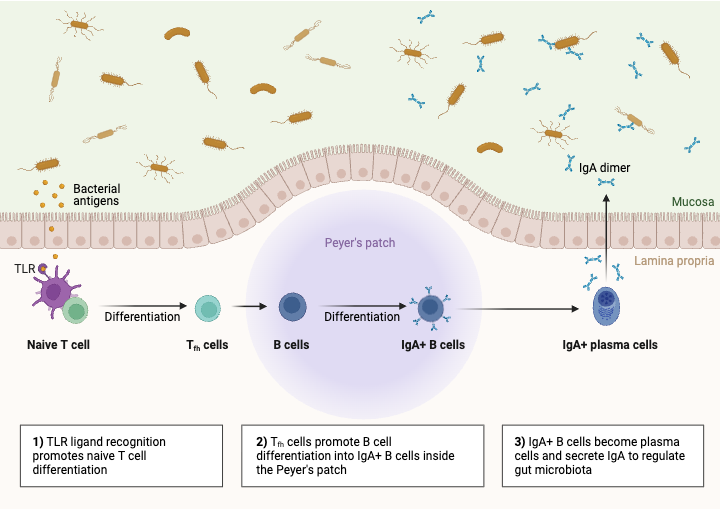
- IgA present in mucosal secretion is produced locally by plasma cells. These plasma cells are present below the epithelial tissue of mucosal surface. It is mainly produced in gut, airway and other mucosal regions. This form is mostly polymeric IgA.
- Naive B cells first produce IgM and IgD. Then these cells change into IgA producing cells by class-switch recombination (CSR). This process is controlled by enzyme AID.
- Transforming growth factor-beta (TGF-β) is the main cytokine for IgA class switching. It gives signal to B cells for production of IgA.
- BAFF, APRIL, IL-4, IL-5, IL-6 and IL-10 also help in this process. These factors support survival of B cells. They also help in differentiation of B cells into IgA producing plasma cells.
- Inside plasma cell, synthesis of IgA takes place in endoplasmic reticulum (ER). Newly formed heavy chains join with light chains. Heavy chain-light chain complex or HL complex is formed.
- MZB1 is an ER resident protein. It binds with tailpiece of heavy chain. It works as molecular chaperone. It prevents wrong folding and degradation of HL complex.
- Joining chain (J-chain) then binds with the complex and displaces MZB1. J-chain forms disulfide bonds with tailpieces of two IgA monomers. Dimeric IgA (dIgA) is formed.
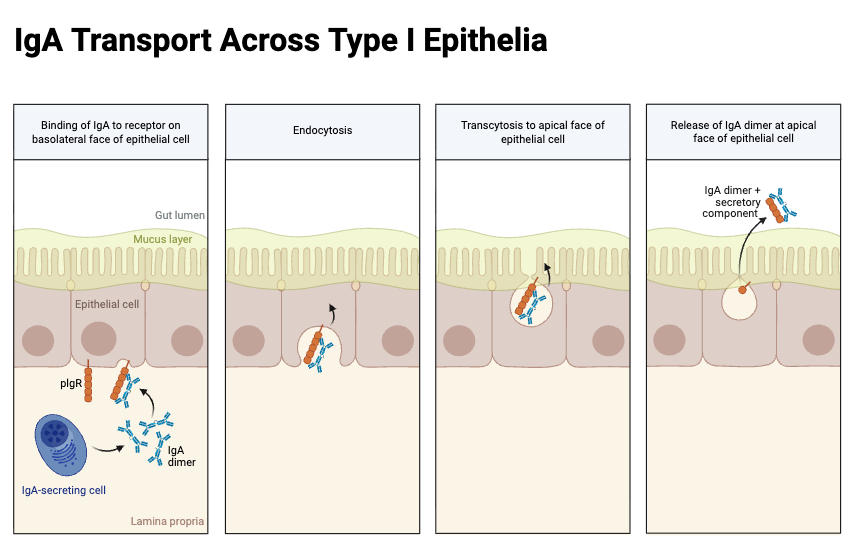
- Dimeric IgA binds with polymeric immunoglobulin receptor (pIgR). This receptor is present on basolateral side of mucosal epithelial cells.
- The epithelial cell takes the pIgR-IgA complex inside a vesicle. Then it is carried across the cell. It moves from inner side to outer apical surface.
- At apical surface, pIgR is cut by enzyme. Dimeric IgA is released into secretion with one part of receptor attached. This attached part is called Secretory Component (SC). This complete molecule is called secretory IgA (sIgA).
Mechanism of IgA Production
- Naive B cells first express IgM and IgD on their surface. After stimulation, these cells change into IgA producing cells by class-switch recombination (CSR). This process needs activation-induced cytidine deaminase (AID) enzyme.
- Transforming growth factor-beta (TGF-β) is the main cytokine for this switching. It activates SMAD proteins and Runx3 transcription factor. Then germline alpha transcript is started.
- Other factors also help in IgA production. IL-4, IL-5, IL-6, IL-10, IL-15, IL-21, BAFF and APRIL support survival of B cells. These also help the B cells to become IgA producing plasma cells.
- IgA switching may occur by T-cell dependent pathway. In this pathway, CD40-CD40L interaction takes place in germinal centre. This interaction gives signal to B cells for class switching.
- IgA switching may also occur by T-cell independent pathway. In this pathway, B-cell receptor cross-linking or Toll-like receptor stimulation takes place on mucosal B cells.
- Inside the plasma cell, newly formed heavy chains and light chains are made in endoplasmic reticulum (ER). Heavy chain joins with light chain and forms heavy-chain-light-chain (HL) complex.
- BiP and GRP94 are chaperone proteins. These help in folding of heavy chain and light chain. They also help to keep the newly formed chains in proper form.
- MZB1 is an ER resident protein. It binds with penultimate cysteine residue of heavy chain tailpiece. It covers weak part of HL complex and prevents intracellular degradation.
- Joining chain (J-chain) then joins with the stabilized HL complex. It displaces MZB1 from the complex. J-chain forms disulfide bonds at penultimate cysteine.
- Two IgA monomers are joined by J-chain. This forms dimeric IgA (dIgA). Sometimes larger polymeric IgA may also be formed.
- Fully formed dimeric IgA binds with polymeric immunoglobulin receptor (pIgR). This receptor is present on basolateral surface of mucosal epithelial cell.
- The pIgR-dIgA complex enters into epithelial cell by vesicle formation. It is taken into clathrin-coated vesicles. Then it is transported through the cell towards apical surface.
- At the apical surface, pIgR is cleaved by enzyme. The dimeric IgA is released into mucosal secretion. A part of pIgR remains attached with it.
- This attached part of receptor is called Secretory Component (SC). The complete molecule formed after this is called Secretory IgA (sIgA).
Secretory Component of IgA
- Secretory Component (SC) is a 70-80 kDa glycoprotein. It is produced by mucosal epithelial cells and glandular cells. It is not made by plasma cell.
- SC is derived from polymeric immunoglobulin receptor (pIgR). It is the cleaved outer part of pIgR. This outer part is called ectodomain.
- SC is made up of five immunoglobulin like domains. These domains are D1, D2, D3, D4 and D5. These domains are folded into compact triangular structure.
- SC is highly glycosylated molecule. Carbohydrate forms about 22% of its total weight. These carbohydrate chains are present on outside surface.
- SC binds with dimeric IgA. It surrounds the Fc region of IgA. It forms protective covering around the antibody.
- SC is attached with IgA by disulfide bond. The D5 domain of SC links with constant alpha-2 (Cα2) domain of IgA heavy chain.
- Binding of SC with IgA needs Joining chain (J-chain). J-chain helps in recognition and binding. But SC and J-chain are not covalently joined with each other.
- During transport, pIgR carries dimeric IgA across epithelial cell. This process is called transcytosis. After reaching mucosal surface, pIgR is cleaved and SC remains attached with IgA.
- SC protects secretory IgA (sIgA) in mucosal secretion. It prevents breakdown by digestive enzymes and bacterial proteases. So IgA stays stable in gut, airway and other secretion.
- The carbohydrate chains of SC gives negative charge and hydrophilic nature. It makes secretory IgA mucophilic. So it remains attached with mucus layer.
- SC also helps in trapping pathogens in mucus. The trapped pathogens are then removed with mucus secretion. This is important in mucosal defence.
- Some SC is released without antibody. This is called free SC. In human, up to 50% of pIgR may be released as free SC.
- Free SC also works in innate immunity. It binds with bacterial surface proteins. Its glycans act as decoy receptor and prevent attachment of pathogen with host cells.
Transport Mechanism of Secretory IgA
- Dimeric IgA is produced by plasma cells present in mucosal tissue. It then binds with polymeric immunoglobulin receptor (pIgR). This receptor is present on basolateral surface of epithelial cell.
- After binding, pIgR-IgA complex is taken inside the epithelial cell. This process is by endocytosis. The complex enters into clathrin-coated vesicles.
- The complex moves through the epithelial cell. It passes from basolateral early endosome to tubulo-vesicular compartments. Then it reaches apical recycling endosome.
- This movement across epithelial cell is called transcytosis. It depends on microtubule network of the cell. The complex moves from inner side to outer mucosal side.
- At apical membrane, pIgR is cut by proteolytic enzyme. This is called proteolytic cleavage. The outer part of receptor remains attached with IgA.
- The dimeric IgA is released into mucosal secretion. It remains attached with cleaved protective part of pIgR. This attached part is called Secretory Component (SC).
- The released complete molecule is called Secretory IgA (sIgA). It is now present in external mucosal secretion like mucus, saliva, tears and gut fluid.
Functions of IgA
- IgA acts as the first line defence of mucosal surface. It is mainly present in gastrointestinal tract, respiratory tract and genitourinary tract. It protects these surfaces from local infection.
- IgA neutralizes viruses and bacterial toxins. It acts both inside and outside the cell. It prevents damage of epithelial cells by these toxins and viruses.
- IgA prevents attachment of bacteria and viruses on epithelial cells. It also stops their penetration through mucosal lining. This process prevents entry of foreign substance into blood stream.
- IgA causes agglutination of microorganisms. The organisms are clumped together and trapped in mucus layer. Then these are removed by mucociliary flow or by peristalsis.
- IgA helps in excretion of pathogens and antigens. IgA-antigen complexes are transported through epithelial cells. Then these are cleared from body with secretion and less inflammation occurs.
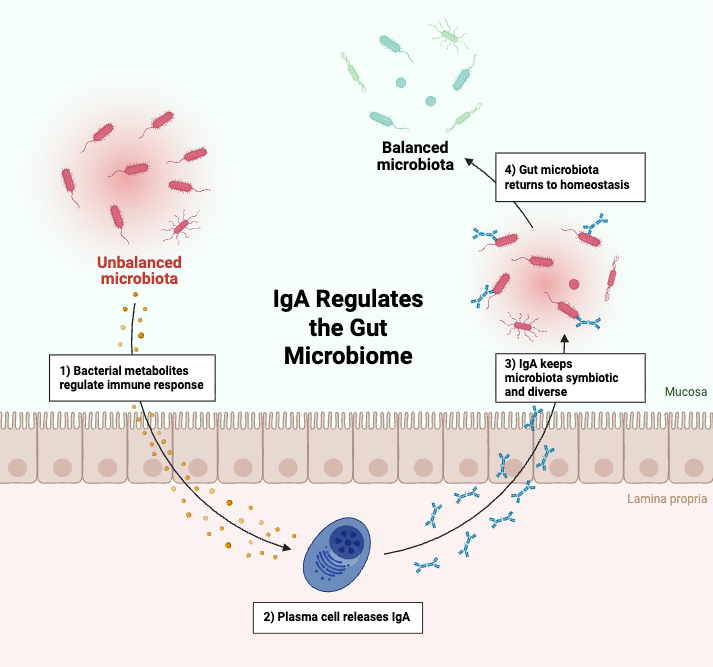
- IgA helps in regulation of intestinal microbiota. It controls the composition of gut bacteria. It also maintains normal relation with harmless commensal bacteria.
- Secretory IgA gives passive immunity to infants. It is present in high amount in colostrum and breast milk. It protects newborn from many microbial antigens before the immune system becomes mature.
- In blood, monomeric IgA works as anti-inflammatory regulator. It helps in maintaining immunological tolerance. But IgA immune complexes may bind with receptors like CD89 and start inflammatory response.
- IgA immune complexes can cause phagocytosis, neutrophil degranulation and antibody-dependent cellular cytotoxicity (ADCC). These reactions help in destruction of pathogens.
- IgA does not activate classical complement pathway. But aggregated or polymeric IgA can activate alternative and lectin complement pathways. This helps in immune response against antigen.
Immunological Significance of IgA
- IgA is the main immune defence of mucosal surface. It is present in gastrointestinal tract, respiratory tract and genitourinary tract. It protects these regions from local infection.
- IgA neutralizes viruses and bacterial toxins. It acts outside the cell and also inside the host cell. It prevents injury of mucosal epithelial cells.
- IgA prevents attachment of bacteria and viruses with epithelial cell. It also prevents penetration through mucosal surface. So foreign substances are blocked before entering into blood stream.
- IgA causes agglutination of microorganisms. The organisms become clumped together. These clumps are trapped in mucus layer and removed by mucociliary flow or peristalsis.
- IgA helps in excretory clearance of antigen. IgA-antigen complex is transported across epithelial cell. Then it is removed from body with secretion. It causes less local inflammation.
- IgA maintains mucosal microbiota. It helps in proper colonization of useful microbes. It also keeps normal relation with harmless commensal bacteria.
- Secretory IgA gives passive immunity to newborn baby. It is present in high amount in colostrum and breast milk. It protects infant before its own immune system become fully developed.
- In blood, uncomplexed monomeric IgA works as immune regulator. It helps in immunological tolerance. It also suppresses unnecessary inflammation.
- Multivalent IgA immune complex can bind with myeloid receptor like CD89. This can start pro-inflammatory response. It causes phagocytosis and antibody-dependent cellular cytotoxicity (ADCC) against pathogen.
- IgA does not activate classical complement pathway. But polymeric or aggregated IgA can activate alternative pathway and lectin pathway. This helps in immune defence.
- Secretory IgA also works with lysozyme in mucosal secretion. Lysozyme breaks carbohydrate of bacterial cell wall. This helps in clearing infection.
Laboratory Detection and Measurement of IgA
- Quantitative serum immunoglobulin- It is a common blood test. It is used to measure total IgA level with other immunoglobulins. It helps to know general immune function and selective IgA deficiency.
- Turbidimetry- It is used to measure serum IgA subclasses. Mainly IgA1 and IgA2 are measured. In this method, serum sample is mixed with specific antiserum. Insoluble antigen-antibody complex is formed and transmitted light is measured.
- Serum protein electrophoresis- It is a qualitative test. It studies antibody level in blood. It can detect abnormal monoclonal antibody peak. It is useful in plasma cell disorders.
- Enzyme-Linked Immunosorbent Assay (ELISA)- It is used to detect and measure specific IgA antibodies in blood sample. Tissue transglutaminase IgA (tTG-IgA) is one example. It is used for screening of celiac disease.
- Autoantibody panel- These are specific blood tests for IgA antibody detection. IgA Endomysial Antibody (EMA) and Deamidated Gliadin Peptide IgA (DGP IgA) are included. These are used with tTG-IgA for confirmation of celiac disease and in case of total IgA deficiency.
- Lectin based assay- It is a special indirect ELISA test. It uses Helix aspersa agglutinin (HAA) lectin. This lectin binds with terminal sugar. It is used to measure galactose-deficient IgA1 (Gd-IgA1) in IgA nephropathy.
- Mass spectrometry- It is a molecular technique. It is used to detect under-galactosylated form of IgA1. It can also measure this abnormal IgA1 form.
- Immunofluorescence microscopy- It is done on tissue biopsy. Kidney biopsy or skin biopsy may be used. It shows IgA immune complex deposition directly in tissue.
- KM55 staining- It is a specific staining method. It is lectin-independent method. It is used on tissue biopsy to detect abnormal galactose-deficient IgA1 (Gd-IgA1) deposits.
Diseases Associated with Elevated IgA Levels
- IgA nephropathy- It is an autoimmune kidney disease. In this disease total serum IgA level is increased. It may be more than 350 mg/dl. Abnormal galactose-deficient IgA1 (Gd-IgA1) is also increased.
- IgA vasculitis- It is also called Henoch-Schönlein purpura. It is a systemic small vessel vasculitis. It has similar pathogenic mechanism like IgA nephropathy. Increased serum IgA is found in more than 50% patients.
- Celiac disease- It is an autoimmune gluten sensitive disease. Body shows abnormal immune response against gluten. Specific IgA antibodies are increased in blood. These include tissue transglutaminase IgA (tTG-IgA) and endomysial antibody (EMA).
- Hyper IgD syndrome- It is a periodic fever disorder. In this condition total serum IgA concentration may be increased. Fever occurs again and again.
- Monoclonal gammopathies- These are plasma cell proliferative disorders. Multiple myeloma and monoclonal gammopathy of undetermined significance (MGUS) may cause increased total IgA. Increased IgA2 with normal or low IgA1 indicates clonal disorder producing monoclonal IgA2.
- Benign disorders- Common infection, inflammation and allergy can also increase total IgA level in blood. This increase is usually related with immune stimulation.
Diseases Associated with Reduced IgA Levels
- Selective IgA deficiency- It is the most common primary immunodeficiency. In this disease IgA1 and IgA2 are almost absent. Some patients have no symptom. But recurrent respiratory, gastrointestinal and genitourinary infections may occur. Risk of autoimmune disease, atopy and anaphylactic transfusion reaction also increases.
- Common variable immunodeficiency- It is an acquired immunodeficiency. IgA level becomes low with other antibodies. Patient gets recurrent pyogenic infections. Risk of lymphoma, autoimmune disease and bronchiectasis is also increased.
- X-linked agammaglobulinemia- It is also called Bruton agammaglobulinemia. It is due to genetic defect in B-cell maturation. So all immunoglobulin classes are absent or very low. IgA is also severely reduced.
- Transient hypogammaglobulinemia of infancy- It is temporary deficiency of immunoglobulins in infants. It is physiological condition. Recurrent bacterial infections may occur. It decreases when child immune system starts producing its own immunoglobulins.
- Giardiasis and SIBO- Giardiasis and small-bowel bacterial overgrowth (SIBO) may be associated with underlying IgA deficiency. These are related with intestinal problem and villus atrophy.
- Selective subclass deficiency- Some patients have low level of only one IgA subclass. Low IgA2 with normal IgA1 is one example. This may increase infection by bacteria like Haemophilus influenzae.
- Bacterial induced apparent IgA deficiency- Some bacteria produce proteases which cleave IgA1. If patient also has IgA2 deficiency, infection by such bacteria may show overall IgA deficiency.
Advantages of IgA
- First line mucosal defence- Secretory IgA is present in large amount in mucosal secretion. It is found in saliva, tears and breast milk. It prevents bacteria, viruses and toxins from attaching with epithelial surface.
- Non-inflammatory protection- IgA protects the mucosal surface without strong inflammation. It does not activate classical complement pathway. In blood, monomeric IgA gives inhibitory signal and helps in immunological tolerance.
- Enzyme resistance- Secretory IgA has Secretory Component (SC) around it. SC is highly glycosylated. It protects IgA from digestive enzymes and microbial proteases.
- High binding capacity- Secretory IgA is mostly dimeric. So it has four or more antigen binding sites. It can bind more antigen at a time and causes agglutination of microbes and toxins.
- Safe excretory clearance- IgA binds with foreign antigen in tissue. Then IgA-antigen complex is transported across epithelial cell by transcytosis. It is removed into external secretion with less tissue damage.
- Functional adaptability- IgA usually keeps non-inflammatory state. But when it forms multivalent immune complex, it can bind with receptor like CD89. This can start phagocytosis and targeted inflammatory response against pathogen.
- Free secretory component- Some Secretory Component (SC) is released without antibody. This is called free SC. It acts as innate defence molecule. Its carbohydrate chains trap bacteria and prevent attachment with host cell.
- Microbiome homeostasis- IgA regulates normal gut microflora. It supports colonization of useful commensal bacteria. It also neutralizes opportunistic pathogens in mucosal surface.
Limitations of IgA
- Protease sensitivity- IgA1 has long hinge region. This region can be cut by bacterial IgA1 proteases. Bacteria like Streptococcus pneumoniae, Haemophilus influenzae and Neisseria meningitidis produce these enzymes. So IgA1 becomes inactive fragments and bacterial invasion becomes easy.
- Poor classical complement activation- IgA cannot bind with C1q. So it does not start classical complement pathway. It is weak complement activating antibody and does not cause direct bacterial lysis like IgG and IgM.
- Weak opsonophagocytosis- IgA is less efficient in opsonophagocytosis than IgG. It does not coat pathogen for phagocytosis very strongly. So engulfment by immune cells is comparatively low.
- Short serum half life- IgA has short half life in blood serum. It remains for about 6 days. So its serum persistence is less.
- Autoimmune potential- IgA1 may show abnormal O-glycosylation. It forms galactose-deficient IgA1 (Gd-IgA1). Body may treat it as autoantigen. Immune complexes are formed and deposited in renal mesangium or small blood vessels. It is related with IgA nephropathy and IgA vasculitis.
- Dependence on assembly- Mucosal IgA needs correct assembly. It depends on MZB1 for folding and protection inside cell. It needs Joining chain (J-chain) for dimer formation. It also needs polymeric immunoglobulin receptor (pIgR) for epithelial transport.
- Transport limitation- If J-chain, MZB1 or pIgR is absent or defective, IgA cannot reach mucosal surface properly. Then mucosal immunity becomes weak.
Comparison of IgA with Other Immunoglobulins
| Point | IgA | Other immunoglobulins |
|---|---|---|
| Daily production | IgA is produced in very large amount. About 40-60 mg/kg body weight daily. | Its production is more than all other antibody classes together. |
| Serum amount | IgA is second most abundant immunoglobulin in blood. Average level is about 2-4 mg/mL. | IgG is highest in serum. Its level is about 9-12 mg/mL. |
| Polymer formation | IgA can form dimer. It uses Joining chain (J-chain). | IgM can form pentamer with J-chain. IgG, IgD and IgE are mainly monomer. |
| Mucosal transport | Polymeric IgA binds with polymeric immunoglobulin receptor (pIgR) and moves into mucosal secretion. | IgM can also bind with pIgR, but its mucosal transport is very low in normal person. |
| Complement activation | IgA cannot bind C1q. So it does not start classical complement pathway. Aggregated IgA can activate alternative and lectin pathway. | IgG and IgM bind with C1q and activate classical complement pathway. |
| Placental transfer | IgA cannot cross placenta. It gives mucosal passive immunity to newborn through colostrum and breast milk. | IgG can cross placenta and gives systemic passive immunity to fetus. |
| Opsonophagocytosis | IgA is less efficient in opsonophagocytosis. It is weak than IgG in coating pathogen for phagocytosis. | IgG is more efficient in opsonophagocytosis and phagocytic removal. |
| Glycan position | IgA has complex N-linked glycans projecting outside from protein backbone. These are highly sialylated. | In IgG1, glycans are hidden between heavy chains. |
References
- Aryal, S. (2024, January 23). Immunoglobulin A (IgA) – Structure, properties, subclasses, functions. MicrobiologyInfo.com.
- Berthoux, F., Mohey, H., Maillard, N., & Mariat, C. (2015). IgA nephropathy: New aspects in pathophysiology and pathogenesis. EMJ Nephrology, 3(1), 97–103.
- bioRxiv. (n.d.). The structures of secretory and dimeric immunoglobulin A.
- Castañeda, S., Quiroga-Colina, P., Floranes, P., Uriarte-Ecenarro, M., Valero-Martínez, C., Vicente-Rabaneda, E. F., & González-Gay, M. A. (2024). IgA vasculitis (Henoch–Schönlein purpura): An update on treatment. Journal of Clinical Medicine, 13(21), Article 6621. https://doi.org/10.3390/jcm13216621
- Celiac Disease Foundation. (n.d.). Testing.
- Cleveland Clinic. (2026, April 28). tTG-IgA test. Diagnostics & Testing.
- Cui, C., Feng, X., Min, Q., Lu, C., Wen, Z., Meng, X., Zhang, R., Dong, L., & Wang, J.-Y. (2026). Cooperative control of IgA synthesis and secretion by MZB1 and the J chain. Frontiers in Immunology, 17, Article 1744147. https://doi.org/10.3389/fimmu.2026.1744147
- Liu, J., Wang, Y., Xiong, E., Hong, R., Lu, Q., Ohno, H., & Wang, J.-Y. (2019). Role of the IgM Fc receptor in immunity and tolerance. Frontiers in Immunology, 10, Article 529. https://doi.org/10.3389/fimmu.2019.00529
- Liu, W., Jiang, K., Jin, M., & Chen, X. (2026). Research progress on the role of MZB1 in immune regulation. Frontiers in Immunology, 17, Article 1741773. https://doi.org/10.3389/fimmu.2026.1741773
- Mayo Clinic Laboratories. (n.d.). IgA subclasses, serum. Pediatric Catalog.
- Mayo Clinic Laboratories. (n.d.). Tissue transglutaminase antibodies, IgA and IgG profile, serum. Neurology Catalog.
- MedChemExpress. (n.d.). Attention required! Cloudflare.
- MedChemExpress. (n.d.). Fc alpha/mu receptor | Recombinant proteins. Cloudflare.
- Medjeral-Thomas, N. R., Cook, H. T., & Pickering, M. C. (2021). Complement activation in IgA nephropathy. Seminars in Immunopathology, 43(5), 679–690. https://doi.org/10.1007/s00281-021-00882-9
- Molecular biology of immunoglobulin A: Structural heterogeneity, subclass dynamics, biosynthetic chaperoning, and effector pathophysiology. (n.d.).
- National Center for Biotechnology Information. (2026, June 3). Fcamr Fc receptor, IgA, IgM, high affinity [Mus musculus (house mouse)]. U.S. National Library of Medicine.
- National Center for Biotechnology Information. (n.d.). Cellular signaling and production of galactose-deficient IgA1 in IgA nephropathy. PubMed Central.
- National Center for Biotechnology Information. (n.d.). Class switch recombination in selective IgA-deficient subjects. PubMed Central.
- National Center for Biotechnology Information. (n.d.). Current understanding of the role of complement in IgA nephropathy. PubMed Central.
- National Center for Biotechnology Information. (n.d.). IgA and FcαRI: Pathological roles and therapeutic opportunities. PubMed Central.
- National Center for Biotechnology Information. (n.d.). IgA vasculitis and IgA nephropathy: Same disease? PubMed Central.
- National Center for Biotechnology Information. (n.d.). IgA: Structure, function, and developability. PubMed Central.
- National Center for Biotechnology Information. (n.d.). Immunoglobulin class-switch recombination: Mechanism, regulation… PubMed Central.
- National Center for Biotechnology Information. (n.d.). MZB1 folding and unfolding the role of IgA. PubMed Central.
- National Center for Biotechnology Information. (n.d.). Pathogenesis of IgA nephropathy: Current understanding and implications for development of disease-specific treatment. PubMed Central.
- National Center for Biotechnology Information. (n.d.). Role of polymeric immunoglobulin receptor in IgA and IgM transcytosis. PubMed Central.
- National Center for Biotechnology Information. (n.d.). The complement system: An important new therapeutic target in IgA nephropathy. PubMed Central.
- National Center for Biotechnology Information. (n.d.). The polymeric immunoglobulin receptor (secretory component) mediates transport of immune complexes across epithelial cells: A local defense function for IgA. PubMed Central.
- National Center for Biotechnology Information. (n.d.). The regulation of IgA class switching. PubMed Central.
- National Center for Biotechnology Information. (n.d.). The structures of secretory and dimeric immunoglobulin A. PubMed Central.
- National Library of Medicine. (n.d.). Class switch recombination in selective IgA-deficient subjects. PubMed.
- National Library of Medicine. (n.d.). Structure and function of human IgA Fc receptors (Fc alpha R). PubMed.
- National Library of Medicine. (n.d.). Structure and function of immunoglobulins. PubMed.
- Patel, P., Jamal, Z., & Ramphul, K. (2023). Immunoglobulin. In StatPearls. StatPearls Publishing.
- Proceedings of the National Academy of Sciences. (n.d.). Impaired IgA class switching in APRIL-deficient mice. PNAS.
- Proceedings of the National Academy of Sciences. (n.d.). MZB1 promotes the secretion of J-chain–containing dimeric IgA and is critical for the suppression of gut inflammation. PNAS.
- Ramsawak, S., Cohen, S., Linares, A., & Cavanaugh, C. (2025, September 25). IgA nephropathy: Reviewing the evidence on pathogenesis, diagnosis and prognosis. Cleveland Clinic Consult QD.
- Reinholdt, J., & Husby, S. (2013). IgA and mucosal homeostasis. In Madame Curie bioscience database. Landes Bioscience.
- Song, Y., Huang, X., Yu, G., Qiao, J., Cheng, J., Wu, J., & Chen, J. (2021). Pathogenesis of IgA vasculitis: An up-to-date review. Frontiers in Immunology, 12, Article 771619. https://doi.org/10.3389/fimmu.2021.771619
- Stadtmueller, B. M., Huey-Tubman, K. E., López, C. J., Yang, Z., Hubbell, W. L., & Bjorkman, P. J. (2016). The structure and dynamics of secretory component and its interactions with polymeric immunoglobulins. eLife, 5, Article e10640. https://doi.org/10.7554/eLife.10640
- Thermo Fisher Scientific. (n.d.). Immunoglobulin IgA class.
- University of Rochester Medical Center. (n.d.). Anti-tissue transglutaminase antibody. Health Encyclopedia.
- Wang, Y., Wang, G., Li, Y., Zhu, Q., Shen, H., Gao, N., & Xiao, J. (2020). Cryo-EM structure of human secretory immunoglobulin A [Data set]. Protein Data Bank Japan. EMD-30004.
- Wikipedia contributors. (2026, June 3). Polymeric immunoglobulin receptor. In Wikipedia, The Free Encyclopedia.
- Woof, J. M., & Kerr, M. A. (2006). The function of immunoglobulin A in immunity. The Journal of Pathology, 208(2), 270–282. https://doi.org/10.1002/path.1877
- Woof, J. M., & Russell, M. W. (2011). Structure and function relationships in IgA. Mucosal Immunology, 4(6), 590–597. https://doi.org/10.1038/mi.2011.39
- Yu, X., Gao, H., & Sun, X. (2026). Research progress on the lectin pathway of complement in IgA nephropathy. Frontiers in Immunology, 17, Article 1757595. https://doi.org/10.3389/fimmu.2026.1757595