

Mucosa Associated Lymphoid Tissue (MALT) is a lymphoid tissue present in mucosal and submucosal lining of body. It protects mucosal surfaces from harmful antigen and microbes entering through digestive, respiratory and other tracts.
Mucosa Associated Lymphoid Tissue (MALT) is a specialized lymphoid tissue present in the mucosal and submucosal lining of body. It is not a capsulated organ like lymph node. It is distributed in different body tracts where outside materials can enter.
It is found in digestive tract, respiratory tract, urinary tract, reproductive tract, eyes and skin associated mucosal regions. These areas are exposed to external environment. So the chance of entry of bacteria, virus, fungi and other foreign particles is more.
MALT is an important part of immune system. It contains many immune cells like T lymphocytes, B lymphocytes, macrophages and dendritic cells. These cells are present near the mucosal surface and detect foreign antigen entering through that surface.
The mucosal surface is thin and permeable. Because of this reason MALT acts as first line defence of body. It gives quick immune response before the pathogen enter deeper tissues.
M cells or microfold cells are also present in MALT region. These cells collect antigen from mucosal surface and transfer it to the immune cells present below. Then immune reaction is started against harmful antigen.
MALT also helps in immunological tolerance. It does not allow unnecessary immune reaction against food antigen and normal flora. Normal flora are beneficial microorganisms present in body.
According to location, MALT is divided into different types. These are Gut Associated Lymphoid Tissue (GALT), Bronchus Associated Lymphoid Tissue (BALT) and Nasal Associated Lymphoid Tissue (NALT). GALT includes tonsils, appendix and Peyer’s patches present in intestine.
Historical Background of MALT
Mucosa Associated Lymphoid Tissue (MALT) was understood mainly from the study of mucosal immunity. The mucosal surface is always in contact with outside antigen. So this lymphoid tissue developed for handling the microbes present in intestine and other mucosal regions.
From evolutionary view, MALT is related with the interaction between host body and intestinal bacteria. The body has to tolerate useful bacteria and food antigen. At same time it has to give defence against harmful virus, fungi and bacteria.
Earlier the vermiform appendix was considered as a useless vestigial organ. It was thought that it has no important function. Later it was understood that appendix is an active lymphoid structure and it is a part of MALT.
The appendix contains organized lymphoid tissue. It helps in B lymphocyte mediated immune response. It also contains T lymphocytes and helps to keep useful commensal bacteria. These bacteria may help in recolonization of intestine after diarrhoeal disease.
A major development in the study of MALT was the understanding of antibody secretion through mucosal epithelium. Per Brandtzaeg showed that a secretory component acts as a receptor for IgA and IgM antibodies on epithelial cells.
This secretory component was first confusing because it was found as soluble protein. Later Keith Mostov and co-workers showed that it is actually a fragmented part of a bigger precursor molecule. This gave the idea of polymeric immunoglobulin receptor (pIgR).
After this, the transport of antibodies through epithelial cells became more clear. pIgR helps in movement of polymeric IgA and IgM across mucosal epithelium. This is important for mucosal defence.
With more study, M cells or microfold cells were also identified as important antigen sampling cells. These cells take antigen from mucosal surface and send it to lymphoid cells present below the epithelium.
Some pathogens also use these M cells for entry into body. Organisms causing polio, Salmonella, Shigella infection and infectious prions can cross the mucosal barrier by using this pathway. So MALT became important not only for defence but also for understanding disease entry through mucosal surface.
Characteristics of MALT
- Mucosa Associated Lymphoid Tissue (MALT) is present in the mucosal and submucosal region of body. It is found in digestive tract, respiratory tract, urinary tract, reproductive tract, eyes and skin associated regions.
- It is not present as a single capsulated organ. It is distributed in mucosal lining where outside antigen can easily enter. So its position is very important for body defence.
- MALT is a large part of immune system. It contains nearly 50 to 70% of total white blood cells of body. These cells include T cells, B cells, macrophages, plasma cells and dendritic cells.
- It acts as first line defence of body. The mucosal surface is directly exposed to external environment. So virus, bacteria, fungi and other antigen are first encountered by this tissue.
- MALT has two main structural forms. These are Organized MALT (O-MALT) and Diffuse MALT (D-MALT).
- Organized MALT (O-MALT) is present as organized lymphoid masses. It includes tonsils, Peyer’s patches and appendix. These are mainly inductive sites where immune response is started.
- Diffuse MALT (D-MALT) is not arranged as definite mass. It contains scattered immune cells present in mucosal tissue and lamina propria. These cells act as effector site and complete the immune response.
- According to location, MALT is divided into different types. These are Gut Associated Lymphoid Tissue (GALT), Bronchus Associated Lymphoid Tissue (BALT), Nasal Associated Lymphoid Tissue (NALT) and Skin Associated Lymphoid Tissue (SALT).
- MALT performs antigen sampling. Special epithelial cells called M cells or microfold cells are present. These cells take foreign antigen from mucosal surface and transfer it to immune cells below the epithelium.
- M cells do not have thick mucus covering. So antigen trapping and transport becomes easy. This helps in early detection of harmful antigen.
- MALT mainly produces secretory Immunoglobulin A (sIgA). This antibody neutralizes pathogens and prevents their attachment with mucosal lining.
- It also maintains immunological tolerance. It does not produce strong immune reaction against harmless food antigen and useful commensal bacteria.
- Regulatory T cells are involved in this tolerance. They suppress unnecessary inflammatory reaction and maintain normal balance in mucosal region.
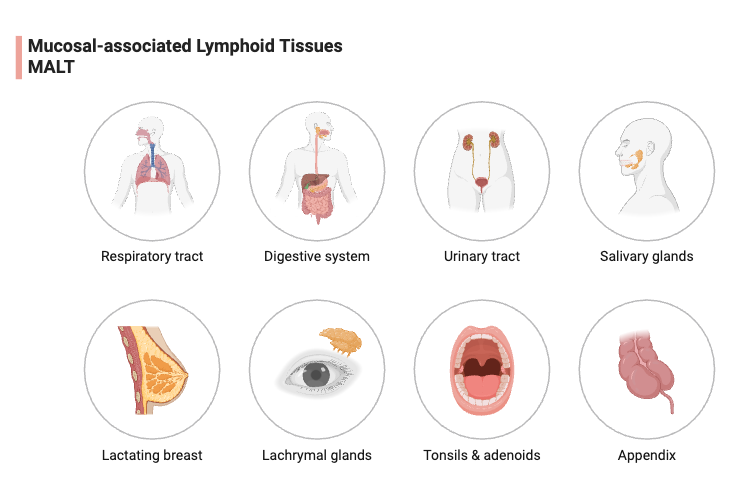
Distribution of MALT in the Body
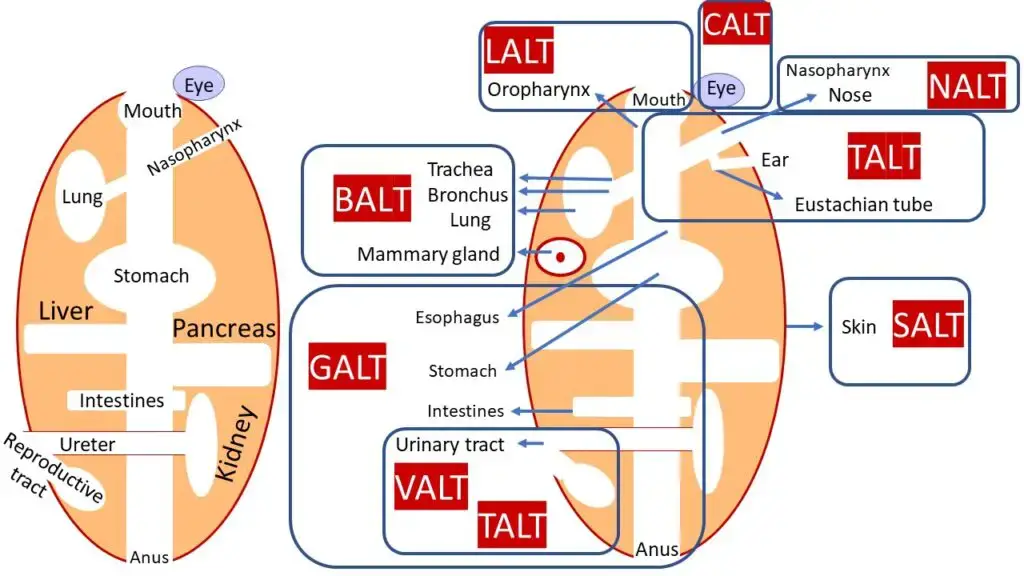
MALT is distributed in different mucosal regions of body. It is not present in one place. It is mainly present where the body surface is exposed to outside antigen.
- Gut Associated Lymphoid Tissue (GALT) is present in digestive tract. It is found in stomach, small intestine, large intestine, Peyer’s patches and vermiform appendix. It protects against antigen entering with food and intestinal microbes.
- Bronchus Associated Lymphoid Tissue (BALT) is present in respiratory tract. It is found in lungs and bronchial tree. It gives protection against inhaled antigen, dust and microbes.
- Nasal Associated Lymphoid Tissue (NALT) is present in nasal region and upper respiratory duct. It includes nose, nasopharynx, adenoids and tonsils. These lymphoid tissues are also present as part of Waldeyer’s ring.
- Conjunctival Associated Lymphoid Tissue (CALT) is present in eye. It is found in conjunctival membrane and ocular adnexa. It protects the eye surface from foreign antigen.
- Larynx Associated Lymphoid Tissue (LALT) is present in the throat region. It is found in subepithelial region of larynx. These are present as lymphoid aggregates.
- Skin Associated Lymphoid Tissue (SALT) is present in skin. It is scattered in epidermis and dermis. It gives immune defence in cutaneous layer.
- Vulvovaginal Associated Lymphoid Tissue (VALT) is present in female reproductive tract. It is found in vulvo-vaginal wall and lower reproductive tract.
- Testis Associated Lymphoid Tissue (TALT) is present in male reproductive and urogenital tract. It is found in testis associated mucosal region.
Types of MALT
A. On the basis of structural organization
- Organized MALT (O-MALT)– These are organized lymphoid tissue masses. They are anatomically independent but not capsulated. It includes tonsils, Peyer’s patches and vermiform appendix. These are mainly inductive sites where antigen is sampled and immune response is started.
- Diffuse MALT (D-MALT)– These are scattered lymphoid cells present in mucosal tissue. It is not present as definite mass. It is found in mucosal epithelium and lamina propria. These are mainly effector sites where final immune response takes place.
B. On the basis of anatomical location
- GALT– Gut Associated Lymphoid Tissue is present in gastrointestinal tract. It extends from oesophagus to rectum. It includes Peyer’s patches, appendix and other intestinal lymphoid tissues.
- BALT– Bronchus Associated Lymphoid Tissue is present in bronchial tree and lower respiratory tract. It protects against inhaled antigen and microbes.
- NALT– Nasal Associated Lymphoid Tissue is present in nasopharyngeal tract and upper respiratory duct. It includes tonsils and adenoids.
- CALT– Conjunctival Associated Lymphoid Tissue is present in eye region. It is found in conjunctival membrane and ocular adnexa.
- LALT– Larynx Associated Lymphoid Tissue is present in laryngeal submucosa. It is found in upper airway region.
- SALT– Skin Associated Lymphoid Tissue is present in skin. It is distributed in dermal and epidermal cutaneous layers.
- VALT– Vulvovaginal Associated Lymphoid Tissue is present in vaginal wall and lower female reproductive tract.
- TALT– Testis Associated Lymphoid Tissue is present in male reproductive and urogenital tract.
Structure and Organization of MALT
MALT is arranged in two main functional regions. These are inductive sites and effector sites. These two parts work in different way in mucosal immunity.
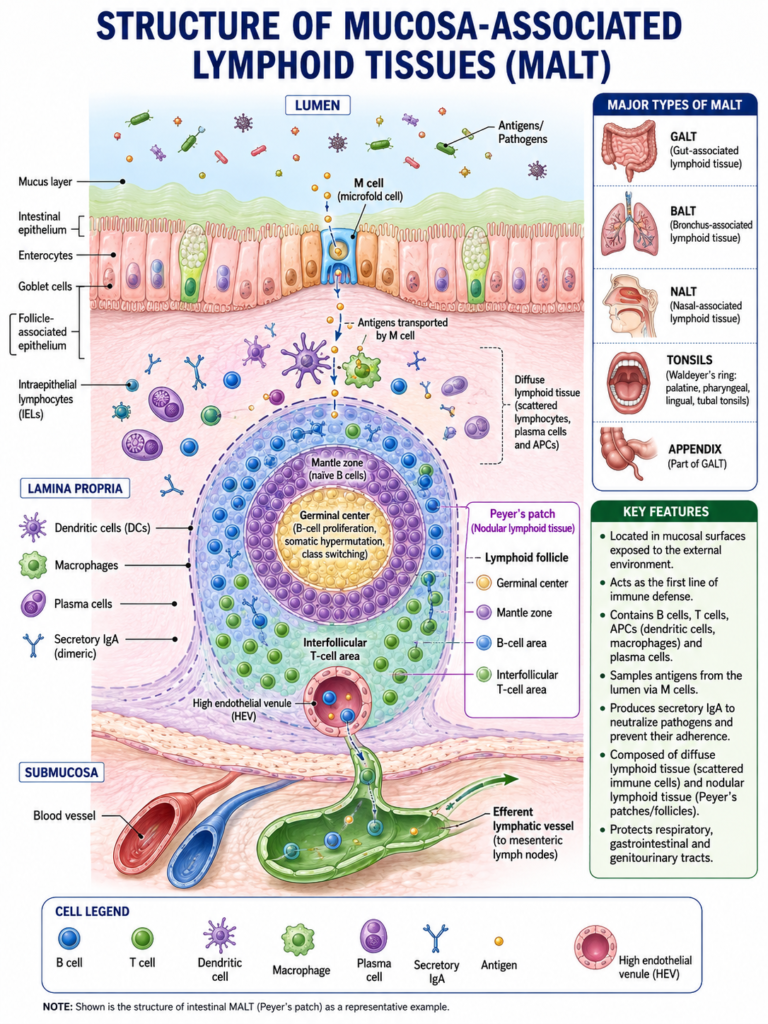
- Inductive sites are also called Organized MALT (O-MALT). These are organized lymphoid tissue masses. They are not surrounded by capsule. They are mainly used for antigen presentation and starting of adaptive immune response.
- O-MALT has definite histological regions. It contains B-cell follicles, germinal centres, T-cell interfollicular zones, subepithelial dome and follicle associated epithelium (FAE).
- The main cells present in O-MALT are naive B cells, helper T cells, dendritic cells and M cells. These cells take part in antigen recognition and activation of immune response.
- Examples of O-MALT are Peyer’s patches of small intestine, palatine tonsils and vermiform appendix. These are organized sites where antigen is first handled.
- The organized MALT does not have afferent lymphatic vessels. It means incoming lymphatic vessels are absent. But efferent lymphatic vessels are present, which carry activated lymphocytes to regional lymph node.
- Effector sites are also called Diffuse MALT (D-MALT). These are not arranged as clear follicle or mass. The cells are scattered in mucosal tissue.
- D-MALT is present in mucosal epithelium and subepithelial connective tissue. It is found in lamina propria and intraepithelial leukocyte (IEL) region.
- The main cells of D-MALT are IgA producing plasma cells, CD8+ intraepithelial lymphocytes, macrophages and mast cells. These cells perform final immune response at mucosal surface.
- M cells or microfold cells are special cells of MALT. These are present in follicle associated epithelium (FAE) over mucosal lymphoid follicles.
- The upper surface of M cells is different from normal epithelial cells. It has no well formed microvilli. It also has no mucus secretion and thick glycocalyx. It has short irregular microfolds.
- These microfolds contain adhesion receptors. They help to catch foreign antigen from gut lumen or airway lumen.
- The lower surface of M cells has deep pocket like structure. This is called basolateral pocket. It contains macrophages, dendritic cells and helper T lymphocytes.
- Due to this pocket structure, antigen can pass quickly from M cells to immune cells. So antigen processing becomes fast in mucosal lymphoid tissue.
Cellular Components of MALT
- T lymphocytes– These are important immune cells of MALT. It includes naive helper T cells, regulatory T cells (Tregs), CD8+ intraepithelial lymphocytes (IELs) and gamma delta (γδ) T cells. These cells control immune response, maintain tolerance and detect infected or injured cells in mucosal region.
- B lymphocytes– These are mainly present in organized inductive sites of MALT. They are present in lymphoid follicles like Peyer’s patches. They recognize antigen and prepare for immune response.
- Plasma cells– These are fully differentiated B cells. They are mainly present in effector sites of MALT. Most of them produce Immunoglobulin A (IgA), which neutralizes pathogens and prevent attachment of microbes with mucosal epithelium.
- M cells– These are also called microfold cells. These are special epithelial cells which do not have normal microvilli and thick mucus layer. They capture antigen and microbes from lumen and transport them to immune cells present below the epithelium.
- Dendritic cells– These are important antigen presenting cells (APCs). They are present below M cells and in mucosal tissue. They capture antigen, process it and present it to T lymphocytes for starting adaptive immune response.
- Macrophages– These are phagocytic cells of innate immunity. They are present in lamina propria and also in basolateral pocket of M cells. They engulf, process and destroy foreign particles and pathogens.
- Mast cells– These are effector cells present in diffuse mucosal tissue layer. They help in local inflammation and terminal immune response. They release chemical mediators during antigenic stimulation.
- Enterocytes– These are normal absorptive epithelial cells of mucosa. Their main function is absorption. But they also take part in immune function by releasing cytokines and chemokines during infection and attract other immune cells.
Mechanism of Mucosal Immune Response in MALT
- Antigen capture– The antigen first comes in contact with mucosal surface. M cells or microfold cells present in mucosal epithelium capture the antigen and pathogens from lumen. These cells transfer them to the lower region by vesicular transport process called transcytosis.
- Antigen presentation– The transported antigen is taken by dendritic cells and macrophages present below the M cells. These cells engulf and process the antigen. Then they present it to naive T lymphocytes in interfollicular region.
- T cell activation– After antigen presentation, T lymphocytes become activated. Some activated T cells are changed into T follicular helper cells (Tfh cells). These cells then move toward B cell rich germinal centres.
- B cell response– In germinal centre, Tfh cells help B lymphocytes. Here B cells undergo clonal expansion, somatic hypermutation and class switching. This process mainly leads to formation of Immunoglobulin A (IgA) producing cells.
- Lymphocyte homing– Activated lymphocytes leave the local mucosal tissue. They pass through lymphatic system and then enter into blood circulation. After this they return back to mucosal effector sites like lamina propria.
- Homing signals– This return of lymphocytes is controlled by chemokines and adhesion molecules. CCL25 and CCL28 attract the lymphocytes. α4β7 integrin present on lymphocytes binds with MAdCAM-1 present on mucosal blood vessels.
- Antibody production– In effector site, mature plasma cells produce polymeric antibodies. Mainly dimeric IgA and also pentameric IgM are formed. These antibodies are important for mucosal humoral defence.
- Antibody transport– The polymeric antibodies bind with polymeric immunoglobulin receptor (pIgR). This receptor is present on basolateral surface of epithelial cells. Then the antibody is transported across epithelial cell layer.
- Secretory antibody formation– On luminal surface, pIgR is cleaved. Then antibody is released as secretory IgA (sIgA) and secretory IgM. These secretory antibodies remain on mucosal surface.
- Pathogen neutralization– sIgA and secretory IgM trap the pathogens. They neutralize microbes and prevent their attachment with epithelial lining. They also help in removal of antigen-antibody complex into lumen.
- Immune tolerance– When harmless food protein or useful commensal bacteria are present, strong immune reaction is not produced. In absence of danger signal, antigen presenting cells do not give proper co-stimulation.
- Treg formation– This condition forms regulatory T cells (Tregs) like TH3 and TR1 cells. These cells secrete suppressive cytokines such as TGF-β and IL-10. They cause anergy or deletion of reactive cells and prevent harmful inflammation in mucosal tissue.
Antigen Processing and Presentation in MALT
- Antigen sampling– M cells or microfold cells are present in mucosal epithelium. These cells take foreign macromolecules and pathogens from gut lumen or airway lumen. The antigen is taken by endocytosis or phagocytosis.
- Initial processing– M cells can do some early processing of antigen. They contain Cathepsin E, which is a protease enzyme. It helps in breaking antigen partly during transport.
- Transcytosis– The captured antigen is transported across epithelial barrier. It moves in vesicles from apical surface of M cell to basolateral surface. This transport process is called transcytosis.
- Basolateral pocket– The lower surface of M cells has deep pocket like structure. This pocket contains immune cells like dendritic cells and macrophages. So antigen is quickly given to these cells.
- APC uptake– Dendritic cells and macrophages are professional antigen presenting cells (APCs). They engulf the antigen released by M cells. Then antigen is processed inside these cells.
- Dendritic cell migration– After antigen uptake, immature dendritic cells move from subepithelial dome. They migrate to interfollicular region, where many naive T lymphocytes are present.
- T cell presentation– Dendritic cells present processed antigen with MHC molecules. This antigen-MHC complex is recognized by naive T cells. Then T cells become activated and adaptive immune response is started.
- B cell presentation– Sometimes antigen-specific B cells present in subepithelial dome receive intact antigen directly from M cells. In this case dendritic cell may be bypassed. Then B cells migrate to germinal centre.
- Direct DC sampling– Some special dendritic cells like LysoDCs can directly sample antigen from lumen. They extend their dendrites through pores of M cells. They engulf antigen and then retract back for presentation.
- Immune response– After antigen presentation, activated T cells help other immune cells. B cells may form antibody producing plasma cells. In mucosal region this response mainly gives IgA mediated defence.
Clinical Significance of MALT
- MALT lymphoma– Chronic inflammation can change MALT into malignant lymphoid tumour. It is commonly seen in stomach due to Helicobacter pylori infection. H. pylori can inject CagA oncoprotein into B lymphocytes, which stop normal cell death and helps tumour growth. Early gastric MALT lymphoma may be treated by antibiotics against this bacteria.
- IBD– Dysregulation of Gut Associated Lymphoid Tissue (GALT) is important in Crohn’s disease and ulcerative colitis. Here mucosal immune balance is disturbed. If inflammation remains for long time, then chronic inflammation can increase risk of colorectal cancer.
- Celiac disease– In celiac disease, gluten derived peptides activate GALT in wrong way. This produces inflammatory reaction in intestine. It damages intestinal mucosa and disturb normal absorption.
- Pathogen entry– M cells are normally used for antigen sampling. But some pathogens use these cells as entry route. Shigella, Salmonella, Listeria, HIV and infectious prions can pass through M cells and cross mucosal barrier.
- Immunodeficiency– In Selective IgA Deficiency, Common Variable Immunodeficiency (CVID) and Hyper-IgM syndrome, production of secretory IgA (sIgA) becomes poor. Due to this mucosal defence become weak. Recurrent gastrointestinal and respiratory infections are common.
- Allergy and flora imbalance– Poor MALT function can also cause severe allergy and abnormal growth of gut microflora. Because mucosal surface cannot control antigen and microbes properly.
- Autoimmune disease– MALT may be related with some systemic autoimmune diseases. Uptake of Campylobacter jejuni by M cells can form autoantibodies against peripheral nerves and cause Guillain-Barré syndrome. Abnormal mucosal lymphocyte homing may also take part in multiple sclerosis (MS) and rheumatoid arthritis.
- Mucosal vaccine– MALT is an important target for oral and nasal vaccines. M cells can take vaccine antigen from mucosal surface and present it to immune cells. This helps in formation of local mucosal immunity and also systemic immune memory.
Disorders Associated with MALT
A. Malignancies and Cancers
- MALT lymphoma– It is a type of non-Hodgkin lymphoma. It occurs in mucosal tissues like stomach, ocular adnexa, salivary gland, lung and skin. It is mostly related with chronic inflammation, autoimmune disorder and infection by Helicobacter pylori or Chlamydia psittaci.
- Diffuse Large B-cell Lymphoma (DLBCL)– It is a high grade malignant lymphoma. It may arise from low grade gastric MALT lymphoma. The disease is more aggressive in nature.
- Gastric adenocarcinoma– It is a stomach cancer. It may develop due to chronic inflammation of gastric mucosa. Helicobacter pylori infection is one important cause.
- Colorectal cancer– It is related with chronic Inflammatory Bowel Disease (IBD). Long duration inflammation and abnormal intestinal immune cell activity helps in cancer formation.
- Pancreatic Ductal Adenocarcinoma (PDAC)– It is a highly aggressive cancer of pancreas. MALT related mechanism and gut homing T cells may affect its tumour microenvironment.
B. Inflammatory and Autoimmune Diseases
- Inflammatory Bowel Disease (IBD)– It includes Crohn’s disease and Ulcerative colitis. It is due to chronic immune reaction against intestinal microbiota. The mucosal barrier is also disturbed.
- Celiac disease– It is a disorder where GALT is wrongly activated by gluten derived peptides. It produces inflammatory reaction in intestine. The intestinal mucosa becomes damaged.
- Multiple Sclerosis (MS)– It is an autoimmune demyelinating disease of central nervous system. It is influenced by intestinal dysbiosis. Abnormal movement of mucosal lymphocytes to brain and spinal cord may occur.
- Rheumatoid Arthritis (RA)– It is a systemic autoimmune disease of joints. Gut microbiota dysbiosis is related with it. T follicular helper cells from Peyer’s patches may enter systemic circulation.
- Type 1 Diabetes Mellitus (T1D)– It is autoimmune destruction of pancreatic beta cells. Its development is affected by interaction between GALT and commensal microbiota.
- Guillain-Barré Syndrome (GBS)– It is acute autoimmune disease of peripheral nerves. It may occur when M cells take up Campylobacter jejuni. This may form cross reactive autoantibodies.
- Sjögren’s syndrome– It is an autoimmune disease of salivary gland. It has strong relation with development of MALT lymphoma.
- Hashimoto’s thyroiditis– It is an autoimmune disease of thyroid gland. It is also linked with MALT lymphoma in some cases.
- Primary Sclerosing Cholangitis (PSC)– It is an enterohepatic disease. Lymphocytes activated in inflamed gut may migrate to liver through mucosal homing receptors.
- Non-Alcoholic Steatohepatitis (NASH)– It is also an enterohepatic disease. Gut activated lymphocytes may take part in liver inflammation.
- Pancreatitis– It is inflammation of pancreas. In Crohn’s disease, autoantibodies against GP2 may be formed. GP2 is present in pancreatic secretion and also on mucosal M cells.
- Asthma– It is an inflammatory disease of airway. It is linked with dysfunction of respiratory MALT.
- Chronic rhinosinusitis– It is chronic inflammation of nasal and sinus mucosa. It is also related with abnormal function of respiratory mucosal lymphoid tissue.
C. Primary Immunodeficiencies
- Selective IgA deficiency– It is a disorder where mucosal IgA production becomes reduced. The mucosal barrier becomes weak. Recurrent gastrointestinal and respiratory infections are common.
- Common Variable Immunodeficiency (CVID)– It is a disorder of poor antibody formation. Mucosal immunity becomes defective. Repeated infection and abnormal expansion of commensal microflora may occur.
- Hyper-IgM syndrome– It is a disorder where class switching is defective. IgA production becomes poor. So mucosal defence is weak and infection occurs repeatedly.
D. Infectious Diseases and Pathogen Exploitation
- Peptic ulcer disease– It is painful sore in stomach lining. It is caused by excessive inflammatory response to Helicobacter pylori infection.
- Systemic bacterial infection– Some bacteria use M cells for crossing mucosal barrier. Salmonella, Shigella, Listeria and Yersinia can spread by this route.
- Systemic viral infection– Some viruses also exploit M cells. HIV and Poliovirus may use this pathway to bypass mucosal defence and spread systemically.
- Prion diseases– These are fatal neurodegenerative diseases. Infectious prions like PrPSc can use M cells as entry portal. It may reach systemic neural pathway.
- Clostridium difficile infection– It is a severe bacterial infection of intestine. It generally occurs after antibiotic use when normal flora is depleted. It causes bloody diarrhoea and mucosal injury.
Advantages of MALT
- First defence– MALT acts as first immune barrier of body. It protects the mucosal surfaces of respiratory tract, gastrointestinal tract and urogenital tract. These surfaces are thin and exposed to outside pathogen.
- Large immune tissue– MALT is the largest part of immune system. It contains about 50 to 80% of total white blood cells of body. So it gives strong local immune defence at mucosal region.
- Antigen detection– MALT can detect antigen very rapidly. M cells or microfold cells continuously sample the mucosal surface. They capture foreign antigen and transfer it to immune cells present below.
- Pathogen neutralization– MALT produces secretory Immunoglobulin A (sIgA). This antibody is released into mucosal lumen. It traps and neutralizes pathogen before it attach with epithelial lining.
- Toxin clearance– sIgA also helps to clear toxins from mucosal surface. It prevents toxins from entering deeper tissue. This gives local protection without much inflammation.
- Immune tolerance– MALT maintains tolerance against harmless antigen. Regulatory T cells suppress unnecessary immune reaction. This prevents harmful inflammation against food proteins.
- Normal flora support– MALT helps to maintain normal flora. These commensal bacteria live in mucosal region and help in nutrient synthesis. They also stop harmful microbes by competition.
- Recovery after illness– Some organized MALT structures like vermiform appendix keep useful bacteria as reservoir. After diarrhoeal disease, these bacteria help to recolonize the colon again.
- Immune memory– Lymphocytes activated in MALT can move through lymph and blood. Then they return to different mucosal sites. This helps in broad mucosal protection.
- Vaccine target– MALT is useful target for oral and nasal vaccines. Vaccine antigen can be taken by M cells and given to immune cells. It helps to form local immunity and systemic immune memory.
Limitations of MALT
- Pathogen exploitation– M cells have no thick mucus layer and normal microvilli. So these cells may act as weak entry site. Salmonella, Shigella, Yersinia, HIV, infectious prions and botulinum toxin can use M cell transcytosis to enter deeper tissue.
- M cell destruction– Some microbes can directly damage MALT structure. Salmonella species may target and destroy M cells. Due to this normal antigen processing becomes disturbed and bacteria get easy entry into subepithelial region.
- Age effect– The number and function of M cells decreases with age. So mucosal antigen sampling becomes weak. This may reduce mucosal immunosurveillance in old age.
- Chemotherapy effect– Chemotherapy can also reduce M cell population. It damages mucosal immune function. So mucosal defence becomes poor and infection risk becomes more.
- Autoimmune reaction– Sometimes antigen uptake by M cells may start wrong immune response. Uptake of Campylobacter jejuni may form autoantibodies related with Guillain-Barré syndrome. In Crohn’s disease, bacteria attached with GP2 protein may help in pancreatic autoantibody formation.
- Chronic inflammation– If M cell structure is damaged, foreign macromolecules may enter without control. This can increase inflammation in mucosal tissue. It may worsen diseases like Crohn’s disease.
- Inducible M cells– During severe inflammation, extra inducible M cells may appear in colon. These cells increase bacterial translocation. So inflammation may become more severe.
- MALT lymphoma– Continuous immune stimulation in MALT may cause clonal growth of B cells. This can form MALT lymphoma. It is one important limitation of long active mucosal lymphoid tissue.
- Helicobacter pylori effect– Helicobacter pylori may inject CagA oncoprotein into MALT B lymphocytes. It disturb cell signalling and prevent normal cell death or apoptosis. This helps in tumour growth in gastric MALT.
References
- Bailu, D. (2024). Insights into the function of mucosal associated lymphoid tissues (MALT) in immune surveillance. Journal of Mucosal Immunology Research, 8(4), 253.
- Cleveland Clinic. (2025). Mucosa-associated lymphoid tissue (MALT).
- Davis, H. (2025). Exploring GALT. Today’s Dietitian Magazine.
- Du, M.-Q. (2017). MALT lymphoma: Genetic abnormalities, immunological stimulation and molecular mechanism. Best Practice & Research Clinical Haematology, 30, 13–23. https://doi.org/10.1016/j.beha.2016.09.002
- Effects of Helicobacter pylori CagA protein on the growth and survival of B lymphocytes, the origin of MALT lymphoma. (n.d.). PubMed.
- Elmore, S. A. (2006). Enhanced histopathology of mucosa-associated lymphoid tissue. Toxicologic Pathology, 34(5), 687–696.
- Faculty of Biological Sciences, University of Leeds. (n.d.). Mucosa associated lymphoid tissue and Peyer’s patches. The Histology Guide.
- Fu, H., Jangani, M., Parmar, A., Wang, G., Coe, D., Spear, S., Sandrock, I., Capasso, M., Coles, M., Cornish, G., Helmby, H., & Marelli-Berg, F. M. (2019). A subset of CCL25-induced gut-homing T cells affects intestinal immunity to infection and cancer. Frontiers in Immunology, 10, 271. https://doi.org/10.3389/fimmu.2019.00271
- Gastric MALT lymphoma refractory to Helicobacter pylori antibiotic therapy. (n.d.). PubMed Central (PMC).
- Helicobacter pylori cagA status and gastric mucosa-associated lymphoid tissue lymphoma: A systematic review and meta-analysis. (n.d.). PubMed Central (PMC).
- Immunoglobulin responses at the mucosal interface. (n.d.). PubMed Central (PMC).
- Janeway, C. A., Jr., Travers, P., Walport, M., & Shlomchik, M. J. (2001). The mucosal immune system. In Immunobiology: The immune system in health and disease (5th ed.). Garland Science.
- Kemp, H. (n.d.). Mucosa associated lymphoid tissues | MALT definition & functions. Study.com.
- Kobayashi, N., Takahashi, D., Takano, S., Kimura, S., & Hase, K. (2019). The roles of Peyer’s patches and microfold cells in the gut immune system: Relevance to autoimmune diseases. Frontiers in Immunology, 10, 2345. https://doi.org/10.3389/fimmu.2019.02345
- Kuhbandner, K., Hammer, A., Haase, S., Terbrack, E., Hoffmann, A., Schippers, A., Wagner, N., Hussain, R. Z., Miller-Little, W. A., Koh, A. Y., Stoolman, J. S., Segal, B. M., Linker, R. A., & Stüve, O. (2019). MAdCAM-1-mediated intestinal lymphocyte homing is critical for the development of active experimental autoimmune encephalomyelitis. Frontiers in Immunology, 10, 903. https://doi.org/10.3389/fimmu.2019.00903
- Kuo, S.-H., & Cheng, A.-L. (2013). Helicobacter pylori and mucosa-associated lymphoid tissue: What’s new. Hematology Am Soc Hematol Educ Program, 2013, 109–117. https://doi.org/10.1182/asheducation-2013.1.109
- Lin, W.-C., Tsai, H.-F., Kuo, S.-H., Wu, M.-S., Lin, C.-W., Hsu, P.-I., Cheng, A.-L., & Hsu, P.-N. (2010). Translocation of Helicobacter pylori CagA into human B lymphocytes, the origin of mucosa-associated lymphoid tissue lymphoma. Cancer Research, 70(14), 5740–5748. https://doi.org/10.1158/0008-5472.CAN-09-4690
- Lin, W.-C., Tsai, H.-F., Kuo, S.-H., Wu, M.-S., Lin, C.-W., Hsu, P.-I., Cheng, A.-L., & Hsu, P.-N. (2010). Translocation of Helicobacter pylori CagA into human B lymphocytes, the origin of mucosa-associated lymphoid tissue lymphoma. PubMed.
- MBBS NAIJA. (n.d.). Mucosa associated lymphatic tissue (MALT) histology [Video]. YouTube.
- Microfold cell. (2025). In Wikipedia. https://en.wikipedia.org/wiki/Microfold_cell
- Miles, A., Liaskou, E., Eksteen, B., Lalor, P. F., & Adams, D. H. (2008). CCL25 and CCL28 promote alpha4 beta7-integrin-dependent adhesion of lymphocytes to MAdCAM-1 under shear flow. American Journal of Physiology-Gastrointestinal and Liver Physiology, 294(5), G1257–G1267. https://doi.org/10.1152/ajpgi.00266.2007
- Mucosa-associated lymphoid tissue. (2025). In Wikipedia. https://en.wikipedia.org/wiki/Mucosa-associated_lymphoid_tissue
- Mucosa-associated lymphoid tissues (MALT): Structural architecture, immunological mechanics, and clinical oncology. (n.d.).
- Normal structure, function, and histology of mucosa-associated lymphoid tissue. (n.d.). PubMed.
- OpenStax. (n.d.). Mucosal surfaces and immune tolerance. In Biology for Majors II. Lumen Learning.
- Polymeric immunoglobulin receptor. (2026). In Wikipedia. https://en.wikipedia.org/wiki/Polymeric_immunoglobulin_receptor
- Role of polymeric immunoglobulin receptor in IgA and IgM transcytosis. (n.d.). PubMed Central (PMC).
- Role of β7 integrins in intestinal lymphocyte homing and retention. (n.d.). PubMed Central (PMC).
- Sauls, R. S., & Taylor, B. N. (2022). Histology, M cell. In StatPearls. StatPearls Publishing.
- Sheng, X., Qian, X., Tang, X., Xing, J., & Zhan, W. (2018). Polymeric immunoglobulin receptor mediates immune excretion of mucosal IgM–antigen complexes across intestinal epithelium in flounder (Paralichthys olivaceus). Frontiers in Immunology, 9, 1562. https://doi.org/10.3389/fimmu.2018.01562
- Suzuki, H., Saito, Y., & Hibi, T. (2009). Helicobacter pylori and gastric mucosa-associated lymphoid tissue (MALT) lymphoma: Updated review of clinical outcomes and the molecular pathogenesis. Gut and Liver, 3(2), 81–87. https://doi.org/10.5009/gnl.2009.3.2.81
- Targeting mucosal sites by polymeric immunoglobulin receptor-directed peptides. (n.d.). PubMed Central (PMC).
- The role and application of MAdCAM-1/α4β7-induced lymphocyte migration in inflammatory enterohepatic diseases. (n.d.). PubMed Central (PMC).