

Homogenizer is a mechanical device used to make a uniform and stable mixture of two substances which normally do not mix well. It is used in food, dairy, pharmaceutical and cosmetic industries.
It forces a liquid or semi-fluid product through a narrow gap called homogenizing valve under very high pressure. In this process, the liquid moves with high speed and large particles or droplets are broken into very small particles.
The breaking of particles occurs due to shear force, turbulence and cavitation. The small particles are then spread uniformly in the whole liquid. It prevents separation of particles and improves texture, appearance, shelf life and stability of the product.

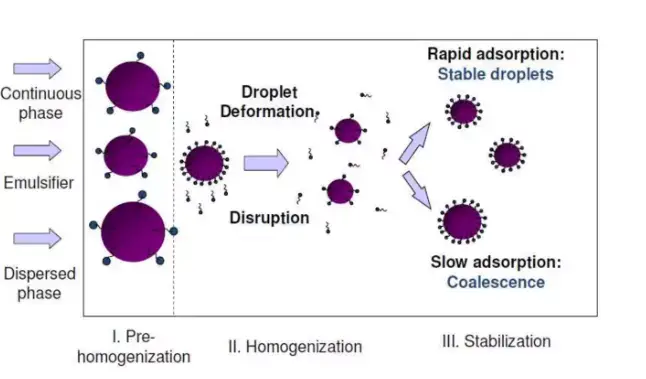
What is High Pressure Homogenizer?
High Pressure Homogenizer is a specialized mechanical device used to reduce the size of solid particles or liquid droplets present in a fluid. It is used to make a uniform and stable mixture, emulsion or dispersion.
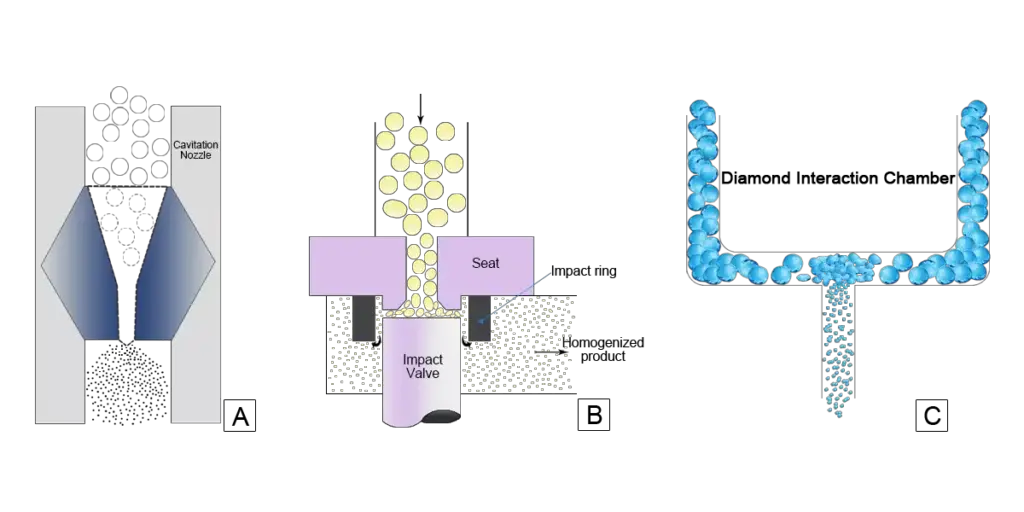
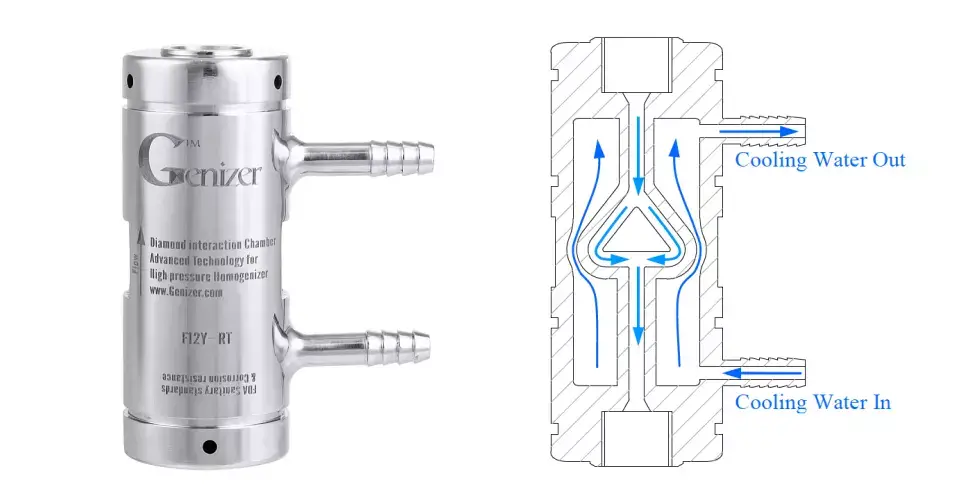
It works by using a high-pressure pump. The liquid mixture is forced through a very narrow gap, which is called homogenizing valve or interaction chamber. The pressure may range from 500 to 60,000 psi.
During this process, the fluid passes through the narrow opening with very high speed. The fluid is affected by high shear stress, turbulence, impact collision and cavitation. These forces break the large particles, fat globules or biological cell wall into micron or nanometer size.
The small particles are then distributed uniformly in the whole fluid. This prevents clumping and separation of particles. It improves texture, stability, shelf life and also increases the nutritional bioavailability of the product.
It is used in dairy industry, food industry, cosmetic industry, biotechnology and pharmaceutical industry. It is used for stabilizing dairy products, making smooth creams, extracting proteins and preparing nanoemulsions for drug delivery.
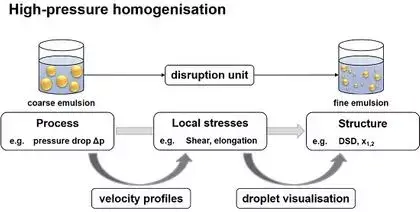
Working principle of high pressure homogenizer
Working Principle of High Pressure Homogenizer is based on the conversion of hydraulic pressure into high kinetic and mechanical energy. This energy is used to break large particles, droplets or cells into very small size.
In this process, the liquid product is first taken by a strong positive-displacement pump. Then the liquid is pressurized at very high pressure, usually from several thousand psi up to 60,000 psi.
The pressurized liquid is forced to pass through a very narrow gap present in the homogenizing valve. When the liquid enters this narrow opening, its pressure suddenly decreases and velocity increases very rapidly.
Due to this rapid movement, the liquid is affected by shear force, cavitation, turbulence and impact force. Shear force tears the particles when liquid layers move with different speed. Cavitation forms small vapour bubbles and these bubbles collapse strongly, producing shock waves.
At the same time, turbulence creates irregular movement of liquid and impact force occurs when particles strike with valve surface and other particles. These forces together break the large particles, fat droplets or biological cells into sub-micron or nanoscale size.
After passing through the valve, the product becomes smooth and uniform dispersion or emulsion. It resists separation for long time. In some homogenizer, the liquid is again passed through second valve at lower pressure to break the particle clusters and to maintain proper back pressure.
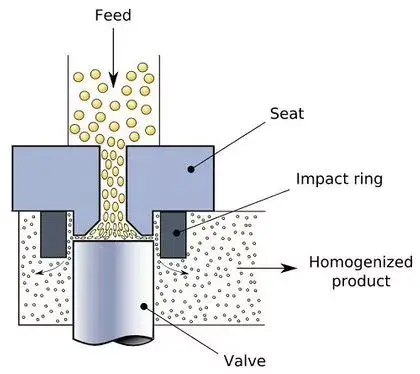
Homogenization Mechanism
The following are the important mechanism involved in homogenization–
- Shearing – In this mechanism, the fluid is forced through a narrow homogenizing valve. Different layers of fluid move with different speed and produces strong pulling or tearing force. This force breaks large particles or droplets into small size.
- Cavitation – During homogenization, the fluid moves with very high speed and pressure is suddenly decreased. Due to this, small vapour bubbles are formed. When pressure increases again, these bubbles collapse strongly and produce shock waves and microjets, which breaks particles, droplets or cell wall.
- Turbulence – In this process, high velocity fluid shows irregular and chaotic movement. This produces small eddies in the fluid. These eddies pull, stretch and break the droplets into smaller droplets.
- Impact – In this mechanism, particles move with high speed and collide with metal surface of the homogenizer or with each other. Due to this high energy collision, solid particles and agglomerates are broken into small size.
Working of High Pressure Homogenizer
The following are the operating procedure of High Pressure Homogenizer–
- The pressure control must be kept idle and the handles of homogenizing valves are released. The water supply is turned on for lubrication and cooling of pump pistons.
- The feed material should be present in proper amount, so that the homogenizer does not run dry. The feed should be a good premix and should not contain large particles or air bubbles.
- The motor is turned on and the machine is allowed to run with water for about 5 minutes. Then the machine is stopped and water is drained by loosening and tightening the inlet union.
- The instrument is checked for any leakage. If leakage is absent, the sample is supplied into the homogenizer by adjusting the 3-way valve properly.
- The pressure is increased slowly. In two-stage homogenizer, the pressure of second-stage valve is adjusted first for back pressure and then the first-stage valve is adjusted to the required pressure.
- The product discharge is first redirected until the required homogenizing pressure is obtained. After normal pressure is reached, the bypass valve is turned and product flow is sent into the main processing system.
- The 3-way valve on the product delivery line should not be closed when the machine is running. It may damage the homogenizer.
- After the processing is completed, the product flow is diverted. Water is immediately poured into the hopper to flush the system.
- The pressure from both first-stage and second-stage valves are fully released. Then the machine is switched to cleaning sequence for proper cleaning and sanitization.
- After the cleaning cycle is completed, the High Pressure Homogenizer is turned off.
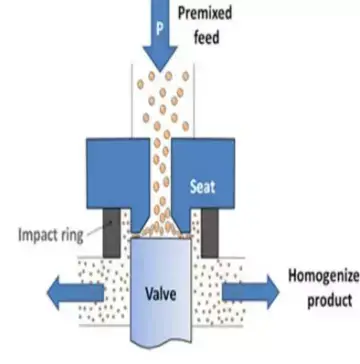
Types of High Pressure Homogenizer
The following are the types of High Pressure Homogenizer–

- Electric High Pressure Homogenizer – It is operated by using electric motor. It is the most common type of high pressure homogenizer. It may be of direct-drive type or intensifier type.
- Hand-driven High Pressure Homogenizer – It is operated manually by hand. It is also called handgenizer. It is used for small laboratory work where very small amount of sample is required.
- Air-driven High Pressure Homogenizer – It uses compressed gas such as nitrogen to produce hydraulic pressure. It is compact in size but consumes more gas and produces lower homogenizing pressure.
- Direct-drive Homogenizer – In this type, electric motor drives a crankshaft through gearbox. The crankshaft moves the plungers back and forth and directly pressurizes the sample. It gives high flow rate and constant pressure.
- Intensifier Homogenizer – In this type, motor drives a hydraulic oil pump. The large piston moves a small high-pressure plunger and increases the pressure. It gives very high pressure up to 60,000 psi but flow rate is lower.
- Single-stage Homogenizer – It contains only one homogenizing valve. It is used for normal emulsification where clumping of particles is not a major problem. It is also used for products having low fat content.
- Two-stage Homogenizer – It contains two valve assembly. The second valve gives back pressure and breaks the droplet clusters formed after first stage. It gives more uniform and stable mixture.
- Laboratory Scale Homogenizer – It is used in research and development work. It is used for small scale cell lysis and small sample processing. It usually processes about 1 mL to 400 mL per minute.
- Pilot Plant Scale Homogenizer – It is used for process optimization and scale-up trial. It usually handles about 22 to 360 litres per hour.
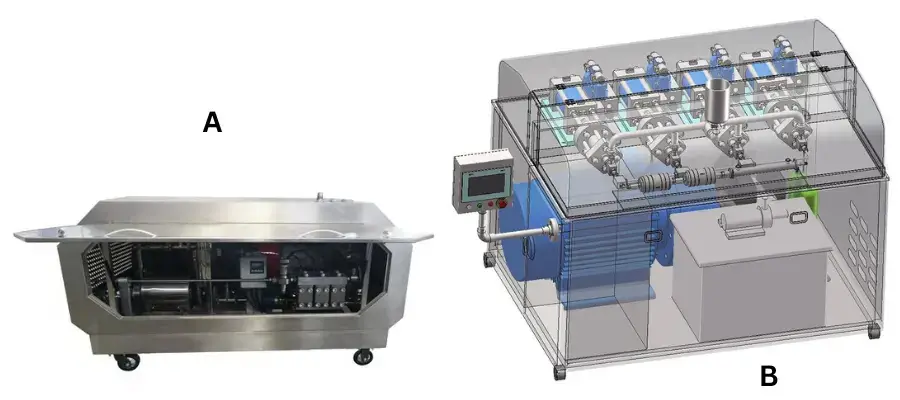
- Industrial Scale Homogenizer – It is used for continuous and large scale production. It is used in dairy, beverage and special chemical industries. It can process about 1,000 to 63,600 litres per hour.
Parts of High Pressure Homogenizer
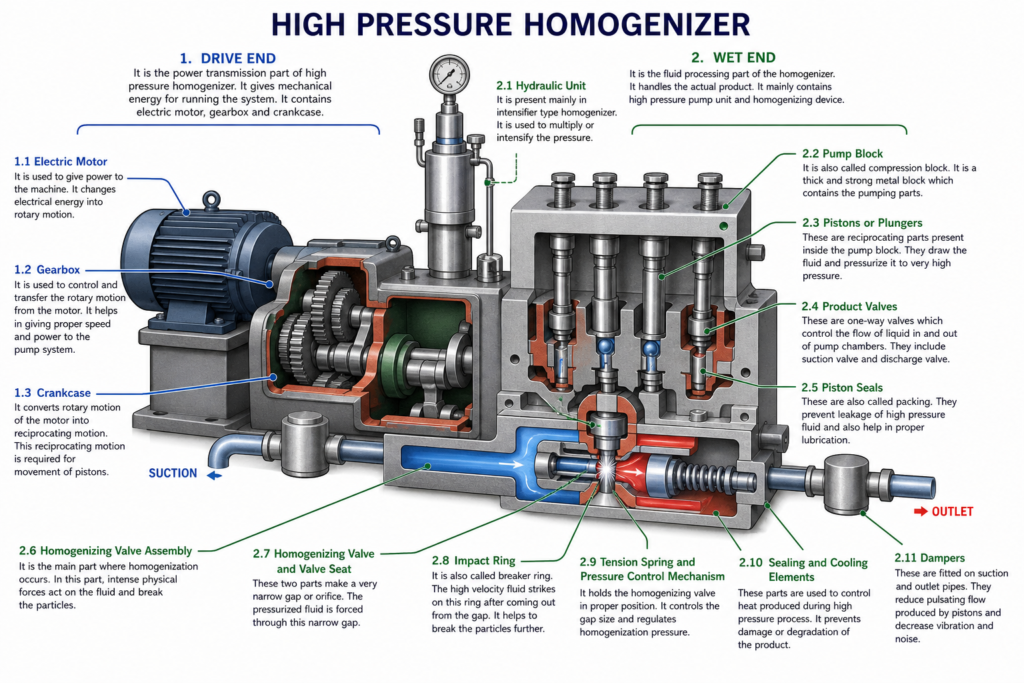
The following are the important parts of High Pressure Homogenizer–
- Drive End – It is the power transmission part of high pressure homogenizer. It gives mechanical energy for running the system. It contains electric motor, gearbox and crankcase.
- Electric Motor – It is used to give power to the machine. It changes electrical energy into rotary motion.
- Gearbox – It is used to control and transfer the rotary motion from the motor. It helps in giving proper speed and power to the pump system.
- Crankcase – It converts rotary motion of the motor into reciprocating motion. This reciprocating motion is required for movement of pistons.
- Hydraulic Unit – It is present mainly in intensifier type homogenizer. It is used to multiply or intensify the pressure.
- Wet End – It is the fluid processing part of the homogenizer. It handles the actual product. It mainly contains high pressure pump unit and homogenizing device.
- Pump Block – It is also called compression block. It is a thick and strong metal block which contains the pumping parts.
- Pistons or Plungers – These are reciprocating parts present inside the pump block. They draw the fluid and pressurize it to very high pressure.
- Product Valves – These are one-way valves which control the flow of liquid in and out of pump chambers. They include suction valve and discharge valve.
- Piston Seals – These are also called packing. They prevent leakage of high pressure fluid and also help in proper lubrication.
- Homogenizing Valve Assembly – It is the main part where homogenization occurs. In this part, intense physical forces act on the fluid and break the particles.
- Homogenizing Valve and Valve Seat – These two parts make a very narrow gap or orifice. The pressurized fluid is forced through this narrow gap.
- Impact Ring – It is also called breaker ring. The high velocity fluid strikes on this ring after coming out from the gap. It helps to break the particles further.
- Tension Spring and Pressure Control Mechanism – It holds the homogenizing valve in proper position. It controls the gap size and regulates homogenization pressure.
- Sealing and Cooling Elements – These parts are used to control heat produced during high pressure process. It prevents damage or degradation of the product.
- Dampers – These are fitted on suction and outlet pipes. They reduce pulsating flow produced by pistons and decrease vibration and noise.
Applications of High a Pressure Homogenizer
The following are the applications of High Pressure Homogenizer–
- It is used in food and beverage industry for preventing cream separation in milk. It is also used to improve the texture of ice cream, yogurt and other dairy products.
- It is used to stabilize emulsions in sauces, mayonnaise, salad dressing and peanut butter.
- It is used in the preparation of plant-based milk, fruit juice, baby food and functional beverages.
- It is used in pharmaceutical industry for preparing stable nanoemulsions, liposomes and nanoparticle drug carriers.
- It helps to improve the bioavailability and targeted delivery of active pharmaceutical ingredients.
- It is used for the formulation of antibiotics, intravenous emulsions and ointments.
- It is used in biotechnology for cell disruption. It breaks the tough cell wall of bacteria, yeast, algae and mammalian cells.
- It is used for extraction of intracellular materials like proteins, enzymes, RNA, DNA and vaccine antigens.
- It is used in cosmetics and personal care industry for making stable and smooth creams, lotions, hair conditioners and lipsticks.
- It is used in nanocosmetics for uniform distribution of nano-sized UV blocking agents in sunscreens.
- It is used in chemical industry for processing specialty chemicals, paints, lubricants and battery slurries.
- It is used in nanotechnology for liquid phase exfoliation and dispersion of graphene, carbon nanotubes and nano-oxides such as zinc oxide.
Advantages of High a Pressure Homogenizer
The following are the advantages of High Pressure Homogenizer–
- It improves the stability of emulsion and dispersion. It prevents separation, clumping and settling of particles for long time.
- It increases the shelf life of the product. The product remains uniform and stable during storage.
- It breaks particles and droplets into very small size. The particle size becomes uniform in micro or nano scale.
- It gives same type of result in different batches. So the process is more reliable.
- It improves texture, appearance and flavour of the product. It gives smooth texture and better mouthfeel.
- In milk, it prevents cream separation and makes the milk look more uniform and brighter.
- It increases bioavailability of active ingredients. Small particle size helps in better absorption of drugs and nutrients by the body.
- It is used for efficient cell disruption. It breaks the cell wall of microbes, yeast and plant cells and helps to extract proteins, DNA and enzymes.
- It can reduce microbial contamination. The strong mechanical forces may destroy vegetative bacteria and pathogens.
- It can be used from laboratory scale to industrial scale. The same processing condition can be maintained during scale up.
- It reduces the need of synthetic emulsifiers and chemical stabilizers. The mixture becomes stable by the homogenization process itself.
- It is versatile in use. It can process different materials and also many viscous liquids used in food, cosmetic, biotechnology and chemical industries.
Limitations of High a Pressure Homogenizer
The following are the limitations of High Pressure Homogenizer–
- High Pressure Homogenizer is costly instrument. The initial cost is high and so it is difficult to use in small and medium scale industry.
- It requires high amount of energy during working. This increases the operational cost of the process.
- It requires proper cleaning after every use. The cleaning process is time taking and must be done carefully.
- It requires regular maintenance. Skilled person is needed for operation, handling and solving the mechanical problem.
- The homogenizing valve and valve seat are damaged slowly due to strong turbulence and cavitation. These parts require frequent replacement.
- During homogenization, large amount of heat is produced. This heat may denature proteins, enzymes and other temperature sensitive compounds.
- Cooling system is often required to control the temperature. This makes the instrument more complex and costly.
- It is not suitable for large solid particles, solid food and highly viscous material. These materials may block the narrow gap of homogenizing valve.
- The high pressure and strong shear force may destroy shear sensitive compounds present in the sample.
- Industrial High Pressure Homogenizer is large and heavy. It requires more space for installation.
- The machine should not be run dry. The liquid product is required for cooling and lubrication of high-pressure seals.
- Air bubbles should not be present in the feed material. It may cause strong cavitation damage inside the machine.
- In milk processing, homogenization may increase sensitivity of milk to light and may produce rancid flavour. It also forms softer curd and creates problem in hard cheese preparation.
- It is not suitable for raw milk because rapid flavour deterioration may occur due to lipase activity.
- The process may increase the surface area of particles. This may increase the chance of microbial contamination.
References
- Kleinig, A. R., & Middelberg, A. P. J. (1998). Microbial cell disruption by high-pressure homogenization. ResearchGate.
- 3-A Sanitary Standards, Inc. (2005). 3-A accepted practices for the sanitary construction, installation, testing and operation of high-temperature short-time and higher-heat shorter-time pasteurizer systems.
- SPX FLOW. (2016). APV Rannie and Gaulin homogenizers. Integral Process Equipment.
- Patrignani, F., & Lanciotti, R. (2016). Applications of high and ultra high pressure homogenization for food safety. Frontiers in Microbiology, 7, 1132. PMC.
- Ayling, B. (2025). BEE high pressure homogenizer exfoliate graphite to graphene. Pion Inc.
- Cavitation. (n.d.). MIT.
- Cavitation. (n.d.). The Engineering ToolBox.
- Cavitation. (n.d.). Wikipedia.
- Certifications. (n.d.). FBF North America.
- Combating cavitative corrosion and erosive corrosion. (n.d.). Corrosionpedia.
- Creating stable dispersions with homogenizers. (n.d.). Pion Inc.
- Degradation and protection of materials from cavitation erosion: A review. (n.d.). PMC.
- E. coli cell disruption by high-pressure homogenization. (n.d.). Genizer.
- Morata, A., del Fresno, J. M., Gavahian, M., Guamis, B., Palomero, F., & López, C. (2023). Effect of HHP and UHPH high-pressure techniques on the extraction and stability of grape and other fruit anthocyanins. Antioxidants, 12(9), 1746. MDPI.
- Katsimichas, A., Katsouli, M., Spantidos, N., Giannakourou, M. C., & Taoukis, P. (2025). Effect of high-pressure homogenization on the functional and emulsifying properties of proteins recovered from Auxenochlorella pyrenoidosa. Applied Sciences, 15(1), 131. MDPI.
- Environmental sustainability of ultra high pressure homogenization application for liquid foods (milk case study). (n.d.). ResearchGate.
- FDA pumps, valves, mixers, homogenizers, heat exchangers and spare parts. (n.d.). AxFlow.
- GEA Mechanical Equipment Italia S.p.A. (2018). GEA homogenizing valves. EFPS.
- Graphene exfoliation and dispersion using high pressure homogenizers. (n.d.). Genizer.
- High homogenization pressures to improve food quality, functionality and sustainability. (n.d.).
- High pressure homogenizer applications in pharma, biotech and nanoemulsion production. (n.d.).
- High pressure homogenizer: Working principle, types, and applications. (n.d.).
- IndexBox. (2026). High pressure homogenizers market fueled by nanotechnology in cosmetics through 2035. News and Statistics.
- High-pressure homogenization: A comprehensive technical analysis of principles, engineering systems, and industrial applications. (n.d.).
- High-pressure homogenizer applications in pharmaceutical industry. (n.d.). Duoning Biotech.
- High-pressure homogenizer: Working principle and operation. (2026). Hommak.
- High-shear mixer vs. homogenizer: Which should you use? (n.d.). Hockmeyer.
- Homogenization of milk and milk products. (n.d.). Dairy Science and Technology eBook – University of Guelph Open Books.
- Homogenization of food products. (2025). FoodTechProcess.
- Kashyap, S. (n.d.). Homogenization: Meaning, process, and advantages. Neologic Engineers.
- Homogenizer applications. (2023). Hommak USA.
- Homogenizer theory and basics. (n.d.). SPX Flow.
- Homogenizer working principle in industrial processing. (n.d.).
- Karki, P. (n.d.). Homogenizer- Principle, procedure, parts, types, uses, examples. Microbe Notes.
- Homogenizer: What it is and how it works. (n.d.). BaiLun Biotechnology Co., Ltd.
- Tetra Pak. (2022). Homogenizers and high-pressure pumps.
- Homogenizers. (n.d.). Dairy Processing Handbook – Tetra Pak.
- Homogenizing NanoVALVE®. (n.d.). GEA.
- Homogenizing valves. (n.d.). GEA.
- Homogenizing standard valve. (n.d.). GEA.
- How pressure affects homogenization efficiency and particle size reduction? (n.d.). Drawell.
- How does a homogenizer improve the stability of products? (n.d.). Scientz Biotechnology Blog.
- Kouzegaran, V. J. (2020). How to perform dry and liquid-phase exfoliation of graphene. Nanografi Advanced Materials.
- The Graphene Council. (2020). How to perform liquid-phase exfoliation on graphene. AZoNano.
- How to prevent cavitation damage in high-pressure ball valves. (n.d.).
- Influence of cavitation and high shear stress on HSA aggregation behavior. (n.d.). PMC – NIH.
- Key factors influencing milk homogenization efficiency. (2025). Agriculture Institute.
- Micro-gap. (n.d.). SPX Flow.
- APV/SPX Corporation. (2009). Micro-Gap®.
- Middelberg, A. P. J. (n.d.). Microbial cell disruption by high-pressure homogenization.
- Microfluidizer high shear fluid processors vs homogenizers. (2026). IDEX.
- Microfluidizer® high shear homogenizer technology. (2026). IDEX.
- Milk fat globule structure & function; nanoscience comes to milk production. (n.d.). PMC.
- Milk homogenization. (n.d.). HORIBA.
- Operation and benefits. (n.d.). E.W. Process.
- Preparation of VC nanoliposomes by high pressure homogenization: Process optimization and evaluation of efficacy, transdermal absorption, and stability. (n.d.). PMC.
- Zhang, K., Tang, J., Yuan, J., Li, J., Sun, Y., Matsuba, Y., Zhu, D.-M., & Qin, L.-C. (2018). Production of few-layer graphene via enhanced high-pressure shear exfoliation in liquid for supercapacitor applications. ACS Applied Nano Materials, 1(6), 2877-2884.
- Sonication vs high pressure homogenizers – comparison. (n.d.). Homogenising Systems.
- Standards. (n.d.). 3-A Sanitary Standards, Inc.
- Techniques for formulation of nanoemulsion drug delivery system: A review. (n.d.). PMC.
- Kumar, M., Bishnoi, R. S., Shukla, A. K., & Jain, C. P. (2019). Techniques for formulation of nanoemulsion drug delivery system: A review. Preventive Nutrition and Food Science, 24(3), 225-234.
- The basics of a waterjet pump. (n.d.). Flow International Corporation.
- The effect of high-pressure homogenization conditions on the physicochemical properties and stability of designed fluconazole-loaded ocular nanoemulsions. (n.d.). PMC.
- The forces involved in homogenization explained. (n.d.). Laboratory Supply Network Blog.
- Guanyinuo. (2026). The ultimate 2026 guide to FDA and 3-A compliance for sanitary food heat exchanger systems. Grano Heat Energy Technology Co., Ltd.
- Genizer LLC. (2026). Types of homogenizers explained. AZoM.
- APV Gaulin Inc. (1988). High pressure homogenizer pump (U.S. Patent No. 4,773,833). U.S. Patent and Trademark Office. Google Patents.
- Understanding waterjet pump technology. (n.d.). Canadian Metalworking.
- Waterjet – intensifier vs direct drive which is better? (n.d.).
- What you need to know about cavitation erosion. (n.d.). A&A Thermal Spray Coatings.
- What are the differences between a homogenizer and a microfluidizer? (n.d.). Holland Applied Technologies.
- What is a high pressure homogenizer and how does it work? (n.d.).
- Why choose high-pressure homogenization for efficient extraction of intracellular compounds from microbial cells. (n.d.). Duoning Biotech.
- Details-count. (n.d.). GEA.
- 多宁生物 [Duoning Biotech]. (n.d.).