

Ultrasonic Homogenizer is a scientific device used to disrupt, mix and homogenize liquid materials. It is also called sonicator or ultrasonic processor. It is used to make uniform dispersion and emulsion in liquid sample.
It mainly consists of three parts, such as generator, piezoelectric transducer and metal probe. The metal probe is also called horn or sonotrode. The generator converts electrical power into high frequency signal, usually about 20 kHz.
The transducer changes this high frequency signal into rapid mechanical vibration. These vibrations are passed through the probe into the liquid sample. The tip of the probe expands and contracts very fast and produces pressure changes in the liquid.
The working of ultrasonic homogenizer is based on acoustic cavitation. During low pressure phase, small vacuum bubbles are formed in the liquid. During high pressure phase, these bubbles collapse strongly and releases high energy, shock waves and liquid microjets.
These forces produce strong shear force and break the surrounding particles, droplets or cell membrane. It is used for cell lysis, extraction of intracellular components, dispersion of nanoparticles and formation of stable emulsions. It is widely used in biotechnology, pharmaceutical, food processing, cosmetic and nanotechnology fields.
Principle of Ultrasonic Homogenizers
Principle of Ultrasonic Homogenizer is based on the principle of acoustic cavitation. In this process, ultrasonic sound waves are used to break particles, droplets or cells and make a uniform mixture.
The ultrasonic generator converts normal AC electrical power into high frequency electrical signal. This signal is usually about 20 kHz. The signal is then passed to the piezoelectric transducer.
The piezoelectric transducer converts electrical energy into rapid mechanical vibration. These vibrations are increased and passed through the metal probe or horn. The tip of the probe expands and contracts very rapidly inside the liquid sample.
Due to this vibration, alternate high pressure and low pressure cycles are produced in the liquid. During low pressure phase, very small vacuum bubbles are formed. These bubbles grow during repeated sound cycles.
When the bubbles become unstable, they collapse strongly during high pressure phase. This formation and collapse of bubbles is called cavitation.
The collapse of bubbles releases high localized energy. It produces high temperature, high pressure, shock waves and liquid microjets. These forces produce strong shear force and turbulence.
The combined action of cavitation, shear force, shock waves and turbulence breaks cells, solid particles and droplets into smaller size. Finally, a uniform and stable liquid mixture is formed.
Parts of Ultrasonic Homogenizers
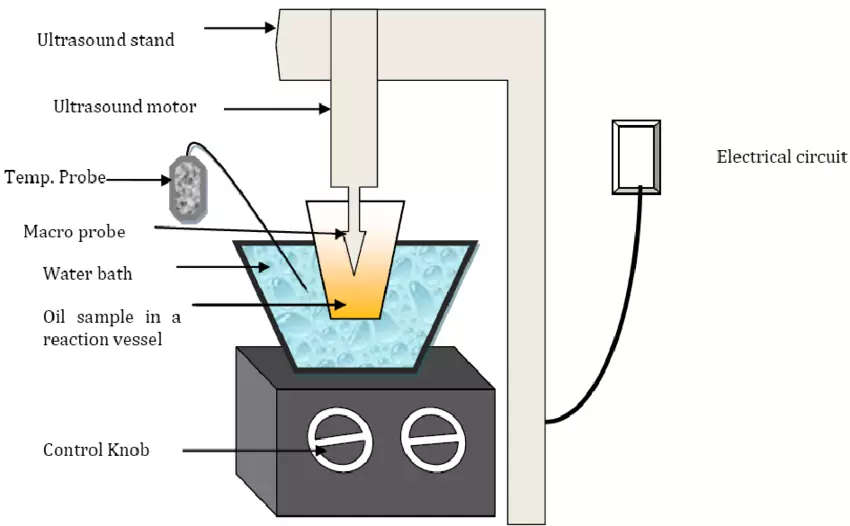
The following are the important parts of Ultrasonic Homogenizer–
- Generator – It is the power supply unit of ultrasonic homogenizer. It converts normal electrical power into high frequency electrical signal.
- Transducer – It is also called converter. It contains piezoelectric crystals or ceramics. It receives the electrical signal from generator and changes it into mechanical vibrations.
- Probe – It is also called horn, sonotrode or tool head. It is generally made up of titanium. It is attached with the transducer and dipped into the liquid sample.
- Reactor Vessel – It is the sample container used to keep the liquid sample during sonication. It may be a cup, beaker or special flow cell.
- Sound Enclosure – It is also called acoustic enclosure. It is a sound reducing box which reduces the loud and high pitched noise produced during sonication.
- Support Stand – It is used to hold the converter and probe in proper position. It has heavy base and rod system for stable holding.
- Connecting Cables – These cables connect the generator with transducer and main power supply. They help in transfer of electrical signal to the system.
Types of Ultrasonic Homogenizers
The following are the types of Ultrasonic Homogenizer–
- Probe-type Sonicator – It is also called direct sonicator. It contains a metal probe or horn which is directly inserted into the liquid sample. It gives highly focused and high intensity ultrasonic energy.
- Bath-type Sonicator – It is also called indirect sonicator or ultrasonic bath. In this type, ultrasonic waves pass through water bath and then enters into the sample vessel. It gives mild energy distribution.
- Cup Horn Sonicator – It is a high intensity indirect sonicator. It works like powerful ultrasonic water bath. It is used to process many sealed samples at same time.
- Microplate Horn Sonicator – It is a special indirect sonicator. It is used to process whole multi-well microtiter plate or many microtubes at same time. It is useful in high-throughput laboratory work.
- Inline Sonicator – It is also called flow-through sonicator. In this type, liquid sample continuously passes through a flow cell and cavitation field. It is used for large volume, continuous and industrial scale production.
Operating Procedure of Ultrasonic Homogenizers
The following are the operating procedure of Ultrasonic Homogenizer–
- The transducer cable is connected to the main generator unit. Then the transducer is fixed properly on a bracket or inside the sound enclosure.
- Suitable probe or horn is selected according to the volume of sample. Small probe is used for small volume and large probe is used for large volume.
- The sample is prepared in a proper sample vessel. As sonication produces heat, the sample vessel is kept in ice bath to prevent degradation of sample.
- The probe is slowly lowered into the centre of the liquid sample. The probe tip should remain about 5 to 10 mm below the surface of liquid.
- The probe should not touch the bottom or side wall of the container. The instrument should not be started when the probe is exposed to air, because it may damage the equipment.
- The power switch is turned on. The required parameters are set from the digital control panel.
- The total processing time, amplitude and pulse setting are adjusted according to the sample. Short Pulse ON and Pulse OFF time is generally used.
- The start button is pressed to begin the sonication process. The probe vibrates rapidly and produces cavitation bubbles in the sample.
- These bubbles collapse and produce strong shear force, which breaks the particles, droplets or cells. The probe should not be touched by hand during working.
- After completion of the cycle, the power switch is turned off and the machine is unplugged. The probe is cleaned properly for next use.
Applications of Ultrasonic Homogenizers
The following are the applications of Ultrasonic Homogenizer–
- It is used for cell lysis. It breaks bacterial, fungal, plant and mammalian cells to extract DNA, RNA, proteins and enzymes.
- It is used for tissue disruption. It breaks the tissue structure and helps to release intracellular components.
- It is used for emulsification. It makes stable and uniform mixture of immiscible liquids, such as oil and water.
- It is used for preparation of microemulsion and nanoemulsion in pharmaceutical, cosmetic and food processing work.
- It is used for particle dispersion. It breaks solid aggregates in liquid and forms uniform suspension.
- It is used for deagglomeration of nanomaterials such as graphene, carbon nanotubes and pigments.
- It is used for general homogenization and mixing. It mixes liquid-liquid and solid-liquid systems to make a uniform formulation.
- It is used for extraction of bioactive compounds from plant and herbal materials. It helps in extraction of essential oils, polyphenols and other extracts.
- It is used in sonochemistry and catalysis. The cavitation produces high temperature and high pressure which helps to start or increase chemical reactions.
- It is used in biodiesel synthesis and other chemical reaction process.
- It is used for DNA and chromatin shearing. It breaks high molecular weight DNA into small fragments for molecular biology work.
- It is used for degassing or deaeration. It removes dissolved gases and small bubbles from liquids, solvents, resins, adhesives and detergents.
- It is used for dissolving solid powders in liquid. It increases the solubility of compounds in liquid phase.
- It is used for liposome preparation. It helps in encapsulation of active pharmaceutical ingredients for drug delivery system.
- It is used for surface cleaning. It removes residues from laboratory equipment, small recesses and heavily soiled parts.
Advantages of Ultrasonic Homogenizers
The following are the advantages of Ultrasonic Homogenizer–
- It works with high efficiency and speed. It gives focused ultrasonic energy directly into the sample and breaks the material in short time.
- It reduces particle size very effectively. It is used to prepare uniform microemulsion and nanodispersion.
- It is easy to clean after use. The sonotrode or probe is generally single metal piece and has no small or hidden openings.
- It requires low maintenance. The probe structure is simple and can be handled easily.
- It gives proper control of the process. Amplitude, pulse duration and power can be adjusted according to the type of sample.
- It is suitable for delicate as well as tough samples. The intensity can be increased or decreased as required.
- It has wide application. It is used for cell lysis, emulsification, nanoparticle dispersion, degassing and extraction.
- It can be scaled up from small laboratory sample to continuous industrial processing. The same working condition can be increased according to sample volume.
- It reduces the chance of contamination. It works by acoustic cavitation and does not require grinding beads or extra chemical solvent.
- It does not require separation of milling media after processing. This makes the process simple.
- It is cost effective for laboratory use. The initial cost is generally lower than High Pressure Homogenizer.
- It is energy efficient for small and medium volume sample. It also gives fast processing result.
- It has compact design. Most laboratory models are small and light weight and can be placed on normal laboratory bench.
Limitations of Ultrasonic Homogenizers
The following are the limitations of Ultrasonic Homogenizer–
- It produces large amount of heat during working. This heat may damage temperature sensitive sample, proteins and enzymes.
- Cooling system is required during sonication. Ice bath or chiller is used to prevent overheating of the sample.
- The metal probe or horn may slowly erode due to continuous cavitation. So the probe requires replacement after some time.
- The eroded probe may release small metal particles, mainly titanium, into the sample. This may cause sample contamination.
- It produces loud and high pitched noise during operation. Sound enclosure or personal protective equipment is required to reduce hearing damage.
- It is not suitable for dry powder. Cavitation occurs properly only in liquid medium.
- It is not suitable for highly viscous liquid. The liquid should be low or medium viscous for proper sonication.
- The probe is directly inserted into the sample. So cross contamination may occur between two samples if the probe is not cleaned properly.
- It is difficult to scale up for very large continuous industrial production. It is mostly effective for small and medium laboratory samples.
- The piezoelectric transducer is delicate part. It may be damaged by falling, improper cleaning or overheating.
- It may not break all types of cells equally. It may show less effect on high density fibrous tissues and tough plant cell wall.
- Strong shear force may fragment DNA. This is not suitable when intact DNA is required.
References
- Ahammed, S. M. S. M., Roy, A. K. A. K., Li, X.-Z., Basir, F. A., & Roy, P. K. (2026). Optimization of biodiesel synthesis using ultrasound and mechanical stirring methods: A comparative study. Frontiers in Applied Mathematics and Statistics, 12, 1694271.
- Ahari, H., & Nasiri, M. (2021). Ultrasonic technique for production of nanoemulsions for food packaging purposes: A review study. Coatings, 11(7), 847.
- Application of high-intensity ultrasound to improve food processing. (n.d.).
- Aurora Pro Scientific. (2026). Ultrasonic cell homogenizer working principle and their applications.
- Bueno-Biotech. (2019). How does an ultrasonic processor work?
- Bueno-Biotech. (2019). What are the factors affecting the ultrasonic intensity of the ultrasonic cell processor?
- Cao, X., Ahammed, S. M., Datta, S., Chowdhury, J., & Roy, P. K. (2024). Enhancement of biodiesel production via ultrasound technology: A mathematical study. ACS Omega, 9, 20502–20511.
- Generator acoustic enclosure design guide. (n.d.).
- Goldenwall. (n.d.). Ultrasonic homogenizer operation instruction.
- Hanspire. (n.d.). How ultrasonic sonicators work vs other homogenizers.
- Hielscher Ultrasonics. (n.d.). Cavitation erosion testing.
- Hielscher Ultrasonics. (n.d.). Homogenizers – Working principle, use and scale-up.
- Hielscher Ultrasonics. (n.d.). How does probe and bath sonication differ? – A comparison of efficiency.
- Hielscher Ultrasonics. (n.d.). Probe-type sonicators vs. ultrasonic baths.
- Homogenising Systems. (n.d.). Sonication vs high pressure homogenizers – comparison.
- Industrial Sonomechanics. (n.d.). Scaling up the production of a pharmaceutical nanoemulsion with Barbell Horn Ultrasonic Technology.
- Labquip-admin. (2024). Ultrasonic homogenizers (sonicators). Labquipasia.
- Martínez-Maldonado, M. A., Millán-Chiu, B. E., Fernández, F., Larrañaga, D., Gómez-Lim, M. A., & Loske, A. M. (2024). Underwater shock wave-enhanced cavitation to induce morphological changes and cell permeabilization in microscopic fungi. Fluids, 9(4), 81.
- Mason, T. J. (1997). Ultrasound in synthetic organic chemistry. Chemical Society Reviews, 26, 443-451.
- MedSolut AG. (2021). Effective homogenization with ultrasound techniques.
- Misonix. (n.d.). MISONIX – Acme revival.
- Misonix. (n.d.). SONICATOR – Ultrasonic liquid processors.
- MS Noise. (n.d.). Ultrasonic bath noise enclosure – Reduce ultrasonic cleaner noise by 25 dB.
- Ningbo Scientz Biotechnology Co., Ltd. (2024). What is the working principle of an ultrasonic homogenizer – Knowledge.
- Ningbo Scientz Biotechnology Co., Ltd. (2025). Ultrasonic homogenizer: Core components & industrial applications – Knowledge.
- Ningbo Scientz Biotechnology Co., Ltd. (2026). Ultrasonic homogenizer: Why SCIENTZ stands out as your ideal choice – News.
- O’Driscoll, A. (2021). Ultrasonic homogenizers versus high pressure homogenizers. Laboratory Supply Network.
- Organic Chemistry Portal. (n.d.). Sonochemistry: Ultrasound in organic chemistry.
- Qsonica. (2018). SONICATOR® – Laboratory equipment.
- Qsonica. (n.d.). How does an ultrasonic homogenizer work?
- Qsonica. (n.d.). Q700 microplate horns.
- Qsonica. (n.d.). Q700 sonicator | Ultrasonic homogenizer & emulsifier.
- Qsonica. (n.d.). Sound enclosure – For Q500 / Q700 sonicators.
- Ralsonics. (2026). Understanding ultrasonic homogenization and ultrasonic emulsification.
- ResearchGate. (n.d.). (PDF) Increasing ultrasonic cavitation erosion resistance of metallic parts by means of the surface modification.
- ResearchGate. (n.d.). (PDF) Ultrasound induced cavitation and sonochemical yield.
- ResearchGate. (n.d.). Cannabis extract nanoemulsions produced by high-intensity ultrasound: Formulation development and scale-up.
- ResearchGate. (n.d.). Comparative study of ultrasonic and conventional method for biodiesel production using different heterogeneous catalyst.
- ResearchGate. (n.d.). PLL-dependent piezoelectric transducer frequency tracking technique based on static capacitance compensation.
- Roop. (2026). The complete guide to ultrasonic homogenization: How probe sonicators work. RTUL Group.
- RPS-SONIC. (n.d.). Ultrasonic homogenizer.
- Sakurai, T. (1990). Circuit for driving ultrasonic transducer (U.S. Patent No. 4,965,532). U.S. Patent and Trademark Office.
- Shechter, D. (2016). Ultrasonic homogenizers vs. high pressure homogenizers. Pion Inc.
- Sonics & Materials, Inc. (n.d.). Cavitation erosion of ultrasonic probes.
- Sophora japonica nanoemulsion: Ultrasound‐assisted extraction and characterization. (n.d.).
- Suslick, K. S. (1990). Sonochemistry. Science, 247(4949), 1439-1445.
- Theoretical and practical framework of ultrasonic homogenization: Mechanisms, instrumentation, and multi-scale industrial applications. (n.d.).
- Ultrasonic cavitation: Causes, effects & prevention methods. (2023).
- Ultrasonic-assisted preparation of eucalyptus oil nanoemulsion: Process optimization, in vitro digestive stability, and anti-Escherichia coli activity. (n.d.). PMC.
- Ultrasonic Resonators. (2015). Cavitation erosion.
- Wei, L. (n.d.). Advantages of high-pressure homogenizers compared to ultrasonic homogenizers. Drawell.
- Wei, L. (n.d.). Ultrasonic vs. high-pressure homogenizer: How to choose for processing materials. Drawell.
- Wikipedia. (2026). Sonochemistry.
- Zhengzhou Keda Machinery and Instrument Equipment Co., Ltd. (2018). Ultrasonic homogenizer working principle.
- Zijlstra, H. (2017). Wattage and amplitude for ultrasonic homogenizers. Laboratory Supply Network.