Gradient PCR is a modified type of Polymerase Chain Reaction used to find the best temperature for a PCR reaction. It is mainly used for finding the proper primer annealing temperature. In normal PCR, all the tubes get the same temperature. But in gradient PCR, different temperatures are made in different rows or columns of the heating block.
In simple words, gradient PCR or PCR gradient is a method where many annealing temperatures are tested at the same time. The same DNA sample, primers and PCR mixture are kept in different wells. Each well gets a slightly different annealing temperature.
After the reaction, the PCR products are checked by agarose gel electrophoresis. The temperature which gives a bright and specific DNA band is selected as the best annealing temperature.
Temperature gradient PCR helps to get a good amount of DNA product with proper specificity. If the annealing temperature is too low, non-specific bands or primer dimers may occur. If the temperature is too high, weak amplification or no amplification may occur.
Gradient PCR saves time, reagents and template DNA because many temperatures are tested in one run. Without gradient PCR, separate PCR runs are needed for each temperature. So it is commonly used for PCR optimization in molecular biology laboratory.
Gradient PCR is also called Gradienten PCR in some German books, laboratory manuals and thermal cycler instructions.
Principle of Gradient PCR
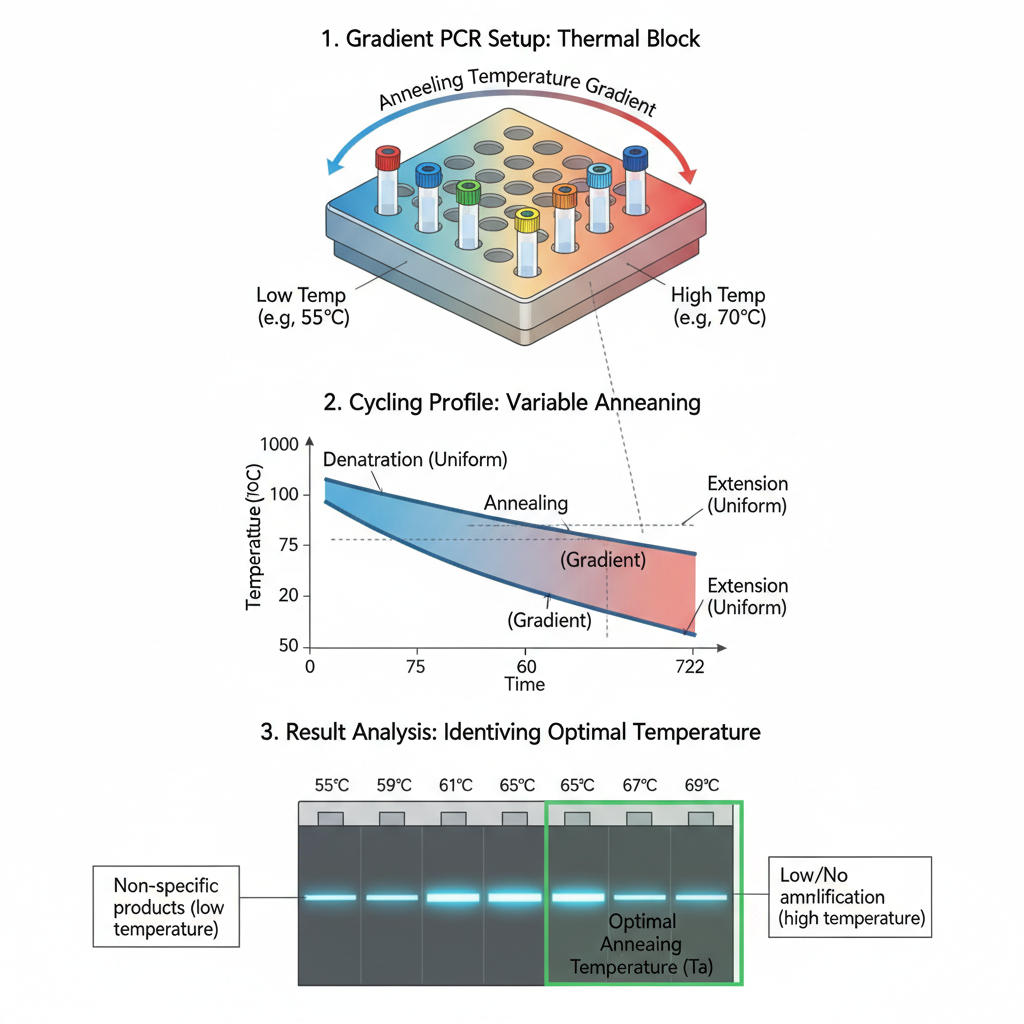
Principle of Gradient PCR is based on the use of different temperatures in the same PCR run. In normal PCR, all tubes get one same annealing temperature. But in Gradient PCR, the thermal cycler makes a range of temperatures across the heating block.
This temperature gradient is made by a special heating and cooling system like Peltier elements. One side of the block has a lower temperature and another side has a higher temperature. The wells present between these two sides get intermediate temperatures.
The same PCR master mix, primers and template DNA are placed in different wells. Each well is exposed to a different annealing temperature. In this way, many annealing temperatures are tested at one time.
During the annealing step, the primers bind with the complementary sequence of template DNA. If the temperature is too low, primers may bind with non-specific sequences and extra DNA bands may form. If the temperature is too high, primers may not bind properly and weak or no amplification may occur.
After the reaction, the amplified DNA products are checked by agarose gel electrophoresis. The temperature which gives a strong and specific band of correct size is selected as the best annealing temperature.
Thus, the gradient PCR principle helps to find the proper annealing temperature in less time and with less reagent.
Gradient PCR Temperature Range
Gradient PCR temperature range is selected according to the melting temperature or Tm of the primers.
Usually, the annealing temperature is kept about 3°C to 5°C lower than the primer Tm. But the exact temperature also depends on primer sequence, GC content, length, buffer and DNA polymerase.
For example, if the primer Tm is about 60°C, a gradient range from about 52°C to 64°C can be tested.
A small gradient range like 5°C to 10°C is used when the approximate annealing temperature is already known. A wider range like 10°C to 20°C is used when the proper temperature is not known.
The maximum gradient PCR temperature range depends on the thermal cycler model. Some machines allow a small gradient and some machines allow a range of 20°C or more.
Parts of Gradient PCR
- Lower Heating Block – Lower heating block is the metal block where PCR tubes or plate are kept. It is generally made of aluminium or silver. In Gradient PCR, this block makes different temperature in different row or column.
- Peltier Elements – Peltier elements are present below the heating block. These are used for heating and cooling of the block. By electric current, they quickly increase or decrease the temperature.
- Upper Heated Lid – Upper heated lid is present above the tubes. It gives heat to the top of PCR tubes. It prevents evaporation and condensation of reaction mixture during high temperature step.
- Thermal Sensors – Thermal sensors are present inside the block. They check the temperature of different zones. It helps to keep the temperature stable and correct during the cycle.
- Internal Control System – Internal control system has microprocessor and control program. It controls temperature, time and ramp rate. It also calculates the middle temperature between low and high gradient points.
- User Interface and Display – User interface is the control panel of the machine. It may have buttons or colour touch screen. The user enters the PCR program, low temperature, high temperature and cycle number here.
- Connectivity Interfaces – Connectivity ports are used for data transfer. USB, Ethernet or Wi-Fi may be present in modern machine. Protocol can be loaded, saved or transferred through these ports.
How to Do Gradient PCR?
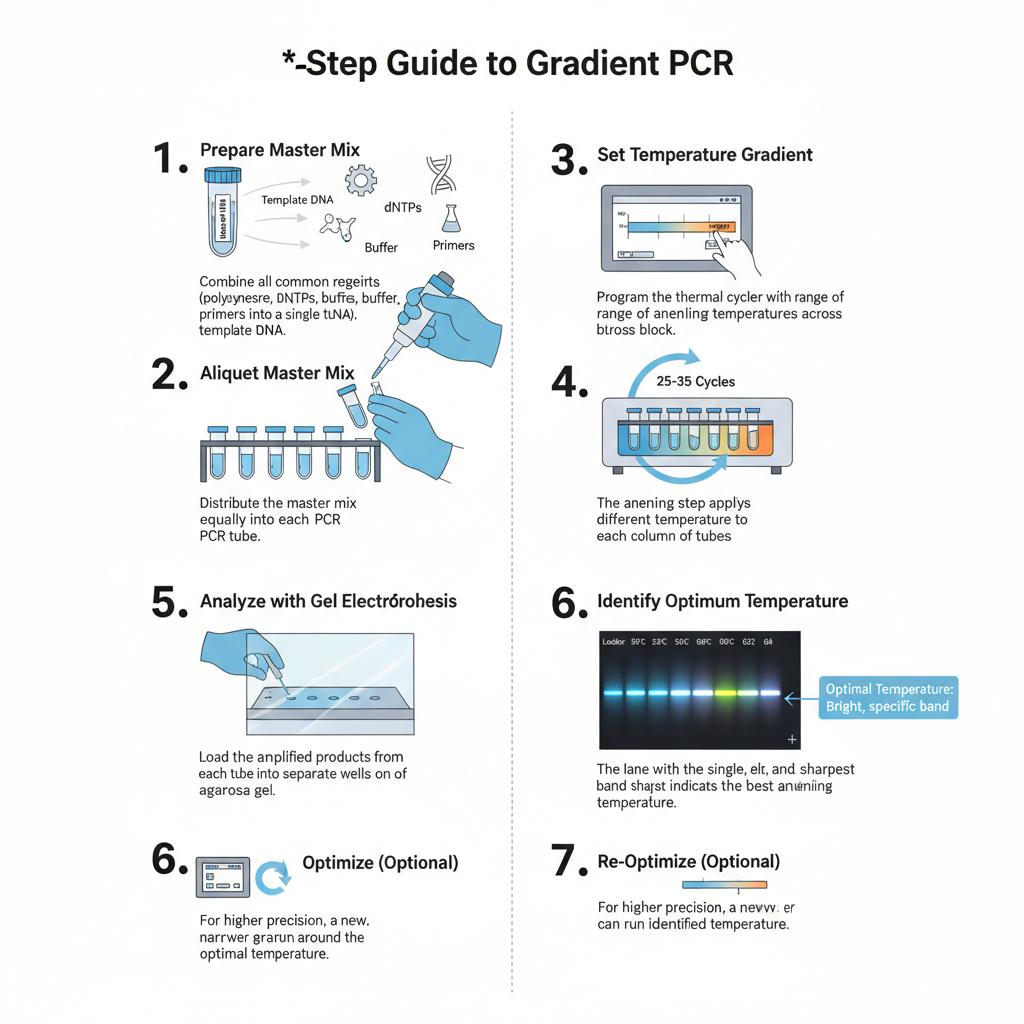
- The PCR mixture is prepared first. It contains template DNA, forward primer, reverse primer, dNTPs, DNA polymerase and buffer. The same mixture is distributed in different PCR tubes or wells.
- The melting temperature or Tm of the primers is calculated. Then a temperature range is selected around the Tm value. Usually, a range of about 5°C to 20°C is tested depending on the primers and thermal cycler. For example, if the primer Tm is about 60°C, a gradient of about 52°C to 64°C can be selected.
- The Gradient PCR machine is programmed. Denaturation, annealing and extension steps are set like normal PCR. During the annealing step, the lowest and highest temperatures are entered. The machine then produces the intermediate temperatures across different rows or columns.
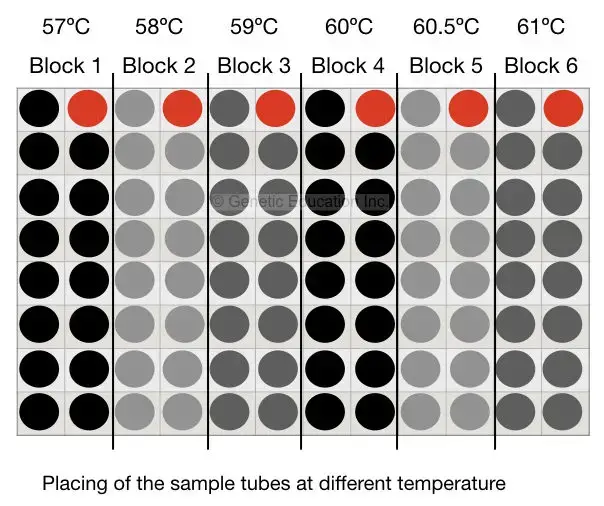
- The tubes or plate are placed in the thermal cycler. Each row or column gets different annealing temperature. Then the reaction is started.
- During the reaction, the same sample is amplified at different temperature. So many annealing temperatures are tested in one run. This saves time and reagent.
- After PCR, the products are checked by agarose gel electrophoresis. The bands are observed under gel documentation system.
- The temperature which gives bright and clear band of correct size is selected. If there are extra bands or primer dimer, that temperature is not suitable.
- If more than one temperature gives good band, the higher temperature is usually selected. It gives more specific amplification.
- The selected annealing temperature is used later for normal PCR with the same primer pair. It is better to perform one confirmation PCR at this temperature before using it for routine amplification.
Gradient PCR Protocol
A general gradient PCR protocol is given below. The exact temperature, reaction volume and time can change according to the primer pair, DNA polymerase and PCR kit.
The PCR reaction mixture is prepared with template DNA, forward primer, reverse primer, dNTPs, DNA polymerase, PCR buffer, MgCl₂ and nuclease-free water.
The same PCR mixture is distributed in different tubes or wells. All tubes should contain the same amount of template DNA, primers and other reagents.
The thermal cycler is programmed with the following general conditions–
Initial denaturation– 94°C to 95°C for about 2 to 5 minutes.
Denaturation– 94°C to 95°C for about 20 to 30 seconds.
Gradient annealing– A selected temperature range, commonly about 50°C to 65°C, for 20 to 30 seconds.
Extension– Usually 72°C for about 30 seconds to 1 minute per kilobase.
Number of cycles– About 25 to 35 cycles.
Final extension– 72°C for about 5 to 10 minutes.
Final hold– 4°C.
After the PCR run, the products are checked by agarose gel electrophoresis. The temperature which gives one bright band of correct size without non-specific bands is selected.
This gradient PCR protocol is only a general example. The protocol supplied with the DNA polymerase should always be checked.
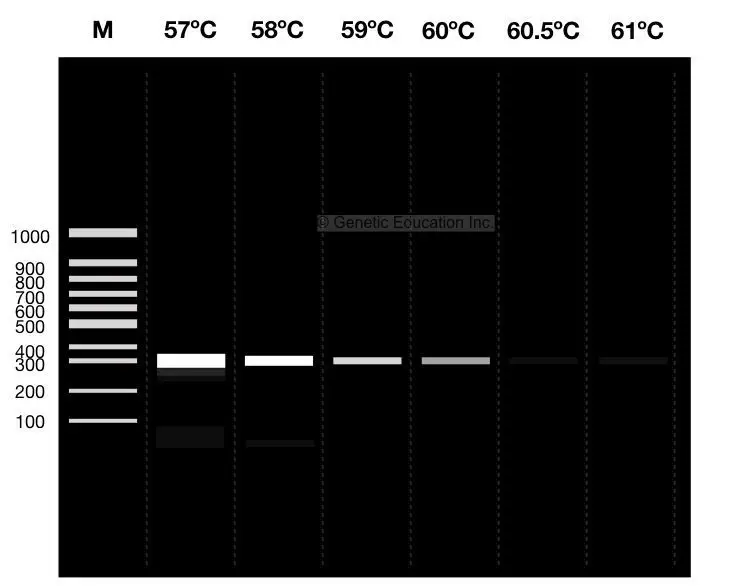
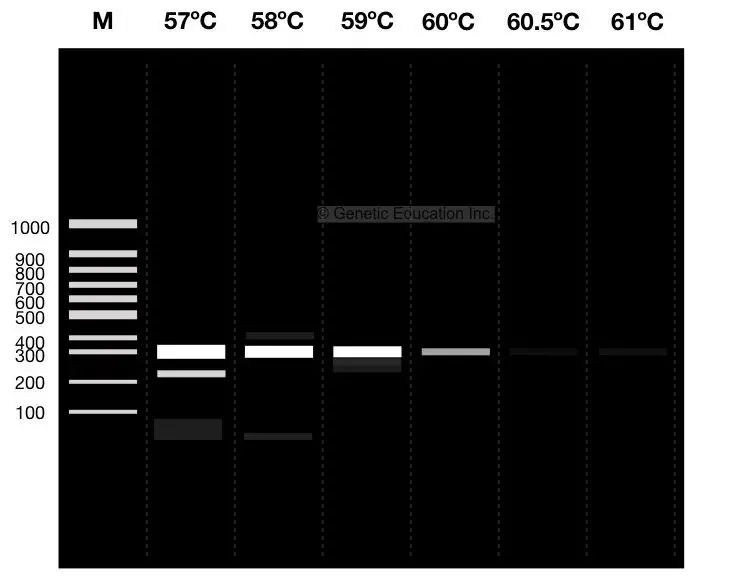
Explanation of Gradient PCR Using Images
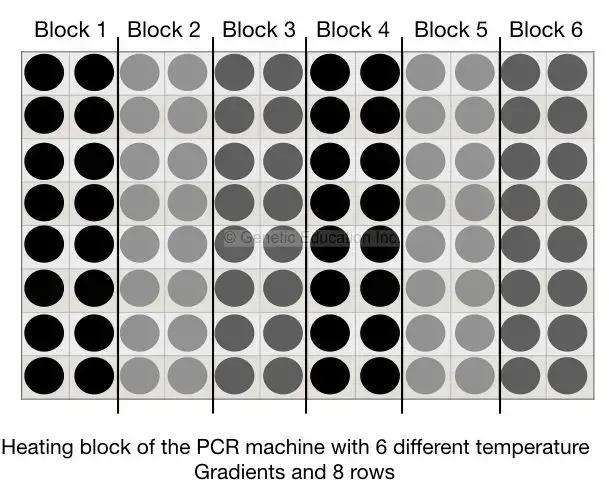
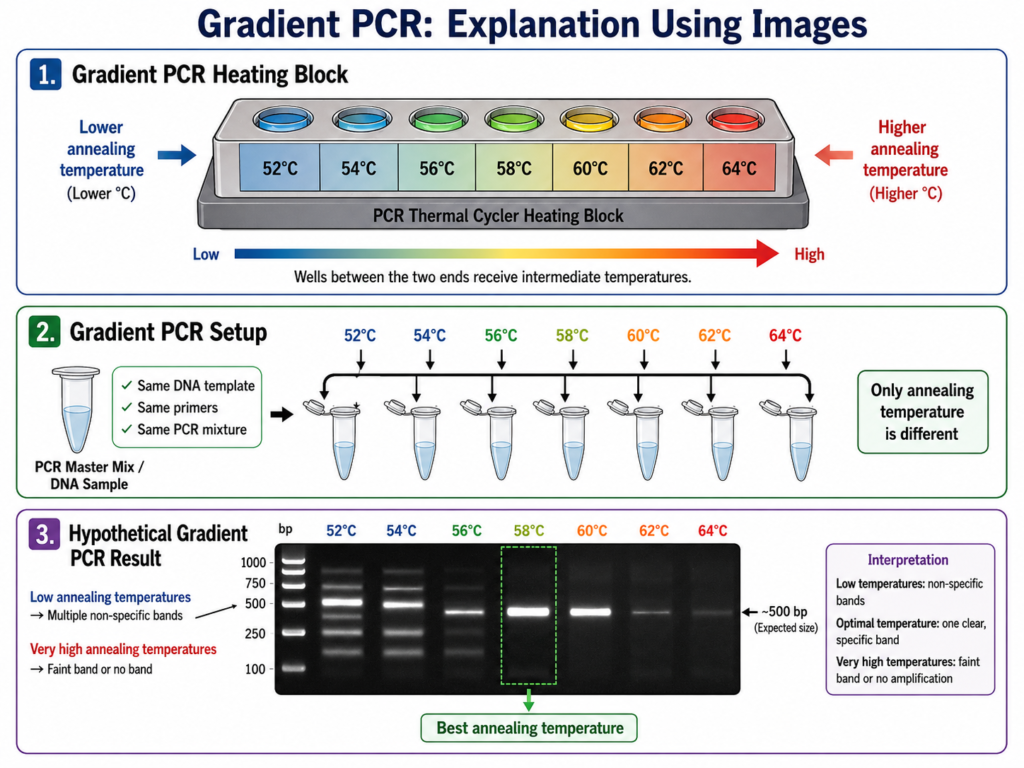
In the gradient PCR heating block image, one side of the block shows a lower annealing temperature and another side shows a higher temperature. The wells between these two sides get intermediate temperatures.
In the gradient PCR setup image, the same PCR mixture is added into different wells. Only the annealing temperature is different in each well.
In the hypothetical gradient PCR result image, PCR products from different temperatures are compared on agarose gel.
A low annealing temperature may show many non-specific bands.
A very high annealing temperature may show a faint band or no band.
The best annealing temperature gives one bright and clear band of correct size.
Suggested image alt text– Gradient PCR setup showing different annealing temperatures in PCR wells.
Suggested gel image alt text– Gradient PCR result showing the best annealing temperature by agarose gel electrophoresis.
Advantages of Gradient PCR
- Gradient PCR saves time. Many annealing temperatures are tested in one run. Separate PCR run is not needed for each temperature.
- It reduces the use of reagents. Same experiment can check different temperatures together. So dNTPs, primers, buffer, polymerase and template DNA are saved.
- It is useful for optimization of new primer pair. The best annealing temperature can be selected from the temperature range. This gives better amplification.
- It increases the chance of successful PCR result. The temperature giving proper band is selected. Weak band, non-specific band and primer dimer can be avoided.
- It gives more specific amplification. Higher suitable annealing temperature helps primer to bind only with correct target sequence. So false amplification is reduced.
- It can also be used for other PCR conditions. Denaturation temperature, extension temperature, MgCl₂ concentration and primer concentration can also be optimized with the help of gradient set up.
- It is useful in Multiplex PCR. Many primer pairs are used in same tube. Gradient PCR helps to find one suitable temperature where all primer pairs can work properly.
- It saves sample material. This is important when template DNA is less or precious. Many condition can be tested without using much sample.
Limitations of Gradient PCR
- Gradient PCR machine is costly. It is more expensive than normal thermal cycler. So initial investment is high.
- It has limited temperature range. The gradient range depends on the machine model. Some machine allow only small range like 5°C, and some allow 20°C or 24°C.
- All wells are not directly controlled by separate heater. In many machine, only hot end and cold end are controlled. The middle temperature are calculated by the block condition.
- Edge effect may occur in the heating block. The wells present at the side may lose heat to surrounding air. So the heating may not be exactly same like central wells.
- Temperature reaching time may be different in different wells. Some wells reach the set temperature slightly fast or slow. This can affect the amplification.
- Sometimes gel band may show smiling pattern. This happens due to difference in ramp rate and heating across the gradient. The product size or yield may look slightly changed.
- The optimized protocol may not work same in normal PCR mode. If heating and cooling rate are different in gradient and non-gradient run, the result may change.
- It is mainly useful for optimization. After the best temperature is found, normal PCR is still needed for routine work. So it is not always required for every PCR reaction.
Applications of Gradient PCR
- Gradient PCR is mainly used for finding proper annealing temperature. Primer binds best at this temperature. Good band is formed and non-specific amplification is reduced.
- It is used in Multiplex PCR optimization. Many primer pairs are present in same tube. Gradient helps to find one temperature where all primers can work together.
- It is used for checking denaturation temperature. Lowest useful denaturation temperature can be selected. This helps to protect DNA polymerase from too much heat damage.
- It is used for extension temperature optimization. This is useful for long DNA sequence and high GC content template. Proper extension gives better amplification.
- It is used for troubleshooting failed PCR. Missing band, faint band, primer dimer and smear can be checked. Sometimes these problems occur due to wrong temperature.
- It is used with chemical optimization also. Different amount of MgCl₂, dNTPs and primers can be tested with temperature gradient. Best condition is then selected.
- It is used in qPCR assay development. Proper annealing temperature gives clean melt curve. It also gives more reliable quantification result.
- It is used in SNP genotyping and allelic discrimination. Correct temperature helps probe to bind only with matched target sequence. Wrong allele binding is reduced.
- It is used for Sanger sequencing reaction optimization. Sequencing primer annealing can be improved. This helps to get longer read and less background noise.
- It is used in fast PCR protocol development. High suitable annealing or extension temperature and low useful denaturation temperature are selected. So total run time can be reduced.
- It is used for testing new PCR reagents. When new kit, new polymerase or new supplier reagent is used, gradient helps to adjust the protocol again.
Frequently Asked Questions
What is Gradient PCR?
Gradient PCR is a modified PCR method where different annealing temperatures are tested in the same PCR run. It is mainly used to find the best primer annealing temperature.
What is the principle of Gradient PCR?
The gradient PCR principle is based on producing different temperatures across the thermal cycler block. The same PCR mixture is tested at these temperatures and the best result is selected after gel electrophoresis.
What is the normal Gradient PCR temperature range?
The temperature range is commonly about 5°C to 20°C. The exact gradient is selected according to the primer melting temperature and thermal cycler.
How to do Gradient PCR?
First, calculate the primer Tm and select a temperature range. Prepare one PCR master mix and distribute it into different wells. Run the PCR with different annealing temperatures and check the products by agarose gel electrophoresis.
What is Gradienten PCR?
Gradienten PCR is the German term for Gradient PCR. Both terms refer to the same PCR temperature optimization method.
References
- Eppendorf AG. (2012). Amplify [PDF].
- Applied Biosystems™ VeritiPro™ Thermal Cycler for Outstanding Performance. (n.d.).
- Continuous-flow thermal gradient PCR – PubMed. (n.d.).
- Design and Validation of a High-Speed Miniaturized Thermocycler with Peltier Elements for Efficient PCR Thermal Cycling – PMC. (n.d.).
- Eppendorf AG. (2016). Eppendorf Mastercycler®: Meeting all your PCR needs with reliability and flexibility [PDF].
- Reina, O. (2025, June 8). Get to know your DNA polymerases. Bitesize Bio.
- Animated biology With arpan. (n.d.). Gradient PCR [Video]. YouTube.
- Gradient PCR for optimization of temperatures and elongation time – Eppendorf US. (n.d.).
- Gradient thermal cyclers: When and how to use them – LabX. (n.d.).
- Guidelines for PCR optimization using Phusion RT-PCR kit – NEB. (2026). New England Biolabs.
- Guidelines for PCR optimization with thermophilic DNA polymerases – NEB. (2026). New England Biolabs.
- How should one perform gradient PCR, and how much time will it take? (n.d.). ResearchGate.
- How to choose the right gradient PCR for your lab? (2023, February 24). FOUR E’s Scientific.
- Multiplex PCR using Q5® high-fidelity DNA polymerase – NEB. (2026). New England Biolabs.
- Multiplex PCR: Optimization and application in diagnostic virology – PMC – NIH. (n.d.).
- Optimization of annealing temperature and other PCR parameters. (2017, June 19). Genaxxon.
- PCR machines | Biocompare. (n.d.).
- PCR optimization (E0555) – NEB. (2026). New England Biolabs.
- PCR troubleshooting | Bio-Rad. (2026). Bio-Rad Laboratories.
- PCR cycler ramp rates explained. (2020). Eppendorf US.
- Meitnik. (2024). PCR optimization. Reddit.
- Thermo Fisher Scientific. (2020). PCR solutions brochure [PDF].
- Pcr troubleshooting and optimization the essential guide. (n.d.).
- Peltiers in PCR matter! (2020, October 26). Eppendorf US.
- Khehra, N., Padda, I. S., & Zubair, M. (2025, July 7). Polymerase chain reaction (PCR). StatPearls – NCBI Bookshelf.
- RT-PCR troubleshooting. (2026). Merck Millipore.
- Thermo Fisher Scientific. (2018). Routine PCR, elevated [PDF].
- Thermo Fisher Scientific. (2026). Six key considerations for selecting a PCR thermal cycler.
- Herman Lab. (2026). Standard PCR conditions. University of Nebraska–Lincoln.
- T100 thermal cycler | Bio-Rad. (2026). Bio-Rad Laboratories.
- Technical analysis of gradient polymerase chain reaction: Thermodynamic principles, mechanical architecture, and optimization paradigms. (n.d.).
- Eppendorf SE. (n.d.). The next stage [PDF].
- Bio-Rad Laboratories. (2007). Thermal gradient feature maximize your optimization [PDF].
- Zeng, S., Cai, L., Chen, B., & Liu, Q. (n.d.). Thermal simulation for continuous-flow PCR system. Atlantis Press.
- Douglas, B. (2026). Troubleshooting non-specific amplification. Bento Lab.
- Understanding thermal cyclers: An introduction and overview – Lab Manager. (n.d.).
- Klee, S. M., Lund, S., & Patton, G. C. (2026). Universal annealing temperature in PCR and its impact on amplification results [PDF]. New England Biolabs.
- Thermo Fisher Scientific. (n.d.). VeriFlex Blocks technology enhances PCR assay optimization [PDF].
- Chauhan, T. (2019, April 12). What is gradient PCR and how to use it? Genetic Education.
- What is gradient PCR and why it matters in modern laboratories? (2024). AliExpress.
- Noiri, E. (n.d.). QuantStudio 5 real-time PCR system: Your innovative research [PDF]. Thermo Fisher Scientific.
- qPCR assay design and optimization | Bio-Rad. (2026). Bio-Rad Laboratories.