

Charophyta is a division of green algae which are commonly known as charophytes. They are mostly found in freshwater habitat. These algae are multicellular and show some plant like characters.
The body of charophytes is more complex than many other algae. It has branching system with main axis like stem and small structures like leaves. Due to this, they look like small aquatic plants in water.
Many members of Charophyta are known as stoneworts. This is because their outer surface may become covered by calcium carbonate. So the plant body becomes hard and rough in texture.
Charophytes are very important from evolutionary point of view. They are considered as the closest living algal relatives of land plants. They have chlorophyll a and chlorophyll b, store food as starch inside plastids, and also have similar cell wall composition.
In aquatic ecosystem, Charophyta forms dense underwater growth. These growths help in improving water clarity and also maintain nutrient and carbon cycle. They also provide food and shelter to many small aquatic animals.
General Characteristics of Charophyta
- Charophyta is a division of green algae. They are regarded as the closest living relatives of land plants or embryophytes.
- The vegetative body is not same in all members. It may be unicellular, simple filamentous or large multicellular body with stem like and leaf like parts.
- They are mostly freshwater algae. They occur in ponds, lakes and slow moving streams, but some members are also found in moist soil, brackish water, hot spring and dry desert crust.
- The cells contain chlorophyll a and chlorophyll b. The reserve food is stored as starch inside the plastids.
- The cell wall is made up of cellulose, hemicellulose and pectin. It also has phenolic compounds, lignin precursors and sporopollenin which make the wall resistant.
- Some members show phragmoplast during cell division. It helps in the formation of cell plate and this character is very similar with land plants.
- In multicellular forms, the cells are connected by plasmodesmata. These are small channels which helps in movement of nutrients, ions and other signalling substances between two cells.
- Many members of Charales become covered with calcium carbonate and magnesium carbonate. Due to this their body become hard and rough, and they are known as stoneworts.
- The life cycle is generally haplontic. The main plant body is haploid and the diploid phase is present only in zygote stage.
- Reproduction takes place by vegetative and sexual methods. Vegetative reproduction occurs by fragmentation, bulbils and amylum stars.
- Sexual reproduction is usually advanced oogamous type. Male sex organ is antheridium producing flagellated sperm and female sex organ is oogonium containing a large non-motile egg.
Occurrence of Charophyta
Charophyta are mostly aquatic algae and occur chiefly in freshwater. They are commonly found in shallow ponds, lakes, tanks and slow moving streams.
They grow usually submerged in water. The plant body remains attached to the muddy, sandy or silty bottom by root like structures called rhizoids.
Some forms of Charophyta may also grow trailing on the soil. These forms are found in moist terrestrial places.
They mostly prefer hard and alkaline water. Such water contains good amount of calcium and organic matter.
They are also found in water having low oxygen condition. They are generally absent in water containing mosquito larvae.
Most of the members occur in clear water. They are common in nutrient poor water bodies like oligotrophic and mesotrophic waters.
The presence of charophytes is regarded as an indicator of good ecological quality of water. But some species can also grow in nutrient rich or eutrophic water.
Charophyta show wide distribution. They are found in almost all continents except Antarctica.
They occur in temperate and tropical regions. Some members are also found in high mountain regions and Arctic region.
Though they are mainly freshwater forms, some members can tolerate brackish and saline water. Chara baltica is found in stagnant brackish estuaries and hypersaline waters.
Some species are found in hot springs. Chara fragilis and Chara tragilis are able to tolerate elevated temperature.
Some members also occur in extreme habitats. They are found in moist soil, snow and ice, alpine algal mats, temporary pools and biological soil crusts of desert.
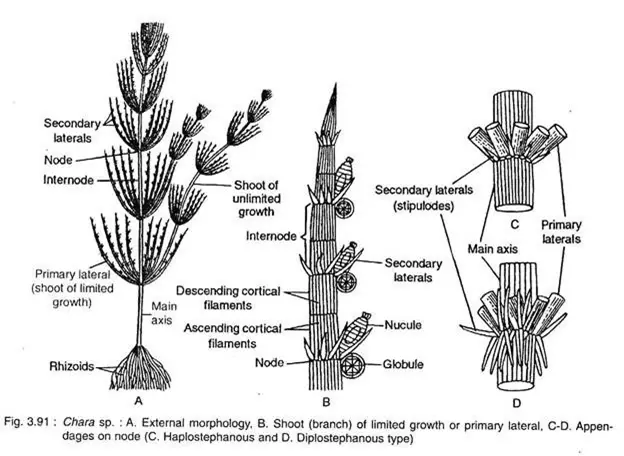
Thallus Structure of Charophyta/Morphology of Charophyta
- The plant body of Charophyta is called thallus. It is multicellular, macroscopic and green in colour. In many members like Chara, the thallus look like higher plant or Equisetum.
- The thallus may be 20 cm to 1 metre in height. The surface is often rough and brittle due to deposition of calcium carbonate. For this reason they are commonly called stoneworts.
- The main plant body has an erect central stem like axis. This axis is clearly differentiated into nodes and internodes.
- Internodes are the long region present between two nodes. Each internode is made up of a single large and elongated axial cell.
- In many species, the axial cell is covered by a layer of small elongated cells. This outer covering is called cortex and such species are called corticate forms.
- Nodes are the joint like region of the main axis. Each node usually contains central cells surrounded by a ring of 6 to 20 peripheral cells.
- The nodes are important region because all branches and other outgrowths arise from here. So the thallus become regularly arranged.
- Short leaf like branches arise from the nodes in whorls. These are called branchlets or primary laterals.
- The number of branchlets is usually 6 to 16 in each whorl. They are branches of limited growth because after forming some nodes they stop further growth.
- The reproductive organs are formed on these branchlets. So branchlets are important for sexual reproduction also.
- Long branches may arise from the axil of branchlets at older nodes. These are called axillary branches or long laterals.
- These branches are branches of unlimited growth. They grow like the main axis and form their own nodes, internodes and whorls of branchlets.
- Stipulodes are small pointed outgrowths present at the basal nodes of branchlets. They are needle like and unicellular in nature.
- True roots are absent in Charophyta. Instead of roots, thread like colourless structures are present which are called rhizoids.
- Rhizoids are branched and multicellular. They have oblique cross walls or septa.
- Rhizoids arise from the base of the plant body. They fix the thallus with muddy or sandy bottom and also absorb water and nutrients.
- The rhizoids grow downward showing positive geotropism. Their tips contain gravity sensing bodies called statoliths.
Cell Structure of Charophyta (Chara)
- Cell type– Charophyta cells are eukaryotic cells. In Chara, the thallus is made by different type of cells. These are mainly nodal cells and internodal cells.
- Cell wall– Cell wall is made up of cellulose. It is also covered by calcium carbonate and silica. Due to this the plant body is hard and brittle.
- Porous wall– The wall between two cells are porous. Through this pore the cytoplasm of one cell remain connected with another cell.
- Chloroplast– Chloroplasts are present in the cells. They are discoid or ellipsoidal in shape. Pyrenoids are absent.
- Nodal cells– Nodal cells are small cells. They are short and isodiametric. These cells are present at the nodal region.
- Nucleus of nodal cells– Nodal cell has only one nucleus. So it is uninucleate cell.
- Cytoplasm of nodal cells– Cytoplasm is dense and granular. Large central vacuole is absent. Small vacuoles may be present.
- Chloroplast of nodal cells– Few chloroplasts are present in nodal cells. They are less in number.
- Internodal cells– Internodal cells are long cells. They are cylindrical and highly elongated. These cells form the long internode of Chara.
- Nucleus of internodal cells– Internodal cell has many nuclei. So it is multinucleate cell. The nuclei are formed by amitosis.
- Vacuole of internodal cells– One large central vacuole is present. It occupies the greater portion of the cell. Cytoplasm is present around the vacuole.
- Cytoplasm of internodal cells– Cytoplasm is divided into two parts. Outer part is stationary and called ectoplasm or exoplasm. Inner part is moving and called endoplasm.
- Cyclosis– Endoplasm shows rotatory movement. This movement is called cytoplasmic streaming or cyclosis. It occurs continuously in the internodal cell.
- Chloroplast of internodal cells– Many chloroplasts are present in internodal cells. They are fixed in the ectoplasm. Therefore they do not move with the endoplasm.
Reproduction of Charophyta
Vegetative Reproduction
- In Charophyta, vegetative reproduction takes place by some special vegetative bodies. Asexual spores are absent. Motile or non-motile asexual spores are not formed.
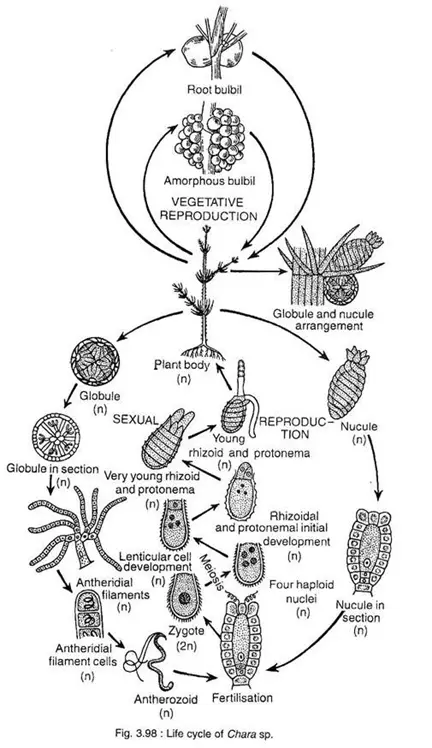
- Amylum stars are star shaped multicellular bodies. They are filled with amylum starch. They are formed on the lower nodes of main axis.
- When amylum stars are detached from the plant body, they grow directly. New Chara plant is formed from them.
- Bulbils are small spherical or oval tuber like bodies. They are developed on rhizoids or lower stem nodes. They easily germinate into new algal plant.
- Amorphous bulbils are irregular mass of cells. They are formed on lower nodes or rhizoids. They contain reserve food and remain as perennating structure.
- During adverse condition, amorphous bulbils survive. When favourable condition comes, they regenerate and form new plant.
- Secondary protonema are thread like or filamentous structures. They are formed from basal cells of rhizoids or primary protonema. Later they develop into new plants.
Sexual Reproduction
- Sexual reproduction in Charophyta is highly advanced oogamous type. Male gamete is motile and female gamete is large and non-motile.
- The sex organs are complex and macroscopic. Male sex organ is called globule or antheridium. Female sex organ is called nucule or oogonium.
- Most species are monoecious. Male and female sex organs are present on same plant. Some species are also dioecious.
- Most species are protandrous. In this condition male sex organ mature before female sex organ.
- Globule is the male sex organ. It is spherical in shape. It is bright yellow to red coloured structure.
- The outer covering of globule is made by 8 curved shield cells. Inside this, manubrial cells and capitulum cells are present.
- From these internal cells many antheridial filaments are formed. These filaments produce many male gametes.
- Male gametes are called antherozoids. They are motile, spirally coiled and biflagellate.
- Nucule is the female sex organ. It is oval and greenish structure. It is usually present just above the globule on the node.
- The nucule contains one large egg or ovum. The egg is non-motile. It contains starch and oil as reserve food.
- The egg is covered by five spirally twisted tube cells. At the upper end five corona cells are present. They form crown like structure.
- At maturity, the spiral tube cells separate slightly at the upper region. Narrow slits are formed. Through these slits antherozoids enter into the nucule.
- One antherozoid reaches the egg. It penetrates through the gelatinized wall at receptive spot. Male nucleus fuses with egg nucleus and forms diploid zygote.
- The zygote is also called oospore. It forms hard and thick protective wall. It remains dormant for some period.
- During favourable condition, oospore germinates. The diploid nucleus undergoes meiosis and forms four haploid nuclei.
- Out of four haploid nuclei, three degenerate. One haploid nucleus remains functional. It forms protonemal initial and rhizoidal initial.
- Protonemal initial grows upward and forms the main plant body. Rhizoidal initial grows downward and forms rhizoids. Thus new haploid Chara plant is formed.
Taxonomic Status of Chara
Historical Perspectives
- The taxonomic position of Chara is not fully fixed from earlier time. It was placed differently by different workers. The classification was mainly based on morphology, physiology and reproductive characters.
- Chara is commonly known as stonewort. It is a green alga, but its structure is more advanced than many common algae. For this reason, its position is considered as doubtful by many botanists.
- Fritsch (1935) placed Chara under the order Charales of the class Chlorophyceae. He considered it as a member of green algae.
- According to Fritsch, the cell wall of Chara is cellulosic. It contains chlorophyll a and chlorophyll b. Reserve food is starch.
- In Chara, the motile cells have two equal flagella. The life cycle also shows similarity with other members of Chlorophyceae. So Fritsch kept it under Chlorophyceae.
- Smith (1938, 1955) did not keep Chara simply under Chlorophyceae. He placed the order Charales in a separate class Charophyceae under the division Chlorophyta.
- According to Smith, Chara has erect branched thallus. The thallus is differentiated into nodes and internodes. Each node bears whorl of branches of limited growth.
- In Chara, axillary branches may show unlimited growth. The plant body is highly calcified. Due to this it becomes hard and rough like stone.
- The female sex organ is called nucule or oogonium. It is one celled in nature but covered by sterile sheath cells. It is generally present on the leaves.
- The male sex organ is called antheridium or globule. It is also one celled. It contains uniseriate branched antheridial filaments. The whole structure is covered by a spherical envelope of eight cells.
- Prescott (1965) supported the classification of Smith. He also placed Chara in the class Charophyceae under the phylum Charophyta.
- Bold and Wynne (1978) placed Chara and its related members under the division Charophyta. They did not use the word “phyco” in the division name. Because their algal nature was not very certain.
Evolutionary Characteristics
- Chara shows some characters which are more advanced than ordinary algae. So it is considered as a higher type of green alga. It also shows some approach towards Bryophytes.
- The plant body has a well developed erect portion. It is differentiated into nodes and internodes. A prostrate root like system is also present.
- The sexual organs are complex and macroscopic. The male gametes are elongated and biflagellate. The female gamete is large and non-motile.
- Sexual reproduction is oogamous type. The egg is protected by many sterile cells. After fertilization, some post fertilization changes also occur.
Transition Between Algae and Bryophytes
- Chara is sometimes regarded as a connecting type between algae and Bryophytes. Because it has advanced plant body and complex sex organs.
- But the plant body of Chara is haploid. The diploid stage is only the zygote. This is an important algal character.
- The nucule looks very complex from outside. But actually it is a simple unicellular oogonium. This also supports its algal nature.
- Due to this, Chara cannot be placed with true Bryophytes. It is better considered as an advanced member of green algae.
Cytological and Morphological View
- Some workers studied the morphology, cytology and oospore ornamentation of Chara. These characters show that Chara is a specialized group under Charales.
- Dr. P. Chatterjee, Dr. Samit Roy and Dr. Ruma Pal considered Chara as a specialized algal group. They supported its position under Chlorophyceae.
- So the taxonomic status of Chara is still important. It has both algal characters and advanced characters. But mainly it is kept under Charophyta or Charophyceae by many modern workers.
Indian Species of Chara
- Some important Indian species of Chara are Chara brachypus, C. fragilis, C. gymnopitys, C. zeylanica, C. braunii and C. benthamii.
Importance of Charophyta
- Charophyta are important aquatic algae. They help in maintaining the balance of freshwater ecosystem. They are mostly found in clean and nutrient poor water.
- They absorb excess dissolved nutrients from water. Mainly phosphorus is absorbed by them. Due to this harmful algal bloom and eutrophication is reduced.
- Their rhizoids hold the loose sediments of water body. It prevents erosion of bottom soil. It also reduces turbidity and makes water more clear.
- During photosynthesis, Charophyta release oxygen into surrounding water. This oxygen is useful for fishes and other aquatic organisms. So they help in oxygenation of water.
- They form dense underwater meadow like growth. These meadows provide shelter to small fishes, microorganisms and other aquatic animals.
- Dense growth of Charophyta also gives protection from strong water current. It also protect small organisms from predators. So it acts as breeding ground also.
- The plant body of Charophyta is used as food by many aquatic animals. Herbivorous water birds also feed on them. Sometimes their biomass is also used by farm animals.
- Charophyta are good bioindicators of water quality. They are sensitive to pollution and environmental changes. Their presence generally indicates clean water.
- They mostly grow in oligotrophic water. This means water having low nutrients. So the presence of Charophyta shows high ecological condition of water body.
- Charophyta deposit calcium carbonate on their surface. This process is called biomineralization. It helps in formation of limestone and carbonate sediments.
- The deposition of calcium carbonate also helps in regulation of water pH. It stores carbon and nutrients for long time. So they have importance in carbon storage.
- Charophyta are useful in climate related research. Their carbonate deposition process gives idea about safe storage of carbon dioxide. It is also useful for artificial decarbonization studies.
- Chara is used as an important experimental plant. It has very large internodal cells. These cells are easily studied in laboratory.
- Chara is used to study cytoplasmic streaming, membrane function and plant electrophysiology. It is also useful in biophysics study. The large cells make observation easier.
- Charophyta are the nearest living algal relatives of land plants. They give information about origin of terrestrial plants. They show how early plants moved from water to land.
- Charophyta also have practical use. Their biomass decomposes slowly and contains stored nutrients. So it was used as fertilizer in crop field.
- Some members are used in traditional medicine. They are also used as decorative plants in freshwater aquariums. They help in fish farming also.
- Charophyta are associated with water bodies where mosquito larvae are absent or less. So their growth may help to reduce mosquito breeding in some places.
References
- Barbosa, M., Lefler, F., Berthold, D. E., & Laughinghouse IV, H. D. (2021). The ecology of charophyte algae (Charales) (SS-AGR-448). UF/IFAS Extension. https://doi.org/10.32473/edis-ag448-2021
- Beilby, M. J. (2016). Multi-scale characean experimental system: From electrophysiology of membrane transporters to cell-to-cell connectivity, cytoplasmic streaming and auxin metabolism. Frontiers in Plant Science, 7, 1052. https://doi.org/10.3389/fpls.2016.01052
- Boyer, J. S. (2016). Enzyme-less growth in Chara and terrestrial plants. Frontiers in Plant Science, 7, 866. https://doi.org/10.3389/fpls.2016.00866
- Briggs, G. M. (2021). Chara, the stoneworts. In Inanimate Life. Milne Publishing.
- Calcium deprivation disrupts enlargement of Chara corallina cells: further evidence for the calcium pectate cycle – PMC. (n.d.). PubMed Central (PMC).
- Changes in alkaline band formation and calcification of corticated charophyte Chara globularis – PMC. (n.d.). PubMed Central (PMC).
- Chara. (n.d.).
- Chara algae Morphology Cell Structure Reproduction | PPTX – Slideshare. (n.d.). SlideShare.
- Chara An Introduction, structure and reproduction.pptx – Slideshare. (n.d.). SlideShare.
- Chara: Classification, Structure and Life Cycle. (n.d.). BYJU’S.
- Chara: Structure, Classification and Life Cycle. (n.d.). Allen.in.
- Charophytes: Evolutionary Giants and Emerging Model Organisms – PMC. (n.d.). PubMed Central (PMC).
- Convoluted Plasma Membrane Domains in the Green Alga Chara are Depleted of Microtubules and Actin Filaments – PMC. (n.d.). PubMed Central (PMC).
- Describe the structure and life cycle of chara. (2026, January 10). Filo.
- Editorial: Charophytes: Evolutionary Ancestors of Plants and Emerging Models for Plant Research – PMC. (n.d.). PubMed Central (PMC).
- Electron microscopic analysis of gravisensing Chara rhizoids developed under microgravity conditions – PubMed. (n.d.). PubMed.
- Evolutionary Physiology, Cytology, and Life-Cycle Dynamics of the Charophyta: A Comprehensive Treatise on Chara. (n.d.).
- Figure 10.2 Chara Cell Diagram. (n.d.).
- Fine structure of charasomes in a control cell (A) and in cells exposed… – ResearchGate. (n.d.). ResearchGate.
- Green Algae: Precursors of Land Plants – OpenEd CUNY. (n.d.). OpenEd CUNY.
- Hoepflinger, M. C., Hoeftberger, M., Sommer, A., Hametner, C., & Foissner, I. (2017). Clathrin in Chara australis: Molecular analysis and involvement in charasome degradation and constitutive endocytosis. Frontiers in Plant Science, 8, 20. https://doi.org/10.3389/fpls.2017.00020
- https://www.lndcollege.co.in/syllabus/co_po/I am sharing ‘Chara’ with you.pdf. (n.d.).
- Image of internodal Chara cell used for detection of cyclosis-mediated… – ResearchGate. (n.d.). ResearchGate.
- Juniper, B. E. (1976). Geotropism. Annual Review of Plant Physiology, 27, 385-406. https://doi.org/10.1146/annurev.pp.27.060176.002125
- Lawrence, D. M. (2023). Charophyceae. In Biology | Research Starters. EBSCO.
- Lect. 5 Phycology Division: Charophyta. (n.d.).
- Life cycle of chara. (2025, November 25). Filo.
- Lifecycle of chara bsc 1st sem. (2025, November 25). Filo.
- [Microanalytical identification of barium sulphate crystals in statoliths of Chara rhizoids (Ch. fragilis, desv.)] – PubMed. (n.d.). PubMed.
- Morphology of the charophyte thallus, an example of Chara rudis is given. – ResearchGate. (n.d.). ResearchGate.
- Okazaki, M., & Tokita, M. (1988). Calcification of Chara braunii (Charophyta) caused by alkaline band formation coupled with photosynthesis. Japanese Journal of Phycology, 36, 193-201.
- Pectate chemistry links cell expansion to wall deposition in Chara corallina – PMC – NIH. (n.d.). PubMed Central (PMC).
- Photosynthesis-dependent formation of convoluted plasma membrane domains in Chara internodal cells is independent of chloroplast position – PMC. (n.d.). PubMed Central (PMC).
- Regulation of the position of statoliths in Chara rhizoids – PubMed. (n.d.). PubMed.
- Sahoo, A. (2022, September 20). Chara: Salient Features, Occurrence, Thallus Structure, Reproduction. Biology Learner.
- Saraswat, K. (2025, May 30). Chara, Diagram, Structure, Characteristics, Reproduction and Life Cycle. Physics Wallah.
- Suzuki, M., Shikina, S., & Takeda, B. T. (2024, August 5). Mineralization and decarbonization of marine organisms. Ocean Newsletter, 576. The Ocean Policy Research Institute.
- Thallus of Chara australis and charasomes in internodal cells. a… – ResearchGate. (n.d.). ResearchGate.
- The statolith compartment in Chara rhizoids contains carbohydrate and protein – PubMed. (n.d.). PubMed.
- Tiwari, S. (n.d.). Classification and life cycle of – Chara. Gyan Sanchay.
- Ultrastructure and Differentiation In Chara Sp. III. Formation of the Antheridium – SciSpace. (n.d.). SciSpace.
- van de Meent, J.-W., Sederman, A. J., Gladden, L. F., & Goldstein, R. E. (n.d.). Measurement of cytoplasmic streaming in single plant cells by magnetic resonance velocimetry. Journal of Fluid Mechanics.
- Wikipedia contributors. (2026, April 23). Chara (alga). In Wikipedia, The Free Encyclopedia.
- Wikipedia contributors. (2026, May 6). Cytoplasmic streaming. In Wikipedia, The Free Encyclopedia.