

Xanthophyta are commonly called yellow-green algae. They are a group of photosynthetic algae. Most of the members are freshwater forms, but some are also found in marine water, damp soil and on tree trunks.
The plant body of Xanthophyta shows much variation. It may be unicellular, colonial, filamentous or coenocytic type. In some forms, the thallus is large, multinucleate and tube like, as found in Vaucheria.
The members are yellow-green in colour. This colour is due to presence of chlorophyll a, chlorophyll c, β-carotene and different xanthophylls. Chlorophyll b is absent. Fucoxanthin is also absent.
The reserve food is not starch. Members of Xanthophyta never store starch like green algae. The stored food materials are oil droplets and chrysolaminarin or leucosin.
The cell wall is generally made up of pectic substances, cellulose and hemicellulose. In Tribonema, the wall is special type. It is made by two overlapping H-shaped pieces, which fit together like a cylinder.
Reproduction takes place by vegetative, asexual and sexual methods. Asexual reproduction is very common. It occurs by formation of zoospores, aplanospores and thick-walled resting cysts.
The motile cells generally have two unequal flagella at the anterior end. One flagellum is long and hairy tinsel type. Other flagellum is short and smooth whiplash type.
Sexual reproduction is rare in Xanthophyta. When present, it may be isogamous or oogamous type. In simple type, similar gametes fuse and in advanced type male and female sex organs are formed.
Characteristics of Xanthophyceae
- Most of the members of Xanthophyceae are freshwater forms. Some species are also found in marine water, damp soil, rock crevices and on tree trunks.
- They are commonly known as yellow-green algae. The yellow-green colour is due to excess of xanthophyll pigments. The brown pigment fucoxanthin is absent.
- The chief photosynthetic pigments are chlorophyll a, chlorophyll c, β-carotene and xanthophylls. In old texts chlorophyll c was sometimes written as chlorophyll e. Chlorophyll b is absent.
- The reserve food material is not starch. Members of Xanthophyceae never synthesize starch. Reserve food is present in the form of oil droplets and chrysolaminarin or leucosin.
- The cell wall is generally made up of pectic compounds, cellulose and hemicellulose. In many filamentous forms, the wall is made by two overlapping H-shaped pieces. They fit together with each other.
- Motile cells usually have two unequal flagella. These flagella are inserted at the anterior end of the cell. One flagellum is long and other is short.
- The longer flagellum is hairy and tinsel type. It pulls the cell forward. The shorter flagellum is smooth and whiplash type and acts like rudder.
- The cells usually contain discoid chloroplasts. Pyrenoids are generally absent. If pyrenoids are present, starch sheath is absent around them.
- The thallus shows many type of organization. It may be unicellular motile or non-motile, colonial, filamentous, branched or unbranched.
- In some members, thallus is siphonous type. It is tube like and multinucleate. This type is seen in Vaucheria.
- Reproduction takes place by vegetative, asexual and sexual methods. Vegetative reproduction mainly occurs by fragmentation.
- Asexual reproduction occurs by zoospores, aplanospores and thick-walled akinetes. These structures help in multiplication and survival.
- Sexual reproduction is rare in this group. It is mostly isogamous type. But in Vaucheria, advanced oogamous type of sexual reproduction is found.
Classification of Vaucheria
| Kingdom | Chromista |
| Division | Xanthophyta |
| Class | Xanthophyceae |
| Order | Vaucheriales |
| Family | Vauchericeae |
| Genus | Vaucheria |
Thallus Organization of Xanthophyta
- The thallus of Xanthophyta shows different type of organization. It may be unicellular, colonial, filamentous or siphonous type. This variation is seen in different members of this group.
- In unicellular motile form, the plant body is made up of single cell. The cell can move actively. It may be rhizopodial or flagellated type.
- In rhizopodial type, the cell wall is not rigid. The movement takes place by amoeboid pseudopodia. This type is found in Rhizochloris.
- In flagellated type, the cell has rigid wall. The cell moves by two unequal anterior flagella. This type is found in Heterochloris.
- In unicellular non-motile form, the thallus is made up of single stationary cell. The cell has distinct and rigid cell wall. Flagella are absent in vegetative condition.
- The unicellular non-motile form is also called coccoid form. This type is found in Characiopsis and Botrydiopsis.
- In colonial form, many non-motile cells remain together. The cells form a colony. The colony may be palmelloid or dendroid type.
- In palmelloid colony, the cells are embedded in a broad gelatinous matrix. The colony is irregular and amorphous. This type is found in Chlorosaccus.
- In dendroid colony, the cells are joined end to end. The colony looks like small branched tree. This type is found in Mischococcus.
- In filamentous form, the plant body is made up of many cells arranged in a row. The filament may be unbranched or branched.
- In unbranched filament, the cells are arranged in single uniseriate row. In many forms the cell wall is made by overlapping H-shaped pieces. This type is found in Tribonema.
- In branched filament, the filament divides into many directions. The cells have normal cross walls. This type is found in Heterococcus.
- In siphonous form, the thallus is large and tubular. It is multinucleate and without regular cross walls. This type of thallus is also called coenocytic type.
- Siphonous thallus is the most developed type of thallus in Xanthophyta. Septa are absent in vegetative phase. This type is found in Vaucheria and Botrydium.
Occurrence of Vaucheria
- Most of the members of Xanthophyta are found in freshwater. They occur in streams, rivers, lakes, ponds and standing water. Some are also found in temporary spring pools.
- In freshwater habitat, they may remain free floating. Some members remain attached with substratum. They may grow on mud, stone or other aquatic plants.
- Few members of Xanthophyta are marine. They are found in sea water in small number. Some are also found in estuaries and coastal salt marshes.
- Some species occur in brackish water. They grow in stagnant brackish canals and mixed water habitat. Their number is less than freshwater forms.
- Many members are terrestrial or subaerial in nature. They grow on damp soil, wet agricultural field, rock crevices, tree trunks and moist walls.
- Some terrestrial forms of Vaucheria form dense green mats. These mats are soft and velvety. They are formed on exposed mudflats and wet soil.
- The mat like growth of Xanthophyta helps in binding the soil particles. It prevents soil erosion in wet exposed places.
- Some species are found in iron rich water. They can grow in acidic water having low pH. Such habitat may be metal polluted stream also.
- In iron rich acidic water, they may form benthic or floating mats. These mats are mostly seen during late winter and early spring.
- Some xanthophytes live in symbiotic condition. They are found inside green freshwater sponges as endosymbionts. This is a special ecological habitat for them.
Morphology of Xanthophyta
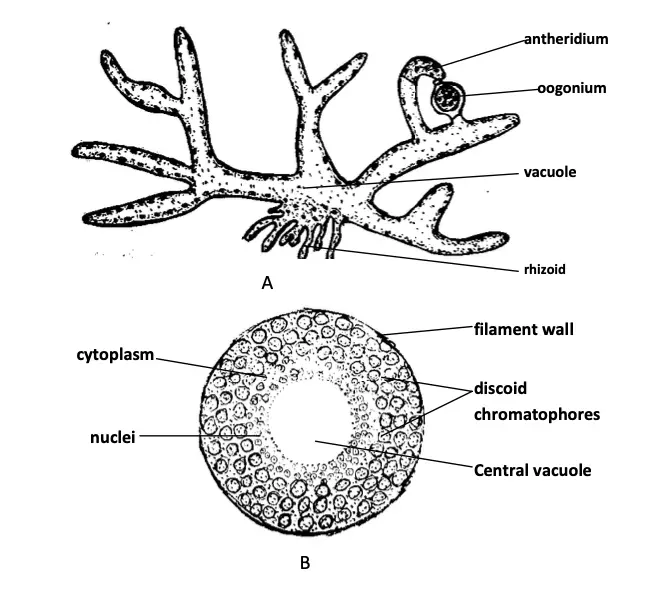
Vaucheria A. Thallus structure B. T.S. of vegetative filament
- The plant body of Xanthophyta shows different morphological forms. It may be unicellular, colonial, filamentous and siphonous type. Highly complex tissue like forms are absent.
- In unicellular motile form, the plant body is made by single cell. The cell can move from one place to another place. It may be rhizopodial or flagellated type.
- In rhizopodial type, rigid cell wall is absent. The movement takes place by amoeboid pseudopodia. This type of body is simple in structure.
- In flagellated type, the cell moves by two unequal flagella. The flagella are present at the anterior end. One is long and another is short.
- In unicellular non-motile form, the plant body is also made by single cell. But the cell is stationary. It has rigid cell wall and flagella are absent.
- Some unicellular non-motile forms are epiphytic in nature. They grow attached on other surface. In some forms, attachment takes place by a stalk.
- In colonial form, many non-motile cells remain together. The colony has definite or indefinite shape. It may be palmelloid or dendroid type.
- In palmelloid form, the cells are embedded in gelatinous matrix. The matrix is broad and amorphous. The cells remain loosely arranged inside it.
- In dendroid form, the cells are joined end to end. The colony appears like a small branched tree. This is a special colonial form.
- In filamentous form, the thallus is multicellular and thread like. The cells are arranged in a row. The filament may be unbranched or branched.
- In unbranched filament, the cells are arranged in single uniseriate row. In some forms, the cell wall has distinct H-shaped overlapping pieces.
- In branched filament, the filament gives branches. The branches may grow in different direction. This makes the thallus more developed than simple filament.
- In siphonous form, the thallus is large and tubular. It is continuous and multinucleate. Regular cross walls or septa are absent in vegetative condition.
- Siphonous thallus is also called coenocytic thallus. It is the most advanced morphological type in Xanthophyta.
- Xanthophyta do not show highly elaborate pseudoparenchymatous or parenchymatous forms. So true tissue like organization is absent in this group.
Reproduction Methods of Xanthophyta
1. Vegetative Reproduction
- Vegetative reproduction in Xanthophyta takes place by simple methods. It is common in unicellular and filamentous members. New plant body is formed without formation of spores.
- In filamentous forms, reproduction takes place by fragmentation. The thallus breaks into small fragments due to mechanical injury or any other cause. Each fragment grows into a new plant.
- In unicellular forms, reproduction occurs by cell division. The cell divides into two daughter cells. This type of division is generally bilateral.
2. Asexual Reproduction
- Asexual reproduction is very common in Xanthophyta. It takes place by formation of different type of spores. These spores may be motile or non-motile.
- Zoospores are motile spores. They generally have two unequal flagella. One flagellum is tinsel type and other is whiplash type.
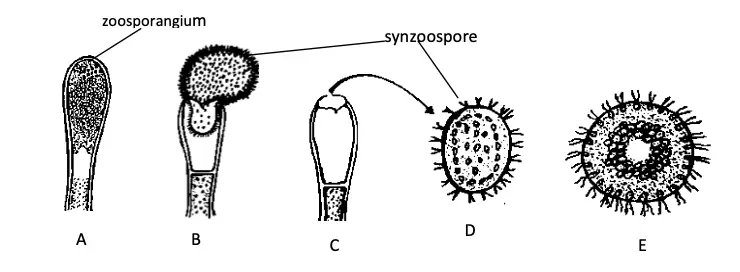
- In Vaucheria, a special type of large compound zoospore is formed. It is multinucleate and multiflagellate. It is called synzoospore or coenozoospore.
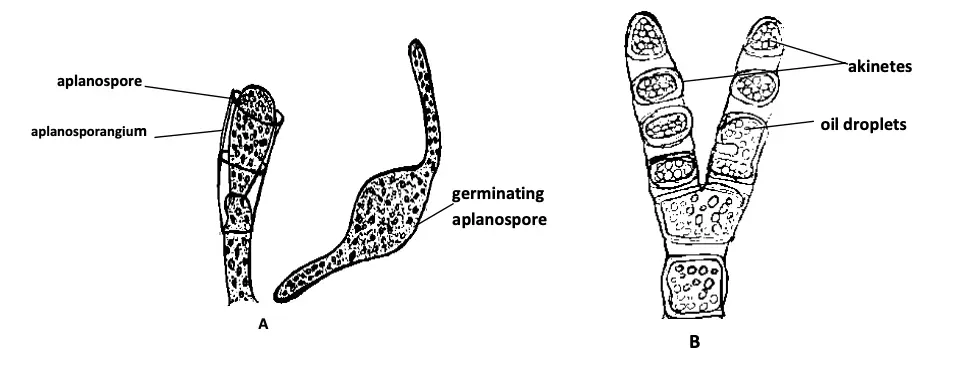
- Aplanospores are non-motile spores. They are thin walled and formed inside sporangia. These are generally formed during dry or unfavourable terrestrial condition.
- Akinetes, cysts and hypnospores are resting structures. They are formed during severe unfavourable condition like drought and low temperature.
- In these resting structures, the protoplasm separates into small segments. Each segment becomes surrounded by thick gelatinous wall. They remain protected during adverse period.
- In Vaucheria, this resting condition is called Gongrosira stage. It is highly septated. It looks like the alga Gongrosira.
- Some members also produce statospores. These are internal resting cysts. They are also called endogenous cysts.
3. Sexual Reproduction
- Sexual reproduction is not very common in Xanthophyta. It is found only in some members. It may be isogamous, anisogamous or oogamous type.
- Isogamy is the common type of sexual reproduction when it is present. In this type, two similar flagellated gametes fuse together. It is seen in Botrydium.
- Anisogamy is very rare in Xanthophyta. In this type, the fusing gametes are unequal or different from each other.
- Oogamy is the advanced type of sexual reproduction. In this type, female gamete is large and non-motile egg. Male gamete is small and motile sperm.
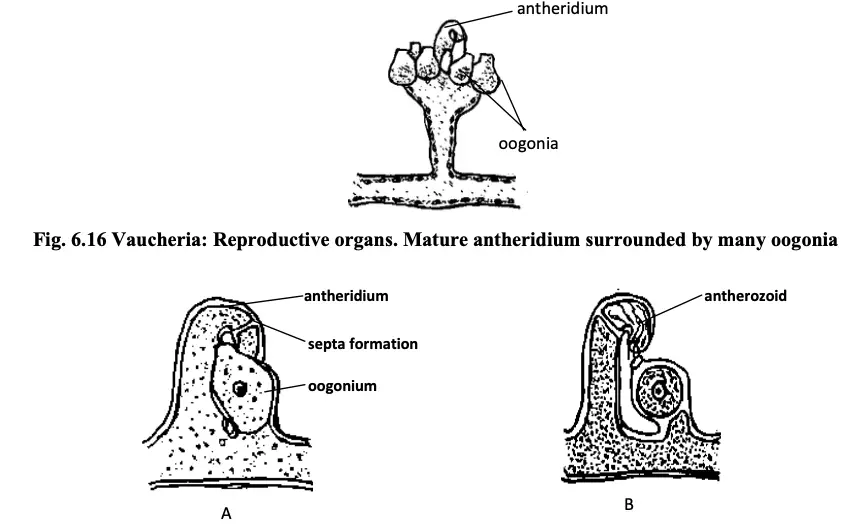
- In oogamous type, egg is formed inside oogonium. The sperms are produced inside antheridium. This type is well seen in Vaucheria.
- In Vaucheria, sexual reproduction is complex and highly developed. The male gamete comes out from antheridium and fuses with egg present in oogonium. After fertilization, zygote is formed.
Life-Cycle of Xanthophyta
The life-cycle of whole Xanthophyta is not clearly known. Many members reproduce mainly by asexual method. Sexual reproduction is found only in few genera.
Many species reproduce by bilateral cell division. Some members also produce endogenous cysts. So the complete life-cycle is not fully described for all members.
Sexual reproduction is mostly studied in Vaucheria. It is a complex member of Xanthophyta. For this reason Vaucheria is taken as main example.
1. The Haplontic Life Cycle
- The commonly accepted life-cycle of Vaucheria is haplontic type. In this type, main plant body is haploid.
- The vegetative thallus is haploid (n). It is the main growing plant body. It grows actively and forms new haploid filaments.
- Asexual reproduction occurs by zoospores, aplanospores or akinetes. These spores are formed from haploid thallus. They again germinate into haploid plant.
- During sexual reproduction, the haploid thallus forms sex organs. Male sex organ is called antheridium. Female sex organ is called oogonium.
- The gametes are formed by mitosis. Male gamete is small and motile. Female gamete is large and non-motile egg.
- Fertilization takes place by fusion of male and female gametes. After fertilization, diploid zygote (2n) is formed.
- The zygote is also called oospore. It is the only diploid structure in haplontic life-cycle. It forms thick wall and remains as resting stage.
- The oospore remains dormant during unfavourable condition. When favourable condition comes, it germinates.
- During germination, diploid zygote undergoes meiosis. This is called zygotic meiosis. After this haploid condition is restored.
- The germinating structure develops into new haploid vegetative filament. Thus haplontic life-cycle is completed.
2. The Diplontic Life Cycle
- Some cytological studies give another view for Vaucheria. According to this view, the life-cycle is diplontic type.
- In diplontic type, the main vegetative thallus is diploid (2n). The asexual spores are also diploid. They form diploid plant body.
- Meiosis takes place only during gamete formation. This is called gametic meiosis.
- The sperm and egg are the only haploid (n) structures in this life-cycle. Other plant body remains diploid.
- After fertilization, diploid oospore is formed. It does not undergo meiosis during germination.
- The oospore divides by normal mitosis. It grows directly into a new diploid vegetative plant.
- Therefore, haplontic life-cycle is commonly accepted in Xanthophyta. But diplontic view is also described for Vaucheria by some workers.
Examples of Xanthophyta and their Characteristics
- Vaucheria is commonly known as water felt. The thallus is siphonous and coenocytic type. It is long, tubular and multinucleate filament. Regular cross walls are absent in vegetative body.
- Vaucheria shows advanced oogamous type of sexual reproduction. Male sex organ is antheridium and female sex organ is oogonium. Asexual reproduction takes place by large multiflagellate compound zoospore, called synzoospore.
- Tribonema is a multicellular unbranched filamentous form. The filament is made by single row of cells. It is found in freshwater pools, rivers and also in metal polluted streams.
- In Tribonema, the cell wall is thick and special type. It is made up of two interlocking H-shaped overlapping pieces. The cells contain many discoid chloroplasts.
- Botrydium has siphonous or coenocytic thallus. The plant body is simple multinucleate vesicle like structure, not long tube like. It is attached to the soil by underground rhizoids.
- Botrydium reproduces by zoospores and aplanospores. Sexual reproduction may be isogamous or anisogamous type. The thallus remains simple but multinucleate.
- Mischococcus is a dendroid colonial form. The non-motile cells are joined end to end. The colony looks like small branched tree under microscope.
- In Mischococcus, mucilage is secreted at the basal junction of cells. This mucilage helps in joining the cells. The colony is branched in appearance.
- Heterochloris and Chloramoeba are unicellular motile forms. They swim actively in water. The cell has thin rigid wall or periplast.
- In Heterochloris and Chloramoeba, two unequal flagella are present at the anterior end. One flagellum is long and another is short. These flagella help in movement.
- Rhizochloris is unicellular rhizopodial form. It is also motile but flagella are absent. It moves by forming amoeboid pseudopodia.
- In Rhizochloris, rigid cell wall is absent. Due to this the cell can change its shape. The movement is amoeboid type.
- Characiopsis is unicellular non-motile or coccoid form. It is generally solitary or loosely grouped. It often grows as epiphyte on other surface.
- In Characiopsis, the cell wall is distinct and rigid. Flagella are absent in vegetative condition. So the cell does not show movement.
- Heterococcus is a branched filamentous form. The cells divide in different directions. Due to this the thallus becomes branched and more complex.
- In Heterococcus, the cell wall is thin. Standard cross walls are present. It is different from Tribonema, where H-shaped wall pieces are present.
- Chlorosaccus is a palmelloid colonial form. Many non-motile cells remain together in one colony. The cells are embedded in broad gelatinous matrix.
- In Chlorosaccus, the gelatinous matrix is secreted by the cells. The number of cells may be indefinite. The colony is amorphous in shape.
References
- Aziz, Z. N. (n.d.). Stage 2 seventh lecture Xanthophyta (yellow-green algae). Al Mustaqbal University.
- ALGAE: General characteristics & classification proposed by FRITSCH. (n.d.). Sariya College, Suriya.
- Barman, D. (n.d.). Algae thallus organization. Goalpara College, Goalpara.
- Biological life cycle. (2026, February 25). In Wikipedia.
- Chapter 9 – The photosynthetic pigments. (n.d.).
- Classification of Vaucheria. (n.d.). BYJU’S.
- Dales, R. P. (1960). On the pigments of the Chrysophyceae. Journal of the Marine Biological Association of the United Kingdom, 39, 693-699.
- Das, K. (n.d.). B. Sc. (Subsidiary: Botany) first year Vaucheria sp. systematic position class: Chlorophyceae order. RLSY College Bettiah.
- Evolution of life cycles and reproductive traits: Insights from the brown algae. (n.d.). bioRxiv.
- Gilbert, S. F. (2000). Plant life cycles. In Developmental biology (6th ed.). Sinauer Associates.
- Johnson, L. R. (2024). Phylum Xanthophyta (Tribophyta) (Yellow-Green Algae). In D. M. John, B. A. Whitton, & A. J. Brook (Eds.), The freshwater algal flora of the British Isles: An identification guide to freshwater and terrestrial algae (pp. 318-345). Cambridge University Press.
- Life in freshwater. (n.d.).
- M.J., A. (2016). Chrysophyta & Xanthophyta.
- Meiosis in allopolyploid Arabidopsis suecica. (n.d.). PubMed.
- Molecular phylogeny of the genus Tribonema (Xanthophyceae) using rbcL gene sequence data: Monophyly of morphologically simple algal species. (n.d.). ResearchGate.
- Phycokey – Tribonema. (n.d.). Center for Freshwater Biology.
- Plant pigments. (n.d.). Let’s Talk Science.
- Range of thallus organisation in algae. (n.d.). LND College, Motihari.
- Sahoo, A. (2022, February 17). Vaucheria: Salient features, occurrence, thallus structure, reproduction. Biology Learner.
- Salient features of algae and Fritsch classification. (n.d.). SlideShare.
- Sanalkumar, S. (2015, September 19). What is gongrosira stage? NextGurukul.
- Sharma, D. (n.d.). Fritsch’s classification of algae. NAS College, Meerut.
- Sharma, N. (2025, August 20). Algae: Characteristics, classes, structure, reproduction, importance. Microbe Notes.
- Studies in botany. (n.d.). Berhampore Girls’ College.
- Synzoospore is found in A Ulothrix B Volvox C Vaucheria class 12 biology CBSE. (n.d.). Vedantu.
- Synzoospore is found in A Ulothrix B Volvox C Vaucheria class 12 biology CBSE. (n.d.). Vedantu.
- Systematics, thallus diversity, and life history strategies in the Xanthophyta: A specialized analysis of the genus Vaucheria. (n.d.).
- Talreja, D. S. (n.d.). Vaucheria NEET biology guide: Structure, life cycle & features. Vedantu.
- Talreja, D. S. (n.d.). Vaucheria NEET biology guide: Structure, life cycle & features. Vedantu.
- Tribonema. (n.d.).
- Tribonema. (n.d.).
- Tribonema (Tribonemataceae). (n.d.). Manaaki Whenua – Landcare Research.
- Vaucheria. (n.d.). SlideShare.
- Vaucheria A.P.de Candolle, 1801. (n.d.). AlgaeBase.
- Xanthophyceae. (n.d.). ResearchGate.
- Xanthophyta. (n.d.).
- Yellow-green algae. (2026, May 11). In Wikipedia.