

Chlorophyta are commonly known as green algae. It is one of the major group of algae. They are mostly aquatic and found in freshwater as well as marine water.
Some members are also found in damp soil. Some forms can grow in extreme places like arctic snow. So the habitat of Chlorophyta is not only limited to water.
The green colour of the members is due to chlorophyll a and chlorophyll b. These pigments are present in chloroplast. With the help of these pigments, they trap light and carry out photosynthesis.
The reserve food material is starch. Starch is stored inside the chloroplast. The cell wall is mainly made up of cellulose.
The thallus shows different forms. It may be unicellular, colonial or multicellular. Some unicellular forms are motile and move with the help of whip like flagella.
In Chlorophyta, simple microscopic forms are present. Colonial forms are also present. Large multicellular sea weeds are also found, such as sea lettuce.
They are photosynthetic autotrophs. They are used as food source by many aquatic animals. They also release oxygen during photosynthesis.
Important features of Chlorophyta
- Chlorophyta are the green algae which contain chlorophyll a and chlorophyll b as the chief photosynthetic pigments. Due to presence of these pigments the members show bright green colour. Some other pigments like carotenoids and xanthophylls are also present.
- The reserve food material of Chlorophyta is mainly starch. The starch is stored inside the chloroplast and in many forms pyrenoids are present in the chloroplast, which helps in the formation and storage of starch.
- The cell wall is firm in most of the members. It is mostly composed of cellulose and gives proper shape and protection to the algal cell.
- The plant body of Chlorophyta shows much variation in structure. It may be unicellular, colonial, filamentous, multicellular or coenocytic type. Some forms are very small and microscopic, while some are comparatively large.
- Many members and reproductive cells are motile in nature. The motile cells generally have two or four flagella, which are equal in length and arise from the anterior end of the cell.
- The members of Chlorophyta are mainly freshwater forms, but some members are also marine. They are also found on damp soil, tree bark, moist rocks and other wet places.
- Some members can grow in extreme habitats also. They may occur in alpine snow fields, desert region and hypersaline ponds. Thus the habitat of this group is very wide.
- Some Chlorophyta also show symbiotic association. They live with fungi and form lichens. Some members also occur inside corals and molluscs.
- Reproduction takes place by vegetative, asexual and sexual methods. Vegetative reproduction occurs by cell division or fragmentation, while asexual reproduction takes place by spores such as zoospores.
- Sexual reproduction takes place by fusion of gametes. It may be isogamy, anisogamy or oogamy according to the size and nature of the gametes.
- In some multicellular forms, alternation of generations is found. Here the gametophytic and sporophytic phases occur in the life cycle.
- Chlorophyta are photosynthetic autotrophs and act as important primary producers. They fix carbon dioxide, release oxygen and form the basic food material for many aquatic herbivores.
Cell structure of Chlorophyta
- Chlorophyta has eukaryotic type of cell structure. The cell is covered by a cell wall and the living part of the cell remains inside it as protoplast.
- Cell wall is generally two layered. The inner layer is made of microfibrillar cellulose, which gives rigidity. The outer layer is made of pectose and sometimes it dissolves and forms a slippery mucilage around the cell.
- In some members like Volvocales, the wall is different. Here cellulose is absent and the wall is formed by many layered hydroxyproline-rich glycoprotein matrix.
- Protoplast is enclosed by plasma membrane. Inside it cytoplasm is present with nucleus and other organelles. The nucleus is distinct and covered by double nuclear envelope.
- The cell contains ordinary eukaryotic organelles. These are mitochondria, dictyosomes, endoplasmic reticulum and ribosomes. These remain scattered in the cytoplasm.
- Chloroplast is the important structure in the cell. It is double membrane bounded and its shape is not same in all members. It may be cup-shaped, spiral, ribbon-like or reticulate.
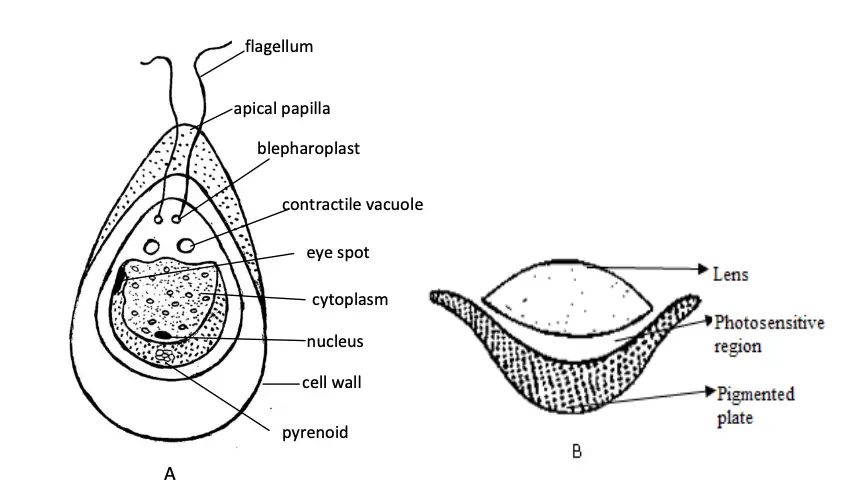
- In Chlamydomonas, chloroplast is cup-shaped. In Spirogyra, it is spiral ribbon like. In some forms it becomes net like structure.
- Inside the chloroplast, thylakoids are present. They are arranged in stacks of two or more. But true grana like higher plants are not formed.
- Pyrenoid is present inside the chloroplast in many members. It is a dense body and mainly associated with starch formation.
- A pyrenoid has dense protein core. It is made of Rubisco matrix. The core is crossed by thylakoid tubules and outside it starch sheath is present.
- Motile cells have flagella. These are usually two or four in number and arise from the anterior end of the cell. The flagella are equal in length, so they are isokont type.
- The flagella are whiplash type and have 9+2 microtubule arrangement. At the base of flagella, basal bodies are present.
- The rootlet system of flagella is cross shaped. It is described as X-2-X-2 type. Basal bodies are connected with nucleus by fibrous structure called rhizoplast.
- Eyespot or stigma is present in many motile members. It is red or orange coloured and is present near the anterior end of chloroplast.
- Eyespot has carotenoid rich lipid droplets. It helps in perception of light. Movement of cell towards suitable light is called phototaxis.
- Contractile vacuoles are found mainly in freshwater unicellular forms. They are present near the anterior end and remove excess water from the cell.
- Contractile vacuole also helps in excretion. It keeps water balance inside the cell, especially in freshwater forms.
Eyespot of Chlorophyta
- Eyespot is also called stigma. It is a small red or orange coloured spot present in motile members of Chlorophyta.
- It is a photoreceptive organelle. It receives light and helps the cell for movement according to the direction of light.
- The eyespot is generally present at the anterior end of the chloroplast. It remains near the surface of the cell.
- In Chlamydomonas, the eyespot has a fixed position. It is present close to the rootlet microtubule bundle and keeps a particular angle with the flagella.
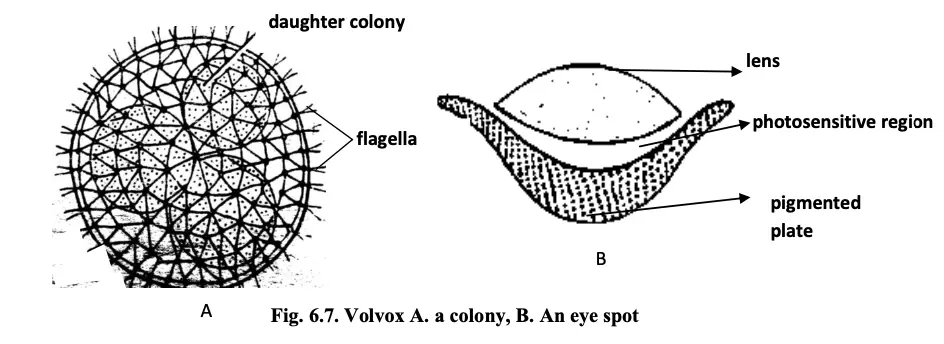
- The eyespot is made up of rhodopsin-like photoreceptors. These photoreceptors are also called channelrhodopsins.
- Below the photoreceptors, there is a layer of lipid droplets. These droplets are rich in carotenoids, so the eyespot becomes red or orange in colour.
- The pigment layer acts as a shading layer. It blocks light coming from some side and helps the cell to know from which direction light is coming.
- Due to this arrangement, the eyespot works as a directional photodetector. It is not a true eye but it acts like eye of the algal cell.
- The eyespot works along with the flagella. When light is detected, the beating of flagella is changed and the cell turns towards or away from light.
- This movement in response to light is called phototaxis. By phototaxis the cell can reach suitable light region for photosynthesis.
Phototaxis of Chlorophyta
- Phototaxis is the movement of motile green algal cell in response to light. It is seen in many members of Chlorophyta which have flagellated cells.
- This movement helps the cell to go towards proper light region. By this the cell can get suitable light for photosynthesis.
- The main structure for phototaxis is eyespot or stigma. It is usually red or orange coloured spot present near the anterior end of the chloroplast.
- The eyespot works as a light detecting structure. It helps the cell to know the direction of light and then the cell moves according to it.
- The eyespot has rhodopsin-like photoreceptors and a layer of lipid droplets. These droplets are rich in carotenoids.
- The carotenoid droplets act like shading body. It blocks light from some direction and allows the photoreceptors to receive light from certain angle.
- When light falls on the eyespot, ion current is produced. Then calcium channels of the flagellar membrane are activated.
- Due to this, the beating of two flagella becomes unequal. One flagellum beats in one way and another flagellum beats differently, so the cell turns towards or away from light.
- For proper phototaxis, the eyespot must remain in proper position with the flagellar apparatus. If the angle is not proper, the movement of cell will not be properly directed.
- In colonial forms like Volvox, many cells have anterior eyespot. These cells coordinate their flagellar beating and the whole colony moves towards light.
- Phototaxis is also important in reproductive cells. Many non-motile green algae produce motile swarmers, which use phototaxis for movement.
- In Ulva, the sexual gametes are generally positive phototactic. They move towards light.
- The asexual zoospores of Ulva are generally negative phototactic. They move away from light and this helps them to settle on dark solid surface for growth.
Reproduction of Chlorophyta
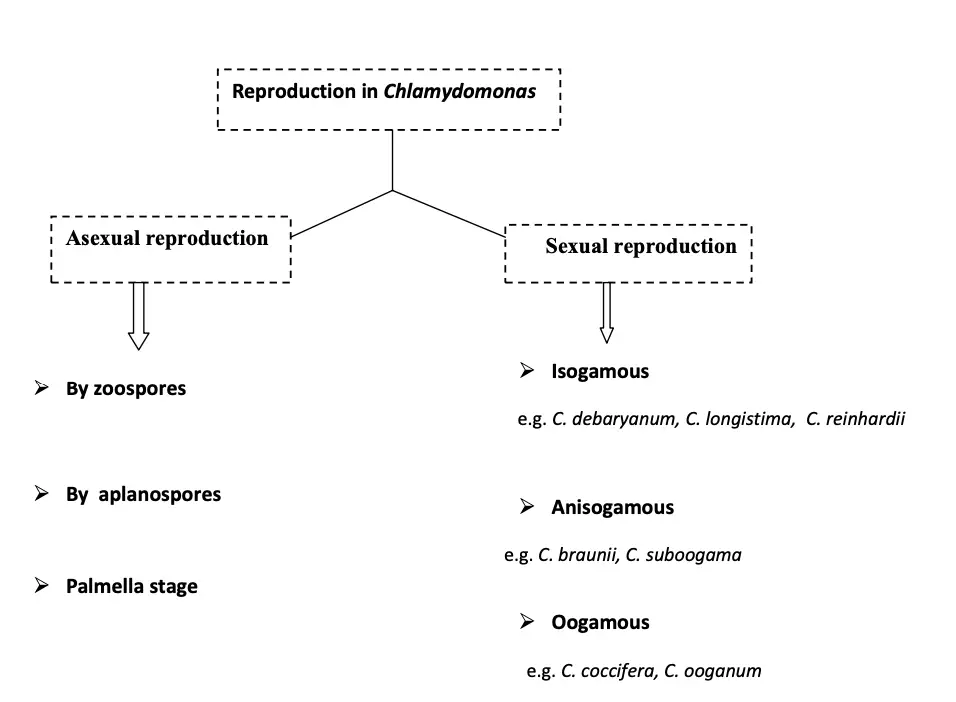
Chlorophyta reproduce by three methods. These are vegetative, asexual and sexual methods. In different members one or more than one method may be present.
Vegetative Reproduction
- Vegetative reproduction is the simple type of reproduction in Chlorophyta. It takes place without the formation of special reproductive cells.
- In filamentous forms like Spirogyra and Cladophora, reproduction takes place by fragmentation. Here the filament breaks into small pieces and each piece grows into new filament.
- Fragmentation may occur due to injury, mechanical pressure or natural breaking of thallus. The broken part contains living cells and so it develops into new individual.
- In unicellular members, vegetative reproduction takes place by cell division. It is also called binary fission. In this method one parent cell divides mitotically and forms two daughter cells.
Asexual Reproduction
- Asexual reproduction takes place by formation of spores. The spores are produced inside the parent cell and after liberation they develop into new plant body.
- Zoospores are naked and motile spores. They contain flagella and eyespot may also be present. They swim in water for sometimes and then settle on suitable substratum.
- After settling, the zoospore loses flagella and germinates into new individual. This type of reproduction is found in Ulva, Oedogonium and Chlamydomonas.
- Aplanospores are non-motile spores. They do not have flagella. These are generally formed during unfavourable condition.
- Autospores are also non-motile spores. They look like small copy of parent cell and after release they grow directly into new individual.
- In very unfavourable condition, thick walled resting spores are formed. These are called hypnospores and akinetes.
- Hypnospores and akinetes contain stored food like starch and oil. They remain dormant during dryness, cold or other bad condition.
- In colonial forms like Volvox, daughter colonies are formed inside the parent colony. Some special cells divide repeatedly and form small daughter colony.
- In some motile forms, during stress condition the cells lose their flagella and become embedded in mucilage. The cells then divide inside a common mucilaginous envelope and this is called palmella stage.
Sexual Reproduction
- Sexual reproduction takes place by fusion of gametes. The gametes may be similar or dissimilar according to the members.
- In isogamy, two gametes are similar in size, shape and structure. Both are generally motile and after fusion zygote is formed.
- In anisogamy, two gametes are unequal in size. The smaller gamete is male gamete and larger gamete is female gamete.
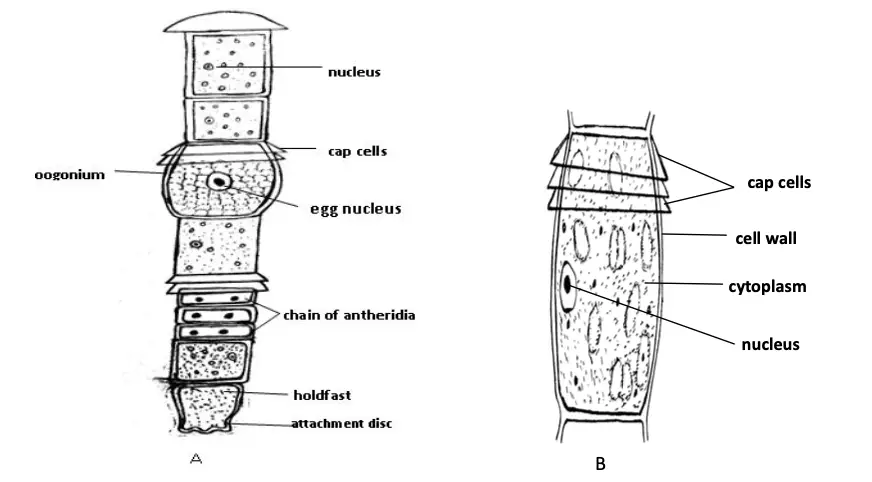
- In oogamy, the female gamete is large and non-motile. It is called egg. The male gamete is small and motile and it swims towards the egg.
- Oogamy is found in advanced forms like Volvox and Oedogonium. It shows more specialization than isogamy and anisogamy.
- In Spirogyra, sexual reproduction takes place by conjugation. It is a special process where gametes are not released outside.
- During conjugation, two filaments come side by side and form conjugation tube. This is called scalariform conjugation.
- Sometimes conjugation takes place between adjacent cells of same filament. This is called lateral conjugation.
- In conjugation, the male protoplast passes through conjugation tube and enters into the female cell. Then fusion takes place and diploid zygote is formed.
Life Cycle
- In most green algae, life cycle is haplontic type. The main plant body is haploid and only diploid stage is the zygote.
- The zygote develops thick wall and becomes zygospore. Later it undergoes meiosis and produces haploid cells.
- In some members like Ulva, alternation of generations is present. Here haploid gametophyte and diploid sporophyte both are multicellular.
- In Ulva, the gametophyte and sporophyte are almost similar in external appearance. So it is called isomorphic alternation of generations.
Life Cycles of Chlorophyta
The following are the life cycles found in Chlorophyta.
1. Haplontic Life Cycle
Haplontic life cycle is a common life cycle of green algae. It is found in Chlamydomonas, Spirogyra and Volvox.
In this life cycle the plant body is haploid. It is the main vegetative body. It is free living.
The diploid phase is not well developed. It is represented by only zygote.
During reproduction the haploid plant body forms haploid gametes. The gametes are formed by simple mitotic division.
The gametes fuse together and form diploid zygote. This process is called syngamy.
The zygote becomes thick walled. It behaves as resting spore. It is called zygospore.
When favourable condition comes, the zygospore undergoes meiosis. Haploid spores or haploid cells are formed.
These haploid cells germinate and give rise to new haploid plant body.
In this type, meiosis occurs in zygote. So it is also called zygotic meiosis.
2. Diplohaplontic Life Cycle
Diplohaplontic life cycle is found in some multicellular green algae. It is found in Ulva and Cladophora.
In this life cycle two plant bodies are found. One is haploid gametophyte. Another is diploid sporophyte.
The gametophyte is haploid. It produces haploid gametes by mitosis.
The gametes are usually motile. In Ulva, gametes are biflagellate.
The male and female gametes fuse together. A diploid zygote is formed.
The zygote does not divide by meiosis directly. It develops into diploid sporophyte.
The sporophyte is diploid plant body. It produces haploid zoospores by meiosis.
The zoospores are motile. In Ulva, zoospores are generally quadriflagellate.
These zoospores swim for some time. Then they settle on substratum.
After germination, the zoospores form new haploid gametophyte.
In Ulva, gametophyte and sporophyte looks alike. This condition is called isomorphic alternation of generation.
In this type, meiosis occurs during spore formation. So it is also called sporic meiosis.
Classification of Chlorophyta
The following are the classification of Chlorophyta which are made mainly on the basis of cell structure, flagellar apparatus, type of cell division and molecular characters.
1. Chlorophyceae
Chlorophyceae is the largest and most diverse class of Chlorophyta which includes mostly freshwater forms and some terrestrial forms also.
The members show different types of thallus organization like unicellular, colonial, motile and filamentous condition, due to which this class shows wide variation in its body structure.
Chlamydomonas is unicellular motile form, Volvox is colonial form and Oedogonium is filamentous form which are common examples of this class.
2. Ulvophyceae
Ulvophyceae is mainly marine class of Chlorophyta where the plant body is generally multicellular and comparatively large than many other green algae.
The thallus may be filamentous, tubular, sheet like or parenchymatous type, and these forms are commonly found in sea water attached with substratum.
Ulva is the common example of this class which has flat sheet like thallus and is commonly called sea lettuce.
3. Trebouxiophyceae
Trebouxiophyceae is a diverse class of Chlorophyta which includes unicellular, colonial and some simple multicellular forms that are present in freshwater, terrestrial and subaerial habitat.
Many members of this class are important because they live in symbiotic association with fungi and take part in formation of lichen.
Trebouxia is a common lichen forming alga and Chlorella is also an important unicellular member of this class.
4. Chlorodendrophyceae
Chlorodendrophyceae includes unicellular flagellated green algae which have special outer covering around the cell.
This outer covering is called theca, which is made by fused organic scales and gives a definite covering to the cell.
The members are placed separately because the cell covering and flagellar characters are different from other green algal groups.
5. Chloropicophyceae
Chloropicophyceae is a class of small marine green algae which are unicellular and coccoid in shape.
The cells are spherical or rounded and they lack flagella and pyrenoid, which is an important character of this group.
They are included under marine picoplanktonic green algae because of their small size and simple cell structure.
6. Mamiellophyceae
Mamiellophyceae includes unicellular solitary flagellated green algae which are mostly small marine forms.
The cell is covered by one or two layers of flat organic scales, and these scales are often spiderweb like in appearance.
This class is included under early diverging green algal group due to its simple flagellated nature and scale covered cell surface.
7. Nephroselmidophyceae
Nephroselmidophyceae includes unicellular flagellated algae which are covered by scales and occur in both marine and freshwater habitats.
The cells are usually motile and the body organization is simple, but the scale covering and flagellar arrangement are used for their classification.
They are also included with early diverging groups of Chlorophyta.
8. Pedinophyceae
Pedinophyceae includes unicellular asymmetrical flagellated green algae.
The cell generally has one flagellum and this flagellum bears fine hair like structures called mastigonemes.
The asymmetrical cell body and hairy flagellum are important characters by which this class is separated from other flagellated chlorophytes.
9. Picocystophyceae
Picocystophyceae is a class of unicellular green algae in which the cells are ovoid and sometimes trilobed.
The members lack flagella and they are specially adapted in hypersaline lakes where the salt concentration is very high.
This class is different from many other chlorophytes because of its non-flagellated body and special saline habitat.
10. Pyramimonadophyceae
Pyramimonadophyceae includes marine unicellular green algae which have many flagella.
The cells may have 4 to 16 flagella and the surface of the cell is covered by many layers of complex organic scales.
These scale coverings and number of flagella are important characters in this class and are used in its identification.
11. Chuariophyceae
Chuariophyceae is an extinct class of Chlorophyta which is known only from fossil records.
It includes carbonaceous megafossils which are found in ancient Ediacaran rocks.
The members of this class are not living forms at present and they are studied as fossil green algal group.
Note
In some old classification, some other algal groups were also kept near Chlorophyta, but in modern classification they are treated separately on the basis of ultrastructure and molecular study.
Charophytes are not kept under true Chlorophyta in modern system because they are more closely related with land plants.
Importance of Chlorophyta
- Primary production and oxygen generation
Chlorophyta are important primary producer in aquatic habitat and they prepare organic food by photosynthesis using sunlight, carbon dioxide and water. This prepared food is used by small aquatic animals and other organisms. Oxygen is also liberated during this process which is necessary for respiration of fishes and other aquatic animals. - Carbon fixation
Chlorophyta help in fixation of carbon dioxide and carbon is changed into organic food material. A large amount of carbon is fixed by green algae every year in freshwater and marine ecosystem. So they are important in maintaining carbon balance of nature. - Nutrient cycling
Green algae absorb inorganic nutrients such as nitrogen and phosphorus from water. These nutrients are used for their growth and body formation. After death, the algal body decomposes and the nutrients are returned again to the water and soil. - Evolutionary importance
Chlorophyta are important from evolutionary point of view because they show plant like characters. They contain chlorophyll a, chlorophyll b, starch as reserve food and cellulose in cell wall. For this reason green algae are considered close to land plants. - As human food
Some members of Chlorophyta are used as food by human. They contain protein, vitamin, minerals and other nutritive substances. Ulva and Monostroma are used as edible green algae in different places. Ulva is commonly known as sea lettuce. - As dietary supplement
Some unicellular green algae are used as dietary supplement because they have high food value. Chlorella is rich in protein, vitamins, pigments and antioxidant substances. It is used as health food and also in commercial food preparation. - Biofuel production
Some green algae are used for production of biofuel because they can store lipids and hydrocarbons inside the cell. Chlorella, Scenedesmus and Botryococcus are important examples. They are cultivated for biodiesel and other fuel products. - Wastewater treatment
Chlorophyta are used in wastewater treatment because they absorb excess nutrients from polluted water. They remove nitrate, phosphate and organic pollutants from sewage water, industrial effluent and agricultural runoff. This process helps in cleaning of water. - Bioremediation
Some green algae can absorb heavy metals and toxic substances from water. Due to this ability they are used in bioremediation. In this process polluted water is treated by using living algal cells. - Agricultural importance
Chlorophyta are used in agriculture as biofertilizer and soil improving organism. They add organic matter to soil after decomposition. This helps in increasing fertility, moisture content and nutrient condition of soil. - Aquaculture importance
Green algae are used as feed in aquaculture. They contain protein, vitamins and other essential nutrients. They are used as food for fishes, shrimps, larvae and other aquatic animals during their growth. - Pharmaceutical importance
Chlorophyta produce many bioactive compounds which are useful in medicine. Some compounds have antibiotic, antiviral, antioxidant and cancer preventing properties. Beta-carotene and other pigments are also obtained from green algae. - Cosmetic importance
Some green algae are used in cosmetic industries. They contain pigments, vitamins and antioxidant compounds. These compounds are used in anti-aging cream, skin care product and other cosmetic preparation. - Symbiotic association
Some members of Chlorophyta live in symbiotic association with other organisms. Trebouxia lives with fungi and forms lichen. In this association alga prepares food and fungus gives protection, water and mineral substances. - Association with animals
Some green algae live inside the body of corals, ciliates and molluscs. They prepare food by photosynthesis and supply food materials to the host. The host gives shelter and suitable condition for growth of algae. - Scientific research
Some members of Chlorophyta are used as model organisms in laboratory. Chlamydomonas is used in study of genetics, photosynthesis, flagella and cell biology. Volvox is used for study of colonial organisation and origin of multicellular condition.
Examples of Chlorophyta and their Characteristics
- Chlamydomonas
Chlamydomonas is a unicellular and motile green alga which is generally found in freshwater, moist soil and also in some extreme habitat. The cell has two anterior flagella by which it moves in water and it has a cup-shaped chloroplast inside the cell. Some species like Chlamydomonas nivalis are found in alpine snowfield and it gives red colour to snow, which is called watermelon snow. It is also used as model organism in genetics, cell biology and study of flagellar movement. - Volvox
Volvox is a colonial green alga which forms spherical and motile colony. The colony may contain large number of biflagellate cells which are arranged at the surface of a hollow gelatinous ball. The cells of colony show some division of labour, where some cells are somatic cells and help in swimming, and some cells become reproductive cells. It is important because it shows advanced colonial organisation among green algae. - Spirogyra
Spirogyra is a free floating and unbranched filamentous green alga which is commonly found in ponds, ditches and slow running water. It is commonly called pond silk or water silk because its filament is slippery due to mucilage covering. The chloroplast is ribbon shaped and spirally arranged inside the cell, which is the most important identifying character of Spirogyra. It reproduces by fragmentation and also by sexual reproduction through conjugation. - Ulva
Ulva is a marine green alga which is commonly called sea lettuce. The plant body is multicellular, flat and sheet like thallus, which is usually two cells thick. It remains attached to substratum by holdfast. Ulva shows isomorphic alternation of generation, where gametophyte and sporophyte look similar in external structure. It is also used as edible green alga in many places. - Chlorella
Chlorella is a unicellular and non-motile green alga which has spherical or coccoid cell. It has no flagella and the cell is simple in structure. It grows rapidly and contains high amount of protein, vitamins, pigments and antioxidant substances. Due to this it is commercially cultivated as dietary supplement. It is also used in wastewater treatment because it can absorb excess nutrients from polluted water. - Oedogonium
Oedogonium is an unbranched filamentous green alga which is mostly found in freshwater. The filament remains attached to substratum by a basal holdfast cell. The cells have reticulate or net like chloroplast, which is an important character of this genus. It shows advanced type of sexual reproduction called oogamy, where large non-motile egg and small motile male gamete are formed. - Cladophora
Cladophora is a branched filamentous green alga which is found in freshwater as well as marine habitat. The cells are multinucleate and have thick cell wall. The plant body remains attached to rock, wood or other substratum. It forms dense green tufts in water and is easily seen in attached condition. - Caulerpa
Caulerpa is a marine green alga which has siphonous or coenocytic thallus. The whole plant body is a single large multinucleate cell and internal cross walls are absent. Though it is single celled, it shows differentiation into leaf like blades, stem like stolon and root like rhizoids. This makes Caulerpa a special example of large unicellular green alga. - Codium
Codium is a marine green alga which has soft and spongy plant body. The thallus is pseudoparenchymatous and it is made by interwoven branched multinucleate siphons. It is generally attached to rocks in sea water. Some marine animals like sea slugs feed on Codium and may retain its chloroplast inside their body for use of photosynthetic products. - Dunaliella
Dunaliella is a unicellular green alga which is found in extreme saline habitat. Dunaliella salina grows in hypersaline ponds and brine water where salt concentration is very high. The cell accumulates large amount of beta-carotene, which protects it from strong sunlight. Due to this character it is used commercially for production of natural beta-carotene pigment.
References
- Systematics of the green algae: Conflict of classic and modern approaches. (n.d.). ResearchGate.
- 2 Different types of flagellar apparatus found among the green algae. (n.d.). ResearchGate.
- A Rubisco-binding protein is required for normal pyrenoid number and starch sheath morphology in Chlamydomonas reinhardtii. (n.d.). PubMed Central (PMC).
- Advances in the Genus Ulva Research: From Structural Diversity to Applied Utility. (n.d.). PubMed Central (PMC).
- Alternation of generations. (n.d.). In Wikipedia.
- Machingura, M. C., & Moroney, J. V. (2018). Carbon Fixation: Closing the circle. eLife, 7, e42507. https://doi.org/10.7554/eLife.42507
- Cell shape changes and the mechanism of inversion in Volvox. (n.d.). PubMed.
- Checking your browser – reCAPTCHA. (n.d.). PubMed Central (PMC).
- Chlamydomonas. (n.d.). BYJU’S.
- Marshall, W. F. (2024). Chlamydomonas as a model system to study cilia and flagella using genetics, biochemistry, and microscopy. Frontiers in Cell and Developmental Biology, 12, 1412641. https://doi.org/10.3389/fcell.2024.1412641
- Chlamydomonas: Classification, Structure, Life Cycle and Reproduction. (n.d.). ALLEN.
- Chlamydomonas: Classification, Structure, Life Cycle and Reproduction. (n.d.). ALLEN.in.
- Chlorophyceae. (n.d.). In Wikipedia.
- Chlorophyta. (2022, August 27). Biology Online Dictionary.
- Chlorophyta. (n.d.). In Wikipedia.
- Chlorophyta. (n.d.). SlideShare.
- Chlorophyta, Chloroplast, Oedogonium. (2023). EduBirdie; University of Phoenix.
- Chloroplast phylogenomic analysis of chlorophyte green algae identifies a novel lineage sister to the Sphaeropleales (Chlorophyceae). (n.d.). PubMed Central (PMC).
- Criteria for classification of chlorophyta detail notes hindi english mix.. (2025, December 20). Filo.
- Embryonic Inversion in Volvox carteri: The Flipping and Peeling of Elastic Lips. (n.d.). PubMed Central (PMC).
- Sharma, N. (2025, June 19). Green Algae (Chlorophyta): Characteristic, Class, Importance. Microbe Notes.
- Green Algae: Precursors of Land Plants. (n.d.). Biology for Majors II, Lumen Learning.
- Daggett, S. S. (2022). Green algae. Botany | Research Starters, EBSCO.
- Inversion in Volvox (Chlorophyceae). (n.d.). ResearchGate.
- Isomorphic alternation of generation is found in A. (n.d.). Vedantu.
- Ayad, M. J. (n.d.). Lecture -3- Chlorophyta [PDF].
- Carl, C., de Nys, R., Lawton, R. J., & Paul, N. A. (2014). Methods for the Induction of Reproduction in a Tropical Species of Filamentous Ulva. PLoS ONE, 9(5), e97396. https://doi.org/10.1371/journal.pone.0097396
- Fučíková, K., Leliaert, F., Cooper, E. D., Škaloud, P., D’Hondt, S., De Clerck, O., Gurgel, C. F. D., Lewis, L. A., Lewis, P. O., Lopez-Bautista, J. M., Delwiche, C. F., & Verbruggen, H. (2014). New phylogenetic hypotheses for the core Chlorophyta based on chloroplast sequence data. Frontiers in Ecology and Evolution, 2, 63. https://doi.org/10.3389/fevo.2014.00063
- John, D. M., Whitton, B. A., & Brook, A. J. (2024). Phylum Chlorophyta (Green Algae). In The Freshwater Algal Flora of the British Isles (pp. 364-765). Cambridge University Press. https://doi.org/10.1017/CHOL9781108784122.024
- Range of Thallus Organisation in Algae. (n.d.). LND College, Motihari.
- Goudet, M. M. M., Orr, D. J., Melkonian, M., Müller, K. H., Meyer, M. T., Carmo-Silva, E., & Griffiths, H. (2020). Rubisco and carbon-concentrating mechanism co-evolution across chlorophyte and streptophyte green algae. New Phytologist, 227(3), 810-823. https://doi.org/10.1111/nph.16577
- Guiry, M. D., & Kuipers, P. (n.d.). Chlorophyta: Green Algae. Seaweed.ie.
- Spirogyra. (n.d.). BYJU’S.
- Spirogyra. (n.d.). In Wikipedia.
- Spirogyra: Structure, Reproduction & Key Facts for Biology. (n.d.). Vedantu.
- Systematics, Physiological Ecology, Thallus Evolution, and Reproductive Biology of the Chlorophyta. (n.d.).
- The chemical composition of the cell wall of Chlamydomonas gymnogama and the concept of a plant cell wall protein. (n.d.). PubMed Central (PMC).
- Thallus Organisation in Chlorophyceae. (2025, December 17). Filo.
- The Cell Walls of Green Algae: A Journey through Evolution and Diversity. (n.d.). PubMed Central (PMC).
- The Chlamydomonas cell cycle. (n.d.). PubMed Central (PMC).
- The chemical composition of the cell wall of Chlamydomonas gymnogama and the concept of a plant cell wall protein. (n.d.). PubMed.
- He, S., Crans, V. L., & Jonikas, M. C. (2023). The pyrenoid: the eukaryotic CO2-concentrating organelle. The Plant Cell. https://doi.org/10.1093/plcell/koad157
- Ultrastructure and Composition of the Nannochloropsis gaditana Cell Wall. (n.d.). ASM Journals.
- Ulva Linnaeus, 1753, nom. et typ. cons. (n.d.). AlgaeBase.
- Ulva lactuca. (n.d.). In Wikipedia.
- Ulva life cycle. (n.d.).
- Guiry, M. D., & Kuipers, P. (n.d.). Ulva: Sea lettuce. Seaweed.ie.
- Schafer, E. D. (2023). Ulvophyceae. Botany | Research Starters, EBSCO.
- Upside down and inside out. (2015, April 27). University of Cambridge.
- Volvox. (n.d.). In Wikipedia.
- Volvox and volvocine green algae. (n.d.). PubMed Central (PMC).
- Mackinder, L. C. M., Meyer, M. T., Mettler-Altmann, T., Pallesen, L., Stitt, M., Griffiths, H., & Jonikas, M. C. (2017). Algal components of the pyrenoid’s carbon concentrating mechanism (Patent No. WO2017196790A1). World Intellectual Property Organization.
- Mackinder, L. C. M., Meyer, M. T., Mettler-Altmann, T., Pallesen, L., Stitt, M., Griffiths, H., & Jonikas, M. C. (2017). Algal components of the pyrenoid’s carbon concentrating mechanism (Patent No. WO2017196790A1). World Intellectual Property Organization.
- Range of thallus organization. (n.d.). Kamrup College.
- Dangat, B. T. (n.d.). Spirogyra [PDF]. Vivekanand College, Kolhapur.
- The chemical composition of the cell wall of chlamydomonas gymnogama and the concept of a plant cell wall protein. (n.d.). ResearchGate.
- The chemical composition of the cell wall of chlamydomonas gymnogama and the concept of a plant cell wall protein. (n.d.). Semantic Scholar.