

What is BT Cotton?
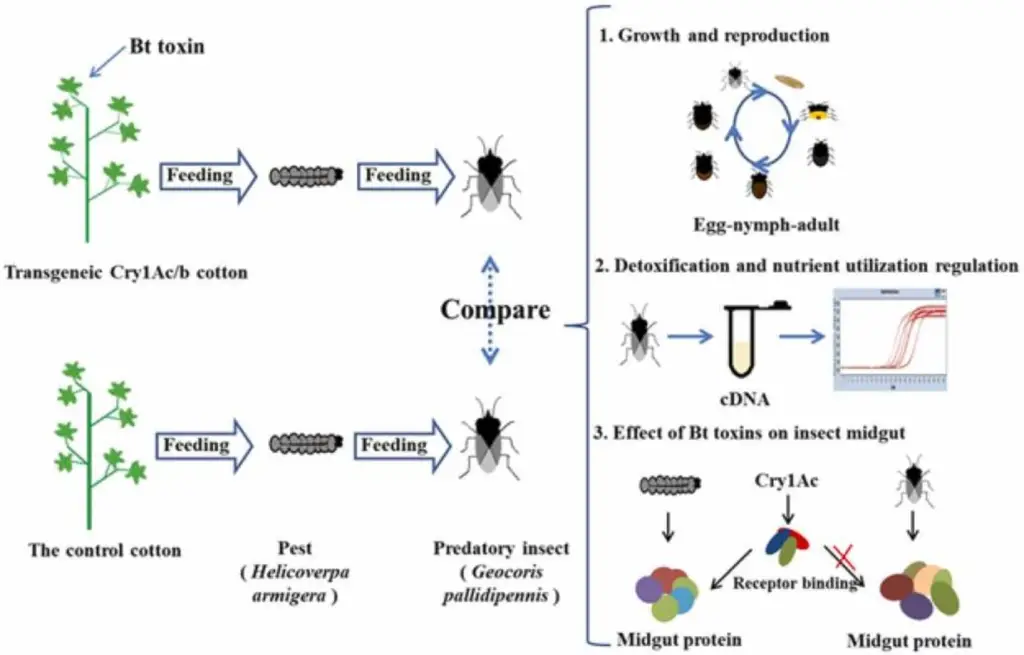
Bt cotton is a genetically modified cotton variety in which genes from the bacterium Bacillus thuringiensis are inserted into the plant, and it is the process that allows the cotton plant to produce Cry proteins within its own tissues. These are insecticidal proteins that act specifically on harmful caterpillar pests like pink bollworm and American bollworm. When the insects feed on any part of the plant, the toxin becomes activated in their alkaline midgut and it is the step where the gut lining is destroyed causing paralysis of digestion and death in a short period. It is important that this toxin affects only insects having specific receptors, therefore it remains harmless to humans and most beneficial insects. The major advantage is reduction in chemical insecticide use, and this helps in lowering pollution, decreasing production cost and improving cotton yield as the plant protects itself naturally.
What is Bacillus thuringiensis?
- It is a naturally occurring gram-positive and spore-forming bacterium found mainly in soil and on plant surfaces.
- It is the microbe that produce protein crystals during the spore-forming stage, and these crystals is called Cry proteins.
- It is the process where insects ingest these crystals and the crystals act on the insect gut and destroy the digestive lining.
- These proteins is activated only in alkaline gut conditions, so they are harmless to humans and other vertebrates.
- It is used as a safe bio-pesticide because it targets only specific insect pests.
- Bt genes is inserted into GM crops like Bt cotton and Bt corn so the plants produce their own insect-killing proteins.
Features of Bt Cotton
- It is a transgenic cotton plant where one or more genes from Bacillus thuringiensis is inserted into the crop genome.
- It is the process where the plant produce Cry proteins inside its tissues, including leaves, squares and bolls.
- These proteins is specific for Lepidopteran pests like tobacco budworm, pink bollworm and American bollworm.
- It is harmless to humans and other non-target organisms because the toxin needs an alkaline insect gut for activation.
- The toxin act as a stomach poison and it is activated only after ingestion of plant tissue, causing gut cell rupture.
- It reduces the use of broad-spectrum chemical insecticides as the plant already contain its own defence mechanism.
- It is helping in protecting the crop yield by preventing bollworm damage although no yield-enhancing gene is present.
- The Bt protein expression decrease as the plant ages which may increase susceptibility in later growth stages.
- Newer Bt cotton varieties contain stacked traits where more than one Bt gene is present to broaden pest control.
Development of Bt Cotton
Development of Bt Cotton
1. Isolation of the Bt Gene
The specific insecticidal gene such as cry gene is isolated from the soil bacterium Bacillus thuringiensis (Bt).
This gene is responsible for the production of insecticidal protein which kills the target pest.
2. Construction of the Transgene Cassette
The isolated Bt gene is combined with other necessary DNA sequences to form a genetic construct. This is referred to as transgene cassette.
The main components are–
Promoter (CaMV 35S promoter) – It acts as an “on switch” and controls the expression of Bt protein inside the plant.
Target gene – It encodes the insecticidal Bt protein.
Terminator sequence – It signals the end of transcription process.
Genetic marker – It is generally an antibiotic or herbicide resistance gene used to identify transformed cells.
3. Gene Insertion (Transformation)
The complete genetic construct is inserted into the cotton plant genome.
This process is achieved by two main methods–
Agrobacterium-mediated transformation – A modified Agrobacterium tumefaciens is used to transfer the Bt gene into plant chromosome.
Microparticle bombardment (Gene gun) – Microscopic gold or tungsten particles coated with DNA are shot into plant tissue at high velocity.
4. Selection of Transformed Cells
After transformation, plant cells are exposed to antibiotic or herbicide linked with the marker gene.
Only those cells which have successfully incorporated the Bt gene is survived.
Untransformed cells do not grow under these conditions.
5. Regeneration and Backcross Breeding
The selected transformed cells are regenerated into whole plants by tissue culture technique.
These plants are then crossed with elite high-yielding cotton varieties through traditional backcross breeding.
This step ensures that desirable agronomic characters are retained.
6. Final Variety Development
After four or five generations of backcrossing, a stable Bt cotton variety is developed.
The final plant retains high yield and fiber quality of parent variety while expressing insect resistant Bt trait consistently.
How is Bt cotton different from conventionally bred cotton?
- It is the genetic makeup that makes the major difference– Bt cotton is genetically engineered and the Bt gene from Bacillus thuringiensis is inserted into the plant tissue. Conventional cotton is produced by traditional breeding methods and these varieties do not carry any foreign bacterial gene.
- It is the process of pest resistance that also separates them– Bt cotton produces Cry proteins inside the plant parts which act as insecticidal proteins. These proteins kill bollworm larvae when they feed on the plant tissue. Conventional cotton does not have this built-in defence so the plants are highly damaged by bollworms.
- Pesticide requirement is different in both– Bt cotton needs fewer chemical sprays because the plant itself is able to resist major caterpillar pests. Conventional cotton is dependent on repeated insecticide sprays during the whole growing season.
- Environmental and health effects is also not the same– Bt cotton reduces the use of toxic chemicals, so beneficial insects are less harmed and the workers are exposed to fewer hazardous sprays. Conventional cotton uses heavy pesticides which pollute soil and water and affects non-target organisms.
- Cost of seeds is also different– Bt cotton seeds are costly because a technology fee is added. Conventional cotton seeds are cheaper and usually reused by farmers.
- Yield obtained from the crop is not the same– Bt cotton shows higher effective yield because bollworm damage is prevented. Conventional cotton often loses yield even after multiple sprays due to pest attack.
- Maturity time shows variation– Bt cotton varieties have been observed to mature earlier by about 20–30 days. Conventional cotton generally takes longer to mature.
- Some of the main features therefore shows that Bt cotton is developed for protection while conventional cotton depends on external control measures.
What is Herbicide-Tolerant (HT) Bt cotton?
- Herbicide–Tolerant (HT) Bt cotton is a stacked transgenic crop.
- It is genetically engineered to contain more than one foreign gene in a single plant.
- One of the inserted gene is Bt gene (from Bacillus thuringiensis) which provides resistance against insect pests.
- Another inserted gene provides tolerance against herbicides.
- It is the process by which both insect resistance and herbicide tolerance are combined in one cotton variety.
- The herbicide tolerant gene allows the plant to survive after spraying of broad-spectrum herbicides such as glyphosate, glufosinate, dicamba, bromoxynil and imidazolinone.
- In this condition weeds are destroyed but the cotton plants is not affected.
- This is referred to as improved weed management in the agricultural field.
- The resistance to herbicide is achieved by insertion of specific gene which may be obtained from bacteria (e.g. Klebsiella ozeanae).
- This inserted gene enables the plant to detoxify the herbicide or modify the target enzyme so that it becomes insensitive to the chemical.
- Due to this trait farmers can spray herbicide directly over the crop without damaging the cotton.
- HT Bt cotton varieties are widely used in modern agriculture and large percentage of cotton area is planted with these stacked seeds.
- It reduces weed competition and insect damage at the same time, thereby improving the yield of cotton crop.
Uses of Bt Cotton
- It is used for targeted pest management in cotton fields.
- It provides in-built biological control against caterpillar pests such as American bollworm, spotted bollworm and pink bollworm.
- It reduces the need of repeated spraying of broad-spectrum chemical insecticides.
- It is used to protect crop from severe insect damage.
- It helps in preventing heavy crop losses in the field.
- This results in increase of overall harvestable yield.
- It stabilizes agricultural production under pest pressure conditions.
- The primary commercial use of Bt cotton is production of lint and fiber.
- The fiber obtained is used in textile and apparel industry similar to conventional cotton.
- The cottonseeds obtained from Bt cotton is used as animal feed.
- Cottonseed oil and other byproducts are used in processed food ingredients.
- It is also used in production of biofuels from cottonseed derivatives.
- Scientists are researching the use of transgenic cotton as a biofactory for production of specific chemicals and proteins for medicinal purpose.
Advantages of Bt Cotton
- It increases the effective yield of cotton crop.
- Bt cotton does not contain a yield enhancing gene, but it prevents severe losses caused by bollworm damage.
- It reduces the use of chemical insecticides in the field.
- The pesticide use is reduced significantly due to in-built Bt toxin in the plant.
- It lowers the expenditure on chemical sprays.
- Higher yield and reduced pesticide cost results in higher net profit to farmers.
- It improves health and safety of farmers and farm workers.
- Reduced spraying of toxic chemicals decreases the risk of pesticide poisoning.
- It helps in lowering environmental pollution in agricultural ecosystem.
- It reduces the toxic load in soil and surrounding environment.
- The Bt toxin is specific to target pests and does not harm beneficial insects such as honey bees, lady beetles and parasitic wasps.
- It helps in maintaining natural biological control in the field.
- The insecticidal protein is produced continuously inside the plant tissues and cannot be washed away by rainfall.
- It saves time and labour as repeated insecticide application is not required.
- Bt cotton varieties have been observed to mature earlier than conventional varieties.
- It improves fiber quality by reducing insect damage to cotton bolls.
- Increased income from Bt cotton cultivation improves the standard of living of farming families.
Limitations of Bt Cotton
- Bt cotton is not effective against secondary pests.
- It does not control insects such as aphids, plant bugs, stink bugs, mirid bugs and boll weevils.
- Because broad-spectrum insecticides are sprayed less frequently, these secondary pests may multiply rapidly.
- In such condition farmers may again require heavy chemical spraying.
- Target pests can develop resistance against Bt toxin.
- This occurs when resistance management practices such as planting non-Bt refuge crops is not properly followed.
- Over time bollworms may adapt genetically and survive against the toxin.
- The expression of Cry protein is not uniform throughout the life cycle of the plant.
- The toxin level decreases as the crop ages, making plants more vulnerable in later stages.
- Bt cotton seeds are more expensive than conventional seeds due to technology fee.
- Farmers cannot save hybrid Bt seeds for next season and must purchase new seeds every year.
- Bt cotton hybrids require high water and nutrient supply.
- They are not suitable for rain-fed regions or marginal soils with poor irrigation.
- High initial cost of seeds, fertilizers and irrigation creates financial risk for farmers.
- If crop fails due to drought or disease farmers may fall into severe debt.
- Some Bt cotton hybrids are susceptible to diseases such as root rot and wilt.
- Continuous release of Bt toxin into soil through root exudates and plant residues may affect soil microorganisms.
- There is risk of purchasing illegal or spurious Bt seeds from black market which can lead to crop failure.
Examples of Bt Cotton
- Bollgard (Bollgard I) – It is the first commercial Bt cotton technology developed by Monsanto. It contains a single insecticidal gene (Cry1Ac).
- Bollgard II – It is a stacked Bt cotton variety containing multiple Bt genes such as Cry2Ab along with Cry1Ac.
- Bollgard III – It contains additional Bt gene such as Vip3A to provide broader pest control and delay resistance.
- WideStrike – It is developed by Dow AgroSciences and expresses stacked Bt toxins such as Cry1Ac and Cry1F.
- WideStrike 3 – It expresses three Bt toxins including Cry1Ac, Cry1F and Vip3A.
- TwinLink Plus – It is a modern stacked-trait Bt cotton expressing multiple insecticidal toxins.
- MECH 12 – It is one of the first approved Bt cotton hybrids in India developed by Mahyco in collaboration with Monsanto.
- MECH 162 – It is an officially approved Bt cotton hybrid for commercial cultivation in India.
- MECH 184 – It is another early approved Bt cotton hybrid cultivated in India.
- NuCotn 33 – It is a Bollgard cotton variety marketed in the USA and South Africa.
- NuCotn 35 – It is an early adopted Bollgard cotton variety.
- NuCOTN 37-B – It is a specific Bollgard Bt cotton variety.
- NuOpal – It is a Bollgard cotton variety introduced in Brazil.
- DP90B – It is a genetically modified Bollgard variety cultivated in Brazil.
- Bikaneri Narma (Bikaneri Nerma) – It is the first indigenous Bt cotton variety developed by public sector institutions in India.
- Vishwanath – It is a Bt cotton hybrid released by Nath Seeds using fusion Bt gene.
- SGK321 – It is a Bt cotton variety widely adopted in China.
- CN-C01 – It is another Bt cotton variety developed in China.
- Seini 1 – It is a Bt cotton variety developed in China and released in Sudan for commercial cultivation.
- Mahyco C 567 BGII – It is a Bollgard II Bt cotton variety cultivated in Nigeria.
- Mahyco C 571 BGII – It is another Bollgard II variety grown in Nigeria.
- JKCH 1947 – It is a Bt cotton genotype developed by JK AgriGenetics.
- JKCH 1050 – It is another Bt cotton genotype developed by JK AgriGenetics.
- NB-151 – It is an early unapproved Bt cotton hybrid sold in Indian black market before official approval.
- Abdallah, N. A. (2014). The story behind Bt cotton: Where does Sudan stand? GM Crops & Food, 5(4), 241–243. https://doi.org/10.4161/21645698.2014.997119
- AgbioInvestor. (2024). Global GM crop area review. The Health Sciences Academy.
- Benardete, A. A. (2016). Unweaving the “development narrative”: Bt cotton and farmer suicides in India. Yale University.
- Bravo, A., Gill, S. S., & Soberón, M. (2006). Mode of action of Bacillus thuringiensis Cry and Cyt toxins and their potential for insect control. Toxicon, 49(4), 423–435. https://doi.org/10.1016/j.toxicon.2006.11.022
- Bt cotton – Easy explanation | Transgenic plants |. (n.d.). YouTube.
- College of Agricultural Sciences. (n.d.). Bacillus thuringiensis (Bt). Oregon State University.
- Department of Climate Change, Energy, the Environment and Water. (n.d.). Ecological impacts of GM cotton on soil biodiversity.
- Economic Research Service. (n.d.). Adoption of genetically engineered crops in the United States – Recent trends in GE adoption. U.S. Department of Agriculture.
- Genetic Literacy Project. (n.d.). Are GMOs to blame for the mass suicides of Indian farmers?
- Gervais, J., Cocks, M., & Mermer, S. (2025). Bacillus thuringiensis (Bt) in genetically modified crops fact sheet. National Pesticide Information Center, Oregon State University Extension Services.
- GRAIN. (n.d.). Bt cotton – the facts behind the hype.
- Hardee, D. D., Van Duyn, J. W., Layton, M. B., & Bagwell, R. D. (2001). Bt cotton & management of the tobacco budworm-bollworm complex. United States Department of Agriculture, Agricultural Research Service.
- Hu, D., Wang, D., Pan, H., & Liu, X. (2025). Molecular mechanisms underlying resistance to Bacillus thuringiensis Cry toxins in lepidopteran pests: An updated research perspective. Agronomy, 15(1), 155. https://doi.org/10.3390/agronomy15010155
- Huang, J., Mi, J., Lin, H., Wang, Z., Chen, R., Hu, R., Rozelle, S., & Pray, C. E. (2010). A decade of Bt cotton in Chinese fields: Assessing the direct effects and indirect externalities of Bt cotton adoption in China. Science China Life Sciences, 53, 981–991.
- Huber, S. A., Roberts, J. K., Shappley, Z. W., & Doherty, S. (2004). Cotton event MON15985 and compositions and methods for detection thereof (U.S. Patent Application Publication No. US20040250317A1). U.S. Patent and Trademark Office.
- Huber, S. A., Roberts, J. K., Shappley, Z. W., & Doherty, S. (2011). Cotton event MON15985 and compositions and methods for detection thereof (U.S. Patent Application Publication No. US20110143346A1). U.S. Patent and Trademark Office.
- International Cotton Advisory Committee. (1999). The ICAC recorder.
- ISAAA. (n.d.). Global status of GM crops – Cotton.
- ISAAA. (2024). MON15985 | GM approval database.
- Kathage, J., & Qaim, M. (2012). Economic impacts and impact dynamics of Bt (Bacillus thuringiensis) cotton in India. Proceedings of the National Academy of Sciences, 109(29), 11652–11656. https://doi.org/10.1073/pnas.1203647109
- Khadi, B. M. (2007). Biotech cotton: Issues for consideration [BT cotton adoption in India]. International Cotton Advisory Committee.
- Market.us. (n.d.). Genetically modified seeds market size, share | CAGR of 7.6%.
- Monsanto ~ Company history. (n.d.). Regulations.gov.
- Muhammad, S. A., Muhammad, U. A., Bashir, T., & Saeed, S. (n.d.). An expression analysis of cry1Ac in BT cotton event MON531.
- Multidecadal, county-level analysis of the effects of land use, Bt… (n.d.). Proceedings of the National Academy of Sciences (PNAS).
- Nester, E. W., Thomashow, L. S., Metz, M., & Gordon, M. (2002). 100 years of Bacillus thuringiensis: A critical scientific assessment. American Society for Microbiology.
- Parkhurst, C. C., & Patel, R. (2009). Genetics of cotton. New Georgia Encyclopedia.
- PBS. (2007). Global cotton industry: Bt cotton farming. Wide Angle.
- Pray, C. E., Nagarajan, L., Huang, J., Hu, R., & Ramaswami, B. (n.d.). Impact of Bt cotton, the potential future benefits from biotechnology in China and India.
- Project Censored. (2013). 21. Monsanto and India’s “suicide economy”.
- Quan, Y., & Wu, K. (2023). Managing practical resistance of lepidopteran pests to Bt cotton in China. Insects, 14(2), 179. https://doi.org/10.3390/insects14020179
- Randhawa, G. J., Chhabra, R., & Singh, M. (2010). Decaplex and real-time PCR based detection of MON531 and MON15985 Bt cotton events. Journal of Agricultural and Food Chemistry, 58(18), 9875–9881. https://doi.org/10.1021/jf100466n
- Reza, R. (2014, January 1). The farmer suicides of India. The Upstream Journal.
- Sadashivappa, P., & Qaim, M. (2009). Bt cotton in India: Development of benefits and the role of government seed price interventions. AgBioForum, 12(2), 172–183.
- Shinde, M. A., Ghorband, C. D., Maindargikar, M. M., Bokharepatil, A. D., & Shinde, S. L. (n.d.). Impact of genetically modified cotton (Bt cotton) on ecosystem: A review. IJSDR.
- Sujan, M. H. K., Kazal, M. M. H., Akhteruzzaman, M., Kundu, S., Islam, M. K., & Rahman, M. S. (2024). Economic viability of releasing Bt cotton in Bangladesh: An early insight. Heliyon, 10(9), e30589. https://doi.org/10.1016/j.heliyon.2024.e30589
- The distinct properties of natural and GM cry insecticidal proteins. (2017). Taylor & Francis.
- Thomas, G., & De Tavernier, J. (2017). Farmer-suicide in India: Debating the role of biotechnology. Life Sciences, Society and Policy, 13(8). https://doi.org/10.1186/s40504-017-0052-z
- Thomazoni, D., Degrande, P. E., Silvie, P. J., & Faccenda, O. (2010). Impact of Bollgard genetically modified cotton on the biodiversity of arthropods under practical field conditions in Brazil. African Journal of Biotechnology.
- U.S. Environmental Protection Agency. (2010). Biopesticide registration action document: Bacillus thuringiensis Cry1Ac protein and the genetic material (vector PV-GMIR9) necessary for its production in MON 87701 soybean.
- UT Crops. (n.d.). Bt cotton.
- Vadakattu, G., & Watson, S. (2004). Ecological impacts of GM cotton on soil biodiversity: Below ground production of Bt by GM cotton and Bt cotton impacts on soil biological processes. CSIRO Land and Water.
- Wikipedia. (n.d.). Monsanto.
- Witjaksono, J., Wei, X., Mao, S., Gong, W., Li, Y., & Yuan, Y. (2014). Yield and economic performance of the use of GM cotton worldwide over time: A review and meta-analysis. China Agricultural Economic Review, 6(4), 616–643. https://doi.org/10.1108/CAER-02-2013-0028
- Wu, K.-M. (2007). Environmental impact and risk management strategies of Bt cotton commercialization in China. Chinese Journal of Agricultural Biotechnology, 4(2), 93–97. https://doi.org/10.1017/S1479236207001490
- Yamamoto, T. (2022). Engineering of Bacillus thuringiensis insecticidal proteins. Journal of Pesticide Science, 47(2), 47–58. https://doi.org/10.1584/jpestics.D22-016
- Zhao, G., Geng, Z., Liu, J., Tian, H., Liu, X., An, Z., Zhao, N., Zhang, H., Wu, L., & Zhang, G. (2024). Identification of crucial modules and genes associated with Bt gene expression in cotton. Genes, 15(4), 515. https://doi.org/10.3390/genes15040515