

Algae are simple, mostly aquatic and photosynthetic organisms. They are different from land plants because true root, stem and leaves are absent. Vascular tissues are also absent.
The plant body of algae is simple. It is not differentiated into different plant parts. This type of body is called thallus.
Algae show great variation in size and form. Some are microscopic and unicellular. Some are large and multicellular like giant kelp. It may grow up to about 65 meters long.
Chlorophyll is the main photosynthetic pigment of algae. But algae may be green, red, brown, blue-green or golden in colour. This colour variation is due to presence of different pigments.
Algae do not have single common evolutionary origin. So they are called polyphyletic group. Eukaryotic algae are placed under Protista. Prokaryotic blue-green algae or cyanobacteria are placed under Monera.
Different Modes of Algae Reproduction
The reproduction in algae takes place by three main methods. These are vegetative reproduction, asexual reproduction and sexual reproduction.
- Vegetative reproduction
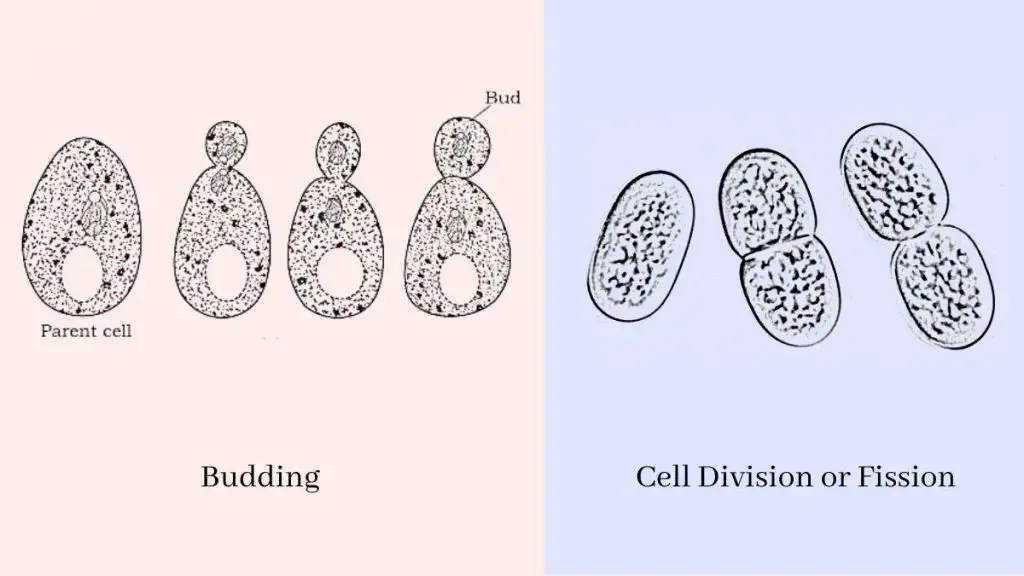
In this method, new plants are formed from vegetative part of the algal body. No spore and gamete is formed. It is common in simple algae.- a. Cell division or fission– In unicellular algae, the parent cell divides into two daughter cells. Each daughter cell becomes a new plant.
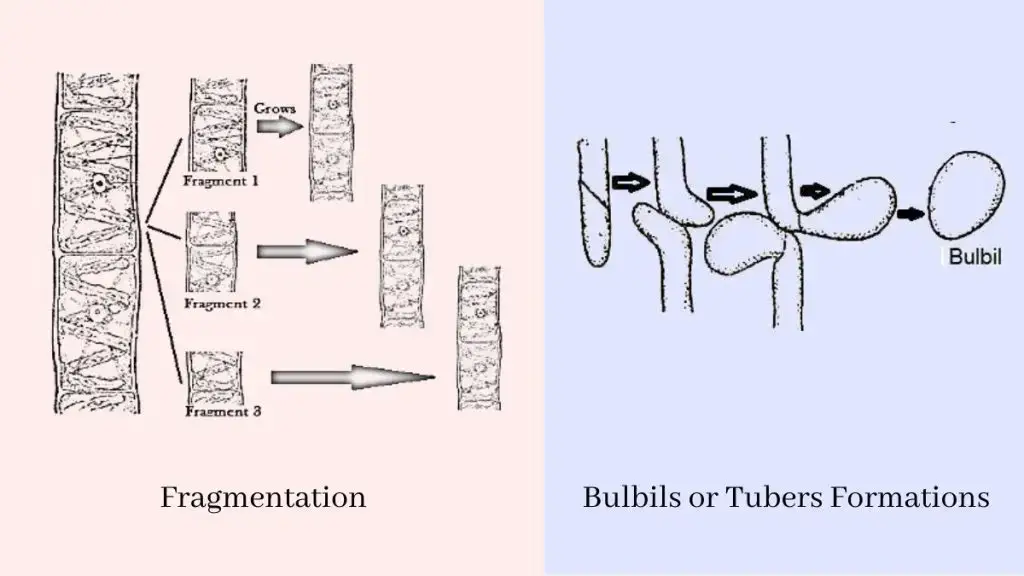
- b. Fragmentation– In this method, the filament or thallus breaks into small pieces. Each piece grows into a new individual.
- c. Splitting of colony– In some colonial algae, the mature colony splits into small colonies. Each part grows into new colony.
- d. Hormogonia– In some filamentous forms, the trichome breaks into small motile fragments. These fragments are called hormogonia. They grow into new plants.
- e. Vegetative bodies– Some algae form tubers, bulbils and amylum stars. These are swollen or starch filled bodies. They separate from parent and form new plant.
- f. Adventitious branches– Special branches are formed on the thallus. These branches get detached and grow into new plant.
- g. Budding– In this method, small bud like outgrowth is formed. It is separated from parent cell by septum. Later it forms new plant.
- Asexual reproduction
In this method, reproduction takes place by formation of spores. Fusion of gametes is absent. The spores germinate and form new algal plant.- a. Zoospores– These are motile spores. Flagella are present. They swim for some time, lose flagella and germinate into new plant.
- b. Aplanospores– These are non-motile spores. They are thin walled. They are generally formed during unfavourable condition.
- c Hypnospores– These are thick walled resting spores. They contain much reserve food. They survive during harsh condition.
- d. Akinetes– These are thick walled vegetative cells. They survive dry and unfavourable condition. Later they germinate.
- e. Autospores– These are non-motile spores. They look like small form of parent cell. They develop into new individuals.
- f. Endospores and exospores– These are small non-motile spores. Endospores are formed inside the parent cell. Exospores are formed outside the parent cell.
- g. Carpospores and tetraspores– These spores are common in red algae and some other algae. They are non-motile. They germinate and form new plant.
- Sexual reproduction
In this method, two gametes fuse together. After fusion, diploid zygote is formed. The zygote later gives rise to new plant.- a. Isogamy– In this type, both gametes are same in size, shape and structure. They fuse to form zygote.
- b. Anisogamy or heterogamy– In this type, gametes are similar in shape but unequal in size. One gamete is larger and less active.
- c. Oogamy– It is advanced type of sexual reproduction. Male gamete is small, active and motile. Female gamete is large and non-motile.
- d. Autogamy– In this type, two nuclei of same mother cell fuse together. It is a type of self fertilization.
- e. Hologamy– In this type, whole vegetative cells behave as gametes. Two cells of opposite strains fuse directly.
1. Vegetative Methods of Reproduction in Algae
The following are the vegetative methods of reproduction in algae–
- Simple cell division or binary fission
This method is found in unicellular algae. The nucleus divides by mitosis. After this, cytoplasm divides and two daughter cells are formed. Each daughter cell acts as new individual. - Fragmentation
It is common in filamentous algae. The filament or colony breaks into two or more pieces. This break may occur due to mechanical injury, intercalary decay or separation disc. Each fragment again grows by mitotic division and forms new plant. - Splitting of colonial forms
In this method, mature colony splits into small colonies. These small parts separate from parent colony. Each part increases in size and forms new full colony. - Hormogonia formation
This method is found in blue green algae. The filament or trichome breaks into small many celled pieces called hormogonia. The breakage occurs due to death of intercalary cells or formation of necridia. Each hormogonium glides away and forms new plant. - Formation of adventitious branches
Some large algae form special branches on internodes or stolons. These branches may be protonema like. When they detach from main plant body, they form their own attachment and grow into new individual. - Budding
In this method, small vesicle like outgrowths are formed from parent cell. These are called buds. A septum separates the bud from parent cell. The bud later detaches and develops into new plant. - Tubers and bulbils
These are swollen vegetative structures. They are formed on lower nodes or rhizoids. They contain stored food, lipids and starch. They detach from parent plant and remain dormant in mud or sediments. On favourable condition, they germinate into new plant. - Amylum stars
These are star shaped cell clusters. They are filled with amylum starch. They are formed on basal nodes of some algae. They detach and act like vegetative seeds. Later they produce new plants.

2. Asexual Reproduction or Reproduction by Spores
Asexual reproduction in algae takes place by formation of spores. The spores are formed from the protoplast of parent cell. Fusion of gametes is absent in this method.
The following are the important methods of asexual reproduction in algae–
- Zoospores
Zoospores are naked and motile spores. They are formed inside the parent cell or zoosporangium. They are produced in favourable condition. They have flagella which may be two, four or many. Eyespot may also be present. After swimming for some time, they lose flagella and germinate into new plant. - Synzoospores
Synzoospore is a large compound zoospore. It is multinucleate and many flagellated. It helps in quick dispersal in water. It is found in some algae. - Aplanospores
Aplanospores are non-motile spores. They are thin walled and without flagella. They are formed in unfavourable condition like drought or high salinity. When favourable condition comes, they germinate into new plant. - Hypnospores
Hypnospores are thick walled resting spores. They are formed during severe unfavourable condition. The spore becomes rounded and forms thick secondary wall. Food reserve is also stored inside. They remain dormant and later germinate. - Autospores
Autospores are non-motile spores. They are formed inside the parent cell by mitotic division. They look like small form of parent cell. Flagella are absent. They are released by rupturing of parent cell wall. - Akinetes
Akinetes are thick walled resting cells. In this method, whole vegetative cell becomes enlarged. It stores much reserve food and forms thick wall. They survive dry and cold condition. They may remain dormant in sediments for long time. - Tetraspores
Tetraspores are haploid non-motile spores. They are formed inside tetrasporangium. The diploid nucleus divides meiotically and forms four spores. After release, they germinate into male and female gametophytes. - Endospores and exospores
Endospores are small spores formed inside the mother cell. They are released when mother cell wall breaks. Exospores are formed outside the parent cell. They are cut off from the exposed end of parent protoplast. - Palmella stage
In dry condition, some algae form palmella stage. The cells divide repeatedly but flagella are not formed. The cells remain embedded in mucilage. When water is available, they form flagella and come out as active zoospores.
3. Sexual Reproduction
Sexual reproduction in algae takes place by fusion of two gametes. The gametes are haploid. After fusion, diploid zygote is formed. This method brings genetic variation in algae.
The following are the types of sexual reproduction in algae–
- Isogamy
It is the simplest type of sexual reproduction. In this type, two fusing gametes are similar in size, shape and structure. The gametes may be motile and flagellated. Sometimes they may be non-motile also. - Anisogamy or heterogamy
In this type, the two gametes are different in size and behaviour. The male gamete is smaller and more active. It is called microgamete. The female gamete is larger and less active. It is called macrogamete. - Oogamy
It is the advanced type of sexual reproduction. In this type, male gamete is small and motile. It is called sperm or antherozoid. Female gamete is large, non-motile and food rich. It is called egg or ovum. - Autogamy
It is a type of self fertilization. In this method, two gametes or nuclei of same parent cell fuse together. The zygote is formed but new genetic variation is not formed. - Hologamy
This type is found in some unicellular algae. The whole vegetative cells act as gametes. Two compatible cells fuse directly and form diploid zygote. - External fertilization
In this method, male and female gametes are released in water. Fusion takes place outside the parent body. It is common in many aquatic algae. - Internal fertilization
In this method, female gamete remains inside the female reproductive organ called oogonium. The motile male gamete swims and enters the oogonium. Then it fuses with the egg. - Conjugation
It is found in some filamentous algae. Two filaments come close and form conjugation tubes. The cell content of one filament moves through the tube. It fuses with the cell content of another filament and forms zygote.

Alternation of Generation
Alternation of generation is the life cycle of algae where two phases are present. One phase is haploid and other phase is diploid. It is also called metagenesis.
The following are the main points of alternation of generation in algae–
- Haploid phase
The haploid phase is called gametophyte. It has n number of chromosomes. It produces gametes by mitosis. These gametes fuse and form zygote. - Diploid phase
The diploid phase is called sporophyte. It has 2n number of chromosomes. It develops from the fertilized zygote. It produces haploid spores by meiosis. - Isomorphic alternation of generation
In this type, gametophyte and sporophyte look similar. Both are almost same in shape and structure. It is seen in Ulva and Ectocarpus. - Heteromorphic alternation of generation
In this type, gametophyte and sporophyte are different in shape and size. In Laminaria, the diploid sporophyte is large kelp body and haploid gametophyte is microscopic. In Porphyra, the gametophyte is the main large body. - Triphasic alternation
This type is found mainly in red algae. In this life cycle, three phases are present. These are haploid gametophyte, diploid carposporophyte and diploid tetrasporophyte. Example is Polysiphonia.
Thus in algae, the life cycle may show change between gametophyte and sporophyte. This change of haploid and diploid generation is known as alternation of generation.
Factors affecting algal reproduction
The following are the factors affecting algal reproduction–
- Light
Light is important for reproduction of algae. Intensity of light, duration of light and type of light affect cell division, gamete formation and spore formation. Less light slows down reproduction. Very high light may cause photo-inhibition. - Temperature
Every alga has a suitable temperature for reproduction. Very high or very low temperature affects formation of spores and gametes. Sudden change in temperature may change vegetative growth into asexual or sexual reproduction. - Nutrient availability
Nutrients like nitrogen, phosphorus, iron and silica help in rapid growth and reproduction. High nutrients may cause algal bloom. Lack of nutrients, mainly nitrogen, may start sexual reproduction or resting spore formation. - Salinity and pH
Change in salinity affects reproduction of algae. It may start some reproductive process in some forms. Very acidic or very alkaline water affects enzymes and metabolism. So gamete formation may be reduced. - Water movement and oxygen
Water movement helps in mixing of nutrients. It also helps in dispersal of spores and gametes. In still water oxygen may become low and reproduction is affected. In some algae, sudden less water movement may start asexual spore release. - Sex pheromones
In some algae, reproduction is controlled by chemical substances. These are called sex pheromones. In Volvox and Eudorina, these substances are released in water and start male gamete formation. - Physical injury
Mechanical injury also affects algal reproduction. Wave action, grazing animals or breaking of thallus may cause fragmentation. The broken parts again grow and form new algal plants.
Algal Reproductive Adaptations
The following are the important reproductive adaptations of algae–
- Formation of dormant spores
Some algae form thick walled resting spores. These spores survive dry, cold and other unfavourable condition. Akinetes are enlarged vegetative cells with stored food. Hypnospores have thick resistant wall and contain lipids and carotenoids. - Zygospore formation
After sexual reproduction, the zygote forms a thick wall around it. This dormant structure is called zygospore. It can survive freezing and long dry condition. When condition becomes favourable, it germinates. - Nutrient storage structures
Some macroalgae form storage structures during nutrient deficiency. In Chara, tubers and bulbils are formed on lower nodes or rhizoids. They contain amylum starch and lipids. They remain dormant in mud and later grow into new plant. - Palmella stage
In dry condition, some motile algae stop forming flagella. The cells divide but remain inside mucilage. This is called palmella stage. It protects the cells from drying. When water comes, the cells again form flagella and come out. - Freezing tolerance
Some algae change their membrane lipids during cold stress. In red algae like Bangia, lipid desaturation occurs. This helps in freezing tolerance. It also helps in release of asexual spores during winter low tides. - Regeneration after injury
Algal body may break by wave action or grazing animals. The remaining part again grows into new shoot. Sometimes holdfast also regenerates new vegetative body. This is useful when high temperature or nutrient lack is present. - Change in reproductive method
Algae can change their reproduction according to environmental condition. In favourable condition, asexual reproduction takes place fast. It gives many new individuals. In stress condition, sexual reproduction starts. It gives genetic variation. - Alternation of generation
Some algae show change between gametophyte and sporophyte phase. The haploid phase forms gametes. The diploid phase gives protection against harmful mutation. This life cycle helps in survival, dispersal and reproduction of algae.
References
- Al-Barzinjy, Y. O. (n.d.). Algae reproduction. Biology Dept.
- Algal reproductive strategies: Structural mechanics, evolutionary transitions, and environmental triggers. (n.d.).
- Amon, P., Haas, E., & Sumper, M. (1998). The sex-inducing pheromone and wounding trigger the same set of genes in the multicellular green alga Volvox. Plant Cell, 10(5), 781–789.
- Barman, D. (n.d.). Algae reproduction. Goalpara College.
- Biology LibreTexts. (n.d.). 14.5: Life cycles.
- Characteristics of algae. (n.d.).
- Checking your browser – reCAPTCHA. (n.d.).
- Diatom identification including life cycle stages through morphological and texture descriptors. (n.d.). PMC.
- Extracellular matrix and sex-inducing pheromone in Volvox. (n.d.). ResearchGate.
- Gametogenesis in the Chlamydomonas reinhardtii minus mating. (n.d.). PMC.
- Gametogenesis in the Chlamydomonas reinhardtii minus mating type is controlled by two genes, MID and MTD1. (n.d.). ResearchGate.
- Gilbert, S. F. (2000). Plant life cycles. In Developmental biology (6th ed.). Sinauer Associates.
- Goodenough, U., Lin, H., & Lee, J.-H. (2007). Sex determination in Chlamydomonas. Seminars in Cell & Developmental Biology, 18, 350–361.
- Juyal, P. (n.d.). Course name-Biology and diversity of algae, bryophyta and pteridophyta (Paper Code: BOT 502). Uttarakhand Open University.
- Kawai-Toyooka, H., Ono, M., Hamaji, T., Nozaki, H., & Hirono, M. (2025). Synergistic effects of proteinaceous pheromone and nitrogen starvation on male gametogenesis in the anisogamous volvocine alga Eudorina. PLoS ONE, 20(11), e0326066.
- Life cycle of algae. (n.d.). SlideShare.
- Morphology and life history of Amphora commutata (Bacillariophyta) II: Sexual reproduction and auxosporulation, with special reference to auxospore wall structures. (n.d.). Taylor & Francis.
- Nitric oxide–triggered remodeling of chloroplast bioenergetics and thylakoid proteins upon nitrogen starvation in Chlamydomonas reinhardtii. (n.d.). PMC.
- Reproduction in algae. (n.d.). Kamrup College.
- Reproduction in algae. (n.d.). LND College, Motihari.
- Reproduction in algae. (n.d.). SlideShare.
- Reproduction in algae. (n.d.).
- Research on the regulatory mechanism of algae reproduction. (n.d.). PMC.
- Sahoo, A. (2022, January 10). Reproduction in algae with examples. Biology Learner.
- Sato, S., Mann, D. G., Nagumo, T., Tanaka, J., Tadano, T., & Medlin, L. K. (2008). Auxospore fine structure and variation in modes of cell size changes in Grammatophora marina (Bacillariophyta). Phycologia, 47(1), 12–27.
- Sexual pheromone induces diffusion of the pheromone. (n.d.). PMC.
- Sharma, N. (2025, June 17). Algal reproduction: Asexual and sexual life cycles. Microbe Notes.
- Synergistic effects of proteinaceous pheromone and nitrogen starvation on male gametogenesis in the anisogamous volvocine alga Eudorina. (n.d.). bioRxiv.
- The epigenetic origin of life history transitions in plants and algae. (n.d.). PMC.
- Tutorsglobe. (2023). Reproduction and life cycle in algae.
- U.S. National Office for Harmful Algal Blooms. (2019). Diatom – Harmful algal blooms. Woods Hole Oceanographic Institution.
- Vedantu. (n.d.). Algae reproduction and life histories made simple.
- Wikipedia contributors. (2026, March 30). Asexual reproduction. In Wikipedia, The Free Encyclopedia.
- Wikipedia contributors. (2025, October 21). Autospore. In Wikipedia, The Free Encyclopedia.
- Wikipedia contributors. (2025, October 13). Auxospore. In Wikipedia, The Free Encyclopedia.