

Hot air oven is a specialized laboratory and industrial equipment used for dry heat sterilization, drying and thermal processing. It is an electrical device having thermostatically controlled insulated chamber, where hot air is circulated. The normal temperature range is about 50°C to 300°C.
It is mainly used for sterilization of materials which are heat-resistant but moisture-sensitive. These include glassware, metal surgical instruments, powders and oils. As the process is done without moisture, it prevents rusting, corrosion and damage by water.
The working of hot air oven is based on continuous dry heat. During this process, microorganisms, viruses and bacterial spores are destroyed by oxidation, protein denaturation and dehydration. The hot air acts as a lethal agent and makes the materials free from harmful microorganisms.
The origin of hot air oven is related with the work of French scientist Louis Pasteur in the late 19th century. He was trying to remove spoilage causing organisms from wine without changing its taste and quality. He observed that short exposure to dry heat can kill harmful microorganisms.
This idea later helped in the development of the Pasteur oven. It is considered as the historical precursor of modern hot air oven. Now it is used in scientific, pharmaceutical and medical fields for safe sterilization and drying of different materials.
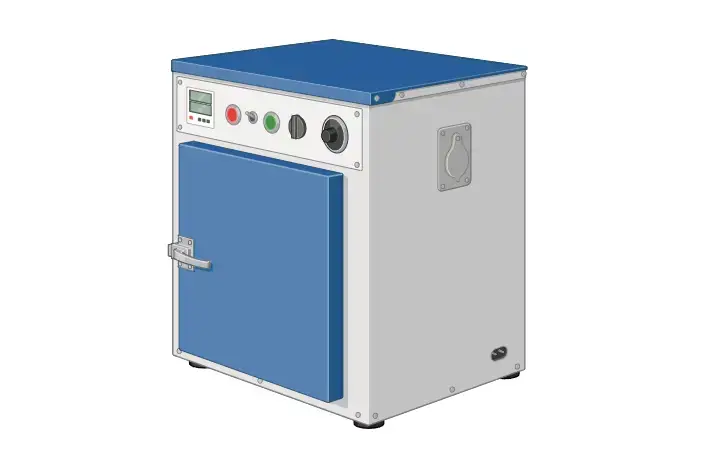
Working Principle of Hot air oven/Principle of Hot Air Oven
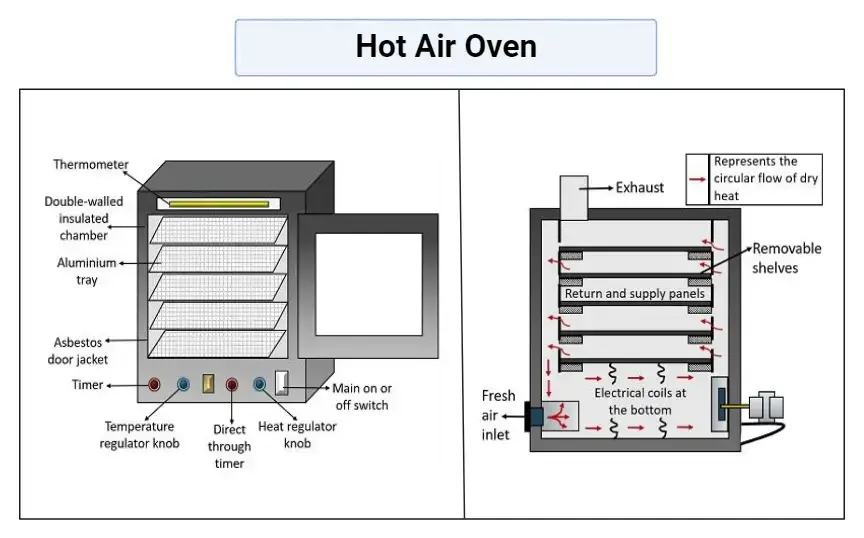
Principle of Hot Air Oven is based on dry heat sterilization. In this process, high temperature dry air is used to kill microorganisms present on the materials. It uses convection, conduction and radiation for proper heating.
The electrical heating elements produce high temperature inside the oven. The fan or blower circulates this hot air continuously throughout the chamber. This helps in uniform distribution of heat and prevents cold spots.
The hot air first heats the outer surface of the materials. Then the heat slowly passes inside towards the centre by conduction. In this way, the whole material gets heated properly.
During this process, the dry heat removes intracellular water from microbial cells. It also causes oxidation of cellular structures and denaturation of important proteins and enzymes. As a result bacteria, viruses, fungi and spores are destroyed completely.
Parts of Hot air oven
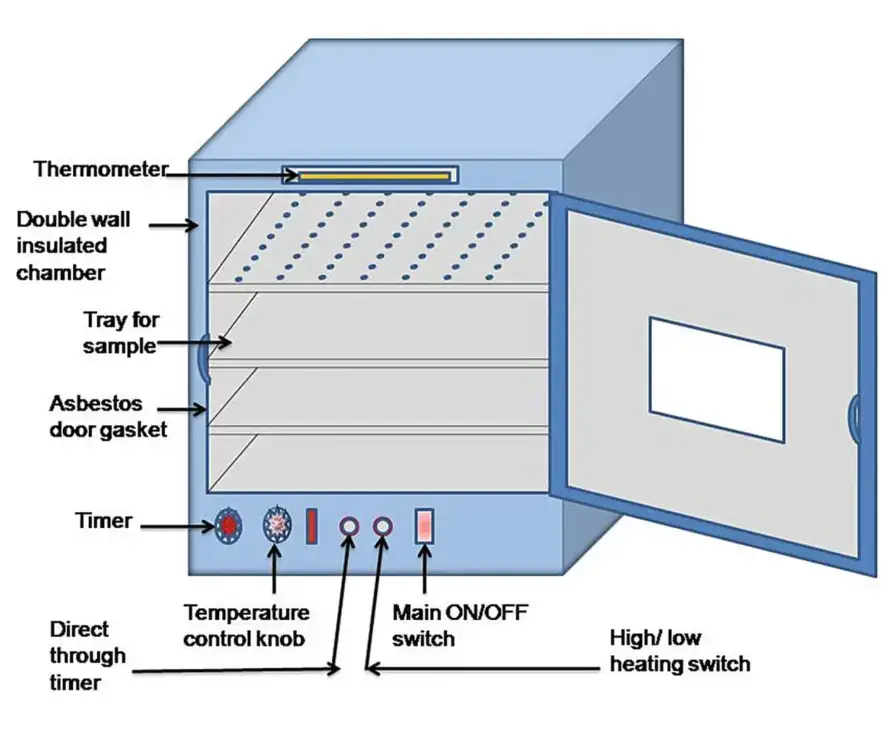
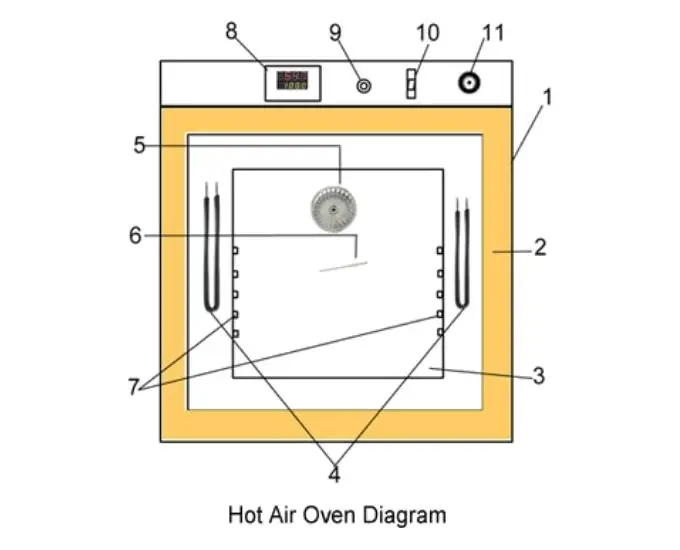
The hot air oven is made up of different parts, which are as follows-
- Outer body or cabinet
It is the outer structure of the hot air oven. It is generally made up of powder coated mild steel, stainless steel or aluminium. It gives mechanical support to the oven and protects from mechanical shocks and corrosion. - Inner chamber
The inner chamber is the inside space where materials are kept for sterilization. It is commonly made up of stainless steel or anodized aluminium. It helps in easy cleaning, durability and even reflection of heat. - Insulation layer
It is present between the outer body and inner chamber. It is made up of glass wool, ceramic fibre or fiberglass. This layer prevents heat loss, increases energy efficiency and protects the user from high outer temperature. - Heating elements
Heating elements are electric resistive coils or nichrome wires. These are generally present at the bottom, sides or back side of the oven. They produce high temperature needed for dry heat sterilization. - Air circulation fan or blower
It is a motor driven fan used to circulate hot air inside the chamber. It helps in uniform distribution of heat. It also removes cold spots and helps in proper sterilization of materials. - Shelves or racks
Shelves are adjustable and removable trays used to keep the materials. These are made up of wire mesh, chrome plated metal or stainless steel. They allow free movement of hot air around the articles. - Gasket door
It is an insulated heavy hinged door fitted with silicone or asbestos free gasket. It helps to retain heat inside the oven. Some doors also contain glass window for observation of materials inside the chamber. - Temperature controller or thermostat
It is used to control and maintain the required temperature inside the oven. It may be analog dial type or digital PID controller. It prevents overheating by regulating the temperature. - Sensors and timers
Sensors like PT-100 temperature sensor give real time temperature data. Timers are used to maintain the exact time of sterilization cycle. These may be digital or mechanical type. - Ventilation or exhaust system
It consists of adjustable vents present in the oven. It allows controlled removal of moisture during drying process. It also helps in escape of expanding gases. - Control panel
Control panel is present on the outer side of the oven. It contains temperature setting buttons, on/off switch, timer, safety control and indicator lights. It is used for operating the hot air oven. - Power supply and fuses
Power supply gives electrical energy to the oven. Fuses are used as safety components. They protect the oven from high current and short circuit damage.
Types of Hot Air Oven
Different types of hot air oven are mentioned below-
- Gravity convection or static-air oven
This type of hot air oven works by natural convection. In this, hot air rises upward and cool air moves downward, forming slow heating cycle. It does not use fan, so the air movement is gentle. It is suitable for lightweight powders or materials which may be disturbed by forced air. But the temperature distribution may not be very uniform. - Forced air or mechanical convection oven
This oven contains a motorized fan or blower. The fan pushes hot air throughout the inner chamber. It gives fast and even heat distribution and removes cold spots. It is mostly useful for precise scientific work and industrial drying process. - Side draught oven
Side draught oven has unidirectional flow of hot air. In this oven, hot air moves from one side of the chamber to the other side. This steady air current helps the materials to absorb heat quickly. It is used for fast preheating of plastic hospital garments and sterilization of flat materials like sheets and metal plates. - Infrared hot air oven
Infrared hot air oven uses infrared heating elements for heating. It raises the temperature very fast. It is more energy efficient and faster than common resistive coil ovens. It is used for precision drying and material testing. - Vacuum oven
Vacuum oven works by using heat under vacuum condition. In this type, the materials are dried, cured or heated under low pressure. It is useful for materials which need drying without normal atmospheric pressure. - Programmable or smart oven
This type of oven has digital control system. It allows the user to store particular temperature and time settings. It can automatically run heating cycles at selected time. Some smart ovens can also be controlled by smart devices.
Operating procedure of Hot air oven
Operating Procedure of Hot Air Oven
- First the materials are cleaned and dried. Moisture should not present, because hot air oven works by dry heat. Glasswares are wrapped with kraft paper, newspaper or aluminium foil. Test tubes and flasks are plugged with non-absorbent cotton wool.
- The oven is plugged in and switched on. The chamber is kept for preheating for about 30 minutes. This is done before putting the materials inside.
- The materials are then placed on the shelves. Space is kept between one material and another material. This is needed for movement of hot air. The chamber should not be overcrowded. Materials should not touch the wall and floor of the oven.
- The door is closed tightly. The temperature and time are set as required. Usually 160°C for 2 hours or 170°C for 1 hour is used for sterilization.
- The cycle is started. The temperature is observed during the process. The door is not opened in between the cycle. If the door is opened, heat is lost and sterilization may not occur properly.
- After the time is over, the oven is switched off. The oven is allowed to cool slowly up to about 40°C. The door is opened only after cooling. Sudden cooling may break glasswares due to thermal shock.
- The sterilized materials are removed carefully. Heat resistant gloves or tongs are used for taking out the materials. After removing all materials, the door is closed to avoid dust and dirt entry inside the chamber.
Calibration of Hot air Oven
Calibration of Hot Air Oven
- First a fixed temperature is selected for calibration. It may be 100°C, 150°C or 200°C. Then the oven is switched on and heating is started.
- A certified reference thermometer or thermocouple probe is placed inside the chamber. It is kept near the centre of the oven. If uniform heating is checked, then the probes are placed at different points of the chamber.
- The door is closed properly. The oven is allowed to run till the temperature becomes stable. In convection type oven, it usually takes about 30 to 45 minutes.
- The temperature shown in the oven display is then noted. At the same time, the temperature shown by the reference thermometer is also noted. Both readings are compared.
- If both readings are same or within the allowed limit, then the oven is considered calibrated. The accepted difference is generally about ±2°C.
- If there is more difference between the readings, then adjustment is done. The temperature controller or digital PID setting is corrected as given in the manual of the oven.
- All the calibration details are recorded properly. Date, selected temperature, observed reading, difference and adjustment done are written in the record. This is needed for traceability and audit purpose.
- Calibration is done at regular interval. It is generally done by trained person. Regular calibration helps to maintain accuracy, laboratory safety, long life of oven and quality standards like GMP and ISO 17025.
Sterilization Control of Hot air Oven
Sterilization control of hot air oven is done by using biological and chemical indicators. These indicators are used to check whether proper dry heat sterilization has occurred or not. The following are the methods-
- Biological Indicators (BIs)
Biological indicators are considered as the gold standard for sterilization validation. In this method, highly heat resistant bacterial spores are used to check whether microorganisms are killed or not.- Test Organism
The organism used for dry heat sterilization is generally Bacillus atrophaeus. It was formerly known as Bacillus subtilis var. niger. - Placement of Spore Strips or Vials
Spore strips or vials are placed in different locations throughout the oven load. They are usually kept in those areas where heat may reach slowly. - Incubation and Result
After sterilization cycle, the spore strips or vials are incubated. If there is no microbial growth, the sterilization is confirmed as successful.
- Test Organism
- Chemical Indicators (CIs)
Chemical indicators contain heat sensitive dyes. These dyes show permanent colour change when required time and temperature conditions are reached. The colour may change from green to dark brown or black.- Type 1 Process Indicators
These are external tapes or adhesive labels placed outside the materials. They are used to identify which packs are processed and which are not processed. - Type 4 Multi-Variable Indicators
These indicators are placed deep inside the packs or loads. They are used to check that both required temperature and time are achieved at the core. - Type 5 Integrating Indicators
These are advanced indicators which respond to all critical parameters of sterilization cycle. They give assurance nearly similar to biological indicators. - Type 6 Emulating Indicators
These indicators are used for checking specific and special sterilization cycles. They are high precision indicators and used for accurate cycle verification.
- Type 1 Process Indicators
Advantages of Hot Air Oven
- Hot air oven is useful for dry heat sterilization. It kills bacteria, viruses, fungi and spores by using high temperature. Moisture is not needed in this process.
- It is safe for moisture sensitive materials. Powders, oils and electrical components can be sterilized or dried in hot air oven. These materials may be damaged by water.
- It does not use steam or water. So metal surgical instruments and laboratory instruments do not get rusting and corrosion.
- It gives uniform heating inside the chamber. Modern ovens have fan or blower for movement of hot air. So all materials get heat more equally.
- It is easy to operate. The control panel, timer and thermostat are simple to use. Very much technical training is not required.
- It can be used for continuous operation. It can maintain stable high temperature for several hours. So it is useful for long drying and testing cycles.
- Hot air oven is less costly than autoclave. It does not need water connection, steam generator and pressure valve. So purchase and maintenance cost is low.
Limitations of Hot air oven
- Hot air oven is not suitable for heat sensitive materials. High temperature like 160°C to 180°C can melt or damage plastics, rubber, fabrics and surgical dressings.
- It takes more time for sterilization. Dry heat moves slowly than moist heat. So the sterilization cycle takes about 1 to 2 hours.
- Dry heat has less penetration power. It cannot easily enter into thick, porous or tightly packed materials. If the oven is overloaded, sterilization may not occur properly.
- It needs more electricity for working. High temperature is maintained for long time. So the running cost may increase.
- There may be chance of overheating and fire. This may occur due to defective temperature control or blocked ventilation ports.
- Flammable liquids and volatile chemicals should not be kept inside. These materials may catch fire and cause hazard.
- It is less effective against some resistant organisms. Some highly heat resistant bacterial endospores and prions may not be destroyed properly by dry heat.
Applications of hot air oven
- Hot air oven is used in laboratories and microbiology for dry heat sterilization. Heat resistant glasswares like test tubes, petri dishes, pipettes and flasks are sterilized by this method.
- It is used for sterilizing metal instruments. Scalpels, forceps and scissors are sterilized in hot air oven. These materials are not damaged by dry heat.
- It is used for drying washed laboratory equipments. It is also used for preparing laboratory samples. Powders and oils which are moisture sensitive are sterilized by using hot air oven.
- In pharmaceutical and medical field, hot air oven is used for sterilizing medical tools and surgical instruments. Drug containers, glass ampoules, vials and syringes are also sterilized.
- In pharmaceutical manufacturing, it is used for depyrogenation. This means removal of bacterial endotoxins from glass materials. It is also used for treatment of anhydrous materials.
- In food industry, it is used for sterilizing food processing equipments. Utensils and packaging containers are also sterilized by hot air oven.
- It is used for removing moisture from food samples. This is done during stability testing. It is also used to create storage condition for shelf-life testing.
- In material science and electronics, hot air oven is used for drying electronic components before assembly. This prevents short circuit.
- It is used for baking, curing and drying of adhesives, polymers and coatings. It is also used for testing thermal stability and aging of plastics and rubber.
- In textile industry, hot air oven is used for testing colour fastness. It is also used to check fabric durability and shrinkage under dry heat. Fabric finishes are cured by this oven.
- In cosmetic industry, it is used for sterilizing packaging materials, cosmetic oils, creams and bottles. This helps to maintain hygienic condition during production.
Precautions of Hot Air Oven
- Hot air oven is kept on a flat and stable place. The place should have good ventilation. Any flammable things should not kept near the oven.
- The oven should be grounded properly. It is done to prevent electrical shock. The power supply should match with the company specification.
- The materials are washed and dried before keeping inside. Water should not remain on the materials. Dirt and organic matter also should removed because it interfere with dry heat sterilization.
- Combustible materials are not kept inside the oven. Volatile solvents, rubber and low melting plastics are avoided. These may melt or catch fire.
- Glasswares are wrapped with aluminium foil or kraft paper. The mouth of flasks and test tubes are plugged with non-absorbent cotton wool.
- The chamber is not overcrowded. Space is kept between the materials. It helps in free movement of hot air. If the air cannot move properly, cold spots are formed and sterilization may not be complete.
- The materials should not touch the inner wall and floor of oven. These parts become very hot. It may damage the materials.
- The oven is preheated before loading the samples. This helps to start the sterilization at proper temperature.
- The door is not opened during the cycle. Opening of door causes heat loss. It also disturb the temperature inside the chamber and may cause burn to the operator.
- After the cycle is over, the oven is allowed to cool slowly. The door is opened when temperature comes near 40°C. Sudden cooling may crack or break glasswares.
- Heat resistant gloves or tongs are used during unloading. It prevents burn injury and falling of hot materials.
- Sterilized materials are handled with clean gloves or sterile instruments. This prevents re-contamination before use.
Hot Air Oven Working Principle Video
References
- Consolidated Sterilizer Systems. (n.d.). How to validate an autoclave. https://consteril.com/wp-content/uploads/2017/06/Consteril_Autoclave_Validation.pdf
- STERIS Life Sciences. (2018, November 7). 6 ISO types of chemical indicators for steam sterilization. https://www.sterislifesciences.com/Resources/Technical-Learning-Library/Technical-Learning-Library-Folder/Articles/6-ISO-Types-of-Chemical-Indicators-for-Steam-Sterilization
- Sipcon Instrument. (2025, May 22). A complete guide for hot air oven in laboratories. Cablemeasurement. https://cablemeasurement.com/blog/a-complete-guide-for-hot-air-oven-in-laboratories/
- A complete guide to temperature mapping in the lab. (n.d.). Lab Manager. https://www.labmanager.com/a-complete-guide-to-temperature-mapping-in-the-lab-33471
- Presto Enviro. (2025, August 14). A complete guide to using hot air oven. https://www.prestoenviro.com/blogs/a-complete-guide-to-using-hot-air-oven
- ZX Laboratory Equipment Suppliers. (2024, January 17). A guide to proper maintenance and calibration of laboratory ovens. https://www.zxwylab.com/20248.html
- Pacorr. (n.d.). A step-by-step guide to operate a laboratory hot air oven. https://www.pacorr.com/blog/a-step-by-step-guide-to-operate-a-laboratory-hot-air-oven/
- Ases Chemical Works. (2025, January 29). Autoclave vs hot air oven: Key differences & best uses for sterilization. https://ases.in/blogs/news/difference-between-autoclave-and-hot-air-oven
- McDonald, K. (2023, June 11). Best practices for maintenance of a laboratory oven. Laboratory Supply Network. https://labsup.net/blogs/blog/best-practices-for-maintenance-of-a-laboratory-oven
- SSI Diagnostica Group. (n.d.). Chemical indicator oven. SSID. https://ssid.com/disease-areas/general-microbioligy/indicators/chemical-indicator-oven/
- GKE. (2026, January 8). Understanding chemical indicator classification: Your guide to sterilization monitoring. https://gke-healthcare.com/gke-blog/understanding-chemical-indicator-classification-sterilization-monitoring-guide
- STERIS. (n.d.). Chemical indicators for steam sterilization. https://www.steris.com/healthcare/products/sterility-assurance-and-monitoring/chemical-indicators
- Comprehensive analysis of hot air oven technology: Thermodynamics, microbial inactivation, and validation protocols. (n.d.).
- Harrier Enterprises. (n.d.). Difference between hot air oven and autoclave. https://www.harriergroups.com/mufflefurnace/difference-between-hot-air-oven-and-autoclave/
- Mishra, R. (2026, May 4). Dry heat sterilization | Principles, benefits and formula. Testronix Instruments. https://www.testronixinstruments.com/blog/dry-heat-sterilization-principles-benefits-and-formula/
- Sandle, T. (n.d.). Dry heat sterilization… Pharmaceutical Microbiology Resources. https://www.pharmamicroresources.com/2022/02/dry-heat-sterilization-explained.html
- Presto Group. (n.d.). Fundamental of laboratory hot air oven. Presto Testing Instruments. https://www.prestogroup.com/blog/fundamental-of-laboratory-hot-air-oven/
- Presto Group. (n.d.). Hot air oven guide: Everything you need to know. Testing Instruments. https://www.testing-instruments.com/blog/hot-air-oven-guide-everything-you-need-to-know/
- Presto Enviro. (2025, October 6). Hot air oven sterilization: How it works guide. https://www.prestoenviro.com/blogs/hot-air-oven-sterilization-how-it-works-guide
- Bionics Scientific. (n.d.). Hot air oven temperature and time chart complete guide. https://bionicsscientific.com/blogs/hot-air-oven-temperature-time/
- Unfried, A. (n.d.). Hot air oven for sterilization: Definition & working principle. Study.com. https://study.com/academy/lesson/hot-air-oven-for-sterilization-definition-working-principle.html
- Mishra, R. (2026, January 7). Hot air oven vs autoclave: What is the difference. Testronix Instruments. https://www.testronixinstruments.com/blog/hot-air-oven-vs-autoclave/
- Bionics Scientific. (n.d.). Hot air oven vs autoclave: Which is best for dry sterilization?. https://bionicsscientific.com/blogs/hot-air-oven-vs-autoclave/
- Malhotra, G. (2025, June 28). Hot air oven vs autoclave: Which is best for dry sterilization?. Presto Testing Instruments. https://www.prestogroup.com/blog/hot-air-oven-vs-autoclave-which-is-best-for-dry-sterilization/
- Presto Instruments. (2025, April 14). Hot air oven: Diagram, principle, types, and applications. Presto Enviro. https://www.prestoenviro.com/blogs/hot-air-oven-diagram-principle-types-and-applications
- Karki, P. (2024, May 26). Hot air oven: Principle, parts, types, uses, examples. Microbe Notes. https://microbenotes.com/hot-air-oven/
- Wikipedia contributors. (2026, January 14). Hot air oven. Wikipedia, The Free Encyclopedia. https://en.wikipedia.org/wiki/Hot_air_oven
- Gram BioLine. (2025, February). Introducing 9-point temperature mapping. https://gram-bioline.com/en-en/news-knowledge/introducing-9-point-temperature-mapping/
- Pakmo Testing Instrument Pvt. Ltd. (n.d.). Maintenance tips for laboratory hot air oven. https://pakmo.in/blog/calibration-and-maintenance-tips-for-laboratory-hot-air-ovens/
- Labindia Instruments. (2025, October 2). Mastering sterilization: The ultimate guide to using hot air ovens for effective disinfection. https://www.labindiainstruments.com/blog-details/2/mastering-sterilization-the-ultimate-guide-to-using-hot-air-ovens-for-effective-disinfection
- Centers for Disease Control and Prevention. (2023, December 11). Other sterilization methods. Infection Control. https://www.cdc.gov/infection-control/hcp/disinfection-sterilization/other-sterilization-methods.html
- Daylight Medical. (2026, April 19). Sterilization process validation: Your guide to chemical and biological indicators. https://daylightmed.com/blog/sterilization-process-validation-your-guide-to-chemical-and-biological-indicators
- Contronics. (2026, February 24). Temperature mapping explained | ISO 17025 standard guide. https://contronics.co.uk/news-articles/iso-17025-temperature-mapping/
- Nguyen, A. (2025, March 20). Temperature mapping: A critical process for maintaining compliance. Dickson Data. https://dicksondata.com/temperature-mapping-quality-compliance
- Konradsen, J. (n.d.). Temperature mapping: Tips, frameworks, and pitfalls. Eupry. https://eupry.com/temperature-mapping/
- iGene Labserve. (n.d.). The laboratory hot air oven: Applications, key features, and essential maintenance. https://www.igenels.com/the-laboratory-hot-air-oven-applications-key-features-and-essential-maintenance/
- Mishra, R. (2026, February 2). Top 10 maintenance tips for laboratory hot air ovens. Testronix Instruments. https://www.testronixinstruments.com/blog/laboratory-hot-air-oven-maintenance-tips/
- Whitcomb, J. G. (2026, February 11). Use of biological indicators in sterilization validations. LexaMed. https://www.lexamed.com/use-of-biological-indicators-in-sterilization-validations/
- Choudhary, A. (2026, May 8). Validation of biological indicators for sterilization. Pharmaguideline. https://www.pharmaguideline.com/2026/05/validation-of-biological-indicators.html
- SenseAnywhere. (n.d.). What are the ISO 17025 requirements for temperature monitoring calibration?. https://www.senseanywhere.com/what-are-the-iso-17025-requirements-for-temperature-monitoring-calibration/
- Mishra, R. (2025, December 31). What is hot air oven? Diagram, uses, temperature & time. Testronix Instruments. https://www.testronixinstruments.com/blog/uses-of-hot-air-ovens-in-laboratories/
- Henderson, A. (2019, July 3). What is temperature mapping and why is it needed?. Henderson Biomedical. https://henderson-biomedical.co.uk/blog/temperature-mapping-what-is-it-and-why-is-it-needed/