

Gel electrophoresis system is a laboratory setup used for separation of charged biological molecules. It is used for DNA, RNA and proteins.
It contains a gel box, gel matrix, running buffer and power supply. The gel matrix may be agarose or polyacrylamide. The buffer conducts electric current and keeps the molecules moving properly.
When electric current is applied, the charged molecules move through the gel. DNA and RNA are negatively charged, so they move towards positive electrode.
The gel acts as a molecular sieve. Small molecules pass through the pores easily and move faster. Large molecules move slowly and remain nearer to the well.
After separation, the molecules form bands in the gel. These bands are seen by using staining dye and imaging system. Fluorescent stains are commonly used for DNA and RNA.
The basis of electrophoresis was developed by Arne Tiselius for separation of proteins. Later solid gel materials were used, so the separated molecules did not mix again.
Agarose gel and polyacrylamide gel made the method more useful. SDS-PAGE was later developed for separation of proteins according to molecular weight.
At present gel electrophoresis is used in molecular biology, genetics, clinical laboratory and forensic work. It is also used after PCR for checking amplified DNA fragments.
Principle of Gel Electrophoresis
Principle of Gel Electrophoresis is based on movement of charged molecules through a gel under electric field. The molecules are separated according to their size and charge.
In this method the sample is loaded into wells of agarose or polyacrylamide gel. The gel is placed in buffer and electric current is applied.
DNA and RNA have negative charge because phosphate group is present in their backbone. So they move towards the positive electrode.
The gel acts as a molecular sieve. It has small pores through which the molecules move.
Small fragments pass through the gel pores more easily. So they move faster and travel longer distance.
Large fragments move slowly because they face more resistance in the gel. So they remain nearer to the well.
Thus the mixture of DNA, RNA or proteins is separated into different bands. The smallest molecules move farthest and larger molecules move less distance.
Parts of Gel Electrophoresis Apparatus
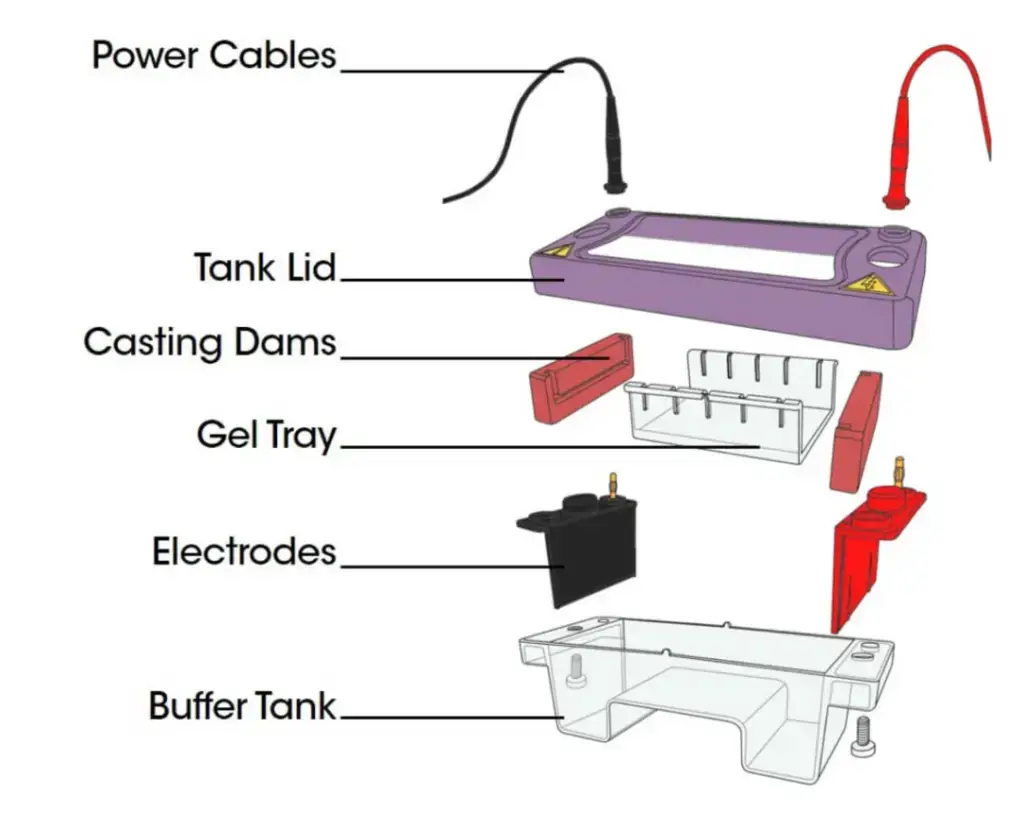
The following are the parts of Gel Electrophoresis Apparatus–
- Electrophoresis chamber
It is the main tank of the apparatus. It holds the running buffer and gel during electrophoresis. - Gel tray
It is the platform where liquid gel is poured. The gel is allowed to solidify on this tray. - Comb
It is a toothed instrument placed in the gel before solidification. It makes wells in the gel for loading the sample. - Buffer dam
It is used to close the open ends of gel tray during gel casting. It prevents leakage of liquid gel. - Electrodes
These are thin wires present in the chamber. They produce electric field through the buffer and gel. - Anode
It is the positive electrode of the apparatus. It is usually marked with red colour. - Cathode
It is the negative electrode of the apparatus. It is usually marked with black colour. - Power supply
It gives direct electric current to the electrophoresis chamber. The voltage and current can be adjusted according to the experiment. - Lead wires
These wires connect the chamber with the power supply. They carry current from power supply to the electrodes. - Banana plugs
These are plug ends of the lead wires. They are inserted into the power supply sockets. - Lid
It covers the electrophoresis chamber during running. It protects the user from electric shock. - Running buffer
It is the liquid present inside the chamber. It conducts electricity and helps the movement of DNA, RNA or proteins through the gel.
Types of Electrophoresis
The following are the types of Electrophoresis–
- Agarose gel electrophoresis
It uses agarose gel as supporting medium. It is mainly used for separation of large DNA and RNA fragments. - Polyacrylamide gel electrophoresis
It is also called PAGE. It uses polyacrylamide gel with small pores and gives high resolution separation of proteins and small nucleic acid fragments. - Native PAGE
In this method proteins are separated in their natural form. The proteins are not denatured and separation depends on natural size, charge and shape. - SDS-PAGE
It is a denaturing electrophoresis method. Sodium dodecyl sulfate (SDS) unfolds the proteins and gives them negative charge, so proteins are separated mainly by molecular weight. - Isoelectric focusing
It is also called IEF. Proteins are separated according to their isoelectric point. The protein stops moving at the pH where its net charge becomes zero. - Two-dimensional electrophoresis
It is a two step electrophoresis method. First proteins are separated by IEF according to charge and then by SDS-PAGE according to molecular weight. - Pulsed-field gel electrophoresis
It is also called PFGE. It is used for separation of very large DNA fragments by changing the direction of electric field. - Denaturing gradient gel electrophoresis
It is also called DGGE. It separates DNA fragments of same length but different sequence by using chemical denaturant gradient. - Temperature gradient gel electrophoresis
It is also called TGGE. It separates nucleic acids by using temperature gradient, because different sequences melt at different temperature. - Capillary electrophoresis
In this method separation takes place inside a thin glass capillary tube. It is automated and used in forensic, clinical and rapid sample analysis. - Paper electrophoresis
It is an older electrophoresis method. It uses buffer soaked paper strip and is used for separation of small molecules like amino acids and peptides.
Chemicals and Reagents Used in Electrophoresis
The following are the chemicals and reagents used in Electrophoresis and their purpose-
- Agarose
It is used for preparing gel. It forms porous gel matrix and is mainly used for separation of large DNA and RNA fragments. - Acrylamide and Bis-acrylamide
These are used for preparing polyacrylamide gel. This gel has small pores and is used for separation of proteins and small nucleic acid fragments. - Ammonium persulfate (APS)
It is used to start gel formation in PAGE. It produces free radicals and starts polymerization of acrylamide. - TEMED
It is used with APS. It makes free radical formation faster and helps the polyacrylamide gel to set quickly. - Sodium dodecyl sulfate (SDS)
It is used in SDS-PAGE. It unfolds the proteins and gives negative charge to them, so proteins move according to their molecular weight. - Beta-mercaptoethanol and DTT
These are used for reducing disulfide bonds in proteins. They help to make the protein chain open and straight. - TAE buffer
It is used as running buffer for DNA electrophoresis. It is useful for larger DNA fragments and also for DNA recovery from gel. - TBE buffer
It is also used as running buffer. It gives good buffering capacity and is useful for smaller DNA fragments and long run. - Glycerol, Ficoll or Sucrose
These are used in loading dye. They make the sample heavy, so the sample settles at the bottom of well. - Tracking dyes
Bromophenol blue, xylene cyanol and Orange G are used as tracking dyes. They show the movement of sample during electrophoresis. - EDTA
It is used in buffer and loading dye. It binds metal ions and stops nuclease activity, so DNA and RNA are protected. - Ethidium bromide
It is used for staining DNA and RNA. It binds with nucleic acid and gives fluorescence under UV light. - SYBR Green and SYBR Safe
These are also used for staining nucleic acids. They are safer stains than ethidium bromide. - Coomassie Brilliant Blue
It is used for staining protein bands in polyacrylamide gel. After staining, protein bands become visible. - Silver stain
It is used when very small amount of protein or nucleic acid is present. It is more sensitive than ordinary staining. - Urea and Formamide
These are used as denaturing agents. They prevent folding of nucleic acids by breaking hydrogen bonds. - Isopropanol or Butanol
These are layered over liquid polyacrylamide gel during casting. They stop oxygen contact and help to make a flat gel surface.
Procedure of Electrophoresis
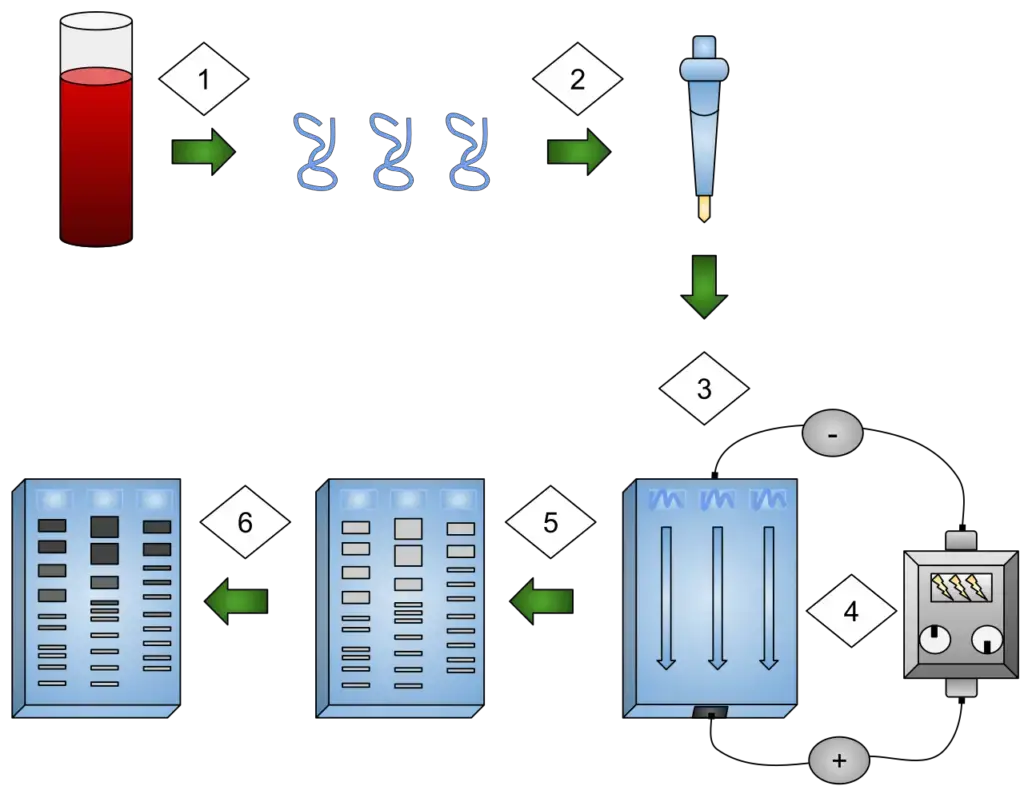
The following are the procedures of Electrophoresis–
- Agarose powder is mixed with electrophoresis buffer like TAE or TBE. The mixture is heated until agarose dissolves completely.
- The agarose solution is allowed to cool little. Then it is poured into the casting tray and comb is inserted for making wells.
- The gel is left undisturbed until it becomes solid. After solidification, the comb is removed carefully.
- The gel is placed inside the electrophoresis chamber. Running buffer is added until the gel becomes fully covered.
- The sample is mixed with loading dye. The dye gives colour and makes the sample heavy, so it settles into the well.
- The sample and molecular weight marker or ladder are loaded into the wells by micropipette. The wells should not be broken during loading.
- The lid is placed on the gel box. The electrodes are connected correctly with power supply.
- The negative end should be near the sample wells. DNA and RNA are negatively charged, so they move towards positive electrode.
- The power supply is switched on and proper voltage is set. The gel is allowed to run until the tracking dye moves sufficient distance.
- After running, the power supply is switched off. The gel is removed carefully from the chamber.
- If stain is not already present, the gel is kept in staining solution. Fluorescent dye is used for seeing the bands.
- The gel is observed under UV transilluminator or blue light imaging system. The separated bands are seen and photographed for analysis.
Applications of Electrophoresis
The following are the applications of Electrophoresis–
- It is used in medical and clinical diagnosis. Serum protein disorders, monoclonal gammopathy, multiple myeloma, liver disease, nutritional status and hemoglobinopathies like sickle cell disease and thalassemia can be studied by this method.
- It is used for diagnosis of genetic diseases. Mutations related with cystic fibrosis, hereditary breast cancer and other inherited diseases can be detected.
- It is used in forensic science. DNA fingerprinting and STR analysis are done for matching suspect sample with crime scene sample.
- It is used for human identification. Unknown human remains, disaster victims and paternity cases can be identified by DNA analysis.
- It is used in molecular biology research. DNA and RNA fragments produced by PCR or restriction enzyme digestion can be separated and their size can be estimated.
- It is used for purification of nucleic acids. Separated DNA or RNA fragments can be used later for sequencing, Southern blotting and Northern blotting.
- It is used for protein analysis. Molecular weight, charge, purity and expression level of proteins can be studied by electrophoresis.
- It is used for detection of genetic variation. Single nucleotide polymorphism (SNPs) and other changes in genetic material can be analysed.
- It is used in evolutionary and wildlife study. Endangered species identification, migration pattern and phylogenetic relationship between species can be studied.
- It is used for microbial community analysis. Soil, water and host microbiome samples can be studied for changes in microbial population.
- It is used in food and industrial work. Specific probiotic strains can be identified and checked for food, medical and environmental products.
- It is used in nanotechnology study. Metal and metal oxide nanoparticles like gold, silver and zinc oxide can be separated according to size, shape and surface property.
Advantages of Electrophoresis
The following are the advantages of Electrophoresis–
- It gives high resolution separation. Complex mixture of DNA, RNA and proteins can be separated clearly.
- It gives precise result. Some special electrophoresis methods can separate molecules which differ by only one base pair.
- It is simple to perform. Slab gel electrophoresis is easy and used in routine laboratory work.
- It is useful for quick checking of sample. PCR products, restriction fragments and protein samples can be checked visually.
- It is comparatively low cost method. The apparatus and reagents are cheaper than many advanced analytical instruments.
- It is flexible method. Gel concentration can be changed according to size of molecule to be separated.
- It can be modified into many special types. 2D electrophoresis, PFGE and DGGE are used for special separation needs.
- It has wide application. It is used in clinical diagnosis, forensic science, genetic engineering and microbial ecology.
- It needs small amount of sample. Capillary and microfluidic electrophoresis can work with very small sample volume.
- It can give fast result in advanced systems. Some automated electrophoresis methods give rapid and sensitive separation.
Limitations of Electrophoresis
The following are the limitations of Electrophoresis–
- It cannot separate very large DNA fragments properly. In ordinary gel, fragments above 20-50 kb may move almost in same way and proper separation is not obtained.
- Heat may be produced during running. This is called Joule heating and it may melt the gel, damage the sample or produce curved bands.
- Some chemicals used in electrophoresis are hazardous. Polyacrylamide is toxic before polymerization and ethidium bromide is mutagenic stain.
- It has limited sensitivity in ordinary gel method. Very small amount of DNA or protein may not be seen clearly.
- Buffer may become exhausted during long run. If ions are depleted, pH changes and separation becomes poor.
- Band smearing may occur easily. Overloaded sample, high salt, protein contamination or bad gel preparation may give smeared bands.
- Complex mixtures are difficult to interpret. Mixed DNA samples or fragments of very close size may not be separated clearly.
- Molecular weight estimation may not always be accurate. In SDS-PAGE, glycosylation, protein shape and unusual amino acid composition may change migration.
- It is time taking and mostly manual method. Traditional slab gel electrophoresis has low throughput than automated methods like capillary electrophoresis.
Precautions of Electrophoresis
The following are the precautions of Electrophoresis–
- Hazardous chemicals should be handled carefully. Ethidium bromide is mutagenic, acrylamide is neurotoxic and chemicals like TEMED and formamide are also harmful, so nitrile gloves and proper protective dress should be used.
- Acrylamide and other volatile or harmful chemicals should be handled in fume hood as far as possible. Direct inhalation and skin contact should be avoided.
- While heating agarose, the flask lid should be kept loose. Otherwise pressure may build up inside the flask.
- Agarose solution should be heated in short intervals. Over-boiling and evaporation should be avoided.
- Hot agarose flask should be handled with heat resistant gloves or cloth. Direct touching may cause burn.
- The electrophoresis chamber should be handled carefully. The platinum electrodes are very thin and may break during cleaning or rough handling.
- Sample should be loaded gently into the wells. Pipette tip should not pierce the bottom of wells because sample may leak out.
- After sample loading, the gel tray should not be moved or shaken. The sample may come out from the wells.
- The lid of electrophoresis chamber should be fitted properly before switching on the power. This prevents electric shock.
- Power supply should be switched off before connecting or removing cords. Wet hand should not be used near electric connection.
- While observing gel under UV transilluminator, eye and face protection should be used. UV light may damage eyes and skin.
- Gel should not be exposed to UV light for long time. Long exposure may damage or degrade DNA.
Common Problems in Electrophoresis and their Troubleshoot
The following are the common problems in Electrophoresis and their troubleshoot-
- Faint or missing bands
It occurs due to low amount of sample, degraded sample, insufficient staining, reversed electrode connection or over running of gel. More sample should be loaded, fresh and nuclease free reagent should be used, electrode connection should be checked and the run should be stopped when tracking dye reaches near the bottom. - Smeared or blurry bands
It occurs due to high voltage, excess heat, incomplete gel setting, overloaded wells, old running buffer or degraded DNA, RNA or protein. Voltage should be reduced, gel should be allowed to set properly, sample amount should be reduced and fresh running buffer should be used. - Poorly separated bands
It occurs when gel percentage is not suitable for the fragment size, run time is less, sample is overloaded or wrong buffer is used. Proper gel concentration should be selected, gel should be run for longer time and suitable buffer like TAE or TBE should be used according to sample size. - Smiling or curved bands
It occurs due to uneven heating of the gel. The centre of the gel becomes hotter and sample moves faster in the middle. Voltage should be decreased and gel should be run for longer time, or chilled buffer may be used. - Sample floating or leaking from well
It occurs due to less glycerol in loading dye, solvent carryover in sample or damaged wells. Proper loading dye should be used, sample should be purified to remove ethanol or other solvent and comb should be removed carefully after complete solidification of gel. - Edge effect or distorted side bands
It occurs when outer wells are left empty. This may disturb the electric field near the side lanes. Empty wells should be filled with sample buffer or blank DNA or protein solution. - Gel running too slow or too fast
It occurs due to wrong concentration of running buffer. Too concentrated buffer gives slow run and too dilute buffer gives fast run. Buffer stock should be diluted properly to 1X working concentration. - No movement of sample
It occurs when power supply is not working, buffer is not added properly or electrodes are not connected. Power supply, lead wires, buffer level and electrode position should be checked before running. - Bands running in wrong direction
It occurs due to reversed electrode connection. The wells should be near the negative electrode for DNA and RNA, because they move towards positive electrode. - Gel melting during run
It occurs due to high voltage or long running time. Voltage should be reduced and running buffer should be kept at proper level to remove heat.
References
- Labcorp. (n.d.). 001487: Protein Electrophoresis, Serum.
- IUPAC. (n.d.). 9.6 ELECTROPHORESIS Electrophoretic separation techniques have been developed and refined over decades, and are now widely used.
- Herkimer, E. (n.d.). A Deep Dive into STR Analysis. Sorenson Forensics.
- Menter, P. (n.d.). Acrylamide Polymerization: A Practical Approach. Bio-Rad Laboratories.
- PubMed. (n.d.). Agarose gel electrophoresis for the separation of DNA fragments.
- Ali, T. (2024). Agarose vs Polyacrylamide: A Comparative Analysis. Assay Genie.
- American Academy of Family Physicians. (2022). Alpha- and Beta-thalassemia: Rapid Evidence Review.
- PubMed. (n.d.). Alpha-1 Antitrypsin Deficiency Screening Using Serum Protein Electrophoresis.
- Warwick, T. (2024). An Easy SDS-PAGE Gel Recipe & 10-Step Protocol. Bitesize Bio.
- Analysis of the Effectiveness of DNA Quality Using the Short Tandem Repeat Combined DNA Index System (STR CODIS) –TH01 in Forensic Identification. (2025). Proceeding of International Conference on Medical Science & Health.
- Bento Bio. (n.d.). Biotechnology 101 Guide: Introduction to Gel Electrophoresis.
- Teach Genetics. (2006). Build a Gel Electrophoresis Chamber. University of Utah.
- FBI. (n.d.). CODIS and NDIS Fact Sheet.
- Capillary Electrophoresis vs Gel Electrophoresis: Comparing Separation Techniques. (n.d.).
- LabX. (n.d.). Capillary Electrophoresis vs. Gel Electrophoresis: A Comprehensive Guide.
- Kroemer, T. (n.d.). Choosing Between TAE buffer and TBE Buffer for Agarose Gel Electrophoresis. GoldBio.
- Keren, D. F. (2003). Clinical Evaluation of Hemoglobinopathies: Part II. Structural Changes. Warde Report, 14(3).
- ResearchGate. (n.d.). Clinical and Forensic Applications of Capillary Electrophoresis.
- Comprehensive Analysis of Gel Electrophoresis Systems: Scientific Foundations, Methodologies, and Clinical-Forensic Applications. (n.d.).
- QIAGEN. (n.d.). DNA analysis using analytical gels.
- Creative Biolabs. (n.d.). Denaturation Gradient Gel Electrophoresis.
- Department of Environmental Sciences. (n.d.). Denaturing Gradient Gel Electrophoresis (DGGE). University of Toledo.
- Creative Enzymes. (n.d.). Denaturing Gradient Gel Electrophoresis.
- PubMed. (n.d.). Denaturing gradient gel electrophoresis (DGGE).
- Everse, S. J. (2014). Electrophoresis.
- Electrophoresis. (n.d.).
- Wikipedia contributors. (2026). Electrophoresis. Wikipedia, The Free Encyclopedia.
- teamBiofargo. (2026). EtBr vs. SYBR Safe vs. GelRed: Which DNA Stain is Best? Biofargo.
- UC Santa Barbara Sustainability. (n.d.). Ethidium Bromide: Swap or Not.
- Gel Electrophoresis. (n.d.). Nature Publishing Group.
- Barrick Lab. (n.d.). Gel Electrophoresis.
- UNC Physics. (n.d.). Gel Electrophoresis.
- Cicek, S. (2015). Gel Electrophoresis. iGEM Toronto.
- Thomas Scientific. (n.d.). Gel Electrophoresis Equipment.
- Carrillo, A. (2023). Gel Electrophoresis Steps Explained | Protocol, Timing & Key Equipment. Azure Biosystems.
- jorodeo. (n.d.). Gel Electrophoresis System (mini) : 7 Steps (with Pictures). Instructables.
- PatSnap Eureka. (2025). Gel Electrophoresis in Forensic Science: Key Innovations.
- Dalvoy. (2020). Gel Electrophoresis: Principle & Applications | UPSC Mains ZOOLOGY 2020.
- Khan Academy. (n.d.). Gel electrophoresis (article).
- Griffitts Lab. (n.d.). Gel electrophoresis. Microbiology and Molecular Biology, Brigham Young University.
- Wikipedia contributors. (2026). Gel electrophoresis. Wikipedia, The Free Encyclopedia.
- Chakravarty, P. R. (n.d.). GelRed vs. Ethidium Bromide: A Comprehensive Look. GoldBio.
- Sridhar, A., & Idowu, M. (2021). Hemoglobin Electrophoresis in Sickle Cell Disease: A Primer for the Clinician. Hematology.org.
- Cleveland Clinic. (2026). Hemoglobin Electrophoresis: Test, Procedure & Results.
- UCSF Health. (n.d.). Hemoglobin electrophoresis.
- Shop Genomics. (2026). How to Fix Gel Electrophoresis Smearing: A Step‑by‑Step Guide.
- PatSnap Eureka. (2025). How to Select Optimal Staining Methods in Gel Electrophoresis?
- The Wolbachia Project. (n.d.). Lab 4: Gel Electrophoresis. Vanderbilt University.
- Thermo Fisher Scientific. (n.d.). Loading Dye in Gel Electrophoresis.
- PMC. (n.d.). Modification of gel architecture and TBE/TAE buffer composition to minimize heating during agarose gel electrophoresis.
- Thermo Fisher Scientific. (n.d.). Nucleic Acid Detection on Gels, Blots and Arrays—Section 8.4.
- Thermo Fisher Scientific. (n.d.). Nucleic Acid Gel Electrophoresis Troubleshooting.
- Thermo Fisher Scientific. (n.d.). Nucleic Acid Gel Electrophoresis—Overview and History.
- ResearchGate. (n.d.). On the reptation theory of gel electrophoresis.
- Zimm, B. H., & Levene, S. D. (1992). Problems and prospects in the theory of gel electrophoresis of DNA. Quarterly Reviews of Biophysics, 25(2), 171-204.
- Bio-Rad. (n.d.). Protein Electrophoresis Methods.
- Chakravarty, P. R. (n.d.). Protein Electrophoresis Using SDS-PAGE: A Detailed Overview. GoldBio.
- MedlinePlus. (n.d.). Protein Electrophoresis by Immunofixation Blood Test. National Library of Medicine.
- Thermo Fisher Scientific. (n.d.). Protein Gel Electrophoresis Chamber Systems.
- Youtube. (n.d.). SDS PAGE | Stacking vs Resolving gel.
- Wikipedia contributors. (2025). SDS-PAGE. Wikipedia, The Free Encyclopedia.
- Sigma-Aldrich. (n.d.). Sample Prep & Gel Electrophoresis Troubleshooting.
- Office of the Inspector General. (2004). Standards Governing Forensic DNA Analysis – Special Report. Department of Justice.
- Shop Genomics. (2025). TAe vs TBe Buffer: A Clear Comparison for Your Lab Work.
- Shop Genomics. (2025). TAe vs TBe Buffer: A Clear Comparison for Your Lab Work.
- International Myeloma Foundation. (n.d.). Tests to assess monoclonal protein.
- TotalLab. (n.d.). The Essential Guide to 2D Electrophoresis.
- LabX. (n.d.). Troubleshooting Common Electrophoresis Problems and Artifacts.
- Chakravarty, P. R. (n.d.). Troubleshooting SDS-PAGE Gel Running Issues. GoldBio.
- Creative Proteomics. (2018). Two dimensional gel electrophoresis (2-DE).
- O’Connell, T. X., Horita, T. J., & Kasravi, B. (2005). Understanding and Interpreting Serum Protein Electrophoresis. Am Fam Physician, 71(1), 105-112.
- National Institute of Justice. (2011). What Is STR Analysis?
- ResearchGate. (n.d.). What are the key differences between agarose and polyacrylamide gels in terms of their use in gel electrophoresis?
- QIAGEN. (n.d.). What buffer conditions give the best resolution for agarose gel electrophoresis?
- Your Genome. (n.d.). What is gel electrophoresis?
- Oswald, N. (n.d.). Which is Best: TAE, TBE or Something Else? Bitesize Bio.