

Centrifuge tube is a specialized tube that is used to hold liquid samples during centrifugation. It is made up of strong and durable material so that it can tolerate high rotational force without breaking or leakage. It is commonly used in biological, medical and chemical laboratories.
During centrifugation, the tube is placed inside the centrifuge machine and rotated at very high speed around a fixed axis. Due to this rotation, centrifugal force is produced. This force helps in separating the components of the sample according to their density.
The heavier and denser particles move towards the bottom of the tube and form a solid mass called pellet. The lighter liquid portion remains above the pellet and it is called supernatant. In this way, different components of a mixture can be separated easily.
Centrifuge tubes usually have conical bottom which helps in collecting the pellet at one point. Some tubes may also have round bottom or flat bottom depending on the use. These tubes have screw cap or snap cap which helps to close the tube tightly and prevents leakage during spinning.
The tubes are commonly made up of polypropylene, polycarbonate or special glass. These materials are chemically resistant and can safely hold biological and chemical samples. The wall of the tube is also made strong to resist pressure during high speed centrifugation.
Centrifuge tubes are used for separation of blood components such as plasma and red blood cells. It is also used for isolation of DNA and RNA, protein purification, cell sedimentation and processing of environmental or industrial samples. Thus centrifuge tube is an important laboratory container used in many separation process.
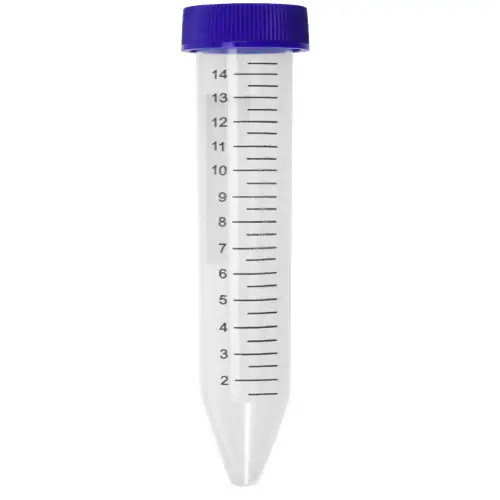
Characteristics of Centrifuge tube
The following are the important characteristics of centrifuge tube-
- Material- Centrifuge tubes are made up of polypropylene (PP), polycarbonate (PC), polystyrene (PS) and borosilicate glass. Polypropylene is used because it is chemical resistant and autoclavable. Polycarbonate is strong and transparent. Polystyrene is used in routine low speed work. Borosilicate glass is used when strong chemical resistance is required.
- Bottom shape- The bottom of centrifuge tube may be conical, round or flat. Conical bottom is used for collecting the pellet in one place. Round bottom gives equal support to the tube wall during high speed rotation. Flat bottom tubes can stand on the working bench.
- Volume capacity- Centrifuge tubes are present in different sizes. Microcentrifuge tubes are of 0.1 ml to 2.0 ml capacity. The common conical tubes are 15 ml and 50 ml. Large centrifuge bottles may be of 100 ml to 2000 ml capacity and are used for large amount of sample.
- Closure type- Centrifuge tubes are closed by snap cap or screw cap. Snap cap is used for easy opening and closing. Screw cap is used when tight closing is needed. It prevents leakage during high speed centrifugation and storage.
- Force tolerance- Centrifuge tubes have thick and uniform wall. This wall helps the tube to resist high centrifugal force. The force is expressed as Relative Centrifugal Force (RCF). Ultracentrifuge tubes can tolerate more than 100,000 x g force.
- Marking- Most centrifuge tubes contain graduation marks on the outer surface. These marks are used to measure the volume of sample. They also contain frosted writing portion, where sample name or number can be written.
- Sterility- Some centrifuge tubes are sterile and non-pyrogenic. They are free from DNase, RNase and human DNA. These types of tubes are used for sensitive biological work to avoid contamination.
- Special design- Some centrifuge tubes are specially made for special samples. Amber coloured tubes are used for light sensitive sample. Low-retention tubes are used for maximum recovery of protein and nucleic acid.
Composition material of Centrifuge tube
The following are the composition materials of centrifuge tube-
- Polypropylene (PP)- It is the most common material used for centrifuge tube. It is strong, durable and has good chemical resistance. It can be safely autoclaved.
- Polypropylene Copolymer (PPCO)- It is also used for making centrifuge tube. It has good strength and chemical resistance. It is useful where durable plastic tube is needed.
- Polycarbonate (PC)- It is a tough plastic material. It is clear and has high strength. It is used for high speed and ultracentrifugation work. But it has less resistance against strong bases and some organic solvents.
- Polystyrene (PS)- It is a transparent plastic material. It is more brittle than other plastics. It is mainly used for low speed routine clinical work. It cannot tolerate autoclaving and high g-force.
- Borosilicate glass- It is used when high chemical resistance is required. It is chemically inert and can tolerate aggressive organic solvents. It can also withstand repeated heat sterilization. But it is fragile than plastic tubes.
- Fluoropolymers (FEP and ETFE / Teflon)- These are nearly chemically inert plastics. They are used for highly aggressive chemical samples. They can tolerate very low and very high temperature from -100°C to +150°C.
- Polyethylene (PE)- It is a flexible plastic material. It is chemically stable but has poor temperature resistance. So it is not suitable for autoclaving and high speed centrifugation.
- Polyethylene Terephthalate (PET / PETG)- It is an ultra-clear polymer. It is tough and transparent. It is used in density gradient centrifugation where separation bands need to be seen clearly.
- Polysulfone (PSF)- It is a transparent plastic material with slight straw colour. It has better resistance against acids and bases. It also helps to see the separation interface easily.
- Steel- It is a strong material used for special centrifuge ware. It does not deform easily and can tolerate heat and frost. But it should not come in contact with strong corrosive chemicals.
- Other materials- Some other materials are also used for special centrifuge tube or centrifuge ware. These include polyallomer, polyetherimide, acrylic and aluminum.
Types of Centrifuge tube
The following are the different types of centrifuge tube-
- Conical bottom tube- These tubes have a tapered lower end. It is used for collecting the solid material in the form of pellet at the bottom. It is commonly used for cell pelleting and nucleic acid purification.
- Round bottom tube- These tubes have a uniform curved base. It is useful for large volume sample and proper mixing. It also gives better support during high speed centrifugation.
- Flat bottom tube- These tubes have a flat base. It can stand on the laboratory bench without any rack. It is mostly used for storage, reaction work and low speed centrifugation.
- Microcentrifuge tube- These are small centrifuge tubes. Its capacity is about 0.1 ml to 2.0 ml. These tubes are used in molecular biology work and for very small amount of sample. PCR tubes are also included in this type.
- Standard centrifuge tube- These tubes are commonly available in 15 ml and 50 ml size. It is used in clinical diagnosis, cell culture and general sample separation work.
- Large volume centrifuge tube- These tubes are also called centrifuge bottles. Its capacity ranges from 100 ml to 2000 ml. These are used for bulk sample processing, industrial work and environmental testing.
- Polypropylene tube- These tubes are made up of polypropylene plastic. It is most commonly used because it is strong, chemical resistant and autoclavable.
- Polycarbonate tube- These tubes are made up of polycarbonate. It is transparent and very strong. It is used for high speed centrifugation, but it is affected by some harsh chemicals.
- Glass centrifuge tube- These tubes are usually made up of borosilicate glass. It has good chemical resistance and can tolerate high temperature. But it is fragile and may break during high speed work.
- Polystyrene tube- These tubes are made up of transparent plastic. It is mainly used for low speed centrifugation. It is brittle and cannot be autoclaved.
- Screw cap tube- These tubes have threaded cap. It gives tight and leak proof closing. It is used for high speed centrifugation, long term storage and hazardous sample.
- Snap cap tube- These tubes have attached cap which can be opened and closed easily. It is used for routine and low risk laboratory work.
- Ultracentrifuge tube- These tubes are made with thick wall and strong sealing. It is used in ultra high speed centrifugation where very high g-force is produced.
- Amber tube- These tubes are dark or coloured tubes. It is used for light sensitive sample. It protects the sample from light damage.
- Low-retention tube- These tubes are specially treated tubes. It prevents DNA, RNA and proteins from sticking to the tube wall. It helps in better recovery of sample.
- Sterile tube- These tubes are pre-sterilized tubes. It is free from contamination and used for sensitive biological samples. RNase-free tubes are used when RNA sample is handled.
Centrifuge tube sizes
Different sizes of centrifuge tube are-
- PCR tubes- These are very small tube. Its capacity is 0.1 ml and 0.2 ml. These are used for PCR and small reaction mixture.
- Ultra-micro tubes- These tubes are also very small in size. It is generally 0.1 ml or 0.2 ml. It is used where very little amount of sample is present.
- Microcentrifuge tubes- These are small plastic centrifuge tubes. The capacity is 0.5 ml to 2.0 ml. Commonly used sizes are 0.5 ml, 1.5 ml and 2.0 ml.
- Oak Ridge tubes- These are larger centrifuge tubes. The capacity is 10 ml to 80 ml. It is used for centrifugation of medium volume sample.
- Standard conical tubes- These tubes are generally 15 ml and 50 ml. These are common laboratory centrifuge tubes. It is used in routine laboratory work.
- Large capacity tubes- These tubes are used for large volume sample. Its capacity is 100 ml to 2000 ml. It is used in bulk sample centrifugation.
- Centrifuge bottles- These are large centrifuge container. The common sizes are 200 ml, 250 ml, 500 ml, 1000 ml or 1 L and 2000 ml or 2 L. These are used when large amount of sample is centrifuged.
Applications of centrifuge tubes
The following are the applications of centrifuge tubes-
- Clinical diagnosis- Centrifuge tubes are used in clinical laboratory for blood sample separation. It separates red blood cells, white blood cells, plasma and serum. These separated parts are used for different diagnostic tests.
- Healthcare use- It is also used in viral load test and infectious disease diagnosis. The sample is kept in the tube and then centrifuged for further testing.
- Molecular biology- Centrifuge tubes are used for DNA and RNA extraction. It is also used during PCR test and protein purification. Small tubes are commonly used for these works.
- Cell culture- It is used for harvesting and washing of cells. Cells are collected at the bottom of the tube as pellet. It is also used for storing media supplements and buffer solution.
- Tissue culture- Centrifuge tubes are used for handling tissue culture sample. It helps in separating cells and other cell parts. Cellular organelles can also be isolated by using centrifuge tube.
- Microbiology- It is used for separation of microorganisms from sample materials. Bacteria, viruses, fungi and protozoa can be separated from other debris.
- IVF work- Centrifuge tubes are used in in vitro fertilization process. It is used for safe handling of egg, sperm and embryo sample. The sample is prepared and retrieved in controlled way.
- Sample storage- Centrifuge tubes are used as sample storage container. It can be used for short term and long term storage. Biological and chemical samples are stored in these tubes.
- Cryopreservation- Some centrifuge tubes are used for storing sample at very low temperature. This is used for preservation of biological sample.
- Environmental testing- It is used in water, soil and sediment testing. Suspended particles are removed from the sample by centrifugation. It is also used before analysis of acid digested sample.
- Industrial use- Centrifuge tubes are used in industrial sample processing. It is used for separation of emulsion and other mixture.
- Pharmaceutical use- It is used in drug formulation testing and quality control. It is also used in vaccine production and extraction of active pharmaceutical ingredients (APIs).
- Special separation technique- Centrifuge tubes are used in density gradient centrifugation. Sucrose or cesium chloride medium may be used in this process. It is also used in ultrafiltration concentration.
Advantages of centrifuge tubes
The following are the advantages of centrifuge tubes-
- Improved efficiency- Centrifuge tubes help in separation of many samples at the same time. It reduces the time required for sample processing.
- Greater accuracy- The tubes are made with proper closing system. It prevents spillage of sample and cross-contamination. So the experimental result becomes more accurate.
- Safety- Centrifuge tubes are made up of strong material. It prevents leakage, spilling and breaking during high speed centrifugation. Thus it protects the sample and also the worker.
- Cost effective- Good centrifuge tubes prevent tube damage and sample loss. This reduces the need of repeating the experiment again. So it saves time, chemicals and money.
- Sediment separation- Conical bottom centrifuge tubes help in collecting solid materials at the tip. The sediment forms a tight and dense pellet at the bottom.
- Accurate pipetting- The pellet is collected at one point in conical tube. So the upper liquid portion or supernatant can be removed easily by pipette without disturbing the pellet.
- Space saving- Centrifuge tubes can be arranged closely in racks and boxes. It saves space in laboratory bench, refrigerator and deep freezer.
- Secure sealing- Centrifuge tubes have screw cap or snap cap. Screw cap gives leak proof closing for high speed and hazardous samples. Snap cap is used for quick opening and closing in routine work.
- Sample protection- Some centrifuge tubes are specially made for sample protection. Amber coloured tubes protect light sensitive sample from UV light. LoBind tubes prevent DNA, RNA and proteins from sticking to the tube wall.
- Easy handling- Centrifuge tubes are simple to use in laboratory. The sample can be added, closed, centrifuged and stored in the same tube. So sample handling becomes easier.
Limitations of centrifuge tubes
The following are the limitations of centrifuge tubes-
- Glass tubes- Glass centrifuge tubes are fragile. It can break easily during high speed centrifugation. If it breaks inside the rotor, it may damage the rotor and contaminate the sample.
- Polypropylene tubes- Polypropylene tubes are strong but not suitable for all chemicals. Some organic solvents like chloroform may swell or damage the tube. Repeated autoclaving may also cause warping of the tube.
- Polycarbonate tubes- Polycarbonate tubes have limited chemical resistance. Strong bases, acetone and some alcohols can damage the tube. Repeated autoclaving may produce cracking or crazing.
- Polystyrene tubes- Polystyrene tubes are brittle. It is not used for high speed centrifugation. It also cannot be autoclaved because it may melt. At freezing temperature it may become more brittle.
- Polyethylene tubes- Polyethylene tubes have poor temperature resistance. It cannot be autoclaved. It is also not suitable for high speed centrifugation.
- Conical bottom tubes- Conical bottom tubes cannot stand on bench by itself. It requires rack for holding. Otherwise it may fall and spill the sample.
- Round bottom tubes- In round bottom tubes the pellet may spread on the curved base. Due to this, proper recovery of pellet becomes difficult.
- Flat bottom tubes- Flat bottom tubes are not good for pelleting. The sediment spreads on the flat base. So the pellet is not collected at one point.
- Snap cap tubes- Snap cap may open during high speed, high pressure or heating. It may also leak in some condition. So it is not good for hazardous sample.
- Screw cap tubes- Screw cap gives tight closing but it takes more time to open and close. It usually needs two hands. So it is less convenient for large number of routine samples.
- Fill volume- Centrifuge tubes cannot be filled completely in many cases. Most tubes are filled only up to 75-80% to prevent leakage. But some thin wall ultracentrifuge tubes must be filled fully otherwise the wall may collapse.
- Balancing- Tubes must be balanced properly before centrifugation. The balancing is done by mass, not only by volume. Small imbalance can cause vibration, tube breakage and damage of centrifuge machine.
- Sample adsorption- In normal plastic tubes, proteins, DNA and RNA may stick to the inner wall. This causes loss of sample. For these samples, low-retention tubes are required.
- Contamination- Some normal laboratory tubes may contain RNase or DNase. These enzymes can degrade RNA or DNA sample. So certified RNase-free and DNase-free tubes are needed for sensitive genetic work.
Precaution of centrifuge tubes
Precaution of centrifuge tubes
The following precautions should be taken for centrifuge tubes-
- Balancing- The tubes should be balanced properly before centrifugation. It should be balanced by weight, not only by volume. The tubes are placed opposite to each other in the rotor. Unbalanced tube may cause vibration and damage the centrifuge.
- Tube checking- Tubes should be checked before use. Cracks, stress marks, colour change or deformation should be observed. Damaged tubes should not be used. It may break during centrifugation.
- Speed limit- The tube should be used only within its given speed limit. Maximum RCF or RPM should not be exceeded. Higher speed may cause leakage, deformation or breaking of the tube.
- Filling- The tube should be filled up to recommended level. In most standard tubes, 75-80% filling is suitable. Overfilling may cause leakage. Underfilling may cause tube collapse in some condition.
- Ultracentrifuge filling- Thin wall ultracentrifuge tubes need full filling. It is usually filled to 100% capacity. If it is not filled properly, the tube wall may collapse during very high speed centrifugation.
- Chemical compatibility- The tube material should be suitable for the sample. Polypropylene, polycarbonate or other material may not resist all chemicals. Incompatible solvent may weaken or damage the tube.
- Cap closing- The cap should be closed tightly before centrifugation. Screw cap should be tightened properly. Snap cap should be pressed firmly. This prevents leakage, evaporation and aerosol formation.
- Temperature- The tube should be used according to its temperature range. For deep freezer, low temperature resistant tubes are needed. Polystyrene tube should not be autoclaved because it cannot tolerate high heat.
- Rotor fitting- The size and shape of tube should match with rotor or adapter. The tube should sit properly inside the bucket or hole. Wrong fitting may cause imbalance and breakage.
- Reuse- Disposable plastic tubes should not be reused. Washing, autoclaving and repeated spinning may produce small cracks. These cracks may cause breaking in next centrifugation.
- Biohazard sample- Infectious sample should be handled carefully. Tubes with tight seal should be used. After centrifugation, the lid should not be opened immediately. It is better to wait for about 10 minutes so that aerosols can settle down.
- Disposal- Used tubes should be decontaminated before disposal. Biohazard tubes should be discarded in proper waste container. This prevents contamination and laboratory infection.
References
- Norell. (n.d.). Amberized NMR sample tubes.
- GMP Plastics. (n.d.). Benefits of using amber centrifuge tubes.
- Essentra Components. (n.d.). Caps and plugs: How do HDPE and PP compare?.
- Drucker Diagnostics. (n.d.). Centrifuge tube guide: Types, sizes, and selection for clinical labs.
- LabChoice Australia. (n.d.). Centrifuge tubes explained: Materials, sizes, and safe autoclaving.
- Dawn Scientific. (n.d.). Centrifuge tubes guide: Types, usage, and best practices for labs.
- Corning. (n.d.). Centrifuge tubes | Centrifugation liquid handling tubes.
- Fisher Scientific. (n.d.). Centrifuge tubes.
- Fisher Scientific. (n.d.). Centrifuge tubes.
- Thermo Fisher Scientific. (n.d.). Centrifuge tubes.
- Thermo Fisher Scientific. (n.d.). Centrifuge ware chemical resistance table [PDF].
- CP Lab Safety. (n.d.). Chemical compatibility chart – LDPE, HDPE, PP, Teflon resistance.
- Needle.Tube. (n.d.). Choosing between screw cap and snap cap centrifuge tubes: Quality comparison for urgent care clinics.
- Boston Med Supply. (n.d.). Choosing the best centrifuge vials & tubes for your lab.
- Comprehensive analysis of centrifuge vessels: Advanced material science, engineering, and functional applications in modern laboratory workflows [Markdown]. (n.d.).
- Boston Med Supply. (n.d.). Conical tubes vs. flat-bottom tubes: When to use each type.
- Isovax Technologies. (n.d.). Difference between sterile and pyrogen-free.
- Pharmaguideline. (2017). Difference between sterile and pyrogen free.
- Cotton Mouton Diagnostics. (n.d.). Does pyrogen free mean endotoxin-free.
- Environmental Protection Agency. (1994). EPA Method 200.8: Determination of trace elements in waters and wastes by inductively coupled plasma-mass spectrometry [PDF].
- High-Tech Conversions. (n.d.). Endotoxin limits for medical devices according to USP chapter 161.
- Medical Design Briefs. (2013). Endotoxin testing: FDA update prompts time for review.
- Eppendorf. (n.d.). Eppendorf amber conical tubes: Maximal sample protection and visibility [PDF].
- ResearchGate. (n.d.). Eppendorf DNA LoBind tube: What makes it “LoBind” to DNA?
- Eppendorf. (2020). Eppendorf LoBind® tubes and plates [PDF].
- Sigma-Aldrich. (n.d.). Eppendorf LoBind®: Evaluation of protein recovery … [PDF].
- Genesee Scientific. (n.d.). Eppendorf protein LoBind® tubes, PCR clean.
- AliExpress. (n.d.). Everything you need to know about RNase free tubes.
- NSF. (n.d.). FDA pyrogen and endotoxins testing Q&A.
- CP Lab Safety. (n.d.). Glass centrifuge tubes and culture tubes.
- Eppendorf. (n.d.). High-quality centrifuge tubes.
- Eppendorf. (n.d.). Lab tubes.
- Environmental Protection Agency. (1994). Method 200.2, revision 2.8: Sample preparation procedure for spectrochemical determination of total recoverable elements [PDF].
- Environmental Protection Agency. (1994). Method 200.7, rev. 4.4 [PDF].
- Thermo Fisher Scientific. (n.d.). Nalgene and Nunc centrifuge ware – Select the right vessel and spin with confidence [PDF].
- GMP Plastics. (n.d.). Not all centrifuge tubes are created equal—are you using the right one.
- Thermo Fisher Scientific. (n.d.). Oak Ridge centrifuge tubes.
- CELLTREAT Scientific Products. (n.d.). Oak Ridge style centrifuge tubes.
- Electron Microscopy Sciences. (n.d.). Oakridge style centrifuge tubes.
- Closure Systems International. (n.d.). PE and PP bottle caps: Which is better for your project?
- Foxx Life Sciences. (n.d.). Polypropylene chemical compatibility chart.
- Eppendorf. (n.d.). Protein LoBind® tubes.
- Thermo Fisher Scientific. (n.d.). Pure protection–microcentrifuge tubes [PDF].
- Bioendo. (n.d.). Pyrogen free consumables – Endotoxin free tubes / tips / microplates.
- Beckman Coulter. (n.d.). Selection guide for centrifuge tubes and bottles.
- Simplified endotoxin test method for compounded sterile products [PDF]. (n.d.).
- Eppendorf. (n.d.). The best material for original Eppendorf tubes®, tips, and plates: Properties and chemical resistance of polypropylene [PDF].
- CellProBio. (n.d.). The importance of choosing the right centrifuge tube for your research.
- Biofargo. (2022). The ultimate guide to centrifuge tubes.
- Melfu Biotechnology. (n.d.). The ultimate guide to centrifuge tubes.
- Mini-Plast. (n.d.). The ultimate guide to centrifuge tubes: Types, uses, and best practices.
- USPC. (2017). USP-NF 〈161〉 Medical devices—Bacterial endotoxin and pyrogen tests [PDF].
- Labcon. (n.d.). UVSafe® UV blocking centrifuge tubes.
- Packaging Compliance Labs. (n.d.). Understanding endotoxin testing in the medical device industry.
- Pyrostar. (n.d.). Understanding the difference between sterility, bioburden, pyrogen, and bacterial endotoxin testing.
- Lab Pro Inc. (2026). What is a centrifuge tube? Materials, uses, and safety guide.
- Boston Med Supply. (n.d.). What is a centrifuge tube? Types, uses, and essential laboratory guide.
- DSCBalances. (2024). What is a centrifuge: Understanding its types and uses.
- Hawach. (2022). What are centrifuge tubes used for.
- Aarvi Touch. (2026). What is a centrifuge tube and what is it used for?
- Globe Scientific. (n.d.). What is the difference between RNase, DNase-free and sterile?
- Crystalgen. (2023). When to use a snap cap vs. screw cap tube – Blog.
- Jybioscience. (n.d.). Why choose polypropylene for centrifuge tube?
- LabPro Solutions. (2025). Why DNase/RNase-free labware matters in RNA workflows …
- Suzhou Ace Biomedical Technology. (2023). Why are laboratory consumables required to be DNase and RNase free?