

Automated Cell Counter is an analytical laboratory instrument that is used to count the number and concentration of cells in a given sample.
It is used to measure cell viability also, with minimum human interaction. It replaces manual counting by using physical and optical sensors. So it gives more accurate and reproducible result.
Automated cell counter can analyse thousands to millions of cells within few seconds. It may work by digital image analysis, electrical impedance or laser light scattering method. It is commonly used in research laboratory, biopharmaceutical manufacturing and clinical diagnosis.
Principle of Automated Cell Counter
Principle of Automated Cell Counter is based on the use of physical and optical sensors to count the number, size and viability of cells present in a sample. The cells are passed or observed by the instrument and signals are produced. These signals are then converted into cell count and other cell information.
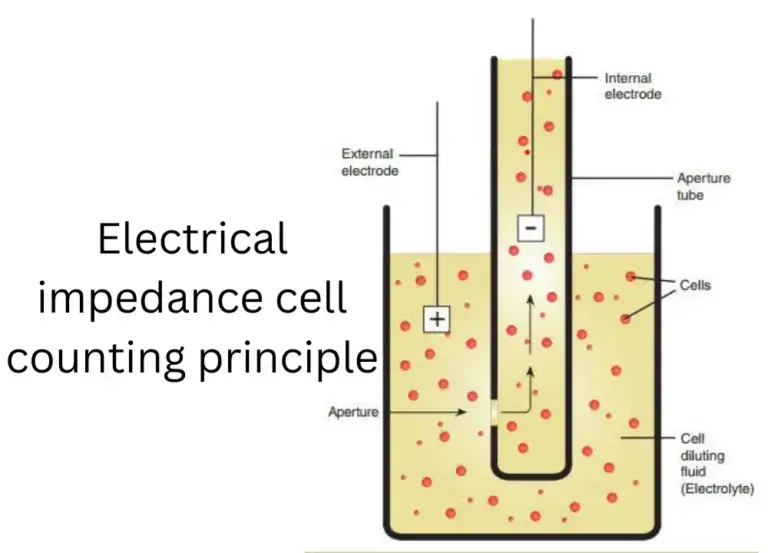
In electrical impedance method or Coulter Principle, the cells are suspended in an electrolyte solution and passed through a small aperture. When each cell passes through the aperture, it displaces the conducting fluid. This produces a small increase in electrical resistance or voltage pulse. The pulse is proportional to the volume of the cell.
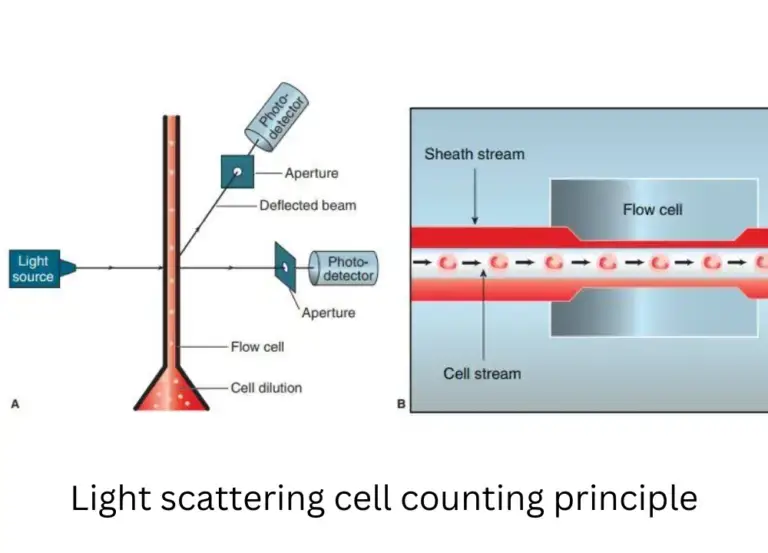
In optical detection method, the cells are arranged in single line and passed through a focused laser beam. The scattered light and fluorescence are detected by photodetectors. Forward scatter gives information about cell size and side scatter gives information about internal complexity of the cell.
In image cytometry, the cell sample is placed in a measured counting chamber. The instrument captures images by brightfield or fluorescence optics. Then software analyse the images and identify, separate and count the individual cells. Thus it reduces human visual bias and gives more reproducible cell counting.
Types of Automated Cell Counters
The following are the main types of automated cell counters–
1. Electrical Impedance-Based Counters (Coulter Counters)– These counters are based on the Coulter Principle. In this type, cells are passed one by one through a narrow aperture in a conductive electrolyte solution. When each cell passes, it changes the electrical resistance. This change is used to count the cells and measure the cell volume.
2. Flow Cytometers– Flow cytometers are automated cell counting instruments in which suspended cells are passed in a single-file fluid stream through a focused laser beam. The scattered light is measured to determine cell number, size and internal complexity. Fluorescence detection is also used to study specific cellular characters.
3. Image Cytometers (Image-Based Counters)– Image cytometers are automated microscope-like counters. In this type, the cell sample is placed on a slide, chamber or cassette. Digital camera takes images of the cells and software analyse the images. It is used to determine cell count, cell size and cell viability by brightfield or fluorescence imaging.
4. Hematology Analyzers– Hematology analyzers are specialized automated cell counters used mainly in clinical laboratory. They are used to perform complete blood count (CBC). It measures the number of red blood cells, white blood cells, platelets and also hemoglobin concentration.
5. Time-Lapse Cytometers– Time-lapse cytometers are automated counters that combine image cytometry with time-lapse microscopy. They are used to observe and count cells continuously inside a cell culture incubator. It helps to study cell growth, movement and other cellular changes over time.
6. Cell Sorters– Cell sorters are special type of flow cytometers. These instruments not only count cells but also physically separate the cells into different containers. Sorting is done based on electrical characters or fluorescent markers present in the cells.
Automated cell counters may also be classified as benchtop research counters, clinical hematology analyzers and specialty bioanalyzers. Benchtop counters are used for routine laboratory work. Clinical analyzers are used for hospital diagnosis. Specialty bioanalyzers are used in large scale biomanufacturing and bioreactor monitoring.
How to Operate an Automated Cell Counter
Operation of Automated Cell Counter
- The cell suspension is collected from the culture and mixed with suitable staining reagent such as trypan blue for brightfield counting or fluorescent dyes like acridine orange and propidium iodide (AO/PI).
- The counting parameters are set in the instrument according to the sample type and dilution factor or predilution multiplier is entered before counting.
- The required volume of stained cell mixture is taken by pipette and placed on a disposable counting slide, reusable measuring chamber or into a self-loading cassette.
- The prepared slide or cassette is inserted properly into the automated cell counter so that the sample area comes under the detection system.
- The autofocus of the instrument is checked and if the image is not clear then focus is corrected immediately or manual focusing is done.
- The count button is started and the instrument takes images or sensor readings of the cells. Then the software analyse the sample and displays the cell count, cell concentration and cell viability.
- After counting, the disposable slide or cassette is discarded. In case of reusable chamber, the cells are wiped away with dry laboratory wipe and the counting surface is kept clean.
Applications of Automated Cell Counter
- Automated cell counter is used in clinical diagnosis for routine complete blood count (CBC). It counts red blood cells, white blood cells, platelets and helps in detecting abnormal blood cells in diseases like leukemia.
- It is used to monitor immune cell population such as CD4+ T cells in HIV patients. It also helps in point-of-care diagnosis where fast cell counting is required.
- It is used in biopharmaceutical manufacturing to check cell growth, cell health and viability in large scale bioreactors. This is important for production of vaccines, monoclonal antibodies and therapeutic proteins.
- It is used in cell and gene therapy for checking cell concentration and viability during collection, isolation, expansion and final dose preparation. It is important in CAR-T cell therapy and regenerative medicine.
- It is used in drug discovery and toxicity testing. It helps to study the effect of new drugs on cell growth, cell death and apoptosis. Anti-cancer drugs can also be tested by using this instrument.
- It is used in basic research laboratory for routine cell culture work, cell passage determination and preparation of samples for single-cell sequencing. It is also used in microbiological quantification and clonogenic assay.
- It is used in food and beverage industries to count yeast cells in brewing process. It helps to determine the proper amount of yeast required for fermentation.
- It is used in agriculture and animal breeding to measure sperm concentration and viability. It is also used in cultured meat production to follow the growth of stem cells.
Advantages of Automated Cell Counter
- Automated cell counter gives more accurate result because it counts thousands to millions of cells within short time. So the statistical confidence is high and counting error is reduced.
- It removes human subjectivity because the counting is done by physical sensors, optical sensors and software algorithm. So the result does not depend on human visual judgment.
- It gives fast result than manual counting. Many automated counters can count one sample within few seconds or less than 30 seconds. So it is useful in clinical diagnosis and pharmaceutical production.
- It helps in standardization of laboratory work. Same counting protocol can be created, saved and used by different operators. So the counting procedure remains same in different shifts and laboratories.
- It automatically calculates cell count, cell concentration and cell viability. The data can be stored digitally and exported for further use.
- It provides better data traceability. Modern instruments can keep digital records, images and audit trails. This is useful in quality control and regulated laboratory work.
- It reduces biological hazard because many systems use disposable slides, self-loading cassettes or closed fluidic system. So the direct handling and cleaning of contaminated chamber is less.
- It reduces labour work and saves time. Less trained manual counting is required and more number of samples can be processed in short time.
Limitations of Automated Cell Counter
- Automated cell counter has high initial cost. It also needs maintenance, calibration, special reagents and disposable counting slides. So the operational cost is also high.
- In electrical impedance-based counter, coincidence error may occur. When two or more cells pass through the aperture at same time, they may be counted as one particle.
- It cannot count complex samples properly in all cases. Flow cytometers and impedance counters need single-cell suspension. Aggregated cells, debris or contaminating red blood cells may create error in counting.
- Some automated counters have complex fluidic system. These systems may get clogged and need regular cleaning. Daily maintenance and frequent calibration are required for proper result.
- In image-based counters, image processing error may occur. Low contrast image, low resolution image, merged colonies or non-circular cells may not be detected and separated correctly by the software.
- Some image cytometers require manual focusing before counting. This may again introduce user-to-user variation and human subjectivity in the result.
- Many instruments require staining of cells before counting. Dyes like trypan blue may be toxic to cells and delayed counting may increase false dead cell count.
- Operation of advanced automated counters needs skilled person. Interpretation of flow cytometry scatter plots, fluorescence data and system errors require trained laboratory personnel.
Precautions of Automated Cell Counter
- The cell suspension should be diluted properly before counting. If the sample is too concentrated, two or more cells may pass through the sensor at same time and counted as a single cell.
- The correct sample parameters should be set in the instrument before counting. The dilution factor or predilution multiplier should be entered properly to get correct cell concentration.
- The optical focus should be checked before running the count. In autofocus instrument, the focus should be verified and corrected if needed. In manual focus instrument, focusing should be done carefully.
- Trypan blue and other staining dyes should be handled carefully. Trypan blue is toxic to cells and if the stained sample is kept for long time, it may change cell viability result.
- In flow cytometer, proper signal threshold should be set. This helps the detector to avoid background noise from dust, stray light and non-cellular debris.
- The instrument should be cleaned and maintained regularly. Complex instruments with fluidic and optical system need daily cleaning to prevent clogging and to give accurate reading.
- Reusable chambers or permanent measuring surfaces should be cleaned carefully after use. No cleaning reagent should remain on the surface because it can affect cell viability in next sample.
- The optical surface should not be scratched during cleaning. Scratched surface may affect image quality and cause wrong counting result.
Automated cell counter vs Hemocytometer
- Automated cell counter counts the cells within few seconds to few minutes. Hemocytometer counting is manual process and it takes more time, usually about 5 minutes for one sample.
- Hemocytometer depends on human eye observation and counting. So the result may change from person to person. Automated cell counter uses sensors and software, so the result is more accurate and reproducible.
- In hemocytometer, only small number of cells are counted from a small visual field. So the statistical accuracy is less and error may be high. Automated cell counter can analyse thousands to millions of cells and gives higher statistical confidence.
- In hemocytometer, error may occur due to wrong pipetting, improper dilution or incorrect placement of coverslip. In automated cell counter, these errors are reduced by fixed volume chamber, calibrated slide or controlled fluid system.
- Hemocytometer is a reusable glass chamber, so cleaning and handling may expose the user to biological hazards. Automated cell counter often uses disposable slides or closed system, so contamination risk is less.
- Hemocytometer has low initial cost and low consumable cost. But it needs trained person and more working time. Automated cell counter has high initial cost and may need special slides or reagents, but it saves time and reduces labour.
- In hemocytometer, cell concentration and viability are calculated manually and data are recorded by hand. In automated cell counter, the instrument directly gives cell count, cell concentration and cell viability. It can also store digital data, images and reports.
| Basis | Automated Cell Counter | Hemocytometer |
|---|---|---|
| Speed | It counts cells within few seconds to few minutes. | It is a manual process and usually takes about 5 minutes for one sample. |
| Counting method | It uses physical sensors, optical system and software for cell counting. | It uses manual counting by human eye under microscope. |
| Accuracy | It gives more accurate and reproducible result. | Result may vary from person to person due to visual judgment. |
| Statistical confidence | It can analyse thousands to millions of cells in one sample. | It counts small number of cells from a small visual field. |
| Error | Pipetting and volume errors are reduced by calibrated slide, fixed chamber or fluid system. | Error may occur due to wrong pipetting, dilution error and improper coverslip placement. |
| Safety | It often uses disposable slides or closed system, so contamination risk is less. | It is reusable glass chamber, so handling and cleaning may expose biological hazards. |
| Cost | It has high initial cost and may need special slides or reagents. | It has low initial cost and low consumable cost. |
| Labour | It saves time and reduces labour work. | It needs trained person and more working time. |
| Data management | It directly gives cell count, cell concentration and cell viability. It can store digital data and images. | Cell concentration and viability are calculated manually and recorded by hand. |
References
- Atta-Fosu, T., Guo, W., Jeter, D., Mizutani, C. M., Stopczynski, N., & Sousa-Neves, R. (2016). 3D clumped cell segmentation using curvature based seeded watershed. Journal of Imaging, 2(4), 31. https://doi.org/10.3390/jimaging2040031
- ACCT is a fast and accessible automatic cell counting tool using machine learning for 2D image segmentation – PMC. (n.d.). PubMed Central. https://pmc.ncbi.nlm.nih.gov/articles/PMC10202925/
- Malpica, N., Ortiz de Solórzano, C., Vaquero, J. J., Santos, A., Vallcorba, I., Garcı́a-Sagredo, J. M., & del Pozo, F. (1997). Applying watershed algorithms to the segmentation of clustered nuclei. Cytometry, 28(4), 289–297. https://www2.die.upm.es/im/papers/cytometry96.pdf
- DeNovix. (n.d.). Automated cell counter principles. https://www.denovix.com/automated-cell-counter-principles/
- Automated cell enumeration: Technological principles, taxonomic variations, and multi-sectoral applications in modern biomedicine. (n.d.). [Markdown].
- Khandekar, R., Shastry, P., Jaishankar, S., Faust, O., & Sampathila, N. (2021). Automated blast cell detection for acute lymphoblastic leukemia diagnosis. Biomedical Signal Processing and Control, 68, 102690. https://shura.shu.ac.uk/28683/
- Smith-Craig, C. (2025, October 31). Automated cell counting drives development of novel therapeutics. SelectScience. https://www.selectscience.net/article/automated-cell-counting-drives-development-of-novel-therapeutics
- ChemoMetec. (n.d.). Automated vs. manual cell counting – The complete guide. https://chemometec.com/manual-vs-automated-cell-counting/
- Beckman Coulter. (n.d.). Cell counters, sizers and media analyzers. https://www.beckman.com/cell-counters-and-analyzers
- Cell counting. (n.d.). 24×7. https://24x7mag.com/professional-development/education/cbet-exam/icc-prep-cell-counting/
- Bonafide Research. (2025, June). Cell counting market overview, 2025-30. Research and Markets. https://www.researchandmarkets.com/reports/6103107/cell-counting-market-overview-30
- Fortune Business Insights. (2026, April 20). *Cell counting market size, share, trends | Growth report *. https://www.fortunebusinessinsights.com/cell-counting-market-115163
- Beckman Coulter. (n.d.). Cellular analysis using the Coulter principle: Measurement with great accuracy and speed. https://www.beckman.com/resources/reading-material/application-notes/cellular-analysis-using-the-coulter-principle
- Challenges of cell counting in cell therapy products. (n.d.). PubMed Central. https://pmc.ncbi.nlm.nih.gov/articles/PMC11520012/
- Bruker Spatial Biology. (n.d.). Common questions in molecular biology: How many types of cell counters are there?. https://brukerspatialbiology.com/blog/how-many-types-of-cell-counters-are-there/
- Coulter principle short course chapter 2. (n.d.). Beckman Coulter. https://www.mybeckman.co/resources/technologies/coulter-principle/coulter-principle-short-course-chapter-2
- Coulter counter. (2025, May 24). Wikipedia. https://en.wikipedia.org/wiki/Coulter_counter
- Aird, W. (2023, August 13). Counting white blood cells. The Blood Project. https://www.thebloodproject.com/counting-white-blood-cells/
- Differential blast counts obtained by automated blood cell analyzers. (n.d.). ResearchGate. https://www.researchgate.net/publication/49682508_Differential_Blast_Counts_Obtained_by_Automated_Blood_Cell_Analyzers
- Sarkar, S., Pierce, L., Lund, S., & Newton, D. (2025, March 26). Evaluating the quality of cell counting methods: Experimental design and statistical analysis. National Institute of Standards and Technology. https://www.nist.gov/programs-projects/evaluating-quality-cell-counting-methods-experimental-design-and-statistical
- Newport Corporation. (n.d.). Flow cytometry. https://www.newport.com/n/flow-cytometry/
- DeNovix. (n.d.). Flow cytometry | Image-based cell counting. https://www.denovix.com/flow-cytometry-image-cell-counting-accurate-quantification/
- Flow cytometry: An overview. (n.d.). PubMed Central. https://pmc.ncbi.nlm.nih.gov/articles/PMC5939936/
- Sysmex America. (n.d.). Hematology analyzers & systems. https://www.sysmex.com/en-us/lab-solutions/hematology
- Choudhry, P. (2016, February 5). High-throughput method for automated colony and cell counting by digital image analysis based on edge detection. PLOS One, 11(2), e0148469. https://journals.plos.org/plosone/article?id=10.1371/journal.pone.0148469
- How artificial intelligence is transforming leukemia detection and diagnosis. (n.d.). AJMC. https://www.ajmc.com/view/how-artificial-intelligence-is-transforming-leukemia-detection-and-diagnosis
- HORIBA. (n.d.). How cell counters help in acute myeloid leukemia (AML). https://www.horiba.com/int/healthcare/how-cell-counters-help-in-acute-myeloid-leukemia-aml/
- ChemoMetec. (n.d.). How do automated cell counters work?. https://chemometec.com/how-do-automated-cell-counters-work/
- ISCT Workforce Development. (n.d.). ISO the implementation of cell counting standards. https://www.isctglobal.org/workforce-development/iso-cell-counting-standards
- Meštrović, T. (2019, June 25). Introduction to the Coulter principle. News-Medical.Net. https://www.news-medical.net/life-sciences/Introduction-to-the-Coulter-Principle.aspx
- Singh, S. (2024, March 13). ML guide on cell segmentation using watershed algorithm. Labellerr. https://www.labellerr.com/blog/ml-guide-on-cell-segmentation-using-deep-learning/
- DeNovix. (n.d.). Manual vs. automated cell counters. https://www.denovix.com/manual-vs-automated-cell-counters/
- Omega Optical. (n.d.). Optical detection in flow cytometry. https://omega-optical.com/flow-cytometry-optical-detection/
- Bio-Rad Antibodies. (n.d.). Optics & detection – Flow cytometry guide. https://www.bio-rad-antibodies.com/flow-cytometry-optics-detection.html
- Principles of advanced flow cytometry: A practical guide. (n.d.). PubMed Central. https://pmc.ncbi.nlm.nih.gov/articles/PMC10802916/
- QuPath: Cell counting. (n.d.). Cancer Informatics. https://cancer-informatics.org/docs/ai/qupath_02_Cell-Counting/
- Perelman School of Medicine at the University of Pennsylvania. (n.d.). Quality control laboratory | Clinical cell and vaccine production facility (CVPF). https://www.med.upenn.edu/cvpf/qcl.html
- Food and Drug Administration. (n.d.). SRS ISO 20391-1 – General guidance on cell counting methods. https://www.fda.gov/media/184456/download
- Split and merge watershed: A two-step method for cell segmentation in fluorescence microscopy images. (n.d.). PubMed Central. https://pmc.ncbi.nlm.nih.gov/articles/PMC7950640/
- RWD Life Science. (n.d.). Summary of manual and automated cell counting. https://www.rwdstco.com/manual-and-automated-cell-counting/
- ChemoMetec. (n.d.). The secrets of the world of cell counters. https://chemometec.com/the-ultimate-guide-to-cell-counters/
- Beckman Coulter. (n.d.). USP 1046. https://www.beckman.com/resources/industry-standards/usp-1046
- Logos Biosystems. (n.d.). Ultimate guide to automated cell counting. ATA Scientific. https://www.atascientific.com.au/wp-content/uploads/2021/03/Ultimate_Guide_To_Automated_Cell_Counting_eBook.pdf
- Logos Biosystems. (n.d.). Understanding cell counting standards: ISO 20391-1. https://logosbio.com/understanding-cell-counting-standards-iso-20391-1/
- Useful information provided by graphic displays of automated cell counters. (n.d.). PubMed Central. https://pmc.ncbi.nlm.nih.gov/articles/PMC6816877/
- What is better: Manual or automated cell counting?. (n.d.). Biocompare. https://www.biocompare.com/Editorial-Articles/582216-What-s-Better-Manual-or-Automated-Cell-Counting/
- MarketsandMarkets. (n.d.). Why is cell counting becoming a strategic priority in biotech and biopharma?. https://www.marketsandmarkets.com/blog/HC/navigating-the-future-of-cell-counting
- Bartell, L. R., Bonassar, L. J., & Cohen, I. (2017, June 2). A watershed-based algorithm to segment and classify cells in fluorescence microscopy images. arXiv. https://arxiv.org/abs/1706.00815
- Standards Coordinating Body. (n.d.). iso cell counting Bundle. https://www.standardscoordinatingbody.org/iso-cell-counting-bundle