What is Centrifugation? – explained in Detail

Transcript
Introduction to Centrifugation Measurements -Welcome to our video on RCF vs RPM in centrifugation. These two measurements are often confused but represent fundamentally different aspects of centrifugation. RPM measures rotation speed while RCF measures the actual force applied to samples. Understanding this distinction is crucial for proper experimental procedures and reproducible results. This video will break down everything you need to know about these measurements and why they matter in laboratory settings.
What is RPM in Centrifugation? -RPM stands for Revolutions Per Minute and simply measures how many complete rotations the centrifuge rotor makes in one minute. It’s a direct measurement of rotational speed. RPM ranges vary widely across centrifuge types – from low-speed centrifuges at around 300 RPM to high-speed models reaching 15,000 RPM. Ultracentrifuges can achieve even higher speeds, exceeding 150,000 RPM. However, RPM alone doesn’t tell you the actual force experienced by your sample.
What is RCF in Centrifugation? -RCF stands for Relative Centrifugal Force and is measured in units of ‘g’ (gravitational force). Unlike RPM, RCF measures the actual gravitational force applied to your samples during centrifugation. This is the force that causes particles to separate based on their density. RCF is the preferred measurement in scientific protocols because it provides a standardized value that remains consistent regardless of which centrifuge model you use, making experiments more reproducible.
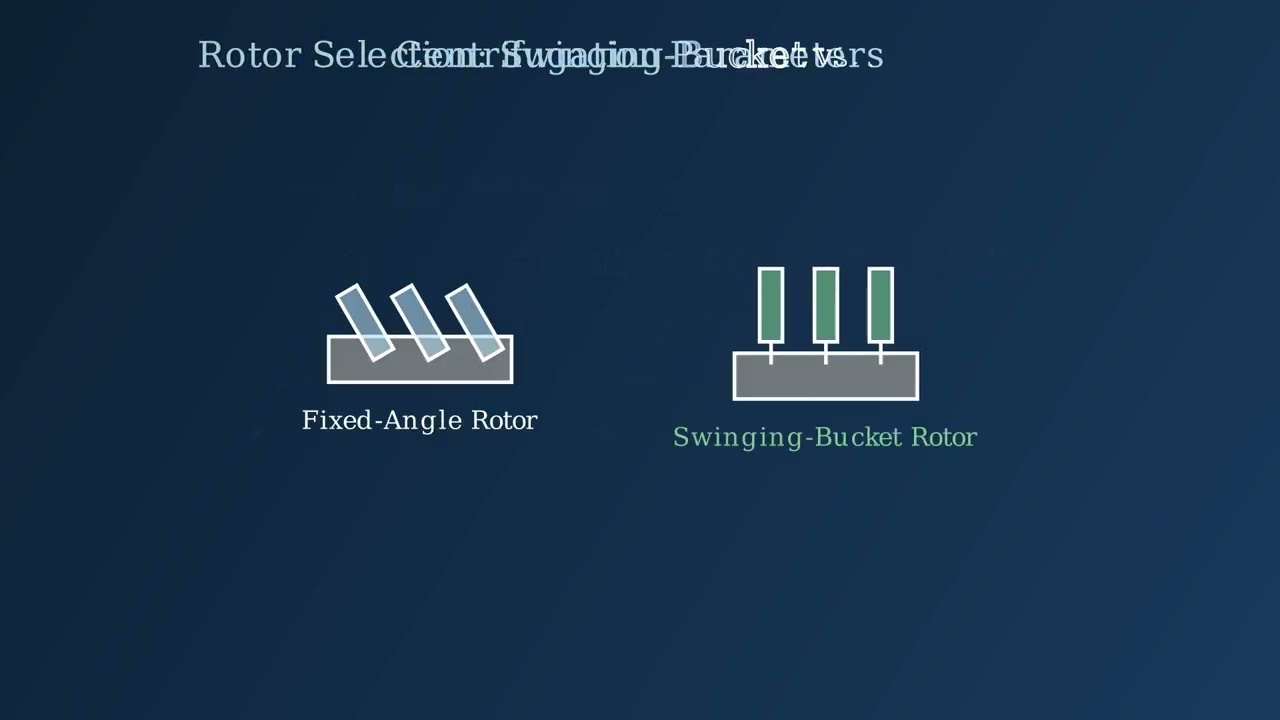
Why RCF Considers Both Speed and Radius -A critical difference between RCF and RPM is that RCF accounts for both the rotation speed AND the rotor radius. Two centrifuges running at identical RPM but with different rotor sizes will generate different forces on the samples. The larger the radius of rotation, the greater the centrifugal force at the same RPM. This is why protocols specified only in RPM can lead to inconsistent results when performed on different centrifuge models.
The Physics of Centrifugation -During centrifugation, samples rotate around a fixed point, creating an accelerative force perpendicular to the rotation axis. This force causes particles suspended in solution to move toward the edge or bottom of the tube. The separation occurs because particles experience force proportional to their mass – larger particles require less force to separate than smaller ones. This is the fundamental principle that makes centrifugation such a valuable technique for separating components in a mixture.
The Mathematical Relationship Between RCF and RPM -RCF and RPM are mathematically related through the formula: RCF = (1.118 × 10⁻⁵) × R × S². In this equation, R represents the radius in centimeters from the center of rotation to the sample, and S is the speed in RPM. This formula shows that RCF increases with the square of the RPM, meaning small increases in rotation speed result in much larger increases in centrifugal force. This quadratic relationship is crucial to understand when adjusting centrifugation parameters.
Converting Between RCF and RPM -Several methods exist for converting between RCF and RPM. You can calculate manually using the formula we just discussed, use nomograms or graphic calculators provided by centrifuge manufacturers, utilize online calculators specifically designed for this purpose, or consult reference websites and tables. Most modern centrifuges allow you to input either value and will automatically calculate the other, making proper experimental setup much easier.
Practical Examples of RCF vs RPM -Let’s look at a practical example: two centrifuges with different rotor radii (10cm vs 20cm) both running at 1000 RPM. Using our formula, the first generates an RCF of 112g, while the second produces 224g – twice the force despite the same RPM! This demonstrates why specifying protocols in RCF rather than RPM is so important. If your experiment requires a specific force to achieve separation, using RPM alone could lead to inconsistent results.
Best Practices for Laboratory Protocols -When writing or following laboratory protocols, always record and report centrifugation parameters in terms of RCF (g-force) rather than RPM. This ensures your methods can be accurately reproduced on different centrifuge models. If a protocol only specifies RPM, you should calculate the corresponding RCF using your specific centrifuge’s rotor radius. Many journals and research institutions now require reporting in RCF to ensure experimental reproducibility.
Summary and Key Takeaways -To summarize: RPM measures rotation speed while RCF measures the actual force applied to samples. RCF accounts for both speed and rotor radius, making it the more scientifically relevant measurement. Different centrifuges at the same RPM can produce vastly different RCF values. Always record and report centrifugation in terms of RCF (g-force) for experimental consistency. Understanding these differences ensures proper experimental design and reproducible results across different laboratory settings.
Related Videos