

The EMBL Nucleotide Sequence Database, commonly referred to as EMBL-Bank, is a pivotal resource in the realm of molecular biology. As an extensive repository of nucleotide sequences, EMBL-Bank plays a crucial role in biological research by providing a comprehensive and up-to-date collection of DNA sequences from a diverse range of organisms. This database is invaluable for researchers as it facilitates the analysis of genetic information, aiding in the identification of gene functions, understanding genetic variations, and exploring evolutionary relationships among species.
The importance of nucleotide sequence databases like EMBL-Bank cannot be overstated. These databases serve as foundational tools in genomic research, enabling scientists to access and compare sequences with ease. They support a variety of applications including gene discovery, functional genomics, and comparative genomics, which are essential for advancing our understanding of biology and developing new biotechnological applications. By offering a centralized platform for sequence data, EMBL-Bank significantly enhances the efficiency and accuracy of research, allowing for more rapid scientific discoveries and advancements.
The EMBL-Bank has a rich history that reflects the evolution of genomic research. Established in the early 1980s, it was one of the first major nucleotide sequence databases to be developed. Its inception was driven by the growing need for a standardized and accessible repository of genetic information as sequencing technologies advanced. Over the years, EMBL-Bank has evolved through numerous updates and expansions, incorporating data from new sequencing projects and integrating with other major databases. This continuous development underscores its enduring importance and its role in supporting the global scientific community.
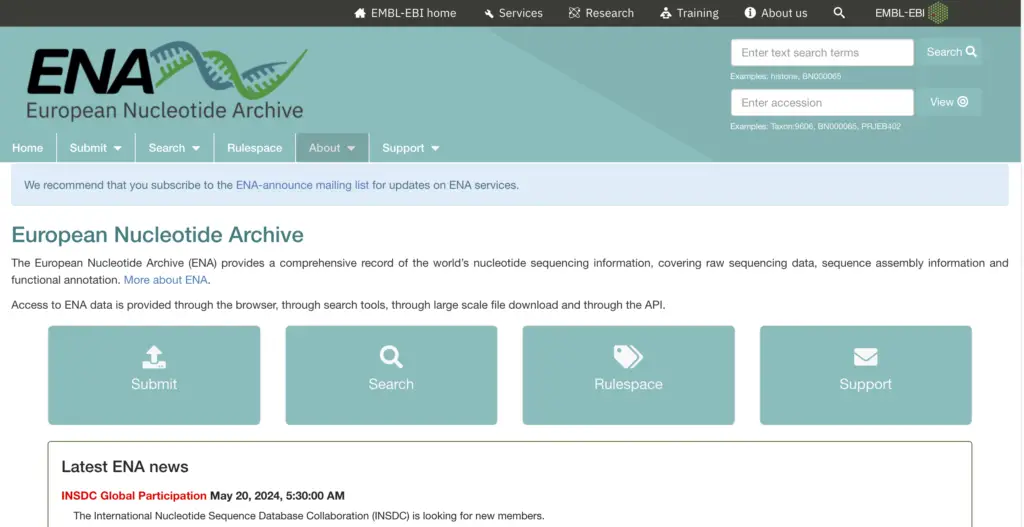
Website url: https://www.ebi.ac.uk/ena/browser/home
Purpose and Objectives
- The EMBL Nucleotide Sequence Database (EMBL-Bank) is driven by several key goals that underpin its mission and functionality. Primarily, EMBL-Bank aims to provide a comprehensive and accessible repository of nucleotide sequence data. This involves the collection, annotation, and dissemination of genetic sequences from a wide array of organisms. The database strives to ensure that researchers have access to high-quality, accurate, and up-to-date sequence information, which is crucial for various applications in molecular biology.
- In addition to its primary goal of data provision, EMBL-Bank plays a critical role in supporting genomic research and data sharing. By serving as a centralized platform, it facilitates the efficient exchange of genetic information among researchers worldwide. This accessibility enables scientists to perform comparative studies, validate experimental results, and build upon each other’s work, thereby accelerating scientific discovery and innovation. EMBL-Bank’s integration with other databases and its adherence to standardized data formats further enhance its role in promoting collaborative research and advancing genomic knowledge.
- The contribution of EMBL-Bank to the global scientific community is profound. It not only supports fundamental research but also fosters international collaboration by providing a shared resource that is accessible to researchers across the globe. The database’s continuous updates and expansions ensure that it remains a valuable tool for understanding genetic diversity, exploring evolutionary relationships, and developing new biotechnological applications. Through its efforts, EMBL-Bank significantly contributes to the advancement of science, reinforcing its position as a cornerstone in the field of genomics.
Types of nucleotide sequences included in EMBL-Bank
The EMBL Nucleotide Sequence Database (EMBL-Bank) encompasses a diverse array of nucleotide sequences, reflecting the broad scope of biological research it supports. The primary types of sequences included in EMBL-Bank are:
- Genomic Sequences: These sequences represent the complete DNA of an organism, including both coding and non-coding regions. Genomic sequences provide comprehensive information about an organism’s entire genetic makeup and are essential for studying genome structure, function, and evolution.
- mRNA Sequences: Messenger RNA (mRNA) sequences are transcribed from DNA and serve as templates for protein synthesis. EMBL-Bank includes mRNA sequences that are crucial for understanding gene expression and the regulation of gene activity. These sequences help researchers identify coding regions and infer protein structures.
- cDNA Sequences: Complementary DNA (cDNA) is synthesized from mRNA and represents expressed genes. cDNA sequences included in EMBL-Bank are valuable for studying gene expression patterns, especially in different tissues or developmental stages, and for functional analysis of genes.
- Expressed Sequence Tags (ESTs): ESTs are short, random sequences derived from cDNA libraries. They provide insights into gene expression and can be used to identify new genes and construct gene maps. EMBL-Bank includes ESTs to aid in the annotation of genomic sequences and the discovery of novel genes.
- Organellar DNA Sequences: This category includes DNA sequences from organelles such as mitochondria and plastids. Organellar DNA sequences are important for studying the genetics of these organelles, which have their own distinct genetic systems and play key roles in cellular functions.
- Synthetic Sequences: EMBL-Bank also includes sequences of synthetic origin. These sequences are designed and created in the laboratory for various experimental purposes, including gene synthesis, functional studies, and synthetic biology applications.
Procedures for Data Submission by Researchers
Submitting nucleotide sequence data to the EMBL Nucleotide Sequence Database (EMBL-Bank) involves a systematic process designed to ensure data quality and consistency. Here’s a step-by-step overview of the procedures researchers typically follow:
- Preparation of Data: Researchers should first prepare their sequence data for submission. This involves ensuring that the sequences are correctly formatted and annotated. Data should be accompanied by relevant metadata, including information about the organism, the source of the sequence, and any experimental details. It is crucial to adhere to EMBL-Bank’s guidelines for data format and quality to facilitate smooth integration into the database.
- Data Submission Tools: EMBL-Bank provides specific tools and platforms for data submission. Researchers can use the European Nucleotide Archive (ENA) submission portal, which is part of the EMBL-EBI (European Bioinformatics Institute) services. The portal allows users to upload their sequence data and associated metadata through a user-friendly interface. Tools such as Webin and APIs are available for batch submissions or automated data uploads.
- Submission Process: Researchers will need to create an account or log in to the ENA submission portal. The submission process involves filling out online forms with details about the sequences and uploading the data files. This includes specifying the type of data being submitted (e.g., genomic, mRNA, cDNA) and providing detailed annotations for each sequence.
- Data Validation: Once the data is submitted, it undergoes a validation process. EMBL-Bank staff and automated systems review the submission for completeness and accuracy. This may involve checking for proper formatting, verifying metadata, and ensuring that the sequences meet quality standards. Researchers may be contacted if there are any issues or if additional information is required.
- Data Integration and Curation: After successful validation, the sequence data is integrated into the EMBL-Bank database. It undergoes further curation to ensure that it is properly annotated and linked with related data. This process helps maintain the integrity and usability of the database.
- Publication and Access: Once the data is incorporated into EMBL-Bank, it becomes publicly accessible. Researchers can then obtain accession numbers for their submitted sequences, which can be used to reference their data in publications and other research outputs.
- Ongoing Updates and Corrections: Researchers have the option to update or correct their submitted data if necessary. EMBL-Bank provides mechanisms for data revision and update requests, allowing researchers to ensure that their data remains accurate and up-to-date.
Search functionalities and tools available for users
The EMBL Nucleotide Sequence Database (EMBL-Bank) offers a range of search functionalities and tools to help users efficiently access and analyze nucleotide sequence data. Here’s an overview of the key features available:
- Basic Search: Users can perform straightforward searches using keywords, accession numbers, or other identifiers. This type of search allows users to quickly find specific sequences or datasets by entering relevant terms into the search interface.
- Advanced Search: For more detailed queries, EMBL-Bank provides advanced search options that allow users to refine their searches based on multiple criteria. These may include sequence length, organism, publication date, and specific annotations. Advanced search tools are particularly useful for locating sequences that meet specific research needs or criteria.
- BLAST (Basic Local Alignment Search Tool): EMBL-Bank integrates with BLAST, a powerful tool for comparing a query sequence against the database to identify similar sequences. BLAST helps users find homologous sequences, predict gene function, and study evolutionary relationships by providing detailed alignment results and similarity scores.
- Sequence Retrieval: Users can retrieve detailed information about individual sequences, including annotations, source data, and associated metadata. This functionality allows researchers to view comprehensive data for specific sequences and explore related information.
- Batch Retrieval: For handling large-scale data, EMBL-Bank supports batch retrieval, allowing users to download or query multiple sequences at once. This is particularly useful for researchers working with large datasets or conducting high-throughput analyses.
- Genome Browsers: EMBL-Bank may include integration with genome browsers that provide graphical representations of sequences within their genomic context. These browsers allow users to visualize gene locations, annotations, and functional elements within the genome.
- Data Download and Export: Users have the option to download sequence data in various formats, including FASTA, GenBank, and others. This feature enables researchers to work with data offline and incorporate it into their analyses or bioinformatics workflows.
- Cross-Referencing and Links: EMBL-Bank provides cross-references to other relevant databases and resources. Users can access related information from linked databases such as UniProt, Ensembl, and others, facilitating comprehensive research and data integration.
- Custom Queries and APIs: For advanced users, EMBL-Bank offers APIs and custom query functionalities that enable automated data retrieval and integration into external applications or pipelines. This is particularly useful for researchers developing custom bioinformatics tools or workflows.
- Help and Support: EMBL-Bank provides help resources and user support to assist with search functionalities and tool usage. This includes user guides, tutorials, and contact support for troubleshooting and guidance.
Data Access and Retrieval Steps for Students
Accessing and retrieving data from the EMBL Nucleotide Sequence Database (EMBL-Bank) is a straightforward process, but it’s helpful to follow a structured approach to ensure efficiency and accuracy. Here’s a step-by-step guide tailored for students:
- Understand Your Needs: Before accessing EMBL-Bank, clarify what specific data you need. Determine the type of sequences (e.g., genomic, mRNA, cDNA), the organism of interest, or any particular gene or region you are studying. This will guide your search and retrieval process.
- Access the EMBL-Bank Portal: Navigate to the EMBL-Bank portal or the European Nucleotide Archive (ENA) website, which hosts EMBL-Bank data. You can access it directly through the EMBL-EBI (European Bioinformatics Institute) website or by searching for “EMBL-Bank” online.
- Use the Search Tools:
- Basic Search: Enter relevant keywords, accession numbers, or gene names into the search bar. This is a good starting point if you know specific details about the data you are looking for.
- Advanced Search: If you need more precise results, use the advanced search options. You can filter by criteria such as sequence type, organism, or sequence length.
- Review Search Results: Examine the list of search results to identify the sequences of interest. Each entry typically includes a summary of the sequence, its metadata, and links to detailed information.
- Retrieve Detailed Information: Click on the entries to access detailed information about individual sequences. This will include annotations, source data, and any relevant references.
- Download Data:
- Select Format: Choose the format you need for your work (e.g., FASTA, GenBank). Different formats may be available depending on your requirements.
- Download Files: Use the download options to save the data to your computer. You may have the option to download individual sequences or batch files if you need multiple datasets.
- Use BLAST for Similar Sequences: If you want to find similar sequences, use the BLAST tool integrated within EMBL-Bank. Enter your query sequence to compare it against the database and identify homologous sequences.
- Explore Cross-References: Utilize cross-references to access additional data from linked databases. This can provide further context and related information relevant to your research.
- Leverage Data Export and APIs: For more advanced use, explore data export options or use APIs for automated data retrieval. This can be useful if you’re integrating EMBL-Bank data into bioinformatics tools or conducting large-scale analyses.
- Seek Help if Needed: If you encounter difficulties or have questions, refer to the help resources available on the EMBL-Bank website. You can also reach out to support teams or consult with your instructors or peers for guidance.
Integration with Other Databases
The EMBL Nucleotide Sequence Database (EMBL-Bank) integrates with various other databases and resources to enhance the accessibility and utility of nucleotide sequence data. This integration supports a comprehensive approach to genomic research and provides a more connected data landscape. Here’s an overview of how EMBL-Bank integrates with other databases:
- Cross-Referencing with External Databases: EMBL-Bank includes cross-references to a variety of external databases. These links allow users to access related data from resources such as:
- UniProt: For protein sequence and functional information.
- Ensembl: For detailed genomic annotations and comparative genomics.
- NCBI (National Center for Biotechnology Information): For additional sequence data and tools.
- DDBJ (DNA Data Bank of Japan): To ensure comprehensive coverage of nucleotide sequence data globally.
- Data Exchange with Other Sequence Databases: EMBL-Bank participates in global data-sharing initiatives and networks, such as the International Nucleotide Sequence Database Collaboration (INSDC). This collaboration with DDBJ and NCBI ensures that nucleotide sequence data is consistently updated and available across different databases, promoting data interoperability and reducing redundancy.
- Integration with Functional Annotation Databases: EMBL-Bank is linked to databases that provide functional annotations of genes and proteins. Examples include:
- Gene Ontology (GO): For information on gene functions and biological processes.
- KEGG (Kyoto Encyclopedia of Genes and Genomes): For pathway and functional annotations.
- Reactome: For detailed biological pathways and reactions.
- Genomic Browsers and Visualization Tools: EMBL-Bank integrates with genomic browsers and visualization tools to provide graphical representations of sequences. Tools such as:
- UCSC Genome Browser: For detailed genome visualization.
- JBrowse: For interactive genome exploration.
- IGV (Integrative Genomics Viewer): For visualizing large-scale genomic data.
- Bioinformatics Tools and Pipelines: EMBL-Bank provides links to bioinformatics tools and pipelines that facilitate sequence analysis, including:
- BLAST: For sequence similarity searching.
- Clustal Omega: For multiple sequence alignment.
- MAFFT: For high-speed multiple sequence alignment.
- Data Submission and Access Services: EMBL-Bank integrates with submission and access services provided by EMBL-EBI. These include:
- ENA (European Nucleotide Archive): For data submission and retrieval.
- EBI’s RESTful APIs: For programmatic access to data and integration with other bioinformatics tools.
- Collaborative Projects and Platforms: EMBL-Bank is involved in various collaborative projects and platforms that provide access to integrated datasets. For example:
- EGA (European Genome-phenome Archive): For genomic and phenotypic data integration.
- ArrayExpress: For functional genomics data related to gene expression.
Applications in Research
The EMBL Nucleotide Sequence Database (EMBL-Bank) serves as a cornerstone for a wide range of research applications in molecular biology and genomics. Its extensive repository of nucleotide sequences supports various research endeavors, including:
- Gene Discovery and Annotation: Researchers use EMBL-Bank to identify and annotate genes within genomic sequences. By comparing sequences against known data, scientists can discover new genes, determine their functions, and understand their roles in biological processes. This is crucial for expanding our knowledge of gene functions and regulatory mechanisms.
- Comparative Genomics: EMBL-Bank facilitates comparative genomics by providing access to sequences from multiple organisms. Researchers can compare genomes to identify conserved genes, study evolutionary relationships, and uncover genetic variations that contribute to differences between species. This helps in understanding evolutionary processes and functional conservation across organisms.
- Functional Genomics: EMBL-Bank supports functional genomics by providing sequences needed to study gene expression and function. Researchers can analyze mRNA and cDNA sequences to investigate how genes are expressed under different conditions, identify gene expression patterns, and explore the impact of genetic variations on phenotypes.
- Mutation Analysis and Disease Research: EMBL-Bank is a valuable resource for studying genetic mutations associated with diseases. Researchers can compare disease-associated sequences with normal sequences to identify mutations, understand their impact on protein function, and develop insights into disease mechanisms. This information is crucial for developing diagnostic tools and potential therapies.
- Protein Function and Structure Prediction: By linking nucleotide sequences to protein databases such as UniProt, EMBL-Bank aids in predicting protein functions and structures. Researchers can use sequence data to infer protein functions, predict structural motifs, and study interactions between proteins and other biomolecules.
- Bioinformatics Tool Development: EMBL-Bank data is used in the development and testing of bioinformatics tools and algorithms. Researchers and developers use the database to benchmark sequence analysis tools, improve alignment algorithms, and create new software for data visualization and interpretation.
- Evolutionary Studies and Phylogenetics: EMBL-Bank provides data for constructing phylogenetic trees and studying evolutionary relationships. Researchers can analyze nucleotide sequences to trace the evolutionary history of genes and species, investigate patterns of genetic variation, and understand the evolutionary pressures shaping genomic diversity.
- Functional Validation and Experimental Design: EMBL-Bank data supports experimental design by providing baseline sequences for functional validation studies. Researchers can use the database to identify target sequences for gene editing, RNA interference, or overexpression experiments, and design primers for PCR and other molecular techniques.
- Metagenomics and Environmental Studies: In metagenomic studies, EMBL-Bank is used to analyze genetic material from environmental samples. Researchers can compare sequences from diverse microbial communities to explore biodiversity, study microbial interactions, and investigate the roles of different organisms in various ecosystems.
- Educational and Training Resources: EMBL-Bank serves as an educational resource for teaching and training in molecular biology and genomics. Students and educators use the database to learn about nucleotide sequences, practice sequence analysis techniques, and understand the application of genomic data in research.
Challenges and Limitations
While the EMBL Nucleotide Sequence Database (EMBL-Bank) is a crucial resource for genomic research, it faces several challenges and limitations:
- Data Quality and Accuracy: Maintaining high data quality and accuracy is a significant challenge. Errors in sequence data, such as sequencing errors or annotation mistakes, can impact research outcomes. Ensuring rigorous quality control and validation processes is essential to minimize these issues.
- Data Volume and Management: The rapid growth of sequence data poses challenges in terms of data management and storage. As new sequences are continuously added, managing, indexing, and retrieving large volumes of data efficiently requires substantial computational resources and infrastructure.
- Data Integration and Standardization: Integrating data from multiple sources and ensuring consistency across different databases can be complex. Differences in data formats, annotation standards, and metadata can hinder seamless integration and complicate cross-database comparisons.
- Updating and Curation: Keeping the database up-to-date with the latest research and ensuring accurate curation of submitted data are ongoing challenges. As new sequences and annotations are added, outdated or incorrect entries need to be revised or removed to maintain the database’s reliability.
- User Accessibility and Usability: Ensuring that the database is user-friendly and accessible to researchers with varying levels of expertise is important. Developing intuitive interfaces and providing comprehensive documentation and support are necessary to address diverse user needs.
- Data Security and Privacy: While EMBL-Bank focuses on public nucleotide data, issues related to data security and privacy can arise, especially when dealing with sensitive information or proprietary data. Implementing robust security measures to protect data integrity and confidentiality is essential.
- Handling Complex Data Types: Some biological data, such as structural variations, long-read sequences, or epigenetic modifications, may not be well-represented in traditional nucleotide databases. Addressing these complex data types requires ongoing development of new tools and database features.
- Interoperability with Other Databases: Ensuring seamless interoperability with other databases and bioinformatics tools can be challenging. Variations in data standards and technologies between different resources may affect the ease of data integration and cross-referencing.
- Training and Support: Providing adequate training and support for users, particularly those new to bioinformatics, can be challenging. Continuous efforts are needed to offer educational resources, tutorials, and user support to help researchers effectively utilize the database.
- Ethical and Legal Issues: As with any public database, ethical and legal considerations related to data sharing, intellectual property, and the use of genomic data must be addressed. Clear policies and guidelines are necessary to navigate these issues and ensure responsible data management.
Future Directions
As the field of genomics continues to advance, the EMBL Nucleotide Sequence Database (EMBL-Bank) will evolve to address emerging needs and capitalize on new opportunities. Here are some key future directions for EMBL-Bank:
- Enhanced Data Integration: Future developments will focus on improving the integration of diverse types of biological data. This includes combining nucleotide sequences with structural, functional, and phenotypic data to provide a more comprehensive view of genetic information and its implications for biological functions and diseases.
- Incorporation of Long-Read Sequencing Technologies: As long-read sequencing technologies become more prevalent, EMBL-Bank will likely integrate these data to provide information on complex genomic regions, structural variations, and full-length transcripts. This will enhance the accuracy of genome assemblies and annotations.
- Improved Annotation and Functional Insights: Advances in computational tools and algorithms will enable more accurate and detailed annotations of sequences. Future enhancements will focus on providing deeper functional insights, including the identification of regulatory elements, non-coding RNAs, and interactions between genes and their products.
- Enhanced User Interfaces and Accessibility: To support a wider range of users, EMBL-Bank will continue to develop more intuitive and user-friendly interfaces. This includes improving search functionalities, visualization tools, and interactive features to facilitate data exploration and analysis.
- Integration with Artificial Intelligence and Machine Learning: Incorporating AI and machine learning techniques will improve data analysis capabilities, including predicting gene functions, detecting patterns in large datasets, and identifying novel biological insights. These technologies will help manage and interpret the growing volume of data more effectively.
- Expansion of Collaborative Networks: EMBL-Bank will likely strengthen collaborations with other genomic databases, research institutions, and consortia. This will enhance data sharing, standardization, and interoperability, providing a more unified and global resource for researchers.
- Focus on Personalized Medicine: As personalized medicine advances, EMBL-Bank may include more data relevant to individual genetic variations, disease susceptibility, and treatment responses. This will support research into personalized therapies and precision medicine approaches.
- Support for Emerging Fields: EMBL-Bank will need to adapt to emerging research areas such as epigenomics, metagenomics, and synthetic biology. This includes incorporating new types of data, developing relevant tools, and providing resources that support cutting-edge research in these fields.
- Strengthening Data Security and Privacy: Ensuring the security and privacy of sensitive genetic data will remain a priority. EMBL-Bank will continue to implement robust security measures and policies to protect data integrity and address ethical and legal considerations.
- Educational and Training Initiatives: To support the growing community of researchers, EMBL-Bank will expand its educational resources and training programs. This includes providing tutorials, workshops, and online courses to help users effectively utilize the database and related bioinformatics tools.
Conclusion
The EMBL Nucleotide Sequence Database (EMBL-Bank) stands as a cornerstone in the realm of molecular biology and genomics. Its comprehensive repository of nucleotide sequences not only provides essential data for gene discovery, functional genomics, and comparative studies but also plays a critical role in supporting a wide range of research applications. Through its integration with other databases and bioinformatics tools, EMBL-Bank enhances the accessibility and usability of genetic information, facilitating advancements in our understanding of genetics and its implications for health and disease.
Despite the challenges associated with data quality, management, and integration, EMBL-Bank continues to evolve and adapt to meet the needs of the scientific community. Future directions, including the incorporation of new sequencing technologies, improved annotations, and integration with AI, promise to further expand its capabilities and impact. By addressing these challenges and embracing emerging opportunities, EMBL-Bank will remain a vital resource, driving innovation and discovery in genomics.
Ultimately, EMBL-Bank’s ongoing development and its role in facilitating global research collaborations underscore its importance in advancing scientific knowledge and improving our understanding of the complexities of genetic information. Its continued evolution will ensure that it remains at the forefront of genomic research, supporting the quest for new insights and breakthroughs in biology and medicine.