

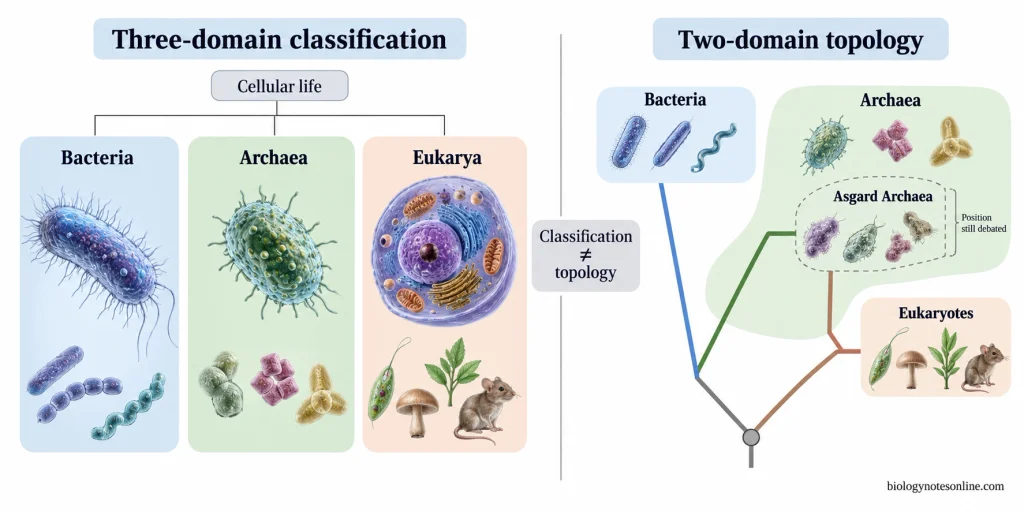
The three-domain system (Carl Woese’s classification) is a system of classification that divides cellular life into three domains: Archaea, Bacteria, and Eukarya.
It is based mainly on molecular evidence, especially comparisons of small-subunit ribosomal RNA (rRNA) sequences used to infer evolutionary relationships. Here, “domain” is a taxonomic category above kingdom.
The system was formally proposed in 1990 by Woese, Kandler, and Wheelis, with Archaea recognized as fundamentally distinct from Bacteria on the basis of these molecular comparisons.
What Is the Three-Domain System?
Three-domain system is a biological classification system formally proposed by Carl Woese and his coworkers in 1990, in which cellular organisms are grouped into three major domains- Archaea, Bacteria, and Eukarya. The highest taxonomic rank used here is the “domain”, which is placed above the kingdom level. It is based on evolutionary relationships, mainly studied through molecular comparisons such as ribosomal RNA (rRNA).
Archaea and Bacteria represent separate domains of prokaryotic cells, while Eukarya contains the eukaryotic organisms. Viruses do not come under these three domains. They are acellular entities and are classified separately.
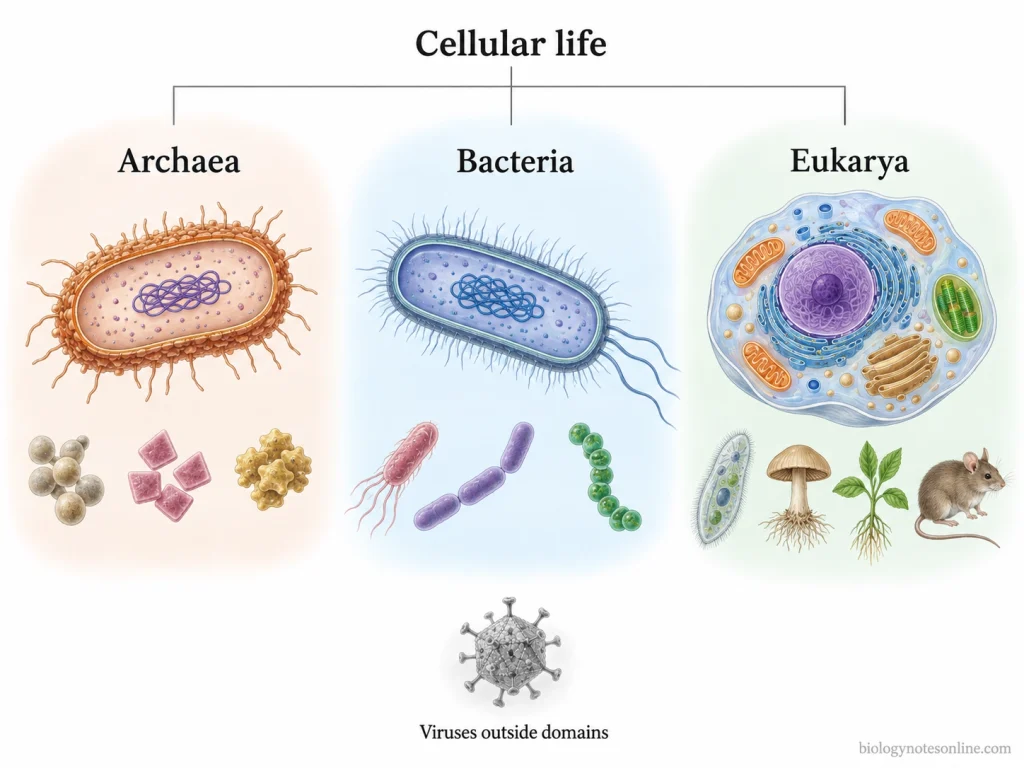
Basis of the Three-Domain Classification
The three-domain system of classification is based on molecular evolutionary relationships rather than mainly on visible morphology or conventional phenotypic characters. Woese used molecular structures and sequences for comparing different organisms. Among these, ribosomal RNA (rRNA) became one of the major basis of this classification.
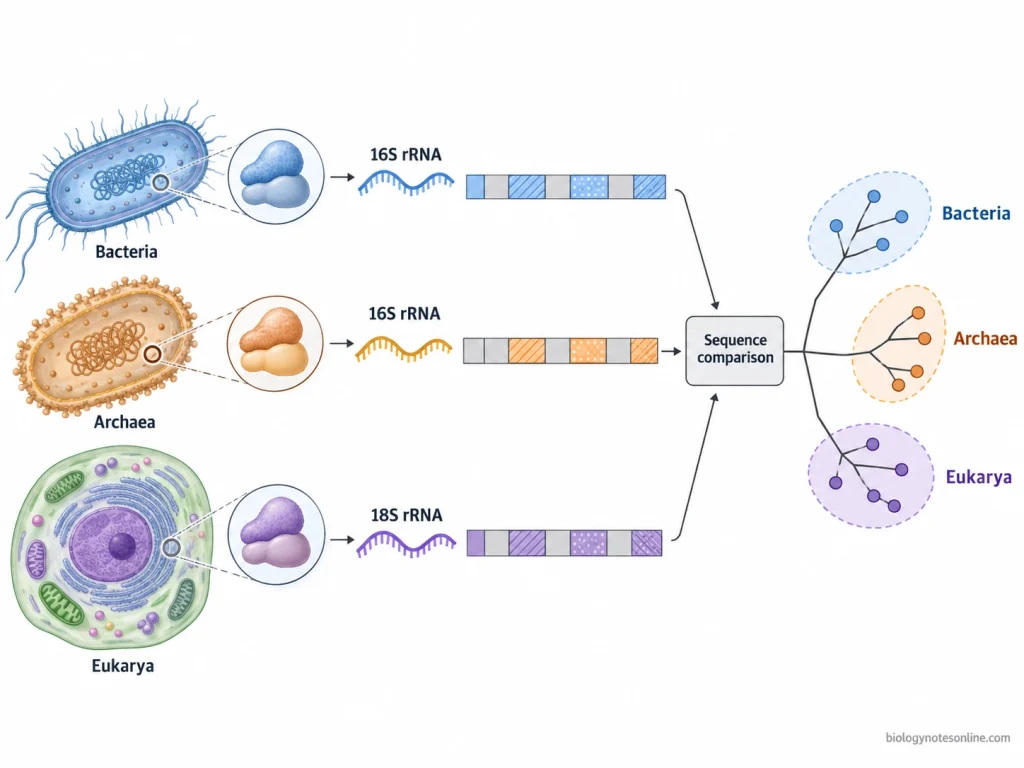
The molecular differences divided cellular life into three groups, Bacteria, Archaea, and Eukarya.
Ribosomal RNA as a molecular marker
Ribosomal RNA (rRNA) is used as a molecular marker because it occurs in all cellular organisms. Some regions of rRNA are highly conserved and it changes relatively slowly during evolution.
Small-subunit rRNA can be compared between organisms which are distantly related. 16S rRNA is used in Bacteria and Archaea, while the corresponding 18S rRNA occurs in eukaryotes. Differences in these rRNA sequences provide information about the evolutionary distance between the organisms.
Evidence separating Archaea from Bacteria
Archaea and Bacteria both may have prokaryotic cell organization. Many members also appear quite similar when observed by ordinary morphological characters. Their rRNA sequences, however, showed a deep difference.
In 1977, Woese and Fox used phylogenetic analysis of ribosomal RNA. The organisms known at that time as “archaebacteria” were identified as a separate primary line of descent from typical bacteria. Later molecular comparisons supported their recognition as a separate domain, Archaea, instead of keeping them as an unusual group of Bacteria.
Molecular phylogeny and evolutionary relationships
Molecular phylogeny is based on comparison of homologous molecular sequences. The similarities and differences present in these sequences are used to infer evolutionary relationships.
With rRNA sequence comparison, organisms can be arranged according to their lines of descent instead of grouping mainly on the basis of shape, physiology, or other phenotypic properties. The phylogenetic pattern obtained from these comparisons formed three major groups, Bacteria, Archaea, and Eukarya. These three groups became the basis of Woese’s three-domain classification.
The Three Domains of Life
The three domains of life include Archaea, Bacteria, and Eukarya. Members under these domains have differences in their cellular organization, molecular characters, cell membrane chemistry, and other cellular features.
Domain Archaea
- Archaea are unicellular prokaryotic organisms, lacking a membrane-bound true nucleus and the membrane-bound cell organelles. In this type of cellular organization, they are similar to the Bacteria.
- The archaeal cell membrane is different from that of bacterial cell. It contains branched isoprenoid chains which are attached to glycerol by ether linkages. Their cell wall when present, does not contain bacterial peptidoglycan. S-layer is common among the members, while pseudomurein occurs in some groups.
- The rRNA of Archaea shows molecular characters different from bacterial rRNA. Several components involved in transcription also have features homologous to the eukaryotic system, although the organisms possess a prokaryotic cellular organization.
- Many of the members are found in extreme environments like hot springs, highly saline water, acidic habitats, and oxygen-free sediments. Archaea are also present in ordinary environments including soil, freshwater, oceans, and digestive systems of animals. Methanogens, extreme halophiles, and thermoacidophiles are some important groups. Halobacterium salinarum and Sulfolobus acidocaldarius are examples.
Domain Bacteria
- Bacteria are mostly unicellular prokaryotic organisms. They lack a membrane-bound nucleus and their genetic material is found in the cytoplasm in a nucleoid region. Ribosomes and other cellular components are also present within the cell.
- In bacterial cell membrane, unbranched fatty acids are generally linked with glycerol by ester linkages. Most bacteria have a cell wall made up of peptidoglycan. This peptidoglycan layer may be thick or comparatively thin depending on the bacterial group.
- Bacteria form a separate molecular lineage with their characteristic rRNA sequences and cellular machinery. The members show a very wide metabolic diversity.
- They occur in soil, freshwater, oceans, sediments and in association with plants and animals. Some bacteria are free-living, whereas others occur as symbionts or pathogens. Escherichia coli and Bacillus subtilis are common examples. Cyanobacteria such as Synechococcus are also members of this domain.
Domain Eukarya
- The domain Eukarya comprises the organisms having eukaryotic cells. A true membrane-bound nucleus is present, within which the DNA is enclosed. Different membrane-bound cell organelles such as mitochondria, endoplasmic reticulum, and Golgi apparatus are also found in these cells.
- Genetic material is arranged mainly in the form of linear chromosomes inside the nucleus. Eukaryotic cells also possess an internal cytoskeleton and have a more compartmentalized cellular organization compared to the prokaryotic cells.
- Some eukaryotic organisms are single-celled, while many of the members are multicellular.
- Protists, fungi, plants, and animals are included under Eukarya. Unicellular forms are also numerous, for example, the yeast Saccharomyces cerevisiae and Amoeba proteus. Plants and animals are the familiar multicellular forms.
Differences Among Archaea, Bacteria, and Eukarya
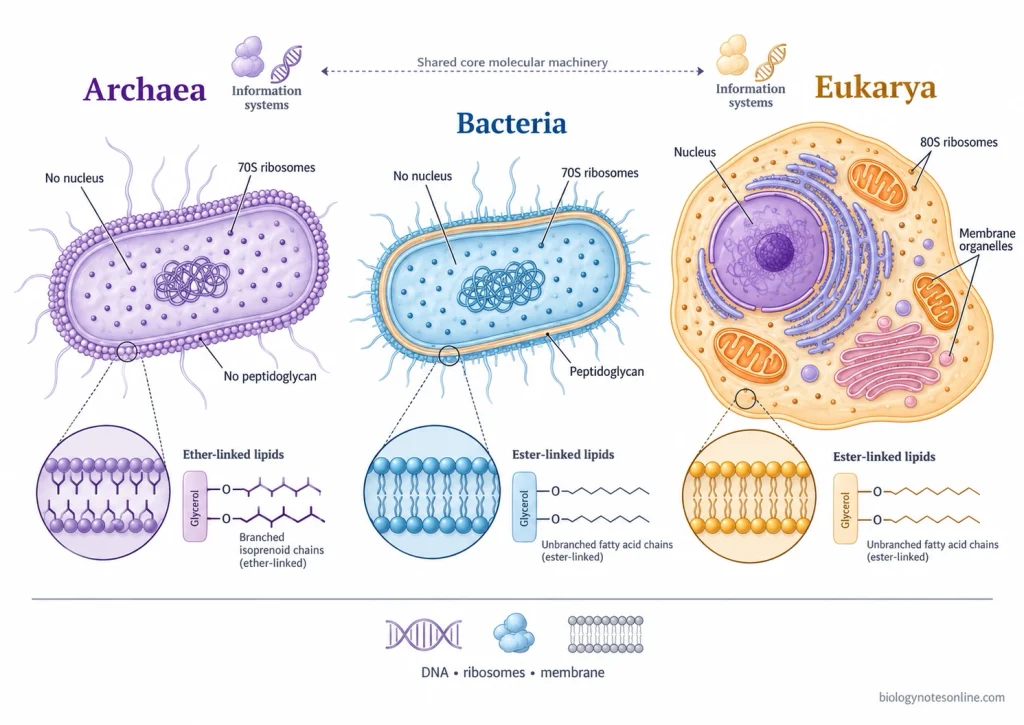
Archaea, Bacteria, and Eukarya are cellular forms and all of them contain DNA, ribosomes, cytoplasm, and a plasma membrane. These basic cellular structures are common, but their cell organization and molecular characters are not the same. The following are some of the important differences among the three domains-
| Characteristics | Archaea | Bacteria | Eukarya |
|---|---|---|---|
| Cell organization | Prokaryotic. Members are unicellular. | Prokaryotic and unicellular. | Eukaryotic. Members may be unicellular or multicellular. |
| Nucleus and membrane-bound organelles | A true membrane-bound nucleus is absent. Membrane-bound cell organelles are also absent. | Nucleus is absent and the DNA occurs in a nucleoid region. Membrane-bound organelles are generally absent. | A true nucleus is present. Mitochondria, endoplasmic reticulum, Golgi apparatus, and other membrane-bound organelles occur in the cells. |
| Cell wall | Peptidoglycan is absent. S-layer is common in many members, while pseudomurein occurs in some Archaea. | Cell wall commonly contains peptidoglycan. | Cell wall varies among the members. Cellulose occurs in plants, chitin and glucans in fungi, while animal cells have no cell wall. |
| Cell membrane lipids | Membrane lipids have branched isoprenoid chains attached to glycerol by ether linkages. Some archaeal membranes may form a monolayer. | Membrane contains mainly fatty acid chains attached to glycerol by ester linkages. | Most eukaryotic membranes also contain ester-linked fatty acid phospholipids. |
| Ribosomal and molecular characters | Cytoplasmic ribosomes are 70S, but the rRNA and ribosomal proteins are different from Bacteria. Several features of DNA replication, transcription, and translation resemble those of Eukarya. | Cytoplasmic ribosomes are 70S with the characteristic bacterial rRNA and ribosomal proteins. | Cytoplasmic ribosomes are mainly 80S. Mitochondria and chloroplasts contain 70S ribosomes. |
| Representative organisms | Methanogens and different thermophilic Archaea. | Escherichia coli, Bacillus, and cyanobacteria are members of Bacteria. | Animals, plants, fungi, and different unicellular eukaryotes are included under Eukarya. |
Bacteria and Archaea both are prokaryotic, and a true nucleus is absent in both. The major difference is found in their molecular and chemical organization.
Bacterial membrane contains mainly ester-linked fatty acids, whereas archaeal membrane contains ether-linked branched isoprenoid chains. Peptidoglycan occurs in bacterial cell wall and is absent from Archaea. Their rRNA and ribosomal proteins are also different.
Several systems involved in DNA replication, transcription, and translation in Archaea show more similarity with Eukarya than with Bacteria.
Five-Kingdom vs Three-Domain Classification
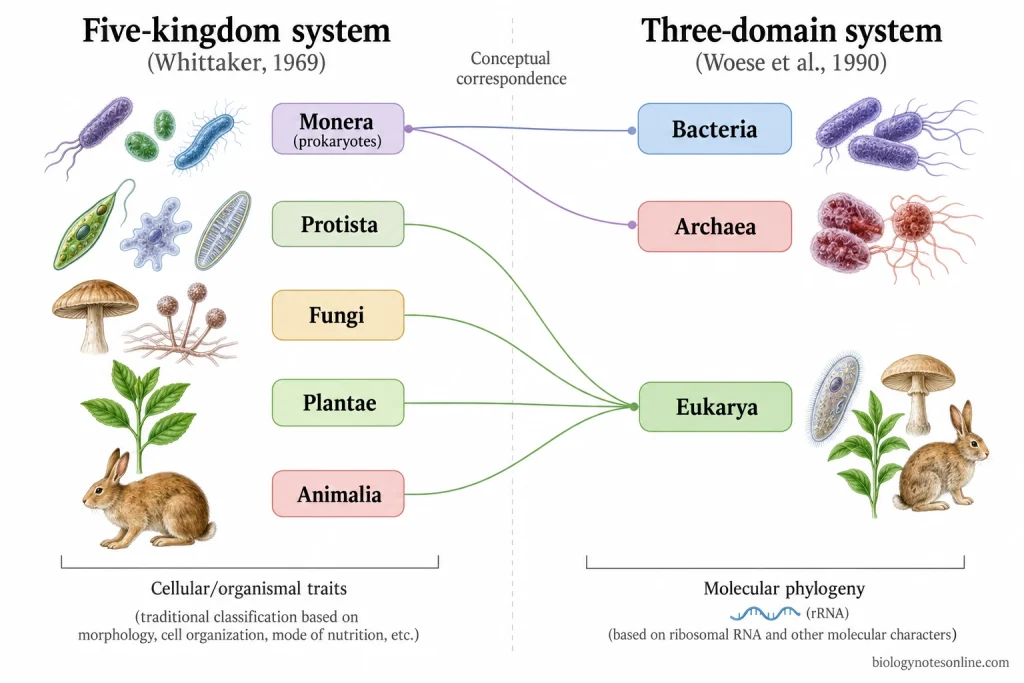
The five-kingdom classification and three-domain classification differ mainly in the basis used for grouping organisms and in the position of prokaryotic organisms. Whittaker’s system recognized five kingdoms, while molecular studies of rRNA separated cellular life into three major domains.
| Characteristics | Five-Kingdom Classification | Three-Domain Classification |
|---|---|---|
| Proposed by | It was proposed by R. H. Whittaker in 1969. | Carl Woese, Otto Kandler, and Mark Wheelis formally proposed the three-domain system in 1990. |
| Major groups | Organisms are placed into five kingdoms- Monera, Protista, Fungi, Plantae, and Animalia. | Cellular life is divided into three domains, Bacteria, Archaea, and Eukarya (Eucarya). |
| Highest major division | Kingdom forms the important grouping of organisms, although Whittaker also recognized an empire or superkingdom level for Prokaryota and Eukaryota. | A new taxonomic rank called “domain” was placed above kingdom. |
| Basis of classification | Classification is based largely on cellular organization and other organismal characters, including the broad differences in mode of nutrition and organization of organisms. | It is based mainly on molecular and evolutionary relationships. Small-subunit ribosomal RNA (rRNA) sequence comparison played a major role in separating the groups. |
| Prokaryotic organisms | Prokaryotic organisms are grouped together under Kingdom Monera. Bacteria and the organisms later called Archaea were not separated as two domains. | Prokaryotes are separated into Bacteria and Archaea on the basis of their major molecular differences. |
| Eukaryotic organisms | Eukaryotes are distributed into Protista, Fungi, Plantae, and Animalia. | The eukaryotic organisms are placed under the domain Eukarya. Animalia, Plantae, Fungi, and other eukaryotic groups occur within this domain. |
| Position of Archaea | Archaea are not given a separate highest group. They were included with other prokaryotic organisms under Monera. | Archaea forms a separate domain, different from Bacteria. Their separation was obtained from molecular comparison, particularly the small-subunit rRNA. |
| Evolutionary relationships | The five-kingdom arrangement does not show the primary three-way molecular division between Bacteria, Archaea, and Eukarya. | Molecular structures and sequences are used for studying the deeper evolutionary relationships among organisms, giving the three primary groupings. |
Importance of the Three-Domain System
- The three-domain system provided a molecular basis for classification using ribosomal RNA (rRNA) and other molecular characters, rather than depending mainly on morphology.
- It recognized Archaea as a separate evolutionary group from Bacteria. Earlier, both were generally placed together as prokaryotes.
- It introduced domain as a taxonomic rank above kingdom and divided cellular life into Bacteria, Archaea, and Eukarya.
- rRNA sequence comparison made it possible to study evolutionary relationships among microorganisms, including organisms having few useful visible characters.
- Microorganisms can also be studied phylogenetically from their genetic sequences without obtaining them first in pure culture. This increased the study of microbial diversity.
- Molecular studies also showed similarities between Archaea and Eukarya in several informational processes, while these systems differ from Bacteria.
- It provided an important framework for studying early cellular evolution and the phylogenetic diversity of life.
Modern Status of the Three-Domain System
- The three-domain system is still used for classification of cellular life into Bacteria, Archaea, and Eukarya. But the three separate branches are not the only model for their deepest evolutionary relationship.
- Recent phylogenomic studies have given strong support to the two-domain tree of life. In this model, Bacteria and Archaea form the two primary domains, while Eukarya originated from within Archaea.
- The study of Asgard Archaea has further supported this relationship. Several analyses place the eukaryotic lineage within or closely related with the Asgard archaeal groups.
- The exact position of Eukarya within Archaea is still not fixed. Different phylogenomic studies have placed the eukaryotic branch at somewhat different positions among Asgard groups.
- Tree-of-life relationships are still being studied. The genes selected, taxon sampling, evolutionary models, and availability of new archaeal genomes can affect the phylogenetic analysis.
Development of the Three-Domain System
- The development of the three-domain system started from Carl Woese’s studies of ribosomal RNA (rRNA) for finding evolutionary relationships among microorganisms.
- During the 1970s, Woese and George Fox compared small-subunit rRNA of different prokaryotes. In 1977, methanogens were found to represent a separate major line of descent from the typical bacteria.
- This group was first called “archaebacteria”. Further rRNA studies placed extreme halophiles and thermoacidophiles with the same lineage, strengthening their separation from Bacteria.
- The name Archaea was later used for this distinct group, replacing the earlier name archaebacteria.
- In 1990, Carl Woese, Otto Kandler, and Mark Wheelis formally proposed the domain level of classification. Cellular life was placed into Bacteria, Archaea, and Eucarya (Eukarya).
The Three Domains at a Glance
| Characteristics | Archaea | Bacteria | Eukarya |
|---|---|---|---|
| Cell type | Prokaryotic | Prokaryotic | Eukaryotic |
| Nucleus | Absent | Absent | Present |
| Membrane-bound organelles | Absent | Absent | Present |
| Cell wall | Peptidoglycan absent | Peptidoglycan usually present | Variable. Cellulose in plants, chitin in fungi, absent in animals |
| Membrane lipids | Ether-linked, branched isoprenoid chains | Ester-linked fatty acids | Mainly ester-linked fatty acids |
| Ribosomes | 70S | 70S | Mainly 80S |
| rRNA and molecular characters | Distinct from Bacteria. Several informational systems show similarity with Eukarya | Characteristic bacterial rRNA and molecular machinery | Eukaryotic rRNA and molecular machinery |
| Cellular organization | Unicellular | Mostly unicellular | Unicellular or multicellular |
| Examples | Methanogens, Halobacterium, Sulfolobus | Escherichia coli, Bacillus, cyanobacteria | Protists, fungi, plants, animals |

References
- Albers, S.-V., & Meyer, B. H. (2011). The archaeal cell envelope. Nature Reviews Microbiology, 9(6), 414–426. https://doi.org/10.1038/nrmicro2576
- Alberts, B., Johnson, A., Lewis, J., Raff, M., Roberts, K., & Walter, P. (2002). Molecular biology of the cell (4th ed.). Garland Science. https://www.ncbi.nlm.nih.gov/books/NBK21054/
- Brown, J. R., & Doolittle, W. F. (1997). Archaea and the prokaryote-to-eukaryote transition. Microbiology and Molecular Biology Reviews, 61(4), 456–502. https://doi.org/10.1128/mmbr.61.4.456-502.1997
- Caforio, A., & Driessen, A. J. M. (2017). Archaeal phospholipids: Structural properties and biosynthesis. Biochimica et Biophysica Acta (BBA) – Molecular and Cell Biology of Lipids, 1862(11), 1325–1339. https://doi.org/10.1016/j.bbalip.2016.12.006
- Chaban, B., Ng, S. Y. M., & Jarrell, K. F. (2006). Archaeal habitats: From the extreme to the ordinary. Canadian Journal of Microbiology, 52(2), 73–116. https://doi.org/10.1139/w05-147
- Clark, M. A., Douglas, M., & Choi, J. (2018). Biology 2e. OpenStax. https://openstax.org/books/biology-2e/pages/1-introduction
- Cooper, G. M. (2000). The cell: A molecular approach (2nd ed.). Sinauer Associates. https://www.ncbi.nlm.nih.gov/books/NBK9839/
- Eme, L., Tamarit, D., Caceres, E. F., Stairs, C. W., De Anda, V., Schön, M. E., Seitz, K. W., Dombrowski, N., Lewis, W. H., Homa, F., Saw, J. H., Lombard, J., Nunoura, T., Li, W.-J., Hua, Z.-S., Chen, L.-X., Banfield, J. F., St John, E., Reysenbach, A.-L., … Ettema, T. J. G. (2023). Inference and reconstruction of the heimdallarchaeial ancestry of eukaryotes. Nature, 618(7967), 992–999. https://doi.org/10.1038/s41586-023-06186-2
- Fry, M. (2024). The discovery of archaea: From observed anomaly to consequential restructuring of the phylogenetic tree. History and Philosophy of the Life Sciences, 46(2), Article 16. https://doi.org/10.1007/s40656-024-00616-8
- Gehring, A. M., Walker, J. E., & Santangelo, T. J. (2016). Transcription regulation in Archaea. Journal of Bacteriology, 198(14), 1906–1917. https://doi.org/10.1128/JB.00255-16
- Gribaldo, S., & Brochier-Armanet, C. (2006). The origin and evolution of Archaea: A state of the art. Philosophical Transactions of the Royal Society B: Biological Sciences, 361(1470), 1007–1022. https://doi.org/10.1098/rstb.2006.1841
- Jarrell, K. F., Albers, S.-V., & de Sousa Machado, J. N. (2021). A comprehensive history of motility and archaellation in Archaea. FEMS Microbes, 2, xtab002. https://doi.org/10.1093/femsmc/xtab002
- Liu, Y., Makarova, K. S., Huang, W.-C., Wolf, Y. I., Nikolskaya, A. N., Zhang, X., Cai, M., Zhang, C.-J., Xu, W., Luo, Z., Cheng, L., Koonin, E. V., & Li, M. (2021). Expanded diversity of Asgard archaea and their relationships with eukaryotes. Nature, 593, 553–557. https://doi.org/10.1038/s41586-021-03494-3
- Meyer, B. H., Albers, S.-V., Eichler, J., & Aebi, M. (2022). Archaea. In A. Varki, R. D. Cummings, J. D. Esko, P. Stanley, G. W. Hart, M. Aebi, D. Mohnen, T. Kinoshita, N. H. Packer, J. H. Prestegard, R. L. Schnaar, & P. H. Seeberger (Eds.), Essentials of glycobiology (4th ed., Chapter 22). Cold Spring Harbor Laboratory Press. https://doi.org/10.1101/glycobiology.4e.22
- Pace, N. R. (2009). Mapping the tree of life: Progress and prospects. Microbiology and Molecular Biology Reviews, 73(4), 565–576. https://doi.org/10.1128/MMBR.00033-09
- Parker, N., Schneegurt, M., Tu, A.-H. T., Lister, P., & Forster, B. M. (2016). Microbiology. OpenStax. https://openstax.org/books/microbiology/pages/1-introduction
- Sapp, J., & Fox, G. E. (2013). The singular quest for a universal tree of life. Microbiology and Molecular Biology Reviews, 77(4), 541–550. https://doi.org/10.1128/MMBR.00038-13
- Spang, A., Mahendrarajah, T. A., Offre, P., & Stairs, C. W. (2022). Evolving perspective on the origin and diversification of cellular life and the virosphere. Genome Biology and Evolution, 14(6), evac034. https://doi.org/10.1093/gbe/evac034
- Walters, K. E., & Martiny, J. B. H. (2020). Alpha-, beta-, and gamma-diversity of bacteria varies across habitats. PLOS ONE, 15(9), e0233872. https://doi.org/10.1371/journal.pone.0233872
- Whittaker, R. H. (1969). New concepts of kingdoms of organisms: Evolutionary relations are better represented by new classifications than by the traditional two kingdoms. Science, 163(3863), 150–160. https://doi.org/10.1126/science.163.3863.150
- Williams, T. A., Cox, C. J., Foster, P. G., Szöllősi, G. J., & Embley, T. M. (2020). Phylogenomics provides robust support for a two-domains tree of life. Nature Ecology & Evolution, 4(1), 138–147. https://doi.org/10.1038/s41559-019-1040-x
- Winker, S., & Woese, C. R. (1991). A definition of the domains Archaea, Bacteria and Eucarya in terms of small subunit ribosomal RNA characteristics. Systematic and Applied Microbiology, 14(4), 305–310. https://doi.org/10.1016/S0723-2020(11)80303-6
- Woese, C. R. (1987). Bacterial evolution. Microbiological Reviews, 51(2), 221–271. https://doi.org/10.1128/mr.51.2.221-271.1987
- Woese, C. R., & Fox, G. E. (1977). Phylogenetic structure of the prokaryotic domain: The primary kingdoms. Proceedings of the National Academy of Sciences of the United States of America, 74(11), 5088–5090. https://doi.org/10.1073/pnas.74.11.5088
- Woese, C. R., Kandler, O., & Wheelis, M. L. (1990). Towards a natural system of organisms: Proposal for the domains Archaea, Bacteria, and Eucarya. Proceedings of the National Academy of Sciences of the United States of America, 87(12), 4576–4579. https://doi.org/10.1073/pnas.87.12.4576
- Zhang, J., Feng, X., Li, M., Liu, Y., Liu, M., Hou, L.-J., & Dong, H.-P. (2025). Deep origin of eukaryotes outside Heimdallarchaeia within Asgardarchaeota. Nature, 642, 990–998. https://doi.org/10.1038/s41586-025-08955-7