

Subculturing technique in microbiology is a method of transferring viable microorganisms from an existing microbial culture into a fresh and suitable growth medium under aseptic conditions. It is used to continue the growth of microorganisms, increase their number or maintain a culture for further laboratory study.
In this technique, a small amount of the original microbial culture is taken and transferred into the fresh medium. The transferred portion is called the inoculum. It contains living microorganisms which can grow in the new medium under suitable conditions.
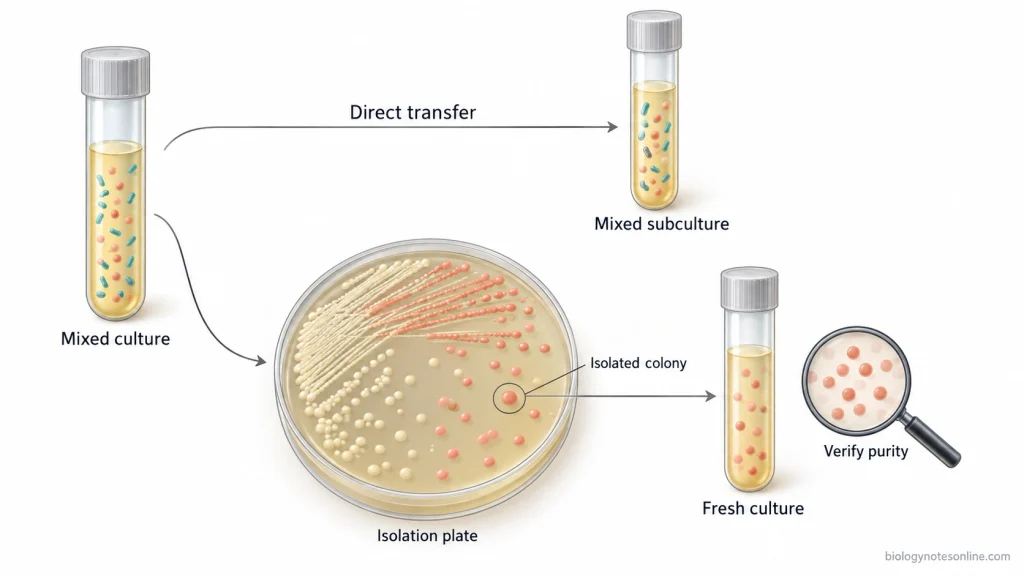
The fresh culture medium is selected according to the growth requirements of the microorganisms. Aseptic technique is followed during the transfer to reduce the chance of contamination by unwanted microorganisms. Subculturing a mixed culture does not automatically produce a pure culture.
Types of Subculturing Techniques
| Type | Starting Medium | Destination Medium | Laboratory Use | Expected Microbial Growth |
|---|---|---|---|---|
| Solid-to-Solid | Agar plate or slant | Fresh agar plate or slant | Culture maintenance and colony isolation | Colonies or surface growth |
| Solid-to-Liquid | Agar plate or slant | Sterile broth | Preparation of liquid cultures and microbial propagation | Turbidity, sediment or surface growth |
| Liquid-to-Solid | Broth culture | Fresh agar plate or slant | Colony isolation and study of cultural characteristics | Colonies or growth along agar surface |
| Liquid-to-Liquid | Broth culture | Fresh sterile broth | Propagation and maintenance of broth cultures | Turbidity, sediment or surface growth |
Based on the physical state of the source and destination culture media, subculturing can be classified into four types-
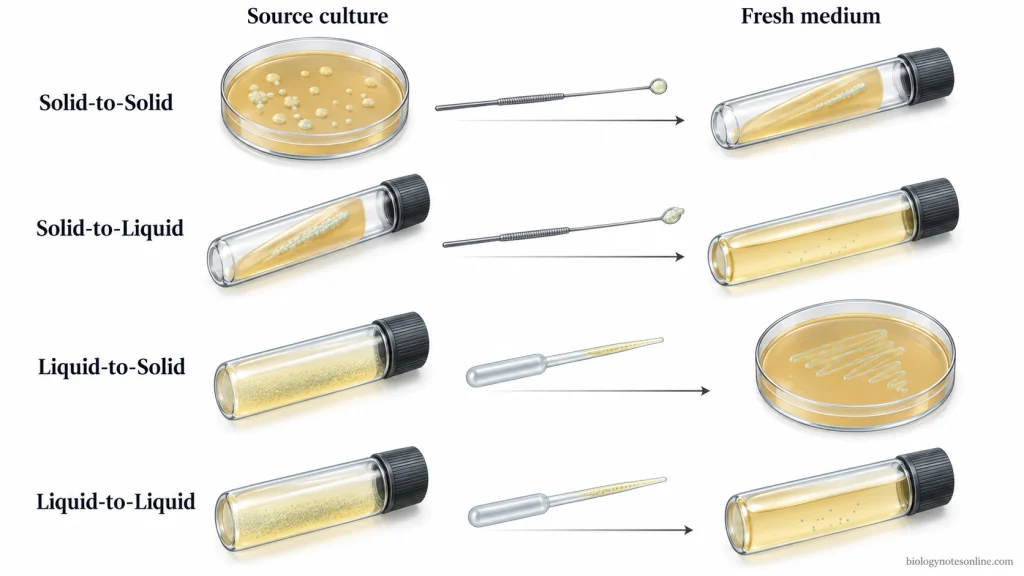
1. Solid-to-Solid Subculturing
In this method, microorganisms are transferred from an existing solid culture medium to another fresh solid medium. The transfer may take place from one agar plate to another or between agar slants.
It is commonly used for maintaining microbial cultures and isolating colonies on agar plates. The growth may appear as separate colonies on plates or along the inoculated surface of agar slants. Isolated colonies are obtained when suitable isolation technique is used.
2. Solid-to-Liquid Subculturing
Solid-to-liquid subculturing involves transferring microorganisms from an agar plate or slant into a fresh liquid culture medium (broth).
A small amount of microbial growth is taken from the agar surface and introduced into the broth. The microorganisms grow in the liquid medium, which may show turbidity, sediment or a surface film depending on the microorganism.
It is used for preparing liquid microbial cultures and increasing the microbial population for further laboratory studies.
3. Liquid-to-Solid Subculturing
In this type, the inoculum is taken from an existing broth culture and transferred onto the surface of fresh solid agar medium.
Agar plates are commonly used for obtaining isolated colonies and studying their cultural characteristics. The inoculum may also be transferred onto agar slants, where microbial growth develops along the inoculated surface.
The colony isolation depends on the inoculation method used.
4. Liquid-to-Liquid Subculturing
It is a method of transferring a small amount of microbial culture from an existing liquid broth into fresh sterile broth.
The microorganisms are allowed to grow in the new medium under suitable conditions. Growth may be seen as turbidity, sediment at the bottom or a surface film. This method is used for propagation of microorganisms and preparation of fresh broth cultures.
Purpose of Subculturing
Subculturing is used to maintain the growth and viability of microorganisms by transferring them into fresh culture medium. In old culture medium, nutrients gradually get depleted and waste products may accumulate, affecting microbial growth. It is also necessary to obtain fresh cultures for further laboratory studies.
The important purposes of subculturing in microbiology are as follows-
- It is used to maintain living microbial cultures in the laboratory by transferring them into fresh media at suitable intervals.
- Fresh culture medium provides nutrients required for continuous growth of microorganisms.
- It is used to prepare fresh and actively growing microbial cultures for staining, microscopic examination and other laboratory tests.
- A small amount of microbial culture can be grown in fresh nutrient medium to increase the number of microbial cells. Broth media are commonly used for this purpose.
- It helps in isolating microorganisms from mixed cultures by transferring isolated colonies into fresh media. Suitable isolation techniques are required to obtain pure cultures.
- The colony shape, size, colour, texture and growth patterns of microorganisms can be studied on suitable culture media.
- Fresh cultures are used in different biochemical tests for the identification of microorganisms.
Aseptic Requirements for Subculturing
Subculturing must be carried out under aseptic conditions to prevent contamination of microbial cultures. The culture medium, transferring instruments and working area must be properly prepared before the transfer.
The important requirements for subculturing are as follows-
- Microbial Culture- A viable microbial culture is required as the source of microorganisms for subculturing.
- Sterile Culture Media– Fresh and sterile culture media, such as nutrient broth, agar plates or agar slants, are required according to the growth requirements of microorganisms.
- Sterile Instruments- Sterile inoculating loops, needles or pipettes are used to transfer microorganisms. Reusable instruments must be sterilized before use.
- Clean Working Area- The working area must be cleaned and disinfected before and after the transfer to reduce contamination.
- Proper Handling- Culture tubes and Petri dishes should be opened only when required. The culture medium and sterile instruments must not come in contact with contaminated surfaces.
- Cooling of Instruments- Sterilized metal inoculating loops must be allowed to cool before touching the microbial culture.
- Personal Protection- Proper hand hygiene and suitable personal protective equipment (PPE), such as laboratory coats and gloves, are required according to laboratory safety rules.
- Culture Labelling- The culture vessels must be properly labelled with the culture identification and date to avoid mixing up different cultures.
- Suitable Growth Conditions- The temperature, pH, oxygen availability and other growth conditions must be suitable for the particular microorganism.
- Prevention of Contamination- Care must be taken to avoid unnecessary splashes, aerosols and exposure of open cultures to surrounding air.
- Waste Disposal- Used culture materials and contaminated instruments must be disinfected, sterilized or disposed of according to laboratory procedures.
Safety Note: Subculturing must follow laboratory-specific risk assessment and approved biosafety practices. Suitable containment equipment, including a biological safety cabinet when required, must be used according to the risk associated with the microorganisms.
Subculturing Procedure
Subculturing involves the transfer of a small amount of microorganisms from an existing culture into fresh sterile culture medium. The whole process is carried out under aseptic conditions.
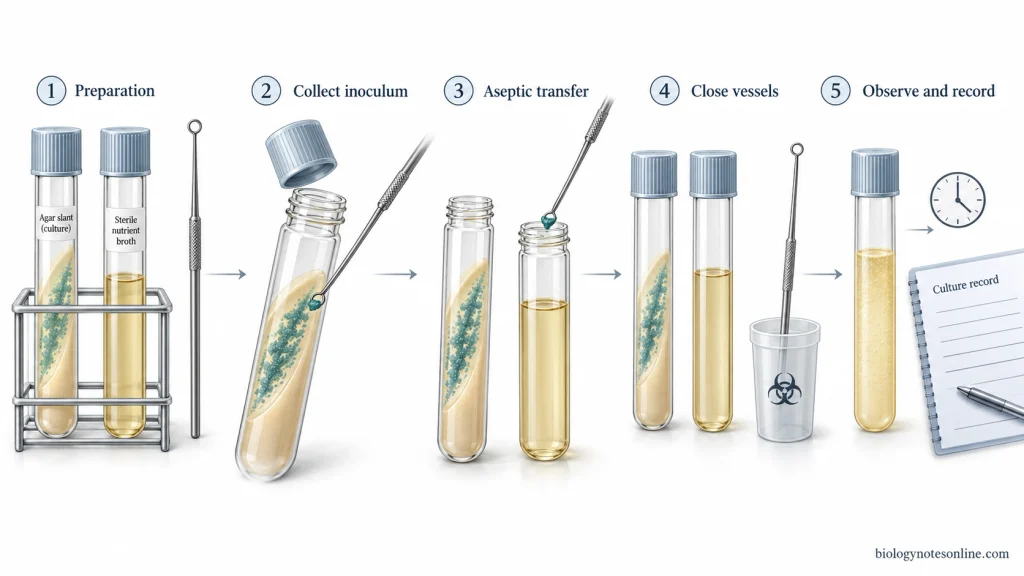
The general steps of subculturing are as follows-
Preparation of the Source Culture and Fresh Medium
- First, a suitable microbial culture is selected for subculturing. The microorganisms should be viable. The culture is also examined for any visible contamination.
- Fresh sterile culture medium is prepared according to the growth requirements of the microorganism. Nutrient broth, agar plates or agar slants may be used.
- The fresh culture vessel is labelled with the name or identification of the microorganism, date and other required details.
- Before starting the transfer, the working area is cleaned and disinfected. All the required materials and sterile inoculating instruments are arranged.
Aseptic Transfer of the Inoculum
- A sterile inoculating loop, needle or pipette is selected depending on the type of culture medium. Reusable instruments are sterilized before use.
- The source culture is opened carefully. A small amount of microbial culture is taken using the sterile instrument. This transferred material is called the inoculum.
- The inoculum is then transferred into the fresh sterile medium. In broth culture, it is introduced into the liquid medium. For agar plates and slants, the inoculum is applied on the agar surface using a suitable inoculation method.
- After transferring the inoculum, both culture vessels are closed to prevent contamination. The used instrument is sterilized or discarded according to the laboratory procedure.
Incubation and Documentation
- The inoculated medium is kept for incubation under suitable growth conditions. The incubation temperature, time and oxygen requirements are not same for all microorganisms.
- After incubation, the culture is examined for microbial growth. In broth medium, growth may appear as turbidity, sediment or surface growth. On solid media, colonies or other surface growth patterns may be observed.
- The new culture is checked for unusual growth or possible contamination. Presence of microbial growth alone does not confirm a pure culture.
- The culture identification, medium used, date of transfer, incubation conditions and growth observations are recorded in the laboratory record.
Evaluation of Subculture Results
After incubation, the subcultured medium is examined for microbial growth and possible contamination. The appearance of growth is not same in all microorganisms. It also varies with the type of culture medium used.
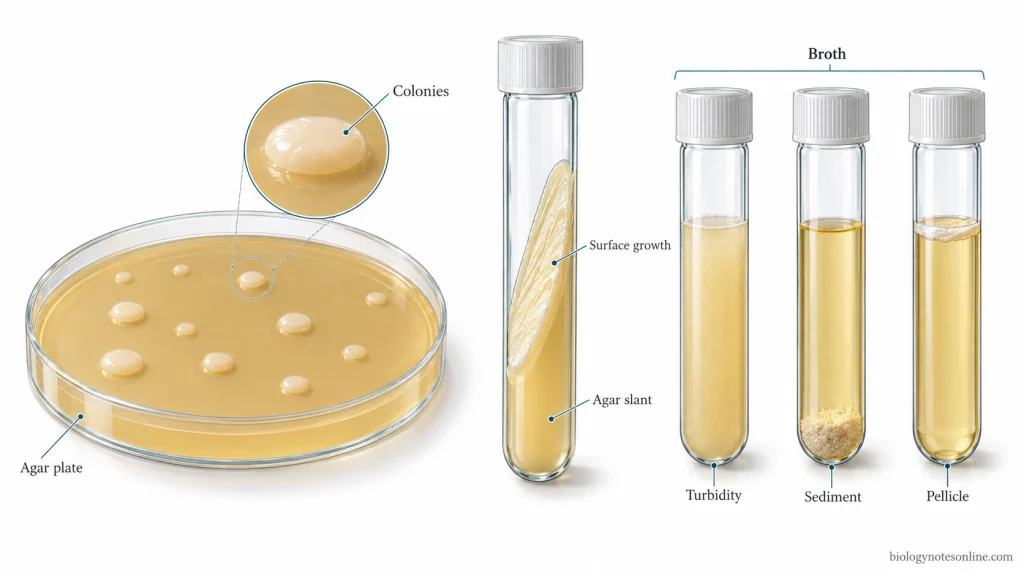
Signs of Successful Growth
Presence of microbial growth in the fresh medium indicates successful subculturing. The growth characteristics are compared with the original culture. Expected growth indicates the transfer of viable microorganisms, but does not confirm that the culture is pure.
The common signs of microbial growth are as follows-
- Agar Plates- Microorganisms form colonies on the agar surface. These colonies are examined for their size, shape, colour and texture.
- Agar Slants- Growth is seen along the inoculated surface of the agar slant. It may be continuous or spreading depending on the microorganism.
- Broth Culture- In liquid medium, microbial growth may produce turbidity (cloudiness), sediment at the bottom or a surface film (pellicle). Some microorganisms also form small clumps in the broth.
Contamination and Unsuccessful Growth
Contamination refers to the growth of unwanted microorganisms in the subcultured medium. In some cases, little or no microbial growth is observed after incubation.
The common signs of contamination and unsuccessful growth are as follows-
- Appearance of unexpected colonies having different shapes, sizes or colours from the original culture may indicate contamination.
- In broth culture, unusual turbidity, surface films or clumps may be observed. These changes alone are not sufficient to confirm contamination.
- In absence of microbial growth, the broth may remain clear. No colonies are formed on the agar surface.
- Microbial growth may fail due to nonviable microorganisms, improper transfer, unsuitable culture medium or incorrect incubation conditions.
- The suspected contaminated culture is compared with the original culture. Microscopic examination or other purity tests may be performed when required.
Advantages of Subculturing Techniques
Subculturing is a simple method used for the growth and maintenance of microorganisms in the laboratory. The major advantages of subculturing are as follows-
- It is used to maintain viable microbial cultures for short periods by transferring them into fresh culture medium at suitable intervals.
- Fresh medium provides nutrients for further growth of microorganisms. It also reduces the effects of nutrient depletion and accumulation of waste products in old cultures.
- A small amount of microbial culture can be grown in fresh nutrient medium to produce a larger number of microbial cells.
- It helps in obtaining fresh and actively growing microbial cultures for staining, microscopic examination and biochemical tests.
- Individual microorganisms can be isolated from mixed cultures by transferring isolated colonies into fresh media. Pure cultures can be maintained by using proper aseptic techniques.
- Subculturing on agar plates allows examination of colony characteristics such as size, shape, colour and texture.
- Different culture media can be used to study the growth characteristics of microorganisms under different nutritional conditions.
- The microorganisms grown by subculturing can be used for further identification, physiological studies and other microbiological experiments.
Limitations of Subculturing Techniques
Subculturing is used for maintaining and growing microbial cultures in the laboratory. However, repeated transfer of microorganisms has some limitations. The important limitations of subculturing are as follows-
- There is a chance of contamination during the transfer of microorganisms, even when aseptic techniques are followed. Unwanted microorganisms may grow along with the original culture.
- Repeated subculturing may cause genetic mutations and changes in the physiological and cultural characteristics of microorganisms. Some microbial strains may also lose their plasmids during successive transfers.
- The microbial cultures need to be transferred into fresh media at suitable intervals. This requires regular monitoring, time and additional culture materials.
- In absence of timely subculturing, microorganisms may lose their viability due to depletion of nutrients and accumulation of metabolic waste products.
- It is not suitable for long-term preservation of many microorganisms. Methods like freezing and freeze-drying are preferred for maintaining stock cultures for longer periods.
- Some microorganisms require special nutrients and growth conditions. They may not grow in ordinary laboratory culture media.
- Subculturing does not always produce a pure culture. In case of mixed cultures, additional isolation techniques are required to separate the microorganisms.
- The growth may fail due to improper transfer, unsuitable culture medium or incorrect incubation conditions.
- Handling of live microbial cultures during repeated transfers may increase the risk of exposure to microorganisms. Proper biosafety precautions are required during the process.
Uses of Subculturing Techniques
Subculturing is used for maintaining microbial cultures, isolation and further study of microorganisms in the laboratory. The important uses of subculturing are as follows-
- The viable microbial cultures are maintained by transferring them into fresh culture media at suitable intervals.
- In mixed cultures, microorganisms can be separated on agar plates using suitable isolation techniques. The isolated colonies are then transferred into fresh media for obtaining pure cultures.
- A small amount of microbial culture is grown in fresh broth medium to increase the number of microbial cells. These cells are used for laboratory experiments.
- Fresh cultures are used for staining and microscopic examination of the cell morphology.
- The colony size, shape, colour and texture of microorganisms are studied on different culture media. Their growth patterns are also examined.
- For identification of microorganisms, fresh cultures are inoculated into different biochemical test media. The metabolic activities of the microorganisms are then studied.
- In clinical microbiology laboratories, microorganisms isolated from patient specimens are subcultured for further identification and antimicrobial susceptibility testing.
- It is used to study the growth of microorganisms in different culture media and under different nutritional conditions.
- Fresh working cultures are prepared from stored microbial stocks. These cultures are used in microbiological research and other laboratory studies.
- The purity of microbial cultures can also be examined by subculturing. The colonies are checked for the presence of unwanted microorganisms. Additional tests are performed when required.
References
- Cappuccino, J. G., & Welsh, C. T. (2022). Microbiology: A laboratory manual (12th ed.). Pearson. https://www.pearson.com/en-us/subject-catalog/p/microbiology-a-laboratorymanual/P200000006788/9780137546527
- Leboffe, M. J., & Pierce, B. E. (2012). Microbiology: Laboratory theory and application. Morton Publishing Company. https://books.google.com/books?id=KSnAAgAAQBAJ
- Madigan, M. T., Bender, K. S., Buckley, D. H., Sattley, W. M., & Stahl, D. A. (2021). Brock biology of microorganisms (16th ed.). Pearson. https://www.pearson.com/en-us/subject-catalog/p/brock-biology-of-microorganisms/P200000006867
- Parker, N., Schneegurt, M., Tu, A.-H. T., Lister, P., & Forster, B. M. (2016). Microbiology. OpenStax. https://openstax.org/books/microbiology/pages/1-introduction
- Prakash, O., Nimonkar, Y., & Shouche, Y. S. (2013). Practice and prospects of microbial preservation. FEMS Microbiology Letters, 339(1), 1–9. https://doi.org/10.1111/1574-6968.12034
- Smith, D., & Ryan, M. J. (2012). Implementing best practices and validation of cryopreservation techniques for microorganisms. The Scientific World Journal, 2012, Article 805659. https://doi.org/10.1100/2012/805659
- Tortora, G. J., Case, C. L., Bair, W. B., Weber, D., & Funke, B. R. (2024). Microbiology: An introduction (14th ed.). Pearson. https://www.pearson.com/en-us/subject-catalog/p/microbiology-an-introduction/P200000009851
- Willey, J. M., Sandman, K. M., & Wood, D. H. (2022). Prescott’s microbiology (12th ed.). McGraw Hill. https://www.mheducation.co.uk/prescott-s-microbiology-ise-9781265123031-emea-group