

Single pan mechanical balance is a precise weighing instrument used for measuring mass of a sample. It is also called unequal arm mechanical balance because the two arms of the beam are not equal in length.
It works on the law of moments or lever principle. The balance has a horizontal beam which rests on sharp knife edges. One arm is short and another arm is long.
The short arm carries the weighing pan and a set of built-in calibrated weights. The long arm carries a fixed counterweight. This counterweight keeps the empty balance in zero position.
In this balance only one pan is used for keeping the sample. The weighing is done by substitution method. When the sample is placed on the pan, the balance becomes disturbed from zero.
Then the internal weights are removed by using external knobs. The weights are removed until the beam again comes to zero equilibrium position. The mass of removed weights is equal to the mass of the sample.
This balance has constant load on the fulcrum. So the sensitivity remains almost same during weighing. It also reduces the error which may occur due to unequal arm length in old balances.
The idea of unequal arm balance is related with old Roman scale or steelyard. Later Joseph Black developed mechanical analytical balance. The modern single pan balance was developed by Dr. Erhard Mettler in 1945.
This balance was faster than two-pan balance. It was also more accurate and easy to use in chemical laboratory. Before electronic balances, single pan mechanical balance was widely used in analytical and laboratory weighing.
Principle of Single Pan or Unequal Arm Mechanical Balance
Principle of Single Pan or Unequal Arm Mechanical Balance is based on law of moments or lever principle. It also works by weighing by substitution method.
In this balance the beam has two unequal arms. The short arm carries the weighing pan and built-in calibrated weights. The long arm carries a fixed counterweight.
When the pan is empty, the fixed counterweight balances the pan and all internal weights present on the short arm. At this time the pointer remains at zero position.
When the sample is placed on the pan, extra mass is added on the short arm. So the beam tilts from its zero position.
To balance it again, some internal weights are removed from the short arm by using knobs. The weights are removed until the pointer again comes to zero.
The total value of removed internal weights gives the mass of the sample. This is called weighing by substitution or weighing by subtraction.
In this method the total load on the beam remains almost constant. So the sensitivity of balance remains same and accurate weighing is obtained.
Parts of Single Pan/Unequal Arm Mechanical Balance
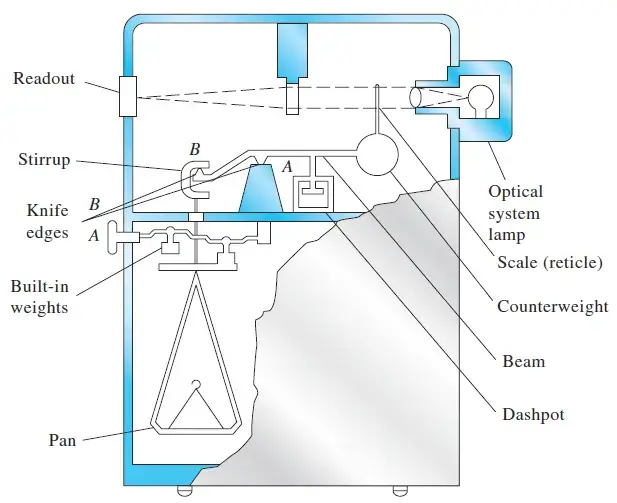
The following are the main parts of Single Pan or Unequal Arm Mechanical Balance–
- Beam
It is the central horizontal lever of the balance. It is usually made up of light alloy or brass and moves on a central knife-edge. - Knife-edges
These are sharp pivot points of the balance. They are made up of hard material like agate or synthetic sapphire and reduce friction during beam movement. - Pan
It is the tray where the object is placed for weighing. It is attached with the shorter arm of the beam and is usually made up of stainless steel or glass. - Built-in weights
These are calibrated standard masses present inside the balance. They are removed mechanically during weighing and the removed weight gives the mass of sample. - Counterweight
It is fixed on the longer arm of the beam. It balances the pan and built-in weights when the balance is empty. - Air damper
It is used to stop the oscillation of the beam quickly. It has piston and cylinder arrangement which gives air resistance. - Optical scale system
It is used to read small deflection of the beam. It has light source, mirror and graduated scale for observing fractional mass. - Beam arrest
It is used to lock the beam when the balance is not in use. It protects the knife-edges from wear and damage. - Pan arrest
It supports or locks the pan before and after weighing. It prevents sudden load on the beam and knife-edges. - Draft shield
It is a glass or acrylic enclosure around the balance. It protects the weighing system from air current, dust and temperature change.
Operating Procedure of Single Pan/Unequal Arm Mechanical Balance
The following are the operating procedure of Single Pan/Unequal Arm Mechanical Balance–
- The zero point is checked first. The pan should be empty and all built-in weights should remain loaded, then the beam is released and pointer or optical scale should show zero.
- If zero is not obtained, the zero adjustment screw is turned slowly. The pointer or optical scale is adjusted to zero position.
- The beam arrest is applied before placing sample on the pan. This protects the knife-edges from sudden load and wear.
- The sample is placed on the pan with a suitable container. Chemicals or sample should not be placed directly on the bare pan.
- The built-in weights are removed by turning external knobs or dials. The largest weight is removed first and then smaller weights are removed one by one.
- After removing each weight, the beam is released partly to check the balance position. This shows whether more weight should be removed or not.
- When the balance comes near equilibrium, the beam is fully released. The remaining small value is read from the optical scale.
- The final mass is obtained by adding the removed internal weights and the optical scale reading. This gives the mass of the sample.
- After reading, the beam arrest is applied again. The sample and container are removed from the pan.
- All knobs or dials are returned to their original position. The internal weights become fully loaded again.
- The zero point is checked again after unloading. The balance should be left clean, empty and arrested for next use.
Factors that affect readings on Single Pan/Unequal Arm Mechanical Balance
The following are the factors that affect readings on Single Pan/Unequal Arm Mechanical Balance–
- Air current affects the weighing pan and beam. Moving air from window, fan or door may push the pan and gives fluctuating reading.
- Temperature variation affects the weighing result. Warm object may produce convection current inside the balance case and the sample may show less weight.
- Vibration disturbs the beam movement. Nearby machine, foot movement and building vibration may make the pointer unstable.
- Humidity affects hygroscopic samples. Such samples absorb moisture from air and their weight increases during weighing.
- Knife edge wear reduces the sensitivity of balance. If the sharp pivot points become worn, friction increases and accurate reading is not obtained.
- Parallax error occurs during reading of pointer or optical scale. If the scale is seen from side or angle, wrong reading may be taken.
Uses of Single Pan/Unequal Arm Mechanical Balance
The following are the uses of Single Pan/Unequal Arm Mechanical Balance–
- It is used in food quality testing for weighing food samples, additives, reagents and reference standards.
- It is used in analytical work for preparing solution of known concentration and for titration related measurement.
- It is used for determination of moisture content. The sample is weighed before and after drying to find loss of water.
- It is used in agricultural research for weighing seeds, soil samples, fertiliser and plant dry matter.
- It is used in pharmaceutical formulation for weighing drug compounds and excipients with high accuracy.
- It is used in schools and universities for teaching mass measurement, lever principle and basic metrological standard.
Advantages of Single Pan/Unequal Arm Mechanical Balance
The following are the advantages of Single Pan/Unequal Arm Mechanical Balance–
- It gives constant sensitivity during weighing. In substitution method the total load on the fulcrum remains same, so the balance response remains uniform.
- It reduces error due to unequal arm length. The sample and internal weights act at the same position on the short arm, so arm length difference does not affect the reading much.
- It is faster than two pan balance. External standard weights are not added again and again, because built-in weights are already present inside the balance.
- It gives more convenient weighing. The weights are removed by knobs or dials and the mass can be obtained easily.
- It has good mechanical strength. Constant load reduces variable stress on the beam and helps the balance to work for long time.
- It can last for many years with proper care. Regular cleaning and careful handling keeps the balance usable.
- It does not need electricity. So it can be used during power failure and in places where electric supply is not available.
- It is less costly than modern electronic analytical balance. So it is useful where precise weighing is needed but budget is limited.
- It is useful for teaching. The beam, weights and lever action can be observed directly by students during weighing.
Limitations of Single Pan or Unequal Arm Mechanical Balance
The following are the limitations of Single Pan/Unequal Arm Mechanical Balance–
- It takes more time than electronic balance. The operator has to adjust the knobs, wait for the beam to settle and then read the optical scale.
- Parallax error may occur during reading. If the pointer or optical scale is not seen straight, the final reading may become slightly wrong.
- It has limited weighing capacity. Usually it is used below 250 g, so large and heavy samples cannot be weighed.
- It has limited resolution. It cannot measure very fine mass like modern electronic analytical balance with Electromagnetic Force Restoration (EMFR).
- It depends on operator skill. Proper training is needed for adjusting weights and reading the fractional scale correctly.
- The knife-edges are delicate part of the balance. With long use they may become worn and friction increases.
- The sensitivity becomes less if the pivot points are damaged. So careful handling and regular maintenance is needed.
Precautions of Single Pan/Unequal Arm Mechanical Balance
The following are the precautions of Single Pan/Unequal Arm Mechanical Balance–
- The balance should be kept on sturdy, flat and vibration free table. Air draft, direct sunlight, dust and sudden temperature change should be avoided.
- The sample should be brought to room temperature before weighing. Hot or cold sample may produce air current inside the balance and reading becomes wrong.
- Substance should not be placed directly on the bare pan. Suitable container or pre-weighed paper should be used.
- Sample and container should not be handled by bare hand. Gloves, forceps or tongs should be used because oil and moisture from skin may add extra mass.
- Beam arrest should be applied before adding or removing sample from the pan. This protects the delicate knife-edges from shock and wear.
- Draft shield doors should be closed before taking final reading. Moving air may push the pan and beam.
- The balance should not be overloaded. Heavy object may damage the beam and knife-edge pivots.
- After use the pan and nearby surface should be cleaned with soft brush. Spilled material should not remain inside the balance.
- The balance should be left with beam arrested after work. It should be kept covered in clean and dry place to prevent dust deposition.
References
- Adam Equipment. (2018, January 17). How do balances and scales work?
- Agriculture Institute. (2025, June 10). How mechanical single pan balances work in mass measurement. Agriculture Notes.
- Agriculture Institute. (2025, June 10). How mechanical single pan balances work in mass measurement… Agriculture Notes.
- Agriculture Institute. (n.d.). Types of analytical balances: Mechanical and electronic. Agriculture Notes.
- Anonymous. (n.d.). The technical evolution of precision metrology: From mechanical substitution to electromagnetic restoration.
- Artmlyn.eu. (n.d.). The scales and weighing methods.
- Automotion Components. (2026). Automotion components dashpots technical page.
- Bowser, E. A. (1893). Steelyard balance. NCpedia. (Image uploaded 2024, June 14).
- Cox, A. (2025, September 2). What is an analytical balance. Triton Store.
- Dickson, R. (2026, April 26). Dashpot mechanism explained: How it works, parts, damping formula, and uses. FIRGELLI Automations.
- DSCBalances. (2023, February 22). Beam balance scale – Overview, components, different types.
- DSCBalances. (2025, December 18). Understanding analytical balance types: Key features and applications.
- Eagle Scales. (2025, February 26). Analytical balances: Definition, principle, types, uses & parts.
- Hinotek. (n.d.). The principle of electromagnetic force compensation in analytical balance.
- ISASC. (2020). Glossary T – Z. ISASC Collection Glossary of Terms.
- Jordan, D. K. (2017, February 14). Steelyards.
- Labnics. (2026). Analytical balance achieving high precision and accuracy in laboratory weighing blog.
- LDA Belgium. (n.d.). Air shock absorbers “dashpot”.
- Liberty Scales. (2026). Mettler Toledo precision scales and balances.
- MatrixBCG.com. (2026, April 13). What is brief history of Mettler-Toledo International company?
- McCormack, V. (2022, October 6). Weighing in on steelyard and bismar scales. Bowers Museum Collection Blog.
- OHAUS. (2026). Mechanical scales and balances.
- Ossila. (2026). Balance calibration: External and internal calibration.
- PortersFiveForce.com. (2026, March 19). What is brief history of Mettler-Toledo International company?
- Precisa. (2026). Analytical balances | Definition, uses, and more…
- Sartorius AG. (1999, July). Sartorius analytical balances with the monolithic weighing system service manual. Data Weighing Systems.
- Sartorius. (2015, May). Laboratory weighing products.
- Sartorius. (2026). Analytical balances.
- Sartorius. (2026). Guide to laboratory balances and scales.
- Sartorius. (2026). Laboratory balances & scales.
- Scales Plus. (2026). Mechanical balances.
- SWOTTemplate.com. (2025, September 28). What is brief history of Mettler-Toledo International company?
- Wikipedia contributors. (2025, December 22). Dashpot. In Wikipedia, The Free Encyclopedia.
- Wikipedia contributors. (2026, March 1). Analytical balance. In Wikipedia, The Free Encyclopedia.
- Wikipedia contributors. (2026, March 20). Mettler Toledo. In Wikipedia, The Free Encyclopedia.
- Wikipedia contributors. (2026, March 31). Weighing scale. In Wikipedia, The Free Encyclopedia.