

Cell differentiation or cellular differentiation is a biological process by which an unspecialized or less-specialized cell becomes a specialized cell with particular structure, identity, and function. The cellular state changes during this process. It is not same as cell division. In cell division, new cells are produced.
Differentiation commonly starts from a stem cell, progenitor cell, or other less-specialized cell. Different genes become active or inactive. Changes in gene expression produce the proteins and other cellular properties required for a particular type of cell. Most differentiated cells contain the same genome, but different sets of genes are used in different cells.
The developmental potential of cell generally becomes more restricted during differentiation. A progenitor cell, for example, may develop into a neuron or a blood cell depending on its cell fate and developmental program. The differentiated cell then develops the structural and functional characteristics of that particular cell type.
Cell Differentiation Process
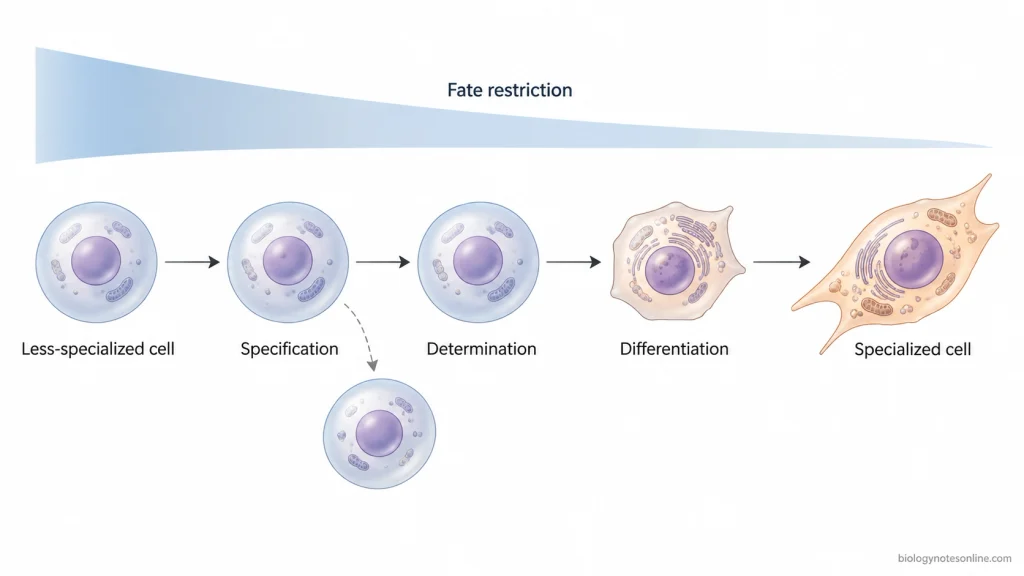
Cell differentiation proceeds from a less-specialized cell toward a stable specialized phenotype. During the process, cell fate becomes progressively restricted and specialized cellular characters develop. A commonly used developmental sequence is specification → determination → differentiation. Here, specification and determination are stages of cell-fate commitment, and this sequence should not be considered as one universal three-step mechanism occurring in the same way in every organism or cell lineage.
1. Specification
Specification is the early stage where a cell becomes committed toward a particular developmental fate. The commitment is still relatively reversible. Its fate is not fixed at this time.
When the specified cell is removed and kept in a neutral environment, it can differentiate according to its expected fate. Under different developmental conditions, however, the fate can still be changed.
2. Determination
In determination, commitment of the cell becomes more stable. A determined cell continues toward its original developmental fate even after it is transferred into another region of the developing embryo.
The surrounding conditions may be different. Still, the developmental fate is retained. In the classical developmental framework, determination represents an irreversible commitment of the cell toward that particular fate.
3. Differentiation
Differentiation is the stage in which specialized characteristics of the committed cell appear. Different sets of genes are expressed and specific proteins are produced. The cell develops its molecular, biochemical, structural, and functional characters.
Large changes in cellular structure and function can take place without requiring cell division itself. In some developmental systems, cell division and differentiation occur together. The relation between these two processes is not same in all tissues and organisms.
Maturation and Terminal Differentiation
After initial differentiation, further maturation of the cell may occur. Specialized morphological and physiological properties continue to develop and the cell reaches a more functional mature state. This maturation can occur as a continuum of changing cellular states, rather than one final switch.
Terminal differentiation refers to a highly specialized cellular state that is commonly associated with stable cell identity and long-term or permanent exit from the cell cycle. It is not identical in every cell lineage. In some differentiated cells, the differentiated state and exit from the cell cycle can be more reversible than in others.
Regulation of Cell Differentiation
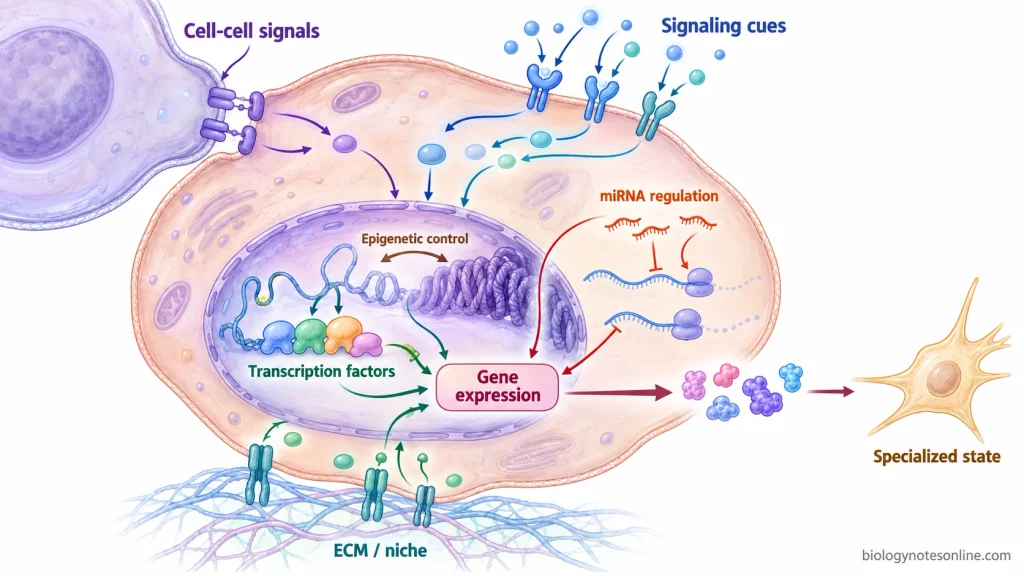
- Differential gene expression– Cell differentiation is mainly regulated by the selective expression of genes. Most somatic cells contain essentially the same genome, but all genes are not active in same way in every cell. Different sets of proteins are produced, giving the cells their particular structure and function.
- Transcription factors- Specific transcription factors bind with regulatory regions of deoxyribonucleic acid (DNA) and control the transcription of differentiation-related genes. Some lineage-determining transcription factors can activate a group of genes required for one cell fate, while genes of other cell fates remain suppressed.
- Cell signalling– Signals received from surrounding cells and tissues also control differentiation. Growth factors and other developmental signalling molecules bind with cell receptors. The signal is then carried through intracellular signalling pathways and can change the activity of transcription factors. Different cells may respond differently to the same signal.
- Epigenetic regulation- DNA methylation, histone modifications and changes in chromatin structure regulate the accessibility of genes. During differentiation, some genes become available for transcription while other genes are maintained in a silent state. These epigenetic patterns can also help to maintain the differentiated identity after cell division.
- Cell-cell interaction- Direct interaction between neighbouring cells can influence which developmental pathway a cell follows. Such contact-dependent signals are important during formation and organization of different tissues. The position of a cell among surrounding cells can therefore affect its differentiation.
- Extracellular matrix and cell niche- The extracellular matrix (ECM) provides physical as well as biochemical signals to the cells. Cells detect many ECM signals through integrins. Matrix composition, attachment and physical properties of the surrounding niche can alter intracellular signalling and cell fate.
- MicroRNA regulation- MicroRNAs (miRNAs) are small non-coding ribonucleic acids (RNAs) that regulate gene expression after transcription. They act on target messenger RNAs (mRNAs) and can reduce their translation or promote their degradation. Different miRNAs participate in stem-cell self-renewal and lineage-specific differentiation.
- Maintenance of cell identity- After differentiation, the cell state has to be continuously maintained. Networks of transcription factors, epigenetic regulators and chromatin organization keep required genes active and suppress gene programs belonging to other cell types.
Examples of Cell Differentiation
The following are some common examples of cell differentiation in animals and plants.
| Starting cell or progenitor | Differentiated cell | Major specialized function |
|---|---|---|
| Hematopoietic stem cell (HSC) | Erythrocyte (red blood cell, RBC) | HSC gives rise to different blood-cell lineages, including erythrocytes. The mature erythrocyte contains hemoglobin and mainly carries oxygen and carbon dioxide in blood. |
| Neural precursor cell | Neuron | Neural precursor cells differentiate into neurons during development. Neurons are specialized to receive, conduct and transmit signals. Electrical impulses travel along their axons. |
| Myoblast | Skeletal muscle fiber | Myoblasts differentiate and then fuse with one another, producing multinucleated skeletal muscle fibers. These fibers are specialized for contraction and voluntary movement. |
| Basal epidermal progenitor cell | Differentiated keratinocyte | Cells produced in the basal layer move outward and undergo differentiation. Keratinocytes form the tough, water-resistant protective layers of epidermis. |
| Mesenchymal stem cell / osteoprogenitor cell | Osteoblast | Osteoprogenitor cells differentiate into osteoblasts. Osteoblasts produce and secrete collagenous and other proteins of the bone matrix, which is later mineralized. |
| Procambial or cambial cell | Xylem vessel element | The vascular precursor differentiates into a xylem vessel element. During differentiation, secondary cell wall is deposited and the cell undergoes programmed cell death. Mature vessel elements form hollow conducting structures for transport of water and dissolved substances. |
Importance of Cell Differentiation
- Formation of specialized cells- Cell differentiation produces cells having different structures and functions from less specialized cells. Muscle cells, neurons, blood cells and epithelial cells perform different work in the body. This makes division of cellular functions possible in multicellular organisms.
- Development of the organism- Differentiation is an important process during embryonic development. Starting from the fertilized egg, dividing cells gradually become different types of cells. These differentiated cells take part in formation of the developing body.
- Formation of tissues and organs- Different specialized cells are organized into tissues. Tissues then form the different organs with their specific functions.
- Maintenance of tissues- Many cells of adult tissues do not remain throughout the life of an organism. They are continuously lost and replaced. Stem cells divide and their descendants undergo differentiation to produce new blood cells, epidermal cells and intestinal epithelial cells.
- Tissue repair and regeneration- After injury, stem or progenitor cells can be activated and form differentiated cells required for repair. The extent of this regeneration is not same in all tissues.
- Maintenance of cell identity- Once differentiated, many cells maintain their specialized character for long periods or through later cell generations. A neuron remains different from a muscle cell even though most cells of an organism contain essentially the same genome.
- Complex multicellular organization- Cell differentiation allows many distinct cell types to exist within a single organism. These cells can be arranged in a particular pattern and work together as tissues and organs.
Reversibility of Cell Differentiation
Cell differentiation is not completely irreversible. In normal physiological conditions, most differentiated cells maintain their particular cell identity and do not readily change into another cell type.
Some differentiated cells can change their state under particular developmental, regenerative or injury conditions. This ability is not same in all cells and tissues.
The differentiated state is generally stable because specific gene-expression and epigenetic patterns are maintained in the cell. Still, the cell identity can be changed in certain conditions.
Dedifferentiation and Transdifferentiation
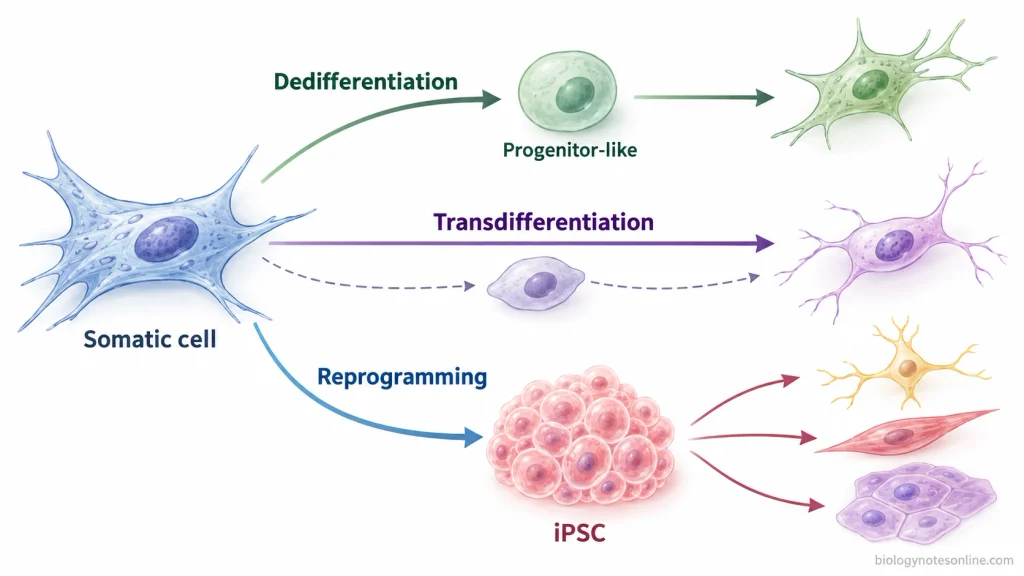
- Dedifferentiation occurs when a differentiated cell loses some of its specialized characters and returns to a less differentiated or progenitor-like state. It occurs naturally in some regenerative processes. For example, differentiated cardiomyocytes can dedifferentiate and proliferate during heart regeneration in zebrafish.
- Dedifferentiation does not mean that every mature cell can return back to a stem-cell state. Such cellular plasticity is much more restricted in many adult mammalian tissues.
- In transdifferentiation, one differentiated cell type changes into another differentiated cell type. The change may occur through an intermediate less-differentiated state, but this intermediate state is not required in every case.
- Natural transdifferentiation is found in some regenerating animals. Pigmented epithelial cells of the newt iris, for example, can change their identity and form lens cells during lens regeneration.
Cellular Reprogramming
- Differentiated cells can also be experimentally reset toward a pluripotent state. This process is known as cellular reprogramming.
- Somatic cells can be converted experimentally into induced pluripotent stem cells (iPSCs) by changing the regulatory program that maintains their differentiated identity. The iPSCs regain pluripotency and can later differentiate into many different cell types.
- Experimental reprogramming is different from natural dedifferentiation or transdifferentiation occurring inside tissues. It is produced under controlled experimental conditions by deliberately changing the cell-state regulatory program.
Cell Differentiation vs Related Processes
Cell differentiation is related to determination, specification, specialization and proliferation, but these terms describe different cellular events.
| Process | What changes? | Is cell fate committed? | Does cell number change? | Relationship with differentiation |
|---|---|---|---|---|
| Differentiation | The cell develops the molecular, structural and functional characters of a particular cell type. | The cell generally expresses an already restricted or committed fate. Differentiation itself refers to the development of that cell character. | Not necessarily | It produces the recognizable specialized cell type. |
| Determination | Developmental fate becomes stably committed. | Yes. The commitment is generally stable even when the cell is placed in a different developmental environment. | No | Determination commonly takes place before visible differentiation. |
| Specification | The cell becomes directed toward a particular developmental fate. | Partly. This early commitment can still be reversed under different conditions. | No | It is an earlier stage of commitment and generally occurs before determination and differentiation. |
| Specialization | The cell has particular structural or functional features for performing a specific work. | Not a separate stage of fate commitment by itself. | No | Specialization is often used closely with differentiation, especially in introductory biology. It can refer more specifically to the specialized characters produced by differentiation. |
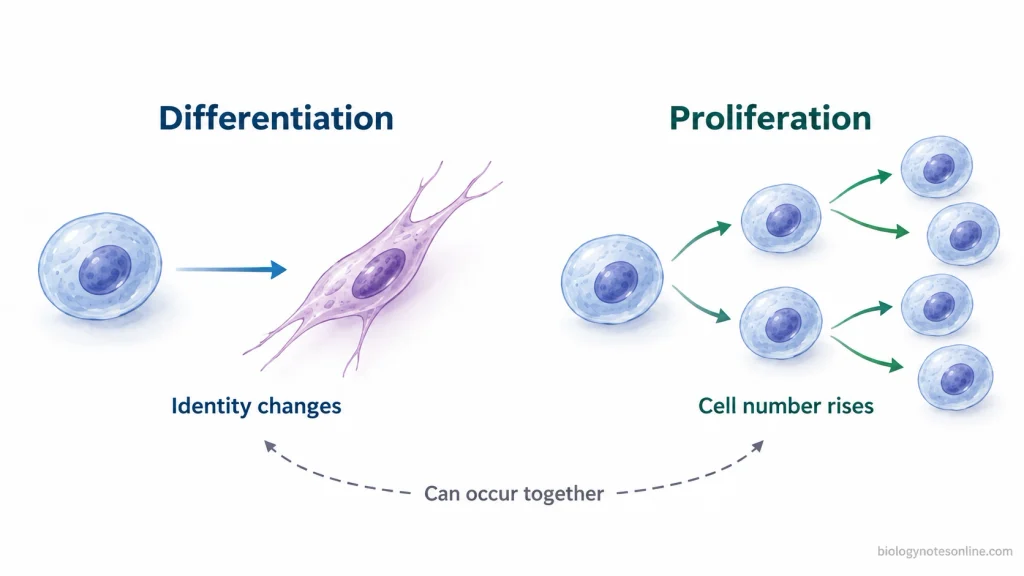
| Proliferation | Cells divide and more cells are produced. | Not necessarily | Yes | Proliferation and differentiation can occur in the same developmental lineage, but they are different processes. |
Differentiation vs Determination
Determination is concerned with the developmental fate of a cell. A determined cell has become stably committed to a particular fate, even before the specialized characters of that cell can be seen. Differentiation occurs when the molecular, structural and functional characters of that fate are developed.
Differentiation vs Specification
Specification is an earlier and more reversible state of cell commitment. A specified cell can develop according to its expected fate in a neutral environment, but its fate may still be changed when placed under different developmental conditions. It is not same as differentiation.
Differentiation involves the actual development of cell-specific properties and functions.
Differentiation vs Specialization
Cell specialization and differentiation are often used closely because differentiated cells become specialized for particular functions. A neuron, muscle cell or erythrocyte has its own specialized structure and work.
Differentiation mainly refers to the developmental process. Specialization can be used for the specialized state or particular characters obtained by the cell.
Differentiation vs Proliferation
Cell proliferation increases the number of cells through cell division. Differentiation changes cell identity and function. The two processes are not same.
During development, precursor cells may undergo several rounds of proliferation while moving along a differentiation pathway. In many cell types, proliferation decreases or stops as the cells become fully differentiated, whereas some differentiated cells can later re-enter the cell cycle under particular conditions.
Cell Differentiation at a Glance
| Feature | Quick summary |
|---|---|
| Definition | Cell differentiation is the process by which an unspecialized or less specialized cell develops into a cell having particular structure and function. |
| Main change | Different sets of genes become active or inactive. This produces changes in cell structure, proteins and cellular functions. |
| When it occurs | It occurs mainly during development, but differentiation also continues in many adult tissues during normal cell replacement and repair. |
| Starting cells | Stem cells and progenitor cells commonly give rise to differentiated cells. |
| Major regulators | Gene expression, transcription factors, cell signalling, epigenetic changes, cell-cell interaction and the extracellular environment regulate differentiation. |
| Examples | Hematopoietic stem cell → blood cell, neural precursor → neuron, myoblast → muscle fiber, osteoprogenitor → osteoblast. |
| Cell fate | Cells progressively become restricted toward particular developmental fates. Specification and determination can occur before the differentiated characters appear. |
| Cell number | Differentiation itself changes cell identity, not necessarily cell number. Cell proliferation is a separate process. |
| Reversibility | Most differentiated states are stable under normal conditions, but they are not universally irreversible. Dedifferentiation and transdifferentiation can occur in particular cells and tissues. |
| Experimental reprogramming | Differentiated somatic cells can be experimentally reprogrammed into induced pluripotent stem cells (iPSCs). |
| Importance | It produces specialized cells required for tissues and organs, development, tissue maintenance and repair. |
References
- Alberts, B., Johnson, A., Lewis, J., Raff, M., Roberts, K., & Walter, P. (2002). Molecular biology of the cell (4th ed.). Garland Science. https://www.ncbi.nlm.nih.gov/books/NBK21054/
- Betts, J. G., Young, K. A., Wise, J. A., Johnson, E., Poe, B., Kruse, D. H., Korol, O., Johnson, J. E., Womble, M., & DeSaix, P. (2022). Anatomy and physiology 2e. OpenStax. https://openstax.org/books/anatomy-and-physiology-2e/pages/1-introduction
- Bitman-Lotan, E., & Orian, A. (2021). Nuclear organization and regulation of the differentiated state. Cellular and Molecular Life Sciences, 78, 3141–3158. https://doi.org/10.1007/s00018-020-03731-4
- Bonifer, C., & Cockerill, P. N. (2011). Chromatin mechanisms regulating gene expression in health and disease. In E. Ballestar (Ed.), Epigenetic contributions in autoimmune disease (pp. 12–25). Springer. https://doi.org/10.1007/978-1-4419-8216-2_2
- Chapman, J., & Zhang, Y. (2023). Histology, hematopoiesis. In StatPearls. StatPearls Publishing. https://www.ncbi.nlm.nih.gov/books/NBK534246/
- Cooper, G. M. (2000). The cell: A molecular approach (2nd ed.). Sinauer Associates. https://www.ncbi.nlm.nih.gov/books/NBK9839/
- Gilbert, S. F. (2000). Developmental biology (6th ed.). Sinauer Associates. https://www.ncbi.nlm.nih.gov/books/NBK9983/
- Kamon, E., & Ohtani, M. (2021). Xylem vessel cell differentiation: A best model for new integrative cell biology? Current Opinion in Plant Biology, 64, 102135. https://doi.org/10.1016/j.pbi.2021.102135
- Moreira, C. A., Dempster, D. W., & Baron, R. (2019). Anatomy and ultrastructure of bone: Histogenesis, growth and remodeling. In K. R. Feingold, R. A. Adler, S. F. Ahmed, et al. (Eds.), Endotext. MDText.com, Inc. https://www.ncbi.nlm.nih.gov/books/NBK279149/
- Ong, S.-G., Lee, W. H., Kodo, K., & Wu, J. C. (2015). MicroRNA-mediated regulation of differentiation and trans-differentiation in stem cells. Advanced Drug Delivery Reviews, 88, 3–15. https://doi.org/10.1016/j.addr.2015.04.004
- Purves, D., Augustine, G. J., Fitzpatrick, D., Katz, L. C., LaMantia, A.-S., McNamara, J. O., & Williams, S. M. (Eds.). (2001). Neuroscience (2nd ed.). Sinauer Associates. https://www.ncbi.nlm.nih.gov/books/NBK10799/
- Roy, S., & Kundu, T. K. (2014). Gene regulatory networks and epigenetic modifications in cell differentiation. IUBMB Life, 66(2), 100–109. https://doi.org/10.1002/iub.1249