

A gamete is a reproductive cell (sex cell) that carries genetic information in the form of deoxyribonucleic acid (DNA). During fertilization, one gamete can unite with another gamete. In animals, these cells are haploid and contain one set of chromosomes.
When two haploid gametes fuse, a diploid zygote is formed. Ordinary body cells are generally diploid. Gametes are different, they contain the haploid chromosome number.
In humans and many other animals, gametes are of two types. The sperm cell is the male gamete and ovum (egg cell) is the female gamete. Both carry one set of chromosomes.
Formation of gametes is called gametogenesis. In animals, meiosis is involved in formation of the haploid gametes. In plants the condition is different, the haploid gametophyte produces gametes by mitosis.
A germ cell is not always the same as a mature gamete. Germ cells can also include the precursor cells which later give rise to gametes.
Where Human Gametes Are Produced
- In humans, gametes are produced in the gonads, the testes in males and ovaries in females. These are the primary reproductive organs where spermatogenesis and oogenesis take place.
- Male gametes or sperm are produced inside the seminiferous tubules of the testes. Spermatogenesis begins at puberty and sperm production continues afterward. The newly formed sperm leave the seminiferous tubules and pass into the epididymis, where further maturation takes place.
- Female gametes develop in the ovaries. In humans, oogonia multiply during fetal life and enter meiosis before birth, forming primary oocytes. These primary oocytes remain arrested for a long period.
- After puberty, selected oocytes continue their development in the ovary. During a reproductive cycle, usually a secondary oocyte is released from the ovary during ovulation.
Characteristics of Gametes
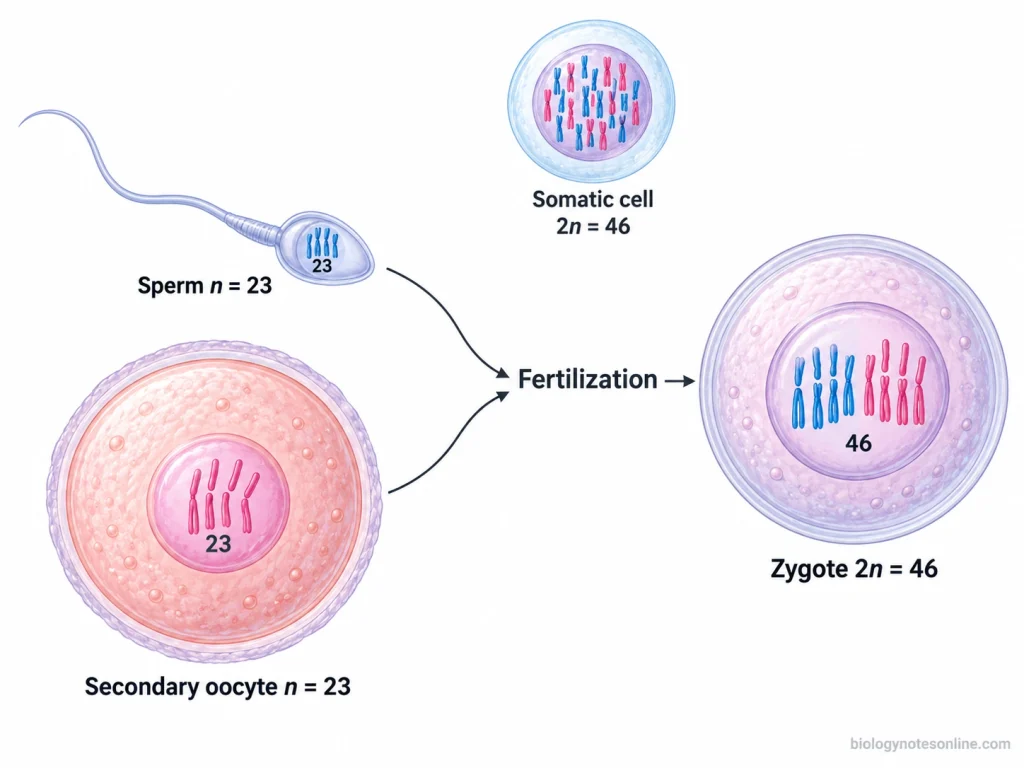
- Gametes are haploid (n) cells. They contain only a single set of chromosomes, whereas the somatic or body cells generally contain two sets (2n). In humans, sperm and egg have 23 chromosomes. The somatic cells have 46.
- The chromosomes of gametes contain deoxyribonucleic acid (DNA). This DNA carries the genetic information from the parent. From each homologous chromosome pair, one chromosome is present in a gamete.
- During formation of animal gametes, the chromosome number is reduced from diploid to haploid by meiosis. One member of each homologous chromosome pair goes into the mature gamete.
- The reduced chromosome number is required for sexual reproduction. During fertilization, two haploid gametes unite and the diploid chromosome number is again restored in the zygote. If the chromosome number was not reduced before fertilization, the normal diploid number would not remain the same from one generation to another.
- In humans and most animals, the somatic cells are diploid while sperm and egg cells are haploid. At fertilization, genetic material carried by the two gametes is brought together.
Types of Gamete
In humans, gametes are of two types, sperm and ovum (egg cell). Sperm is the male gamete. The ovum is the female gamete. Both are reproductive cells involved in fertilization.
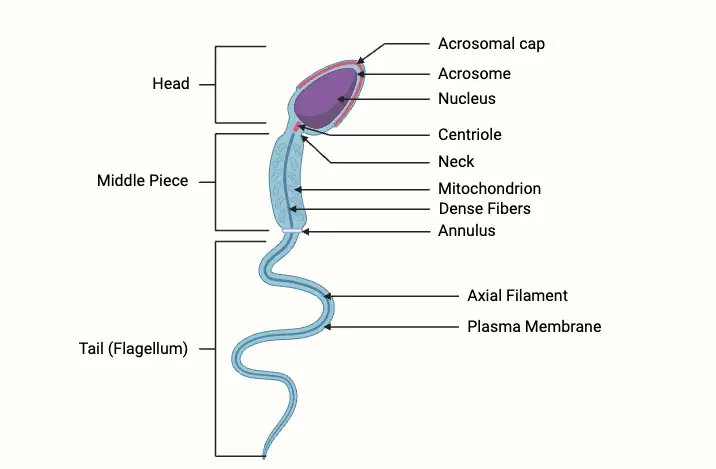
- Sperm- Sperm is the male gamete in humans and many animals. It is a small and motile cell, having a head, middle region and tail. The haploid genetic material is present in the head. An acrosome is also present over the head, while mitochondria are concentrated in the middle region and the flagellum provides movement. Sperm carries the paternal genetic material to the egg during fertilization.
- Ovum or egg cell- The ovum is the female gamete. It is large and nonmotile. Compared with sperm, the egg contains much more cytoplasm and materials required during the beginning of development. It also carries the maternal haploid genetic material. Protective layers are present around the mammalian egg.
The major differences between sperm and egg in humans are given below.
| Character | Sperm | Ovum (egg cell) |
|---|---|---|
| Type | Male gamete | Female gamete |
| Size | Very small | Much larger |
| Movement | Motile | Nonmotile |
| Cytoplasm | Very little cytoplasm | Large amount of cytoplasm |
| Main role | Carries paternal genetic material to the egg | Carries maternal genetic material and cytoplasmic materials |
| Major structure | Head, middle region and tail | Large cell with cytoplasm and surrounding protective layers |
Sperm and egg are not the form of gametes in every sexually reproducing organism. In isogamous organisms, the fusing gametes can be similar in size and morphology and are not separated into the usual sperm and egg forms.
Structure of Gametes
In humans, the male and female gametes have very different structures. Sperm is small and motile, whereas the egg cell is much larger and contains a large amount of cytoplasm.
Structure of Sperm
- A human sperm is an elongated cell having a head, neck, midpiece and tail. Very little cytoplasm remains in a mature sperm.
- The head contains a highly condensed haploid nucleus. Deoxyribonucleic acid (DNA) carrying the paternal genetic information is present in this nucleus.
- Over the anterior part of the head is a cap-like structure called the acrosome. It contains enzymes which are released during fertilization and help the sperm to pass through the coverings of the egg.
- The neck is a short region present between the head and midpiece. The flagellar structure begins from this region.
- Mitochondria are concentrated in the midpiece. They provide energy required for movement of the sperm.
- A long flagellum or tail extends behind the midpiece. Its movement provides motility to the sperm.
Structure of Egg Cell
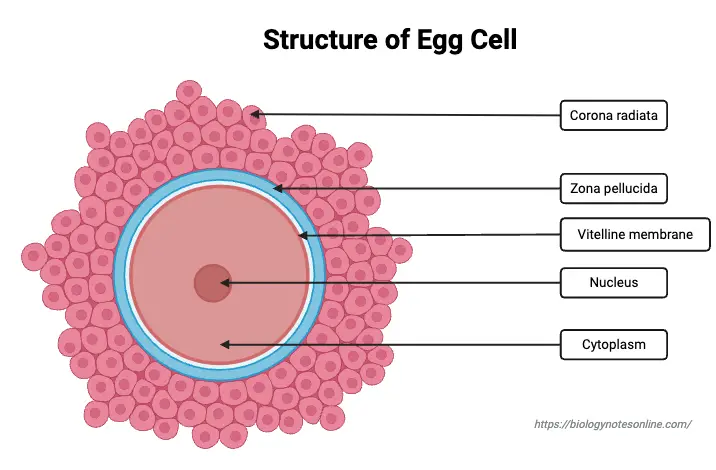
- The human egg cell is a large, generally spherical and nonmotile female gamete. It contains much more cytoplasm than the sperm.
- A haploid set of chromosomes is present in the female genetic material. The egg also contains cell organelles and cytoplasmic materials.
- The cell is enclosed by a plasma membrane (oolemma). Just beneath the plasma membrane are cortical granules.
- Outside the plasma membrane lies a thick extracellular covering known as the zona pellucida. It surrounds the mammalian egg and takes part in the interaction between sperm and egg during fertilization.
- Around the zona pellucida, cells derived from the ovarian follicle remain associated with the released oocyte. The innermost layer of these cells is called the corona radiata.
Gamete Formation
The formation of gametes is known as gametogenesis. In animals, germ cells undergo meiosis and cells with haploid chromosome number are formed. In humans, sperm are produced in the testes, while the female gametes develop in the ovaries.
Formation of sperm is called spermatogenesis. The formation and development of female gamete is known as oogenesis.
Gametogenesis in Animals
- Gamete formation starts from the germ cells present in the reproductive organs or gonads. In human males, these germ cells are present in the testes. The female germ cells develop in the ovaries.
- At the early stage, germ cells divide by mitosis. Some of these cells are maintained, while other cells continue further into the process of gamete formation.
- The cells entering meiosis have diploid chromosome number. During meiosis, this chromosome number is reduced to haploid. Two successive meiotic divisions take place and the resulting gamete contains one set of chromosomes.
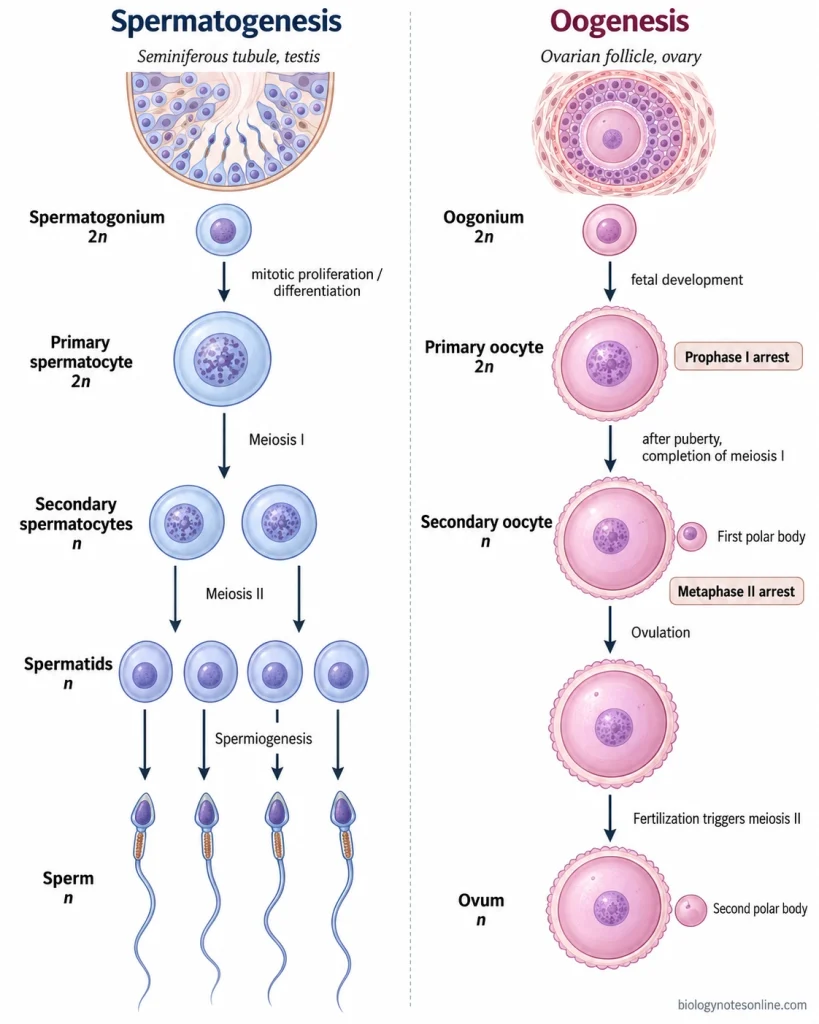
- In males, sperm formation takes place in the seminiferous tubules of the testes. Spermatogonia give rise to primary spermatocytes which then undergo meiosis, producing haploid spermatids. The spermatids later differentiate into spermatozoa. This final differentiation is called spermiogenesis.
- Female gametes are formed by oogenesis in the ovaries. In humans, oogonia give rise to primary oocytes before birth and these primary oocytes remain arrested for a long period. After puberty, selected oocytes resume meiosis. A secondary oocyte is produced and released during ovulation. Its second meiotic division is completed when fertilization occurs.
Gamete Formation in Plants
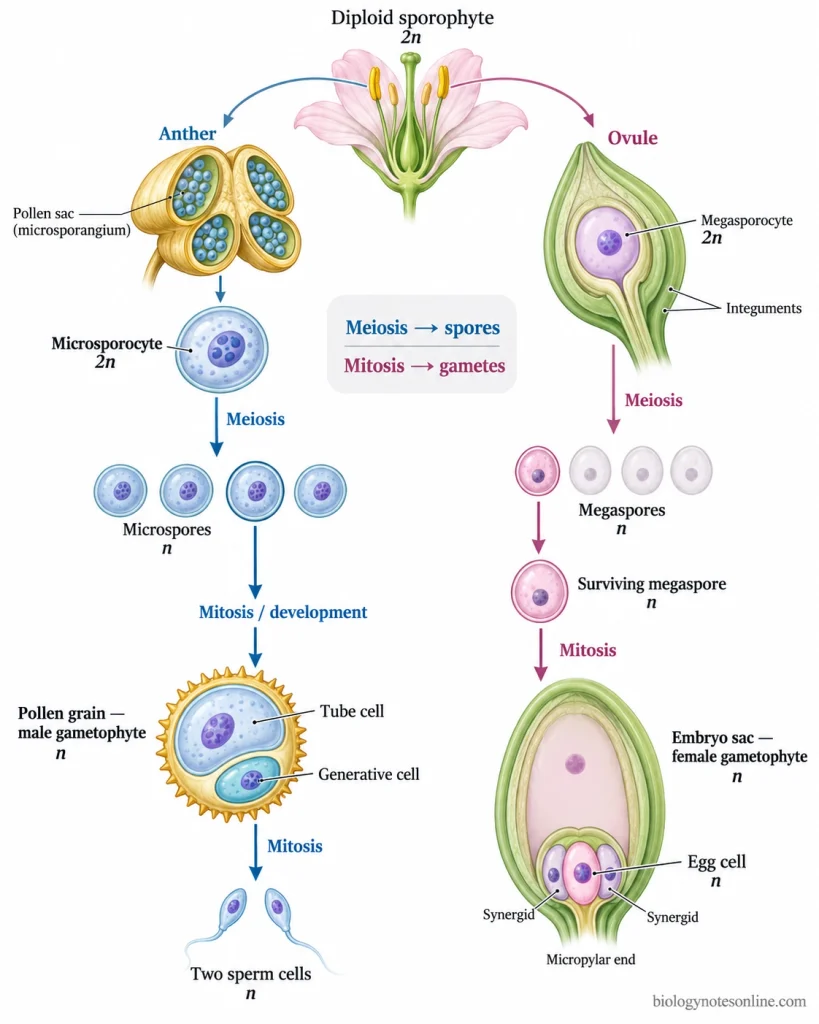
Gamete formation in plants is different from that of animals. Meiosis does not directly form the plant gametes. The diploid sporophyte first produces haploid spores by meiosis. These spores later develop into the haploid gametophyte, from which gametes are produced by mitosis.
- Diploid cells of the sporophyte undergo meiosis inside the spore-producing structures. Haploid spores are formed.
- The haploid spores divide by mitosis and develop into male or female gametophytes.
- In flowering plants, microspores are formed inside the pollen sacs of the anther. A microspore develops into the pollen grain (male gametophyte). The generative cell present in pollen later divides and forms two sperm cells.
- Inside the ovule, meiosis produces haploid megaspores. The surviving megaspore undergoes mitotic divisions and forms the female gametophyte or embryo sac. The egg cell is present within this embryo sac.
Spermatogenesis and Oogenesis
Spermatogenesis is the process of formation of sperm, while oogenesis is the process by which female gamete is formed. Both involve meiosis and produce cells having the haploid chromosome number. The two processes, however, do not occur in the same way.
Spermatogenesis
- Spermatogenesis takes place in the seminiferous tubules of the testes. The process starts from diploid germ cells known as spermatogonia.
- Spermatogonia divide by mitosis. Some cells remain as spermatogonia, while other cells continue their development and form primary spermatocytes.
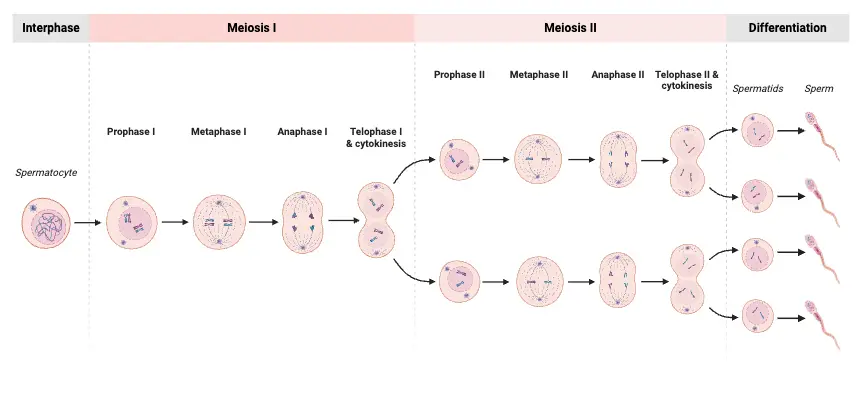
- Each primary spermatocyte undergoes the first meiotic division (meiosis I). Two haploid secondary spermatocytes are formed. The chromosome number becomes half during this division.
- The secondary spermatocytes now undergo meiosis II. Each one produces two haploid spermatids, giving four spermatids from a single primary spermatocyte. No further reduction of chromosome number takes place in this division.
- Spermatids are round and do not have the typical structure of mature sperm. They undergo a differentiation process called spermiogenesis. During this process the nucleus becomes condensed, acrosome and flagellum are formed and much of the extra cytoplasm is removed.
- The differentiated cells become spermatozoa (sperm cells) and are released toward the lumen of the seminiferous tubule. Four haploid sperm can be produced from one primary spermatocyte.
Oogenesis
- Oogenesis takes place in the ovaries. It begins from diploid germ cells called oogonia, which multiply by mitosis during fetal development in humans.
- The oogonia develop into primary oocytes and enter meiosis I. Meiosis does not continue directly. These primary oocytes remain arrested in prophase I before birth and may remain in this stage for many years.
- From puberty, selected primary oocytes resume meiosis. The first meiotic division is unequal, forming one large secondary oocyte and a small first polar body. Most of the cytoplasm remains with the secondary oocyte.
- The secondary oocyte enters meiosis II and becomes arrested at metaphase II. It is released from the ovary during ovulation in this stage.
- If sperm enters the secondary oocyte, meiosis II is completed. A second polar body is formed and the female gamete completes its meiotic division.
- Oogenesis has unequal cell divisions. Instead of producing four similar functional gametes like spermatogenesis, most of the cytoplasm is retained in a single large female gamete while the polar bodies receive very little cytoplasm.
Fertilization and Zygote Formation
Fertilization is the process in which compatible male and female gametes unite and form a zygote. In humans and many animals, these gametes are the sperm and egg. Both contain the haploid chromosome number.
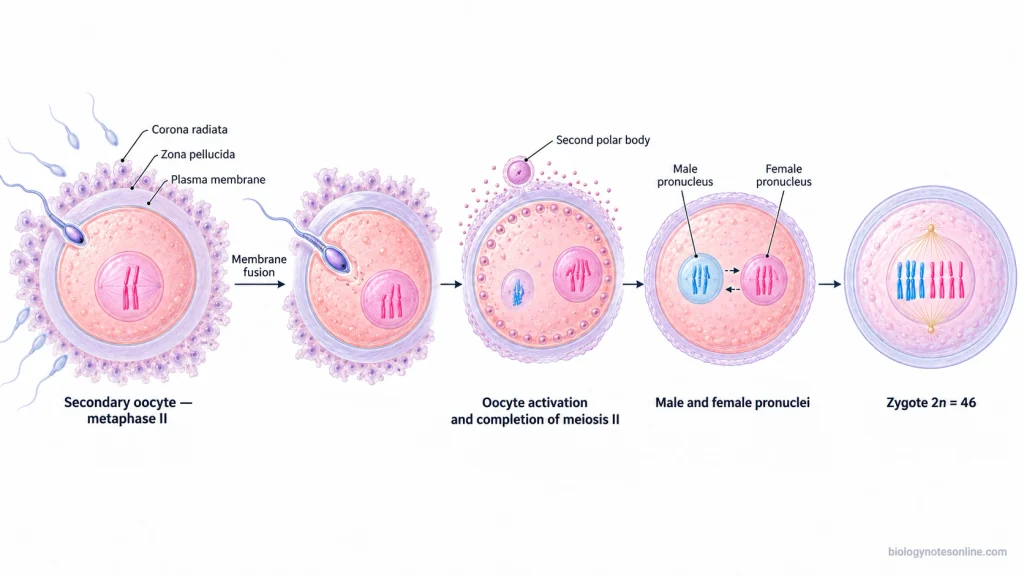
- During fertilization, a sperm reaches and interacts with the egg. Only one sperm normally fuses with an egg in human fertilization.
- The plasma membrane of the sperm fuses with the membrane of the egg. The sperm genetic material then enters the egg.
- Genetic material from both gametes is brought together. One haploid chromosome set comes from the male parent and another set from the female parent.
- The two haploid chromosome sets form a diploid chromosome complement. In humans, sperm and egg each carry 23 chromosomes and the zygote receives 46 chromosomes in total.
- After fertilization, the fertilized egg is referred to as a zygote. It is a single diploid cell containing genetic material contributed by both parents.
Functions of Gamete
- Gametes take part in sexual reproduction. Two compatible gametes unite during fertilization and a zygote is formed.
- They carry the genetic information from one generation to the next. Each gamete contains deoxyribonucleic acid (DNA) with one haploid set of chromosomes.
- The haploid condition of gametes helps to maintain the chromosome number during sexual reproduction. At fertilization, one chromosome set from each gamete comes together and the diploid chromosome number is restored.
- Gametes carry genetic material from two different parents into a single zygote. The paternal and maternal chromosomes are brought together during this process.
- Due to meiosis, gametes can contain different combinations of parental genetic material. This contributes to genetic variation among sexually produced offspring.
- In humans and many animals, the sperm carries the paternal genetic material to the egg. Its motility allows the sperm to move toward the female gamete and take part in fertilization.
- The egg cell provides the maternal genetic material. It also contains a large amount of cytoplasm, organelles and other cellular materials required at the beginning of development.
Gamete At a Glance
| Feature | Quick Summary |
|---|---|
| Definition | Gametes are reproductive or sex cells involved in sexual reproduction. |
| Chromosome number | Gametes are haploid (n) and contain one set of chromosomes. |
| DNA | Gametes contain deoxyribonucleic acid (DNA) carrying genetic information from the parent. |
| Human chromosome number | Human sperm and egg contain 23 chromosomes each. |
| Types in humans | Sperm is the male gamete and ovum (egg cell) is the female gamete. |
| Male gamete | Sperm is small, motile and contains very little cytoplasm. |
| Female gamete | Egg cell is large, nonmotile and contains a large amount of cytoplasm. |
| Sperm structure | Head, neck, midpiece and tail. The head contains the haploid nucleus and acrosome. |
| Egg structure | Contains haploid genetic material, cytoplasm, organelles and is surrounded by the zona pellucida and associated follicular cells. |
| Formation | Formation of gametes is called gametogenesis. |
| Sperm formation | Spermatogenesis takes place in the seminiferous tubules of the testes. |
| Egg formation | Oogenesis takes place in the ovaries. |
| Role of meiosis | Meiosis reduces the chromosome number from diploid to haploid during animal gamete formation. |
| Main function | Gametes carry parental genetic material and take part in fertilization. |
| Fertilization | Male and female gametes fuse and their genetic material is brought together. |
| Zygote formation | Fusion of two haploid gametes forms a diploid zygote. |
| Human zygote chromosomes | The zygote contains 46 chromosomes, 23 from each parent. |
| Gametes in plants | Plant gametes are produced by mitosis in the haploid gametophyte. |
References
- Alberts, B., Johnson, A., Lewis, J., Raff, M., Roberts, K., & Walter, P. (2002a). Fertilization. In Molecular biology of the cell (4th ed.). Garland Science. https://www.ncbi.nlm.nih.gov/books/NBK26843/
- Alberts, B., Johnson, A., Lewis, J., Raff, M., Roberts, K., & Walter, P. (2002b). Meiosis. In Molecular biology of the cell (4th ed.). Garland Science. https://www.ncbi.nlm.nih.gov/books/NBK26840/
- Alberts, B., Johnson, A., Lewis, J., Raff, M., Roberts, K., & Walter, P. (2002c). Sperm. In Molecular biology of the cell (4th ed.). Garland Science. https://www.ncbi.nlm.nih.gov/books/NBK26914/
- Betts, J. G., Young, K. A., Wise, J. A., Johnson, E., Poe, B., Kruse, D. H., Korol, O., Johnson, J. E., Womble, M., & DeSaix, P. (2013). Anatomy and physiology of the male reproductive system. In Anatomy and physiology. OpenStax. https://openstax.org/books/anatomy-and-physiology/pages/27-1-anatomy-and-physiology-of-the-male-reproductive-system
- Clark, M. A., Douglas, M., & Choi, J. (2018). Early plant life. In Biology 2e. OpenStax. https://openstax.org/books/biology-2e/pages/25-1-early-plant-life
- Cooper, G. M. (2000a). Heredity, genes, and DNA. In The cell: A molecular approach (2nd ed.). Sinauer Associates. https://www.ncbi.nlm.nih.gov/books/NBK9944/
- Cooper, G. M. (2000b). Meiosis and fertilization. In The cell: A molecular approach (2nd ed.). Sinauer Associates. https://www.ncbi.nlm.nih.gov/books/NBK9901/
- Gilbert, S. F. (2000a). Gamete production in angiosperms. In Developmental biology (6th ed.). Sinauer Associates. https://www.ncbi.nlm.nih.gov/books/NBK10129/
- Gilbert, S. F. (2000b). Meiosis. In Developmental biology (6th ed.). Sinauer Associates. https://www.ncbi.nlm.nih.gov/books/NBK10019/
- Gilbert, S. F. (2000c). Oogenesis. In Developmental biology (6th ed.). Sinauer Associates. https://www.ncbi.nlm.nih.gov/books/NBK10008/
- Gilbert, S. F. (2000d). Spermatogenesis. In Developmental biology (6th ed.). Sinauer Associates. https://www.ncbi.nlm.nih.gov/books/NBK10095/
- Gilbert, S. F. (2000e). Structure of the gametes. In Developmental biology (6th ed.). Sinauer Associates. https://www.ncbi.nlm.nih.gov/books/NBK10005/
- Gottlieb, S. F., Gulani, A., & Tegay, D. H. (2023). Genetics, meiosis. In StatPearls. StatPearls Publishing. https://www.ncbi.nlm.nih.gov/books/NBK482462/
- Lehtonen, J., Kokko, H., & Parker, G. A. (2016). What do isogamous organisms teach us about sex and the two sexes? Philosophical Transactions of the Royal Society B: Biological Sciences, 371(1706), 20150532. https://doi.org/10.1098/rstb.2015.0532
- Rye, C., Wise, R., Jurukovski, V., DeSaix, J., Choi, J., & Avissar, Y. (2016a). Features of the animal kingdom. In Biology. OpenStax. https://openstax.org/books/biology/pages/27-1-features-of-the-animal-kingdom
- Rye, C., Wise, R., Jurukovski, V., DeSaix, J., Choi, J., & Avissar, Y. (2016b). Fertilization and early embryonic development. In Biology. OpenStax. https://openstax.org/books/biology/pages/43-6-fertilization-and-early-embryonic-development
- Rye, C., Wise, R., Jurukovski, V., DeSaix, J., Choi, J., & Avissar, Y. (2016c). Human reproductive anatomy and gametogenesis. In Biology. OpenStax. https://openstax.org/books/biology/pages/43-3-human-reproductive-anatomy-and-gametogenesis
- Suede, S. H., Malik, A., & Sapra, A. (2023). Histology, spermatogenesis. In StatPearls. StatPearls Publishing. https://www.ncbi.nlm.nih.gov/books/NBK553142/