

Endocytosis is the process of taking substances from outside of the cell into the cell by the formation of vesicles from plasma membrane. During this process, the plasma membrane bends towards inside and a small portion is pinched off.
Exocytosis, on the other hand, is used to release substances from the cell. Here, vesicles present inside the cell move towards plasma membrane and fuse with it, releasing their contents outside.
In endocytosis, the plasma membrane is used for formation of new vesicles, whereas during exocytosis vesicular membrane is added to plasma membrane. Phagocytosis, pinocytosis and receptor-mediated endocytosis are different forms of endocytosis. Exocytosis occurs mainly by constitutive and regulated pathways.
What is Endocytosis and Exocytosis?
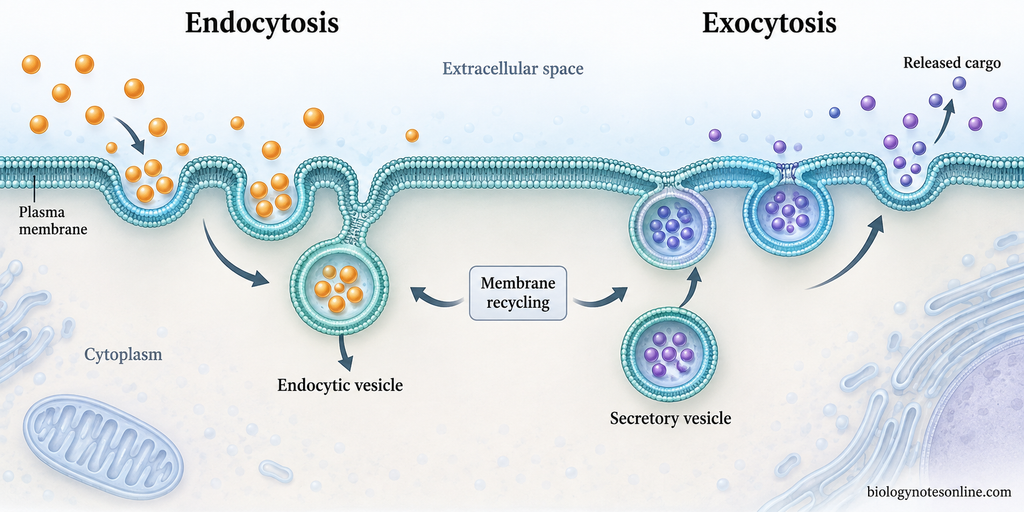
Endocytosis and exocytosis are two processes involved in the transport of materials through the plasma membrane of a cell. During endocytosis, materials from outside are taken into the cell by formation of vesicles. Exocytosis is opposite to this, where intracellular materials are carried in vesicles and released outside the cell.
Endocytosis
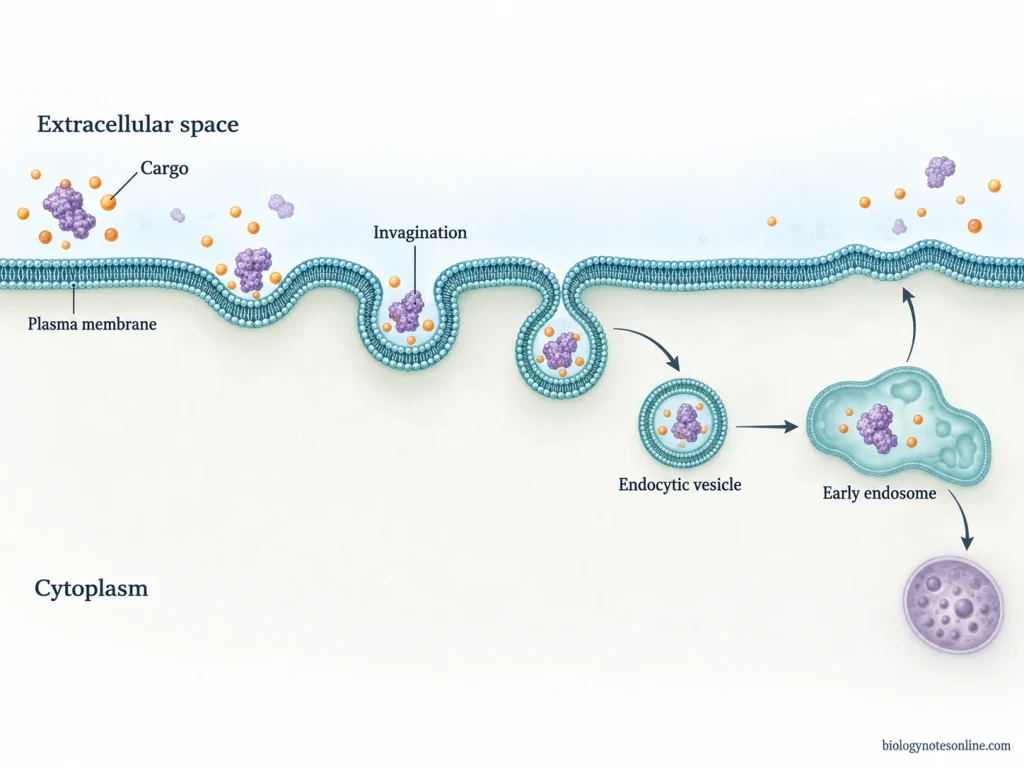
- Endocytosis is the process by which extracellular substances are taken inside the cell through the plasma membrane.
- During this process, a small portion of plasma membrane bends inward around the material. It then pinches off from the membrane and forms a membrane-bound vesicle inside the cytoplasm.
- Fluids, dissolved macromolecules and different extracellular particles can be taken up by this process. In some specialized cells, even large particles such as microorganisms and dead cells are engulfed.
- Endocytosis mainly occurs by phagocytosis and pinocytosis. In phagocytosis, large particles are taken into the cell. Pinocytosis involves uptake of extracellular fluid together with dissolved substances.
- Another type is receptor-mediated endocytosis. Here, specific molecules first bind with receptors present on the cell surface, and the bound materials are then brought inside the cell. It is a selective process.
- The endocytic vesicles usually pass their materials into endosomes. Some materials may be returned back to the cell surface, while others are passed towards lysosomes and degraded.
Exocytosis
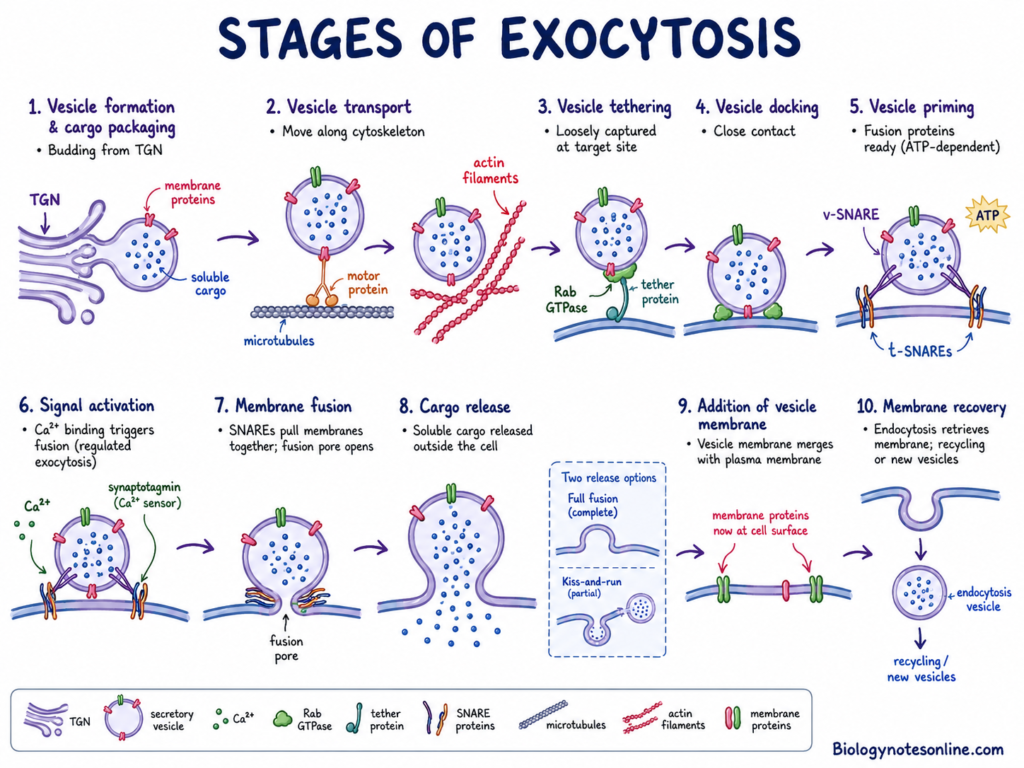
- Exocytosis is the process of releasing intracellular substances outside the cell through membrane-bound vesicles.
- In this process, the vesicle carrying the material moves towards the plasma membrane. The vesicle membrane then fuses with it and contents are released outside.
- Different proteins, hormones, enzymes and neurotransmitters are released by exocytosis. During fusion, the membrane of vesicle also becomes a part of the plasma membrane.
- Exocytosis occurs in two major forms, constitutive exocytosis and regulated exocytosis. Constitutive exocytosis takes place continuously.
- In regulated exocytosis, the substances remain stored inside secretory vesicles. They are released only when a particular signal is received by the cell. This type occurs commonly in specialized secretory cells.
Endocytosis vs Exocytosis
| Basis of Difference | Endocytosis | Exocytosis |
|---|---|---|
| Definition | Endocytosis is the process in which extracellular materials are taken inside the cell through formation of membrane-bound vesicles. | Exocytosis is the process in which materials present inside the cell are transported by vesicles and released outside the cell. |
| Direction of transport | Movement of materials takes place from the extracellular region towards the interior of cell. | Materials move from inside the cell towards the extracellular region. |
| Plasma membrane movement | The plasma membrane bends inward around the material that has to be taken into the cell. | The vesicle moves towards the plasma membrane and joins with it. |
| Vesicle formation | A portion of plasma membrane surrounds the extracellular material and then pinches off, forming an endocytic vesicle. | Vesicles are already present inside the cell. These vesicles carry their contents towards the cell surface for release. |
| Membrane fusion | Vesicle is produced by inward folding and pinching off of the plasma membrane. | The membrane of vesicle fuses with the plasma membrane before its contents are released. |
| Effect on plasma membrane | During vesicle formation, a part of plasma membrane is removed from the cell surface. | The membrane of secretory vesicle becomes incorporated into plasma membrane after fusion. |
| Materials transported | Fluids, dissolved macromolecules and different extracellular particles can be taken up by this process. | Different proteins, enzymes, hormones and neurotransmitters can be released through this process. |
| Transport of large particles | Large particles can also be taken inside. In specialized cells, microorganisms and dead cells may be engulfed by phagocytosis. | It is mainly concerned with release of substances carried inside intracellular vesicles, rather than engulfment of large extracellular particles. |
| Major types | The major forms include phagocytosis, pinocytosis and receptor-mediated endocytosis. | The two major forms are constitutive exocytosis and regulated exocytosis. |
| Selective transport | In receptor-mediated endocytosis, specific substances bind with their respective receptors on the cell surface before being brought inside. | In regulated exocytosis, stored substances are released only after the cell receives a particular signal. |
| Continuous process | Depending on the type, extracellular materials are taken up through formation of vesicles from the cell membrane. | Constitutive exocytosis takes place continuously, where vesicular materials are transported and released from the cell. |
| Storage before transport | Material is first present outside the cell and gets enclosed when the plasma membrane forms a vesicle around it. | In regulated exocytosis, materials can remain stored inside secretory vesicles until a signal for release is received. |
| Fate of vesicles/material | Endocytic vesicles generally transfer their materials into endosomes. Some materials can later reach lysosomes. | After fusion with plasma membrane, the vesicle contents are discharged directly into the extracellular region. |
| Recycling | Some endocytosed materials and membrane components may be returned back towards the cell surface. | The vesicle membrane itself becomes a part of plasma membrane after the vesicle has fused with it. |
| Examples of process | Uptake of extracellular fluid occurs by pinocytosis, whereas large particles are taken up by phagocytosis. | Release of hormones, enzymes and neurotransmitters are common examples of substances transported through exocytosis. |
Similarities between Endocytosis and Exocytosis
The following are some of the important similarities between endocytosis and exocytosis–
- Vesicular transport- Both endocytosis and exocytosis are vesicular transport processes. The materials are transported through membrane-bound vesicles instead of passing directly through the lipid bilayer.
- Plasma membrane involvement- Plasma membrane is directly involved in both the processes. During endocytosis, a portion of membrane bends inward and pinches off. In exocytosis, the vesicle membrane fuses with the plasma membrane.
- Transport of large substances- Both processes help in movement of substances which cannot simply pass through the membrane transport proteins. It includes macromolecules and other cellular materials.
- Membrane trafficking- Endocytosis and exocytosis are important parts of the membrane trafficking system in eukaryotic cells. Through these processes, vesicles carry materials between the cell surface and different membrane-bound compartments.
- Membrane recycling- The plasma membrane components taken inside during endocytosis can be transported back to the cell surface through exocytic transport. Such continuous recycling takes place extensively in many cells.
- Selective transport- Both processes can selectively transport particular materials. In receptor-mediated endocytosis, receptors provide selective uptake of specific molecules. During exocytosis, specific cargo can be sorted into vesicles and transported for secretion.
- Regulated process- Both endocytosis and exocytosis may occur continuously or can be regulated by cellular signals. Endocytosis can occur constitutively or after extracellular stimulation. On the other hand, regulated exocytosis takes place only after receiving an appropriate signal.
References
- Alberts, B., Johnson, A., Lewis, J., Raff, M., Roberts, K., & Walter, P. (2002). Molecular biology of the cell (4th ed.). Garland Science. https://www.ncbi.nlm.nih.gov/books/NBK21054/
- Alberts, B., Johnson, A., Lewis, J., Raff, M., Roberts, K., & Walter, P. (2002). Transport from the trans Golgi network to the cell exterior: Exocytosis. In Molecular biology of the cell (4th ed.). Garland Science. https://www.ncbi.nlm.nih.gov/books/NBK26892/
- Alberts, B., Johnson, A., Lewis, J., Raff, M., Roberts, K., & Walter, P. (2002). Transport into the cell from the plasma membrane: Endocytosis. In Molecular biology of the cell (4th ed.). Garland Science. https://www.ncbi.nlm.nih.gov/books/NBK26870/
- Cooper, G. M. (2000). Endocytosis. In The cell: A molecular approach (2nd ed.). Sinauer Associates. https://www.ncbi.nlm.nih.gov/books/NBK9831/