

The catalase test is a commonly used biochemical test in microbiology for differentiating bacteria based on their reaction with hydrogen peroxide (H₂O₂). It is used to detect the activity of catalase enzyme present in the bacterial cells.
When hydrogen peroxide is added to a bacterial culture containing catalase enzyme, the hydrogen peroxide is broken down with the release of oxygen gas. The oxygen is released in the form of bubbles. These bubbles appear rapidly. Bacteria showing this reaction are called catalase-positive, whereas catalase-negative bacteria do not show the expected immediate bubbling. The catalase enzyme also protects the bacterial cells from the harmful effects of hydrogen peroxide.
The test is commonly used during bacterial identification, especially for differentiating staphylococci, which are generally catalase-positive, from streptococci, which are catalase-negative.
It only detects the catalase activity and cannot be used alone to identify the exact bacterial species.
What Is the Catalase Test?
The catalase test is a qualitative biochemical test used for detection of catalase enzyme activity in microorganisms. It is commonly used in microbiology for the preliminary characterization of bacterial isolates.
In this test, hydrogen peroxide (H₂O₂) is added to the test organism and the reaction is observed for the production of oxygen bubbles. Bubble formation indicates detectable catalase activity. No bubble formation is taken as a negative reaction. The test measures the activity of catalase enzyme in the organism, not the biological function of catalase itself.
Catalase test is used along with other biochemical and phenotypic tests during bacterial identification. It can separate bacteria having detectable catalase activity from those which do not have it. The test alone does not identify the bacterial species.
Objectives of Catalase Test
- To detect the presence of catalase enzyme activity in a bacterial isolate by its reaction with hydrogen peroxide (H₂O₂).
- To differentiate catalase-positive bacteria from catalase-negative bacteria, particularly staphylococci from streptococci.
- To help in the preliminary characterization and identification of an unknown bacterial isolate along with other biochemical tests.
Principle of Catalase Test
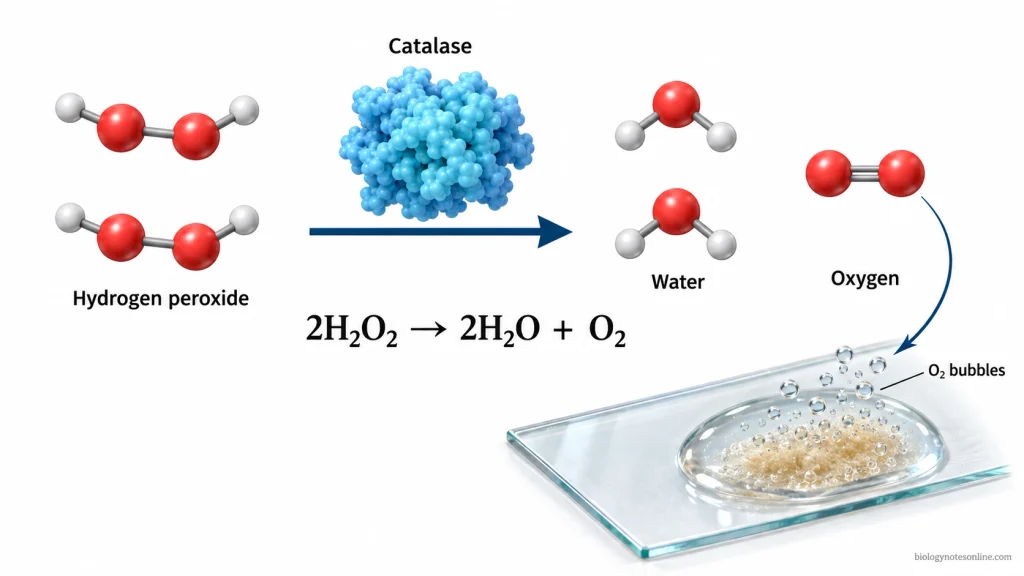
The principle of catalase test is based on the ability of catalase enzyme to break down hydrogen peroxide (H₂O₂) into water and molecular oxygen. Hydrogen peroxide can cause oxidative damage to the cells. Catalase helps in its removal.
The reaction is as follows-
2H₂O₂ → 2H₂O + O₂
This reaction is catalyzed by catalase. When H₂O₂ is added to the bacterial cells containing catalase, it is rapidly decomposed and oxygen gas is released. The released oxygen comes out as visible bubbles. This is observed as a positive catalase reaction.
In the absence of detectable catalase activity, the expected immediate bubbling is not produced.
Requirements for Catalase Test
- Fresh bacterial culture (18–24 hours old), preferably a well-isolated colony from a suitable culture medium.
- 3% hydrogen peroxide (H₂O₂) solution. The reagent should be fresh and protected from light.
- Clean glass slides for performing the slide catalase test.
- Sterile wooden applicator sticks or plastic inoculating loop for transferring the bacterial growth.
- Pasteur pipette or dropper for adding the hydrogen peroxide.
- Clean test tubes and test tube rack when the tube method is used.
- Known catalase-positive and catalase-negative control cultures for checking the test reaction.
Procedure of Catalase Test
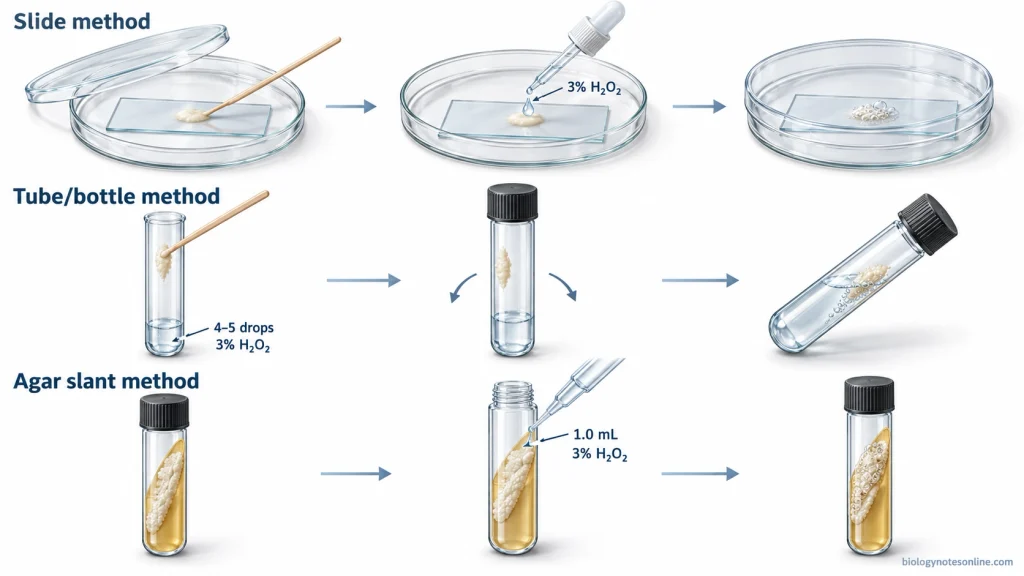
Catalase test can be performed by slide method, tube or bottle method, and agar slant method. For routine aerobic bacteria, fresh 18–24 hours growth and 3% hydrogen peroxide (H₂O₂) are commonly used. Culture taken from a medium containing whole red blood cells may produce false-positive reaction.
Personal protective equipment must be worn during the test. Procedures having a chance of producing bacterial aerosols are carried out in a microbiological safety cabinet according to the laboratory safety procedures.
Slide Method (Drop Method)
- Take a clean glass slide and place it inside a Petri dish. Keep the Petri dish cover ready.
- From an isolated 18–24 hours colony, take a small amount of bacterial growth with a sterile wooden applicator stick or plastic loop. Place the growth on the slide. Avoid picking the agar along with the colony, especially when growth is taken from blood-containing media.
- Add one drop of 3% H₂O₂ directly over the bacterial growth. Do not mix it.
- Cover the Petri dish immediately after adding the reagent. This limits exposure to the aerosols which may be formed during a positive reaction.
- Look for bubbles immediately where H₂O₂ comes in contact with the growth. A dark background can be used for easy observation.
- Immediate effervescence or formation of bubbles is recorded as positive reaction. Discard the used slide, applicator and pipette in appropriate biohazardous waste.
Tube or Bottle Method
- Take a clean test tube or small bottle and add 4–5 drops of 3% H₂O₂ into it.
- Pick a small amount of isolated 18–24 hours bacterial colony by using a sterile applicator stick or suitable disposable loop.
- Rub the bacterial colony on the inner wall of the tube, slightly above the level of H₂O₂. Cap the tube.
- Tilt the closed tube so that hydrogen peroxide comes in contact with the bacterial growth present on the wall. Do not shake.
- Observe immediately for bubbles. The tube remains closed during observation, which helps to contain aerosols formed from a positive catalase reaction.
Agar Slant Method
- Use an 18–24 hours heavily inoculated pure culture grown on a nutrient agar slant.
- Add about 1.0 mL of 3% H₂O₂ directly over the bacterial growth on the agar slant. Replace the cap.
- Observe the culture immediately. Vigorous bubbling or effervescence is taken as a positive catalase reaction.
Results and Interpretation of Catalase Test
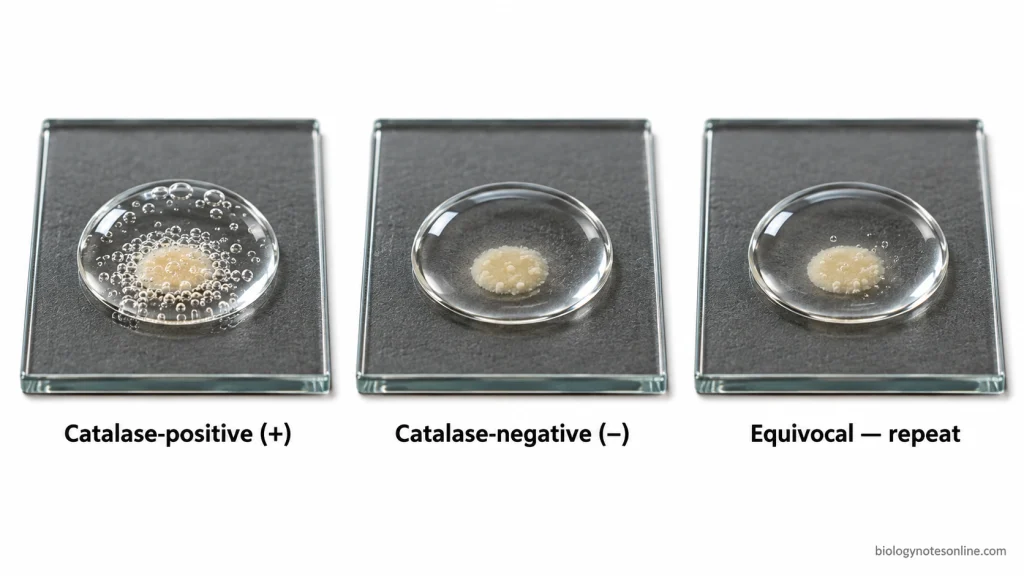
The result of catalase test is observed by the formation of oxygen bubbles when hydrogen peroxide (H₂O₂) comes in contact with bacterial growth. The reaction is observed immediately after adding the reagent. Depending on the bubble formation, the test may show positive, negative or doubtful reaction.
Catalase-Positive Result
In a catalase-positive reaction, bubbles appear immediately after the addition of H₂O₂ to the bacterial growth. The bubbles are formed due to the release of oxygen gas by the breakdown of hydrogen peroxide.
Rapid effervescence is seen in strongly positive reactions. It indicates the presence of detectable catalase enzyme activity in the tested bacterial culture.
Catalase-Negative Result
A catalase-negative reaction shows no immediate bubble formation after adding hydrogen peroxide. The expected effervescence is absent.
It indicates that catalase activity is not detected in the bacterial culture under the given test conditions. A negative reaction does not necessarily mean that the organism cannot produce catalase under other conditions.
Weak or Equivocal Reactions
In some bacterial cultures, only a few small bubbles may be produced. These are difficult to observe. A dark background or magnifying glass can be used to detect weak bubble formation.
Immediate faint bubbling may indicate weak catalase activity. However, delayed bubble formation or an unclear reaction should not be recorded as a definite positive result in the routine catalase test.
False-positive reactions may occur due to the transfer of red blood cells from blood agar or the use of certain metal inoculating loops. Old or inactive hydrogen peroxide may produce weak or false-negative results.
Such doubtful reactions should be repeated with a fresh isolated colony and fresh H₂O₂ reagent. Known catalase-positive and catalase-negative control cultures are used to check the validity of the test.
Catalase Test Results Table
| Test Result | Observation | Interpretation |
|---|---|---|
| Catalase-positive | Immediate formation of distinct oxygen bubbles or effervescence. | Detectable catalase enzyme activity is present. |
| Catalase-negative | No immediate bubble formation after adding H₂O₂. | Catalase activity is not detected under the test conditions. |
Catalase-Positive and Catalase-Negative Bacteria
Bacteria can be differentiated into catalase-positive and catalase-negative based on their reaction with hydrogen peroxide (H₂O₂). Different bacterial species show different catalase reactions. Some bacteria produce immediate oxygen bubbles, whereas others do not show the expected bubbling.
The following are some commonly tested bacteria and their typical catalase reactions-
| Bacterial Genus | Common Examples | Catalase Reaction |
|---|---|---|
| Staphylococcus | Staphylococcus aureus, S. epidermidis | Usually Positive (+) |
| Streptococcus | Streptococcus pyogenes, S. pneumoniae | Usually Negative (−) |
| Enterococcus | Enterococcus faecalis | Usually Negative (−) |
| Micrococcus | Micrococcus luteus | Usually Positive (+) |
| Bacillus | Bacillus subtilis, B. cereus | Usually Positive (+) |
| Escherichia | Escherichia coli | Usually Positive (+) |
| Salmonella | Salmonella enterica serovar Typhimurium | Usually Positive (+) |
| Pseudomonas | Pseudomonas aeruginosa | Usually Positive (+) |
Escherichia coli is generally catalase-positive. Salmonella enterica and Pseudomonas aeruginosa also commonly produce catalase enzyme and give positive reaction.
The catalase reaction may vary among different species and strains of bacteria. Rare catalase-negative strains of Staphylococcus aureus have also been reported. The amount of catalase activity may also differ with the growth conditions and physiological state of the bacterial cells.
Applications of Catalase Test
- The catalase test is commonly used in the preliminary identification of Gram-positive cocci, especially for differentiating staphylococci and micrococci from streptococci and enterococci.
- To differentiate commonly catalase-positive Bacillus from certain catalase-negative Clostridium isolates along with other biochemical and cultural characteristics.
- It is used as an additional biochemical test during the identification of certain Campylobacter species and members of the family Enterobacteriaceae.
- Used to detect catalase enzyme activity in bacterial cells and study their ability to break down hydrogen peroxide (H₂O₂), which is involved in protection against oxidative damage.
- Modified catalase tests, such as the heat-stable catalase test, are used for differentiation of certain Mycobacterium species. These require different test procedures from the routine catalase test.
Quality Control of Catalase Test
- The hydrogen peroxide (H₂O₂) reagent is checked daily or before performing the test. It is an unstable reagent. The reagent is stored in a refrigerator at 2–8°C, protected from light. Each new lot or shipment of H₂O₂ is also tested before use.
- Known catalase-positive and catalase-negative control cultures are used for checking the test reaction. Staphylococcus aureus NCTC 6571 or NCTC 12973 is used as positive control, whereas Streptococcus mitis NCTC 10712 is taken as negative control. The positive control produces immediate bubbles. No bubbling is observed in the negative control. If the expected reactions are not obtained, the reagent and test procedure are checked and the test is repeated.
- Use a fresh and pure 18–24 hours bacterial culture for the test. Old or non-viable bacterial cells may lose their catalase activity, giving false-negative reaction.
- The bacterial growth should be collected without picking the agar along with it, especially from blood-containing media. Red blood cells contain catalase enzyme. When these cells are transferred with the bacterial growth, a false-positive reaction may be obtained.
- Clean glass slides or test tubes and sterile applicators are used for the test. Some metal inoculating loops and dirty glassware may also produce false-positive reactions.
- Observe the reaction immediately after H₂O₂ is added to the bacterial growth. Delayed formation of bubbles is not considered as a positive reaction in the routine catalase test.
Precautions for Catalase Test
- Use a fresh and pure 18–24 hours bacterial culture for the test. Old cultures may show reduced catalase activity and give false-negative reaction.
- The hydrogen peroxide (H₂O₂) reagent should be fresh. For routine catalase test, 3% H₂O₂ is generally used. The reagent is stored protected from light, as it may lose its activity during storage.
- Avoid taking the bacterial growth along with blood agar medium. Red blood cells contain catalase enzyme and may produce false-positive reaction when transferred with the bacterial colony.
- Clean glass slides and test tubes should be used. For transferring the bacterial growth, sterile wooden applicator sticks or plastic loops are preferred, as some metal inoculating loops may react with H₂O₂ and give false-positive results.
- The reaction is observed immediately after adding hydrogen peroxide to the bacterial growth. Delayed bubble formation should not be taken as a positive reaction.
- Known catalase-positive and catalase-negative control cultures should be used to check the test reaction. A doubtful reaction is repeated with fresh culture and reagent.
- Avoid vigorous mixing or shaking of the bacterial growth with H₂O₂. The reaction may produce aerosols containing bacterial cells. In slide method, the slide is kept inside a covered Petri dish, whereas in tube method, a capped tube is used. Tests having risk of aerosol exposure are performed in a microbiological safety cabinet.
- Laboratory coat, gloves and eye protection should be worn during the test. Avoid splashing of H₂O₂ and bacterial culture. The used slides, applicators and other contaminated materials are discarded in appropriate biohazardous waste.
Limitations of Catalase Test
- It is only a preliminary biochemical test and cannot identify the bacterial species. Other tests are required.
- The test detects catalase activity, but cannot measure the amount of catalase enzyme.
- Old or non-viable cultures may give false-negative results. Fresh 18–24 hours growth is required.
- Old or improperly stored hydrogen peroxide (H₂O₂) may lose its activity, giving weak or false-negative reaction.
- Red blood cells carried from blood agar contain catalase and may give false-positive reaction.
- Some metal loops, especially nichrome loops, may react with H₂O₂. Dirty glass tubes may also affect the reaction.
- Catalase activity may vary among species and strains. Some Aerococcus and Enterococcus strains show weak or pseudocatalase reaction. Normally catalase-positive bacteria may also give weak or negative reaction.
- Delayed bubbling is not taken as positive. Weak reactions may be difficult to interpret and require repeat testing with proper controls.
- The test may produce aerosols containing viable bacterial cells. Aerosol exposure is higher in slide method, so proper containment and laboratory safety are required.
Advantages of Catalase Test
- It is a simple and rapid test. The reaction is observed immediately.
- Only a small amount of bacterial growth is required.
- The test requires few materials, mainly hydrogen peroxide (H₂O₂) and bacterial culture.
- It gives a directly visible result by the formation of oxygen bubbles.
- It is useful as a primary identification test for bacterial isolates.
- The catalase test can quickly differentiate catalase-positive staphylococci from catalase-negative streptococci.
Catalase Test vs Coagulase Test
Catalase test and coagulase test are biochemical tests used during identification of Gram-positive cocci. They detect different bacterial activities and are used at different stages of identification.
| Feature | Catalase Test | Coagulase Test |
|---|---|---|
| Enzyme or factor detected | Catalase enzyme | Coagulase or clumping factor |
| Substrate or reagent | Hydrogen peroxide (H₂O₂) | Plasma containing fibrinogen |
| Positive reaction | Immediate formation of oxygen bubbles | Plasma clotting in tube test or clumping in slide test |
| Common differentiation | Staphylococci from streptococci | Staphylococcus aureus from coagulase-negative staphylococci |
| Role in identification | Mainly an early differentiation test | Used for further identification of staphylococci |
The catalase test is commonly used first. Staphylococci are generally catalase-positive, whereas streptococci are catalase-negative.
The coagulase test is used after an isolate has been identified as a staphylococcus. Staphylococcus aureus is usually coagulase-positive. Most other staphylococci tested routinely are coagulase-negative.
In catalase test, H₂O₂ is broken down with release of oxygen. Bubbles are formed. Coagulase test is based on the reaction with plasma, where a positive tube reaction forms a clot. The slide method detects clumping factor by visible clumping.
Catalase Test at a Glance
| Feature | Quick Summary |
|---|---|
| Test name | Catalase Test |
| Type of test | Biochemical test |
| Enzyme detected | Catalase |
| Principle | Catalase breaks down hydrogen peroxide into water and oxygen. |
| Reaction | 2H₂O₂ → 2H₂O + O₂ |
| Reagent used | 3% hydrogen peroxide (H₂O₂) |
| Common culture age | Fresh 18–24 hours culture |
| Main methods | Slide method, tube or bottle method, agar slant method |
| Positive result | Immediate formation of oxygen bubbles |
| Negative result | No immediate bubble formation |
| Positive result indicates | Detectable catalase activity |
| Common catalase-positive bacteria | Staphylococcus, Micrococcus, Bacillus, Escherichia coli, Salmonella, Pseudomonas |
| Common catalase-negative bacteria | Streptococcus and Enterococcus |
| Major use | Differentiation of staphylococci from streptococci |
| False-positive cause | Transfer of red blood cells from blood agar or reaction with some metal loops |
| False-negative cause | Old culture or inactive hydrogen peroxide reagent |
| Important precaution | Observe the reaction immediately after adding H₂O₂. |
| Nature of test | Qualitative |
| Major limitation | Cannot identify the bacterial species alone. |
References
- Bush, P., & Martin, K. (n.d.). WPUNJ microbiology laboratory manual. William Paterson University. https://press.wpunj.edu/microbiologylabmanual/chapter/physiological-characteristics-results-interpretation/