

Coagulase Test is commonly used in microbiology laboratories for differentiation of Staphylococcus aureus from coagulase-negative staphylococci (CoNS) during identification of staphylococci. The test gives a visible reaction when the coagulase activity of bacteria is tested with plasma. Most strains of S. aureus give a positive coagulase reaction, whereas many other staphylococci are coagulase-negative. However, coagulase positivity is not limited only to this species. Some other staphylococcal species may also show a positive reaction.
Plasma is used as the main reagent, commonly rabbit plasma.
Coagulase test can be performed by two commonly used methods, the slide coagulase test and tube coagulase test. In slide method, visible clumping of bacterial cells is observed in a positive reaction. The tube method shows clot formation in the plasma. The results obtained from these two methods may not always be same. Some strains of S. aureus can produce a negative result in the slide test, but show a positive reaction in the tube coagulase test.
What Is the Coagulase Test?
Coagulase test is a differential biochemical test used to detect the coagulase activity of certain bacteria, particularly staphylococci. It is mainly used for the identification of Staphylococcus aureus and its differentiation from coagulase-negative staphylococci (CoNS). The test uses blood plasma, commonly rabbit plasma, to detect the reaction produced by the bacterial cells.
Coagulase is generally associated with the ability of certain staphylococci to cause coagulation of plasma.
There are two different coagulase reactions which can be demonstrated by the slide coagulase test and tube coagulase test. The slide test detects the cell wall-associated clumping factor (bound coagulase), which produces visible clumping of bacterial cells in the presence of plasma. In the tube method, free coagulase released by the bacteria is detected by the formation of a clot in plasma. These two methods detect different bacterial activities.
Purpose of Coagulase Test
- To differentiate Staphylococcus aureus from coagulase-negative staphylococci (CoNS) on the basis of their coagulase reaction.
- To detect the coagulase-related activity of bacterial isolates. The slide test detects the cell wall-associated clumping factor. Free coagulase is detected by the tube test with clot formation in plasma.
- For the presumptive identification of S. aureus in microbiology laboratory. A positive coagulase reaction alone may not always confirm the bacterial species.
- To differentiate the catalase-positive Gram-positive cocci suspected to be staphylococci by their biochemical reaction. Coagulase test is performed on isolated bacterial culture as a differential test. It is not a selective culture medium used for bacterial growth.
Principle of Coagulase Test
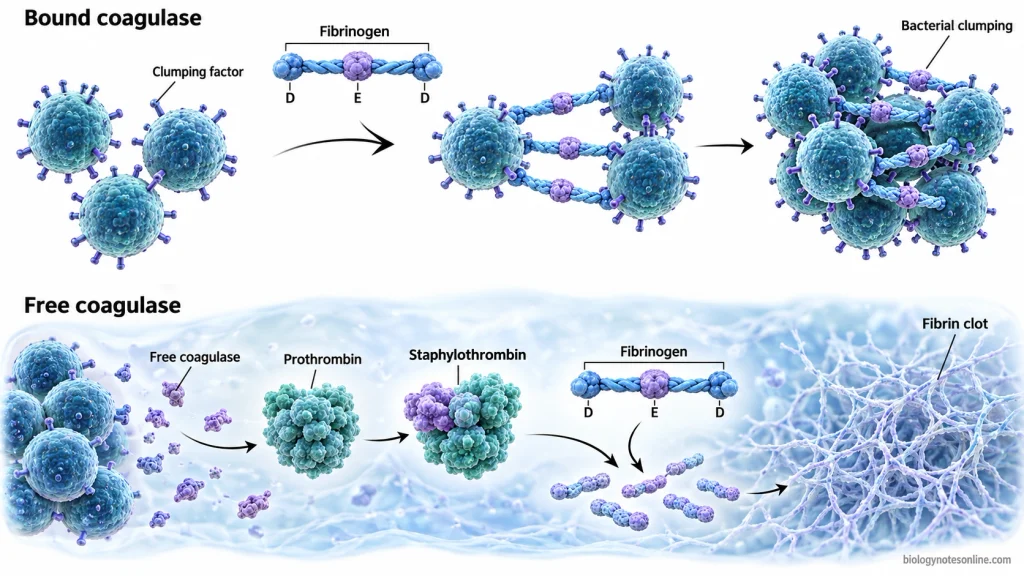
The coagulase test is based on the reaction of staphylococcal cells or their secreted staphylocoagulase with the fibrinogen and prothrombin present in plasma. Two different reactions are involved. The slide method produces visible clumping of bacterial cells, whereas the tube method results in formation of fibrin clot.
Bound Coagulase (Clumping Factor)
The slide coagulase test demonstrates the cell-associated clumping factor, commonly referred to as bound coagulase in the test. The clumping factor present on the bacterial cell surface binds directly with fibrinogen in plasma. Fibrinogen acts as a bridge between the adjacent bacterial cells. The cells are clumped together and visible agglutination is produced. Fibrin formation is not required for this reaction.
Free Coagulase (Staphylocoagulase)
Free coagulase or staphylocoagulase is secreted outside the bacterial cell and is detected by the tube coagulase test. Staphylocoagulase binds with prothrombin and forms an active coagulase-prothrombin complex, also called staphylothrombin. This complex converts soluble fibrinogen into fibrin. A fibrin clot is then formed in the plasma.
The slide and tube methods do not detect the same bacterial factor. A strain may produce staphylocoagulase but have little or no detectable cell-associated clumping factor. In such case, the slide test can give a negative reaction while clot formation is obtained in the tube test. A negative slide reaction is therefore tested further by tube coagulase test.
Reagents and Materials for Coagulase Test
- Rabbit plasma- Rabbit plasma is commonly used as the main reagent for coagulase test. Commercial coagulase plasma is usually supplied as lyophilized EDTA-treated or citrated rabbit plasma.
- Anticoagulant- Ethylenediaminetetraacetic acid (EDTA) treated plasma is more preferred. Citrated plasma can also be used, but some organisms may utilize citrate and produce clotting not related to the true coagulase reaction.
- Plasma preparation- The lyophilized plasma is reconstituted with sterile distilled water before use. The amount of water and storage condition should be followed according to the supplied reagent instructions. Different commercial preparations may not have the same reconstitution requirements.
- Fresh bacterial culture- A fresh culture, usually 24 hours old or younger, is required. Old cultures may not give a proper coagulase reaction.
- Culture medium- The bacterial culture should be grown on a noninhibitory medium. Blood agar, trypticase soy agar and chocolate agar can be used. Mannitol salt agar, phenylethyl alcohol agar and media containing antibiotics are inhibitory and are not preferred for preparing the test culture.
- Control cultures- A known coagulase-positive Staphylococcus aureus culture and a coagulase-negative organism such as Staphylococcus epidermidis are used as positive and negative controls. Controls are required for both slide and tube methods.
- Safety requirements- Live S. aureus should be handled under Biosafety Level 2 (BSL-2) laboratory conditions with appropriate laboratory safety equipment. Used slides, tubes, loops and other contaminated materials are placed in the proper biohazard discard container.
Bound Coagulase (Clumping Factor)
- Microscope slide- A clean glass microscope slide is required for the slide coagulase test.
- Water or saline- Sterile water or physiological saline is used along with the plasma. It also helps to check whether the bacterial cells show autoagglutination without plasma.
- Transfer material- A sterile wire loop, disposable loop or sterile wooden applicator stick can be used for transferring the fresh bacterial colony.
- Droppers- Separate droppers are required for placing the water or saline and the reconstituted plasma.
- Marker and discard container- A marking pen or wax pencil is used for marking the slide. A suitable container is required for disposal of contaminated slides and transfer materials.
Free Coagulase (Staphylocoagulase)
- Sterile test tubes- Small sterile test tubes are used for holding the rabbit plasma and bacterial culture.
- Test tube rack- It is used to hold the tubes during preparation and incubation.
- Pipettor and sterile tips- These are required for accurate transfer of the reconstituted plasma.
- Incubator- An incubator maintained at approximately 37°C is required for the tube coagulase test.
- Timer- A watch or timer is used for recording the incubation and observation time.
- Transfer loop or applicator- A sterile loop or wooden applicator stick is used for transferring the fresh bacterial culture into the plasma. A contaminated-material discard container is also required.
Procedure of Coagulase Test
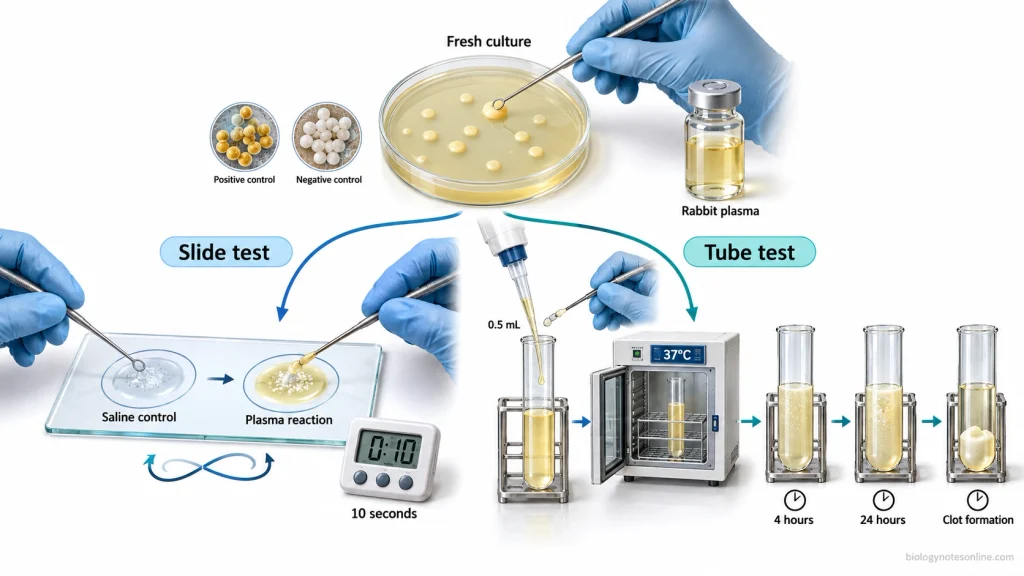
A fresh bacterial culture, 24 hours old or younger, grown on noninhibitory agar is used for the test. Positive and negative control cultures are also tested along with the test organism.
Slide Coagulase Test Procedure
The slide method is used to detect the cell-associated clumping factor (bound coagulase).
- Take a clean glass slide and mark two separate circles on it. One is used for the control suspension and another for the plasma reaction.
- Place a small drop of sterile water or physiological saline in the first circle. Add a small drop of reconstituted rabbit plasma to the other circle.
- Pick cells from one isolated colony with a sterile loop or applicator stick. First emulsify the bacterial cells in the water or saline. The same culture is then emulsified in the plasma drop. The control suspension is prepared first to prevent transfer of plasma into it.
- Gently rock the slide and observe for clumping within 10 seconds. A positive reaction gives visible clumps in the plasma drop. No clumping should occur in the water or saline control.
- Perform the same test with known positive and negative control cultures. The positive control should show clumping with plasma, whereas the negative control should remain without clumping.
- If clumping occurs in the saline or water control, the organism shows autoagglutination and the slide result cannot be interpreted. Such isolate is tested by the tube coagulase method.
- When no clumping occurs in either plasma or control drop, the slide test is negative. A negative slide reaction does not exclude Staphylococcus aureus. The isolate is further tested by the tube coagulase test.
Tube Coagulase Test Procedure
The tube method detects the secreted staphylocoagulase (free coagulase) by formation of a clot in plasma.
- Label a small sterile test tube for the organism being tested.
- Aseptically add 0.5 ml of reconstituted rabbit plasma into the tube.
- Pick two or three well-isolated colonies from the fresh culture and emulsify them in the plasma. Mix properly and place the tube at approximately 37°C.
- Prepare positive and negative control tubes in the same way. A known S. aureus strain can be used as positive control and a coagulase-negative staphylococcus as negative control.
- Observe the tubes at intervals during the first 4 hours. Any visible clot formation is considered a positive tube coagulase reaction.
- If no clot is produced after 4 hours, continue the test with overnight incubation at room temperature and make the final observation at 24 hours.
- The positive control should show clot formation by 24 hours. The negative control should remain without a clot.
Coagulase Test Results and Interpretation
Slide Coagulase Test Results
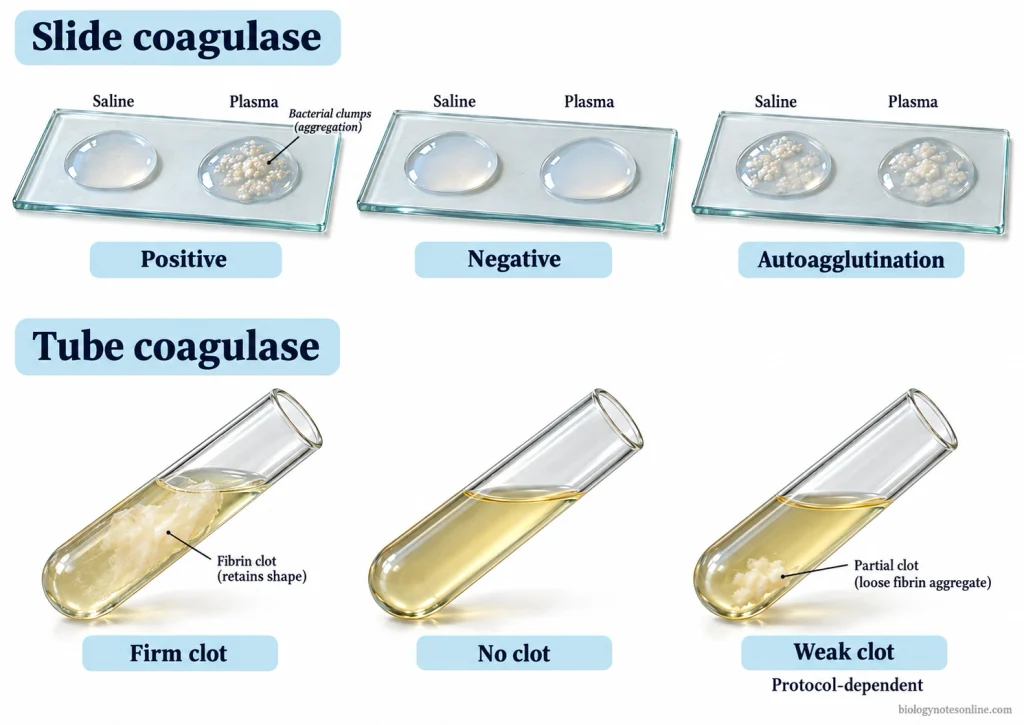
Positive: Visible clumping of bacterial cells occurs in the plasma drop within about 10 seconds, while the saline or water control remains smooth. It indicates the presence of cell-associated clumping factor (bound coagulase).
Negative: No clumping is observed in the plasma as well as the control suspension. However, a negative slide test does not always exclude Staphylococcus aureus. The slide method detects the clumping factor only. Such isolates are further tested by the tube coagulase test.
Inconclusive: Clumping in the saline or water control indicates autoagglutination of the bacterial cells. In this case, the plasma reaction cannot be interpreted. Tube coagulase test is required.
Tube Coagulase Test Results
Positive: Formation of a fibrin clot in the plasma is considered a positive tube coagulase reaction. It indicates the activity of staphylocoagulase (free coagulase). According to the ASM teaching protocol, any clot formation is accepted as positive. The tube is examined during the first 4 hours and, when required, a final reading is made at 24 hours.
For identification of S. aureus, a more strict interpretation has also been used. Sperber and Tatini considered a firm and stable clot, which does not move when the tube is tipped, as a reliable positive reaction. A weak or partial clot alone is not sufficient for definite identification of S. aureus under this criterion.
Negative: The plasma remains fluid and no clot is formed. In the ASM procedure, absence of clot at the final 24-hour reading is considered negative.
Inconclusive: Partial clot formation may be interpreted differently according to the laboratory protocol. It may be accepted as clot formation in a general coagulase protocol, while the stricter identification criterion does not consider a weak or partial clot sufficient for definite species identification. Further identification tests are required for such isolates.
| Method | Positive appearance | Negative appearance | Interpretation |
|---|---|---|---|
| Slide coagulase test | Rapid visible clumping in plasma. No clumping in the control. | No clumping in plasma or control. | Detects clumping factor (bound coagulase). A negative slide result is followed by tube testing. |
| Tube coagulase test | Formation of clot in plasma. | Plasma remains fluid. | Detects staphylocoagulase (free coagulase). Interpretation of weak or partial clotting depends on the protocol used. |
The slide and tube reactions are not always the same. The slide test detects the cell-associated clumping factor, whereas the tube test detects secreted staphylocoagulase. Some staphylococci can give a negative slide reaction but show a positive reaction in the tube test.
| Organism | Typical coagulase result | Interpretation |
|---|---|---|
| Staphylococcus aureus | Positive | Usually gives a positive coagulase reaction. |
| Staphylococcus epidermidis | Negative | Typical coagulase-negative staphylococcus. |
| Staphylococcus saprophyticus | Negative | Coagulase-negative staphylococcus. |
Coagulase positivity is not found only in S. aureus. Some other Staphylococcus species can also give positive slide or tube reactions, and some isolates of S. aureus may not produce the typical coagulase reaction. Other biochemical, phenotypic or identification methods may be required for species identification.
Limitations of Coagulase Test
- Some Staphylococcus aureus strains may give a false-negative slide test because clumping factor is absent or not detected sufficiently. Negative slide reactions should be checked by tube coagulase test.
- Autoagglutination can interfere with the slide test. Clumping in the saline or water control makes the plasma reaction uninterpretable.
- Old cultures and cultures grown on inhibitory media may give poor reactions. Fresh cultures from noninhibitory media are preferred. Mannitol salt agar, phenylethyl alcohol agar and antibiotic-containing media are not preferred.
- The type and condition of plasma can affect the result. Ethylenediaminetetraacetic acid (EDTA)-treated rabbit plasma is generally preferred. Citrated plasma may sometimes clot when citrate is utilized by the organism. Improper storage, preparation or repeated freezing and thawing can also affect the plasma.
- Delayed observation of the slide test may produce a false-positive appearance when the plasma drop starts drying.
- In the tube test, a clot may form and later break down. Reading the tube too late can produce a doubtful or false-negative result. The tubes are checked during the first 4 hours and again at the required final reading.
- Positive and negative controls must give their expected reactions. Test results are not reliable when the controls are incorrect.
- Coagulase positivity is not specific only for S. aureus. Members of the Staphylococcus intermedius group and S. schleiferi subsp. coagulans may also be coagulase-positive. S. lugdunensis and some S. schleiferi can give a positive slide clumping reaction.
- Rare S. aureus strains may be weakly positive or coagulase-negative. Additional biochemical, phenotypic or species-identification tests are required when the coagulase result is doubtful, atypical or does not agree with other characteristics of the isolate.
Advantages of Coagulase Test
- It is a simple and inexpensive test for routine identification of staphylococci.
- The slide coagulase test gives a rapid visible result by clumping of bacterial cells.
- It is useful for the presumptive identification of Staphylococcus aureus and its differentiation from coagulase-negative staphylococci.
- The test requires only basic laboratory materials and plasma. No special instrument is required.
- Both clumping factor and free coagulase can be detected using the slide and tube methods.
- A negative or doubtful slide reaction can be further checked by the tube coagulase test, improving the identification of atypical isolates.
Uses of Coagulase Test
- Used to differentiate Staphylococcus aureus from S. epidermidis and other coagulase-negative staphylococci.
- Used for the presumptive identification of S. aureus in microbiology laboratories. A negative slide reaction is further tested by the tube coagulase test.
- The slide test is used to detect clumping factor (bound coagulase), whereas the tube test detects staphylocoagulase (free coagulase).
- Used to separate coagulase-positive staphylococci from coagulase-negative species before further species identification.
- In the identification of catalase-positive Gram-positive cocci, coagulase test is used along with other biochemical tests. Coagulase reaction alone may not always identify the bacterial species.
Coagulase Test at a Glance
| Feature | Quick Summary |
|---|---|
| Test name | Coagulase Test |
| Main purpose | Differentiation of Staphylococcus aureus from coagulase-negative staphylococci (CoNS) |
| Principle | Detection of clumping factor (bound coagulase) or staphylocoagulase (free coagulase) using plasma |
| Main reagent | Rabbit plasma, commonly EDTA-treated |
| Methods | Slide coagulase test and Tube coagulase test |
| Slide test detects | Clumping factor (bound coagulase) |
| Slide positive result | Rapid visible clumping of bacterial cells |
| Tube test detects | Staphylocoagulase (free coagulase) |
| Tube positive result | Fibrin clot formation in plasma |
| Positive organism | Staphylococcus aureus is usually coagulase-positive |
| Negative organisms | S. epidermidis and S. saprophyticus are usually coagulase-negative |
| Slide test limitation | A negative slide test does not always exclude S. aureus |
| Autoagglutination | Clumping in saline or water control makes the slide test uninterpretable |
| Tube test reading | Checked during the first 4 hours, with final reading up to 24 hours when required |
| Controls | Known positive and negative controls should be tested |
| Important point | Coagulase positivity is not exclusive to S. aureus |
| Further identification | Atypical or doubtful reactions may require additional biochemical or species-identification tests |
References
- Bascomb, S., & Manafi, M. (1998). Use of enzyme tests in characterization and identification of aerobic and facultatively anaerobic gram-positive cocci. Clinical Microbiology Reviews, 11(2), 318–340. https://doi.org/10.1128/CMR.11.2.318
- Brown, D. F. J., Edwards, D. I., Hawkey, P. M., Morrison, D., Ridgway, G. L., Towner, K. J., & Wren, M. W. D. (2005). Guidelines for the laboratory diagnosis and susceptibility testing of methicillin-resistant Staphylococcus aureus (MRSA). Journal of Antimicrobial Chemotherapy, 56(6), 1000–1018. https://doi.org/10.1093/jac/dki372
- Crosby, H. A., Kwiecinski, J., & Horswill, A. R. (2016). Staphylococcus aureus aggregation and coagulation mechanisms, and their function in host-pathogen interactions. Advances in Applied Microbiology, 96, 1–41. https://doi.org/10.1016/bs.aambs.2016.07.018
- De Paulis, A. N., Predari, S. C., Chazarreta, C. D., & Santoianni, J. E. (2003). Five-test simple scheme for species-level identification of clinically significant coagulase-negative staphylococci. Journal of Clinical Microbiology, 41(3), 1219–1224. https://doi.org/10.1128/JCM.41.3.1219-1224.2003
- Ehlers, S., & Merrill, S. A. (2023). Staphylococcus saprophyticus infection. In StatPearls. StatPearls Publishing. https://www.ncbi.nlm.nih.gov/books/NBK482367/
- Friedrich, R., Panizzi, P., Fuentes-Prior, P., Richter, K., Verhamme, I., Anderson, P. J., Kawabata, S.-I., Huber, R., Bode, W., & Bock, P. E. (2003). Staphylocoagulase is a prototype for the mechanism of cofactor-induced zymogen activation. Nature, 425(6957), 535–539. https://doi.org/10.1038/nature01962
- Lainhart, W., Yarbrough, M. L., & Burnham, C.-A. D. (2018). The Brief Case: Staphylococcus intermedius group—Look what the dog dragged in. Journal of Clinical Microbiology, 56(2), e00839-17. https://doi.org/10.1128/JCM.00839-17
- Lee, E., & Anjum, F. (2023). Staphylococcus epidermidis infection. In StatPearls. StatPearls Publishing. https://www.ncbi.nlm.nih.gov/books/NBK563240/
- Sperber, W. H., & Tatini, S. R. (1975). Interpretation of the tube coagulase test for identification of Staphylococcus aureus. Applied Microbiology, 29(4), 502–505. https://doi.org/10.1128/am.29.4.502-505.1975
- Tiwari, H. K., Sapkota, D., & Sen, M. R. (2008). Evaluation of different tests for detection of Staphylococcus aureus using coagulase (coa) gene PCR as the gold standard. Nepal Medical College Journal, 10(2), 129–131. https://pubmed.ncbi.nlm.nih.gov/18828438/
- Yarbrough, M. L., Hamad, Y., Burnham, C.-A. D., & George, I. A. (2017). The Brief Case: Bacteremia and vertebral osteomyelitis due to Staphylococcus schleiferi. Journal of Clinical Microbiology, 55(11), 3157–3161. https://doi.org/10.1128/JCM.00500-17