

Rocket immunoelectrophoresis is a quantitative immunological technique which combines the electrophoretic movement of antigens with antigen-antibody precipitation in an antibody-containing agarose gel. It is mainly used to determine the concentration of a specific antigen, usually a protein, present in a sample.
In this technique, a monospecific antiserum against the antigen is incorporated into the agarose gel. When an electric field is applied, the antigen moves through the gel and reacts with the corresponding antibodies. The antigen-antibody reaction results in the formation of a visible precipitate. This precipitate has a pointed shape resembling a rocket, which is known as a precipitin rocket.
The height of the rocket is proportional to the amount of antigen present under fixed experimental conditions. Higher antigen concentration produces a taller rocket. The concentration of an unknown antigen is determined by comparing the rocket height with those produced by known antigen standards. Unlike conventional immunoelectrophoresis, which is mainly used for qualitative analysis of proteins, rocket immunoelectrophoresis is used for the quantitative estimation of a specific antigen.
The technique was introduced by Carl-Bertil Laurell. It is also known as electroimmunoassay, electroimmunodiffusion or the Laurell technique.
Purpose of Rocket Immunoelectrophoresis
- To determine the amount or concentration of a specific antigen (usually a protein) present in a biological sample. The antigen can be measured even when the sample contains several different proteins. A monospecific antiserum is used to detect the required antigen without measuring the total protein content of the sample.
- To determine the concentration of an unknown antigen sample by comparing it with known antigen standards. The height of the precipitin rocket formed by the unknown sample is compared with those of the standards. This is used to obtain the antigen concentration.
- To compare the amount of the same antigen present in different biological samples under similar experimental conditions.
- To obtain a quantitative result from a specific antigen-antibody reaction, rather than only detecting the presence of an antigen. The formation of a specific precipitate indicates the reaction, while comparison with reference standards is used for measuring the antigen amount.
Principle of Rocket Immunoelectrophoresis
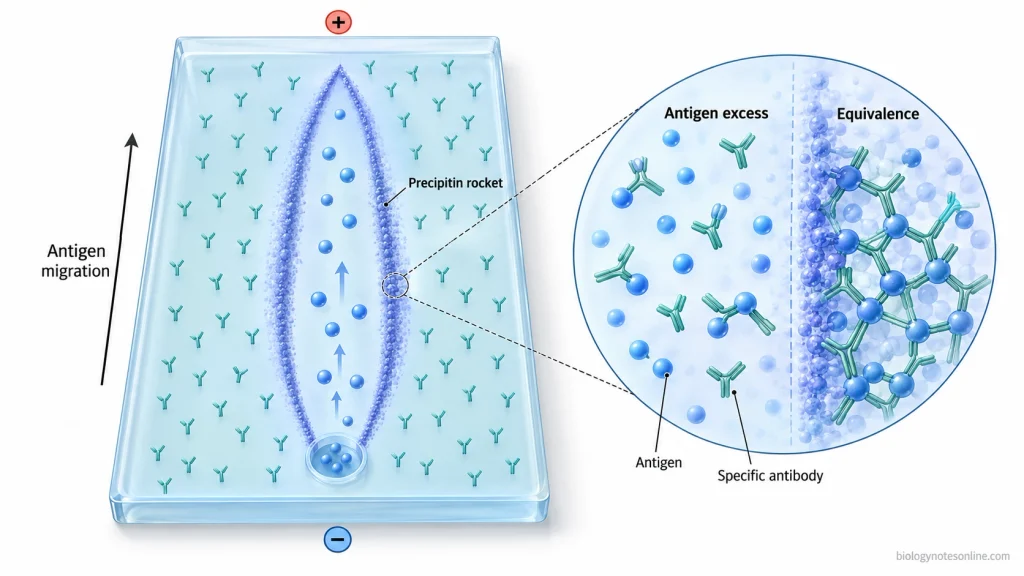
Rocket immunoelectrophoresis is based on the principle of one-dimensional electroimmunodiffusion. In this technique, the antigen migrates in one direction through an agarose gel containing uniformly distributed specific antibodies under the influence of an electric field. The antibodies remain almost stationary in the gel under suitable electrophoretic conditions.
The migrating antigen combines with the corresponding antibody present in the gel to form antigen-antibody complexes. Some of these complexes remain soluble when the antigen is present in excess. They continue to migrate through the gel. When the antigen and antibody reach the zone of equivalence, extensive cross-linking takes place between the antigen and antibody molecules. The complexes become insoluble. A visible precipitin line is formed. These precipitin lines develop along the sides of the migrating antigen and meet at a pointed end, forming a characteristic rocket-shaped precipitate.
The height of the rocket depends on the amount of antigen loaded. A larger amount of antigen can move a greater distance through the antibody-containing gel before it is completely precipitated. This produces a taller rocket. When the antibody concentration and other experimental conditions are kept constant, the rocket height is generally directly proportional to the amount of antigen loaded.
Materials Required for Rocket Immunoelectrophoresis
- Agarose- Used for the preparation of the gel in which antigen-antibody precipitation takes place. Generally, 1% agarose is used.
- Monospecific Antiserum- An antiserum containing antibodies specific to the antigen being tested. It is mixed with the agarose gel for the formation of precipitin rockets.
- Standard Antigen- Antigen solutions of known concentrations are required for comparison with the test samples.
- Test Antigen- The biological sample containing the specific antigen whose concentration is to be determined.
- Electrophoresis Buffer- A suitable buffer is required for gel preparation and electrophoresis. Tris-borate-EDTA (TBE) buffer or barbitone-based buffer may be used depending on the experimental method.
- Glass Plates- Clean, grease-free glass plates are used to prepare and support the agarose gel.
- Electrophoresis Apparatus- A horizontal electrophoresis tank with electrodes and a regulated power supply is required to provide the electric field for antigen migration.
- Gel Puncher and Template- The gel puncher is used to cut uniform wells in the agarose gel. A template helps in maintaining proper position and spacing of the wells.
- Micropipettes and Tips- Used to transfer small and measured volumes of antiserum, standard antigen and test samples.
- Glassware and Heating Equipment- Beakers, conical flasks, measuring cylinders, spatula and microwave oven or suitable heating equipment are required for preparing the agarose solution.
- Distilled Water and Alcohol- Distilled water is used for preparing solutions, while alcohol is used for cleaning the glass plates.
- Moist Chamber and Incubator- A moist chamber is used to prevent drying of the gel during incubation. An incubator may be required depending on the experimental procedure.
- Staining Reagents- Coomassie Brilliant Blue and suitable destaining solutions may be used for visualization of the precipitin rockets when staining is required.
- Measuring Scale- A ruler or suitable measuring device is used to measure the height of the precipitin rockets.
Procedure of Rocket Immunoelectrophoresis
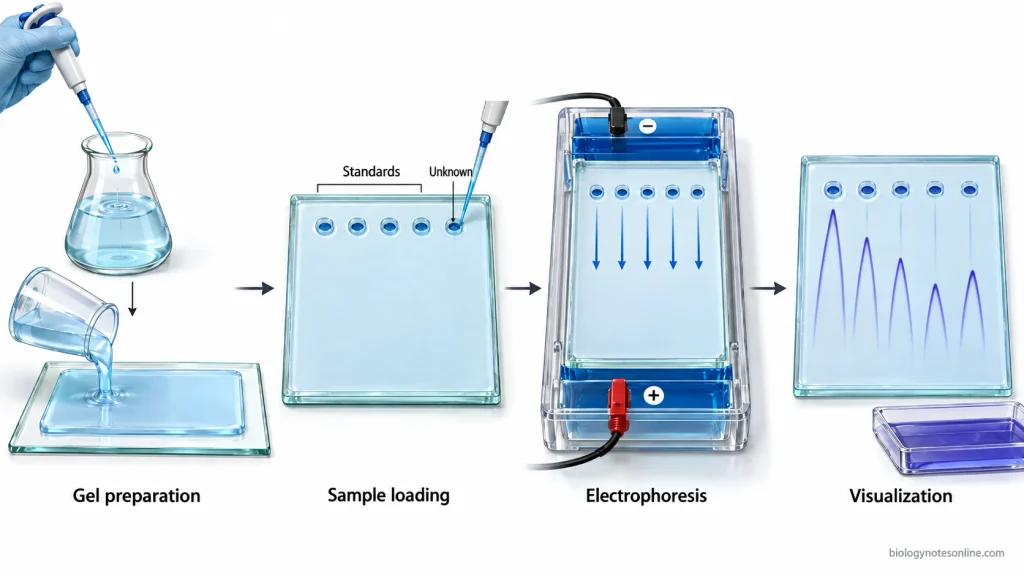
Preparation of Antibody-Containing Agarose Gel
- Prepare the required agarose in the electrophoresis buffer used for the test. Agarose concentration and the buffer composition or pH depends on the particular protocol.
- Heat the agarose until it is completely dissolved. Allow it to cool sufficiently. The specific antiserum is added only after cooling, as excessive heat can affect the antibody.
- Add the required amount of monospecific antibody to the molten agarose and mix it carefully. Antibody concentration is optimized for the antigen-antibody system being tested. Avoid air bubbles during mixing.
- Pour the antibody-containing agarose on a clean glass plate, slide, or other suitable gel support. Keep the surface level and allow the gel to set completely.
- Small circular wells are made in a straight row near one end of the gel. Keep the size and spacing of the wells uniform. Remove the agarose plugs carefully without damaging the gel around the wells.
Loading of Standard and Test Antigens
- Prepare a series of known antigen standards covering the required concentration range. Unknown test samples are prepared in the same suitable buffer or sample system.
- Equal and accurately measured volumes of the known standards are loaded into separate wells. The known reference solutions and unknown samples are run on the same gel.
- Add the test antigens into the remaining wells without overflowing them. The well edges should not be damaged during loading. Electrophoresis is usually started soon after sample loading to reduce excessive diffusion from the wells.
Electrophoresis and Visualization of Precipitin Rockets
- Place the gel in the electrophoresis chamber containing the selected running buffer. Proper electrical contact is maintained between the gel and electrode reservoirs.
- In the commonly used alkaline buffer conditions, the antigen carries negative charge and moves toward the anode (+). The sample wells are therefore placed toward the cathodic (-) end and the anode remains in the direction of rocket development. Exact electrode orientation depends on the migration behaviour of the antigen and the buffer system being used.
- Apply the electric field and run the electrophoresis until well-developed precipitin rockets are formed. Voltage or current, temperature and running time are not the same for all protocols. These conditions are kept controlled during electrophoresis. Excessive heating of the gel should be avoided.
- After electrophoresis, carefully remove the gel. It may be washed to remove soluble and unprecipitated proteins. Pressing or drying is then performed when required by the procedure.
- The dried or processed gel is stained with a suitable protein stain such as Coomassie Brilliant Blue, if staining is used in the protocol. Remove excess stain by destaining until the precipitin rockets become clearly visible against the gel background.
- Observe the rocket-shaped precipitin patterns of the standards and unknown samples. Clear and completely developed rockets are taken for subsequent measurement and interpretation.
Results and Interpretation of Rocket Immunoelectrophoresis
Formation and Appearance of Precipitin Rockets
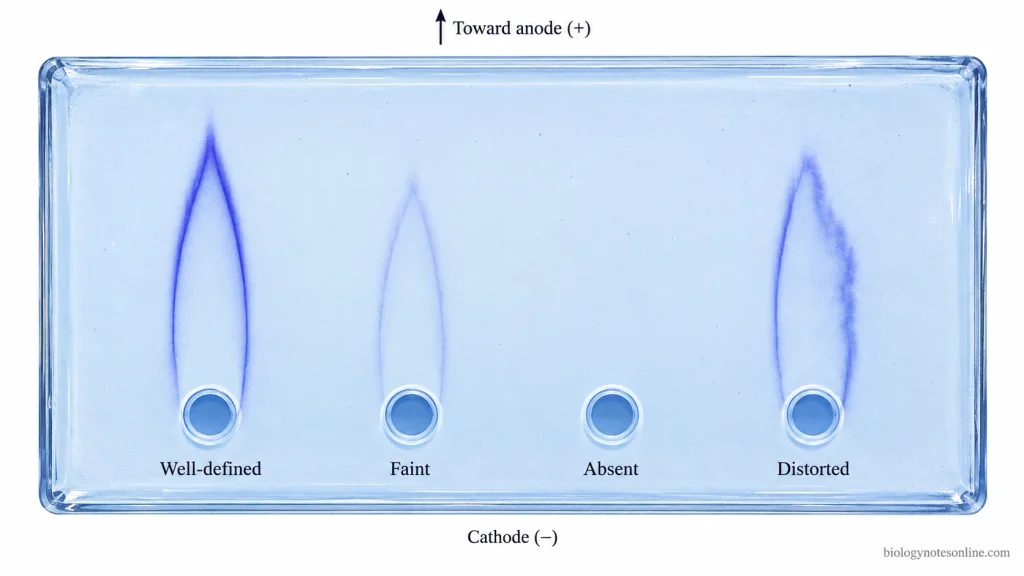
After electrophoresis, rocket-shaped precipitates are formed in the antibody-containing agarose gel. These precipitates extend from the sample wells towards the anode. Each rocket has two precipitation lines which meet at a pointed end. The rockets are generally taller in wells containing higher amounts of antigen when the experimental conditions are kept constant.
The appearance of the rockets may vary depending on the antigen concentration and experimental conditions.
- Well-defined rockets- A distinct rocket with a clear pointed end indicates the formation of a specific antigen-antibody precipitate. The height can be measured for quantitative analysis.
- Weak or faint rockets- These may be formed when the antigen concentration is low. The precipitin lines are not always clearly visible and may require staining for proper observation.
- Absent rockets- No visible precipitation may indicate that the antigen is absent or present below the detection limit of the assay. Improper sample loading, unsuitable electrophoresis conditions or failure of the antigen-antibody reaction may also result in the absence of rockets. The standard reactions should be checked before interpreting the result.
- Distorted rockets- Broad, irregular or poorly resolved precipitin peaks may occur due to uneven gel thickness, excessive antigen loading or unsuitable electrophoresis conditions. Such rockets cannot be measured accurately and the test may need to be repeated.
Measurement of Rocket Height and Standard Curve
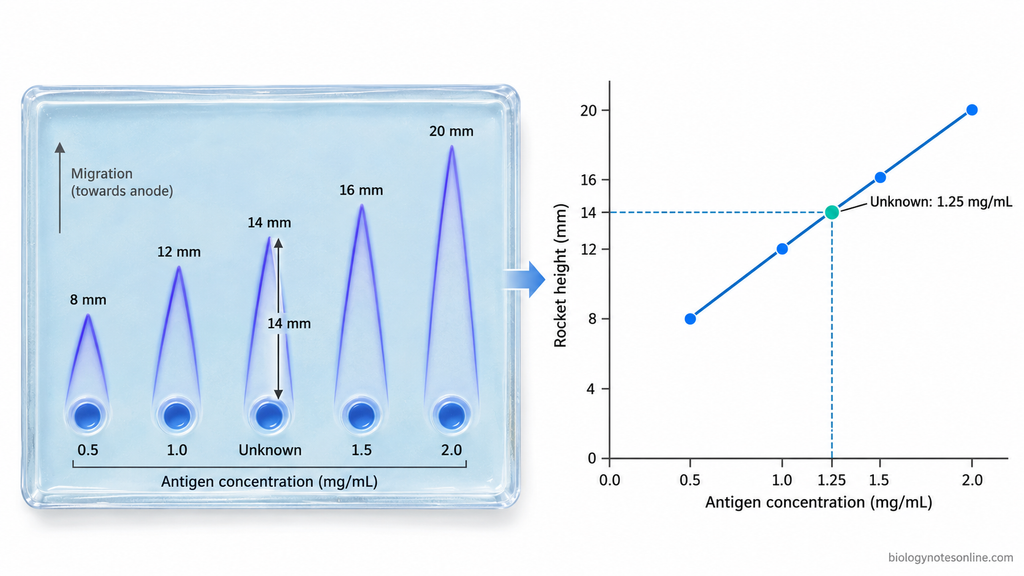
The height of each precipitin rocket is measured in millimetres (mm), from the upper edge of the sample well to the pointed tip of the rocket. The same method of measurement is followed for both standard and unknown samples.
A standard curve is prepared using antigen solutions of known concentrations. The rocket height obtained for each standard is recorded and plotted against its corresponding antigen concentration. The graph contains the antigen concentration on the X-axis and rocket height on the Y-axis.
In a protocol where the height is found to be directly proportional to the antigen concentration within the selected range, a linear calibration curve is used. The relationship may differ outside this range. Standards and test samples should be loaded in equal volumes and tested under the same conditions. Differences in the protein composition of sample diluents may also affect rocket height.
For example, the following are illustrative values for an assay having a linear calibration range.
| Standard antigen concentration (mg/mL) | Rocket height (mm) |
|---|---|
| 0.5 | 8 |
| 1.0 | 12 |
| 1.5 | 16 |
| 2.0 | 20 |
Determination of Unknown Antigen Concentration
The concentration of an unknown antigen is determined by measuring its rocket height and comparing it with the standard calibration curve.
For example, if the unknown sample produces a rocket height of 14 mm, its concentration falls between the standards of 1.0 mg/mL (12 mm) and 1.5 mg/mL (16 mm). Using linear interpolation for the above example, the antigen concentration is 1.25 mg/mL.
If the unknown sample was diluted before electrophoresis, the concentration obtained from the curve is multiplied by the dilution factor to determine the concentration in the original sample.
The unknown concentration should be determined only within the validated range of the standard curve. Samples producing rockets taller than the highest standard may require dilution and repeated analysis. A sample giving a rocket below the lowest measurable standard cannot be assigned an accurate concentration by extrapolation.
The standard rockets must also show the expected increase in height with antigen concentration. If the standard rockets are absent, irregular or do not produce a suitable calibration curve, the quantitative result should not be accepted.
Applications of Rocket Immunoelectrophoresis
- Used for the quantitative estimation of serum and plasma proteins such as albumin, transferrin, alpha-1-antitrypsin and alpha-2-macroglobulin, even in samples containing other proteins.
- To measure immunoglobulins such as immunoglobulin G (IgG) and immunoglobulin M (IgM) in human and animal sera.
- Used to estimate complement proteins, including complement component 3 breakdown product (C3d), in serum, plasma and synovial fluid of patients with immunological diseases.
- Rocket immunoelectrophoresis is used in vaccine research for measuring tetanus toxoid and rabies glycoprotein, identifying pertussis antigens and studying antigen compatibility with formulation additives.
- Used for measuring specific proteins in chromatographic fractions, such as alpha-1-acid glycoprotein in immunoaffinity chromatography eluates.
Advantages of Rocket Immunoelectrophoresis
- It is a simple and rapid technique for the quantitative estimation of specific antigens.
- It can measure a specific antigen even in a mixture containing several different proteins.
- Several samples can be analyzed simultaneously on a single agarose gel plate.
- The height of the precipitin rockets can be measured and compared with known standards to determine the antigen concentration.
- It requires a relatively small amount of antigen for analysis.
- The amount of antiserum required is less compared to the radial immunodiffusion method.
- It provides reproducible results with good precision under controlled experimental conditions.
Limitations of Rocket Immunoelectrophoresis
- It requires a monospecific antiserum against the antigen being tested.
- The antigen must have sufficient electrophoretic mobility under the selected buffer conditions. Proteins with very low or variable mobility may produce irregular precipitin rockets.
- Only one specific antigen can be measured with a particular antiserum, even when the sample contains several different proteins.
- It has limited sensitivity for very low antigen concentrations, as the precipitin rockets may not be clearly visible.
- The height and shape of the rockets are influenced by antibody concentration, buffer pH, ionic strength and electrophoresis conditions. These conditions must be carefully maintained.
- The technique requires suitable standard antigens having similar physicochemical and immunological properties to the test antigen for accurate quantification.
- High antigen concentration may produce broad or distorted rockets, making the measurement difficult. Samples outside the calibrated range require dilution and repeated analysis.
- Some insoluble proteins cannot be analyzed directly without special treatment or modification of the method.
Rocket Immunoelectrophoresis at a Glance
| Features | Description |
|---|---|
| Definition | A quantitative immunological technique used to determine the concentration of a specific antigen. |
| Other Names | Laurell technique, electroimmunoassay, electroimmunodiffusion. |
| Developed By | Carl-Bertil Laurell. |
| Principle | Based on one-dimensional electrophoretic migration of antigen through an antibody-containing gel and antigen-antibody precipitation. |
| Gel Used | Agarose gel containing uniformly distributed specific antibodies. |
| Antibody Used | Monospecific antiserum against the test antigen. |
| Direction of Migration | Antigens migrate towards the anode (positive electrode) under suitable buffer conditions. |
| Antigen-Antibody Reaction | Insoluble antigen-antibody complexes are formed near the zone of equivalence. |
| Precipitation Pattern | Characteristic rocket-shaped precipitin peaks. |
| Relationship | The rocket height generally increases with antigen concentration under controlled assay conditions. |
| Quantification | The height of the unknown rocket is compared with a standard calibration curve prepared using known antigen concentrations. |
| Measurement | Rocket height is measured from the upper edge of the sample well to the pointed tip. |
| Visualization | Precipitin rockets may be observed directly or after staining with Coomassie Brilliant Blue. |
| Applications | Estimation of serum proteins, immunoglobulins, complement proteins and specific vaccine antigens. |
| Advantages | Simple, relatively rapid, quantitative and allows analysis of several samples on a single gel. |
| Limitations | Requires specific antiserum and antigen standards. Low antigen concentration, unsuitable electrophoretic mobility and incorrect assay conditions may affect the results. |
| Result Interpretation | Taller rocket indicates more antigen within the validated assay range. Absence of a visible rocket does not always indicate absence of antigen. |
References
- Ahire, V. J., & Sawant, K. K. (2006). Development of rocket electrophoresis technique as an analytical tool in preformulation study of tetanus vaccine formulation. Drug Development and Industrial Pharmacy, 32(7), 799–808. https://doi.org/10.1080/03639040600683618
- Axelsen, N. H., Krøll, J., & Weeke, B. (Eds.). (1973). A manual of quantitative immunoelectrophoresis: Methods and applications. Blackwell Scientific Publications. https://books.google.com/books?id=y-yAAAAAIAAJ
- Bourke, B. E., Moss, I. K., & Maini, R. N. (1982). Measurement of the complement C3 breakdown product C3d by rocket immunoelectrophoresis. Journal of Immunological Methods, 48(1), 97–108. https://doi.org/10.1016/0022-1759(82)90214-9
- Brandslund, I., Siersted, H. C., Svehag, S. E., & Teisner, B. (1981). Double-decker rocket immunoelectrophoresis for direct quantitation of complement C3 split products with C3d specificities in plasma. Journal of Immunological Methods, 44(1), 63–71. https://doi.org/10.1016/0022-1759(81)90107-1
- Driscoll, M. J. (1973). Specific protein determinations using immunoelectrophoresis. Annals of Clinical Biochemistry, 10(1–6), 4–13. https://doi.org/10.1177/000456327301000102
- Laurell, C.-B. (1966). Quantitative estimation of proteins by electrophoresis in agarose gel containing antibodies. Analytical Biochemistry, 15(1), 45–52. https://doi.org/10.1016/0003-2697(66)90246-6
- Ljungqvist, L., & Lyng, J. (1987). Quantitative estimation of diphtheria and tetanus toxoids. 2. Single radial immuno-diffusion tests (Mancini) and rocket immuno-electrophoresis test in comparison with the flocculation test. Journal of Biological Standardization, 15(1), 79–86. https://doi.org/10.1016/0092-1157(87)90019-9
- Matheis, W., & Schade, R. (2011). Development of an IgY-based rocket-immunoelectrophoresis for identity monitoring of pertussis vaccines. Journal of Immunological Methods, 369(1–2), 125–132. https://doi.org/10.1016/j.jim.2011.04.013
- Merrill, D., Hartley, T. F., & Claman, H. N. (1967). Electroimmunodiffusion (EID): A simple, rapid method for quantitation of immunoglobulins in dilute biological fluids. Journal of Laboratory and Clinical Medicine, 69(1), 151–159. https://pubmed.ncbi.nlm.nih.gov/4163500/
- Ramentol-Massana, M., Grau, G., Beaumariage, M. L., & Salmon, J. (1982). Quantification of the C3 breakdown product C3d by rocket immunoelectrophoresis. International Archives of Allergy and Applied Immunology, 68(3), 219–221. https://doi.org/10.1159/000233101
- Volkova, R. A., Runova, V. F., Romanova, L. N., Khrapova, I. S., El’bert, L. B., & Mal’dov, D. G. (1994). [The use of rocket immunoelectrophoresis for determining glycoprotein in concentrated rabies vaccines]. Voprosy Virusologii, 39(2), 68–71. https://pubmed.ncbi.nlm.nih.gov/8017056/
- Watkins, J., Atkins, B., & Holborow, E. J. (1971). Quantitative estimation of protein by electroimmunodiffusion on Cellogel acetate membranes. Journal of Clinical Pathology, 24(7), 665–667. https://doi.org/10.1136/jcp.24.7.665
- Weeke, B. (1973). Rocket immunoelectrophoresis. Scandinavian Journal of Immunology, 2(Suppl. 1), 37–46. https://doi.org/10.1111/j.1365-3083.1973.tb03777.x