

Moist heat sterilization is one of the commonly used methods in microbiology laboratories and healthcare facilities, where saturated steam under pressure is employed for sterilizing different materials. It can destroy even the resistant bacterial endospores when proper conditions are maintained.
There are different methods by which moist heat can be applied. All of them do not produce sterilization.
Ordinary boiling kills many microorganisms, but some bacterial endospores may remain alive even after prolonged heating. The effectiveness of moist heat depends on the temperature, pressure, exposure time, and whether the steam comes in proper contact with the materials. Moisture alone is not sufficient.
An autoclave is the equipment used for sterilization by pressurized steam. This process is also referred to as steam sterilization, which is different from other moist heat treatments that may not produce sterilization.
In microbiology laboratories, autoclaving is used for sterilizing culture media, glassware, and other heat-resistant materials. Heat-resistant surgical instruments are also sterilized by this method in healthcare facilities.
What is Moist Heat Sterilization?
Moist heat sterilization is a physical method of microbial control in which heat in the presence of moisture is used to destroy all forms of microorganisms, including the resistant bacterial endospores, under suitable sterilizing conditions.
It is commonly carried out using saturated steam under pressure in an instrument called an autoclave. This process is also known as steam sterilization. Unlike disinfection, which kills many microorganisms but may not destroy bacterial endospores, sterilization involves the complete destruction or removal of all forms of microbial life.
Principle of Moist Heat Sterilization
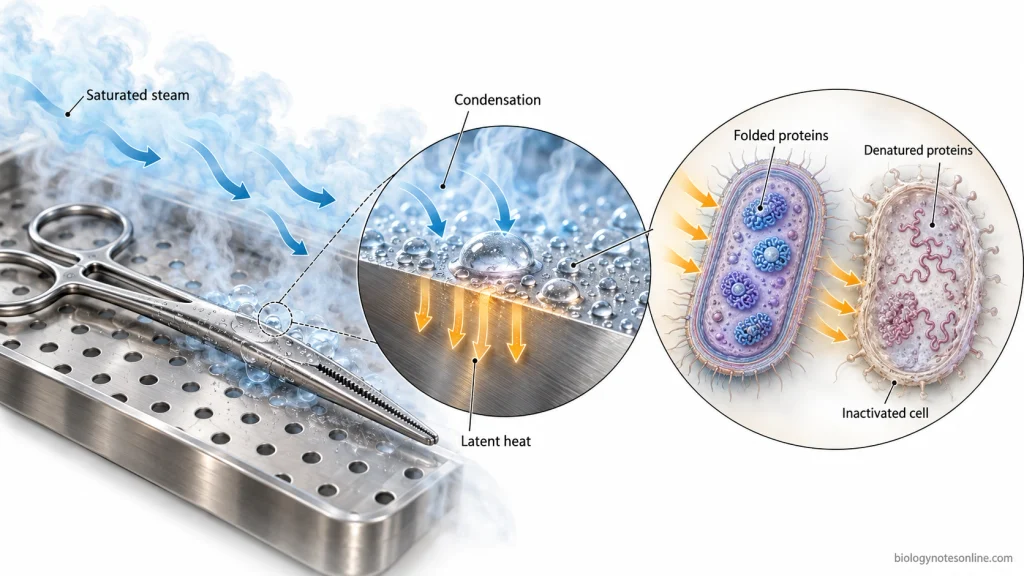
Moist heat sterilization is based on the irreversible denaturation and coagulation of microbial proteins by heat in the presence of moisture. The high temperature changes the normal structure of microbial enzymes and structural proteins and they lose their biological activity. Cell membrane and other cellular structures are also damaged. The microorganisms are killed.
In steam sterilization, saturated steam comes in contact with the cooler material and condenses on its surface. During condensation, a large amount of heat called latent heat is released and transferred to the material. Moisture helps in coagulation of the microbial proteins, and heat is transferred more rapidly than with dry air. It also allows better penetration of heat. Because of this faster heat transfer and penetration, moist heat is more effective than dry heat at the same temperature.
Vegetative microorganisms are destroyed more easily. Bacterial endospores are more resistant to heat, but these can also be destroyed when sufficient temperature and exposure time are maintained. Proper contact of the steam with material is required for sterilization.
Mechanism of Moist Heat Sterilization
The mechanism of moist heat sterilization takes place mainly by the action of heat and moisture on microbial proteins. The process occurs in the following steps-
- Saturated steam first comes in contact with the cooler surface of the material being sterilized. The steam condenses into water and releases a large amount of latent heat. This rapidly heats the material.
- The moisture present with heat makes heat transfer more effective and allows the high temperature to act on microbial cell components. Moist heat is much more effective for this than dry heat at the same temperature.
- The major killing action occurs by denaturation and coagulation of microbial proteins. Heat changes the normal structure of proteins and enzymes. Once essential proteins are denatured, their normal cellular functions cannot continue.
- Enzymes required for metabolism and other essential cellular reactions are also inactivated during heating. The damage is irreversible when sufficient temperature is maintained for the required exposure time.
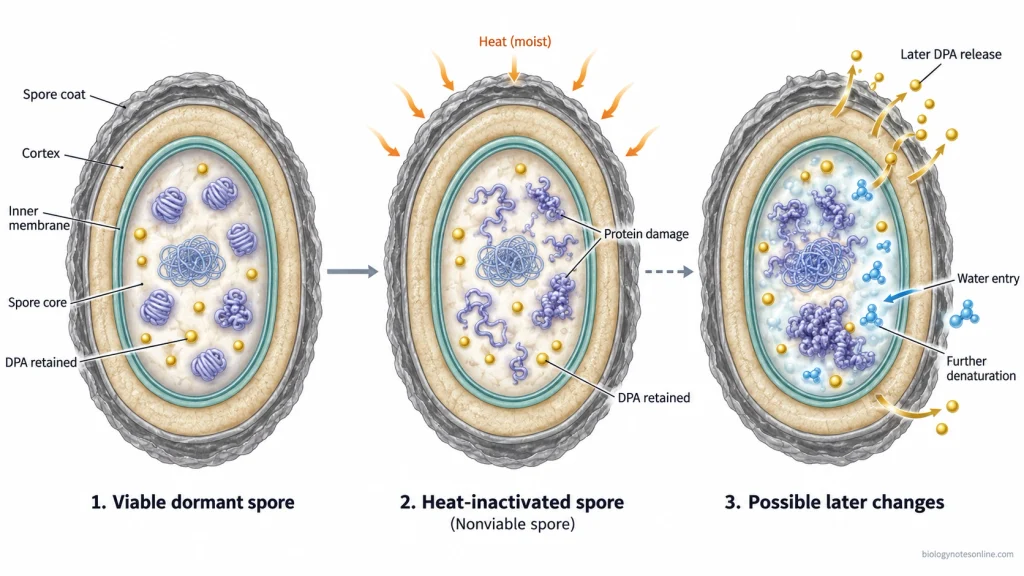
- Moist heat also causes damage to structural components of microorganisms. Cell envelope and membrane-associated components can be affected as heating continues. In bacterial spores, however, changes in the inner membrane may occur after the earlier lethal damage to important proteins.
- Bacterial spores are more resistant to moist heat than vegetative cells. During moist-heat treatment, one or more essential spore proteins are damaged or denatured. The killed spores may still begin germination, but they cannot complete normal outgrowth because important proteins required for further growth have already been damaged.
- With continued heating, damage becomes greater and the spore may release dipicolinic acid (DPA) from its core. Water then enters the spore core and its water content increases. This makes the remaining spore proteins more susceptible to heat, causing further protein denaturation. DPA release generally occurs after the initial lethal damage.
- In spores of Bacillus subtilis, moist-heat killing is not considered to occur mainly by direct damage to deoxyribonucleic acid (DNA). Spore DNA is protected by small acid-soluble spore proteins, while damage to essential proteins is considered the major lethal event.
Types of Moist Heat Sterilization
The methods of moist heat are generally divided into three groups depending on the temperature used. Some of these methods are mainly used for disinfection or treatment of heat-sensitive materials and do not always produce complete sterilization.
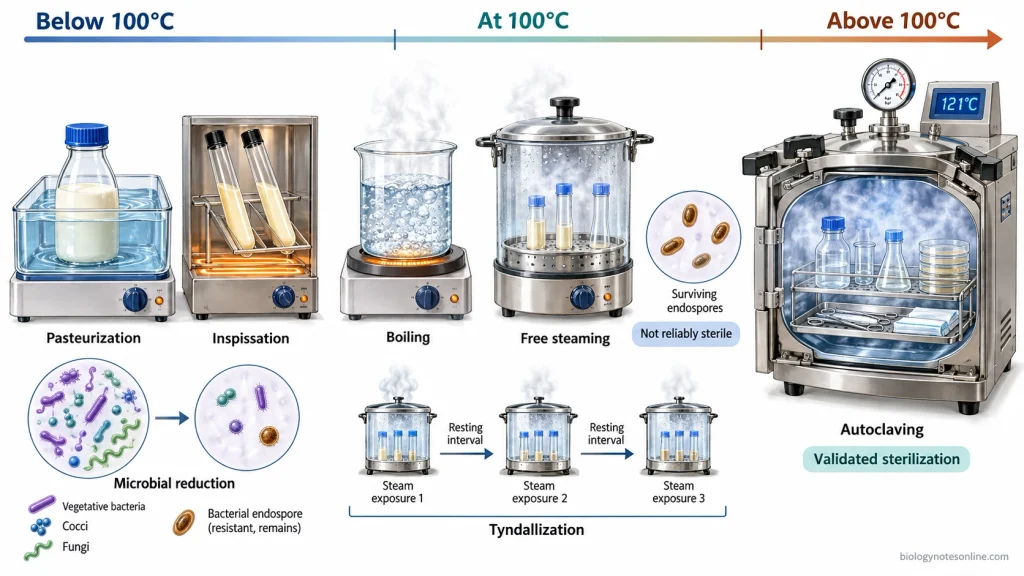
- Moist heat below 100°C- Heat below 100°C is used for materials which cannot tolerate higher temperature. Pasteurization is mainly used for killing pathogenic vegetative microorganisms in liquids such as milk. It does not destroy bacterial endospores. In inspissation, serum or egg-containing media are heated at a lower temperature, usually by repeated heating.
- Moist heat at 100°C- This includes boiling and free steam at atmospheric pressure. Boiling can destroy most vegetative microorganisms, but resistant bacterial endospores may survive. So it is not a reliable method of sterilization. Tyndallization (intermittent sterilization) involves repeated exposure of the material to steam on successive days. The surviving spores are allowed to germinate and the vegetative cells are killed during later heating.
- Moist heat above 100°C- Autoclaving is the commonly used method under this group. Saturated steam is maintained under pressure, which raises the temperature above the normal boiling point of water. It can destroy both vegetative microorganisms and bacterial endospores when proper sterilizing conditions are maintained. Steam sterilization is used for heat and moisture-resistant materials.
Autoclave Sterilization
Autoclaving is a method of moist heat sterilization where saturated steam under pressure is used for sterilization. It is not a dry heat method. All moist heat methods, however, are not autoclaving. In an autoclave, the pressure allows steam to attain the higher temperature required for sterilization.
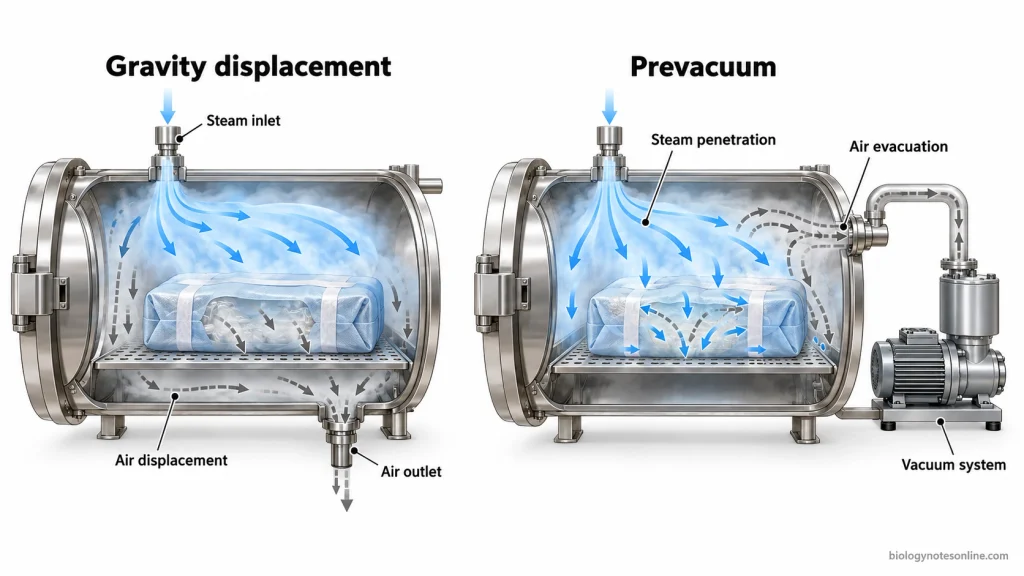
For sterilization, air present inside the chamber and load must be removed first. The air is then replaced by saturated steam. If trapped air remains, proper contact of steam with the material is reduced and heating of the load becomes uneven. Air removal is different with the type of autoclave cycle.
Working of an Autoclave
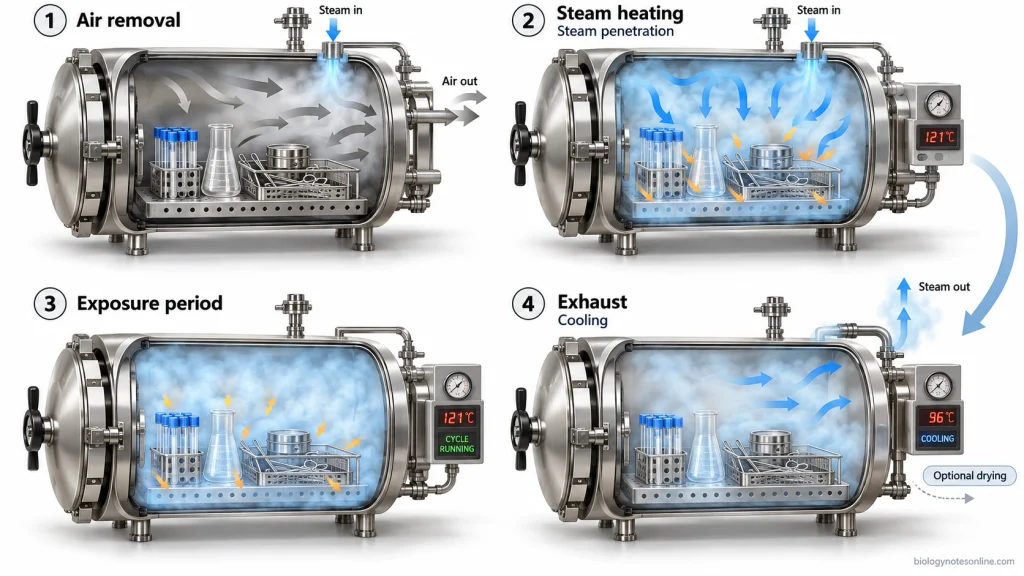
- First, the air present inside the autoclave chamber is removed and saturated steam enters into the chamber. The steam then comes in contact with the materials of the load. Improper removal of air can leave cooler air pockets inside, which interfere with sterilization.
- Steam entering the chamber increases the temperature of chamber and the load. Heating continues until the required sterilization temperature is reached.
- At the required temperature, the material is kept under saturated steam for the selected exposure period. This period varies with the type of load and cycle being used.
- After the exposure period, steam is removed and pressure inside the chamber is reduced. The load is then allowed to cool. Drying is also included when it is required for the particular load and cycle.
Types of Autoclave Cycles
- Gravity displacement cycle- The incoming steam pushes the heavier air downward, and air is removed through the chamber drain. Air removal by this method is slower. Some air may remain within porous materials and steam takes more time to penetrate such loads. This cycle is commonly used for laboratory media, water, medical waste and nonporous materials.
- Prevacuum or dynamic-air-removal cycle- In this cycle, air is removed from the chamber and load by a vacuum system before the steam is introduced. Steam penetrates the load more rapidly and completely. It is commonly used for wrapped instruments, textile packs and other loads where rapid steam penetration is required.
Temperature and Exposure Time for Moist Heat Sterilization
The temperature and exposure time used for moist heat sterilization are not same for every material. Both depend on the type, size and density of the load. With an increase in temperature, a shorter exposure period is generally required.
- At 121°C, saturated steam at about 15 psi is commonly used for autoclave sterilization. The material is generally kept at this temperature for about 15 to 30 minutes after the required temperature is reached. For large or densely packed loads, more time is required.
- When the temperature is increased to about 132°C, the required exposure period becomes shorter. In a prevacuum or vacuum-assisted steam sterilizer, about 4 minutes exposure may be used for suitable loads.
- The exposure period does not start from the beginning of the autoclave cycle. The chamber may reach the required temperature before the material present inside the load reaches the same temperature. Sufficient heating time is required first.
- Liquids, large loads, biohazardous waste and tightly packed materials generally require a longer cycle because heat takes more time to reach the center of the load. Steam must also come in proper contact with all parts of the material.
- The same time-temperature condition is not used for every material. The required condition is selected according to the type of load, volume, packaging and autoclave cycle.
Role of Pressure in Moist Heat Sterilization
The pressure used in moist heat sterilization does not kill microorganisms directly. It is used for increasing the boiling point of water. Under pressure, saturated steam can attain a temperature above 100°C.
- Inside the closed autoclave chamber, steam is accumulated and pressure begins to increase. With increase in pressure, the boiling point of water also increases.
- At about 15 psi above atmospheric pressure, saturated steam reaches approximately 121°C. Microorganisms are killed by the moist heat at this higher temperature. Pressure itself has no sterilizing action.
- The increased pressure helps to maintain saturated steam at the required temperature inside the chamber. Steam must reach and come in contact with the materials of the load. If air remains trapped in any part of the chamber or load, proper steam condition is not obtained and that area may not reach the required temperature.
- Different steam temperatures require different pressure conditions. A higher pressure is required when saturated steam has to be maintained at a higher temperature.
Factors Affecting Sterilization Effectiveness in Moist Heat Sterilization
The following are some of the important factors affecting the effectiveness of moist heat sterilization–
- Temperature- The killing effect of moist heat increases with increase in temperature. The required temperature must reach throughout the material, not only inside the autoclave chamber.
- Exposure time- Microorganisms should be exposed to the required temperature for sufficient time. At lower temperature, a longer exposure period is generally required. Higher sterilization temperature can kill microorganisms within a shorter time.
- Steam quality- Saturated steam is most effective for steam sterilization, as it transfers heat efficiently when steam condenses on the material. Excess condensate and non-condensable gases can interfere with the sterilization process. Superheated steam is less microbicidal than saturated steam under normal steam sterilization conditions.
- Air removal and steam penetration- Air present inside the chamber or load prevents proper contact between steam and the material. It is more important with wrapped, porous and hollow materials. Air must be removed. This allows steam to enter the spaces and heat the complete load.
- Load size and arrangement- Overloading or tightly packed materials reduce proper circulation and penetration of steam. The materials should be arranged so that steam can reach all surfaces. In a dense or poorly arranged load, the inner portions may take more time to reach the required temperature.
- Type of microorganism- Different microorganisms show different degree of resistance to moist heat. Bacterial endospores are much more resistant than vegetative cells. Resistance also varies among different spores and is affected by the water content and chemical composition of the spore core.
- Number of microorganisms- A high initial microbial load (bioburden) requires greater sterilizing exposure than a small microbial population. The number of microorganisms and their resistance to moist heat are considered while determining the sterilization process.
- Nature of material- The physical condition and composition of material can change the heat resistance of microorganisms. Solutes, surrounding medium and availability of water can increase or decrease their resistance. Low water availability generally makes microorganisms more difficult to kill by heat.
- Pressure- Pressure itself is not the main killing agent in an autoclave. It permits steam to reach a temperature above its normal boiling point and the required sterilization temperature can be maintained during the cycle.
Monitoring and Validation of Moist Heat Sterilization
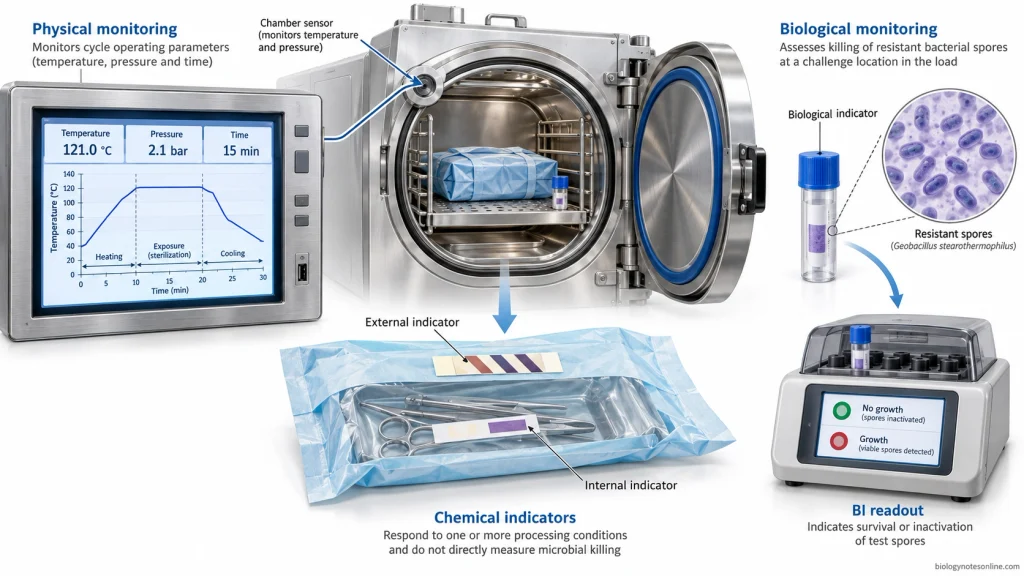
The effectiveness of moist heat sterilization is checked by physical, chemical and biological monitoring. A temperature reading alone cannot confirm that the complete load is sterile. Similarly, a changed indicator tape only indicates that the package has been exposed to certain sterilization conditions. It does not show that all microorganisms have been killed.
Physical Monitoring
- The time, temperature and pressure of each sterilization cycle are monitored. Gauges, displays, recording charts or computer-generated cycle records are used for this purpose.
- Temperature records show whether the required sterilization temperature was reached and maintained for the required period. Pressure is also recorded during steam sterilization.
- Physical monitoring mainly shows that the sterilizer has operated at the selected cycle conditions. It does not directly measure killing of microorganisms. A correct temperature or pressure reading alone cannot confirm sterility of the complete load.
Chemical Indicators
- Chemical indicators contain substances which change their appearance, commonly colour, after exposure to one or more sterilization conditions such as steam, temperature and time.
- External chemical indicators are placed on the outside of packages. They show that the package has passed through the sterilization process. A changed external indicator tape does not confirm that sterilization has occurred.
- Internal chemical indicators are kept inside the package. These indicators give information about penetration of the sterilizing agent into the package and exposure to the conditions for which that particular indicator is designed.
- Chemical indicators give a rapid response and are convenient to use. But they do not directly measure microbial killing. They are used along with other monitoring methods and cannot replace biological indicators.
Biological Indicators
- Biological indicators (BIs) contain highly resistant bacterial spores and are used to check the killing ability of a sterilization process. These spores are more resistant to the sterilizing agent than most microorganisms normally present on the materials.
- For steam sterilization, spores of Geobacillus stearothermophilus are commonly used. The BI is placed in the load and passed through the sterilization cycle.
- After sterilization, the BI is examined for survival of spores by the specified growth or rapid-readout system. No growth or a negative BI result indicates that the resistant spores were inactivated under the tested sterilization conditions.
- A positive BI result indicates survival of the test spores. It may occur due to inadequate steam delivery, incorrect operation or sterilizer malfunction. The sterilization process should then be investigated according to the monitoring procedure.
- BIs directly monitor the lethality of the sterilization process, rather than only checking physical or chemical conditions.
Applications of Moist Heat Sterilization
Some of the important applications of moist heat sterilization are-
- Moist heat sterilization is commonly used for sterilizing culture media and aqueous laboratory solutions before their use in microbiological work.
- It is used for sterilization of laboratory glassware and other materials which can withstand high temperature and moisture. Glassware, pipettes and some autoclave-compatible laboratory items can be processed by steam.
- Surgical instruments and reusable medical devices resistant to heat and moisture are sterilized by steam. Wrapped packs of instruments can also be sterilized in an autoclave using the proper cycle.
- Used for sterilization of heat-resistant respiratory therapy and anesthesia equipment.
- Suitable dressings, fabrics and surgical packs can also be sterilized by moist heat. Steam can penetrate through porous materials when the load is properly arranged.
- Autoclaving is widely used for decontamination of infectious laboratory materials before disposal. Microbial cultures and small contaminated laboratory items can be treated with steam, making them non-infectious.
Advantages of Moist Heat Sterilization
Some of the important advantages of moist heat sterilization are-
- High effectiveness- Moist heat is rapidly microbicidal and can destroy resistant microorganisms including bacterial spores, when proper sterilization conditions are maintained.
- Rapid process- Steam sterilization requires a relatively short exposure and cycle time compared with many other sterilization methods.
- Good penetration- Steam penetrates fabrics, medical packaging and suitable device lumens. It can reach the inner portions of properly arranged porous materials when air is removed effectively.
- Nontoxic- Steam does not involve toxic chemical sterilizing agents. It is considered safe for patients, laboratory workers and the environment when the sterilizer is properly operated.
- Economical- Moist heat sterilization is inexpensive. Water and steam are mainly used for producing the sterilizing conditions, making it suitable for routine laboratory and hospital use.
- Easy to control and monitor- The sterilization cycle can be controlled by maintaining the required time, temperature and pressure. These physical parameters can also be recorded during each cycle.
- Reliable method- Steam sterilization is one of the most dependable methods for heat and moisture-resistant materials. Its effectiveness is also less affected by organic and inorganic soils compared with many other sterilization processes.
Disadvantages of Moist Heat Sterilization
Some of the important disadvantages of moist heat sterilization are-
- Heat-sensitive materials- It cannot be used for materials which are damaged by high temperature or moisture. Many heat-sensitive plastics, rubber materials and some electrical or mechanical devices require another method of sterilization.
- Unsuitable for oils and powders- Anhydrous oils, greases and powders cannot be effectively sterilized by steam because steam does not penetrate these materials properly.
- Damage to instruments- Repeated exposure to steam and high temperature may damage some instruments. Corrosion can occur and wet instruments may develop rust. Some delicate microsurgical instruments are also affected by repeated steam sterilization.
- Air removal required- Air must be removed properly from the sterilizer and load. Trapped air prevents proper contact of steam with the material and can interfere with sterilization.
- Wet packs- Moisture may remain in packages or instruments after the sterilization cycle. Improper loading, poor steam quality or insufficient drying can produce wet packs, which should not be treated as properly stored sterile packages.
- Burn hazard- Hot steam, heated materials and pressurized liquids can cause burns during loading or removal of materials from an autoclave. Care is required while opening the sterilizer.
- Pyrogens are not removed- Steam sterilization does not necessarily eliminate pyrogens present on sterilized materials.
Moist Heat vs. Dry Heat Sterilization
| Characteristics | Moist Heat Sterilization | Dry Heat Sterilization |
|---|---|---|
| Heat used | Moist heat is supplied mainly in the form of saturated steam. | Dry heat uses hot air without added moisture. |
| Common equipment | An autoclave is commonly used for steam sterilization. | It is generally carried out in a hot air oven. |
| Mode of action | Moist heat kills microorganisms mainly by coagulation and denaturation of proteins and enzymes. | The killing action of dry heat occurs mainly by oxidative damage to cellular components. |
| Temperature required | Lower temperature is sufficient. Common steam cycles use about 121–135°C, depending on the type of cycle and load. | Higher temperature is required, generally around 150–170°C for hot-air sterilization. |
| Time required | Sterilization occurs within a shorter time because steam transfers heat efficiently. | Dry heat requires longer exposure. For example, 160°C may require about 120 minutes, while 170°C may require about 60 minutes. |
| Efficiency | Moist heat is more efficient in killing microorganisms at a given temperature. | It is less efficient than moist heat and requires higher temperature or longer time. |
| Heat penetration | Steam transfers heat rapidly and can penetrate suitable porous loads when air is properly removed. | Heat penetration is slower. Dry air transfers heat less effectively than steam. |
| Suitable materials | Used for culture media, aqueous solutions, dressings, glassware and heat-moisture resistant instruments. | Suitable for materials which cannot be exposed to moisture, such as powders, oils, petroleum products and some sharp instruments. |
| Effect on metals | Repeated steam exposure can cause corrosion or rusting of some metal instruments. | Dry heat is non-corrosive to metal and is useful for moisture-sensitive metal instruments. |
| Major limitation | It cannot be used for materials damaged by heat or moisture. Oils and dry powders are also unsuitable for steam sterilization. | High temperature limits its use for many materials. The sterilization process is also comparatively slow. |
References
- Agalloco, J. P. (2017). Increasing patient safety by closing the sterile production gap—Part 3—Moist heat resistance of bioburden. PDA Journal of Pharmaceutical Science and Technology, 71(4), 274–278. https://doi.org/10.5731/pdajpst.2017.007641
- Boom, F. A., Van der Heijden Van Beek, M. A., Paalman, A. C., & Stout-Zonneveld, A. (1991). Microbiological aspects of heat sterilization of drugs. III. Heat resistance of spore-forming bacteria, isolated from large-volume parenterals. Pharmaceutisch Weekblad. Scientific Edition, 13(3), 130–136. https://doi.org/10.1007/BF01981530
- Coleman, W. H., Chen, D., Li, Y.-Q., Cowan, A. E., & Setlow, P. (2007). How moist heat kills spores of Bacillus subtilis. Journal of Bacteriology, 189(23), 8458–8466. https://doi.org/10.1128/JB.01242-07
- Kumaran, M., Fredrick, N., Dudeja, G., Sukumaran, R., & Dorairaj, C. (2026). Steam sterilization: Review of autoclaves, validation, instrument packing, and sterility failures. Indian Journal of Ophthalmology, 74(2), 173–182. https://doi.org/10.4103/IJO.IJO_2023_25
- Miguel, E. A., dos Santos, F. P., Laranjeira, P. R., Ishii, M., & Pinto, T. de J. A. (2024). Steam quality monitoring as a strategy to reduce wet packs and sterilization failure. American Journal of Infection Control, 52(11), 1314–1319. https://doi.org/10.1016/j.ajic.2024.07.002
- Parker, N., Schneegurt, M., Tu, A.-H. T., Lister, P., & Forster, B. M. (2016). Microbiology. OpenStax. https://openstax.org/books/microbiology/pages/1-introduction
- Rutala, W. A., & Weber, D. J. (2015). Disinfection, sterilization, and control of hospital waste. In J. E. Bennett, R. Dolin, & M. J. Blaser (Eds.), Mandell, Douglas, and Bennett’s principles and practice of infectious diseases (8th ed., pp. 3294–3309.e4). Elsevier Saunders. https://doi.org/10.1016/B978-1-4557-4801-3.00301-5
- Setlow, P. (2006). Spores of Bacillus subtilis: Their resistance to and killing by radiation, heat and chemicals. Journal of Applied Microbiology, 101(3), 514–525. https://doi.org/10.1111/j.1365-2672.2005.02736.x