

Basidiomycetes and Deuteromycetes differ mainly in their reproductive structures, sexual stage, and taxonomic position.
Basidiomycetes (Basidiomycota) are recognized fungi in which sexual spores called basidiospores are generally produced on specialized cells known as basidia. Deuteromycetes, also called “Fungi Imperfecti”, was an artificial group of fungi where the sexual stage had not been observed. Their classification was mainly based on asexual structures.
In Basidiomycetes, compatible hyphae can fuse to produce a dikaryotic mycelium. In this condition, two genetically different haploid nuclei remain together before karyogamy and meiosis take place. Basidiospores are then formed, usually externally on the basidium.
In many Basidiomycetes, basidia are present on fruiting bodies called basidiocarps, commonly found in mushrooms. Rusts and smuts are also included in Basidiomycota. Asexual reproduction can occur in some members too.
Deuteromycetes- These fungi were known mostly by their asexual stage. Reproduction commonly takes place by mitotically produced conidia. Some forms may occur only as sterile mycelium.
The characteristic sexual basidia and basidiospores found in Basidiomycetes are not known in Deuteromycetes.
The taxonomic position is also different. Deuteromycetes is no longer accepted as a natural fungal phylum. These fungi were grouped together because of the absence of a known sexual stage, and not because of common ancestry.
Molecular studies have placed many former Deuteromycetes in Ascomycota, while some have been placed in Basidiomycota. Both groups may possess septate hyphae. Septation alone cannot be used for separating Basidiomycetes and Deuteromycetes.
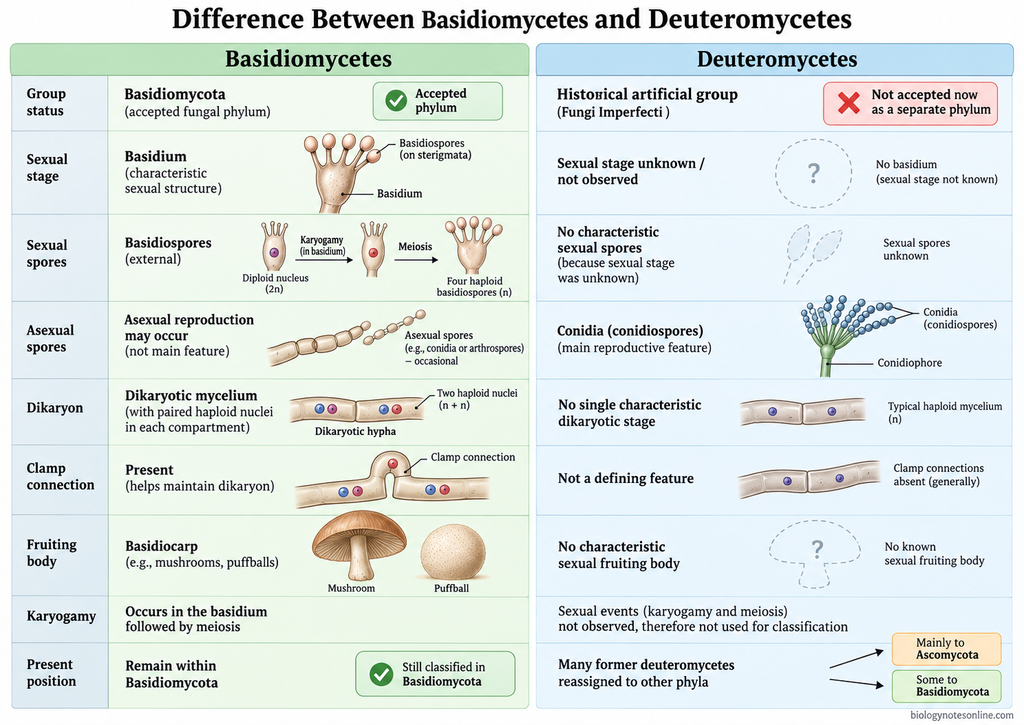
Basidiomycetes vs Deuteromycetes Comparion table
| Characteristics | Basidiomycetes | Deuteromycetes |
|---|---|---|
| Taxonomic position | Basidiomycetes belong to Basidiomycota, a recognized fungal phylum. | Deuteromycetes or “Fungi Imperfecti” is an artificial and obsolete group, not a natural fungal phylum in present classification. |
| Basis of classification | Classification is based on phylogenetic relationship along with sexual and other fungal characters. | Historically grouped mainly because their sexual stage was not known, rather than because of common ancestry. |
| Sexual reproduction | Sexual reproduction is well characterized in many members. The characteristic sexual structure is the basidium. | Sexual reproduction was absent or, more correctly, not observed in fungi placed under this group. Some species once considered asexual were later found with sexual cycles. |
| Sexual spores | Basidiospores are produced following meiosis, usually externally on sterigmata of a basidium. | No characteristic sexual spore was assigned to Deuteromycetes because the sexual state was unknown. |
| Asexual reproduction | Asexual reproduction occurs in some Basidiomycota, but it is not the character defining the phylum. | Asexual propagation is commonly by mitotic conidia. Some historically included forms produced only sterile mycelium. |
| Mycelium | Hyphae are generally septate. In many members a long-lasting dikaryotic mycelium is produced after plasmogamy. | Usually septate mycelium is present in the filamentous forms historically grouped here. Their morphology commonly resembles asexual stages of Ascomycota and, less commonly, Basidiomycota. |
| Dikaryotic phase | The dikaryotic phase is prominent and can be prolonged in many Basidiomycetes. | No single characteristic dikaryotic phase can be assigned to Deuteromycetes, because the group contained unrelated fungi classified from their asexual states. |
| Clamp connections | Clamp connections occur in many Basidiomycetes and help to maintain the dikaryotic nuclear condition, although they are not present in every species. | Clamp connection is not a defining feature of the historical Deuteromycetes group. |
| Karyogamy and meiosis | Karyogamy takes place in the basidium, followed shortly by meiosis and formation of haploid basidiospores. | These events could not be used for defining the group because its sexual stage was unknown when the fungi were classified as Deuteromycetes. |
| Fruiting structure | Many members form spore-bearing basidiocarps, such as mushrooms and puffballs. Rusts and smuts have different reproductive structures. | No single sexual fruiting body characterizes Deuteromycetes. Asexual structures such as conidiophores or conidiomata were used for identification. |
| Present classification | Basidiomycota remains one of the major accepted fungal lineages. | Molecular studies placed many former Deuteromycetes mainly within Ascomycota, and some within Basidiomycota. |
| Examples | Agaricus, Puccinia and Ustilago are common Basidiomycota examples. | Aspergillus and Penicillium are classical examples historically discussed among imperfect fungi when only their asexual stages were known. They are not placed in a modern Deuteromycota phylum. |
Difference Between Basidiomycetes and Deuteromycetes
- Group- Basidiomycetes are members of Basidiomycota, a recognized fungal phylum. Deuteromycetes, also called “Fungi Imperfecti”, was an artificial group in which the sexual stage was not known. It is not accepted as a separate fungal phylum now.
- Sexual stage- Sexual reproduction is well developed in Basidiomycetes. The characteristic sexual structure is called basidium. In Deuteromycetes, sexual reproduction had not been observed.
- Sexual spores- Basidiospores are the sexual spores of Basidiomycetes. These spores are generally produced externally on the basidium after karyogamy and meiosis. No characteristic sexual spores were known in Deuteromycetes because their sexual stage was unknown.
- Asexual spores- Deuteromycetes reproduce mainly by conidia (conidiospores). Asexual reproduction can also occur in some members of Basidiomycetes, but it is not the main character of this group.
- Dikaryon- A long-lasting dikaryotic mycelium commonly occurs in Basidiomycetes. In this condition, two haploid nuclei remain together in the same hyphal cell before fusion. For Deuteromycetes, no single characteristic dikaryotic stage can be given.
- Clamp connection- Clamp connections occur in many Basidiomycetes. They help in proper distribution of nuclei during the division of dikaryotic hyphae. But these connections are not found in every member. It is not a defining character of Deuteromycetes.
- Fruiting body- Many Basidiomycetes produce basidiocarps, as found in mushrooms and puffballs. Rusts and smuts have different reproductive structures. In Deuteromycetes, no characteristic sexual fruiting body occurs.
- Karyogamy- In Basidiomycetes, karyogamy generally takes place inside the basidium. It is followed by meiosis. In Deuteromycetes, these sexual events could not be used for classification because the sexual state had not been observed.
- Present position- Many fungi which were earlier placed under Deuteromycetes are now included mainly in Ascomycota. Some are placed in Basidiomycota. Basidiomycetes remain classified under Basidiomycota.
Similarities Between Basidiomycetes and Deuteromycetes
- Both are eukaryotic fungi having a chitin-containing cell wall. They lack chlorophyll and obtain nutrients by absorption from organic materials.
- A mycelial body made up of hyphae occurs in both groups. The hyphae are commonly septate, particularly in the filamentous fungi historically included under Deuteromycetes.
- Both can reproduce by asexual means. In Deuteromycetes, conidia are commonly produced, whereas asexual reproduction also occurs in several Basidiomycetes along with their sexual cycle.
- Members of both groups may occur as saprophytes or decomposers, growing on organic materials and obtaining nutrients from the substrate.
- Parasitic and pathogenic forms are also present in both. Basidiomycetes include important plant pathogens such as rusts and smuts, while several fungi historically placed under Deuteromycetes cause diseases of plants, animals, and humans.
- Both groups can form spores which help in reproduction and spread of the fungus. Their spore types differ, however. Basidiomycetes characteristically produce basidiospores during sexual reproduction, whereas the old Deuteromycetes group was mainly recognized from its asexual conidia.
Examples of Basidiomycetes and Deuteromycetes
Examples of Basidiomycetes
- Agaricus– It is a common mushroom and one of the well-known members of Basidiomycetes. The basidiospores are produced on the basidia, present on gills of the fruiting body.
- Puccinia– Members are commonly referred to as rust fungi. It includes important plant parasites and belongs to Basidiomycota.
- Ustilago– It is commonly known as smut fungus. Different species of Ustilago infect plants, especially the cereal crops.
Examples of Deuteromycetes
- Alternaria– It is one of the common fungi which was earlier kept under Deuteromycetes or “Fungi Imperfecti”. Asexual conidia are produced.
- Fusarium– Fusarium was also studied among the asexual fungi. In many species, two types of conidia, macroconidia and microconidia are formed. In modern classification, Fusarium is placed under Ascomycota and not under a separate Deuteromycetes group.
- Curvularia– The fungus produces dark-colored conidia which are usually curved and multicellular. It was included among fungi identified mainly by their asexual stage.
- Pestalotia– Another example which was historically placed under Deuteromycetes is Pestalotia. The asexual spores are multicellular, having characteristic appendages.
References
- Borman, A. M., & Johnson, E. M. (2023). Changes in fungal taxonomy: Mycological rationale and clinical implications. Clinical Microbiology Reviews, 36(4), Article e00099-22. https://doi.org/10.1128/cmr.00099-22
- Clark, M. A., Douglas, M., & Choi, J. (2018). Biology 2e. OpenStax. https://openstax.org/books/biology-2e/pages/1-introduction
- Coelho, M. A., Bakkeren, G., Sun, S., Hood, M. E., & Giraud, T. (2017). Fungal sex: The Basidiomycota. Microbiology Spectrum, 5(3), Article FUNK-0046-2016. https://doi.org/10.1128/microbiolspec.FUNK-0046-2016
- Dyer, P. S., & Kück, U. (2017). Sex and the imperfect fungi. Microbiology Spectrum, 5(3), Article FUNK-0043-2017. https://doi.org/10.1128/microbiolspec.FUNK-0043-2017
- Guarro, J., Gené, J., & Stchigel, A. M. (1999). Developments in fungal taxonomy. Clinical Microbiology Reviews, 12(3), 454–500. https://doi.org/10.1128/CMR.12.3.454
- Naranjo-Ortiz, M. A., & Gabaldón, T. (2019). Fungal evolution: Diversity, taxonomy and phylogeny of the Fungi. Biological Reviews, 94(6), 2101–2137. https://doi.org/10.1111/brv.12550
- Parker, N., Schneegurt, M., Tu, A.-H. T., Lister, P., & Forster, B. M. (2016). Microbiology. OpenStax. https://openstax.org/books/microbiology/pages/1-introduction
- Spatafora, J. W., Aime, M. C., Grigoriev, I. V., Martin, F., Stajich, J. E., & Blackwell, M. (2017). The fungal tree of life: From molecular systematics to genome-scale phylogenies. Microbiology Spectrum, 5(5), Article FUNK-0053-2016. https://doi.org/10.1128/microbiolspec.FUNK-0053-2016
- Stajich, J. E., Berbee, M. L., Blackwell, M., Hibbett, D. S., James, T. Y., Spatafora, J. W., & Taylor, J. W. (2009). The fungi. Current Biology, 19(18), R840–R845. https://doi.org/10.1016/j.cub.2009.07.004
- Wallen, R. M., & Perlin, M. H. (2018). An overview of the function and maintenance of sexual reproduction in dikaryotic fungi. Frontiers in Microbiology, 9, Article 503. https://doi.org/10.3389/fmicb.2018.00503