

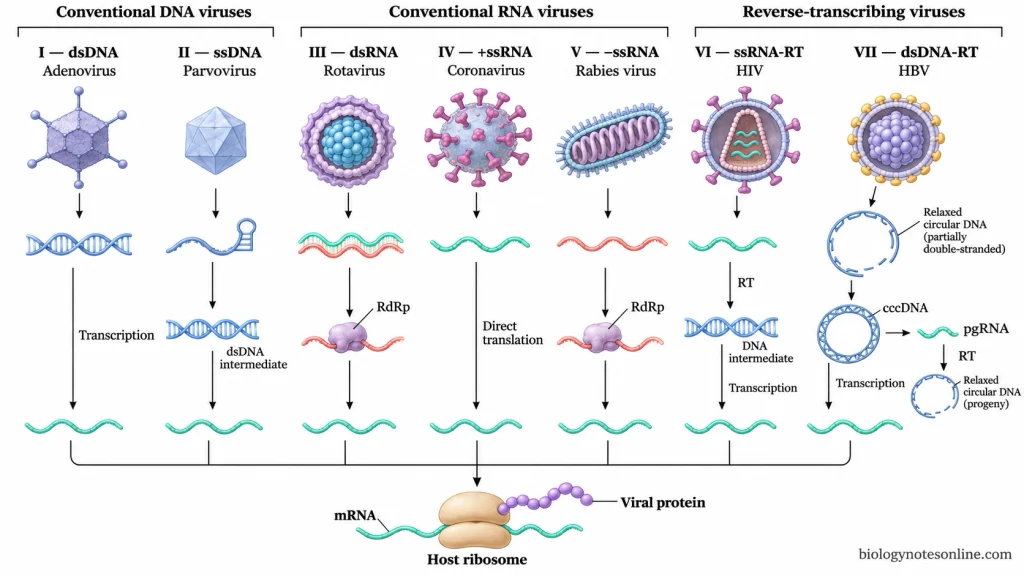
Baltimore classification of viruses consists of seven groups (Group I to Group VII). In the Baltimore system, there are two groups of conventional DNA viruses (I and II), three groups of conventional RNA viruses (III, IV and V) and two groups of reverse-transcribing viruses (VI and VII).
The classification system was proposed by David Baltimore in 1971. The original system had six classes of viruses. A seventh class was added later for the reverse-transcribing DNA viruses.
What is Baltimore Classification?
Baltimore classification of viruses or the Baltimore model is a non-hierarchical classification system based on the nature of the viral genome and the pathway by which the virus obtains its messenger RNA (mRNA).
The Baltimore classification system deals with the expression of viral genomes. It is not a formal taxonomic system based on the evolutionary relationships among viruses. The viruses belonging to the same Baltimore group may have different evolutionary origins.
Bacteria are not classified under this system. Bacteriophages (viruses that infect bacteria) are included in the Baltimore classification.
Basis of Baltimore Classification
Baltimore classification of viruses is based on the type of nucleic acid present in the virus, its strandedness, polarity, mechanism of mRNA synthesis and the involvement of reverse transcription.
Type of Viral Nucleic Acid
- The genetic material of a virus can be either DNA (deoxyribonucleic acid) or RNA (ribonucleic acid).
- The nucleic acid may be single-stranded or double-stranded.
- On the basis of the nature and strandedness of nucleic acid, the viral genomes can be of four basic types, i.e., single-stranded DNA (ssDNA), double-stranded DNA (dsDNA), single-stranded RNA (ssRNA) and double-stranded RNA (dsRNA).
- The nucleic acid present as the genome in the virion is considered for classification and not the intermediate forms of nucleic acid produced during viral replication.
Genome Polarity
- The polarity of RNA is determined with respect to that of the messenger RNA (mRNA).
- Positive-sense RNA (+RNA) has the same polarity as that of mRNA, whereas negative-sense RNA (-RNA) is complementary to the mRNA.
- In Group IV viruses, the positive-sense RNA genome can directly act as mRNA during protein synthesis.
- The negative-sense RNA cannot be translated directly by the ribosomes. A complementary positive-sense RNA has to be synthesised for translation.
- The two strands of a double-stranded RNA molecule are complementary to each other and have opposite polarities.
- Both Group IV and Group VI viruses contain positive-sense RNA genomes. However, in Group VI viruses, replication of the viral genome takes place through a DNA intermediate formed by reverse transcription.
Mechanism of mRNA Synthesis
- Viruses lack ribosomes and depend on the ribosomes of the host cell for the synthesis of viral proteins.
- In some RNA viruses (Group IV), the genomic RNA itself acts as mRNA.
- In DNA viruses, the mRNA is synthesised by transcription from a double-stranded DNA template.
- In double-stranded RNA and negative-sense RNA viruses, the RNA strand complementary to the mRNA acts as a template for mRNA synthesis.
- In Group VI viruses, the DNA formed by reverse transcription is used as a template for the synthesis of mRNA.
- Reverse transcription is also involved in the replication of the DNA genome of Group VII viruses through an RNA intermediate.
- Genome replication involves the production of new copies of the viral genome, whereas the expression of the viral genome involves the production of viral gene products.
Role of Viral Polymerases
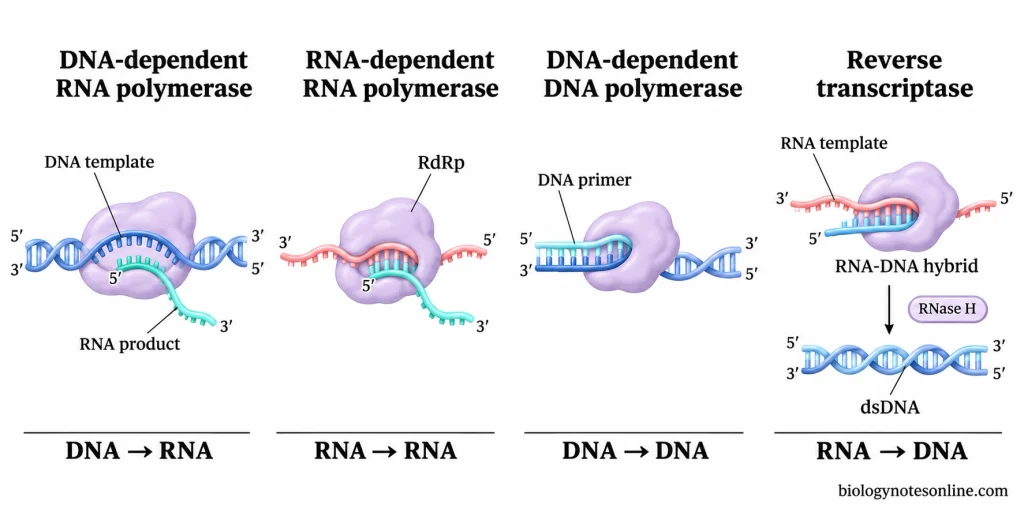
- Different types of polymerases are involved in the synthesis of viral nucleic acids. These enzymes may be encoded by the virus or the host cell.
- DNA-dependent RNA polymerase is responsible for the synthesis of RNA from a DNA template. Some DNA viruses use the RNA polymerase of the host cell, while others encode their own RNA polymerase.
- RNA-dependent RNA polymerase (RdRp) synthesises RNA complementary to the template RNA. It is involved in mRNA synthesis and genome replication in most conventional RNA viruses.
- In Group III and Group V viruses, the RNA-dependent RNA polymerase required for the initial synthesis of mRNA is present within the virion.
- DNA-dependent DNA polymerase synthesises new strands of DNA from a DNA template. The replication of conventional DNA viruses takes place with the help of host-encoded or virus-encoded DNA polymerases.
- Reverse transcriptase is an RNA-dependent DNA polymerase which synthesises DNA from an RNA template. It also exhibits DNA-dependent DNA polymerase activity and is involved in the replication of Group VI and Group VII viruses.
Seven Groups of Baltimore Classification
1. Group I – Double-Stranded DNA (dsDNA) Viruses
- The viruses belonging to Group I of the Baltimore classification contain double-stranded DNA (dsDNA) as their genetic material.
- The viral DNA may be linear or circular.
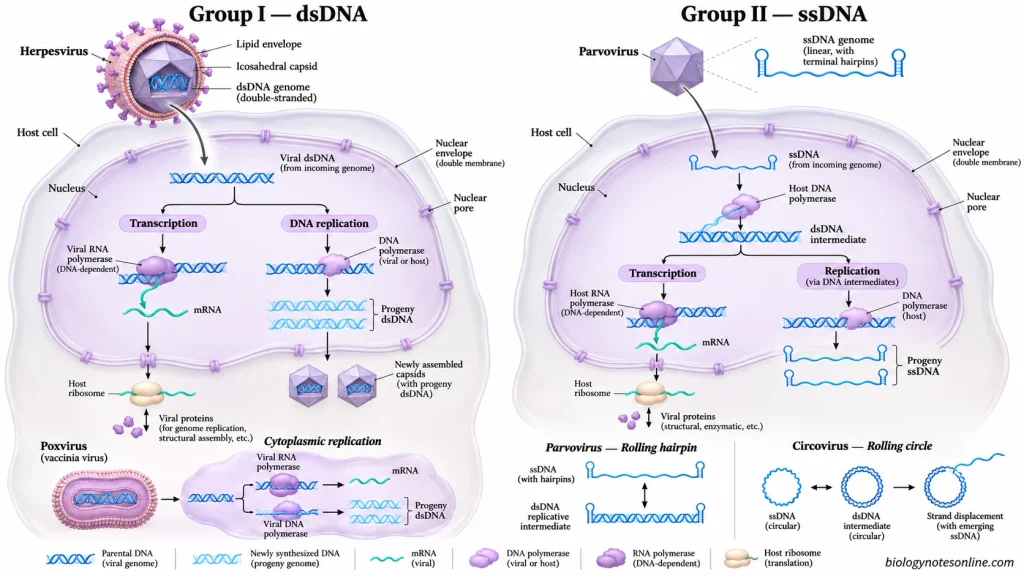
- The mRNA is synthesised directly from the DNA template by the enzyme DNA-dependent RNA polymerase.
- Most animal viruses belonging to this group use the RNA polymerase of the host cell for transcription.
- DNA-dependent DNA polymerase is responsible for the replication of the viral DNA. Some viruses (e.g., papillomaviruses) use the DNA polymerase of the host cell, while others (e.g., herpesviruses and adenoviruses) encode their own DNA polymerase.
- Reverse transcription is not required for the replication of these viruses.
- In most animal dsDNA viruses of this group, transcription and replication of the viral DNA take place inside the nucleus of the host cell.
- However, in poxviruses, viral DNA replication and transcription take place in the cytoplasm. These viruses encode their own DNA-dependent RNA polymerase and DNA-dependent DNA polymerase.
- The viral mRNA is translated into proteins by the ribosomes of the host cell.
Examples:
- Herpes simplex virus (HSV)
- Adenovirus
- Human papillomavirus (HPV)
- Vaccinia virus
- Bacteriophage T4
2. Group II – Single-Stranded DNA (ssDNA) Viruses
- The viruses belonging to Group II of the Baltimore classification contain single-stranded DNA (ssDNA) as their genetic material.
- The viral genome may be linear or circular.
- After entering the host cell, a DNA strand complementary to the viral ssDNA is synthesised by the DNA polymerase of the host cell. This results in the formation of a double-stranded DNA intermediate.
- The double-stranded DNA acts as a template for the synthesis of mRNA with the help of DNA-dependent RNA polymerase of the host cell.
- The viral mRNA is translated into proteins by the ribosomes of the host cell.
- The synthesis of new copies of the single-stranded DNA genome takes place through double-stranded DNA intermediates.
- These viruses depend on the DNA polymerase of the host cell for replication. They also encode certain proteins involved in the replication of viral DNA.
- In most circular ssDNA viruses, DNA replication takes place by the rolling circle mechanism (e.g., circoviruses and bacteriophage φX174).
- Parvoviruses belong to Group II of the Baltimore classification. They contain linear ssDNA with hairpin structures at both ends of the genome and replicate by the rolling hairpin mechanism.
- In animal ssDNA viruses such as parvoviruses and circoviruses, replication of the viral DNA takes place in the nucleus of the host cell.
Examples:
- Parvovirus B19
- Canine parvovirus
- Porcine circovirus
- Bacteriophage φX174
3. Group III – Double-Stranded RNA (dsRNA) Viruses
- The viruses containing double-stranded RNA (dsRNA) as their genetic material belong to Group III of the Baltimore classification.
- The viral RNA consists of two complementary strands, a positive-sense (+RNA) strand and a negative-sense (-RNA) strand.
- The double-stranded RNA cannot directly act as mRNA because the ribosomes require single-stranded mRNA for translation.
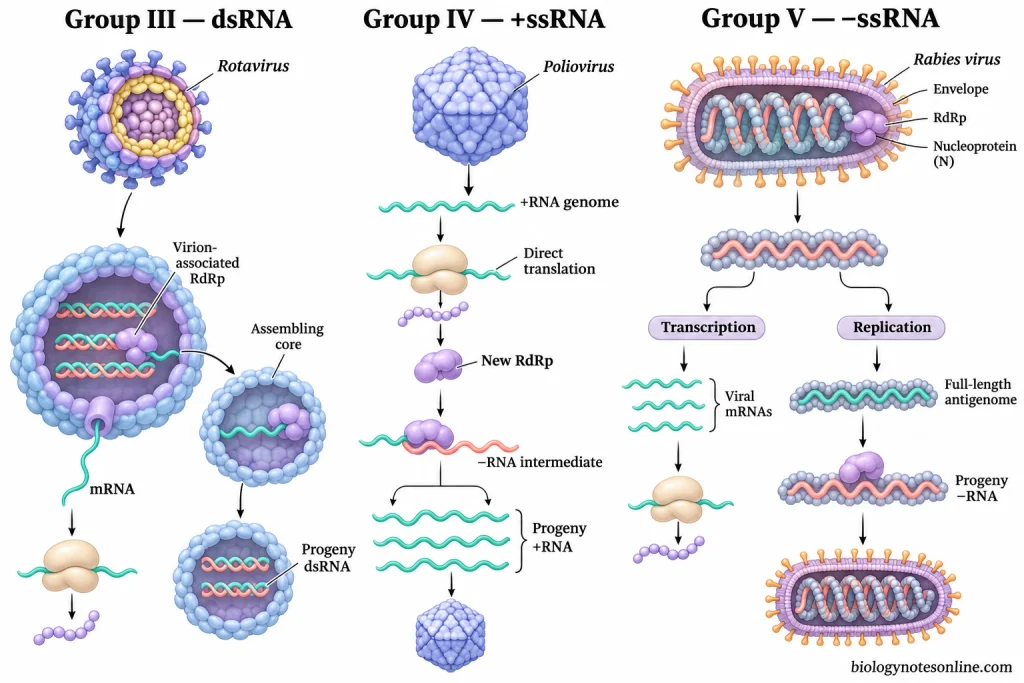
- These viruses contain the enzyme RNA-dependent RNA polymerase (RdRp) within the virion. This enzyme is required for the synthesis of mRNA after the virus enters the host cell.
- RNA-dependent RNA polymerase synthesises positive-sense mRNA using the negative strand of the dsRNA genome as a template.
- In viruses such as rotavirus and mammalian orthoreovirus, transcription takes place within the viral core particles. The newly synthesised mRNA is released into the cytoplasm for protein synthesis.
- During genome replication, the positive-sense RNA acts as a template for the synthesis of a complementary negative-sense RNA strand, which results in the formation of a new dsRNA molecule.
- The replication of these viruses takes place without the formation of a DNA intermediate.
- Most viruses belonging to this group have segmented RNA genomes. The genome of rotavirus consists of 11 dsRNA segments, whereas mammalian orthoreovirus and bluetongue virus contain 10 segments each.
- In bacteriophage φ6, the genome consists of three dsRNA segments.
Examples:
- Rotavirus
- Mammalian orthoreovirus
- Bluetongue virus
- Bacteriophage φ6
4. Group IV – Positive-Sense Single-Stranded RNA (+ssRNA) Viruses
- The viruses belonging to Group IV of the Baltimore classification contain positive-sense single-stranded RNA (+ssRNA) as their genetic material.
- The genomic RNA has the same polarity as that of mRNA and can be directly translated by the ribosomes of the host cell.
- After the release of viral RNA into the host cell, the proteins required for viral replication are synthesised. These include the enzyme RNA-dependent RNA polymerase (RdRp).
- The RNA-dependent RNA polymerase need not be present within the virion as it is synthesised after the virus enters the host cell.
- RNA-dependent RNA polymerase synthesises a negative-sense RNA strand complementary to the genomic RNA.
- This negative-sense RNA acts as a template for the synthesis of new copies of the positive-sense RNA genome.
- In some viruses belonging to this group, shorter RNA molecules known as subgenomic mRNAs are also synthesised for the production of certain viral proteins.
- Poliovirus and coronaviruses belong to Group IV of the Baltimore classification. In poliovirus, the genomic RNA is translated into a single polyprotein which is later cleaved into individual viral proteins.
- In coronaviruses, the proteins required for viral replication are synthesised from the genomic RNA, while most of the structural and accessory proteins are synthesised from subgenomic mRNAs.
- The replication of these viruses takes place without the formation of a DNA intermediate.
Examples:
- Poliovirus
- SARS-CoV-2
- Hepatitis C virus
- Dengue virus
- Tobacco mosaic virus (TMV)
5. Group V – Negative-Sense Single-Stranded RNA (−ssRNA) Viruses
- The viruses belonging to Group V of the Baltimore classification contain negative-sense single-stranded RNA (−ssRNA) as their genetic material.
- The negative-sense RNA is complementary to the mRNA and cannot be directly translated by the ribosomes of the host cell.
- In conventional negative-sense RNA viruses, the enzyme RNA-dependent RNA polymerase (RdRp) is present within the virion along with the viral RNA.
- After the virus enters the host cell, RNA-dependent RNA polymerase synthesises positive-sense mRNAs from the negative-sense RNA template. These mRNAs are translated into viral proteins.
- During replication, a full-length complementary RNA molecule known as the antigenome is synthesised from the genomic RNA.
- The antigenomic RNA is different from the viral mRNA. It contains the complete complementary sequence of the genome or genome segment and acts as a template for the synthesis of new negative-sense RNA genomes.
- The newly synthesised negative-sense RNA molecules are associated with viral nucleoproteins and packaged into the progeny virions.
- The genome of these viruses may be segmented or nonsegmented. For eg., influenza A virus contains eight RNA segments, whereas rabies virus, measles virus and Ebola virus have nonsegmented RNA genomes.
- Some viruses belonging to this group (e.g., arenaviruses) have an ambisense genome organization, i.e., genes are present in both positive-sense and negative-sense orientations within the genomic RNA segments.
- In ambisense viruses, the mRNAs for some viral proteins are synthesised from the genomic RNA, while those for other proteins are synthesised from the antigenomic RNA.
Examples:
- Rabies virus
- Influenza virus
- Measles virus
- Ebola virus
- Respiratory syncytial virus (RSV)
6. Group VI – Single-Stranded RNA Reverse-Transcribing (ssRNA-RT) Viruses
- Retroviruses, including human immunodeficiency virus (HIV), belong to Group VI of the Baltimore classification.
- These viruses contain positive-sense single-stranded RNA as their genetic material, but unlike Group IV viruses, their replication takes place through a DNA intermediate.
- In orthoretroviruses such as HIV, two copies of the single-stranded RNA genome are present within each virion.
- The virion contains an enzyme called reverse transcriptase (RNA-dependent DNA polymerase), which is responsible for the synthesis of DNA from the viral RNA template.
- The RNA strand of the RNA-DNA hybrid is degraded by the RNase H activity of reverse transcriptase. A complementary DNA strand is then synthesised to form double-stranded DNA.
- The viral DNA is integrated into the chromosomal DNA of the host cell with the help of a viral enzyme called integrase. The integrated viral DNA is known as a provirus.
- The proviral DNA acts as a template for the synthesis of viral RNA by RNA polymerase II of the host cell.
- The full-length RNA acts as mRNA for the synthesis of certain viral proteins and is also packaged into the newly formed virions as genomic RNA.
- Spliced mRNAs are involved in the synthesis of other viral proteins.
- In the ICTV classification, HIV-1 and HIV-2 belong to the genus Lentivirus under the family Retroviridae.
Examples:
- Human immunodeficiency virus type 1 (HIV-1)
- Human immunodeficiency virus type 2 (HIV-2)
- Human T-cell leukemia virus type 1 (HTLV-1)
- Rous sarcoma virus
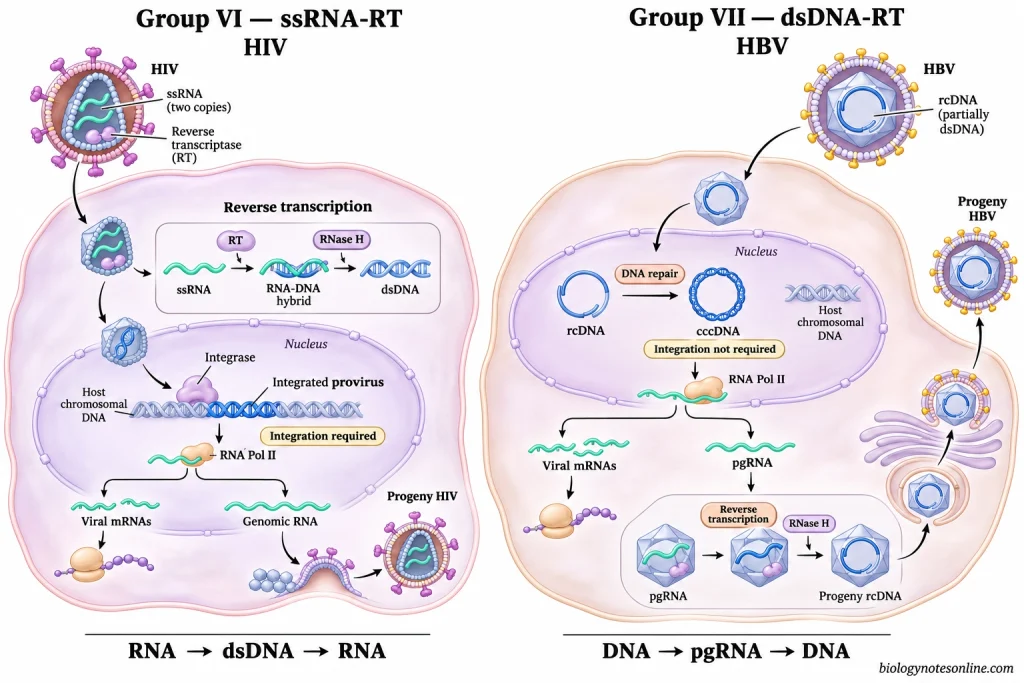
7. Group VII – Double-Stranded DNA Reverse-Transcribing (dsDNA-RT) Viruses
- Group VII (dsDNA-RT) of the Baltimore classification consists of double-stranded DNA reverse-transcribing viruses.
- These viruses contain DNA as their genetic material but the replication of viral DNA takes place through an RNA intermediate.
- Hepatitis B virus (HBV) belongs to Group VII of the Baltimore classification. It is a DNA virus and not an RNA virus, as the genetic material present within the virion is DNA.
- The genome of hepatitis B virus is a partially double-stranded relaxed circular DNA (rcDNA). It consists of a complete negative-sense DNA strand and an incomplete positive-sense DNA strand.
- Inside the nucleus of the host cell, the rcDNA is converted into covalently closed circular DNA (cccDNA) with the help of host DNA repair enzymes.
- The cccDNA acts as a template for the synthesis of viral mRNAs and pregenomic RNA (pgRNA) by RNA polymerase II of the host cell.
- The pregenomic RNA is packaged into the developing nucleocapsid along with the viral polymerase.
- Reverse transcription of the pregenomic RNA takes place within the nucleocapsid in the cytoplasm of the host cell. The viral polymerase synthesises a negative-sense DNA strand from the pgRNA.
- Most of the RNA template is degraded by the RNase H activity of the viral polymerase.
- The negative-sense DNA strand acts as a template for the synthesis of the positive-sense DNA strand. The synthesis of the positive strand is usually incomplete, resulting in the formation of partially double-stranded DNA genomes.
- Unlike retroviruses, the integration of viral DNA into the chromosomal DNA of the host cell is not required for the replication of HBV. However, integration may occur during HBV infection.
- The viruses belonging to the families Hepadnaviridae and Caulimoviridae are included in Group VII.
Examples:
- Hepatitis B virus (HBV)
- Duck hepatitis B virus
- Cauliflower mosaic virus (CaMV)
- Banana streak virus
Baltimore Classification Chart
The Baltimore classification of viruses with examples is given in the following table:
| Group | Type of viral genome | Genome polarity | Route of mRNA production | Replication intermediate | Polymerases involved | Examples |
|---|---|---|---|---|---|---|
| I | Double-stranded DNA (dsDNA) | Not applicable | dsDNA → mRNA | No obligatory RNA intermediate | Host or viral DNA-dependent RNA polymerase and DNA-dependent DNA polymerase | Herpes simplex virus, adenovirus, human papillomavirus, vaccinia virus |
| II | Single-stranded DNA (ssDNA) | Positive or negative sense, depending on the virus | ssDNA → dsDNA → mRNA | Double-stranded DNA | Host DNA-dependent DNA polymerase and DNA-dependent RNA polymerase | Parvovirus B19, canine parvovirus, circovirus, bacteriophage φX174 |
| III | Double-stranded RNA (dsRNA) | Both positive and negative strands | dsRNA (negative strand) → mRNA | Positive-sense RNA | Viral RNA-dependent RNA polymerase (present within the virion) | Rotavirus, mammalian orthoreovirus, bluetongue virus, bacteriophage φ6 |
| IV | Positive-sense single-stranded RNA (+ssRNA) | Positive | Genomic RNA directly acts as mRNA. Subgenomic mRNAs may also be produced. | Negative-sense RNA | Viral RNA-dependent RNA polymerase synthesised after infection | Poliovirus, SARS-CoV-2, hepatitis C virus, dengue virus, tobacco mosaic virus |
| V | Negative-sense single-stranded RNA (−ssRNA) | Negative or ambisense | −ssRNA → positive-sense mRNA | Full-length antigenomic RNA | Viral RNA-dependent RNA polymerase (present within the virion in conventional −ssRNA viruses) | Rabies virus, influenza virus, measles virus, Ebola virus, RSV |
| VI | Single-stranded RNA reverse-transcribing (ssRNA-RT) | Positive | ssRNA → dsDNA → mRNA | Double-stranded DNA (provirus in retroviruses) | Viral reverse transcriptase and host RNA polymerase II | HIV-1, HIV-2, HTLV-1, Rous sarcoma virus |
| VII | Double-stranded DNA reverse-transcribing (dsDNA-RT) | Not applicable | Viral DNA → transcription-competent dsDNA → mRNA | Pregenomic RNA (pgRNA) | Host RNA polymerase II and viral reverse transcriptase | Hepatitis B virus, duck hepatitis B virus, cauliflower mosaic virus, banana streak virus |
In Group VII viruses, mRNA is synthesised by transcription from the DNA template, whereas new copies of the viral DNA genome are synthesised by reverse transcription of the pregenomic RNA (DNA → pgRNA → DNA).
Importance of Baltimore Classification
The importance of Baltimore classification is as follows:
- It helps in understanding how mRNA is produced from different types of viral genomes.
- The Baltimore group of a virus can be used to predict its basic mechanism of genome replication.
- It helps in the identification of RNA or DNA intermediates formed during viral replication.
- It is used to study the differences in genome expression and replication among DNA viruses, RNA viruses and reverse-transcribing viruses.
- The types of polymerases required for viral transcription and replication can be predicted from the Baltimore group of the virus.
- In molecular virology, it is used to study the role of host and viral enzymes in the synthesis of viral nucleic acids.
- It helps in understanding the role of reverse transcription in the replication of retroviruses and DNA reverse-transcribing viruses.
- The enzymes involved in viral replication (e.g., reverse transcriptase, RNA-dependent RNA polymerase) can be studied as potential targets for the development of antiviral drugs.
- Viruses belonging to a particular Baltimore group need not necessarily be susceptible to the same antiviral drug.
Limitations of Baltimore Classification
The following are the limitations of Baltimore classification:
- The classification is not based on the evolutionary relationships of viruses. The viruses belonging to a particular group need not necessarily have a common evolutionary origin.
- It does not classify viruses into different taxonomic ranks such as order, family, genus and species.
- The morphological characteristics of viruses (size and shape of the virion, capsid symmetry, presence or absence of an envelope, etc.) are not used for classification.
- The genomes of viruses belonging to the same group may vary in size, organization and number of segments.
- Both herpesviruses and poxviruses belong to Group I. However, in herpesviruses, DNA replication takes place in the nucleus, while in poxviruses it takes place in the cytoplasm of the host cell.
- Viruses belonging to a single group may differ in their host range and the types of cells and tissues they infect (tissue tropism).
- The antigenic properties of viruses are not considered in the Baltimore classification.
- It gives no direct information about the pathogenicity of the virus, its mode of transmission or the severity of the disease caused by it.
- Viruses belonging to the same group need not necessarily be susceptible to the same antiviral drug.
Differences Between Baltimore Classification and ICTV Classification
The Baltimore classification is a functional classification of viruses, whereas the classification developed by the International Committee on Taxonomy of Viruses (ICTV) is a hierarchical taxonomic system. The Baltimore system is used along with the ICTV classification and is not a replacement for it.
The differences between Baltimore classification and ICTV classification are given below:
| Characteristics | Baltimore Classification | ICTV Classification |
|---|---|---|
| Basis of classification | It is based on the nature of the viral genome and the mechanism of mRNA production. | It is based on various characteristics of viruses such as genome sequences, evolutionary relationships, morphology and other biological properties. |
| Type of classification | It is a functional classification system. | It is a formal taxonomic classification system. |
| Organization | The viruses are divided into seven groups (Group I to Group VII). | The viruses are classified into different taxonomic ranks such as realm, kingdom, phylum, class, order, family, genus and species. |
| Hierarchy | There are no hierarchical ranks within the classification. | It consists of higher and lower taxonomic ranks. |
| Evolutionary relationships | The viruses belonging to the same group need not necessarily have a common evolutionary origin. | Evolutionary relationships are considered in the classification wherever supported by scientific evidence. |
| Morphological characteristics | The structure of the capsid, size and shape of the virion and presence or absence of an envelope are not used for classification. | Morphological characteristics may be considered along with molecular and other biological characteristics. |
| Nomenclature | Roman numerals (I to VII) are used to designate the groups. | Each taxon has a formal name. A binomial system of nomenclature is used for virus species. |
| Primary focus | It mainly deals with viral genome expression, mRNA synthesis and replication strategies. | It deals with the diversity, identification and taxonomic relationships of viruses. |
| Applications | It is used in the study of viral replication, transcription and polymerase requirements. | It is used in virus taxonomy, phylogenetic studies and the naming of virus taxa. |
| Example | Poliovirus belongs to Group IV (+ssRNA). | Poliovirus belongs to the genus Enterovirus under the family Picornaviridae. |
References
- Baltimore, D. (1971). Expression of animal virus genomes. Bacteriological Reviews, 35(3), 235–241. https://doi.org/10.1128/br.35.3.235-241.1971
- Baron, S. (Ed.). (1996). Medical microbiology (4th ed.). University of Texas Medical Branch at Galveston. https://www.ncbi.nlm.nih.gov/books/NBK7627/
- De Clercq, E., & Li, G. (2016). Approved antiviral drugs over the past 50 years. Clinical Microbiology Reviews, 29(3), 695–747. https://doi.org/10.1128/CMR.00102-15
- den Boon, J. A., & Ahlquist, P. (2010). Organelle-like membrane compartmentalization of positive-strand RNA virus replication factories. Annual Review of Microbiology, 64, 241–256. https://doi.org/10.1146/annurev.micro.112408.134012
- den Boon, J. A., Nishikiori, M., Zhan, H., & Ahlquist, P. (2024). Positive-strand RNA virus genome replication organelles: Structure, assembly, control. Trends in Genetics, 40(8), 681–693. https://doi.org/10.1016/j.tig.2024.04.003
- Gelderblom, H. R. (1996). Structure and classification of viruses. In S. Baron (Ed.), Medical microbiology (4th ed.). University of Texas Medical Branch at Galveston. https://www.ncbi.nlm.nih.gov/books/NBK8174/
- Götte, M., Li, X., & Wainberg, M. A. (1999). HIV-1 reverse transcription: A brief overview focused on structure-function relationships among molecules involved in initiation of the reaction. Archives of Biochemistry and Biophysics, 365(2), 199–210. https://doi.org/10.1006/abbi.1999.1209
- International Committee on Taxonomy of Viruses Executive Committee. (2020). The new scope of virus taxonomy: Partitioning the virosphere into 15 hierarchical ranks. Nature Microbiology, 5(5), 668–674. https://doi.org/10.1038/s41564-020-0709-x
- Kleiner, V. A., & Fearns, R. (2024). How does the polymerase of non-segmented negative strand RNA viruses commit to transcription or genome replication? Journal of Virology, 98(8), Article e00332-24. https://doi.org/10.1128/jvi.00332-24
- Koonin, E. V., Krupovic, M., & Agol, V. I. (2021). The Baltimore classification of viruses 50 years later: How does it stand in the light of virus evolution? Microbiology and Molecular Biology Reviews, 85(3), Article e00053-21. https://doi.org/10.1128/MMBR.00053-21
- Liu, R.-D., Wu, J., Shao, R., & Xue, Y.-H. (2014). Mechanism and factors that control HIV-1 transcription and latency activation. Journal of Zhejiang University-SCIENCE B, 15(5), 455–465. https://doi.org/10.1631/jzus.B1400059
- Martin, D. P., Biagini, P., Lefeuvre, P., Golden, M., Roumagnac, P., & Varsani, A. (2011). Recombination in eukaryotic single stranded DNA viruses. Viruses, 3(9), 1699–1738. https://doi.org/10.3390/v3091699
- Moss, B. (2013). Poxvirus DNA replication. Cold Spring Harbor Perspectives in Biology, 5(9), Article a010199. https://doi.org/10.1101/cshperspect.a010199
- Nishikiori, M., den Boon, J. A., Unchwaniwala, N., & Ahlquist, P. (2022). Crowning touches in positive-strand RNA virus genome replication complex structure and function. Annual Review of Virology, 9, 193–212. https://doi.org/10.1146/annurev-virology-092920-021307
- Schramm, B., & Krijnse Locker, J. (2005). Cytoplasmic organization of poxvirus DNA replication. Traffic, 6(10), 839–846. https://doi.org/10.1111/j.1600-0854.2005.00324.x
- Seeger, C., Ganem, D., & Varmus, H. E. (1986). Biochemical and genetic evidence for the hepatitis B virus replication strategy. Science, 232(4749), 477–484. https://doi.org/10.1126/science.3961490
- Seeger, C., & Mason, W. S. (2000). Hepatitis B virus biology. Microbiology and Molecular Biology Reviews, 64(1), 51–68. https://doi.org/10.1128/MMBR.64.1.51-68.2000
- Seeger, C., & Mason, W. S. (2015). Molecular biology of hepatitis B virus infection. Virology, 479–480, 672–686. https://doi.org/10.1016/j.virol.2015.02.031
- Siddell, S. G., & Smith, D. B. (2025). Binomial names for virus species: The rediscovery of an old idea. Journal of General Virology, 106(6), Article 002102. https://doi.org/10.1099/jgv.0.002102
- Siddell, S. G., Smith, D. B., Adriaenssens, E., Alfenas-Zerbini, P., Dutilh, B. E., Garcia, M. L., Junglen, S., Krupovic, M., Kuhn, J. H., Lambert, A. J., Lefkowitz, E. J., Łobocka, M., Mushegian, A. R., Oksanen, H. M., Robertson, D. L., Rubino, L., Sabanadzovic, S., Simmonds, P., Suzuki, N., . . . Zerbini, F. M. (2023). Virus taxonomy and the role of the International Committee on Taxonomy of Viruses (ICTV). Journal of General Virology, 104(5), Article 001840. https://doi.org/10.1099/jgv.0.001840
- Siddell, S. G., Walker, P. J., Lefkowitz, E. J., Mushegian, A. R., Dutilh, B. E., Harrach, B., Harrison, R. L., Junglen, S., Knowles, N. J., Kropinski, A. M., Krupovic, M., Kuhn, J. H., Nibert, M. L., Rubino, L., Sabanadzovic, S., Simmonds, P., Varsani, A., Zerbini, F. M., & Davison, A. J. (2020). Binomial nomenclature for virus species: A consultation. Archives of Virology, 165(2), 519–525. https://doi.org/10.1007/s00705-019-04477-6
- Teycheney, P.-Y., Geering, A. D. W., Dasgupta, I., Hull, R., Kreuze, J. F., Lockhart, B., Muller, E., Olszewski, N., Pappu, H., Pooggin, M. M., Richert-Pöggeler, K. R., Schoelz, J. E., Seal, S., Stavolone, L., Umber, M., & ICTV Report Consortium. (2020). ICTV virus taxonomy profile: Caulimoviridae. Journal of General Virology, 101(10), 1025–1026. https://doi.org/10.1099/jgv.0.001497
- Trask, S. D., McDonald, S. M., & Patton, J. T. (2012). Structural insights into the coupling of virion assembly and rotavirus replication. Nature Reviews Microbiology, 10(3), 165–177. https://doi.org/10.1038/nrmicro2673
- Whelan, S. P. J., Barr, J. N., & Wertz, G. W. (2004). Transcription and replication of nonsegmented negative-strand RNA viruses. Current Topics in Microbiology and Immunology, 283, 61–119. https://doi.org/10.1007/978-3-662-06099-5_3
- Wu, Y. (2004). HIV-1 gene expression: Lessons from provirus and non-integrated DNA. Retrovirology, 1, Article 13. https://doi.org/10.1186/1742-4690-1-13
Comments
Earliest
⋮
nice notes for pharmacy and puc i recomended for this
⋮
The information is fully provided. it has helped me in getting a wider scope on Baltimore classification