

Biologists classify cellular life into two broad cell types: prokaryotic cells and eukaryotic cells. Prokaryotic cells lack a membrane-bound nucleus, whereas eukaryotic cells contain a nucleus and extensive membrane-bound compartments. Bacteria and archaea are prokaryotic, while animals, plants, fungi, and diverse microbial eukaryotes have eukaryotic cells.
What Are the Two Basic Types of Cells?
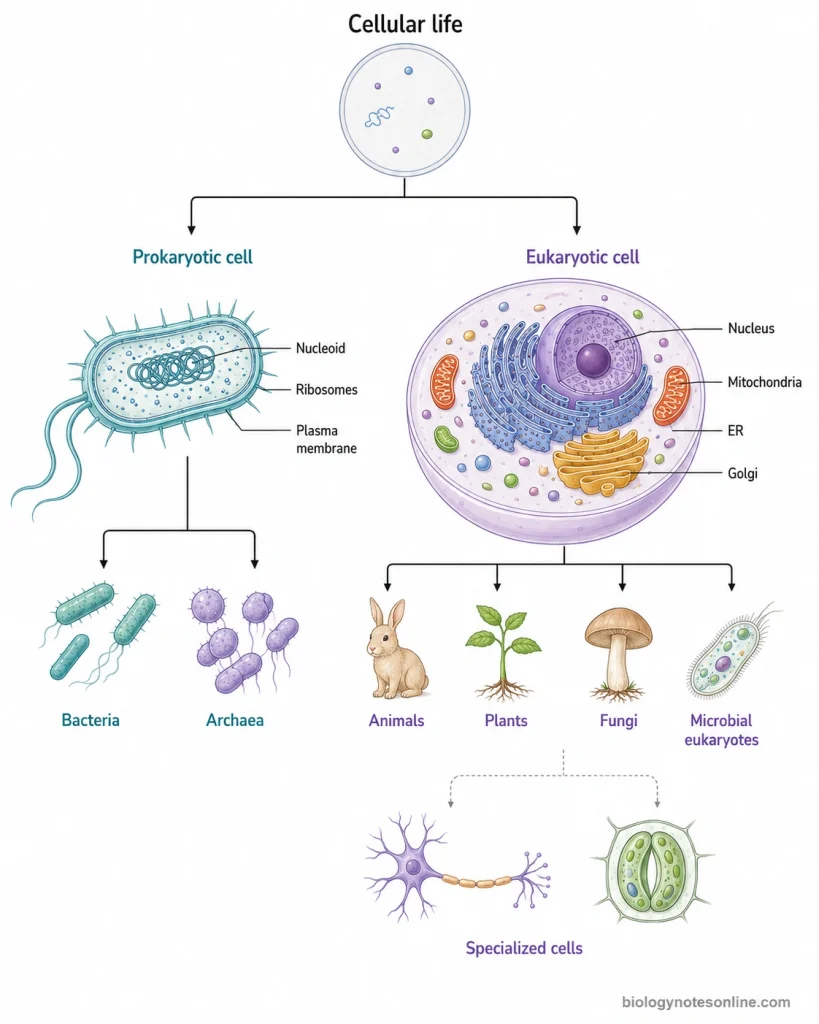
Biologists divide cells into two broad cellular organizations, prokaryotic cells and eukaryotic cells. This classification is mainly based on the internal organization of the cell, especially presence or absence of a membrane-bound nucleus and other membrane-bound compartments. It is not based on the shape of organism, its habitat, or the particular function performed by the cell.
Prokaryotic cells do not contain a membrane-bound nucleus. Their genetic material remains within a nucleoid region, and Bacteria and Archaea come under this cellular organization. Eukaryotic cells, on the other hand, contain DNA enclosed inside a membrane-bound nucleus and different membrane-bound organelles are also present. Plant, animal, fungal, and protist cells are eukaryotic cells.
A fundamental cell type means the basic structural organization of a cell. A specialized cell type is different. It is a cell that has become modified for carrying out a particular function. Thus, neurons, muscle cells, guard cells, and other specialized cells do not make new fundamental categories. These are still eukaryotic cells, although their structure and function may be very different.
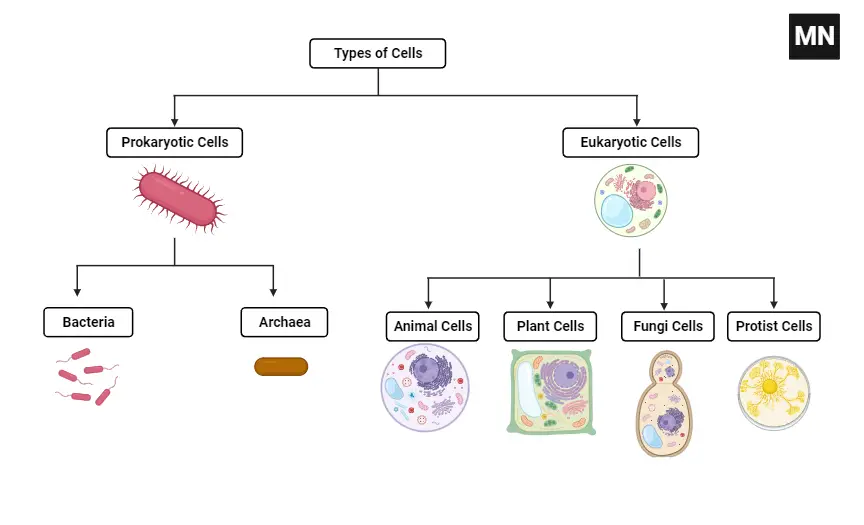
Features Shared by Prokaryotic and Eukaryotic Cells
Prokaryotic and eukaryotic cells have some basic cellular features in common. The following are the major features shared by both cell types-
- Plasma membrane– Plasma membrane is present around both prokaryotic and eukaryotic cells. It separates the internal content of cell from its surrounding environment. It acts as the boundary of the cell.
- Cytoplasm– It is present inside both types of cells. Different cellular components are present within the cytoplasm and many cellular activities take place in this region.
- Genetic material (DNA)– Both prokaryotic and eukaryotic cells contain DNA, which carries genetic information of the cell. The arrangement of DNA, however, is different in these cells. In prokaryotic cells, DNA is present in the nucleoid region without a surrounding nuclear membrane. Eukaryotic cell has its DNA enclosed within the nucleus.
- Ribosomes– Ribosomes are found in both cell types and are used for protein synthesis. They form the basic protein-making machinery of the cell.
Prokaryotic Cells
Prokaryotic cells are cells that do not have a membrane-bound nucleus. Bacteria and Archaea have this type of cellular organization. The DNA is present in a region of cytoplasm called nucleoid, and membrane-bound cell organelles are generally absent.
The following are some of the important features of prokaryotic cells-
- Cell size- Prokaryotic cells are generally smaller than eukaryotic cells. Their internal organization is less compartmentalized.
- Nucleus- A true membrane-bound nucleus is absent. The genetic material remains in the nucleoid region and is not surrounded by a nuclear membrane.
- Genetic material- Most prokaryotic cells contain a main chromosome which is generally a circular double-stranded DNA molecule. Small extra-chromosomal DNA molecules called plasmids are also present in many bacteria and archaea.
- Cell organelles- Membrane-bound cell organelles such as mitochondria, Golgi apparatus, and endoplasmic reticulum are not present. Different cellular reactions take place in the cytoplasm and at the cell membrane.
- Ribosomes- Ribosomes are present freely in the cytoplasm. These are generally of 70S type and are used for protein synthesis.
- Plasma membrane- It surrounds the cytoplasm and separates the internal content of cell from its surrounding environment. Movement of different substances across the cell boundary is also controlled by the plasma membrane.
- Cell wall- Most of the prokaryotes possess a cell wall outside the plasma membrane. In bacteria, the cell wall commonly contains peptidoglycan. The cell wall of Archaea has a different composition from that of bacterial cells.
- Surface structures- Some prokaryotic cells also possess capsule, pili, fimbriae, or flagella. These structures may be used for attachment, movement, or exchange of genetic material depending upon the organism. They are not present in all prokaryotic cells.
Types of Prokaryotic Cells
Prokaryotic cells are classified into two major groups, Bacteria and Archaea. The following are the two types-
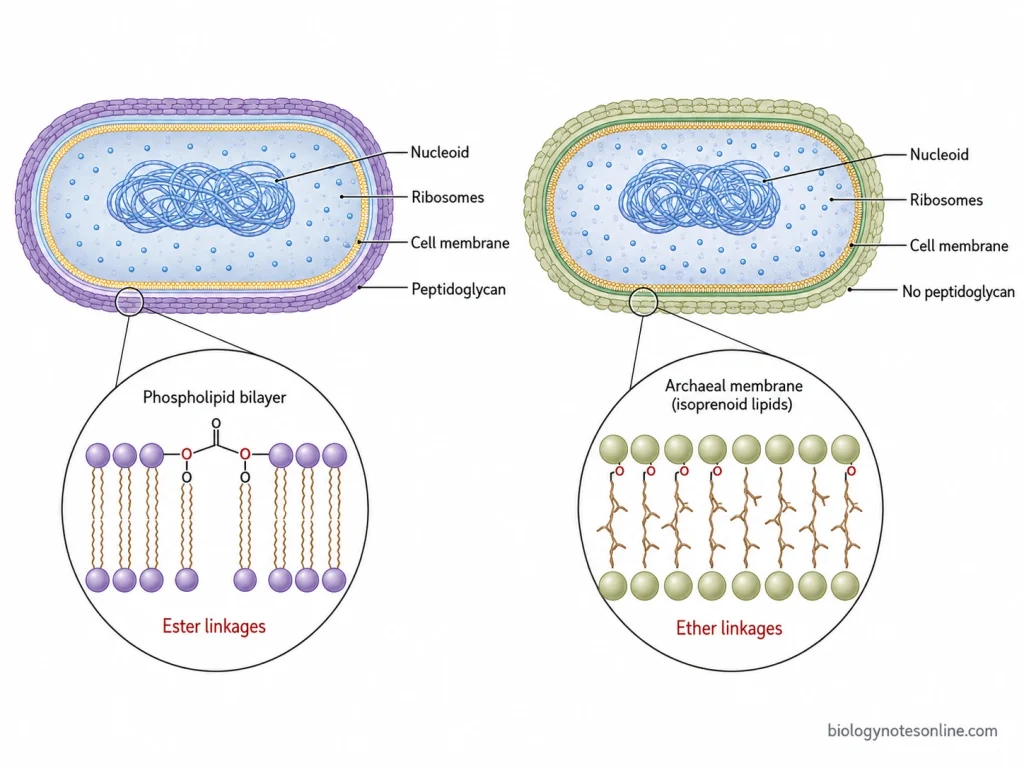
- Bacteria- Members are unicellular prokaryotic organisms belonging to the domain Bacteria. Peptidoglycan is generally present in the cell wall. The membrane has ester-linked fatty acids. Different bacterial groups include cyanobacteria, Gram-positive bacteria, etc.
- Archaea- These are another group of prokaryotic organisms. Members belong to the domain Archaea, and peptidoglycan is absent in their cell wall. The membrane lipids have branched isoprenoid chains joined through ether linkages. They are found in different habitats. Some members are also present in extreme conditions such as hot, acidic, or highly saline environments.
Eukaryotic Cells
Eukaryotic cells are cells having a membrane-bound nucleus, in which most of the genetic material is present. These cells are found in animals, plants, fungi, algae and different protozoans. They may be unicellular or form multicellular organisms.
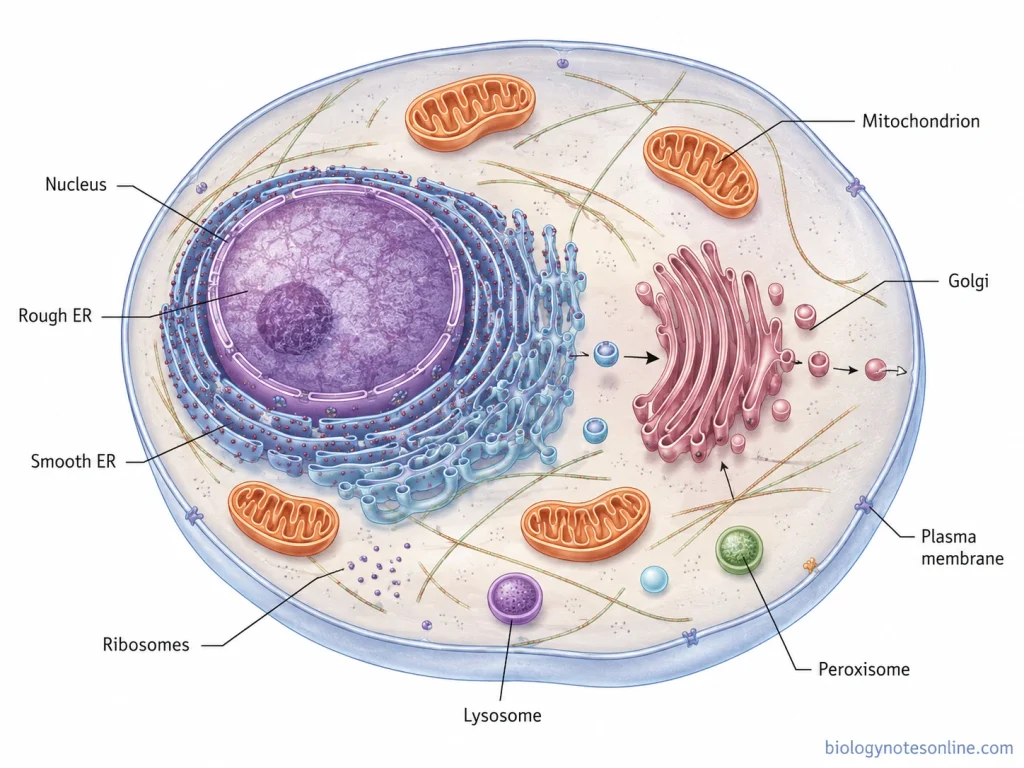
The following are some of the important features of eukaryotic cells-
- Cell organization- Eukaryotic cells are generally larger and more complex than prokaryotic cells. Different membrane-bound structures are present inside the cell. These structures divide the cellular activities into different regions.
- Nucleus- It is a membrane-bound structure containing most of the DNA of cell. The DNA is mainly arranged in the form of linear chromosomes. DNA replication and most of the RNA synthesis takes place inside nucleus, while protein synthesis occurs on ribosomes present in cytoplasm.
- Plasma membrane and cytoplasm- The cell is surrounded by a plasma membrane. Inside the membrane, cytoplasm is present which contains cytosol, cell organelles, cytoskeleton and different dissolved substances.
- Ribosomes- These are the structures used for protein synthesis. Ribosomes may remain freely present in the cytoplasm. Some are attached on the surface of rough endoplasmic reticulum (RER).
- Endoplasmic reticulum (ER)- It is a membranous system distributed in the cytoplasm. Rough ER contains ribosomes on its surface and is mainly involved in synthesis of secretory and membrane proteins. Smooth ER lacks attached ribosomes. It is involved in lipid synthesis.
- Golgi apparatus- Proteins and lipids coming from endoplasmic reticulum are processed and sorted in Golgi apparatus. It is formed of flattened membrane compartments. Different cellular products are also packed and moved from here.
- Mitochondria– These are double membrane-bound organelles present in almost all eukaryotic cells. The inner membrane is folded and forms cristae. During cellular respiration, oxidative reactions are carried out in mitochondria and much of the cellular ATP is formed. Mitochondria also contain their own DNA and ribosomes.
- Lysosomes and peroxisomes- Lysosomes contain digestive enzymes. They break down different macromolecules and worn-out cellular materials, particularly in animal cells.Peroxisomes are involved in different oxidation reactions. During these reactions hydrogen peroxide (H₂O₂) can be formed, which is also broken down inside the peroxisome.
- Cytoskeleton– It is a network of protein filaments present throughout the cytoplasm. This system gives mechanical support to the cell and helps to maintain its shape. Movement of organelles and other intracellular materials also takes place with its help. It is also involved during movement of chromosomes in cell division.
- Vesicles and vacuoles- Vesicles are small membrane-bound structures used in movement and storage of different materials inside cell. Vacuoles are generally larger. In plant cells, a large central vacuole is commonly present and helps in maintaining pressure against the cell wall.
- Plant and algal eukaryotic cells- Plant cells have a cellulose-containing cell wall, plastids and usually a large central vacuole. Photosynthetic plant cells and many algae also possess chloroplasts. Photosynthesis takes place in these chloroplasts. These structures are not found in animal cells.
- Compartmentalization- One of the major features of eukaryotic cells is separation of different cellular reactions into different organelles. Protein processing, energy production, digestion and oxidation therefore take place in their respective cellular compartments.
- Cellular nature- Eukaryotic cells may exist as a single cell or they may combine to form multicellular organisms. Although their structure differs among animals, plants, fungi, algae and protozoans, the presence of membrane-bound nucleus and intracellular organelles is their common cellular feature.
Types of Eukaryotic Cells
Eukaryotic cells are found in animals, plants, fungi and protists. The cells are not similar in all these organisms. The following are the major types-
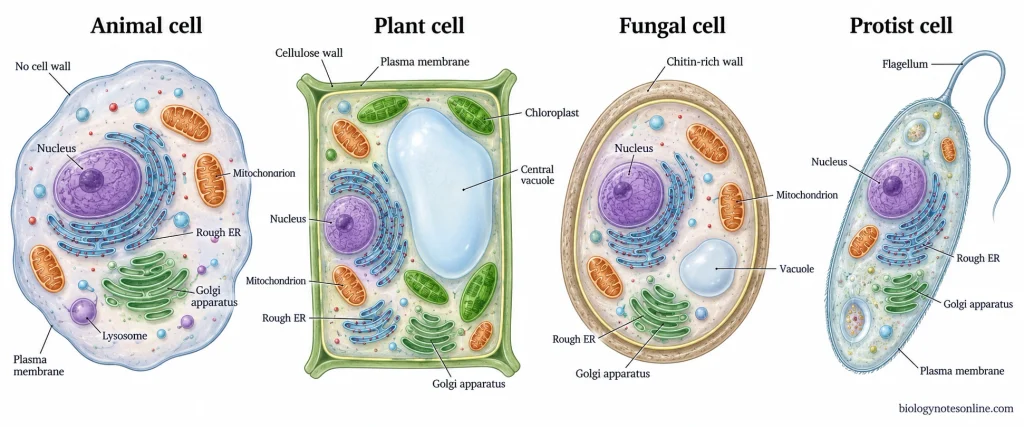
- Animal cells– These are the eukaryotic cells present in animals, which do not possess a cell wall. Plasma membrane forms the outer covering of cell. A membrane-bound nucleus, mitochondria, endoplasmic reticulum (ER), Golgi apparatus, ribosomes and other cell organelles are present.Lysosomes are common in animal cells. Centrosome generally contains a pair of centrioles. Due to absence of the rigid cell wall, the cells occur in different shapes.
- Plant cells– Plant cells are eukaryotic cells, that are found in plants. A cellulose-containing cell wall is present outside the plasma membrane. The cells generally possess a large central vacuole and different types of plastids.In photosynthetic cells, chloroplasts contain chlorophyll. Photosynthesis takes place in these chloroplasts. The large central vacuole also helps in maintaining pressure against the cell wall.
- Fungal cells- These cells contain a membrane-bound nucleus and cell organelles such as mitochondria, ER, Golgi apparatus and vacuoles. A cell wall is also present, but it is different from those of plant cells. The major structural polysaccharide of fungal cell wall is chitin. Chloroplasts are absent.Fungi may occur as unicellular forms such as yeasts or form multicellular structures.
- Protist cells- Protists consist of different types of eukaryotic cells. Most of the members are microscopic and unicellular, whereas some multicellular forms are also present. The cells show considerable variation in their structure.Photosynthetic forms may contain chloroplasts. Protozoan forms are non-photosynthetic and many of them move with cilia, flagella or pseudopodia. Cell wall is present in some forms while in others it is absent.
Human Cells
Human body is made up of different types of specialized cells. These cells have different shape, size and functions. Some of the important human cells are-
- Stem cells– These are unspecialized cells which have the ability of self-renewal and formation of specialized cells. Hematopoietic stem cells (HSCs) form the different cells of blood.
- Epithelial cells- These cells cover the body surface and also line the internal organs, cavities and ducts. They may be squamous, cuboidal or columnar. Some cells are involved in protection while others carry out absorption and secretion.
- Muscle cells- Muscle cells are also referred to as myocytes. These are specialized for contraction and are of three major types, skeletal, cardiac and smooth muscle cells.
- Nerve cells- The major functional cells of nervous system are neurons, which receive and transmit signals. Different glial cells are also present which support and maintain the nervous tissue.
- Blood cells- These include red blood cells (RBCs) and white blood cells (WBCs). Erythrocytes mainly carry oxygen while leukocytes take part in immune responses. Platelets are cell fragments and are involved in blood clotting.
- Fibroblasts- These are common cells of connective tissue. They produce collagen and other components of extracellular matrix (ECM).
- Bone cells- Different types of cells are present in bone tissue. Osteoblasts form new bone, osteoclasts break down bone while osteocytes maintain the bone tissue.
- Cartilage cells- These cells are called chondrocytes. They are present within cartilage matrix and help in formation and maintenance of the matrix.
- Fat cells- Fat cells are also referred to as adipocytes. These cells store fat and form the major cellular part of adipose tissue.
- Reproductive cells- The male reproductive cell is sperm while the female reproductive cell is egg cell (oocyte). These are referred to as gametes and contain 23 chromosomes.
Specialized Cell Types Produced by Cell Differentiation
Cell differentiation is the process by which unspecialized cells are changed into specialized cells having particular functions. During this process, cells get different shape, size and cellular characteristics. Some of the specialized cell types are-
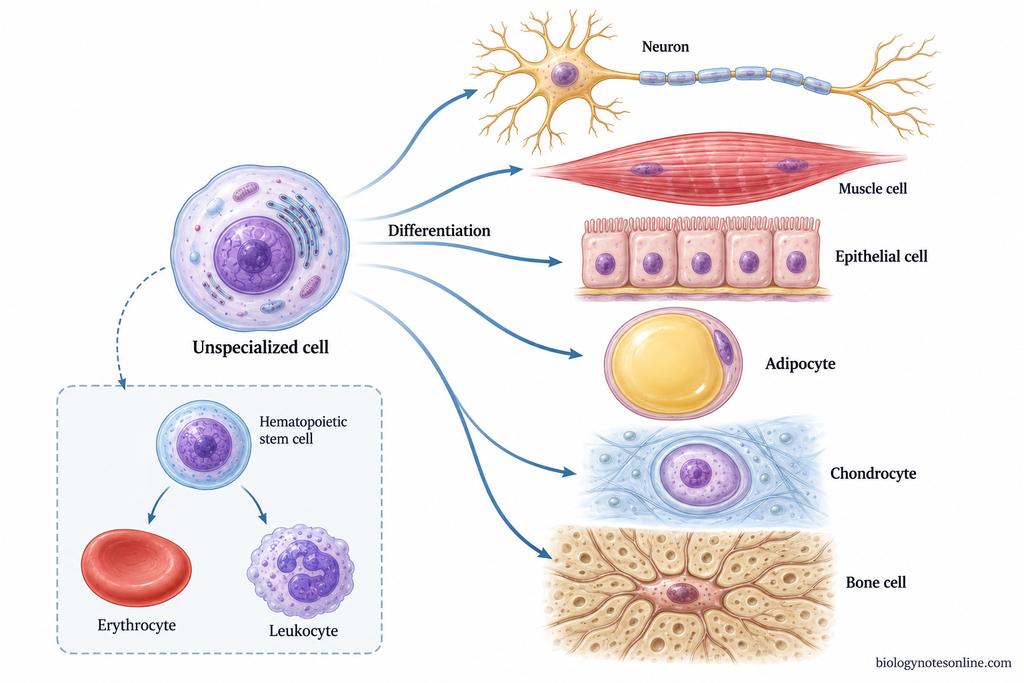
- Nerve cells- Also referred to as neurons, these cells are specialized for receiving and transmitting nerve signals. A neuron generally has cell body, dendrites and an axon.
- Muscle cells- These cells have the ability of contraction. Skeletal, cardiac and smooth muscle cells are the three major types. Skeletal muscle cells contain large amount of contractile proteins.
- Epithelial cells- They form the covering of body surfaces and lining of the internal organs and cavities. The cells may be squamous, cuboidal or columnar. Some perform protection while others are involved in absorption and secretion.
- Blood cells- Different types of blood cells are formed from hematopoietic stem cells (HSCs) during differentiation. These include erythrocytes and leukocytes. Red blood cells carry oxygen whereas leukocytes take part in immune responses.
- Bone cells- Different specialized cells are present in bone tissue. Osteoblasts are involved in formation of bone matrix. Some of them later change into osteocytes, while osteoclasts carry out breakdown or resorption of bone.
- Cartilage cells- These specialized cells are called chondrocytes and are present within the cartilage matrix. Formation and maintenance of the matrix is carried out by these cells.
- Fat cells- Also known as adipocytes, these cells develop from mesenchymal precursor cells. They are specialized for storage of fat.
References
- Alberts, B., Johnson, A., Lewis, J., Raff, M., Roberts, K., & Walter, P. (2002). Fibroblasts and their transformations: The connective-tissue cell family. In Molecular biology of the cell (4th ed.). Garland Science. https://www.ncbi.nlm.nih.gov/books/NBK26889/
- Alberts, B., Johnson, A., Lewis, J., Raff, M., Roberts, K., & Walter, P. (2002). Genetic information in eucaryotes. In Molecular biology of the cell (4th ed.). Garland Science. https://www.ncbi.nlm.nih.gov/books/NBK26909/
- Alberts, B., Johnson, A., Lewis, J., Raff, M., Roberts, K., & Walter, P. (2002). The molecular genetic mechanisms that create specialized cell types. In Molecular biology of the cell (4th ed.). Garland Science. https://www.ncbi.nlm.nih.gov/books/NBK26854/
- Betts, J. G., Young, K. A., Wise, J. A., Johnson, E., Poe, B., Kruse, D. H., Korol, O., Johnson, J. E., Womble, M., & DeSaix, P. (2013). Anatomy and physiology. OpenStax. https://openstax.org/books/anatomy-and-physiology/pages/4-introduction
- Betts, J. G., Young, K. A., Wise, J. A., Johnson, E., Poe, B., Kruse, D. H., Korol, O., Johnson, J. E., Womble, M., & DeSaix, P. (2022). Anatomy and physiology 2e. OpenStax. https://openstax.org/books/anatomy-and-physiology-2e/pages/3-6-cellular-differentiation
- Cooper, G. M. (2000). Cell proliferation in development and differentiation. In The cell: A molecular approach (2nd ed.). Sinauer Associates. https://www.ncbi.nlm.nih.gov/books/NBK9906/
- Cooper, G. M. (2000). The origin and evolution of cells. In The cell: A molecular approach (2nd ed.). Sinauer Associates. https://www.ncbi.nlm.nih.gov/books/NBK9841/
- Dean, L. (2005). Blood and the cells it contains. In Blood groups and red cell antigens. National Center for Biotechnology Information. https://www.ncbi.nlm.nih.gov/books/NBK2263/
- Fowler, S., Roush, R., & Wise, J. (2013). Concepts of biology. OpenStax. https://openstax.org/books/concepts-biology/pages/3-3-eukaryotic-cells
- Gage, F. H., & Verma, I. M. (2003). Stem cells at the dawn of the 21st century. In Regenerative medicine. National Academies Press. https://www.ncbi.nlm.nih.gov/books/NBK215935/
- Henry, J. P., & Bordoni, B. (2023). Histology, osteoblasts. In StatPearls. StatPearls Publishing. https://www.ncbi.nlm.nih.gov/books/NBK557792/
- Institute for Quality and Efficiency in Health Care. (2023). In brief: How are sex cells made (meiosis)? In InformedHealth.org. https://www.ncbi.nlm.nih.gov/books/NBK541152/
- Khan, Y. S., & Farhana, A. (2025). Histology, cell. In StatPearls. StatPearls Publishing. https://www.ncbi.nlm.nih.gov/books/NBK554382/
- Kurn, H., & Daly, D. T. (2023). Histology, epithelial cell. In StatPearls. StatPearls Publishing. https://www.ncbi.nlm.nih.gov/books/NBK559063/
- Nahian, A., & Sapra, A. (2023). Histology, chondrocytes. In StatPearls. StatPearls Publishing. https://www.ncbi.nlm.nih.gov/books/NBK557576/
- Noto, R. E., Leavitt, L., & Edens, M. A. (2023). Physiology, muscle. In StatPearls. StatPearls Publishing. https://www.ncbi.nlm.nih.gov/books/NBK532258/
- Open Resources for Nursing. (2024). Nervous system terminology. In K. Ernstmeyer & E. Christman (Eds.), Medical terminology (2nd ed., Chapter 16). Chippewa Valley Technical College. https://www.ncbi.nlm.nih.gov/books/NBK607437/
- Parker, N., Schneegurt, M., Tu, A.-H. T., Lister, P., & Forster, B. M. (2016). Microbiology. OpenStax. https://openstax.org/books/microbiology/pages/3-4-unique-characteristics-of-eukaryotic-cells
- Rowe, P., Koller, A., & Sharma, S. (2023). Physiology, bone remodeling. In StatPearls. StatPearls Publishing. https://www.ncbi.nlm.nih.gov/books/NBK499863/
- Rye, C., Wise, R., Jurukovski, V., DeSaix, J., Choi, J., & Avissar, Y. (2016). Biology. OpenStax. https://openstax.org/books/biology/pages/4-3-eukaryotic-cells
Thank you for this lesson
I’m very excited to follow the lesson for you l am thankful and respect