

Pipetting is a common laboratory practice in which a particular volume of liquid sample or reagent is measured and transferred with the help of a pipette. It is commonly performed in microbiology, molecular biology and biochemistry laboratories.
Different types of pipettes are used for transferring different volumes of liquids. A micropipette is generally used for handling small volumes of liquids measured in microlitres (µL). During pipetting, the liquid is taken up into the pipette by aspiration and then released into another container by dispensing. The volume transferred must be accurate. Even a small error in the volume of reagent can change the concentration of a solution or affect the experimental result.
The accuracy and precision of pipetting depend on the type of pipette used, properties of the liquid and the technique followed by the operator. Different pipetting techniques are employed depending on the nature of the liquid sample and the volume to be transferred.
Purpose of Pipetting
- To measure and transfer a required volume of liquid samples or reagents with accuracy and precision.
- To handle different volumes of liquids using suitable pipettes.
- To prepare solutions and reaction mixtures by adding measured quantities of different reagents.
- To perform serial dilutions of samples to obtain the required concentration.
- To mix liquid samples and reagents in the required proportions.
- To prevent contamination of samples and reagents during liquid transfer.
- To maintain consistent liquid volumes during repeated experiments for obtaining reproducible results.
Principle of Pipetting
The principle of pipetting is based on the movement of a piston which produces a change in pressure inside the pipette. The pressure difference allows the liquid to be drawn into the pipette tip and then released in a measured volume. The process of taking up liquid into the tip is called aspiration, whereas releasing the liquid is known as dispensing.
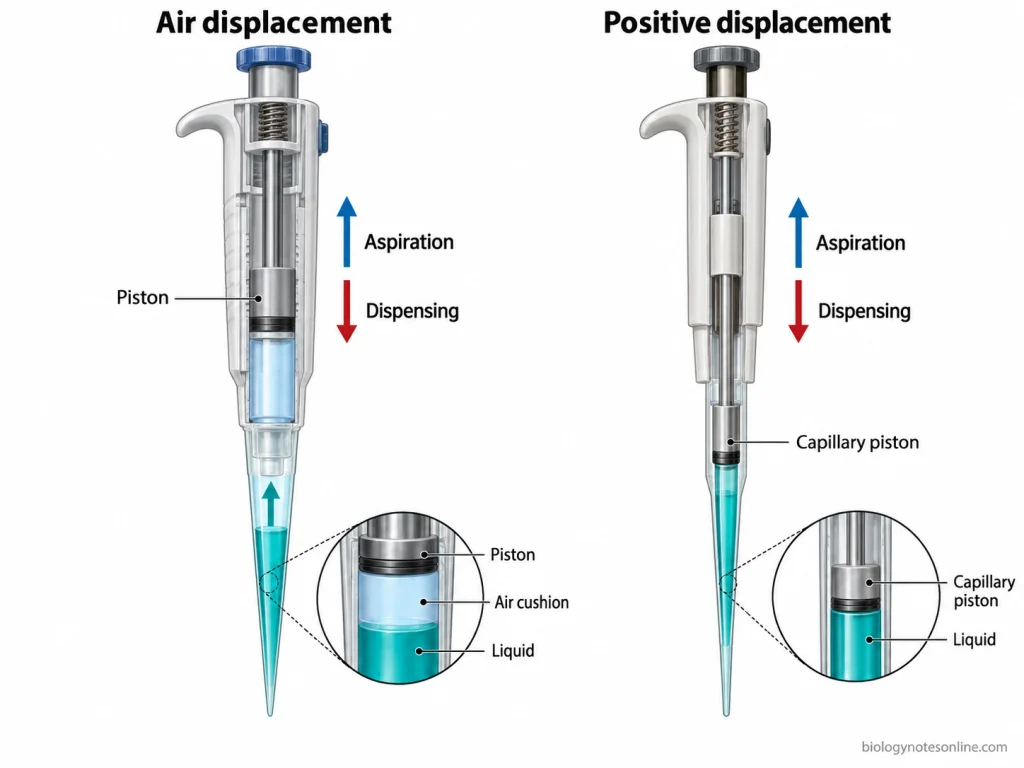
Pipettes mainly work on two different principles, air-displacement and positive-displacement, depending on how the piston moves the liquid.
Air-Displacement Pipetting
Air-displacement pipetting is based on the movement of an air cushion present between the piston and the liquid sample. The piston does not come in direct contact with the liquid. When the piston moves upwards, the pressure inside the tip decreases below atmospheric pressure which causes the liquid to enter the tip. During dispensing, the piston moves downwards and the air cushion pushes the liquid out of the tip.
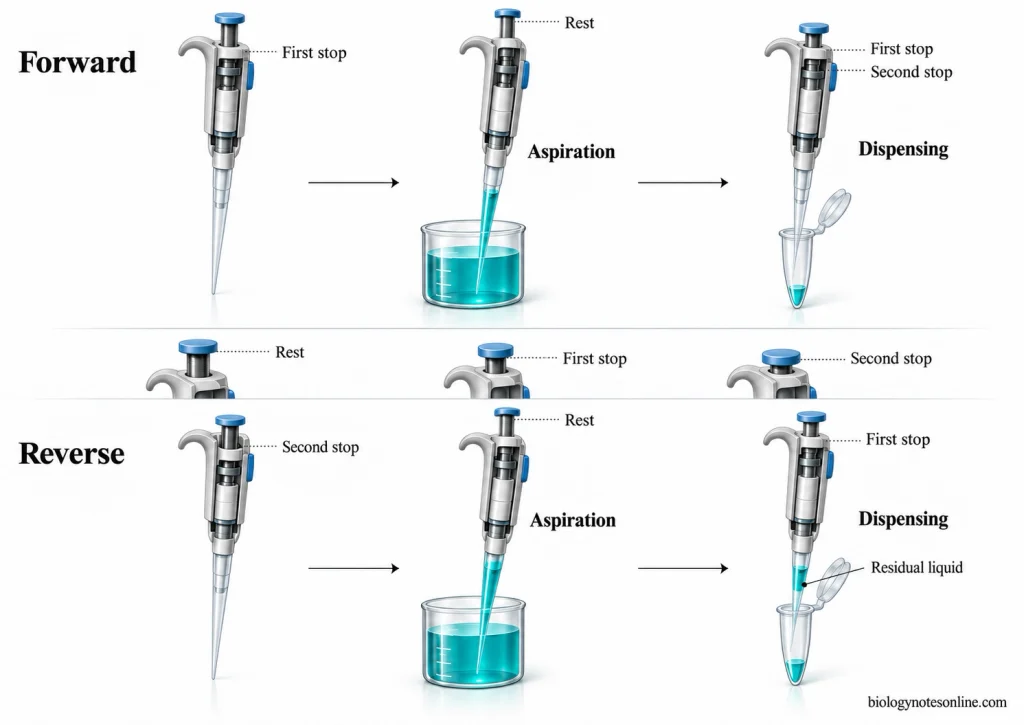
A manual air-displacement micropipette generally has three plunger positions, namely the rest position, first stop and second stop. In the rest position, the plunger is fully released and the piston remains at its upper position.
The first stop represents the measured volume of liquid. During normal forward pipetting, the plunger is pressed to the first stop and then released to aspirate the liquid. On pressing the plunger back to the first stop, the measured liquid is dispensed. A further downward movement to the second stop releases additional air to expel the remaining liquid from the tip. This is called blow-out.
Positive-Displacement Pipetting
In positive-displacement pipetting, the piston is present inside the disposable capillary tip and comes in direct contact with the liquid sample. There is no air cushion between the piston and liquid.
The liquid is drawn into the tip when the piston moves upwards and is expelled by the downward movement of the piston. As the piston directly acts on the liquid, the volume transferred is less affected by evaporation and the physical properties of the sample. This type of pipetting is commonly used for handling viscous and volatile liquids which are difficult to transfer accurately using air-displacement pipettes.
Equipment Used for Pipetting
Different types of pipettes and accessories are used for pipetting. Their selection depends on the volume to be transferred, sample properties, number of transfers and the accuracy required. The selected volume should remain within the working range of the pipette.
Very small volumes are generally handled by micropipettes. For larger volumes, serological or other milliliter-volume pipettes can be used. Liquid properties are also considered. Volatile and highly viscous samples may give larger errors with air-displacement pipettes, and positive-displacement pipettes can be used for such liquids.
Types of Pipettes
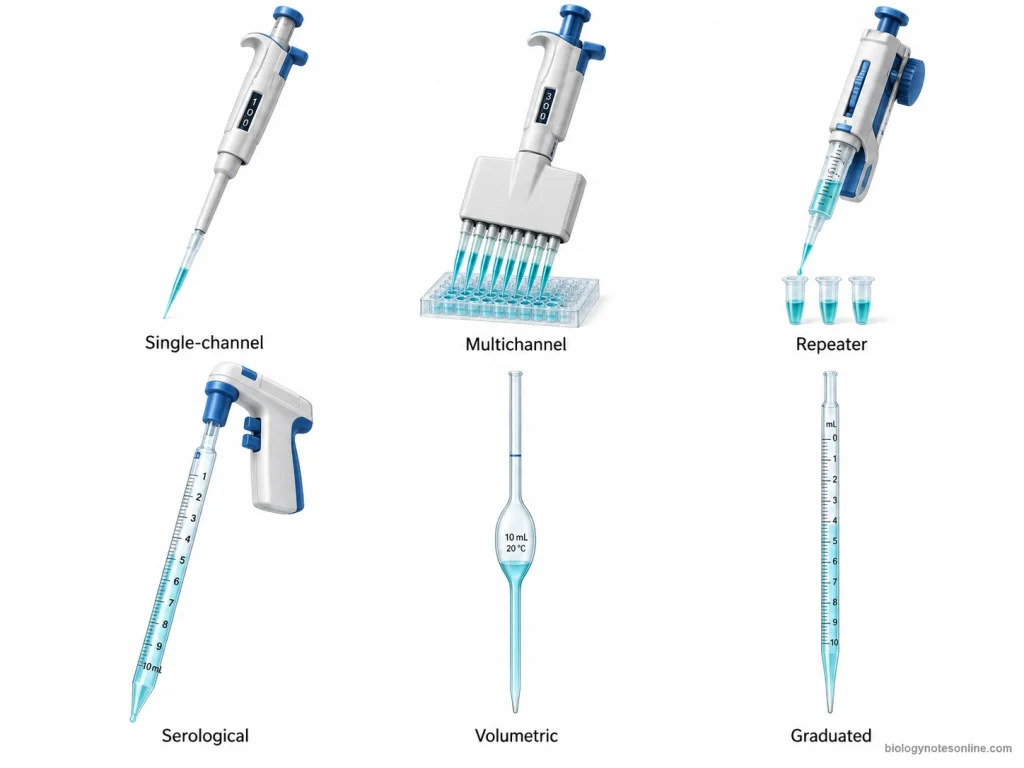
- Air-displacement micropipette- This is a commonly used micropipette for transferring liquid in the microliter (µL) range. They are available as fixed-volume or variable-volume pipettes and also as single-channel or multichannel types. A typical laboratory set may cover ranges such as 0.2-2 µL, 2-20 µL, 20-200 µL and 100-1000 µL. The exact volume range varies with the instrument.
- Positive-displacement pipette- In this pipette, the piston is present inside the capillary or tip and moves in direct contact with the liquid. There is no air cushion between piston and sample. These pipettes are useful for viscous, volatile, hot or cold liquids, where the properties of liquid can interfere with air-displacement pipetting.
- Single-channel pipette- It contains a single pipetting channel and transfers one sample at a time. It is commonly used for preparation of individual samples and reagents.
- Multichannel pipette- It has several pipetting channels which aspirate and dispense liquid together. Eight-channel and twelve-channel pipettes are commonly used with microplates. The same volume can be added into several wells at one time.
- Mechanical pipette- The piston is operated manually. Mechanical pipettes are available in different volume capacities and are commonly used for routine laboratory pipetting.
- Electronic pipette- In electronic pipettes, piston movement is controlled electronically. Depending on the instrument, they can perform aspiration, dispensing and repeated dispensing with less repeated movement of the manual plunger. They are available as single-channel and multichannel pipettes.
- Repeating or stepper pipette- It is used when the same volume has to be dispensed repeatedly. A larger volume is first taken up and then delivered as a series of smaller aliquots.
- Serological pipette- Serological pipettes are used for larger liquid volumes that are not convenient to handle with a micropipette. Common capacities are approximately 1-50 mL. A pipette controller, pipette aid or bulb is required for taking up and dispensing the liquid.
- Volumetric and graduated pipettes- A volumetric pipette is made to deliver one specified volume with high accuracy. Graduated pipettes contain volume markings and can transfer different volumes in the milliliter range.
Pipette Tips and Accessories
- Disposable pipette tips- These are removable tips fitted to micropipettes for aspiration and dispensing of liquid. The tip should fit properly with the pipette and its volume range. A fresh tip is normally used while changing samples or reagents to reduce carryover and cross-contamination.
- Filter or barrier tips- A filter or aerosol barrier is present between the sample and pipette shaft. They are used when aerosol contamination has to be reduced, especially during sensitive molecular work.
- Low-retention tips- The inner surface of these tips reduces attachment of liquid and sample material. They are useful for samples which leave noticeable liquid inside an ordinary pipette tip, where retained sample can affect the volume transferred or cause carryover.
- Wide-bore tips- These tips have a wider opening than the standard pipette tips. They are used for cells, large biological particles and other samples where gentle handling is required.
- Positive-displacement capillary-piston tips- These are special tips used with positive-displacement pipettes. The piston moves directly within the capillary and the sample does not remain separated from the piston by an air cushion.
- Tip racks or boxes- Pipette tips are kept in racks so that the tip can be attached without touching its liquid-contacting end. Sterile tip boxes are used where aseptic handling is required.
- Pipette controller or pipette aid- It is attached to a serological pipette for taking up and releasing the liquid. Mechanical bulbs or electronic controllers can be used. Mouth pipetting should not be used.
- Reagent reservoir- A reagent reservoir provides a wide liquid surface from which several channels of a multichannel pipette can take up liquid together. It is commonly used during microplate work.
- Pipette stand- It is used to keep micropipettes upright when not in use and protects the instruments during storage.
Types of Pipetting Techniques
Pipetting techniques are classified on the basis of how the liquid is aspirated into the tip and then dispensed. The commonly used types are forward pipetting, reverse pipetting and repetitive pipetting.
Forward and reverse pipetting mainly differ in the use of first and second plunger stops. Repetitive pipetting is different. It delivers several aliquots from one initial aspiration.
1. Forward Pipetting Technique
- Forward pipetting is the standard technique used for most ordinary aqueous, low-viscosity and non-foaming liquids. It uses the selected pipette volume for aspiration and the second stop for final blow-out.
- Before taking up the liquid, the plunger is pressed to the first stop. The tip is immersed into the sample and the plunger is allowed to return slowly to its rest position. Liquid is drawn into the tip.
- For dispensing, the plunger is pressed first to the first stop and the measured liquid is released. The plunger is then pushed further to the second stop. This final movement is the “blow-out”, which expels liquid remaining in the tip.
- Highly viscous or strongly volatile liquids may not behave in the same way during air-displacement pipetting. Another pipetting technique may be required for such samples.
2. Reverse Pipetting Technique
- Reverse pipetting is a technique in which more liquid is aspirated than the volume that has to be delivered. The plunger is first pressed completely to the second stop. After immersing the tip into the sample, the plunger is slowly released back to its rest position. An excess volume enters the tip.
- During dispensing, the plunger is pressed only up to the first stop. The required volume is released. A small amount of liquid remains inside the tip and this residual liquid is not included in the delivered volume.
- Reverse pipetting is useful for viscous and foaming liquids. It can also be used for certain volatile liquids, where ordinary forward pipetting may give difficulty.
- Its use depends on the sample and pipette system. Viscosity, volatility and the air-displacement system can affect pipetting performance, so the technique is not equally suitable for every liquid and pipette combination.
3. Repetitive Pipetting Technique
- Repetitive pipetting is used when the same volume of liquid has to be dispensed several times. A larger volume is aspirated once and it is then delivered as a number of smaller aliquots without taking up fresh liquid after every dispense. Repeater pipettes or electronic pipettes having a repeat-dispense function are used for this technique.
- It is commonly used for repeated reagent distribution, preparation of several tubes and filling of microplate wells.
Pipetting Procedure – Step-by-Step
The normal forward pipetting with a manual air-displacement micropipette can be carried out in the following seven steps-
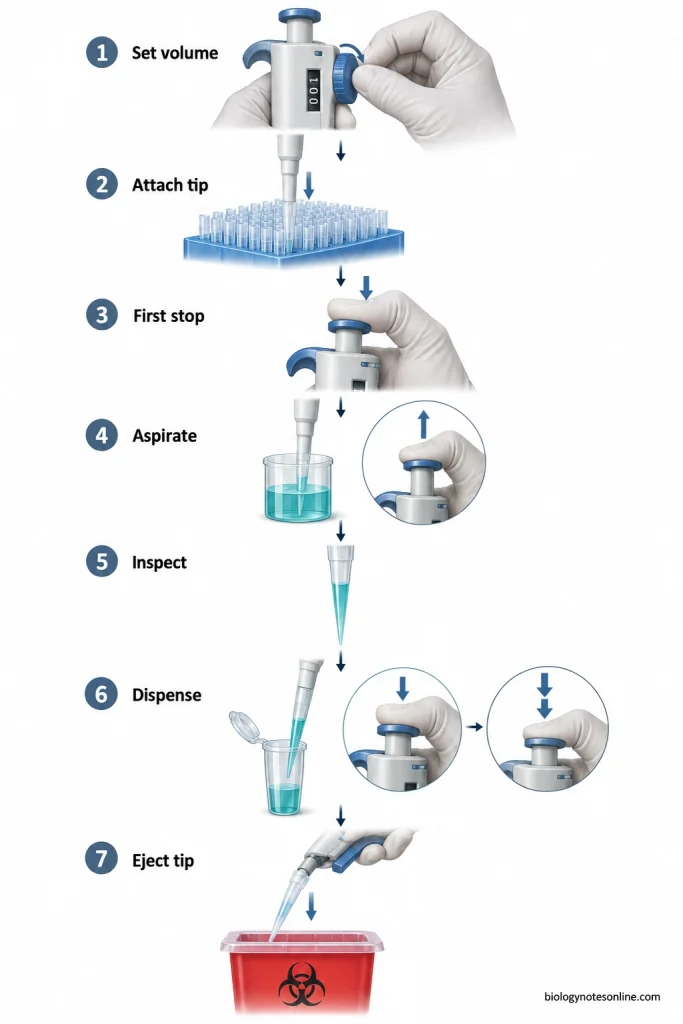
- Select the micropipette according to the volume of liquid to be transferred and set the required volume with the adjustment knob. Do not set the volume outside the specified range of the pipette.
- Fit a clean disposable tip of suitable size onto the micropipette. When pre-wetting is required, take up and release the same liquid once or twice before measuring the required volume.
- Press the plunger down to the first stop before the tip is placed into the liquid. Do not press up to the second stop.
- Hold the micropipette vertically and dip the tip slightly below the liquid surface. Slowly release the plunger back to its original position while keeping the tip inside the liquid. The liquid is taken up into the tip. Do not allow the plunger to snap back.
- After aspiration, keep the tip in the liquid for about one second and then take it out carefully. Check the liquid present inside the tip. Air bubbles should not be present. If bubbles are seen, discard the liquid properly and aspirate the sample again.
- Place the tip against the inner wall of the receiving container and press the plunger slowly to the first stop. Wait briefly, then press it further to the second stop to blow out the liquid remaining in the tip.
- Keep the plunger fully pressed and withdraw the tip along the inner wall of the container. The plunger is then allowed to return to its original position. Eject the used tip into the designated waste container with the tip ejector button. Use a new tip for the next sample.
Factors Affecting Pipetting Accuracy and Precision
The accuracy and precision of pipetting depend on several factors such as the pipette used, nature of the liquid, environmental conditions and the technique followed during pipetting. Some of the important factors are-
- Pipette Volume- The pipette should be selected according to the volume of liquid to be measured. When very small volumes are taken up, the relative variation in volume is generally higher, especially near the lower working range of the pipette.
- Pipette Calibration and Condition- A properly calibrated pipette is required for accurate measurement. The presence of dirt, damaged parts or problems in the pipette mechanism can change the volume of liquid delivered. Regular checking of the pipette is required.
- Pipette Tip- Use a compatible tip that fits tightly onto the pipette. A loose or unsuitable tip can affect the air seal and the volume of liquid transferred.
- Pre-wetting of Tip- Before measuring the required volume, the liquid is taken up and released from the tip. This is known as pre-wetting. It helps to condition the tip and the air present inside it. Pre-wetting is especially useful when small volumes are measured.
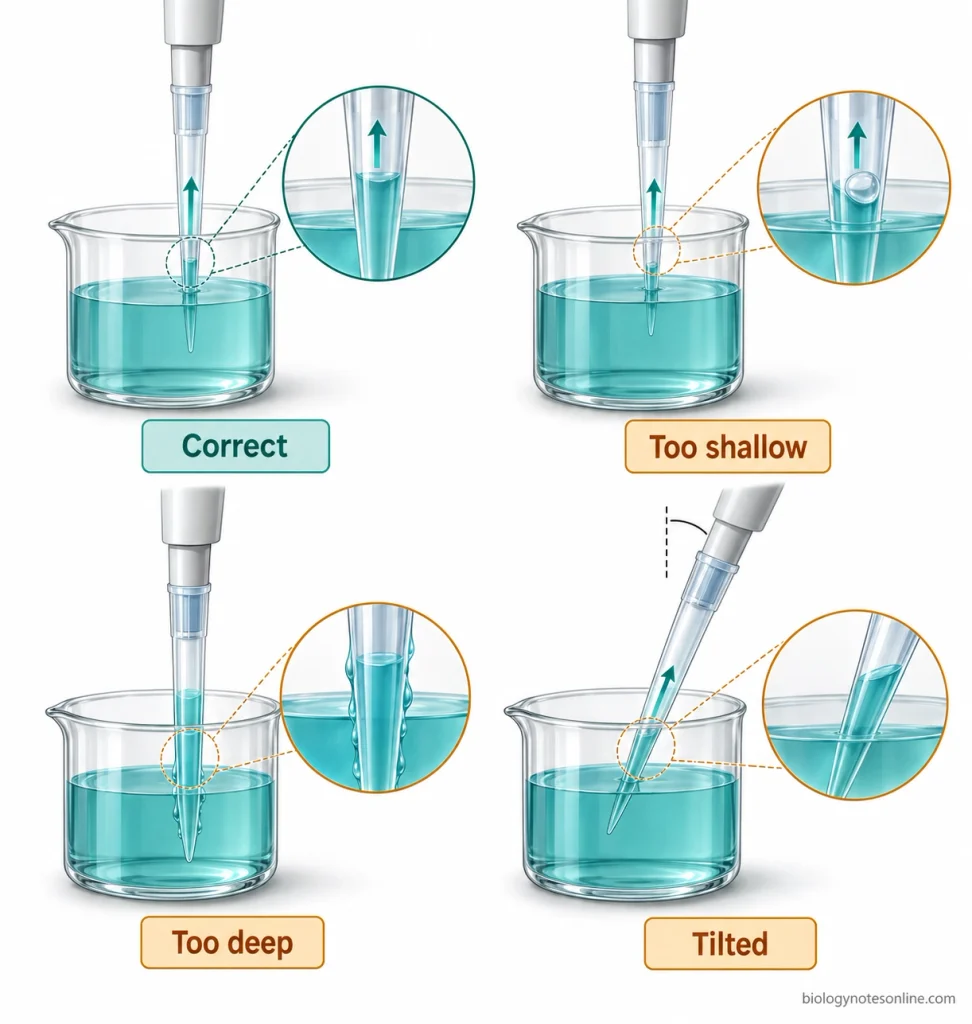
- Immersion Depth and Angle- During aspiration, the pipette should be held nearly vertical and the tip is kept slightly below the liquid surface. If the tip is immersed too deep, excess liquid may be taken up. When the tip is kept very close to the surface, air may enter the tip.
- Pipetting Speed- The plunger should be pressed and released slowly. The movement should be similar during repeated pipetting. Rapid or irregular movement can affect the amount of liquid aspirated, particularly in the case of viscous samples.
- Liquid Properties- Different properties of the liquid such as viscosity, density, vapour pressure and wetting characteristics affect pipetting. Volatile and highly viscous liquids are generally difficult to measure accurately using ordinary air-displacement pipettes.
- Temperature- The pipette, tip and liquid should be kept at similar temperatures before pipetting. A difference in temperature changes the behaviour of the air cushion inside the pipette. The volume of liquid aspirated may be affected.
- Evaporation- During pipetting, a small amount of liquid may be lost through evaporation. This is more common when very small volumes or volatile liquids are handled and can produce an error in the volume transferred.
- Operator Technique- The accuracy and precision also depend on the person performing the pipetting. Differences in tip immersion, plunger movement, aspiration time and handling of the pipette can produce variations in the measured volume during repeated pipetting.
Common Pipetting Errors
Pipetting errors occur when the liquid is not measured or transferred in the required volume. These errors may result from incorrect pipette settings, improper handling of the instrument and mistakes during aspiration or dispensing. Some of the common errors are-
- Incorrect Volume Setting- Selecting a pipette which is not suitable for the required volume can give incorrect measurements. The volume should be within the specified range of the pipette. Sometimes the volume is set incorrectly or the decimal places on the display are misread, resulting in a different volume than required.
- Using Wrong Pipette Tips- A pipette tip which does not fit properly may allow air or liquid to leak during pipetting. The amount of liquid aspirated and dispensed is affected. A compatible tip should be fitted tightly onto the pipette.
- Incorrect Plunger Position- In normal forward pipetting, the plunger is pressed to the first stop before aspiration. If it is pressed down to the second stop, a larger volume of liquid will be taken up than the selected volume.
- Improper Tip Immersion- When the tip is dipped too deep into the liquid, some extra liquid may stick to its outer surface. If the tip is kept too close to the surface, air may enter during aspiration. The pipette should be held nearly vertical while taking up the liquid.
- Rapid Plunger Movement- Sudden release of the plunger may cause formation of air bubbles or splashing of liquid inside the tip. Sometimes the liquid may even enter the pipette body. The plunger should be pressed and released slowly.
- Not Pre-wetting the Tip- While pipetting very small volumes or volatile liquids, an error may occur if the tip is used directly without pre-wetting. When required, the same liquid is first taken up and released before measuring the actual volume.
- Incomplete Aspiration- The tip is sometimes removed from the liquid before the aspiration is completed. In this case, less liquid is taken up. Keep the tip immersed for a short time after the plunger reaches its original position. The aspirated liquid should also be checked for air bubbles before dispensing.
- Incomplete Dispensing- If the plunger is not pressed properly, some amount of liquid may remain inside the tip. During forward pipetting, the measured volume is first released by pressing to the first stop. The remaining liquid is then blown out by pressing further to the second stop. The tip is generally kept against the inner wall of the receiving container during dispensing.
- Improper Handling of Difficult Liquids- Liquids such as viscous, volatile and foaming samples may not be transferred accurately by normal forward pipetting. Their different physical properties affect the aspiration and dispensing of liquid. A suitable pipette or another pipetting technique should be used depending on the liquid.
- Temperature Differences- When the pipette, tip and liquid are at different temperatures, the air cushion inside the pipette is affected. This may change the volume of liquid transferred.
- Reusing Contaminated Tips- Using the same tip for different samples can transfer material from one sample to another. This is known as cross-contamination. A new tip should be used for each sample. If the tip touches any contaminated surface, it should also be replaced.
- Improper Position of Pipette- Placing the pipette horizontally or turning it upside down while liquid is present inside the tip may allow the liquid to enter the pipette body, causing damage or contamination of its internal parts.
- Using an Uncalibrated Pipette- A pipette which is damaged or not properly calibrated may deliver a different volume of liquid than the volume set on the pipette. Regular checking and calibration are required to maintain accuracy and precision.
Precautions During Pipetting
Several precautions should be followed during pipetting to maintain the accuracy and precision of liquid measurement and prevent contamination of samples. Some of the important precautions are-
- Always select a pipette according to the volume of liquid to be measured. Do not adjust the volume above or below the specified range of the pipette.
- Before pipetting, check whether the pipette is clean and properly calibrated. A damaged or leaking pipette should not be used for accurate measurement.
- Use a clean disposable tip of suitable size. The tip should fit tightly onto the micropipette. Never use a micropipette without attaching a tip.
- Avoid touching the pipette tip with fingers or placing it on a contaminated surface. A new tip should be used for each sample to prevent cross-contamination. Sterile or filter tips should be used when required for contamination-sensitive work.
- The pipette, tip and liquid should be at similar temperatures before pipetting. When required, pre-wet the tip by taking up and releasing the same liquid before measuring the actual volume.
- During normal forward pipetting, press the plunger only to the first stop before taking up the liquid. The second stop is used for blowing out the remaining liquid after dispensing the measured volume.
- Hold the micropipette nearly vertical during aspiration. The tip should be immersed only a few millimetres below the liquid surface. Do not dip the pipette shaft into the liquid.
- Release the plunger slowly while keeping the tip inside the liquid until aspiration is completed. Sudden release of the plunger may cause formation of air bubbles and incorrect measurement of liquid volume. Do not allow the plunger to snap back.
- After taking up the liquid, check for the presence of air bubbles inside the tip. If bubbles are present, discard the liquid properly and aspirate the sample again.
- During dispensing, place the tip against the inner wall of the receiving container and press the plunger slowly. In normal forward pipetting, the liquid is released at the first stop followed by the second-stop blow-out. Avoid sudden splashing of liquid.
- Never place the micropipette horizontally or turn it upside down when liquid is present inside the tip. The liquid may enter the pipette body and damage its internal parts. Keep the pipette upright on a suitable stand when not in use.
- Do not perform mouth pipetting under any condition. A mechanical pipetting aid should be used for glass or serological pipettes.
- While handling infectious or hazardous liquids, use the required protective equipment and avoid the formation of aerosols. The pipetting should be carried out inside a biological safety cabinet when required for the material being handled.
- Remove the used pipette tip with the help of the tip ejector button. Do not pull it off by hand. The used tips should be discarded into the designated waste container. Contaminated tips must be disposed of according to the laboratory biosafety and waste-disposal rules.
Applications of Pipetting
Pipetting is used in different laboratory procedures for measuring, mixing and transferring small volumes of liquids. Some of its important applications are-
- Used to measure and transfer accurate volumes of liquids during the preparation of laboratory solutions, reagents and buffers.
- Pipetting is used for preparing serial dilutions of microbial cultures and other liquid samples.
- Used to transfer bacterial suspensions onto agar plates during the spread plate method and microbial colony counting.
- In molecular biology, pipetting is used to add deoxyribonucleic acid (DNA), primers, enzymes and other reagents during polymerase chain reaction (PCR).
- Used for transferring samples and reagents during DNA and ribonucleic acid (RNA) extraction procedures.
- Pipetting is used to add samples, antibodies and other reagents during enzyme-linked immunosorbent assay (ELISA).
- Used in cell culture for transferring cell suspensions and adding culture media.
- In biochemical experiments, it is used for mixing samples with reagents and measuring enzyme activity.
- Used in clinical laboratories for transferring patient samples and preparing different diagnostic tests.
- Multichannel pipettes are used for dispensing reagents into microplates during drug screening and high-throughput experiments.
References
- Burtis, C. A., Begovich, J. M., & Watson, J. S. (1975). Factors influencing evaporation from sample cups and assessment of their effect on analytical error. Clinical Chemistry, 21(13), 1907–1917. https://doi.org/10.1093/clinchem/21.13.1907
- Nejime, T. (2005). [Liquid handling with mechanical pipettes]. Rinshō Byōri, 53(1), 47–53. https://pubmed.ncbi.nlm.nih.gov/15724490/
- Özcan, Ö., Grundel, P. J. M., Heijboer, A. C., & den Elzen, W. P. J. (2026). Pipetting performance across laboratory personnel: A comparative study. The Journal of Applied Laboratory Medicine, 11(3), 460–469. https://doi.org/10.1093/jalm/jfag006
- Pushparaj, P. N. (2020). Revisiting the micropipetting techniques in biomedical sciences: A fundamental prerequisite in good laboratory practice. Bioinformation, 16(1), 8–12. https://doi.org/10.6026/97320630016008