

Positive displacement pipette is a laboratory instrument used to aspirate and dispense small volumes of liquid by the direct movement of a piston inside a capillary tip. The piston remains in direct contact with the liquid. There is no air cushion between them. In positive displacement pipetting, the movement of the piston controls the amount of liquid drawn into the tip and released during dispensing.
In a conventional air displacement pipette, a layer of air is present between the piston and the liquid sample. This air can expand or compress during pipetting and affect the volume of liquid transferred. The positive displacement pipette is mainly used for handling liquids which are difficult to pipette by the air displacement method. These include viscous liquids such as glycerol and volatile liquids which can evaporate into the air cushion.
A positive displacement micropipette is a small-volume pipette that works on the same positive displacement principle. It generally uses special disposable capillary-piston tips, which contain a piston that moves directly inside the capillary during aspiration and dispensing.
What is a Positive Displacement Pipette?
Positive displacement pipette is a type of laboratory instrument used to measure and transfer small volumes of liquid with the help of a movable piston. The piston is present inside a narrow capillary or syringe-like tip where it comes in direct contact with the liquid sample. No air cushion is present between them.
The pipette generally uses a special capillary-piston tip which contains a movable piston inside the capillary. During aspiration and dispensing, the movement of this piston draws the liquid into the tip and releases it from the tip. In an air displacement pipette, the piston is separated from the liquid by a layer of air. The liquid is moved through this air cushion instead of direct piston contact.
Positive displacement pipettes are also used for handling viscous liquids (such as glycerol) and volatile liquids, which may produce pipetting errors when transferred using an air displacement pipette.
A positive displacement micropipette is a micropipette that works on the positive displacement mechanism. Micropipettes are laboratory instruments used to measure and transfer very small quantities of liquid, generally in the microlitre range. They may be of air displacement or positive displacement type.
Principle of Positive Displacement Pipette
The principle of positive displacement pipette is based on the direct displacement of liquid by the movement of a piston inside a narrow capillary. The piston remains in direct contact with the liquid sample. When the piston moves upward, the space available for the liquid inside the capillary increases and the liquid is drawn into the tip. The downward movement of the piston reduces this space, which forces the liquid out through the tip.
The volume of liquid displaced depends on the internal cross-sectional area of the capillary and the distance travelled by the piston (piston stroke). For a capillary having a uniform internal diameter, the displaced volume is given by the following equation-
V = A × s
Where,
- V = Volume of liquid displaced.
- A = Internal cross-sectional area of the capillary.
- s = Length of the piston stroke.
A longer piston stroke displaces a greater volume of liquid when the internal diameter of the capillary remains the same.
In positive displacement pipetting, there is no air cushion between the piston and the liquid sample. The liquid is moved directly by the piston instead of the expansion or compression of an air layer as occurs in air displacement pipettes. This reduces the errors caused by changes in the air cushion, particularly when handling viscous liquids and volatile liquids.
Purpose of a Positive Displacement Pipette
The following are the main purposes of a positive displacement pipette-
- It is mainly used to measure and transfer small volumes of liquid which are difficult to handle using conventional air displacement pipettes.
- Viscous liquids such as glycerol and concentrated protein solutions can be transferred using this pipette. These liquids flow slowly and may cause errors during aspiration and dispensing when an air displacement pipette is used.
- The pipette is also used for transferring volatile liquids (such as ethanol and other organic solvents). Evaporation of these liquids may produce pipetting errors. The absence of an air cushion helps in reducing such errors.
- Hot and cold liquids can be handled using positive displacement pipettes, as temperature differences may cause expansion or contraction of the air cushion in conventional air displacement pipettes.
- It is used for handling foaming liquids such as detergent and surfactant solutions. These liquids may form bubbles during pipetting which can cause irregular transfer of the liquid.
- Positive displacement pipettes are also used to transfer infectious or contaminated samples with a reduced risk of carryover. The capillary-piston tip is disposable and is removed after use. This helps in preventing contamination of the internal parts of the pipette by the liquid sample.
Parts of a Positive Displacement Pipette
The positive displacement pipette is made up of different mechanical parts which are used for holding the pipette, controlling movement of the piston and transferring the liquid sample. The major parts are as follows-
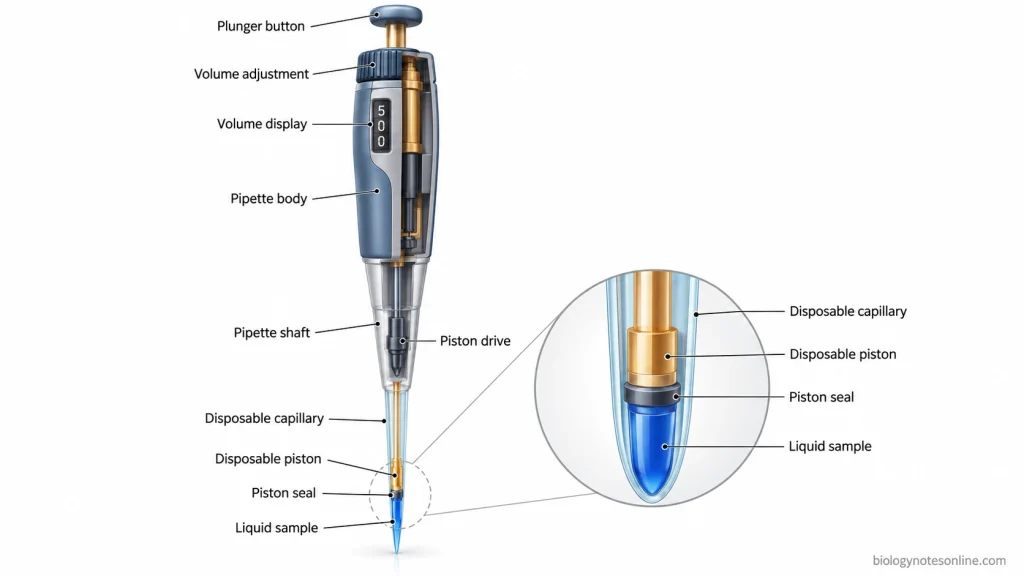
- Pipette Body- Pipette body is the main outer part which holds the internal mechanical components of the pipette. It also provides the grip for holding the pipette during use.
- Plunger Button- The plunger button is present at the upper end of the pipette. It is used to control the upward and downward movement of piston during aspiration and dispensing of liquid.
- Volume Adjustment Knob- This knob is used to set the volume of liquid to be transferred in adjustable positive displacement pipettes. It controls the distance through which the piston moves inside the capillary. Fixed-volume pipettes do not require this adjustment.
- Volume Display- It is a small window which shows the selected volume of liquid, generally in microlitres (µL). It is present in many adjustable pipettes.
- Pipette Shaft- The shaft forms the lower part of the pipette where the disposable capillary-piston tip is attached. It supports the capillary during pipetting.
- Piston Drive Rod- Piston drive rod is an internal mechanical part which transfers the movement of plunger button to the disposable piston. The lower end of this mechanism holds the piston. It moves the piston up or down inside the capillary.
- Disposable Capillary- The disposable capillary is a narrow hollow tube and forms the outer part of the capillary-piston tip. Liquid sample is held inside this capillary. Its internal diameter and the distance moved by the piston determine the volume of liquid displaced during pipetting.
- Disposable Piston- A small movable piston is present inside the capillary. The piston remains in direct contact with the liquid sample and fits closely against the inner wall of capillary. No air cushion is present between the piston and liquid. It moves inside the capillary during aspiration and dispensing. After use, the piston is discarded along with the capillary.
- Tip Ejector- The tip ejector is used to remove the disposable capillary-piston assembly without touching it directly. In some pipettes, a separate button is provided for tip ejection while other models use the plunger mechanism for removing the used tip.
Working Mechanism of a Positive Displacement Pipette
The working mechanism of a positive displacement pipette involves the movement of a disposable piston inside the capillary, which controls the entry and release of the liquid sample. The process takes place in the following steps-
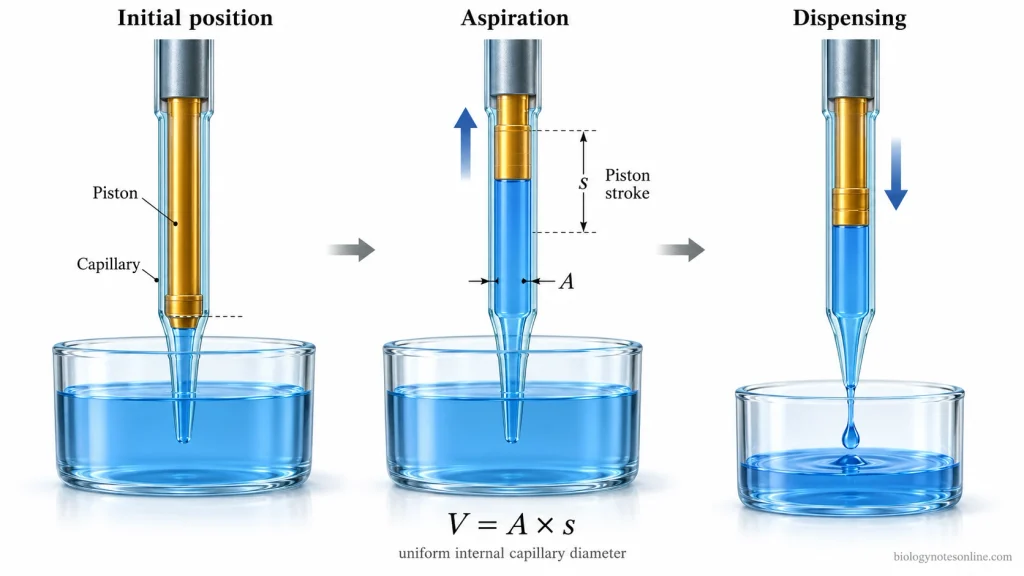
- Initially, the piston is positioned near the lower end of the capillary, leaving very little space for the liquid inside the tip. The piston fits closely against the inner wall of the capillary.
- During aspiration, the piston moves upward inside the capillary. This increases the space below the piston and creates a pressure difference, due to which the surrounding atmospheric pressure forces the liquid through the lower opening of the capillary. The liquid moves upward along with the piston and remains in direct contact with it.
- The upward movement of the piston stops after travelling the selected distance (piston stroke). The volume of liquid drawn into the capillary depends on this distance and the internal cross-sectional area of the capillary. No air cushion is present between the piston and the liquid. The liquid is held inside the capillary until the piston moves downward.
- During dispensing, the piston moves downward through the capillary and pushes the liquid out through the tip opening. The space occupied by the liquid decreases as the piston moves towards the lower end of the capillary. The liquid is expelled by direct piston displacement without the compression of an air cushion.
Positive Displacement Pipette vs Air Displacement Pipette
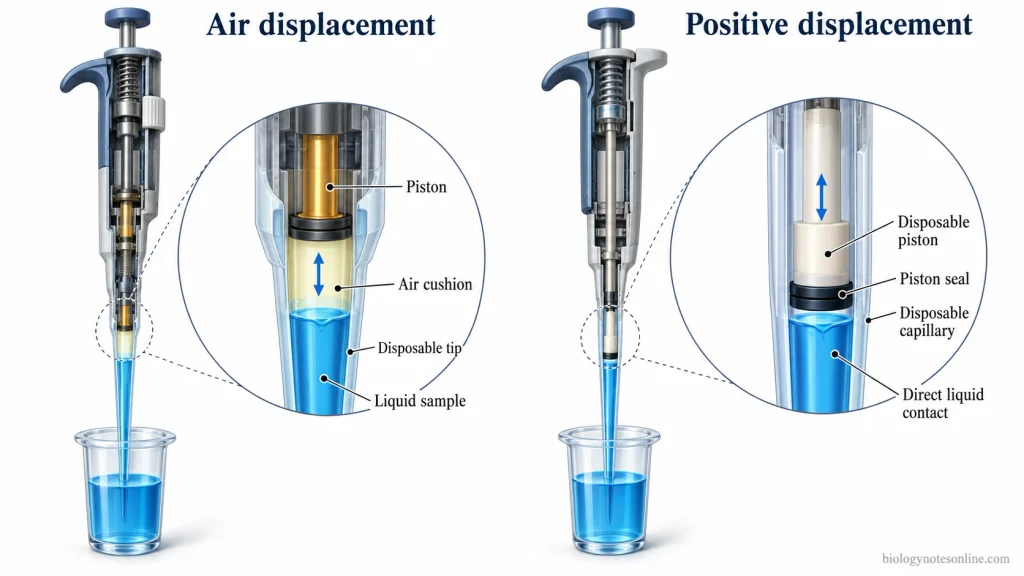
The main difference between a positive displacement pipette and an air displacement pipette is the position of the piston and the method by which liquid is aspirated and dispensed. The major differences are given below-
| Features | Positive Displacement Pipette | Air Displacement Pipette |
|---|---|---|
| Piston Location | The piston is present inside the capillary tip and comes in direct contact with the liquid sample. | The piston is located inside the pipette body and does not directly touch the liquid. |
| Air Cushion | No air cushion is present between the piston and the liquid. | A layer of air separates the piston from the liquid sample. |
| Working Principle | The liquid is drawn in and expelled by the direct movement of the piston inside the capillary. | The piston changes the pressure and volume of the air cushion, which causes aspiration and dispensing of liquid. |
| Pipette Tips | Uses special capillary-piston tips containing a disposable piston. | Generally uses conventional disposable plastic tips. Filter tips are also available. |
| Aqueous Liquids | Can be used for transferring ordinary aqueous solutions. | Commonly used for aqueous liquids such as water and dilute buffers. |
| Viscous Liquids | More suitable for transferring viscous liquids such as glycerol and concentrated protein solutions. | Viscous liquids may be difficult to aspirate and dispense accurately due to their slow flow. |
| Volatile Liquids | Volatile liquids can be transferred with reduced errors caused by evaporation into an air cushion. | Evaporation of volatile liquids may affect the air cushion and produce errors in the transferred volume. |
| Temperature Sensitivity | Less affected by temperature differences between the liquid and the surrounding environment. | Hot or cold liquids may change the volume of the air cushion and affect pipetting accuracy. |
| Effect of Liquid Properties | Less affected by the viscosity, volatility and other physical properties of the liquid, although these may still influence pipetting performance. | The accuracy of pipetting is more sensitive to changes in the physical properties of the liquid. |
| Contamination Risk | The disposable capillary-piston assembly separates the liquid from the internal parts of the pipette. It reduces the risk of aerosol contamination and sample carryover, but does not eliminate all contamination risks. | Aerosols may enter and contaminate the pipette shaft. Filter tips can be used to reduce this risk. |
| Consumable Cost | Special piston-containing tips are generally more expensive. | Conventional disposable tips are usually less expensive. |
| Laboratory Use | Mainly used for handling viscous, volatile and other difficult liquids, or samples requiring greater protection against contamination. | Widely used for routine laboratory work involving ordinary aqueous solutions. |
The term “regular pipette” usually refers to a conventional air displacement pipette when compared with a positive displacement pipette.
A micropipette is an instrument used to measure and transfer small volumes of liquid, generally in the microlitre range. It may work by either air displacement or positive displacement. The term “micropipette” does not refer to a separate operating principle.
How to Use a Positive Displacement Pipette?
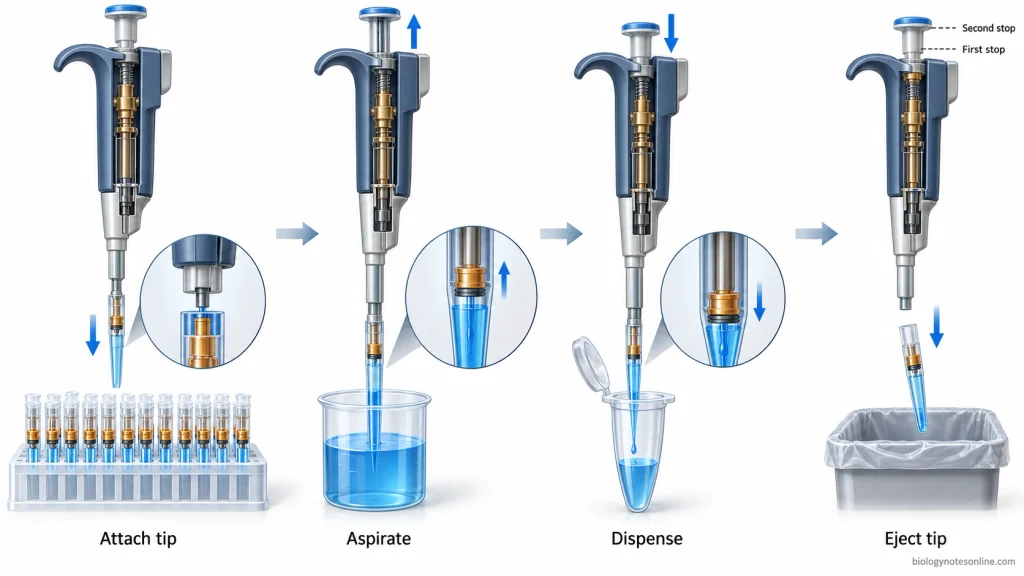
A positive displacement pipette is used with a disposable capillary-piston tip for measuring and transferring liquid samples. The general procedure is given below-
Preparation and Volume Setting
- Select the pipette according to the volume of liquid required. The pipette should be clean and working properly.
- For an adjustable positive displacement pipette, set the required volume with the volume adjustment knob. Check the volume display. The selected volume must remain within the specified range of the pipette. No volume adjustment is required for a fixed-volume pipette.
- Keep the sample and receiving vessel ready. Appropriate protective equipment should be used while handling hazardous or infectious samples.
Attaching the Capillary-Piston Tip
- Select a new capillary-piston tip compatible with the pipette. It contains the capillary and disposable piston fitted together.
- Attach the capillary-piston assembly to the lower end of the pipette according to its attachment system. The disposable piston must properly engage with the internal drive mechanism. Do not touch the open end of the capillary or piston with fingers.
- Check the capillary after attachment. It should remain properly fitted without any loose movement. The method used for attaching the capillary-piston tip may differ between positive displacement pipette models.
Aspirating the Liquid
- Hold the pipette vertically and press the plunger to its specified aspiration position. In the Gilson MICROMAN E, the plunger is pressed to the first stop before aspiration. Other positive displacement pipettes may use different plunger positions.
- Immerse the lower end of the capillary at least 2 mm below the liquid surface. Release the plunger slowly. The piston moves upward and the liquid is drawn into the capillary. Rapid release of the plunger should be avoided because bubbles or irregular aspiration may occur.
- Where the laboratory procedure permits, the capillary can be pre-rinsed by aspirating and dispensing the same sample at least twice before taking the final volume. This reduces formation of an air gap between the liquid and piston.
- Keep the capillary opening below the liquid surface until the piston completes its upward movement. Viscous liquids require more time because they enter the capillary slowly.
- Remove the capillary from the sample and check the liquid inside it. Visible air bubbles should not be present and the liquid should not pass above the piston seal. Any liquid droplet present outside the capillary can be removed carefully with a clean lint-free tissue. Do not touch the tip opening because some liquid may be drawn out of the capillary.
Dispensing the Liquid
- Place the lower end of the capillary against the inner wall of the receiving vessel. This position allows the liquid to enter the vessel without splashing.
- Press the plunger slowly and dispense the sample. The piston moves downward inside the capillary and pushes the liquid through the lower opening. For the MICROMAN E, the plunger is pressed to the first stop during dispensing. The second stop is not used as an additional blow-out step.
- Allow enough time for the sample to leave the capillary, especially for highly viscous liquids. Keep the plunger depressed and move the tip slightly along the inner wall to remove any droplet remaining on the outside of the capillary.
- Withdraw the capillary while the plunger is still depressed. The plunger button is then allowed to return to its original position.
Tip Ejection and Disposal
- After dispensing, hold the pipette over the proper waste container and eject the used capillary-piston assembly.
- In the Gilson MICROMAN E, further pressing of the plunger from the first stop to the second stop ejects the capillary and piston together. Other models may contain a separate ejector button or use a different tip ejection system.
- Discard the used capillary-piston tip into the appropriate laboratory waste container. It should not be reused for another sample when cross-contamination is possible. A new capillary-piston assembly is used for the next sample.
- If liquid comes in contact with the pipette body or shaft, the affected part should be cleaned and decontaminated according to the laboratory safety procedure and the pipette manufacturer’s instructions.
Applications of Positive Displacement Pipette
The following are the major applications of positive displacement pipettes-
- Used to transfer viscous liquids such as glycerol, concentrated protein solutions and oils.
- It is used for pipetting volatile liquids such as ethanol and chloroform, where evaporation may affect the volume of liquid transferred.
- Used for handling foaming liquids such as detergents and surfactant solutions.
- Positive displacement pipettes are used to transfer hot and cold liquids which may cause errors in conventional air displacement pipettes.
- Used in molecular biology laboratories for transferring sticky or highly viscous reagents such as concentrated dextran sulfate solutions.
- They are used for transferring infectious biological samples with reduced risk of contamination of the internal parts of the pipette.
- Used for handling dense liquids and concentrated solutions which are difficult to transfer accurately using conventional pipettes.
Advantages of Positive Displacement Pipette
The following are the major advantages of a positive displacement pipette-
- It provides better accuracy and precision when transferring viscous liquids such as glycerol, compared to conventional air displacement pipettes.
- Volatile liquids can be transferred with less error caused by evaporation. No air cushion is present between the piston and the liquid sample.
- It is less affected by temperature differences between the liquid and surrounding environment, as there is no air cushion to expand or contract.
- The piston moves down through the capillary during dispensing and pushes the liquid out. Less liquid remains inside the tip.
- The disposable capillary-piston tip keeps the liquid sample separated from the internal parts of the pipette. It reduces the risk of aerosol contamination of the pipette and sample carryover.
- It can provide better precision when transferring very small volumes of liquid because the volume is controlled by direct movement of the piston.
Limitations of Positive Displacement Pipette
The following are the major limitations of a positive displacement pipette-
- The capillary-piston tips are more expensive compared to conventional disposable pipette tips. These tips are generally replaced after each sample. This increases the cost of pipetting and produces more laboratory waste.
- It requires special capillary-piston tips which must be compatible with the pipette model and its volume range. Ordinary disposable pipette tips cannot be used.
- For routine transfer of aqueous solutions, positive displacement pipettes are less economical. Conventional air displacement pipettes are generally suitable for such liquids.
- Even very small volumes of liquid may produce pipetting errors due to surface tension and small droplets remaining at the tip opening.
- The narrow opening of the capillary may become blocked by particles or dried sample materials.
- Highly viscous liquids enter the capillary slowly. More time is required during aspiration of these liquids.
- Proper handling and regular calibration are required for accurate pipetting. Incorrect aspiration speed or piston movement may affect the volume of liquid transferred.
References
- Astle, T. W. (1998). Small volume pipetting. JALA: Journal of the Association for Laboratory Automation, 3(3), 62–64. https://doi.org/10.1177/221106829800300317
- Guan, X. L., Chang, D. P. S., Mok, Z. X., & Lee, B. (2023). Assessing variations in manual pipetting: An under-investigated requirement of good laboratory practice. Journal of Mass Spectrometry and Advances in the Clinical Lab, 30, 25–29. https://doi.org/10.1016/j.jmsacl.2023.09.001
- Pushparaj, P. N. (2020). Revisiting the micropipetting techniques in biomedical sciences: A fundamental prerequisite in good laboratory practice. Bioinformation, 16(1), 8–12. https://doi.org/10.6026/97320630016008
- Quijano Velasco, P., Low, K. Y. A., Leong, C. J., Ng, W. T., Qiu, S., Jhunjhunwala, S., Li, B., Qian, A., Hippalgaonkar, K., & Cheng, J. J. W. (2024). Optimization of liquid handling parameters for viscous liquid transfers with pipetting robots, a “sticky situation.” Digital Discovery, 3(5), 1011–1020. https://doi.org/10.1039/D3DD00255A
- Sander, L. C. (2017). Volumetric transfer of liquids. Journal of Research of the National Institute of Standards and Technology, 122, Article 2. https://doi.org/10.6028/jres.122.002
- Schuster, J., Kamuju, V., Zhou, J., & Mathaes, R. (2024). Piston-driven automated liquid handlers. SLAS Technology, 29(3), Article 100128. https://doi.org/10.1016/j.slast.2024.100128