

Air displacement pipetting is a technique used to transfer small measured volumes of liquid with the help of a piston-operated pipette. It is commonly used in laboratories for handling aqueous buffers, reagents and other liquid samples in microlitre (µL) volumes.
The instrument used in this method is known as an air displacement pipette. It is also called an air-cushion pipette and is one of the commonly used types of micropipettes. A small volume of air is present between the piston and the liquid sample. The movement of the piston changes the pressure within this air space, which controls the movement of liquid into and out of the pipette tip.
The liquid is drawn into the tip during aspiration and released during dispensing. The piston does not directly come in contact with the liquid. It is separated by an air cushion.
This air cushion is compressible, and changes in its condition can affect the volume of liquid transferred. In positive displacement pipetting, the piston comes in direct contact with the liquid without an intervening air cushion.
What is Air Displacement Pipetting?
Air displacement pipetting is a piston-operated liquid handling technique used to aspirate and dispense measured volumes of liquid with the help of an air cushion. The instrument used in this technique is known as an air displacement pipette or air displacement micropipette. It is also called an air-cushion pipette.
The air displacement pipette is a common type of micropipette used for transferring small volumes of liquid, usually measured in microlitres (µL). It consists of a piston that moves inside the pipette body and a detachable plastic tip for holding the liquid sample. The movement of the piston produces changes in the pressure of the air present between the piston and the liquid, which causes the liquid to move into or out of the pipette tip.
The piston does not directly come in contact with the liquid. In positive displacement pipettes, the piston comes in direct contact with the liquid sample.
Principle of Air Displacement Pipetting
The principle of air displacement pipetting is based on the movement of a piston that changes the pressure and volume of an air cushion present inside the pipette. The air cushion is present between the piston and the liquid sample. There is no direct contact between the piston and the liquid.
When the piston moves upward, the volume of the enclosed air space increases and its pressure decreases below the atmospheric pressure. The atmospheric pressure acting on the liquid surface pushes the liquid into the pipette tip. This is known as aspiration. During dispensing, the piston moves downward, reducing the air space and increasing the pressure, which forces the liquid out of the tip.
The air cushion is compressible. Its volume changes with pressure and temperature. Changes in the temperature of the pipette and liquid sample can affect the amount of liquid transferred. The properties of the liquid, such as viscosity, density and vapour pressure, also influence the accuracy of air displacement pipetting.
Purpose of Air Displacement Pipetting
The major purposes of air displacement pipetting are as follows-
- To measure and transfer small volumes of liquid accurately from one laboratory container to another, usually in microlitres (µL).
- It is used to add measured amounts of samples, buffers and reagents during the preparation of different laboratory reaction mixtures.
- To prepare serial dilutions and dilute stock solutions by transferring specific volumes of liquid and diluent.
- To divide a liquid sample into smaller portions (aliquots) for storage or testing. These aliquots can be transferred into separate tubes or wells of a microplate.
- It is used to mix small amounts of liquid by repeated aspiration and dispensing.
- To reduce the consumption of expensive reagents and biological samples by working with very small reaction volumes.
- To reduce cross-contamination between different samples by using disposable pipette tips. The tip can be replaced when handling a new sample or reagent.
Parts of an Air Displacement Pipette
The major parts of a typical manual air displacement pipette and their functions are as follows-
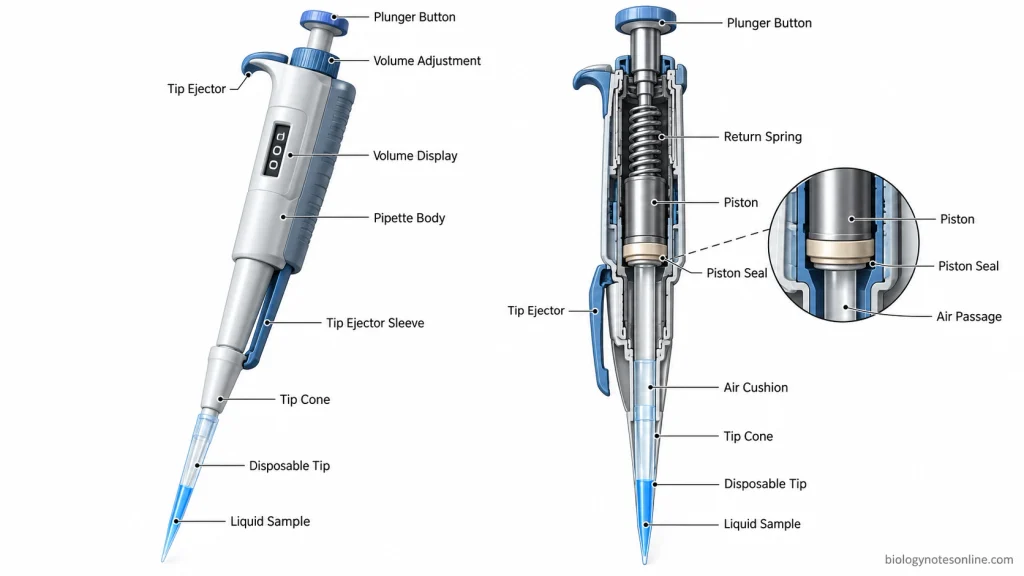
- Pipette Body (Handle)- The body is the outer part of the pipette that holds and supports its internal components. It provides a grip for holding the instrument during pipetting. Some pipettes have a finger hook or finger rest for better handling.
- Plunger Button- It is located at the upper end of the pipette and is operated by the thumb. Pressing the button moves the internal piston downward, while releasing it allows the piston to move upward. It generally has two stop positions, the first stop for measured liquid displacement and the second stop for blowing out the remaining liquid.
- Volume Adjustment Knob- It is used to set the required volume of liquid to be transferred. The knob controls the piston stroke in an adjustable-volume micropipette. In some models, the adjustment knob is combined with the plunger button.
- Volume Display Window- The volume indicator displays the selected volume of liquid, generally in microlitres (µL).
- Piston- The piston is an internal movable component present inside the pipette body. It moves up and down within a cylinder, changing the volume of the enclosed air and causing liquid to enter or leave the pipette tip. The piston does not directly touch the liquid.
- Return Spring- The spring is present inside the pipette and helps to return the piston and plunger button to their original position after releasing the thumb pressure.
- Piston Seal- The seal is present around the piston to prevent air leakage during pipetting. It maintains an airtight system within the pipette. In many micropipettes, a sealing ring (O-ring) is used for this purpose.
- Shaft (Tip Cone)- It is the lower part of the micropipette where the disposable pipette tip is attached. The shaft contains an air passage that connects the piston chamber with the pipette tip. The tip cone provides a tight fitting for the disposable tip.
- Tip Ejector Button and Sleeve- The tip ejector button is generally present near the plunger button. When pressed, it moves the ejector sleeve or arm downward and removes the used pipette tip from the shaft without touching it by hand.
- Disposable Pipette Tip- It is a detachable plastic tip fitted to the lower end of the micropipette. The liquid sample is held inside this tip during aspiration and dispensing. Different sizes of disposable tips are available for different pipette volume ranges. Filter tips are also used when additional protection against aerosols is required.
Working Mechanism of an Air Displacement Pipette
The working of an air displacement pipette is based on the movement of a piston and the air present between the piston and liquid. The piston does not come in direct contact with the liquid.
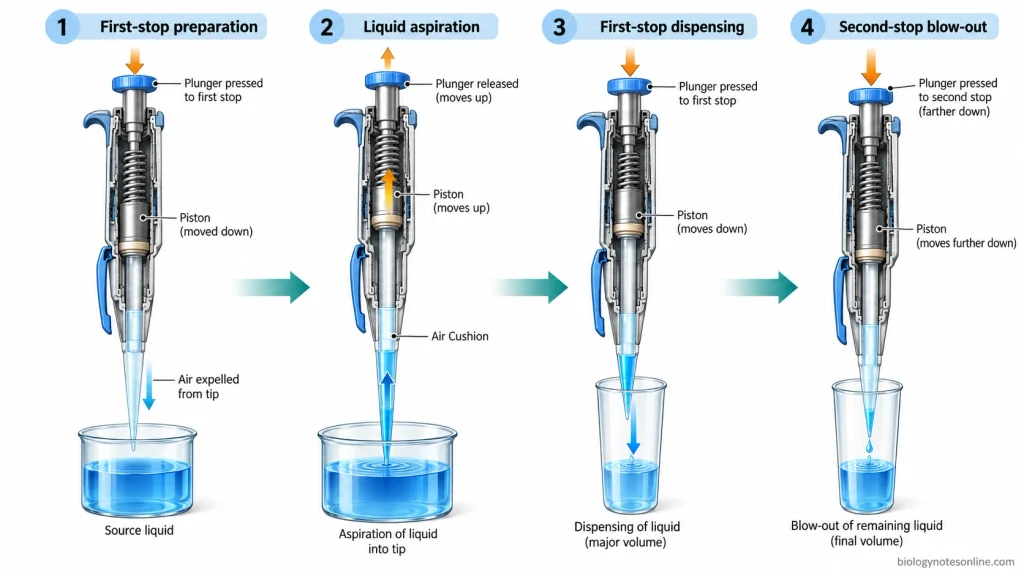
The working mechanism takes place in the following steps-
- The required volume is first set and a clean pipette tip is attached. The plunger is pressed down to the first stop. In this position, the piston moves downward and a measured volume of air is expelled from the tip.
- While keeping the plunger pressed, the pipette tip is placed slightly below the surface of the liquid.
- The plunger is then released slowly. The piston moves upward and increases the air space inside the pipette. This produces a partial vacuum (reduced air pressure) in the tip. Due to this pressure difference, the atmospheric pressure pushes the liquid up into the pipette tip. The required volume of liquid is aspirated.
- After aspiration, the tip is removed from the liquid. A small air cushion remains between the piston and the aspirated liquid. The liquid is held inside the tip due to the pressure balance and can be transferred to another vessel.
- For dispensing, the tip is placed against the inner wall of the receiving vessel. The plunger is again pressed to the first stop. The piston moves downward and displaces the air cushion, which pushes the liquid out through the tip.
- The plunger is further pressed to the second stop (blow-out) to expel the remaining liquid from the tip. The pipette tip is removed from the vessel while the plunger is still pressed. It is then released to its original position.
Types of Air Displacement Pipettes
Air displacement pipettes are of different types depending on the volume adjustment, operating mechanism and number of dispensing channels. These are as follows-
- Fixed-Volume Pipette- A fixed-volume pipette is used to transfer a particular volume of liquid. The volume cannot be changed during normal operation. These are generally used when the same amount of liquid is required repeatedly in laboratory procedures.
- Variable-Volume Pipette- The volume of liquid can be adjusted within a specified range. It has a volume adjustment mechanism through which different volumes are selected according to the requirement of the experiment. These pipettes are commonly used in the preparation of dilutions and reaction mixtures, where different amounts of liquid are required.
- Manual (Mechanical) Pipette- In this pipette, the movement of the piston is controlled manually by pressing the plunger button with the thumb. A spring is present inside the pipette which brings the piston back to its original position after releasing the button. No electrical power is required. It is commonly used for routine pipetting in laboratories.
- Electronic Pipette- The electronic pipette has a motor-driven piston, which is used for aspiration and dispensing of liquid. The required volume and pipetting functions are controlled electronically. Some models also have programmable functions. These are used for repeated dispensing and mixing of liquid samples.
- Single-Channel Pipette- It consists of one dispensing channel with a disposable pipette tip, used to transfer liquid into individual test tubes, microcentrifuge tubes and other laboratory containers.
- Multichannel Pipette– These pipettes have multiple dispensing channels arranged in a row. Generally, 8 or 12 channels are present. The pipette can aspirate and dispense several samples or equal volumes of a reagent at the same time. They are mainly used for handling multiple samples in microplates, such as 96-well plates.
Procedure for Air Displacement Pipetting
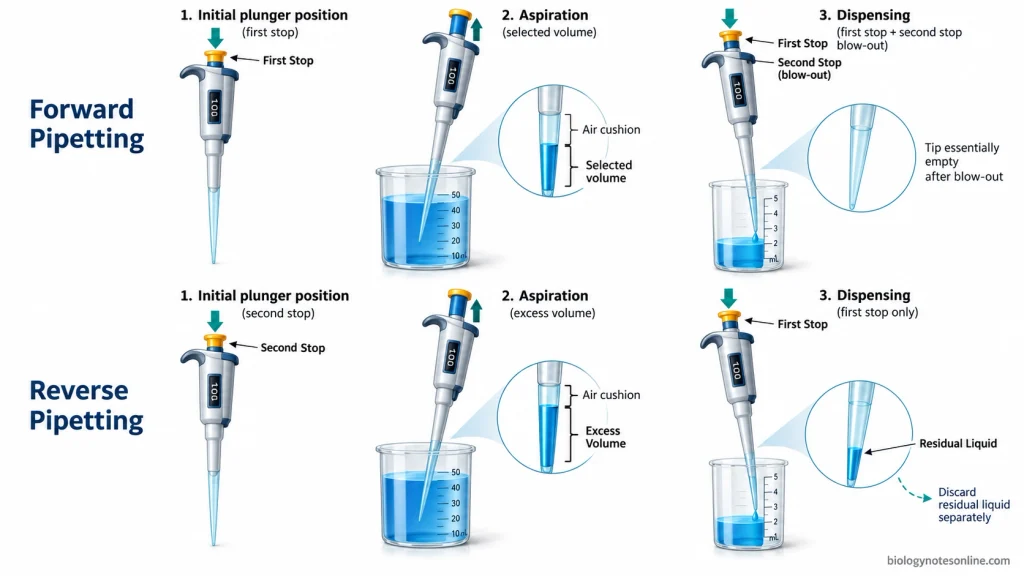
Air displacement pipetting is commonly carried out by forward pipetting. It is the standard method for most aqueous liquids. For viscous, foaming and some volatile liquids, reverse pipetting can be used.
Forward Pipetting Technique
- Select the micropipette according to the volume of liquid required. Set the required volume with the volume adjustment knob. The selected volume must remain within the specified volume range of the pipette.
- Attach a clean disposable pipette tip which is compatible with the micropipette. Fit the tip properly. An improperly fitted tip can allow leakage of air during pipetting.
- If required, pre-wet the tip by aspirating and dispensing the same liquid two or three times. Pre-wetting is particularly useful while transferring small volumes, and gives more consistent pipetting.
- Press the plunger to the first stop before the tip is placed into the liquid.
- Hold the pipette vertically. The tip is immersed slightly below the liquid surface, usually only a few millimetres depending on the volume and tip size. It should not be immersed too deeply.
- Release the plunger slowly and allow the liquid to enter the tip. Do not allow the plunger to snap back. Wait until aspiration is complete before taking the tip out of the liquid. No air bubbles should be present inside the tip.
- Take the tip out while keeping the pipette upright. If liquid remains on the outside of the tip, gently touch the tip against the inner wall of the source vessel.
- Place the tip against the inner wall of the receiving vessel at a slight angle. Press the plunger slowly to the first stop and dispense the measured liquid. The plunger is then pushed to the second stop to blow out the liquid remaining in the tip.
- While the plunger is still pressed, withdraw the tip along the vessel wall. Release the plunger only after the tip has been removed.
- Press the tip ejector button and discard the used tip into the appropriate waste container. A fresh tip is used for another sample to prevent cross-contamination.
Reverse Pipetting Technique
Reverse pipetting is used for liquids which are difficult to pipette by the normal forward method, such as viscous, foaming and some volatile liquids. A volume greater than the selected volume is taken up into the tip. Only the selected volume is delivered.
- Set the required volume and attach a clean disposable tip.
- Before placing the tip into the liquid, press the plunger down to the second stop.
- Immerse the tip slightly below the liquid surface and slowly release the plunger to its original position. An additional volume of liquid is drawn into the tip along with the selected volume. With viscous liquids, allow enough time for the liquid to completely enter the tip.
- Remove the tip from the liquid and carry it to the receiving vessel. Keep the pipette upright.
- Place the tip against the inner wall of the vessel. Press the plunger only up to the first stop. The selected volume is dispensed, while some liquid remains in the tip.
- Remove the tip without pressing the plunger to the second stop. This remaining liquid is not a part of the measured volume.
- Eject the tip and discard the residual liquid with the used tip into the appropriate waste container.
Factors Affecting Accuracy of Air Displacement Pipetting
Several factors can affect the accuracy of air displacement pipetting. Some of the important factors are as follows-
- Pipette Volume Range- A pipette should be selected according to the volume of liquid required. Pipetting very small volumes with a much larger capacity pipette can reduce the accuracy.
- Pipette Tip- The pipette tip must fit properly on the tip cone. A loose or unsuitable tip can allow air leakage and affects the volume of liquid aspirated. Damaged tips can also produce incorrect pipetting.
- Pre-wetting of Tip- Pre-wetting is done by aspirating and dispensing the liquid before taking the actual volume. It conditions the inner surface of the tip and the air present inside it. This is more useful when small volumes are pipetted.
- Immersion Depth- The tip should be immersed just below the surface of liquid during aspiration. If it is placed too deep, more liquid can be drawn into the tip. Very shallow immersion may cause aspiration of air.
- Pipette Position- During aspiration, the pipette is generally held in a vertical position. Holding the pipette at a large angle changes the hydrostatic pressure at the tip and can affect the volume aspirated.
- Plunger Movement- The plunger should be pressed and released slowly and with a consistent movement. Rapid or irregular release can cause splashing, air bubbles and incorrect aspiration. The same pipetting rhythm gives more consistent liquid transfer.
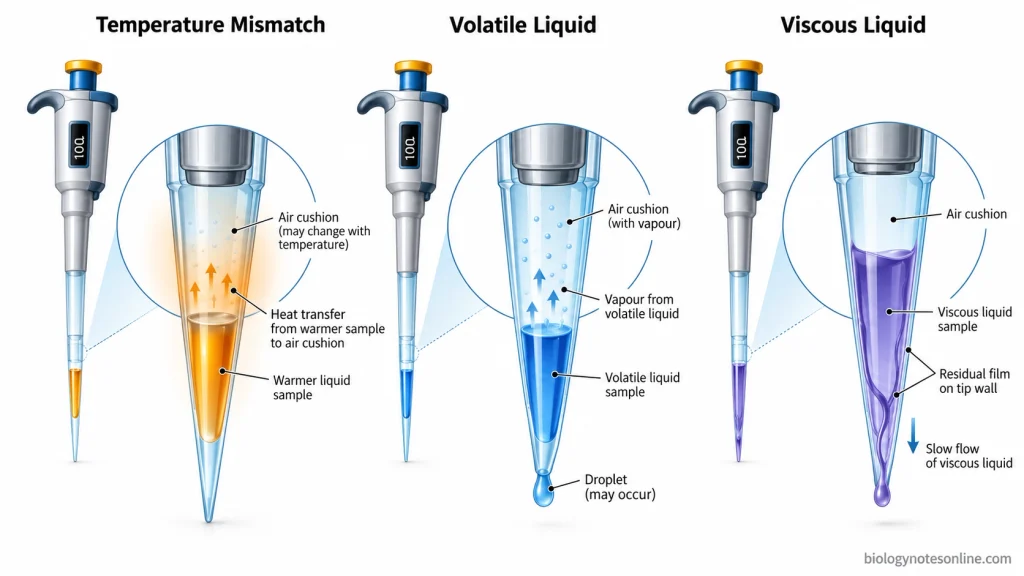
- Temperature- Temperature difference between the liquid, pipette, tip and surrounding air affects the air cushion present inside an air displacement pipette. The air may expand or contract when the temperatures are different, changing the volume of liquid aspirated. Pipette, tips and samples are preferably allowed to reach the same working temperature.
- Properties of Liquid- Viscous liquids move slowly into and out of the pipette tip and may remain attached to the inner wall. Volatile liquids can evaporate into the air cushion. Foaming liquids may introduce bubbles during aspiration. These liquids can give greater pipetting error with normal air displacement pipetting.
- Atmospheric Conditions- Changes in atmospheric pressure and humidity can influence air displacement measurements, particularly when very small volumes are handled. Evaporation becomes more significant with small liquid volumes.
- Calibration and Condition of Pipette- A poorly calibrated pipette will not deliver the selected volume correctly. Worn seals, damaged piston parts or air leakage also affect pipetting accuracy. Regular calibration and proper maintenance are required for accurate volume transfer.
- Operator Technique- Accuracy also depends on how the pipette is handled. Differences in aspiration speed, immersion depth, pipette angle, plunger operation and dispensing technique can produce variation between repeated measurements.
Air Displacement vs. Positive Displacement Pipetting
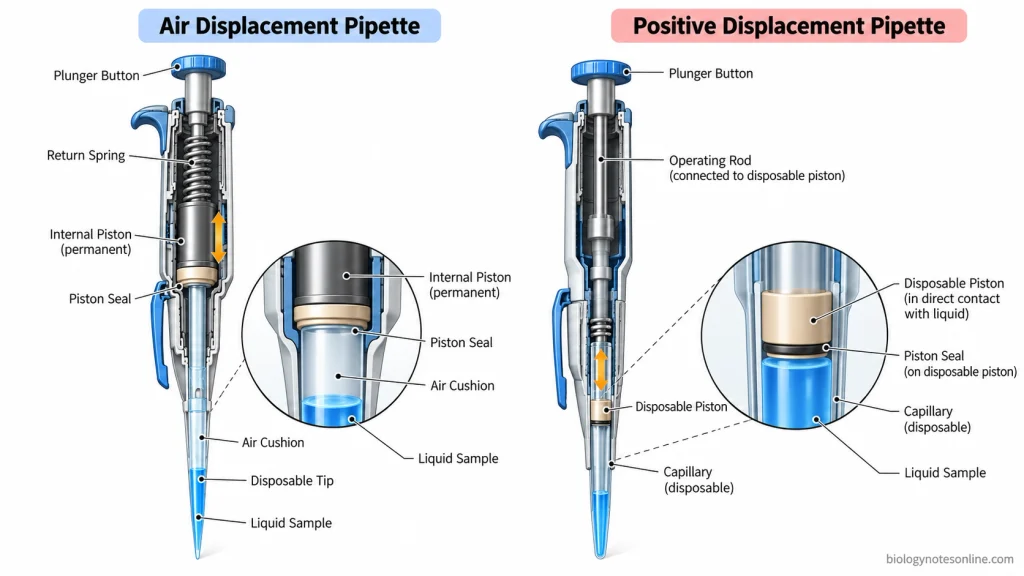
Air displacement pipetting and positive displacement pipetting differ mainly in the position of the piston and the presence of an air cushion between piston and liquid. In air displacement pipettes, the piston does not touch the sample. Positive displacement pipettes have the piston in direct contact with the liquid.
| Feature | Air Displacement Pipetting | Positive Displacement Pipetting |
|---|---|---|
| Piston and liquid | The piston remains inside the pipette body and does not directly come in contact with the liquid. | The piston is present within the tip or capillary and directly contacts the liquid sample. |
| Air cushion | An air cushion is present between the piston and liquid. It is compressible. | No air cushion is present between the piston and liquid. |
| Disposable tip | It generally uses a disposable plastic pipette tip. The piston remains a permanent part of the pipette. | A disposable capillary-piston assembly is generally used, containing both a capillary and movable piston. |
| Working mechanism | Movement of the piston changes the volume and pressure of the enclosed air. This pressure difference causes aspiration and dispensing of liquid. | Movement of the piston acts directly on the liquid inside the capillary. The liquid is aspirated and displaced by movement of this piston. |
| Aqueous liquids | It is commonly used for water-like solutions, buffers and most routine laboratory liquids. | It can also transfer aqueous liquids, but positive displacement is not necessarily more accurate for every aqueous application. |
| Viscous liquids | Highly viscous liquids enter and leave the tip slowly and may remain attached to the tip wall, which can produce volumetric error. | More suitable for highly viscous liquids because the piston directly moves the liquid and there is no compressible air cushion. |
| Volatile liquids | Volatile liquids can evaporate into the air cushion. The increased vapour pressure changes the behaviour of the air column and may affect the transferred volume. | Better suited for volatile liquids because there is no air cushion between the sample and piston. |
| Hot or cold samples | Temperature differences between the sample, pipette and surrounding air can cause expansion or contraction of the air cushion and affect pipetting volume. | Less affected by sample temperature because the air cushion is absent. It is useful for liquids which are considerably warmer or colder than room temperature. |
| Typical limitations | Accuracy can be affected by viscosity, volatility, temperature, air-cushion compression and other liquid properties, particularly with difficult samples and small volumes. | Disposable capillary-piston tips are more expensive. Performance with normal aqueous liquids is not always better than a properly used air displacement pipette. |
Air displacement pipettes are commonly used for normal aqueous samples because they are simple and suitable for routine liquid transfer. Their performance, however, depends partly on the behaviour of the enclosed air column.
Positive displacement pipetting is more suitable when the liquid is highly viscous, volatile, or has a temperature considerably different from the pipette and surrounding environment. With these liquids, direct contact between piston and sample reduces the errors produced by compression, expansion or vapour formation in an air cushion. It does not mean that positive displacement pipettes are always more accurate. The suitable pipetting method depends on the liquid and the required application.
Advantages of Air Displacement Pipetting
- It can measure and transfer very small volumes of liquid accurately when proper pipetting technique is followed.
- Variable-volume micropipettes allow different volumes to be selected within the specified range of the pipette.
- Disposable pipette tips can be changed between samples. This reduces the chance of cross-contamination during liquid transfer.
- The liquid remains inside the disposable tip and does not directly contact the piston during normal pipetting.
- It is simple and convenient for routine transfer of aqueous solutions, buffers and laboratory reagents.
- Small volumes can be aspirated and dispensed rapidly, making it useful where many liquid transfers are required.
- Air displacement pipettes are available in different volume ranges and configurations for handling different laboratory volumes.
Limitations of Air Displacement Pipetting
- The air cushion is affected by temperature, pressure and physical properties of the liquid, which can change the volume transferred.
- Highly volatile liquids may evaporate into the air cushion and cause dripping or inaccurate dispensing.
- Highly viscous liquids are difficult to aspirate and dispense completely with normal air displacement pipetting.
- Hot or cold samples can expand or contract the air present inside the pipette, affecting the amount of liquid aspirated.
- The accuracy depends greatly on operator technique. Changes in immersion depth, pipette angle, aspiration speed and pipetting rhythm can produce errors.
- Pipetting errors become more significant when very small volumes are handled.
- The pipette requires regular checking, calibration and proper maintenance. Air leakage or poor condition of pipette parts can affect volume transfer.
Applications of Air Displacement Pipetting
- Used to measure and transfer microliter volumes of samples, buffers and reagents in molecular biology experiments.
- Used for preparing reaction mixtures and adding small volumes of reagents during polymerase chain reaction (PCR).
- Used during deoxyribonucleic acid (DNA) isolation and for preparation and loading of samples in gel electrophoresis.
- Used to prepare serial dilutions of microbial cultures and transfer measured samples for plating.
- Small volumes of samples and reagents can be transferred into reaction tubes and multiwell plates.
- Used for mixing small liquid volumes by repeated aspiration and dispensing during sample preparation.
References
- Guan, X. L., Chang, D. P. S., Mok, Z. X., & Lee, B. (2023). Assessing variations in manual pipetting: An under-investigated requirement of good laboratory practice. Journal of Mass Spectrometry and Advances in the Clinical Lab, 30, 25–29. https://doi.org/10.1016/j.jmsacl.2023.09.001
- Pushparaj, P. N. (2020). Revisiting the micropipetting techniques in biomedical sciences: A fundamental prerequisite in good laboratory practice. Bioinformation, 16(1), 8–12. https://doi.org/10.6026/97320630016008
- Richter, T. A., Wilkinson, C. D., Griffiths, B. B., & Hunter, R. G. (2022). Pipette Olympics: An engaging exercise for undergraduate laboratory training. Journal of Undergraduate Neuroscience Education, 21(1), A81–A84. https://doi.org/10.59390/NOYQ7921
- Sander, L. C. (2017). Volumetric transfer of liquids. Journal of Research of the National Institute of Standards and Technology, 122, Article 2. https://doi.org/10.6028/jres.122.002
- Sanders, E. R. (2012). Aseptic laboratory techniques: Volume transfers with serological pipettes and micropipettors. Journal of Visualized Experiments, (63), Article 2754. https://doi.org/10.3791/2754
- Schuster, J., Kamuju, V., Zhou, J., & Mathaes, R. (2024). Piston-driven automated liquid handlers. SLAS Technology, 29(3), Article 100128. https://doi.org/10.1016/j.slast.2024.100128