

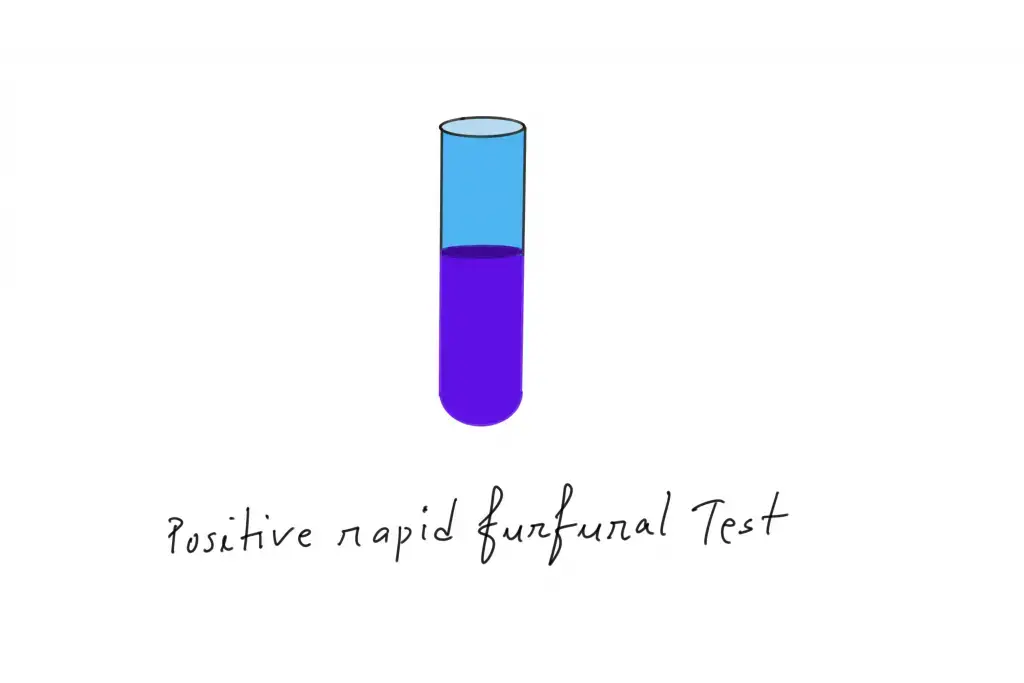
Rapid Furfural Test is a rapid chemical assay used to quickly distinguish between aldohexoses such as glucose and ketohexoses such as fructose. It is done when carbohydrate test solution is mixed with ethanolic α-naphthol solution (Molisch reagent) and concentrated hydrochloric acid (HCl) and then direct boiling is performed. It is based on the principle that ketohexoses are dehydrated much faster than aldohexoses under strong acidic condition. When mixture is boiled fructose is dehydrated rapidly and an organic compound is formed which is referred to as 5-hydroxymethylfurfural (HMF) and it reacts immediately with α-naphthol and deep purple or violet colour is produced within about 30 seconds. In case of glucose the reaction is delayed because glucose first undergo isomerization to become fructose and then dehydration occurs therefore within rapid 30 seconds the solution remains colourless or only faintly tinted. Sucrose also gives positive purple colour because heat and acid hydrolyze glycosidic bonds quickly and reactive fructose is released which shows same rapid colour reaction.
Principle of Rapid Furfural Test
It is a chemical test that is used to differentiate ketohexoses (fructose) and aldohexoses (glucose) based on their reaction speed in strong acid. This process occurs when carbohydrate is heated with concentrated hydrochloric acid (HCl) and it undergo dehydration. In this step three molecules of water is removed from sugar and a furan based aldehyde is formed which is referred to as 5-hydroxymethylfurfural (HMF). Ketohexoses are dehydrated very fast and HMF is produced almost immediately while aldohexoses reacts slowly because first it must isomerize into ketose and this step is energy demanding therefore the colour is delayed. The formed HMF is then condensed with alcoholic α-naphthol solution and a deep purple or violet coloured complex is produced. Hence if intense purple colour is formed within about 30 seconds of boiling it indicates ketohexose and if no immediate colour change is seen then it indicates aldohexose.
Objectives of Rapid Furfural Test
The objectives of Rapid Furfural Test are–
- To quickly differentiate between aldohexoses (glucose) and ketohexoses (fructose) in a given sample.
- To confirm presence of ketose sugars among unknown carbohydrates by rapid colour reaction.
- To identify fructose in biological fluids like urine which acts as a diagnostic marker for essential fructosuria and hereditary fructose intolerance and it can be differentiated from diabetes mellitus.
- To screen food products for adulteration such as addition of high glucose corn syrup in high fructose honey.
- To assess ripeness of fruits by observing change in ratio of glucose and fructose during maturation.
- To study dehydration kinetics and optimize industrial production of 5-hydroxymethylfurfural (HMF) for bio based chemical applications.
Requirements for Rapid Furfural Test
Requirements for Rapid Furfural Test are as follows-
- Carbohydrate test solution (1% aqueous solution of sugar to be tested prepared in distilled or deionized water).
- α-naphthol solution (Molisch reagent) (1% to 5% unoxidized α-naphthol dissolved in 95% to 99% ethanol).
- Concentrated hydrochloric acid (HCl) (laboratory grade about 37-38%) which act as dehydrating agent.
- Clean dry heat resistant test tubes.
- Test tube holder.
- Heat source (Bunsen burner for direct heating or boiling water bath).
- Mechanical pipettes or droppers for measuring and transferring solutions.
Procedure for Rapid Furfural Test
Procedure for Rapid Furfural Test is as follows-
- 2 ml of carbohydrate test solution (1% aqueous sugar solution) is taken in a clean heat resistant test tube.
- 2 drops (or up to 1 ml) of alcoholic α-naphthol solution (Molisch reagent) is added and the tube is swirled gently to mix.
- 5 ml of concentrated hydrochloric acid (HCl) is added into the tube and it is mixed properly to make uniform reaction mixture.
- The test tube is held with a holder and heated directly over Bunsen flame and boiling is brought as rapidly as possible.
- The solution is observed during boiling and the time taken for deep purple or violet colour appearance is noted.
- The tube is removed immediately after result is seen or after maximum 60 seconds and it is cooled under running tap water to stop further non specific reactions.
Result for Rapid Furfural Test
Result for Rapid Furfural Test are as follows-
- Fructose (Positive result)– Deep purple or violet colour is formed almost immediately or within first 30 seconds of boiling and it confirms ketohexose.
- Sucrose (Positive result)– Deep purple colour is developed within about 10 to 30 seconds because acid and heat hydrolyze sucrose rapidly and fructose is released.
- Pentoses (Positive result)– Intense purple or blue purple colour is formed very quickly usually within about 5 to 15 seconds.
- Glucose (Negative result)– No immediate colour change is seen and solution remains colourless or faintly tinted within first 30 seconds and it confirms aldohexose.
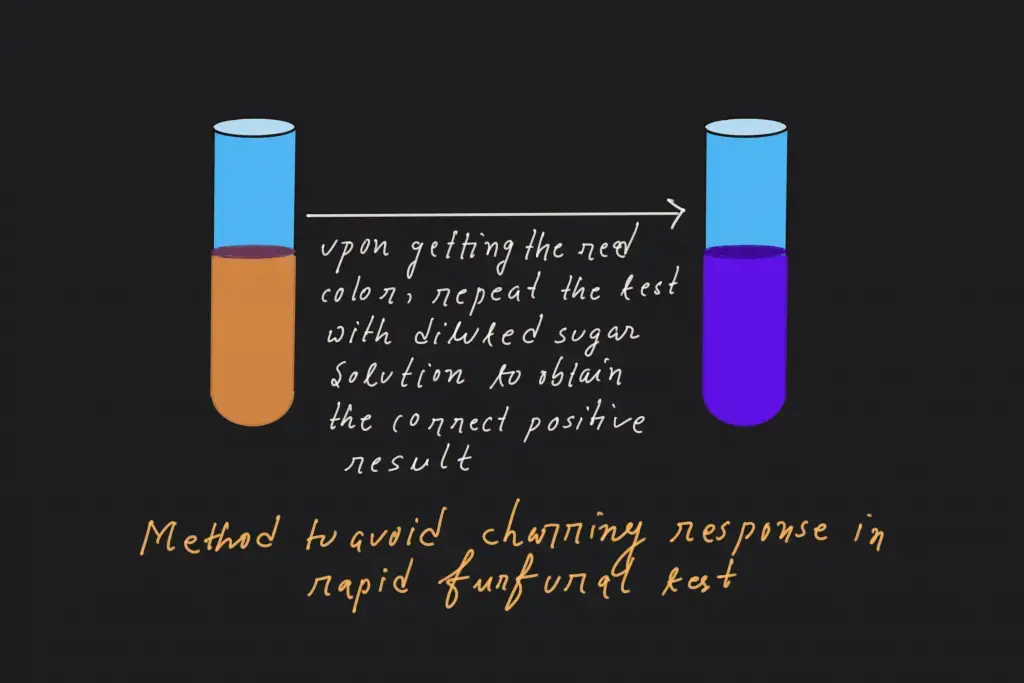
- Delayed false positive– If boiling is prolonged (about 2 to 5 minutes) then aldohexoses like glucose or other carbohydrates like starches can also produce delayed purple colour.
Uses of Rapid Furfural Test
Uses of Rapid Furfural Test are as follows-
- It is used to rapidly distinguish between aldohexoses (glucose) and ketohexoses (fructose) in a sample.
- It is used in food quality control to detect adulteration such as high fructose honey mixed with high glucose corn syrup and it also helps in assessing sweetness.
- It is used in agricultural monitoring to observe changing ratio of glucose and fructose to check fruit maturation and ripeness.
- It is used in clinical diagnosis to detect fructose in biological fluids like urine as a screening test for essential fructosuria and hereditary fructose intolerance and it can be differentiated from glucose related diabetes mellitus.
- It is used in brewing and enology to monitor conversion of mixed sugars during fermentation process.
- It is used in green chemistry and biorefining to study dehydration kinetics and to optimize industrial dehydration of carbohydrates into 5-hydroxymethylfurfural (HMF) which is used as building block for bio based plastics.
Advantages of Rapid Furfural Test
Advantages of Rapid Furfural Test are as follows-
- It gives very rapid result and presence of ketohexose (fructose) is confirmed within about 30 seconds of boiling therefore it is faster than other tests like Seliwanoff test which needs more heating time.
- The colour formed is deep purple or violet and it is intense therefore observation and interpretation is easier.
- It differentiates ketoses and aldoses effectively by using kinetic time window and ketohexoses reacts first before aldoses reacts hence false positive is reduced if time is controlled.
- The procedure is simple and it is based on basic wet chemistry therefore it is cost effective and no complex instruments are required.
- When 30 second limit and reagent purity is controlled the test gives reliable identification of unknown carbohydrates with good accuracy.
- It is useful in different fields and it can be used as quick screening tool in clinical diagnosis (fructose in urine) and food science (honey adulteration with high glucose corn syrup).
Limitations of Rapid Furfural Test
Limitations of Rapid Furfural Test are as follows-
- The test depends on strict 30 second boiling time and if boiling is prolonged for about 2 to 5 minutes then glucose can isomerize to fructose and false positive purple colour can be produced. Other carbohydrates like starch maltose and lactose can also break down and react if heating is too long.
- If fructose concentration is very low (below about 0.1%) then colour may be very faint or delayed and false negative result can be seen. If glucose concentration is very high (above about 5%) then rapid isomerization can occur and false positive may be obtained.
- It cannot differentiate free fructose and sucrose because heat and concentrated HCl hydrolyze sucrose rapidly and fructose is released and positive purple colour is produced.
- Temperature and heating condition must be maintained and vigorous boiling is required to reach about 100-110°C. If mixture is only warmed and not boiled properly then dehydration is slowed and false negative result can occur.
- The test is sensitive to reagent quality and fresh concentrated HCl (about 37-38%) is required. If acid is old and HCl gas is lost then reaction becomes slow and result may not be clear.
- Impurities in acid like oxidizing agents or iron salts can react with α-naphthol and abnormal colour can be produced and interpretation becomes confusing. If α-naphthol is oxidized then brown or green tint may be formed which can mask the actual purple colour.
References
- A Level Biology. (n.d.). Tests for carbohydrates | Types, principles, apparatus.
- Akulaamithsanthosh. (n.d.). Carbohydrate reactions and tests explained. Scribd.
- All Explained. (n.d.). Tests for carbohydrates [Video]. YouTube.
- Analytical evaluation of the rapid furfural test for the differentiation of glucose and fructose: Principles, kinetic mechanisms, and diagnostic applications. (n.d.).
- Ankara University. (n.d.). 2. qualitative tests of carbohydrate.
- Bhima Bhoi Medical College and Hospital. (n.d.). Practical record: Department of biochemistry. Scribd.
- Careers360. (2025, July 2). Molischs test – Definition, test procedure & reaction, uses, FAQs.
- East Point College of Pharmacy. (n.d.). Course outcomes (CO’s) code: BP209P biochemistry.
- Elchemy. (2026, March 28). Hydrochloric acid vs sulfuric acid: Which strong acid is right for your application?
- Hamza, H., Ali, K., & Kadhim, K. (n.d.). Seventh lecture: Carbohydrates tests. Al-Mustaqbal University.
- Kale, S. R., & Kale, R. R. (2020). Practical biochemistry & clinical pathology (29th ed.). Nirali Prakashan.
- Kandagatla, R. (n.d.). Carbohydrate identification tests. Maharashtra State Board of Technical Education.
- Krishna, Rani, Kiran, & Tejaswi, P. S. P. (n.d.). Instruction manual of practical biochemistry for MBBS. GVPIHC & MT.
- Li, M., Li, W., Lu, Y., Jameel, H., Chang, H.-M., & Mac, L. (2017). High conversion of glucose to 5-hydroxymethylfurfural using hydrochloric acid as a catalyst and sodium chloride as a promoter in a water/γ-valerolactone system. RSC Advances, 7, 14330-14336.
- Limtongnoi, C., Amnuaypanich, S., Naknonhan, S., Tharat, B., & Amnuaypanich, S. (2025, July). Predicted reaction rates of glucose, fructose, and HMF as a function of HCl. ResearchGate.
- Mallick, S. (n.d.). Carbohydrates sucrose. Scribd.
- Mathapati, S. R. (2022, January). Flow chart for identification and analysis of carbohydrate. ResearchGate.
- Mwafi, N. (n.d.). Qualitative tests for carbohydrates. Mutah University.
- Patterson, J., & Mura, C. (2013). Rapid colorimetric assays to qualitatively distinguish RNA and DNA in biomolecular samples. Journal of Visualized Experiments, (72), 50225.
- Practical clinical biochemistry. (2013). Jaypee Brothers Medical Publishers.
- Qualitative tests of carbohydrate. (n.d.).
- Reddit. (n.d.). Sulfuric acid and hydrochloric acid question. r/chemistry.
- Royal Society of Chemistry. (n.d.). RSC advances.
- Sattanathan, G., Padmapriya, S. S., & Balamuralikrishnan, B. (2020). Practical manual of biochemistry (1st ed.). Skyfox Publishing Group.
- Satyajit. (n.d.). Laboratory practical guidelines for carbohydrate test. Scribd.
- Shaheen. (n.d.). Carbohydrate biochemistry overview. Scribd.
- Sharma, U., Koli, P., & Gangotri, K. M. (2011). Brilliant cresyl blue – fructose for enhancement of solar energy conversion and storage capacity of photogalvanic solar cells. Fuel, 90, 3336–3342.
- Sigma-Aldrich. (n.d.). Furfural ACS reagent, 99 98-01-1.
- Singh, S. (2021, September 4). Why do ketoses undergo dehydration more rapidly than aldoses? Stack Exchange.
- Sonkar, S. M., Sengupta, S., & Singh, S. (2022). Spot test to differentiate between D-glucose and D-fructose. Journal of Laboratory Chemical Education, 10(1), 1-3.
- Syedasarwath414. (n.d.). Reactions of glucose – Foulger’s test for ketohexoses. Scribd.
- Torres, A. M. (n.d.). Experiment 5. Maharashtra State Board of Technical Education. Scribd.
- Various Authors. (n.d.). List of references for carbohydrate tests.
- Wang, X., Wang, Y., Zeng, Y., Zhu, X., Wang, C., Zhang, Q., Lu, Y., Wang, H., Wang, X., & Yang, X. (2014, July 2). Method for rapid and high-flux determination of polysaccharide content based on sulfuric acid and phenol (Patent No. CN103901031A). Lanzhou Institute of Husbandry and Pharmaceutical Sciences.
- Wikipedia contributors. (2024, April 13). Rapid furfural test. In Wikipedia, The Free Encyclopedia.
- Wikipedia contributors. (2025, August 24). Bial’s test. In Wikipedia, The Free Encyclopedia.
- Wikipedia contributors. (2025, August 24). Molisch’s test. In Wikipedia, The Free Encyclopedia.