

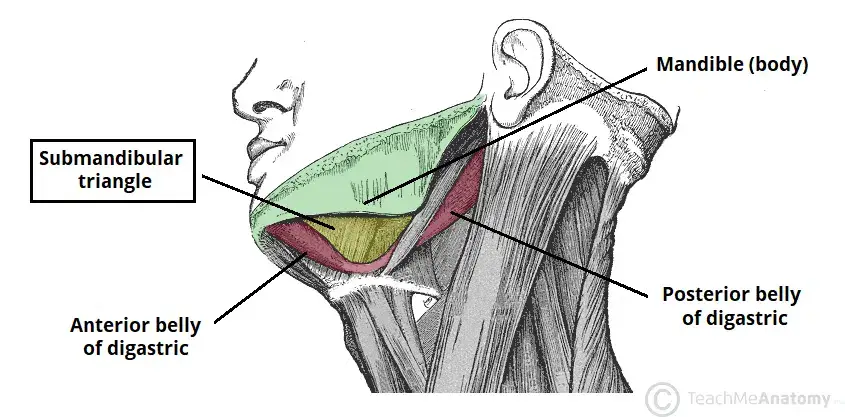
Submandibular gland is the second largest paired salivary gland of human body. It is about walnut size and its weight is about 7 to 15 gram. It is present in the submandibular triangle of neck, just below the lower border of mandible.
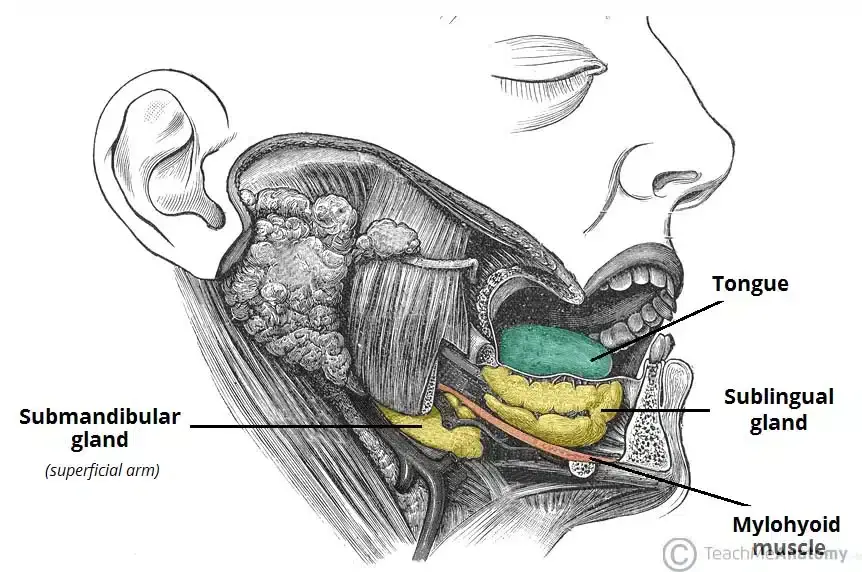
It is an encapsulated gland. The gland is divided by mylohyoid muscle into two parts. One is larger superficial lobe and another is smaller tongue like deep lobe.
Submandibular gland is a mixed salivary gland. It produces both serous secretion and mucous secretion. The serous part is watery and enzyme rich, and mucous part is thick and lubricating.
This gland produces major amount of saliva in resting condition. It gives about 60% to 70% of unstimulated saliva of mouth. So it helps in oral health, lubrication and starting of digestion.
The saliva of submandibular gland passes through Wharton’s duct. This duct runs on the floor of mouth and opens below the tongue at sublingual caruncle.
Clinically, this gland commonly forms salivary stone or sialolithiasis. It accounts for about 80% to 90% of all salivary stone cases. This occurs because its saliva is thick, calcium content is high and duct is long and bent, where saliva has to flow upward against gravity.
Characteristics of Submandibular Gland
- Size– Submandibular gland is the second largest major salivary gland and it is about walnut size.
- Weight– Its weight is about 7 to 15 gram.
- Location– It is located in the submandibular triangle of neck, just below the mandible and above the digastric muscles.
- Capsule– The gland is enclosed by a capsule, so it is an encapsulated gland.
- Lobes– It is divided by mylohyoid muscle into a larger superficial lobe and a smaller tongue like deep lobe.
- Secretion– It is a mixed gland because it produces both serous saliva and mucous saliva.
- Serous part– The serous secretion is watery and enzyme rich, and the serous cells are more in number.
- Mucous part– The mucous secretion is thick and lubricating type.
- Acini– About 90% acini of this gland are mainly formed by serous cells.
- Saliva production– It produces about 60% to 70% of unstimulated saliva during resting condition.
- Stimulated saliva– During eating or stimulation, parotid gland produces more saliva than submandibular gland.
- Duct– The saliva drains through submandibular duct or Wharton’s duct, which is about 5 cm long.
- Duct opening– Wharton’s duct runs along the floor of mouth and opens below the tongue at sublingual caruncle.
- Nerve supply– Its secretion is stimulated by parasympathetic fibres from facial nerve, through chorda tympani and submandibular ganglion.
- Blood supply– It receives blood from branches of facial artery and lingual artery.
- Venous drainage– The venous blood is drained mainly by facial vein.
- Stone formation– Submandibular gland is commonly affected by salivary stone or sialolithiasis.
- Stone cause– Stone formation is common because its saliva is more alkaline, thick, calcium rich and it passes through a long bending duct against gravity.
- Clinical point– It accounts for about 80% to 90% of all salivary stone cases.

Location of Submandibular Gland
- Primary region– Submandibular gland is mainly present in the submandibular triangle or digastric triangle of neck.
- Mandible relation– It is situated just below the lower border of mandible.
- Triangle boundary– The triangle is bounded superiorly by inferior margin of mandible, anteroinferiorly by anterior belly of digastric muscle and posteroinferiorly by posterior belly of digastric muscle.
- Submandibular fossa– The lateral surface of the gland rests in a shallow depression on inner side of mandible, called submandibular fossa.
- Neck position– The larger part of the gland lies in the neck region, below the floor of mouth.
- Mylohyoid relation– Submandibular gland lies around the mylohyoid muscle, and this muscle divides it into two continuous parts.
- Superficial lobe– The superficial lobe is the larger part and lies inferior and superficial to the mylohyoid muscle in submandibular space.
- Deep lobe– The deep lobe is smaller and tongue like part, which turns around the posterior free border of mylohyoid muscle.
- Floor of mouth– The deep lobe passes upward and lies in the floor of mouth.
- Deep lobe relation– The deep lobe lies between mylohyoid muscle laterally and hyoglossus and styloglossus muscles medially.
- Posterior extension– Posteriorly, the gland extends up to the stylomandibular ligament.
- Parotid separation– The stylomandibular ligament separates submandibular gland from the parotid gland.
- Inferior relation– Inferior part of the gland commonly overlaps the intermediate tendon of digastric muscle and insertion of stylohyoid muscle.
- General position– So, submandibular gland is placed between lower jaw, digastric muscles, mylohyoid muscle and floor of mouth.

Submandibular Gland Detail Structure or Anatomy
Gross Anatomy and Lobes
- Capsule– Submandibular gland is enclosed by a capsule, which is derived from the investing layer of deep cervical fascia.
- Lobar division– The gland lies around the mylohyoid muscle, and this muscle divides the gland into two continuous parts.
- Superficial lobe– Superficial lobe is the larger part of the gland and it forms the main bulk of submandibular gland in the neck.
- Deep lobe– Deep lobe is smaller tongue like part, which turns around the posterior free border of mylohyoid muscle and enters into the floor of mouth.
Microscopic Structure
- Gland type– Microscopically submandibular gland is a branched tubuloacinar gland, where tubular branches end into rounded secretory parts called acini.
- Mixed gland– It is a mixed gland because it has both serous cells and mucous cells.
- Serous predominance– The gland is mainly serous type, because about 90% of the glandular acini are serous acini.
- Serous acini– Serous acini are formed by pyramidal cells with central or basal nucleus, and they secrete watery fluid rich in protein and enzyme like amylase.
- Mucous acini– Mucous acini are pale or foamy looking cells with flattened basal nucleus, and they secrete thick mucin for lubrication.
- Serous demilunes– Serous demilunes are crescent shaped serous cell caps present at the end of mucous acini, but they may be artificial structure due to swelling of mucous cells during fixation.
- Myoepithelial cells– Myoepithelial cells are special contractile cells present around the acini and intercalated ducts, and they squeeze saliva into the duct system.
Duct System
- Intercalated duct– Saliva first passes into intercalated ducts, which are lined by simple cuboidal epithelium.
- Striated duct– From intercalated duct, saliva passes into striated ducts, which are lined by columnar epithelium with basal striations.
- Wharton’s duct– All small ducts finally open into the main excretory duct, called Wharton’s duct or submandibular duct.
- Duct size– Wharton’s duct is about 5 cm long and about 1.5 to 4 mm in diameter.
- Duct course– Wharton’s duct comes from the deep lobe, passes forward in the floor of mouth between mylohyoid muscle and hyoglossus muscle, and also loops under the lingual nerve.
- Duct opening– The duct opens into oral cavity at the sublingual caruncle or papilla, present on each side of lingual frenulum below the tongue.
Blood and Lymph Supply
- Arterial supply– The gland is mainly supplied by facial artery, through its submental branch and sublingual branch, and also receives blood from lingual artery.
- Facial artery relation– Facial artery grooves the posterior part of the submandibular gland.
- Venous drainage– Venous blood is drained by facial vein and sublingual vein, which finally pass into the internal jugular system.
- Facial vein relation– Facial vein crosses the superficial surface of the gland.
- Lymph drainage– Lymph first drains into submandibular lymph nodes, and then passes into deep cervical lymph nodes or jugulodigastric lymph nodes.
Nerve Supply
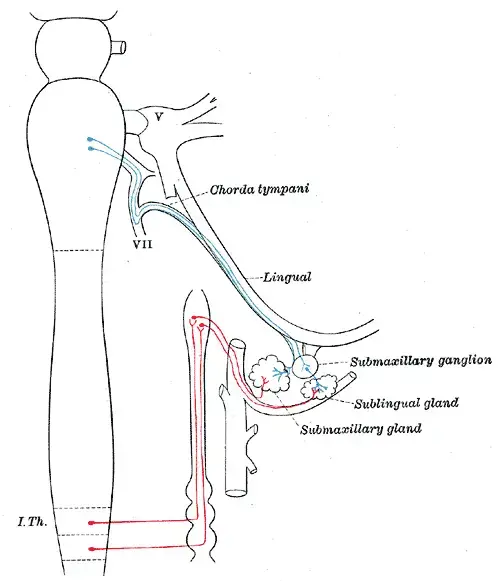
- Parasympathetic supply– Parasympathetic fibres stimulate saliva secretion, and preganglionic fibres come from facial nerve (CN VII) through chorda tympani and join with lingual nerve.
- Submandibular ganglion– These fibres synapse in submandibular ganglion, and postganglionic fibres then enter directly into the gland.
- Sympathetic supply– Sympathetic fibres reduce salivary volume and produce vasoconstriction.
- Sympathetic pathway– Postganglionic sympathetic fibres arise from superior cervical ganglion and reach the gland along the periarterial plexus of facial artery.
Relationship of Submandibular Gland with Nerves
- Lingual nerve– Lingual nerve is a branch of trigeminal nerve (CN V3). It gives general sensory supply to submandibular gland. It has close relation with Wharton’s duct. It passes lateral to the duct, then loops below the duct and comes on medial side.
- Chorda tympani– Chorda tympani is a branch of facial nerve (CN VII). It carries preganglionic parasympathetic fibres for secretion of saliva. These fibres join with lingual nerve and reach the submandibular ganglion.
- Submandibular ganglion– Submandibular ganglion is suspended from the lingual nerve. It is present on the medial surface of submandibular gland. Here preganglionic fibres synapse and postganglionic fibres enter into the gland.
- Sympathetic fibres– Sympathetic fibres arise from superior cervical ganglion. They reach the gland through plexus around external carotid artery and facial artery. It causes vasoconstriction and saliva becomes thick and viscous.
- Marginal mandibular nerve– Marginal mandibular nerve is a branch of facial nerve (CN VII). It passes superficial to the submandibular gland. It lies over the fascial capsule and facial vein. So it may be injured during removal of gland.
- Cervical branch– Cervical branch of facial nerve (CN VII) crosses the superficial surface of submandibular triangle. It also passes over the submandibular gland.
- Hypoglossal nerve– Hypoglossal nerve (CN XII) lies deep and inferior to the deep lobe of submandibular gland. It runs parallel and below the Wharton’s duct. So it is important during gland surgery and stone removal.
- Mylohyoid nerve– Mylohyoid nerve passes on the inferior surface of mylohyoid muscle. It lies deep to the superficial lobe of submandibular gland in submandibular space.
Innervation of Submandibular Gland
A. Parasympathetic Innervation
- Type– Parasympathetic innervation is the main secretomotor supply of submandibular gland. It helps in secretion of watery saliva.
- Origin– The nerve fibres starts from superior salivatory nucleus present in the pons of brainstem.
- Pathway– Preganglionic fibres passes through facial nerve (CN VII) and then through chorda tympani nerve.
- Lingual nerve joining– Chorda tympani joins with lingual nerve, which is a branch of mandibular nerve (CN V3).
- Ganglion– These fibres reaches the submandibular ganglion. It is suspended from the lingual nerve near the gland. Here the fibres synapse.
- Postganglionic fibres– Short postganglionic fibres enters directly into submandibular gland and supply the secretory cells.
- Action– It releases acetylcholine. It stimulates acinar cells for saliva secretion and myoepithelial cells for contraction. It also causes vasodilation.
B. Sympathetic Innervation
- Type– Sympathetic innervation is mainly vasomotor supply of submandibular gland.
- Origin– Preganglionic fibres starts from thoracic part of spinal cord and then reaches superior cervical ganglion.
- Ganglion– In superior cervical ganglion, the fibres synapse and postganglionic fibres are formed.
- Pathway– Postganglionic fibres passes around arteries as periarterial plexus of external carotid artery, facial artery and lingual artery.
- Action– It causes vasoconstriction. Blood flow becomes reduced. Saliva becomes thick, viscous and protein rich.
C. Sensory Innervation
- Sensory nerve– General sensation from submandibular gland and Wharton’s duct is carried by lingual nerve.
- Sensation type– Lingual nerve carries pain, pressure and general sensation from the gland and its duct.
D. Important Nerve Relations
- Marginal mandibular nerve– Marginal mandibular nerve is a branch of facial nerve (CN VII). It passes superficial to the gland. It supplies lower lip muscles. It may be injured during gland surgery.
- Hypoglossal nerve– Hypoglossal nerve (CN XII) lies deep and inferior to submandibular gland. It supplies tongue muscles. It is important during gland removal and stone surgery.
Clinical Significance of Submandibular Gland
- Sialolithiasis– Submandibular gland is commonly affected by salivary stone or sialolithiasis. It forms about 80% to 90% of all salivary duct stone. This is because the saliva is thick, alkaline and calcium rich. Wharton’s duct is also long, bent and saliva passes upward against gravity.
- Sialadenitis– Sialadenitis means inflammation of submandibular gland. It is commonly caused by obstruction of duct by stone. Bacteria may be trapped there, such as Staphylococcus aureus and Streptococcus pyogenes. Viral infection like mumps may also cause it.
- Tumour– Tumour of submandibular gland is less common than parotid gland, but malignant chance is more. About 40% to 50% tumours may be malignant. Common malignant tumours are adenoid cystic carcinoma and mucoepidermoid carcinoma.
- Surgical nerve injury– During removal of submandibular gland or submandibulectomy, some nerves are at risk. These are marginal mandibular nerve, lingual nerve and hypoglossal nerve. Injury may cause lower lip, tongue or sensory problem.
- Xerostomia– Submandibular gland produces about 60% to 70% of resting saliva. So damage of this gland causes dry mouth or xerostomia. It may occur due to head and neck radiation, some drugs and Sjögren’s syndrome. It may cause dental caries, fungal infection and swallowing difficulty.
- Sialadenosis– Sialadenosis is painless and non-inflammatory enlargement of submandibular gland. It may indicate systemic disease. It is seen in diabetes, malnutrition like bulimia and advanced liver cirrhosis.
- Ranula– Injury of submandibular gland or its duct may cause leakage of mucous secretion into nearby tissue. This forms a bluish mucous cyst on the floor of mouth, called ranula. Some cases need surgical excision.
Tests for Submandibular Gland
A. Clinical Examination
- Bimanual palpation– In this test one hand is kept inside the floor of mouth and another hand is kept outside on neck. It is used to feel stone, swelling, tenderness or any mass of submandibular gland.
B. Imaging Tests
- Ultrasound– Ultrasound is commonly the first test for submandibular gland. It is non-invasive and used to detect salivary stone, inflammation, abscess, solid tumour and cystic swelling.
- CT scan– Computed Tomography (CT) scan is used to detect calcified salivary stones, gland mass and surrounding tissue inflammation. It gives clear image of deep part also.
- Cone beam CT– Cone Beam CT (CBCT) gives 3D image of gland and duct region. It has less radiation and less distortion than normal medical CT scan.
- MRI– Magnetic Resonance Imaging (MRI) is used for complex disease of submandibular gland. It shows deep tissue spread, tumour relation and nearby nerve involvement.
- X-ray– Plain X-ray or intraoral occlusal film is used to see radiopaque or calcified salivary stones in Wharton’s duct.
- Sialography– In conventional sialography, contrast dye is injected into Wharton’s duct and then X-ray is taken. It shows duct system, narrowing and blockage.
- MR sialography– MR sialography is an MRI based test. It shows salivary duct without contrast dye and without radiation.
- TPT scan– Technetium 99m pertechnetate scan is a nuclear scan. It is used to check salivary flow and sometimes helps to identify type of salivary tumour.
C. Endoscopic Test
- Sialendoscopy– Sialendoscopy is done by inserting a very small camera into salivary duct. It directly shows the duct, stone or stricture and stone can also be removed in same procedure.
D. Biopsy Tests
- FNAB– Fine Needle Aspiration Biopsy (FNAB) is done by a thin needle. Cells are taken from solid lesion of submandibular gland and examined for tumour or cancer.
- Core needle biopsy– Core needle biopsy uses a larger needle than FNAB. It gives more tissue sample and helps in diagnosis, but bleeding risk is little more.
- Excisional biopsy– In excisional biopsy, the mass or whole submandibular gland is surgically removed and examined under microscope for final diagnosis.
E. Functional and Laboratory Tests
- Salivary flow test– Salivary flow rate measurement is used to measure saliva production from submandibular gland. It helps in dry mouth or xerostomia cases.
- Blood test– Serologic test is done when autoimmune disease is suspected. It includes ANA, Rheumatoid Factor, anti-SSA/Ro, anti-SSB/La and sometimes serum amylase.
- Sjögren’s test– In suspected Sjögren’s syndrome, blood test and salivary flow test are important. It helps to find autoimmune damage of salivary gland.
Functions of Submandibular Gland
- Saliva production– Submandibular gland is main salivary gland in resting condition. It gives about 60% to 70% of unstimulated saliva of mouth.
- Lubrication– The mucous cells secretes thick mucin. Important mucins are MUC5B and MUC7. It covers oral tissue and prevents dryness. It also makes food bolus slippery.
- Swallowing– The saliva mixes with food. Food becomes soft and smooth. So swallowing becomes easy.
- Speech– Saliva keeps the mouth moist. It helps in movement of tongue and lips. So speech becomes clear and easy.
- Digestion– The serous cells secretes α-amylase or ptyalin. This enzyme starts starch digestion in mouth. Starch is changed into simpler sugar like maltose.
- Tissue protection– Submandibular gland gives Epidermal Growth Factor (EGF). It protects oral mucosa, esophageal mucosa and gastric mucosa. It also helps in healing of ulcer.
- Gastric protection– EGF also reduces gastric acid secretion. So injury of stomach lining is decreased.
- Vitamin B12 protection– The gland secretes haptocorrin or R-protein. It binds with vitamin B12. This protects vitamin B12 from acid of stomach.
- Antibacterial action– Saliva contains lysozyme. It breaks the bacterial cell wall. So bacteria are destroyed in oral cavity.
- Lactoferrin action– Saliva contains lactoferrin. It binds with iron. Bacteria cannot get enough iron. So bacterial growth is reduced.
- Immune defence– Saliva contains secretory IgA (sIgA). It prevents bacteria and virus from attaching to oral epithelium.
- pH control– Saliva contains electrolytes and buffer. It maintains normal pH of mouth.
- Oral cleaning– Saliva washes food debris from mouth and teeth. It helps in oral hygiene and prevents dental problem.
References
- Salivary glands, saliva and salivation. (2015). Pocket Dentistry.
- Analysis of Salivary IgA, Amylase, Lactoferrin, and Lysozyme Before and After Comprehensive Dental Treatment in Children: A Prospective Study. (n.d.). PMC–NIH.
- Al-Hayani, A. (2007). Anatomical localisation of the marginal mandibular branch of the facial nerve. Folia Morphologica, 66(4), 450–451.
- Amano, O., Mizobe, K., Bando, Y., & Sakiyama, K. (2012). Anatomy and Histology of Rodent and Human Major Salivary Glands. Acta Histochemica et Cytochemica, 45(5), 241–250.
- Ghannam, M. G., & Singh, P. (2023). Anatomy, Head and Neck, Salivary Glands. In StatPearls. StatPearls Publishing.
- Grewal, J. S., Jamal, Z., & Ryan, J. (2022). Anatomy, Head and Neck, Submandibular Gland. In StatPearls. StatPearls Publishing.
- Characterization and immunohistochemical localization of rat salivary cobalamin-binding protein and comparison with human salivary haptocorrin. (n.d.). PubMed.
- Ding, Y., Su, J.-Z., & Yu, G.-Y. (2024). Comparison of epidermal growth factor expression and secretion in human salivary glands. Archives of Oral Biology, 164, 105989.
- Comprehensive Salivary Flow Measurement for Dry Mouth Diagnosis. (n.d.). The Kingsley Clinic.
- Degradation of MUC7 and MUC5B in Human Saliva. (n.d.). PMC–NIH.
- Villa, A., Connell, C. L., & Abati, S. (2014). Diagnosis and management of xerostomia and hyposalivation. Therapeutics and Clinical Risk Management, 11, 45–51.
- EGF. (n.d.). Multi Sciences Biotech.
- Expression and Localization of α-Amylase in the Submandibular and Sublingual Glands of Mice. (n.d.). PMC–NIH.
- Min, H. J., Lee, S. Y., Yang, H. S., & Kim, K. S. (2020). Factors Influencing the Subjective Symptoms of Submandibular Gland Sialolithiasis. Bangladesh Journal of Medical Science, 19(2), 240–244.
- Giant Submandibular Calculus Eroding Oral Cavity Mucosa. (n.d.). PMC–NIH.
- Wikipedia contributors. (2026). Haptocorrin. In Wikipedia, The Free Encyclopedia.
- WikiDoc contributors. (2018). Haptocorrin. In WikiDoc.
- Brazen, B., & Dyer, J. (2023). Histology, Salivary Glands. In StatPearls. StatPearls Publishing.
- Al-Eryani, K. (n.d.). How to Diagnose and Remove Salivary Stones (Sialoliths). Herman Ostrow School of Dentistry of USC.
- Importance of Saliva. (n.d.). Skygate Dental.
- D’Agostino, C., Elkashty, O. A., Chivasso, C., Perret, J., Tran, S. D., & Delporte, C. (2020). Insight into Salivary Gland Aquaporins. Cells, 9(6), 1547.
- Introduction. (2015). Pocket Dentistry.
- Brelje, T. C., & Sorenson, R. L. (2026). MH 095 Submandibular Gland. Histology Guide.
- MUC5B levels in submandibular gland saliva of patients treated with radiotherapy for head-and-neck cancer: A pilot study. (n.d.). PMC–NIH.
- Major Salivary Glands—Parotid, Sublingual and Submandibular. (n.d.).
- Marginal mandibular branch of the facial nerve: An anatomical study. (n.d.). PMC–NIH.
- Oral Immune System. (n.d.).
- Kessler, A. T., & Bhatt, A. A. (2018). Review of the Major and Minor Salivary Glands, Part 1: Anatomy, Infectious, and Inflammatory Processes. Journal of Clinical Imaging Science, 8, 47.
- Hashim, M. (2024). Salivary Gland Anatomy and Physiology.
- Gavião, M. B. D., & van der Bilt, A. (n.d.). Salivary Secretion and Chewing: Stimulatory Effects from Artificial and Natural Foods. Journal of Applied Oral Science.
- Iorgulescu, G. (2009). Saliva between normal and pathological: Important factors in determining systemic and oral health. Journal of Medicine and Life, 2(3), 303–307.
- Salivary Glands: Location & Function. (2025). Cleveland Clinic.
- Wikipedia contributors. (2026). Salivary gland. In Wikipedia, The Free Encyclopedia.
- Salivary gland function, development, and regeneration. (n.d.). PMC–NIH.
- Sheth, C. (n.d.). Salivary mucins play a role in host defense and prevent diseases. Blog de Odontología, Universidad CEU Cardenal Herrera.
- Wikipedia contributors. (2024). Serous demilune. In Wikipedia, The Free Encyclopedia.
- Hammett, J. T., & Walker, C. (2024). Sialolithiasis. In StatPearls. StatPearls Publishing.
- Wikipedia contributors. (2025). Sialolithiasis. In Wikipedia, The Free Encyclopedia.
- Al-Muharraqi, M. A. (n.d.). Submandibular Region.
- Cumpston, E., Hohman, M. H., Kennedy, E., & Chen, P. (2025). Submandibular Salivary Gland Excision. In StatPearls. StatPearls Publishing.
- Wikipedia contributors. (n.d.). Submandibular gland. In Wikipedia, The Free Encyclopedia.
- Submandibular gland—e-Anatomy. (n.d.). IMAIOS.
- Shahid, S., & Zehra, U. (2023). Submandibular triangle: Anatomy and clinical notes. Kenhub.
- The Salivary Glands. (n.d.). TeachMeAnatomy.
- The Submandibular Gland: A Comprehensive Analysis of Macro-Anatomy, Histological Complexity, and Physiological Significance. (n.d.).
- Thesleff, I., Viinikka, L., Saxén, L., Lehtonen, E., & Perheentupa, J. (1988). The parotid gland is the main source of human salivary epidermal growth factor. Life Sciences, 43(1), 13–18.
- Proctor, G. B. (2016). The physiology of salivary secretion. Periodontology 2000, 70(1), 11–25.
- Zhou, J., Wang, J., Shen, J., Lin, Y., Kang, L., Wang, Y., Zhou, Y., Liao, G., & Ren, B. (2026). The roles of salivary secretory IgA on the development of oral candidiasis. Frontiers in Oral Health, 7, 1760095.
- Yamashina, S., Tamaki, H., & Katsumata, O. (1999). The serous demilune of rat sublingual gland is an artificial structure produced by conventional fixation. Archives of Histology and Cytology, 62(4), 347–354.
- The serous demilune of rat sublingual gland is an artificial structure produced by conventional fixation. (n.d.). Semantic Scholar.
- The submandibular duct (or Wharton’s duct) constitutes the…. (n.d.). ResearchGate.
- An anatomic evaluation and surgical approach to submandibular gland resection for facial rejuvenation. (n.d.). PubMed.