

Digastric muscle is a small suprahyoid muscle present in the neck below the lower jaw. It is an important muscle because it helps in movement of mandible, hyoid bone and larynx.
The name digastric means “two bellies”. So this muscle has two parts, anterior belly and posterior belly. These two bellies are joined in the middle by an intermediate tendon.
It helps in common activities like chewing, swallowing, speaking and breathing. When the hyoid bone remains fixed, it depresses the mandible and helps to open the mouth.
When the mandible is fixed, the muscle elevates the hyoid bone and larynx. This movement helps during swallowing and also helps to prevent choking.
Characteristics of Digastric Muscle
- Digastric muscle is a small suprahyoid muscle present in the anterior part of neck, below the mandible.
- It is made up of two muscular bellies, anterior belly and posterior belly.
- The two bellies are connected by an intermediate tendon present in the middle part.
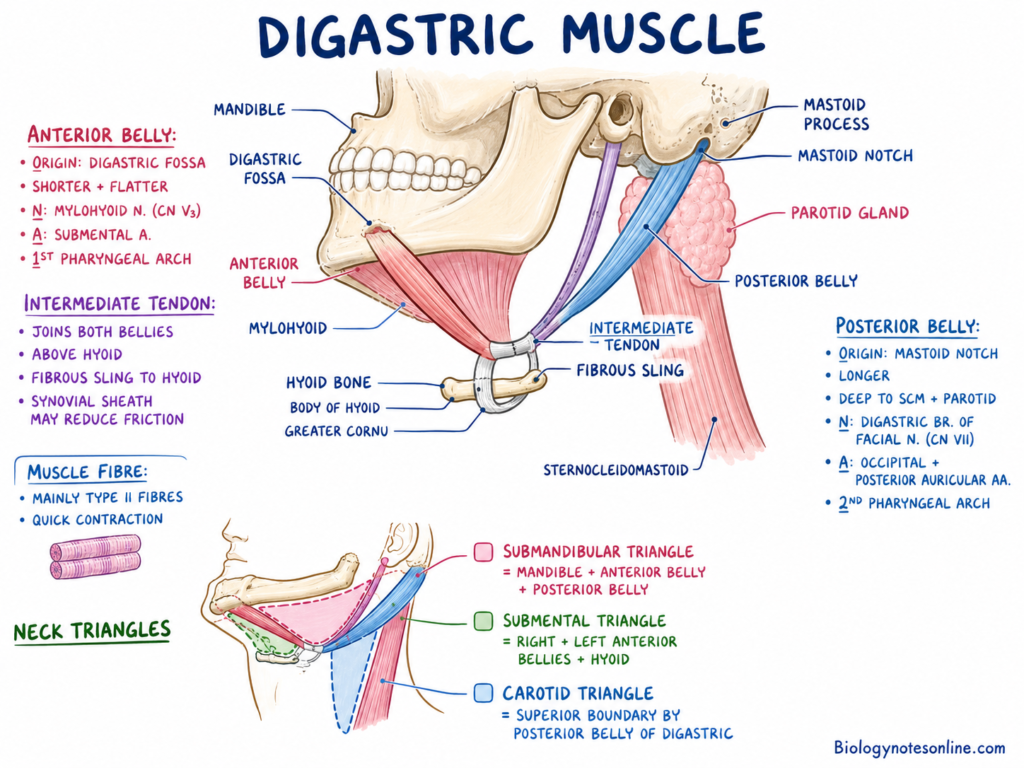
- The anterior belly arises from the digastric fossa of the mandible.
- The posterior belly arises from the mastoid notch of the temporal bone.
- The intermediate tendon is attached to the hyoid bone by a fibrous loop or sling.
- The two bellies develop from different embryonic arches. The anterior belly develops from the first pharyngeal arch and the posterior belly develops from the second pharyngeal arch.
- Due to different origin, the innervation is also different. The anterior belly is supplied by mylohyoid nerve, branch of trigeminal nerve (CN V).
- The posterior belly is supplied by facial nerve (CN VII).
- The blood supply of anterior belly is mainly from submental artery.
- The blood supply of posterior belly is from posterior auricular artery and occipital artery.
- It helps to depress the mandible when the hyoid bone is fixed. This helps in opening of mouth.
- It also elevates the hyoid bone and larynx when the mandible is fixed. This is important during swallowing.
- The anterior belly may show variations commonly. Extra muscular belly or abnormal insertion point may be found.
- It is an important surgical landmark in neck region. It helps to locate some nerves and blood vessels during neck surgery.
- It may also be used in reconstructive surgery as a muscle flap.
Location of Digastric Muscle
- Digastric muscle is located on both side of the anterior part of neck.
- It is present just below the mandible or lower jaw.
- It lies between the lower jaw and the base of skull, through the attachment with hyoid bone.
- The anterior belly is present near the midline, below the chin region.
- It starts from the digastric fossa present on the inner surface of mandible.
- From this area, the anterior belly passes downward and backward towards the hyoid bone.
- The anterior belly lies superficial to the mylohyoid muscle.
- The posterior belly is present near the base of skull.
- It starts from the mastoid notch of the temporal bone, present behind and below the ear.
- From this area, the posterior belly passes downward and forward.
- The posterior belly runs deep to the parotid gland and sternocleidomastoid muscle.
- The intermediate tendon is present just above the hyoid bone.
- This tendon joins the anterior belly and posterior belly of the muscle.
- The tendon is held in its position by a fibrous sling attached with the hyoid bone.
- The position of digastric muscle forms important boundaries in neck region.
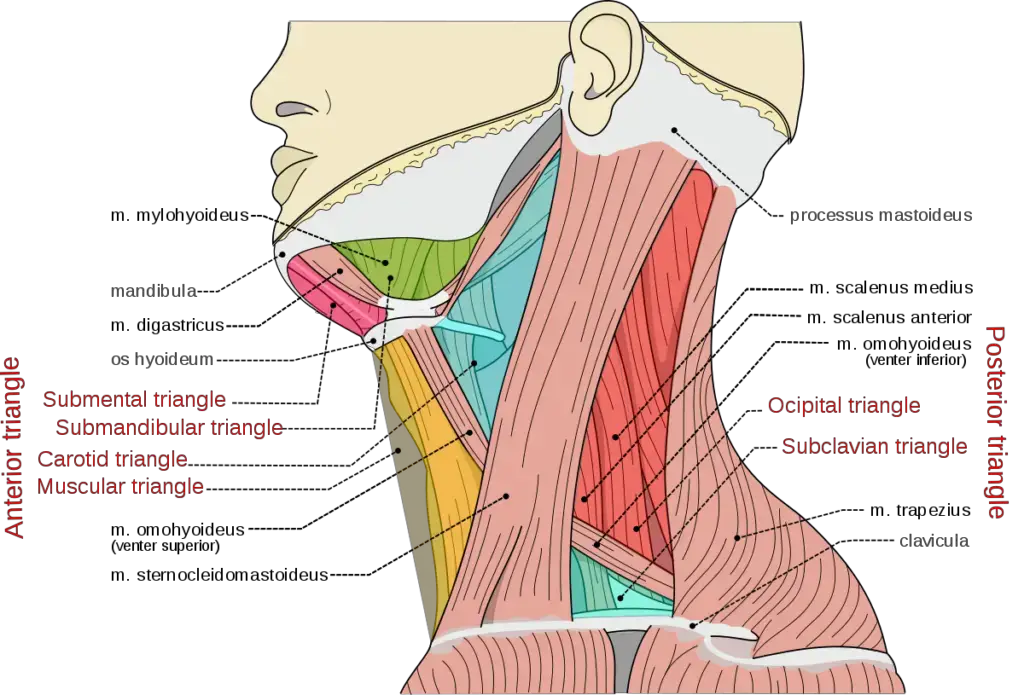
- It helps to form the submandibular triangle, submental triangle and carotid triangle.

Detail Structure or Anatomy of Digastric Muscle
General Anatomy
- Digastric muscle is a paired suprahyoid muscle present in the neck region.
- It connects the mandible and base of skull with the help of hyoid bone.
- It has two muscular parts. They are anterior belly and posterior belly.
- These two bellies are joined in the middle by an intermediate tendon.
Anterior Belly
- The anterior belly is also called venter anterior.
- It arises from the digastric fossa of the mandible.
- The digastric fossa is a depression present on the inner lower surface of mandible, near the midline.
- From its origin, the anterior belly passes downward and backward towards the hyoid bone.
- It is shorter and flatter than the posterior belly.
- It lies superficial to the mylohyoid muscle.
- The anterior belly is supplied by mylohyoid nerve, a branch of trigeminal nerve (CN V).
- Its blood supply is mainly from submental artery.
- It develops from the first pharyngeal arch or mandibular arch.
Posterior Belly
- The posterior belly is also called venter posterior.
- It arises from the mastoid notch of the temporal bone.
- The mastoid notch is present below the skull and medial to the mastoid process.
- From its origin, the posterior belly passes downward and forward to reach the intermediate tendon.
- It is longer than the anterior belly.
- It passes deep to the sternocleidomastoid muscle and parotid gland.
- The posterior belly is supplied by digastric branch of facial nerve (CN VII).
- Its blood supply is from occipital artery and posterior auricular artery.
- It develops from the second pharyngeal arch or hyoid arch.
Intermediate Tendon
- The intermediate tendon joins the anterior belly and posterior belly.
- It is present just above the hyoid bone.
- It acts as a central joining point between the two bellies.
- The tendon is attached to the side of body and greater cornu of hyoid bone.
- This attachment is done by a fibrous sling or loop.
- The tendon commonly passes through the stylohyoid muscle before attachment to the hyoid bone.
- Sometimes it may pass medial or lateral to the stylohyoid muscle.
- A synovial sheath may be present around the tendon. It helps to reduce friction during swallowing movement.
Muscle Fibre
- The digastric muscle is mainly formed by Type II muscle fibres.
- These fibres are suitable for quick contraction.
- So it helps in rapid movement during chewing, swallowing and speech.
Anatomical Boundaries
- The position of digastric muscle forms some important neck triangles.
- The submandibular triangle is bounded by anterior belly, posterior belly and lower margin of mandible.
- The submental triangle is formed between the right and left anterior bellies and the hyoid bone.
- The carotid triangle has the posterior belly of digastric muscle as its superior boundary.

Triangles of Digastric Muscle
1. Submandibular Triangle
- Submandibular triangle is also called digastric triangle.
- It is present below the mandible in the upper part of anterior neck.
- The superior boundary is formed by the inferior margin of mandible.
- The medial boundary is formed by the anterior belly of digastric muscle.
- The lateral boundary is formed by the posterior belly of digastric muscle.
- It contains the submandibular salivary gland and submandibular lymph nodes.
- It also contains hypoglossal nerve, facial artery, anterior facial vein, mylohyoid nerve and mylohyoid vessels.
- The external carotid artery is also present in this region.
2. Submental Triangle
- Submental triangle is a single triangle present in the midline of neck.
- It is present below the chin region.
- The right and left anterior bellies of digastric muscles form the lateral boundaries.
- The body of hyoid bone forms the inferior boundary or base.
- It contains the submental lymph nodes.
- These lymph nodes drain the tip of tongue and floor of mouth.
- It also contains the anterior jugular vein.
3. Carotid Triangle
- Carotid triangle is an important vascular triangle of the neck.
- The superior boundary is formed by the posterior belly of digastric muscle.
- The medial boundary is formed by the superior belly of omohyoid muscle.
- The lateral boundary is formed by the sternocleidomastoid muscle.
- It contains the common carotid artery, internal carotid artery and external carotid artery.
- It also contains the internal jugular vein and deep cervical lymph nodes.
- The important nerves present here are vagus nerve, accessory nerve and hypoglossal nerve.
- This triangle is important because many major blood vessels and nerves are present in this region.
Types of Digastric Muscle
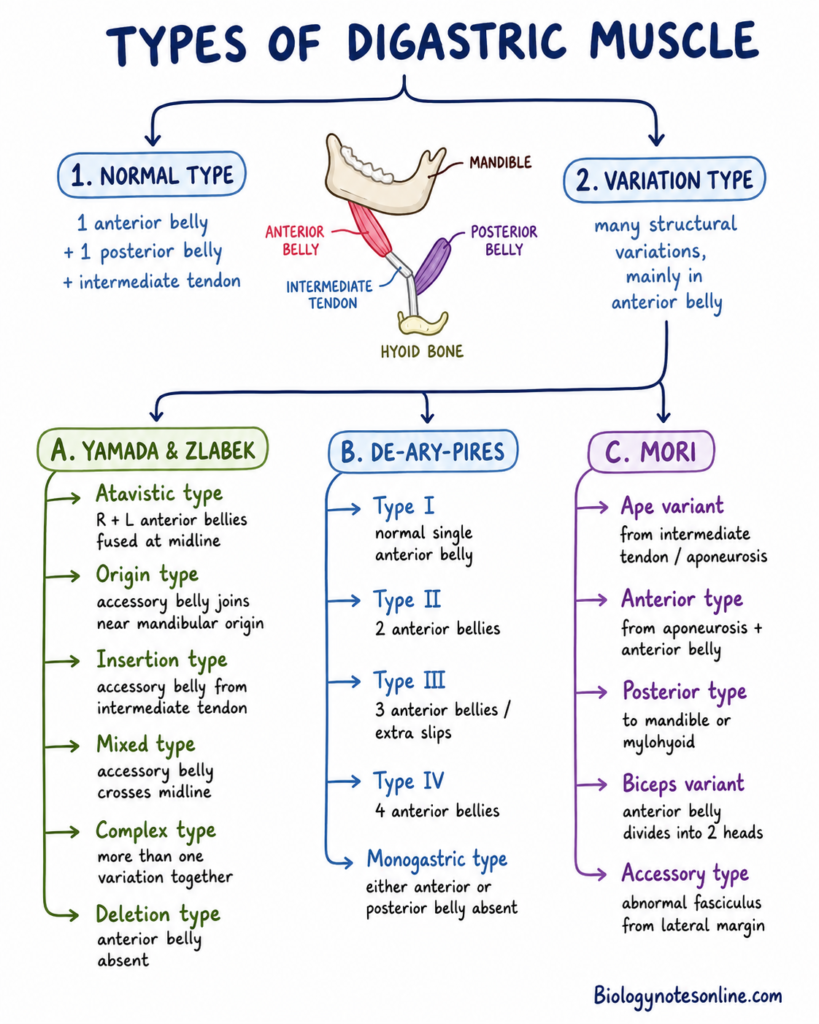
Normal Type
- Normal type– Digastric muscle normally has one anterior belly and one posterior belly, which are joined by an intermediate tendon.
- Variation type– Digastric muscle may show many structural variations, mainly in the anterior belly.
Yamada and Zlabek Classification
- Atavistic type– The right and left anterior bellies fuse together at the midline and form a broad symmetrical muscle sheet over the mylohyoid muscle.
- Origin type– An accessory anterior muscle is joined with the normal muscle at the origin side of mandible and inserted into the fibrous tendinous arch.
- Insertion type– An accessory muscle arises from the intermediate tendon and spreads inward, commonly joining with the mylohyoid muscle.
- Mixed type– An accessory anterior belly crosses the midline of chin or neck and passes to the opposite side.
- Complex type– More than one variation may occur together, such as origin type, insertion type and mixed type in same individual.
- Deletion type– The anterior belly of digastric muscle is completely absent in this rare type.
De-Ary-Pires Classification
- Type I– It is the normal type where the anterior belly is single and normally arranged.
- Type II– There are two anterior bellies attached to the mandible or mylohyoid muscle.
- Type III– There are three separate anterior muscular bellies with extra muscular slips.
- Type IV– There are four anterior bellies, which is called quadrification of the muscle.
- Monogastric type– In this type either anterior belly or posterior belly is absent, so only one muscular belly remains.
Mori’s Classification
- Ape variant– The accessory muscle arises from the intermediate tendon and intertendinous aponeurosis.
- Anterior type– The fibres arise from the intertendinous aponeurosis and from the anterior belly itself.
- Posterior type– The fibres arise from the intertendinous aponeurosis and extend to the mandible or mylohyoid muscle.
- Biceps variant– The anterior belly divides into two heads, and sometimes one head crosses the midline to opposite side.
- Accessory type– An abnormal fasciculus or muscle bundle arises from the lateral margin of the anterior belly.
Functions of Digastric Muscle
- Mandible depression– When the hyoid bone is fixed by infrahyoid muscles, digastric muscle pulls the mandible downward and helps in opening of mouth.
- Mouth opening– This opening movement is needed during eating, breathing and speaking.
- Hyoid elevation– When the jaw is fixed by muscles of mastication, digastric muscle elevates the hyoid bone upward.
- Larynx elevation– It also lifts the larynx upward and forward with the hyoid bone.
- Swallowing– During swallowing, elevation of hyoid bone and larynx helps to close the epiglottis and protect the airway.
- Food passage– It helps to direct food and liquid safely into the esophagus, so choking is prevented.
- Esophageal opening– The upward movement also helps in opening of upper esophageal sphincter during swallowing.
- Chewing– Digastric muscle helps in coordinated movement of jaw during chewing of food.
- Food consistency– Its activity may change according to the hardness or softness of the food being chewed.
- Speech– It helps in rapid and precise adjustment of lower jaw and base of tongue during speech.
- Articulation– These jaw and tongue base movements helps in proper formation of words.
- Head extension– The posterior belly of digastric muscle may secondarily help in backward extension of head.
Examples of Digastric Muscle
- Primary digastric muscle– The main digastric muscle is the suprahyoid muscle present below the mandible, having one anterior belly and one posterior belly joined by an intermediate tendon.
- Omohyoid muscle– Omohyoid muscle is another two-bellied muscle present in the neck region and it also has two muscular bellies joined by a tendon.
- Occipitofrontalis muscle– Occipitofrontalis muscle is a two-bellied muscle of head region and it covers part of the skull.
- Trigastric muscle– In this variation, the digastric muscle has three muscular bellies due to presence of extra muscle slip.
- Quadrigastric muscle– In this variation, the digastric muscle has four muscular bellies instead of normal single anterior belly.
- Monogastric muscle– In this rare type, either anterior belly or posterior belly is absent, so only one belly remains.
- Atavistic variant– In this type, right and left anterior bellies join at the midline and form a broad symmetrical muscle sheet.
- Orangutan example– In orangutan, the posterior belly of digastric muscle attaches directly to the mandible instead of the hyoid bone.
Diseases Related to Dysfunction of Digastric Muscle and Their Causes
- Myofascial pain– It is caused by teeth clenching, bruxism, chronic stress, poor posture, trauma or sudden cold exposure, and this forms tight bands in digastric muscle fibres with referred pain like toothache, earache or TMJ pain.
- Trigger points– Trigger points of digastric muscle are caused by continuous overuse of jaw muscles, wrong neck posture or stress condition, and pain may spread to jaw, ear, throat and teeth region.
- Eagle syndrome– It is caused by abnormal calcification of digastric muscle or stylohyoid ligament, which compresses nearby nerves and produces throat pain, ear pain and pain during tongue or head movement.
- Dysphagia– It is swallowing difficulty caused by weakness, atrophy or fibrosis of digastric muscle, commonly after radiotherapy for oral cancer or after stroke, so elevation of hyoid bone becomes difficult.
- Choking risk– It is caused when hyoid bone and larynx cannot elevate properly during swallowing, so food or liquid may enter into airway.
- Bruxism related hypertrophy– It is caused by repeated grinding and clenching of teeth, which gives heavy load on jaw muscles and causes enlargement, pain and fatigue of digastric muscle.
- Citelli abscess– It is caused by severe middle ear infection or otitis media, which spreads along the posterior belly of digastric muscle and forms painful neck abscess.
- Oromandibular dystonia– It is a neurological movement disorder caused by abnormal nerve control, where involuntary jaw movement and severe spasm involves digastric muscle.
- Fibromyalgia related pain– In fibromyalgia, general body pain and muscle tenderness may also affect digastric muscle, producing jaw and neck region pain.
- TMJ disorder pain– Blockage or dysfunction of temporomandibular joint (TMJ) may cause secondary pain and tenderness in digastric muscle.
- Digastric hemangioma– It is caused by benign vascular tumour inside the digastric muscle tissue, and may produce neck mass, pain, voice change and difficulty in swallowing.
- Facial nerve paralysis– It is caused by injury of marginal mandibular branch of facial nerve, which causes lower lip dysfunction and asymmetrical smile, and digastric muscle may be involved in surgical reconstruction.
- Post radiation fibrosis– It is caused after radiotherapy of oral cancer, where soft tissue becomes fibrotic and digastric muscle loses normal movement during swallowing.
- Post stroke weakness– It is caused by reduced muscle volume and poor nerve control after stroke, so digastric muscle cannot help properly in hyoid elevation and swallowing.
References
- A cadaveric case report of bilateral accessory anterior bellies of the digastric muscles . (n.d.). PubMed Central (PMC).
- Anderson, H., & Tucker, R. P. (2021). A cadaveric analysis of anatomical variations of the anterior belly of the digastric muscle . Folia Morphologica, 80(3), 691–698.
- Kalniev, M., Krastev, D., Krastev, N., Vidinov, K., Veltchev, L., Apostolov, A., & Mileva, M. (2013). A rare variation of the digastric muscle . Clujul Medical, 86(4), 327–329.
- A unique symmetrical variation of the median accessory anterior digastric muscle . (n.d.). PubMed Central (PMC).
- Hsiao, T. H., & Chang, H. P. (2019). Anatomical variations in the digastric muscle . Kaohsiung Journal of Medical Sciences, 35(2), 83–86.
- Kim, S. D., & Loukas, M. (2019). Anatomy and variations of digastric muscle . Anatomy & Cell Biology, 52(1), 1–11.
- Tranchito, E. N., & Bordoni, B. (2024). Anatomy, Head and Neck, Digastric Muscle . In StatPearls. StatPearls Publishing.
- Kyung, D. S., Lee, J. H., Lee, Y. P., Kim, D. K., & Choi, I. J. (2011). Bilateral variations of the head of the digastric muscle in Korean: A case report . Anatomy & Cell Biology, 44(3), 241–243.
- Detailed morphological, developmental, and clinical analysis of the digastric muscle . (n.d.).
- Bidewell, M. (2025, November 6). Digastric . TeachMeAnatomy.
- Digastric muscle (left) . (n.d.). Complete Anatomy–Elsevier.
- Nuzha, R., Washmuth, D., & Cena, C. (n.d.). Digastric muscle: Definition, innervation and functions . Study.com.
- Wikipedia contributors. (2026, June 22). Digastric muscle . In Wikipedia, The Free Encyclopedia.
- Novakov, S., & Delchev, S. (2019). Muscular abnormalities in submental triangle—Variations of anterior belly of digastric muscle . Trakia Journal of Sciences, 17(Suppl. 2), 96–99.
- Kim, J. H., Yoon, H. J., Kim, S., Lee, W., & Park, Y. S. (2023). The digastric muscle: Its anatomy and functions revisited . International Journal of Morphology, 41(5), 1501–1507.
- The variational types of anterior belly of the digastric muscle and clinical importance: A case report . (n.d.). PubMed Central (PMC).
- Kowalewska, K., Frankiewicz, M., Mielecka, H., Larysz, W., Osiowski, M., Osiowski, A., Kozioł, T. S., Plutecki, D., Nowak, A., Fibiger, G., & Walocha, J. (2025). The complete anatomy of the digastric muscle variation: A meta-analysis of its variations, prevalence and clinical implications . Folia Morphologica.
- De-Ary-Pires, B., Ary-Pires, R., & Pires-Neto, M. A. (2003). The human digastric muscle: Patterns and variations with clinical and surgical correlations . Annals of Anatomy, 185(5), 471–479.
- Prado, M., Neto, J., Basto, C., Aragão, I., Aragão, F., Reis, F., & Aragão, J. (2026). Variations of the anterior belly of the digastric muscle: A cadaveric and meta-analysis study . European Journal of Anatomy, 30(3), 375–385.
- Yalinkilic, A. (2026). Variations of the digastric muscle in children: Magnetic resonance imaging evaluation . Journal of Clinical Trials and Experimental Investigations, 5(1).
- Nuzha, R., Washmuth, D., & Cena, C. (n.d.). Video: Digastric muscle—Definition, innervation and functions . Study.com.
- Atlas Terapi. (2025, October 21). What causes digastric muscle pain? Atlas Terapi.