

Antibiotic resistance is a condition in which microorganisms become resistant to antibiotic drugs. It is mostly seen in bacteria and fungi. In this condition the drug cannot kill the germ properly.
The antibiotic is used to kill or inhibit the growth of bacteria. But resistant bacteria can survive in presence of this drug. They multiply again and infection remain inside the body.
It is a natural evolutionary process. But wrong use, over use and incomplete use of antibiotics make this process very fast. Antibiotics used in human, animals and agriculture also increase this resistance pressure.
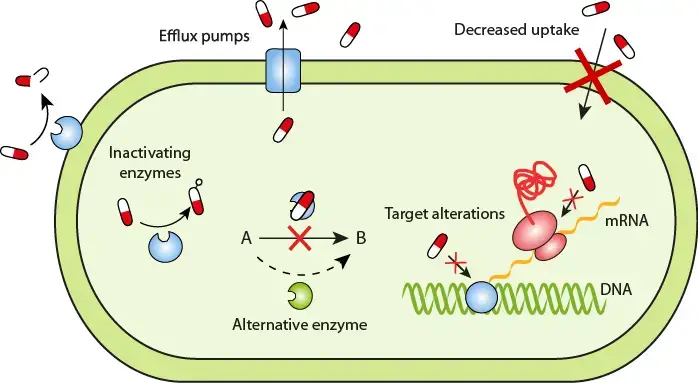
The resistant bacteria protect themselves by different ways. Some bacteria develop pump like structure and remove the antibiotic from the cell. Some change the outer membrane, so the antibiotic cannot enter properly.
Some bacteria produce special enzyme. This enzyme breaks or destroys the antibiotic. So the drug becomes inactive before it reach the target site.
In some cases bacteria change the target place where antibiotic normally acts. The antibiotic cannot attach with the target. Sometimes bacteria also use another pathway and avoid the action of drug. This is referred to as mechanism of antibiotic resistance.
The resistance character may transfer from one bacteria to another through DNA. Due to this, resistance spreads very rapidly among bacterial population. Bacteria resistant to many antibiotics are called superbugs.
Antibiotic resistance makes simple infection difficult to treat. The normal antibiotic may not work. Then stronger and costly drugs are used, which may have more toxic effect.
It increases hospital stay and severity of infection. It also increases chance of death. It is important problem in surgery, organ transplant and cancer treatment because antibiotic is needed for prevention of infection.
So antibiotic resistance is one of the major problem of modern medicine. It reduces the effectiveness of antibiotic and makes treatment of infectious disease more difficult.
Causes of Antibiotic Resistance
The following are the important causes of antibiotic resistance–
- Natural evolution
Antibiotic resistance is a natural evolutionary process. In this process bacteria slowly change and adapt against antibiotic drug. The bacteria which can survive will multiply more. - Genetic transfer
Resistance may pass from one bacteria to another bacteria through DNA. This is called horizontal gene transfer. Due to this, even sensitive bacteria may become resistant. - Misuse of antibiotics
Wrong use of antibiotics is an important cause of resistance. Antibiotic is sometimes taken without proper need, without doctor advice, or for viral infection. This gives pressure on bacteria to survive. - Over use of antibiotics
Repeated and excessive use of antibiotics make resistance very fast. When antibiotic is used again and again, weak bacteria are killed but strong resistant bacteria remain alive. Then they multiply. - Incomplete antibiotic course
If antibiotic course is stopped early, all bacteria are not killed. Some remaining bacteria survive inside the body. These bacteria may become more resistant later. - Use in livestock and agriculture
Antibiotics are also used in animal farming and agriculture. It is used for growth promotion and prevention of disease in healthy animals. This produces resistant bacteria in animals and they may spread to human through food and contact. - Environmental pollution
Untreated sewage, hospital waste, agricultural runoff and pharmaceutical waste may contain antibiotic residues. These residues enter soil and water. In this condition bacteria are exposed to antibiotics for long time and resistance develops. - Poor sanitation
Poor sanitation and unsafe drinking water help in spread of resistant germs. The resistant bacteria can move from one person to another person easily. It increases infection in community. - Poor infection control
Weak infection control in hospital also spread resistance. If cleaning, hand washing and sterilization are not proper, resistant bacteria may spread between patients. This is common in health care places. - Low quality and fake medicines
Substandard or fake antibiotics may contain low amount of active drug. It cannot kill the bacteria completely. Only weak bacteria are killed and strong bacteria survive. - Global travel and trade
Resistant bacteria can spread from one country to another by travel, migration, food trade and animal trade. Due to this, superbugs spread rapidly in different regions.
Antibiotic Resistance Mechanism
The following are the important mechanism of antibiotic resistance–
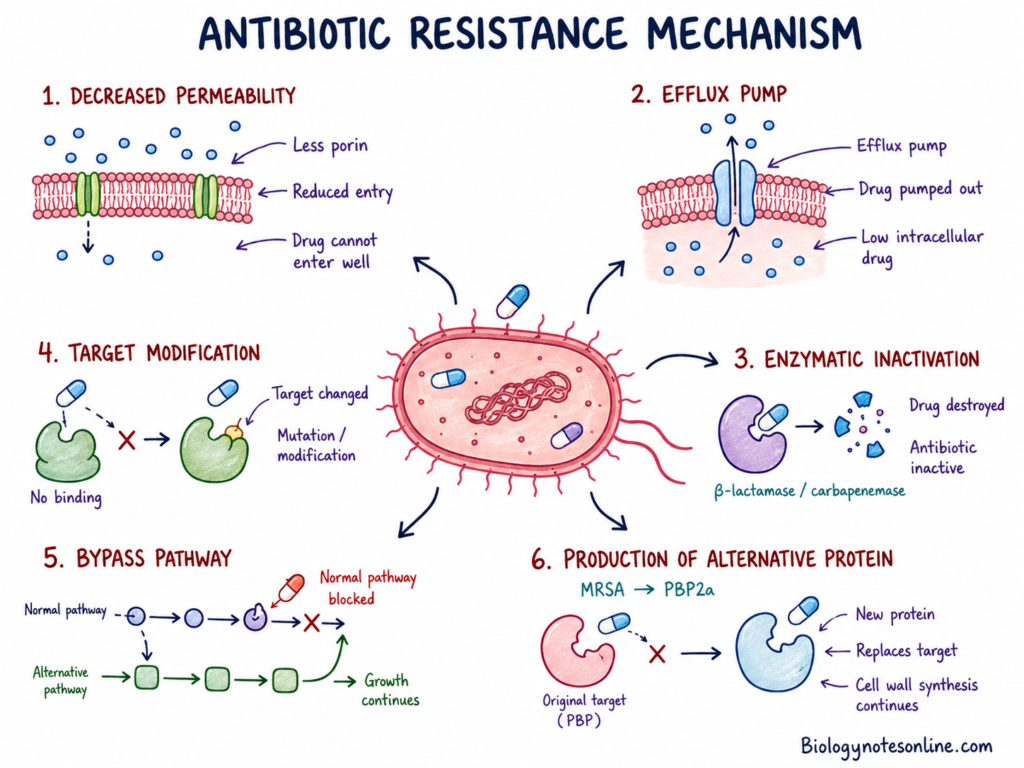
- Decreased permeability
In this mechanism bacteria reduce the entry of antibiotic inside the cell. They change the outer membrane or reduce the number of porin channels. So antibiotic cannot enter properly and its action become weak. - Efflux pump
Some bacteria have pump like structure in their cell membrane. These pumps remove the antibiotic from the bacterial cell. Due to this, the amount of antibiotic inside the cell becomes very low. - Enzymatic inactivation
In this mechanism bacteria produce special enzymes. These enzymes break or modify the antibiotic. Example beta-lactamase and carbapenemase enzyme destroy beta-lactam antibiotics and make them inactive. - Target modification
Antibiotics act on specific target site of the bacteria. But resistant bacteria change this target site by mutation or modification. So antibiotic cannot bind with the target and the drug does not work. - Bypass pathway
Some bacteria develop another metabolic pathway. In this condition the antibiotic blocks the normal pathway but bacteria use alternative pathway and continue their growth. So the effect of antibiotic is avoided. - Production of alternative protein
Some bacteria produce new protein which replace the blocked target protein. For example MRSA produces PBP2a protein. This protein helps in cell wall formation even in presence of penicillin like antibiotics.
Antibiotic Resistance Process
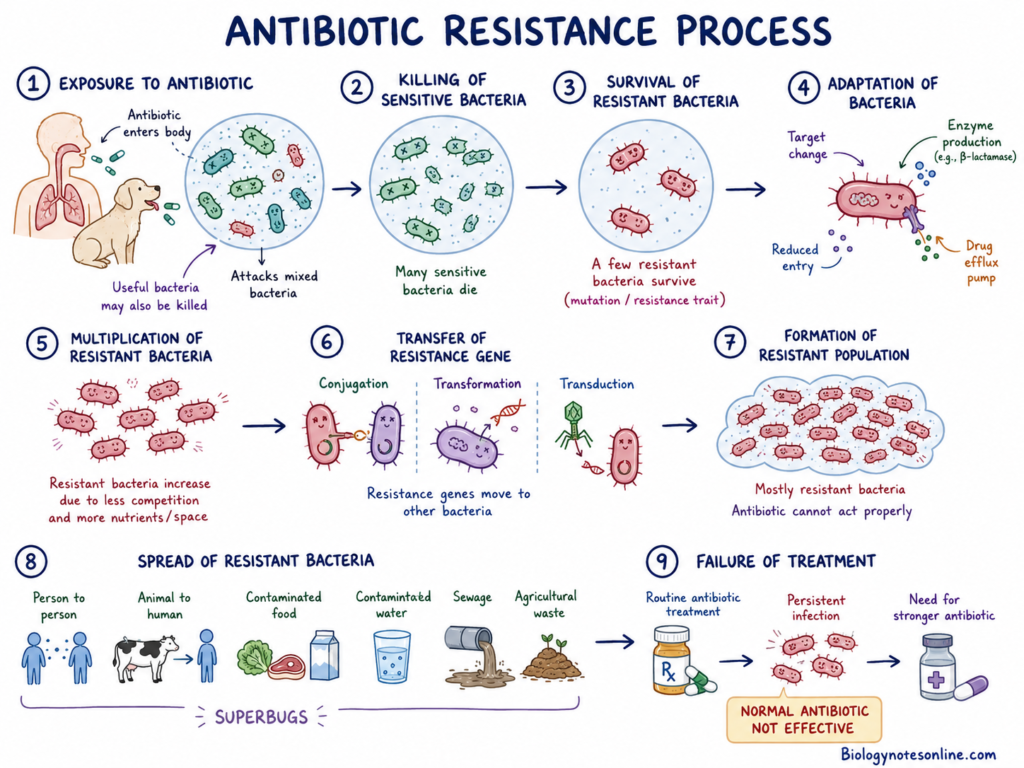
The following are the step by step process of antibiotic resistance mechanism–
- Exposure to antibiotic
In this step antibiotic enter inside the body of human or animal. The antibiotic attacks the sensitive bacteria. Many useful bacteria also may be killed during this process. - Killing of sensitive bacteria
The sensitive bacteria are destroyed by the antibiotic. These bacteria cannot survive in presence of the drug. So their number becomes reduced. - Survival of resistant bacteria
Some bacteria already have resistance character. Some bacteria also develop mutation in their DNA. These bacteria are not killed by antibiotic and they remain alive. - Adaptation of bacteria
The survived bacteria slowly adapt in presence of antibiotic. They may change the target site, produce enzyme, remove drug by pump or stop entry of drug. This helps them to resist the antibiotic action. - Multiplication of resistant bacteria
After the sensitive bacteria are killed, the resistant bacteria get more space and nutrients. There is less competition. So they multiply rapidly and increase their number. - Transfer of resistance gene
The resistant bacteria can transfer their resistant DNA to other bacteria. This may occur by conjugation, transformation and transduction. In this way normal bacteria may also become resistant. - Formation of resistant population
When many bacteria receive resistance gene, a resistant bacterial population is formed. The antibiotic cannot act properly on this population. This condition is referred to as antibiotic resistance. - Spread of resistant bacteria
The resistant bacteria may spread from one person to another person. It may also spread from animals to human, through food, water, sewage and agricultural waste. These resistant bacteria are also called superbugs. - Failure of treatment
In this step normal antibiotic treatment does not work. The infection remain for long time and stronger antibiotic may be needed. This makes the disease more difficult to treat.
Examples of Antibiotic Resistance Genes
The following are some important examples of antibiotic resistance genes–
- blaKPC
blaKPC is a gene which gives resistance against carbapenem antibiotics. It produces KPC carbapenemase enzyme. This enzyme breaks the carbapenem and other beta-lactam antibiotics, so the drug cannot act properly. - blaNDM
blaNDM is an important resistance gene which produces New Delhi metallo-beta-lactamase enzyme. Example are blaNDM-1 and blaNDM-5. It makes the bacteria resistant to many beta-lactam antibiotics, including carbapenems. - blaOXA
blaOXA is a gene which produces oxacillin-hydrolysing enzyme. Example are blaOXA-48 and blaOXA-232. This gene mainly gives resistance against carbapenem antibiotics. - blaIMP and blaVIM
blaIMP and blaVIM are resistance genes which produce metallo-beta-lactamase enzyme. These enzymes act on carbapenem antibiotics. As a result the antibiotic becomes inactive and bacteria can survive. - mecA
mecA is the common resistance gene present in MRSA. It changes the penicillin-binding protein of bacteria. Due to this, methicillin, penicillin and many other beta-lactam antibiotics cannot bind properly. - vanA, vanB, vanC and vanD
These genes are responsible for vancomycin resistance. They change the normal cell wall synthesis of bacteria. Therefore vancomycin cannot attach with its target site and the bacteria become resistant. - mcr-1
mcr-1 gene gives resistance to colistin antibiotic. It changes the outer membrane part of bacterial cell. So colistin cannot damage the bacterial cell wall properly. - tetM
tetM gene gives resistance to tetracycline antibiotics. It produces ribosomal protection protein. This protein protects the bacterial ribosome from the action of tetracycline. - ermB
ermB gene produces methylase enzyme. This enzyme modifies the bacterial ribosome. So macrolide and lincosamide antibiotics cannot bind with ribosome properly. - gyrA and parC
Mutation in gyrA and parC genes gives resistance to fluoroquinolone antibiotics. These genes are related with DNA gyrase and topoisomerase IV enzyme. After mutation the antibiotic cannot inhibit bacterial DNA replication. - rpoB
Mutation in rpoB gene causes resistance to rifampin. This gene changes the RNA polymerase enzyme. So rifampin cannot stop RNA synthesis in bacteria. - cyp1A
cyp1A gene is seen in fungi such as Aspergillus fumigatus. Change in this gene gives resistance against triazole antifungal drugs. The drug cannot bind with its normal target and the fungal cell survive.
Examples of Antibiotic Resistant Bacteria
The following are some of the important examples of antibiotic resistant bacteria–
- Methicillin resistant Staphylococcus aureus (MRSA)–
Methicillin resistant Staphylococcus aureus is a resistant strain of Staphylococcus aureus which is commonly called MRSA. It is resistant to methicillin, penicillin and many other beta-lactam antibiotics. It causes skin infection, wound infection, blood stream infection and surgical site infection. - Carbapenem resistant Enterobacterales (CRE)–
Carbapenem resistant Enterobacterales is a group of bacteria resistant to carbapenem antibiotics. The common examples are Escherichia coli and Klebsiella pneumoniae. These organisms are important because carbapenems are used as last line drugs in serious bacterial infection. - Vancomycin resistant Enterococci (VRE)–
Vancomycin resistant Enterococci are Enterococcus species which are resistant to vancomycin. The important example is Enterococcus faecium. It is commonly found in hospitalized patient and causes urinary tract infection, blood infection and intra-abdominal infection. - Multidrug resistant Mycobacterium tuberculosis (MDR-TB)–
Multidrug resistant Mycobacterium tuberculosis is a resistant form of tuberculosis causing bacteria. It is resistant to important first line anti-tubercular drugs. Rifampicin resistance is one of the important character of this bacteria. - Carbapenem resistant Acinetobacter baumannii (CRAB)–
Carbapenem resistant Acinetobacter baumannii is an important hospital acquired resistant bacteria. It is mainly found in admitted patient, weak patient and intensive care unit. It causes pneumonia, blood stream infection and other difficult infection. - Carbapenem resistant Pseudomonas aeruginosa–
Carbapenem resistant Pseudomonas aeruginosa is a resistant form of Pseudomonas aeruginosa. It is mostly associated with burn patient, ventilator patient and cystic fibrosis patient. It causes severe infection where many common antibiotics are not effective. - ESBL producing bacteria–
ESBL producing bacteria are bacteria which produce extended spectrum beta-lactamase enzyme. This enzyme destroys many penicillin and cephalosporin antibiotics. The common examples are Escherichia coli and Klebsiella pneumoniae. - Cephalosporin and fluoroquinolone resistant Neisseria gonorrhoeae–
Neisseria gonorrhoeae is the bacteria which causes gonorrhoea. Some strains are resistant to cephalosporin and fluoroquinolone antibiotics. This makes the treatment of gonorrhoea difficult by usual drug. - Macrolide and penicillin resistant Streptococcus pneumoniae–
Streptococcus pneumoniae is an important bacteria causing pneumonia, ear infection and bacterial meningitis. Some strains are resistant to macrolide and penicillin antibiotics. In this condition the common antibiotic treatment may fail. - Fluoroquinolone resistant Salmonella and Shigella–
Fluoroquinolone resistant Salmonella and Shigella are bacteria causing food borne and diarrhoeal disease. Salmonella Typhi also may show this resistance. These infections become difficult to treat when fluoroquinolone antibiotics do not work.
Consequences of Antibiotic Resistance
The following are some of the important consequences of antibiotic resistance–
- Increase in death rate
Antibiotic resistance increases the death rate from infectious diseases. The resistant infection is already responsible for many deaths in different countries. If this problem is not controlled, the number of death may increase more in future. - Failure of treatment
In this condition the common antibiotic does not work properly. The first line drug fails to kill the bacteria. So the infection remain for long time and becomes difficult to cure. - Severe infection
Resistant bacteria may produce more severe disease condition. It may lead to serious infection, organ failure and other complications. The patient may need stronger and more toxic antibiotic for treatment. - Long hospital stay
Due to antibiotic resistance, the recovery of patient becomes slow. The infection takes more time to cure. So the patient needs longer hospital stay and more medical care. - Use of costly drugs
When normal antibiotics fail, other alternative drugs are used. These drugs are costly and sometimes have more side effect. It increases the treatment cost of the patient. - Risk in surgery
Many surgery need antibiotics for prevention of infection. But resistant bacteria makes surgery more risky. Routine surgery, joint replacement and other operation may become difficult if effective antibiotic is not available. - Problem in organ transplant and cancer treatment
Antibiotics are important during organ transplantation and cancer chemotherapy. In these conditions patient immunity is low. Resistant infection can become dangerous and may stop the success of treatment. - Reduced life expectancy
Antibiotic resistance may reduce the ability to treat common infection. When simple infection cannot be treated properly, the general health of population is affected. It may reduce the average life expectancy in future. - Economic burden
Treatment of resistant infection needs long hospital stay, costly medicine and more investigation. This creates heavy economic burden on family and health care system. It may also affect the economy of country. - Effect on agriculture and food production
Antibiotic resistance also affects animal farming. Resistant infection in livestock increases disease and loss of production. It may reduce food supply and create problem in agricultural economy. - Spread of superbugs
Resistant bacteria may spread from one person to another person. It may also spread from hospital, animal, food, water and environment. These multidrug resistant bacteria are referred to as superbugs.
Factors Responsible for Antibiotic Resistance
The following are some of the important factors responsible for antibiotic resistance–
- Misuse and overuse of antibiotics
Misuse and overuse of antibiotics is the main factor of antibiotic resistance. It includes unnecessary use, wrong prescription, wrong dose and repeated use of antibiotics. Due to this the sensitive bacteria are killed and resistant bacteria remain alive. - Incomplete antibiotic course
Incomplete course of antibiotic is another important factor. When the drug is stopped early, all the bacteria are not killed. The remaining bacteria survive and later it may become resistant. - Use in animal farming
Antibiotics are used in livestock and poultry farming. It is used for growth promotion and prevention of disease. This produces resistant bacteria in animals and these bacteria may pass to human by food, water and direct contact. - Agricultural use of antibiotics
In agriculture antibiotic is used in some cases to control plant and animal diseases. This exposes environmental bacteria to antibiotic. It increases the formation of resistant bacteria in soil and water. - Environmental pollution
Untreated sewage, hospital waste, agricultural runoff and pharmaceutical waste are important source of antibiotic residue. These residues enter river, soil and water. In this condition bacteria are continuously exposed to antibiotic and resistance increases. - Poor infection control
Poor infection control in hospital helps in spread of resistant bacteria. If hand washing, cleaning, sterilization and isolation are not proper, the resistant bacteria can spread from patient to patient. This is common in health care centre. - Poor sanitation and unsafe water
Lack of clean water and sanitation increases bacterial infection. More infection causes more use of antibiotics. This again increases the chance of antibiotic resistance. - Low quality and fake medicines
Substandard and falsified antibiotics contain low amount of active drug. It cannot kill the bacteria completely. The weak bacteria are killed and strong resistant bacteria survive. - Natural mutation
Resistance is also a natural process. Some bacteria develop mutation in their DNA. These changed bacteria may survive in presence of antibiotic. - Transfer of resistance gene
Resistance gene may pass from one bacteria to another bacteria. This process is called horizontal gene transfer. It occurs by conjugation, transformation and transduction. - Global travel and trade
Resistant bacteria can move from one place to another by travel and trade. It may spread by human movement, food trade, animal trade and migration. Due to this superbugs spread in different countries. - Lack of rapid diagnosis
Sometimes the exact bacteria is not detected early. Then broad spectrum antibiotic is given before proper test. This unnecessary and wrong use of antibiotic increases resistance. - Slow development of new antibiotics
New antibiotic development is slow. But bacteria develop resistance very fast. Due to this, old antibiotics become less effective and treatment option becomes limited.
Reference
- Access to Medicine Foundation. (2026). 2026 Antimicrobial Resistance Benchmark .
- A Review of Carbapenem Resistance in Enterobacterales and Its Detection Techniques . (n.d.).
- AI can help us build a new, more precise, antibiotic pipeline . (n.d.). Pharmaphorum.
- Centers for Disease Control and Prevention. (n.d.). About Antimicrobial Resistance .
- BEACON. (2026). Alarming over 460% increase in infections caused by NDM-producing carbapenem-resistant Enterobacterales in the USA from 2019 to 2023, with implications for diagnosis and treatment .
- Polaris Market Research. (n.d.). Antibiotic Resistance Market Trend 2026: Report by 2034 .
- The Guardian. (2026). Antibiotics use in livestock could rise by a third in next 15 years, UN report warns .
- Centers for Disease Control and Prevention. (n.d.). Antimicrobial Resistance .
- Access to Medicine Foundation. (2026). Antimicrobial Resistance Benchmark 2026 .
- Yardi, S. (2026). Antimicrobial Resistance Statistics and Facts (2026) . Market.us Media.
- National Commission on Correctional Health Care. (2026). Antimicrobial Stewardship .
- Rhouma, M., Carson, C. A., Van Boeckel, T. P., & Madec, J.-Y. (2025). Antimicrobial resistance in livestock: Current trends, challenges and future directions . Revue Scientifique et Technique, 44, 3752.
- Antimicrobial resistance in methicillin-resistant Staphylococcus aureus . (n.d.). PMC–NIH.
- Alzahrani, A. J. (2026). Bacteriophage therapy against multidrug-resistant bacterial infections demonstrates clinical advances and engineering innovations between 2020–2026 . Frontiers in Microbiology, 17, 1865548.
- Yoon, B., Kim, J. A., & Kang, Y. K. (2026). CRISPR–Cas-Mediated Reprogramming Strategies to Overcome Antimicrobial Resistance . Pharmaceutics, 18(1), 95.
- Smith, H. Z., Hollingshead, C. M., & Kendall, B. (2024). Carbapenem-Resistant Enterobacterales . In StatPearls. StatPearls Publishing.
- Han, R., Shi, Q., Wu, S., Yin, D., Peng, M., Dong, D., Zheng, Y., Guo, Y., Zhang, R., Hu, F., & China Antimicrobial Surveillance Network (CHINET) Study Group. (2020). Dissemination of Carbapenemases (KPC, NDM, OXA-48, IMP, and VIM) Among Carbapenem-Resistant Enterobacteriaceae Isolated From Adult and Children Patients in China . Frontiers in Cellular and Infection Microbiology, 10, 314.
- World Health Organization. (n.d.). Draft updated global action plan on antimicrobial resistance 2026–2036 .
- World Veterinary Association. (2026). Essential Veterinary Medicine List strengthened with Poultry coverage and Antimicrobial Stewardship WHO and WOAH classification’s triangulation .
- Food and Agriculture Organization of the United Nations. (n.d.). FAO report highlights long-term economic case for tackling antimicrobial resistance in livestock .
- UCL News. (n.d.). Global livestock antibiotic use falls—but trade shifts the problem abroad .
- Mechanisms of Antibiotic Resistance . (n.d.). PMC–NIH.
- Cuffari, B. (2025). Mechanisms of Antibiotic Resistance: A Molecular Perspective . AZoLifeSciences.
- Mechanisms of antimicrobial resistance: From genetic evolution to clinical manifestations . (n.d.). PubMed Central.
- Wikipedia contributors. (2026). Methicillin-resistant Staphylococcus aureus . In Wikipedia, The Free Encyclopedia.
- Molecular mechanisms of vancomycin resistance . (n.d.). PMC–NIH.
- Piracha, Z. Z., & Saeed, U. (2026). Next-generation bacteriophage therapeutic systems: CRISPR-based engineering, near-infrared bioimaging, and precision strategies for treating multidrug-resistant and extensively drug-resistant bacterial infections . Frontiers in Microbiology, 17, 1748742.
- CIDRAP. (n.d.). Report highlights “spots of progress” in a challenging landscape for new antibiotics .
- ReAct. (n.d.). Resistance mechanisms .
- Medical Group of New Jersey. (n.d.). Resistant Infections (MRSA, ESBL, CRE, VRE) .
- Rattanaporn, S., Wongsakul, N., Thongchai, P., & Kanchana, S. (2024). Review: Biochemical mechanisms of antibiotic resistance . International Journal of Advanced Biochemistry Research, 8(2), 84–89.
- Strengthening healthcare systems to prevent antimicrobial resistance in LMICs: It is time to act . (n.d.). PubMed Central.
- Laxminarayan, R. (2026). The Future of Antimicrobial Use in Livestock . One Health Trust.
- The Global Crisis of Antimicrobial Resistance: Molecular Mechanisms, Evolutionary Dynamics, and 2026 Strategic Horizons . (n.d.).
- The Global Epidemiology of Antimicrobial Resistance: Trends, Determinants, and Public Health Implications . (n.d.). PubMed Central.
- World Health Organization. (2026, May 25). The World Health Assembly adopts updated Global Action Plan on Antimicrobial Resistance (2026–2036) .
- The role of bacteriophages and CRISPR-Cas in combating multidrug-resistant bacteria . (n.d.).
- Access to Medicine Foundation. (n.d.). Thin pipeline, high stakes: How are companies planning to expand access to vital, new antimicrobials? .
- NYU Langone Health. (n.d.). Types of Antibiotic-Resistant Infections .
- World Organisation for Animal Health. (n.d.). Updated global action plan on antimicrobial resistance 2026–2036 .
- Global Leaders Group on Antimicrobial Resistance. (2024). Urgent call from the Global Leaders Group on AMR to Member States of the United Nations .
- Vancomycin-Resistant Enterococci . (n.d.). PMC–NIH.
- Levitus, M., Rewane, A., & Perera, T. B. (2023). Vancomycin-Resistant Enterococci . In StatPearls. StatPearls Publishing.
- Yartsev, A. (2024). Vancomycin-Resistant Enterococcus (VRE) . Deranged Physiology.
- Anderson, S. (2026). WHA Member States Approve Antimicrobial Resistance Strategy After Resolving Tech Transfer Debate . Health Policy Watch.
- World Health Organization. (n.d.). WHO AWaRe system for antimicrobial stewardship .
- World Health Organization. (2026, March 11). WHO releases new target product profiles for urgently needed antibiotics .
- United Nations Environment Programme. (n.d.). World leaders commit to decisive action on antimicrobial resistance .