

Lymph nodes are small bean shaped or kidney shaped organs present in the lymphatic system. It is an important part of the body immune system. These are found throughout the body and about 800 lymph nodes are present in human body. The size of lymph node is generally about 1 to 2 cm.
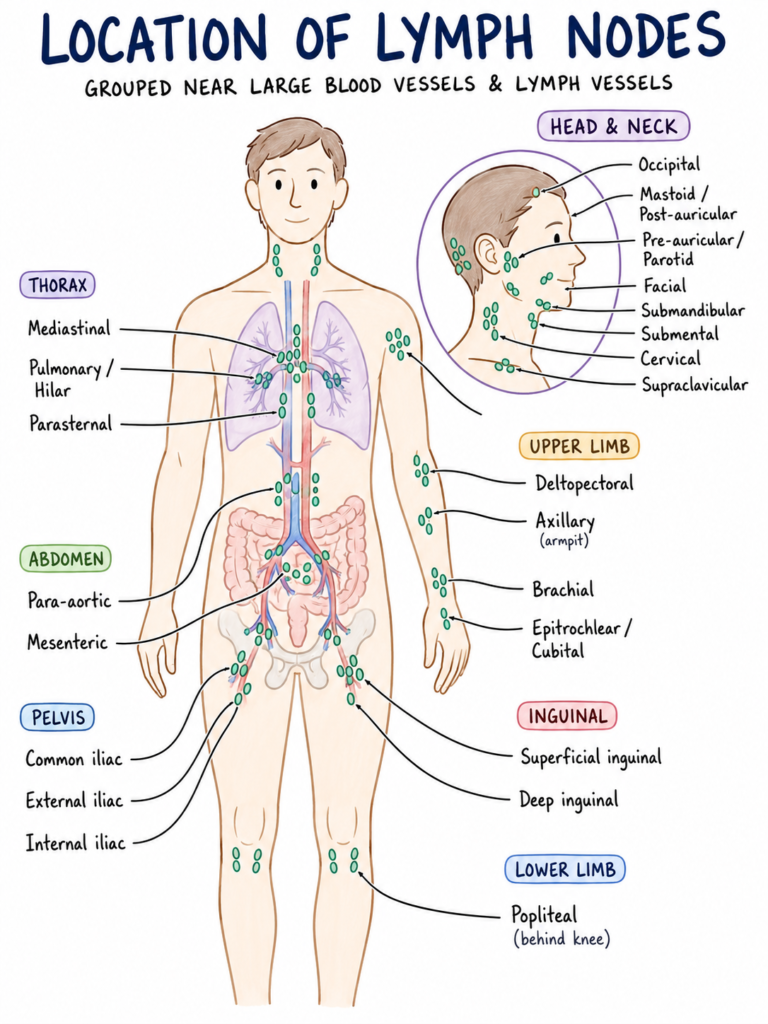
They are mostly present in groups in some specific regions of the body. The common regions are neck (cervical lymph nodes), armpit (axillary lymph nodes), thorax, abdomen and groin (inguinal lymph nodes). They are usually found near the junction of major blood vessels and lymph vessels.
The main function of lymph nodes is to filter the lymph. Lymph is a clear fluid which carries interstitial fluid, proteins, cellular debris and pathogens from the body tissues. This lymph passes through the lymph nodes and then returns back towards the blood circulation.
The internal structure of lymph node contains different types of white blood cells. These are mainly lymphocytes, i.e. T cells and B cells, and macrophages. These immune cells trap the harmful particles and destroy bacteria, viruses and foreign particles present in the lymph.
During infection or disease condition, the immune cells of lymph node multiply rapidly. Due to this the lymph nodes become swollen and tender to touch. This condition is temporary and it indicates the defensive activity of the body against infection.
Location of Lymph Nodes
The lymph nodes are present in different regions of the body. They are mostly found in groups near the large blood vessels and lymph vessels. The following are the important location of lymph nodes in the body-
- Head and Neck Lymph Nodes – These lymph nodes are present in different parts of head and neck region. Occipital lymph nodes are present at the back of head near the base of skull. Mastoid or post-auricular lymph nodes are present behind the ear. Pre-auricular and parotid lymph nodes are present in front of ear and near the parotid gland.
- Facial Lymph Nodes – These lymph nodes are scattered in the face region. They are present in malar region, buccinator region, nasolabial region and mandibular region. They drain the lymph from different parts of face.
- Submandibular and Submental Lymph Nodes – Submandibular lymph nodes are present below the jaw bone in the submandibular triangle. Submental lymph nodes are present below the centre part of chin. These nodes receive lymph from mouth region, lower lip and nearby parts.
- Cervical Lymph Nodes – Cervical lymph nodes are present in the neck region. They form a large network of superficial and deep lymph nodes. They are mostly found along the front, side and back of neck, near the jugular veins.
- Supraclavicular Lymph Nodes – These lymph nodes are present just above the clavicle or collar bone. They are located in the hollow area above the collar bone. They receive lymph from thoracic and abdominal region also.
- Axillary Lymph Nodes – Axillary lymph nodes are present in the armpit region. They are arranged into different groups such as pectoral, subscapular, humeral, central and apical lymph nodes. These nodes drain lymph from upper limb, chest wall and breast.
- Lymph Nodes of Upper Limb – Some lymph nodes are also present around the elbow and upper arm. Epitrochlear or cubital lymph nodes are present near the elbow region. Brachial and deltopectoral lymph nodes are present in upper arm and near the shoulder region.
- Mediastinal Lymph Nodes – These lymph nodes are present in the central part of chest cavity. They are found around the trachea, aorta and oesophagus. The important groups are paratracheal, subaortic and paraaortic lymph nodes.
- Pulmonary Lymph Nodes – These lymph nodes are present near the lung region. Hilar lymph nodes are present near the root of lungs. Interlobar and pulmonary lymph nodes are present deeper inside the lung tissue.
- Parasternal Lymph Nodes – Parasternal lymph nodes are present along the side of sternum or breast bone. They run vertically in the chest wall region. They receive lymph from anterior thoracic wall and breast region.
- Abdominal Lymph Nodes – These lymph nodes are present deep inside the abdominal cavity. Para-aortic lymph nodes are present along the aorta. Mesenteric lymph nodes are present near the intestine and other lymph nodes are found near abdominal organs.
- Iliac Lymph Nodes – Iliac lymph nodes are present deep inside the pelvic region. They are found along the internal iliac, external iliac and common iliac arteries. These lymph nodes receive lymph from pelvic organs and lower limb region.
- Inguinal Lymph Nodes – Inguinal lymph nodes are present in the groin region. They are located in the crease of groin or femoral triangle. These are of two types, superficial inguinal lymph nodes and deep inguinal lymph nodes.
- Popliteal Lymph Nodes – Popliteal lymph nodes are present at the back of knee. They are located in the popliteal fossa. These lymph nodes receive lymph from foot and lower leg region.
Detailed Morphology and Structure of Lymph Nodes
A. General Morphology of Lymph Nodes
- Shape and appearance – Lymph nodes are small bean-shaped or kidney-shaped lymphoid organs. They are usually tan-white to brown in colour. It is soft in normal condition and becomes enlarged during infection.
- Size – The size of lymph nodes is variable. It may be only few millimetres to about 1 to 2 cm in normal state. The size increases when the body is fighting infection.
- Surrounding tissue – The lymph nodes are mostly surrounded by adipose tissue. This fat tissue gives support and protection to the node. It keeps the node cushioned near the blood vessels and lymph vessels.
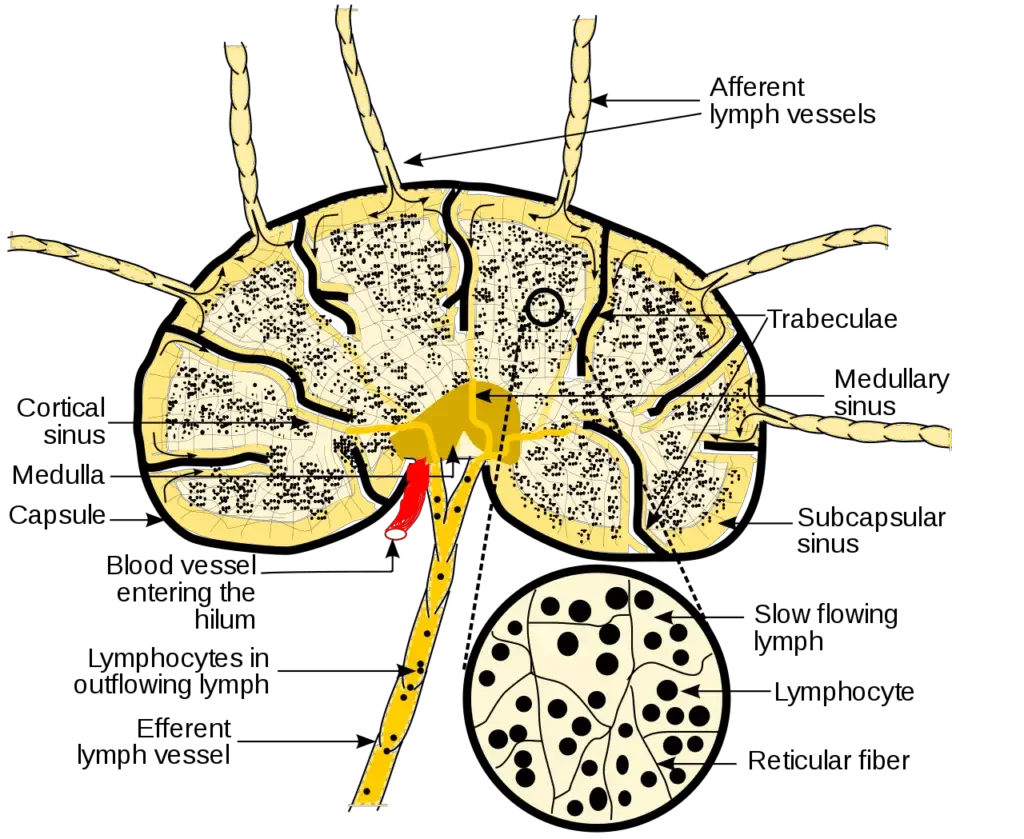
- Hilum or Hilus – One side of the lymph node has a concave depression called hilum or hilus. Blood vessels enter and leave through this region. The filtered lymph also leaves from this part by one or two efferent lymphatic vessels.
- Afferent and efferent lymphatic vessels – Many afferent lymphatic vessels enter the lymph node from the convex surface. They bring unfiltered lymph into the node. The efferent lymphatic vessel leaves from the hilum and carries filtered lymph away from the node.
B. Internal Structure of Lymph Nodes
- Capsule – The outermost covering of lymph node is called capsule. It is made up of dense connective tissue and collagen fibres. It protects the inner lymphoid tissue and also gives shape to the lymph node.
- Trabeculae – From the capsule, some inward extensions pass into the lymph node. These are called trabeculae. They divide the node into small incomplete compartments and provide support to the internal part of the node.
- Subcapsular sinus – Just below the capsule, a space is present called subcapsular sinus or marginal sinus. It receives lymph from the afferent lymphatic vessels. The lymph entering here is not filtered properly at first.
- Reticular fibres and macrophages – The subcapsular sinus contains reticular fibres and macrophages. Reticular fibres form a supporting network. Macrophages trap bacteria, foreign particles and dead cell materials present in lymph.
- Cortex – The outer region of lymph node is called cortex. It is mainly the B cell region. It contains lymphoid follicles where B lymphocytes are present.
- Primary and secondary follicles – In inactive lymph node, the follicles are called primary follicles. During antigen stimulation, they become secondary follicles. Secondary follicle contains pale germinal centre and dark mantle zone. In germinal centre, B cells divide rapidly.
- Paracortex – The region between cortex and medulla is called paracortex. It is mainly the T cell region of lymph node. It contains many T lymphocytes and antigen presenting cells.
- High Endothelial Venules (HEVs) – The paracortex contains special blood vessels called High Endothelial Venules (HEVs). Through these vessels, circulating T cells and B cells enter into the lymph node tissue from blood.
- Medulla – The innermost region of lymph node is called medulla. It extends towards the hilum. It contains lymphatic spaces, blood vessels and many immune cells.
- Medullary cords – Medullary cords are dense cord-like strands present in the medulla. They contain macrophages, B cells and antibody secreting plasma cells. These cells help in immune reaction.
- Medullary sinuses – Medullary sinuses are wide irregular spaces present between the medullary cords. They collect the filtered lymph from outer region and pass it towards the hilum.
- Flow of lymph – Lymph enters through afferent lymphatic vessels. Then it passes into subcapsular sinus, cortical sinuses and medullary sinuses. Finally the filtered lymph leaves through efferent lymphatic vessel from the hilum.
Lymph Circulation in Lymph Nodes
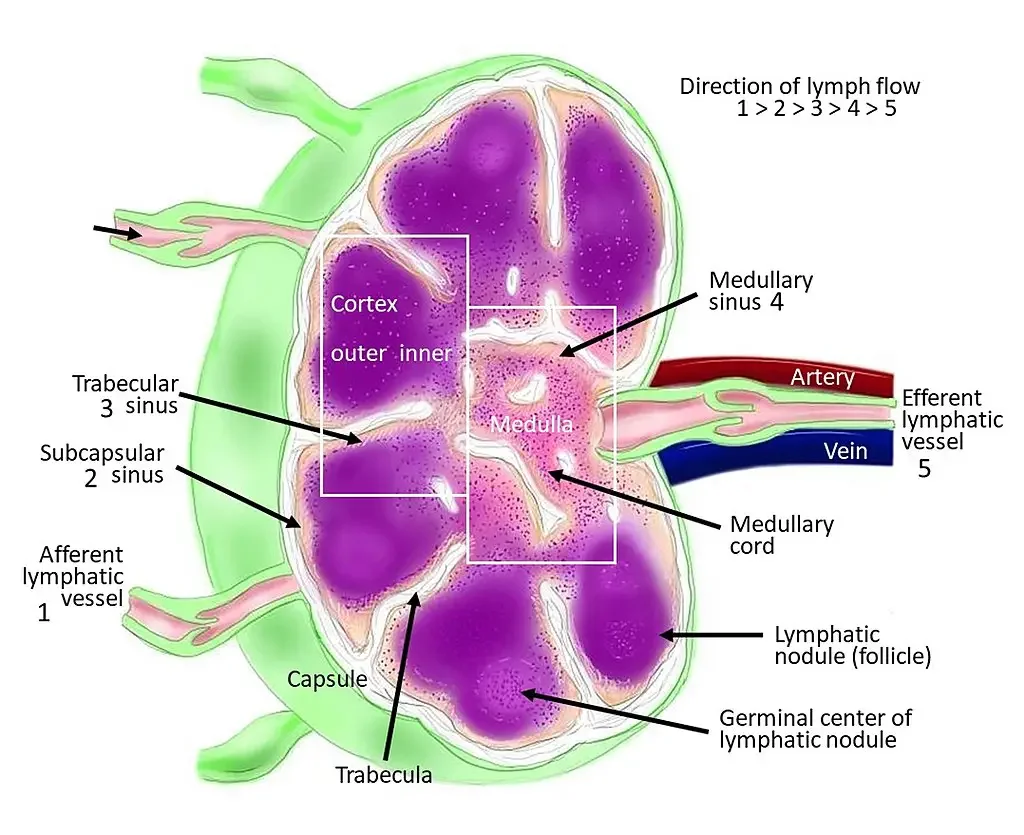
The circulation of lymph inside the lymph node occurs in a definite pathway. The lymph enters from the outer convex surface and leaves from the hilum. During this passage, the lymph is filtered by macrophages, reticular fibres and lymphocytes.
- Afferent lymphatic vessels – These are the lymphatic vessels which bring lymph into the lymph node. Many afferent lymphatic vessels enter through the outer capsule of the lymph node. They carry raw and unfiltered lymph from tissue spaces.
- Subcapsular sinus or marginal sinus – After entering through the afferent vessels, lymph first reaches the subcapsular sinus. It is present just below the capsule. This is a fluid filled space and it receives the incoming lymph from all afferent lymphatic vessels.
- Cortical sinuses – From the subcapsular sinus, lymph passes into the cortical sinuses. These sinuses are present in the cortex region of the lymph node. Here lymph comes in contact with lymphoid follicles, B cells and other immune cells.
- Trabecular sinuses – The lymph then passes along the trabeculae through the trabecular sinuses. These sinuses are present near the connective tissue trabeculae. They help to guide the lymph from outer cortex towards deeper part of the node.
- Medullary sinuses – After passing through cortical and trabecular sinuses, lymph reaches the medullary sinuses. These are wide and irregular spaces present in the medulla. Here the lymph is collected and more filtration takes place by macrophages and plasma cells.
- Hilum – The filtered lymph then moves towards the hilum of the lymph node. Hilum is the concave depression present on one side of the lymph node. Blood vessels are also present in this region.
- Efferent lymphatic vessels – Finally the filtered lymph leaves the lymph node through one or two efferent lymphatic vessels. These vessels are present at the hilum. The lymph then continues its flow towards larger lymphatic vessels and finally returns back to the central venous circulation.
The flow of lymph is as follows-
Afferent lymphatic vessels → Subcapsular sinus → Cortical sinuses → Trabecular sinuses → Medullary sinuses → Hilum → Efferent lymphatic vessels
Functions of Lymph Nodes
The lymph nodes perform important functions in the lymphatic system and immune system. It filters the lymph and helps in defence of body. The following are the main functions of lymph nodes–
- Filtration of lymph – Lymph nodes act as biological filter of lymph. The lymph brings interstitial fluid from soft tissues. It also contains microorganisms, foreign particles and cellular debris. These materials are trapped inside the lymph node before the lymph enters into blood circulation.
- Removal of microorganisms – The lymph node contains many immune cells. Macrophages are important in this function. They engulf bacteria, viruses, damaged cells and other harmful particles present in the lymph. This process prevents the spread of infection.
- Immune surveillance – Lymph nodes continuously examine the lymph coming from tissues. If any foreign antigen is present, it is recognized by immune cells. This helps the body to detect infection or other harmful substances at early stage.
- Activation of adaptive immunity – Lymph nodes are the site where antigen comes in contact with T cells and B cells. Dendritic cells present the antigen to naïve lymphocytes. After this the lymphocytes become activated and start immune reaction.
- Multiplication of lymphocytes – After activation, T lymphocytes and B lymphocytes multiply rapidly. This is called clonal expansion. Large number of similar lymphocytes are produced against the same antigen.
- Production of antibodies – In the germinal centre of lymph node, activated B cells change into plasma cells. These plasma cells secrete specific antibodies. The antibodies help to neutralize the pathogens and protect the body from infection.
- Maintenance of fluid balance – Lymph nodes help in proper lymph drainage. Excess tissue fluid and leaked plasma proteins are collected by lymphatic vessels and passed through lymph nodes. Finally it returns back into blood. This helps in maintaining fluid balance of body.
- Recycling of cellular debris – Dead cells and unwanted macromolecules are removed inside the lymph node. Macrophages phagocytose these materials and break them down. Some useful components may be reused by the body.
- Prevention of spread of disease – Lymph nodes trap harmful particles before lymph returns to blood. Due to this bacteria, virus or cancer cells may be stopped for some time inside the node. So lymph node acts as a barrier in the pathway of lymph flow.
Clinical Significance of Lymph Nodes
The lymph nodes have important clinical value in diagnosis of many disease condition. They become enlarged, painful or hard in different infections, inflammatory disease and malignancy. The following are the important clinical significance of lymph nodes–
- Indicator of disease – Enlargement of lymph nodes is called lymphadenopathy. It is an important clinical sign. It may occur due to viral infection, bacterial infection, inflammatory condition and autoimmune disease.
- Infection localization – Different groups of lymph nodes drain lymph from specific region of the body. So swelling of a particular lymph node group helps to find the site of infection. For example, enlarged cervical lymph nodes may indicate infection of throat, mouth or head and neck region.
- Cancer spread – Lymph nodes are common site for spread of cancer. As they filter lymph from tissues, cancer cells may enter into lymph node and get trapped there. This is commonly seen in breast cancer, colon cancer, and head and neck cancer.
- Metastasis – Spread of cancer cells from primary site to lymph nodes is called lymph node metastasis. It is an important finding in cancer patient. The involved lymph nodes may become hard, enlarged and sometimes fixed to surrounding tissue.
- Cancer staging – The number, size and location of affected lymph nodes are important for staging of cancer. It helps to know how much the cancer has spread. More lymph node involvement usually indicates poor prognosis and more chance of relapse.
- Treatment planning – Knowledge of lymph node drainage is useful in surgery and cancer treatment. Surgeons remove the affected lymph nodes by nodal dissection. Radiation therapy is also planned according to the lymph node region involved.
- Diagnostic sampling – Enlarged or abnormal lymph nodes are useful site for diagnosis. The sample may be collected by fine needle aspiration (FNA), core needle biopsy or excisional biopsy. This helps to diagnose infection, lymphoma or metastatic cancer.
- Primary site of lymphoma – Some cancers start mainly from the lymph nodes. These are called lymphomas. The important types are Hodgkin lymphoma and non-Hodgkin lymphoma.
- Prognosis of disease – Condition of lymph nodes helps to predict the outcome of disease. In cancer, lymph node involvement shows more advanced disease. In infection, tender and movable lymph nodes usually indicate active immune response.
- Clinical examination – Palpation of lymph nodes is an important part of physical examination. The doctor checks their size, tenderness, mobility, consistency and number. These features give clue about infection, inflammation or malignancy.
Diseases Related to Lymph Nodes
Lymph nodes are affected in different disease condition. Enlargement of lymph nodes is called lymphadenopathy. It may be due to infection, malignancy, autoimmune disease and some rare disorders.
1. Malignant diseases
Lymphoma is the malignant disease of lymphoid tissue. It mainly occurs in lymph nodes and other lymphoid organs. It is of two main types, Hodgkin lymphoma and non-Hodgkin lymphoma.
Leukemia is also related with lymph node enlargement. It is due to abnormal increase of white blood cells. Important examples are acute lymphoblastic leukemia, acute myelocytic leukemia and chronic lymphocytic leukemia.
Metastatic cancer is the spread of cancer into lymph nodes from other primary site. It is commonly seen in breast cancer, lung cancer, gastrointestinal cancer, head and neck cancer, thyroid cancer, renal cancer and melanoma.
2. Viral infections
Infectious mononucleosis is caused mainly by Epstein-Barr virus (EBV). It produces enlargement of cervical lymph nodes. Fever and sore throat are also present.
Human Immunodeficiency Virus (HIV) produces generalized lymph node enlargement. The lymph nodes may remain enlarged for long period. It is due to continuous immune stimulation.
Cytomegalovirus (CMV) infection also causes lymph node swelling. It may show mononucleosis like condition. It is more severe in weak immune person.
Other viral infections are hepatitis, herpes simplex, herpes zoster, varicella, adenovirus, rubella, roseola and measles.
3. Bacterial infections
Staphylococcal and streptococcal infections produce painful lymph node swelling. It is usually associated with skin infection, soft tissue infection, pharyngitis and dental abscess. The organisms are Staphylococcus and Streptococcus.
Tuberculosis commonly affects cervical lymph nodes. It is caused by Mycobacterium tuberculosis. Mycobacterium avium intracellulare may also involve lymph nodes.
Cat-scratch disease is caused by Bartonella henselae. It occurs after cat scratch or bite. The nearby lymph nodes become enlarged and tender.
Sexually transmitted infections also involve lymph nodes. These are syphilis, chancroid and lymphogranuloma venereum. The inguinal lymph nodes are mostly affected.
Other bacterial diseases are brucellosis, tularemia, plague, typhoid fever and Yersinia infection.
4. Fungal and parasitic infections
Fungal infections related with lymph nodes are histoplasmosis, coccidioidomycosis and Candida infection. These are more common in low immunity condition.
Parasitic infections are toxoplasmosis, Chagas disease, malaria, babesiosis and lymphatic filariasis.
Lymphatic filariasis is caused by microscopic nematodes. It blocks lymph flow and causes marked swelling of limbs. This condition is called elephantiasis.
5. Autoimmune and systemic diseases
Systemic Lupus Erythematosus (SLE) causes lymph node enlargement. It occurs due to abnormal immune reaction.
Rheumatoid arthritis is a chronic autoimmune disease. In this condition lymph nodes may enlarge due to long term inflammation.
Sjögren’s syndrome is mainly related with salivary and lacrimal glands. Lymph node enlargement may also occur. Risk of lymphoma may increase in some cases.
Kawasaki disease is mostly seen in children. It produces fever, blood vessel inflammation and cervical lymph node enlargement.
Dermatomyositis and Still’s disease are systemic inflammatory diseases. Lymph nodes may enlarge in these conditions.
6. Rare conditions
Sarcoidosis is a granulomatous disease. It affects lymph nodes and lungs commonly. Chest lymph nodes are mostly enlarged.
Castleman disease is a rare lymph node disorder. It causes abnormal growth of lymphoid tissue. It may be unicentric or multicentric type.
Kikuchi lymphadenitis or Kikuchi-Fujimoto disease is a rare inflammatory disease. It mostly affects cervical lymph nodes. Fever and tender swelling may be present.
Gaucher disease and Niemann-Pick disease are inborn metabolic storage disorders. In these diseases abnormal materials are stored in cells. Lymphoid organs may become enlarged.
References
- Aghedo, B. O., & Kasi, A. (2025). Virchow node. In StatPearls. StatPearls Publishing. https://www.ncbi.nlm.nih.gov/books/NBK556100/
- Alberts, B., Johnson, A., Lewis, J., Raff, M., Roberts, K., & Walter, P. (2002). Lymphocytes and the cellular basis of adaptive immunity. In Molecular biology of the cell (4th ed.). Garland Science. https://www.ncbi.nlm.nih.gov/books/NBK26921/
- Ali, U. (n.d.). Lymphatic drainage associations: The ultimate visual guide for boards. King of the Curve. https://kingofthecurve.org/blog/lymphatic-drainage-usmle
- Bujoreanu, I., & Gupta, V. (2023). Anatomy, lymph nodes. In StatPearls. StatPearls Publishing. https://www.ncbi.nlm.nih.gov/books/NBK557717/
- Burlew, J. T., Weber, C., & Banks, K. P. (2023). Anatomy, thorax, mediastinal lymph nodes. In StatPearls. StatPearls Publishing. https://www.ncbi.nlm.nih.gov/books/NBK532863/
- Cleveland Clinic. (2025, September 3). Swollen lymph nodes (lymphadenopathy, adenopathy): Symptoms & causes. https://my.clevelandclinic.org/health/symptoms/15219-swollen-lymph-nodes
- Douketis, J. D. (2026, March). Lymphadenopathy. Merck Manual Professional Edition. https://www.merckmanuals.com/professional/cardiovascular-disorders/lymphatic-disorders/lymphadenopathy
- Falk, N., Joseph, R., & Dieujuste, M. (2025). Lymphadenopathy: Evaluation and differential diagnosis. American Family Physician, 112(3), 286-293. https://www.aafp.org/afp/2025/0900/lymphadenopathy
- Ferrer, R. (1998). Lymphadenopathy: Differential diagnosis and evaluation. American Family Physician, 58(6), 1313-1320. https://www.aafp.org/afp/1998/1015/p1313
- Freeman, A. M., & Matto, P. (2023). Lymphadenopathy. In StatPearls. StatPearls Publishing. https://www.ncbi.nlm.nih.gov/books/NBK513250/
- Gaddey, H. L., & Riegel, A. M. (2016). Unexplained lymphadenopathy: Evaluation and differential diagnosis. American Family Physician, 94(11), 896-903. https://www.aafp.org/afp/2016/1201/p896
- General Practice Supervisors Australia. (n.d.). Lymphadenopathy [Teaching aid]. https://gpsa.org.au/wp-content/uploads/2024/04/Teaching-aid_Lymphadenopathy_V4.1.pdf
- Germinal centers in human lymph nodes contain reactivated memory B cells. (n.d.). PubMed Central. https://pmc.ncbi.nlm.nih.gov/articles/PMC2118493/
- Gest, T. R., & Schlesinger, J. (1995). MedCharts anatomy: Lymphatics of the body – Listed alphabetically. ILOC, Inc. https://anatomy.ttuhscep.edu/anatomytables/lymph_alpha.html
- Hamad, H., & Mangla, A. (2023). Lymphocytosis. In StatPearls. StatPearls Publishing. https://www.ncbi.nlm.nih.gov/books/NBK549819/
- Hanzalová, I., & Matter, M. (2024). Peripheral lymphadenopathy of unknown origin in adults: A diagnostic approach emphasizing the malignancy hypothesis. Swiss Medical Weekly, 154, 3549. https://doi.org/10.57187/s.3549
- Knopov, A. (2022, April 8). Lymphadenopathy in pediatric population. Brown Emergency Medicine Blog. http://brownemblog.com/blogposts/2022/3/8/lymphadenopathy-in-pediatric-population
- Koroulakis, A., Jamal, Z., & Agarwal, M. (2022). Anatomy, head and neck, lymph nodes. In StatPearls. StatPearls Publishing. https://www.ncbi.nlm.nih.gov/books/NBK513317/
- Köse, A. (2026, June 29). Lymph nodes face map & diagram guide. Liv Hospital. https://int.livhospital.com/lymph-nodes-face-map-amp-diagram-guide/
- Kyriacou, H., & Khan, Y. S. (2023). Anatomy, shoulder and upper limb, axillary lymph nodes. In StatPearls. StatPearls Publishing. https://www.ncbi.nlm.nih.gov/books/NBK559188/
- Lymph node disorders. (n.d.). PubMed Central. https://pmc.ncbi.nlm.nih.gov/articles/PMC7158302/
- Lymph nodes – Definition, location, structure and functions. (n.d.).
- Mercadante, A. A., & Tadi, P. (2023). Histology, lymph nodes. In StatPearls. StatPearls Publishing. https://www.ncbi.nlm.nih.gov/books/NBK559053/
- Null, M., Arbor, T. C., & Agarwal, M. (2023). Anatomy, lymphatic system. In StatPearls. StatPearls Publishing. https://www.ncbi.nlm.nih.gov/books/NBK513247/
- Real Bodywork. (2026). Lymphatic drainage map: A clinical reference for massage therapists. https://realbodywork.com/lymphatic-drainage-map-a-clinical-reference-for-massage-therapists/
- Regulation of the germinal center response. (n.d.). PubMed Central. https://pmc.ncbi.nlm.nih.gov/articles/PMC6209676/
- Sokhan, M. S. (n.d.). Comprehensive seminar on lymphadenopathy and splenomegaly diagnosis and management [PowerPoint slides]. SlideShare. https://www.slideshare.net/slideshow/comprehensive-seminar-on-lymphadenopathy-and-splenomegaly-diagnosis-and-management/288154001
- Thompson, C., Williams, P. N., Brigham, S. K., & Watto, M. F. (2020, March 30). #202 LIVE! Lymphadenopathy: Taking your lumps. The Curbsiders Internal Medicine Podcast. http://thecurbsiders.com/episode-list
- Time of Care. (n.d.). Lymphadenopathy (enlarged lymph nodes) – Peds & adults. Retrieved from https://www.timeofcare.com/lymphadenopathy/
- University of Iowa Carver College of Medicine. (2017, May 8). Lymph node groups (levels). Iowa Head and Neck Protocols. https://iowaprotocols.medicine.uiowa.edu/protocols/lymph-node-groups-levels