

Passive immunization is a type of immunization in which already formed antibodies are given to a person. It gives immediate protection against disease, toxin or venom. In this method, the body does not produce its own antibody for protection.
This immunity may be naturally acquired. In natural passive immunization, the maternal antibodies are transferred from mother to baby through placenta and breast milk. It protects the baby for short period during early life.
Passive immunization may also be artificially acquired. In this process, prepared antibodies are injected into the body in the form of immune globulin, antivenom or monoclonal antibodies. These antibodies directly act against the pathogen or toxin.
It is mainly used in emergency conditions where rapid protection is needed. Some important examples are rabies exposure, snake bite, tetanus toxin and botulism toxin. In these cases, ready made antibodies neutralize the harmful agent quickly.
The immunity produced by passive immunization is temporary. It does not produce immunological memory because immune system is not trained to form its own antibody. After few weeks or months, the given antibodies are broken down in the body and protection is lost.
Types of Passive Immunization
The following are the types of passive immunization–
1. Natural Passive Immunization
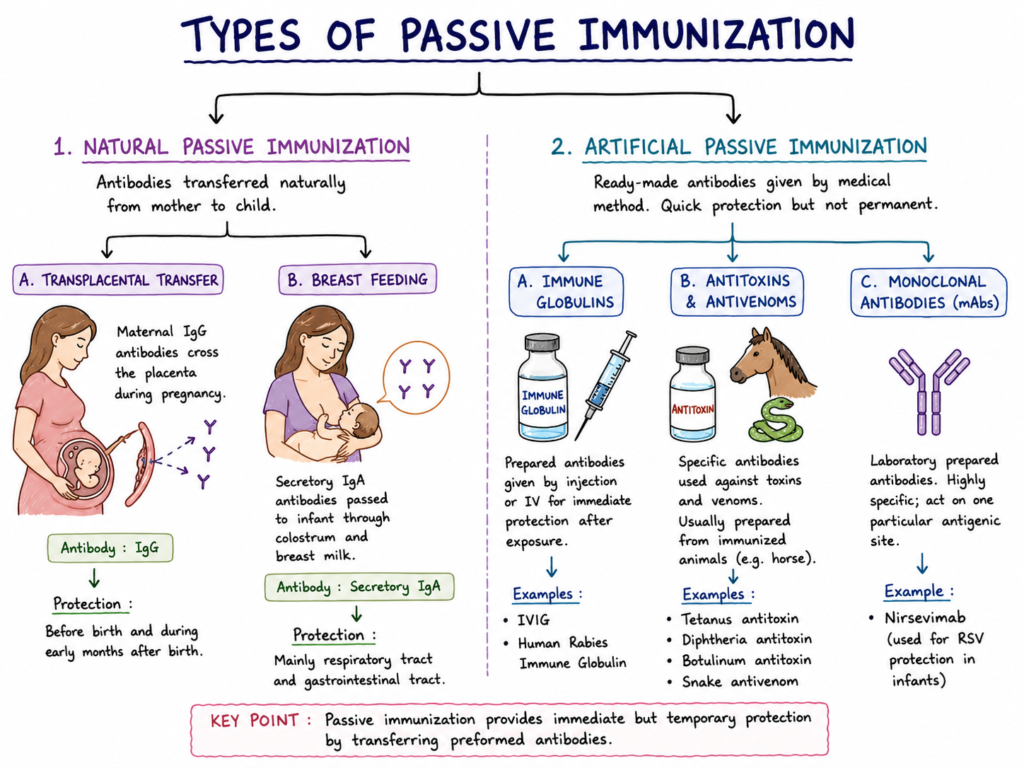
Natural passive immunization is the type of passive immunization which occurs naturally by transfer of already formed antibodies. In this, no injection or medical treatment is used. The antibody comes from mother to child and gives protection for short time.
Transplacental transfer is the transfer of maternal IgG antibody from mother to foetus through placenta. It occurs during pregnancy. This antibody gives protection to the baby before birth and also during early period after birth.
Breast feeding is also a natural passive immunization. In this process, secretory IgA antibody is passed from mother to infant through colostrum and breast milk. It protects mainly the respiratory tract and gastrointestinal tract of the baby.
2. Artificial Passive Immunization
Artificial passive immunization is the type of passive immunization in which ready-made antibodies are given by medical method. The antibody may be prepared from human serum, immunized animal or in laboratory. It gives quick protection but the protection is not permanent.
Immune globulins are prepared antibodies which are given by injection or intravenous route. It is used for immediate protection after exposure to some disease. IVIG and human rabies immune globulin are some important examples.
Antitoxins and antivenoms are specific antibodies used against toxin and venom. These are commonly prepared from immunized animals such as horse. It is used in tetanus, diphtheria, botulism and poisonous bite.
Monoclonal antibodies (mAbs) are laboratory prepared antibodies. These antibodies are very specific and act on one particular antigenic site. Nirsevimab is an example which is used for RSV protection in infants.
Characteristics of Passive Immunization
The following are the important characteristics of passive immunization–
- Exogenous source– In passive immunization, the antibodies are obtained from outside source. It is not produced by the patient’s own body. The source may be human donor, immune animal or laboratory preparation.
- Immediate protection– It gives immediate protection after administration. The antibody is already formed, so it acts very fast. It does not need the lag phase which is required for active immune response.
- Short duration– The immunity produced is temporary. It remains only for few weeks or months. After this, the introduced antibodies are broken down and removed from blood circulation.
- No memory– It does not produce immunological memory. The immune system is not trained to form its own antibody. So memory B cells and T cells are not formed.
- Natural and artificial– Passive immunization may be natural or artificial. Natural type occurs by transfer of maternal antibodies from mother to foetus or infant. Artificial type occurs by giving immune globulin, antitoxin, antivenom or monoclonal antibodies.
- Emergency use– It is useful in emergency condition where rapid protection is needed. It is used in post-exposure prophylaxis, toxin neutralization and venom neutralization. It is also useful in weak immune system where vaccine response is not proper.
Step by Step Process/Mechanism of Passive Immunization
The following are the steps involved in passive immunization–
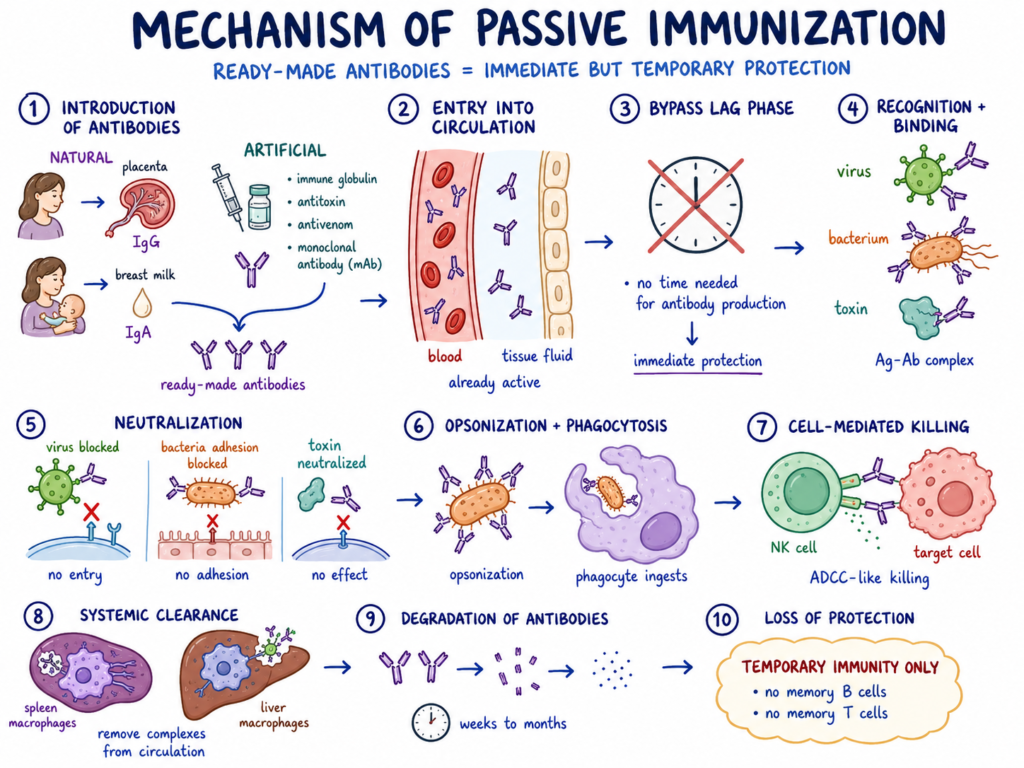
- Introduction of antibody– In passive immunization, ready-made antibodies are introduced into a non-immune person. It may be transferred naturally from mother to baby through placenta or breast milk. It may also be given artificially by injection of immune globulin, antitoxin, antivenom or monoclonal antibodies.
- Entry into circulation– After introduction, the antibodies enter into the blood and tissue fluid. These antibodies are already active. So they do not need to be produced again by the body.
- Bypassing lag phase– In active immunity, the body takes time to identify antigen and produce its own antibody. But in passive immunization this time period is not needed. The ready-made antibody directly gives protection after reaching the circulation.
- Recognition of antigen– In this step, the introduced antibodies recognize the specific antigen present in the body. The antigen may be present on bacteria, virus, venom or toxin. The antibody binds with the matching antigen by its antigen binding site.
- Antigen-antibody binding– The antibody combines with the antigen and forms antigen-antibody complex. This binding is specific. One antibody acts against one particular antigenic site or epitope.
- Neutralization of virus– In case of viral infection, the antibody binds to the surface protein of virus. It blocks the attachment and entry of virus into host cell. So the virus cannot multiply inside the cell.
- Neutralization of bacteria– In case of bacterial infection, the antibody binds to bacterial surface antigen. It may block the adhesion of bacteria to host tissue. Thus colonization and further spread of bacteria is reduced.
- Neutralization of toxin– In toxin mediated disease, the antibody binds directly with the toxin molecule. It blocks the enzymatic activity of toxin and also prevents its binding with host cell receptor. This is important in tetanus, diphtheria and botulism.
- Opsonization– The antibody coated pathogen become more easily recognized by phagocytic cells. This process is called opsonization. Macrophages, neutrophils and dendritic cells engulf and digest the antibody coated antigen.
- Cell mediated killing– Some antibody coated target cells are destroyed by immune cells. Natural killer (NK) cells and neutrophils may attach to the antibody coated cell and kill it. This helps in removal of infected or abnormal cells.
- Systemic clearance– The antibody-antigen complexes are removed from blood circulation. It is mainly done by macrophages present in spleen, liver and other reticuloendothelial tissues. In this way the harmful antigen is cleared from the body.
- Degradation of antibodies– The given antibodies are not produced by the host immune system. So after few weeks or months these antibodies are broken down naturally. They are metabolized and removed from the body.
- Loss of protection– As the introduced antibodies decrease, the protection also gradually falls. No memory B cells or T cells are formed. So passive immunization gives quick but temporary immunity only.
Uses of Passive Immunization
The following are the important uses of passive immunization–
- Post-exposure prophylaxis– Passive immunization is used after exposure to fast acting or fatal disease. It gives immediate protection when there is no time for body to produce own antibody. It is used in rabies and tetanus exposure.
- Toxin neutralization– It is used to neutralize powerful bacterial exotoxins. The ready-made antibody combines with toxin and blocks its action. It is used in diphtheria, botulism and tetanus toxin.
- Venom neutralization– Antivenom is used in snake bite and some insect bite. The antibody binds with venom toxin and reduces its harmful effect. It is useful when venom spreads rapidly in the body.
- Immunodeficiency– It is used in persons having weak immune system. These persons cannot produce proper antibody after infection or vaccination. Intravenous immunoglobulin (IVIG) is given to provide temporary protection.
- Newborn protection– Passive immunization protects newborn and infants because their immune system is not fully developed. This occurs naturally by transfer of maternal antibody through placenta and breast milk. It may also be given artificially by monoclonal antibody like Nirsevimab for RSV protection.
- Rh isoimmunization– Rho(D) immune globulin (RhIG) is used in Rh-negative pregnant woman. It prevents formation of antibody against Rh-positive foetal red blood cells. Thus it helps to prevent Hemolytic Disease of Fetus and Newborn (HDFN).
- Blood transfusion reaction– RhIG may also be used when Rh-negative person accidentally receives Rh-positive blood. It prevents immune reaction against incompatible red blood cells. This is used to reduce further complication.
- Autoimmune blood disorder– Some immune globulins are used in Immune Thrombocytopenic Purpura (ITP). It helps to increase platelet count. It also helps to reduce bleeding tendency.
- Cancer treatment– Passive immunization is used in cancer immunotherapy by giving prepared monoclonal antibodies. These antibodies target tumour cells or block growth factors. It helps in destruction or control of malignant cells.
- Outbreak control– It is used during infectious disease outbreak when rapid protection is needed. It may be used in disease like Ebola virus infection. It gives temporary protection before active vaccine response or vaccine distribution is possible.
- Biological threat– Passive immunization may be used against biological threat like anthrax. The antibody gives rapid and specific protection. It is useful when exposure is suspected or already occurred.
Advantages of Passive Immunization
The following are the important advantages of passive immunization–
- Immediate protection– Passive immunization gives immediate protection because ready-made antibodies are directly given into the body. It does not require long time for antibody formation. So the lag phase of immune response is avoided.
- Emergency use– It is very useful in emergency and life threatening condition. In snake bite, rabies exposure and severe tetanus, there is no time to wait for active immunity. So passive antibody can act quickly and protect the person.
- Useful in weak immunity– It protects persons having weak immune system. In diseases like agammaglobulinemia and severe combined immunodeficiency, the body cannot produce proper antibody. In such cases, ready-made antibody gives useful protection.
- Newborn protection– It protects newborn and infant because their immune system is not fully developed. Maternal antibodies pass through placenta and breast milk. This gives early protection to the baby against many infections.
- Direct action– The given antibody directly combines with antigen, toxin or venom. It does not need activation of whole immune system. This makes the protection fast and useful for short period.
- Temporary support– It gives temporary immune support until the body becomes able to respond. It is also useful before vaccine induced immunity develops. So it can be used along with active immunization in some cases.
Drawbacks of Passive Immunization
The following are the important drawbacks of passive immunization–
- Short duration– The protection produced by passive immunization remains only for short time. It usually lasts for few weeks or months. The given antibodies are gradually broken down and removed from the body.
- No memory– It does not produce immunological memory. The person’s own immune system is not stimulated properly. So memory B cells and T cells are not formed, and future infection may again need treatment.
- Allergic reaction– Sometimes passive immunization may produce hypersensitivity reaction. It may cause allergy, anaphylaxis or serum sickness. This is more common when the antibody is obtained from animal source like horse.
- High cost– The production of antibody is costly and difficult. Antibodies may be collected from human donor, immunized animal or prepared in laboratory. This needs special method, time and more expense.
- Difficult administration– Passive antibody is usually given by intravenous or intramuscular injection. It needs medical person and clinical condition. So it is not so easy for routine and large scale prevention like vaccines.
- Vaccine interference– The introduced antibodies may interfere with active vaccine response. It may neutralize the vaccine antigen before the body produce its own immunity. So some live attenuated vaccines may need to be delayed.
- Mutation problem– Some monoclonal antibodies are very specific for one antigenic site. If the pathogen changes or mutate that site, the antibody may not bind properly. Then the treatment may become less effective.
- Anti-drug response– When therapeutic antibody is given repeatedly, the body may recognize it as foreign. Then the immune system may produce anti-drug antibodies against it. This can reduce the effect of treatment.
Examples of Passive Immunization
The following are some important examples of passive immunization–
Natural Passive Immunization
- Placental antibody transfer– It is the transfer of maternal IgG antibody from mother to foetus through placenta. This occurs during pregnancy. It gives early protection to the baby before birth and during early life.
- Breast feeding– It is the transfer of maternal secretory IgA antibody from mother to infant through colostrum and breast milk. It protects the respiratory tract and gastrointestinal tract of infant. This is also a natural passive immunity.
Artificial Passive Immunization
- Rabies immune globulin– Human rabies immune globulin (HRIG) is given after suspected rabies exposure. It is injected into and around the wound site. It neutralizes the virus before the body produces its own antibody.
- Tetanus immune globulin– Tetanus immune globulin (TIG) is given after tetanus prone wound. It is used in deep puncture wound and contaminated injury. It prevents the action of tetanus toxin.
- Antivenom– Antivenom is given after poisonous snake bite or insect bite. It contains ready-made antibody against venom. It neutralizes the venom toxin quickly.
- Botulism antitoxin– Botulism antitoxin is used against toxin produced by Clostridium botulinum. It neutralizes the circulating toxin. It prevents further muscle paralysis.
- Diphtheria antitoxin– Diphtheria antitoxin is used to neutralize diphtheria toxin. It acts against the bacterial exotoxin. It is given when rapid toxin neutralization is needed.
- Rho(D) immune globulin– Rho(D) immune globulin or RhoGAM is given to Rh-negative pregnant woman. It prevents antibody formation against Rh-positive foetal red blood cells. It helps to prevent haemolytic disease of fetus and newborn.
- Intravenous immunoglobulin– Intravenous immunoglobulin (IVIG) is pooled human antibody given through vein. It is used in persons with weak immune system. It gives temporary protection against different infections.
- Hepatitis B immune globulin– Hepatitis B immune globulin (HBIG) is given after exposure to hepatitis B virus. It gives immediate protection. It is used before active immunity develops.
- Monoclonal antibody– Monoclonal antibodies (mAbs) are laboratory prepared antibodies. They are specific for one antigenic site. Nirsevimab is used in infants for prevention of severe Respiratory Syncytial Virus (RSV) infection.
References
- Alberta Health. (2025, September 1). Tetanus post-exposure prophylaxis in injury/wound management. Open Government Program.
- Allo Hope Foundation. (n.d.). Rh immune globulin (RhIG).
- Bergeson, L. (2026, May 4). Nirsevimab monoclonal antibody for RSV well tolerated in infants, study suggests. CIDRAP.
- Centers for Disease Control and Prevention. (2024, April 17). Treatment of botulism.
- Centers for Disease Control and Prevention. (2024, July 30). Immunity types. Vaccines & Immunizations.
- Centers for Disease Control and Prevention. (2025, July 15). Rabies post-exposure prophylaxis guidance.
- Children’s Mercy Kansas City. (n.d.). Laceration: Tetanus vaccine and immunoglobulin post-exposure prophylaxis.
- Clinical immunology and therapeutic frameworks of passive immunization. (n.d.).
- Communicable Disease Control, Alberta Health Services. (2025, January 31). Immunization: Botulism antitoxin. MyHealth Alberta.
- Dubey, S. D. (2026). YTE-engineered antibodies: From neonatal Fc receptor binding mechanisms to next-generation therapeutics. International Journal of Molecular and Immuno Oncology, 11(1), 12-22.
- HealthLink BC. (2026, June 5). Tetanus immune globulin.
- Kedrion Biopharma Inc. (2018, December). Package insert – RhoGAM and MICRhoGAM. U.S. Food and Drug Administration.
- Kedrion Biopharma Inc. (n.d.). Rabies post-exposure prophylaxis (PEP) | KEDRAB rabies immune globulin (human).
- Kedrion Biopharma Inc. (n.d.). The science behind RhoGAM.
- Knurek, J. (n.d.). Monoclonal antibody prophylaxis for infectious diseases – Passive immunization and prevention. Mabion.
- Minnesota Department of Health. (n.d.). Rabies post-exposure prophylaxis regimen and wound care.
- Narayana Health. (n.d.). RhoGAM shot: Protecting Rh-negative moms and their babies.
- Newby, J. (2026, April 19). Active vs. passive immunity: What’s the difference? MIBlueDaily.
- O’ Sullivan, I. (2025, May 21). Tetanus prophylaxis: When and how to use in the ED. EMed.
- Offit, P. A. (2026, May 27). Types of immunity. Children’s Hospital of Philadelphia.
- Patsnap Synapse. (2025, March 17). For what indications are antitoxin being investigated?
- Rabies post-exposure prophylaxis (RPEP) algorithm. (n.d.).
- Sanofi. (n.d.). Beyfortus (nirsevimab-alip) mechanism of action in RSV.
- U.S. National Library of Medicine. (n.d.). Active and passive immunization for cancer. PubMed Central (PMC).
- U.S. National Library of Medicine. (n.d.). Diphtheria antitoxin treatment: From pioneer to neglected. PubMed Central (PMC).
- U.S. National Library of Medicine. (n.d.). Engineering the supernatural: Monoclonal antibodies for challenging infectious diseases. PubMed Central (PMC).
- U.S. National Library of Medicine. (n.d.). Maternal antibodies: Clinical significance, mechanism of … PubMed Central (PMC).
- U.S. National Library of Medicine. (n.d.). Passive immunization. PubMed Central (PMC).
- U.S. National Library of Medicine. (n.d.). Passive immunization: Toward magic bullets. PubMed Central (PMC).
- U.S. National Library of Medicine. (n.d.). Rabies post-exposure prophylaxis delivery to ensure treatment efficacy and increase compliance. PubMed Central (PMC).
- U.S. National Library of Medicine. (n.d.). Recommendation for use of a long-acting monoclonal antibody to prevent respiratory syncytial virus infection in infants and young children. PubMed Central (PMC).
- Wikipedia. (2026, January 10). Passive immunity.
- Wikipedia. (2026, February 11). Diphtheria antitoxin.
- World Health Organization. (2025, December 19). Respiratory syncytial virus (RSV) immunization products.
- World Health Organization. (n.d.). Monoclonal antibodies for passive immunization of infectious diseases. Product & Delivery Research.
- Yale Medicine. (2023, September 25). New monoclonal antibody and vaccine can protect kids from RSV.
- Yoham, A. L., & Casadesus, D. (2023, May 22). Rho(D) immune globulin. StatPearls – NCBI Bookshelf.