

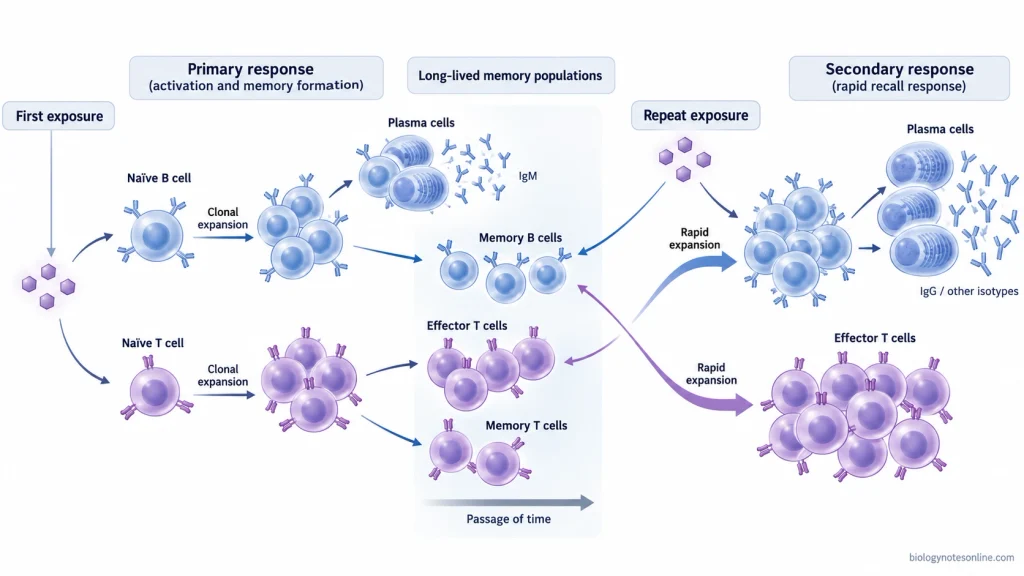
Primary immune response is the adaptive immune response produced when a particular antigen enters the body for the first time. In this response, antigen-specific naïve B and T lymphocytes are activated, proliferate and form the effector cells. It takes more time.
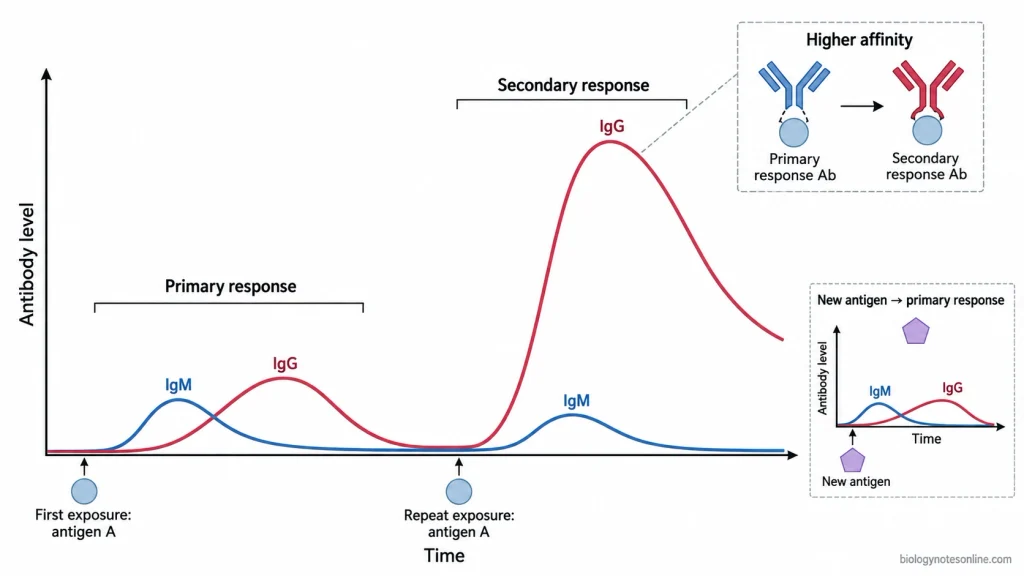
In antibody response, IgM appears early and the amount of antibody increases gradually, followed by class-switched antibodies such as IgG during the later part of the response.
Some of the activated lymphocytes are converted into long-lived memory B cells and memory T cells.
When the same antigen enters again, these memory cells are activated rapidly and produce the secondary immune response, also referred to as the “memory response”. It develops faster and is generally greater than the primary response. Antibodies produced during the secondary response are commonly of higher affinity, with IgG and other class-switched isotypes forming a major part while small amount of IgM may also be produced.
The response to the previously encountered antigen is more rapid because antigen-specific memory lymphocytes have already been formed during the first exposure.
Primary vs Secondary Immune Response comparison table
| Basis of difference | Primary Immune Response | Secondary Immune Response |
|---|---|---|
| Antigen exposure | It develops after the first exposure of the body to a particular antigen. | It occurs when the body is exposed again to the same antigen. |
| Responding lymphocytes | The response mainly begins with activation of antigen-specific naïve B and T lymphocytes. These cells undergo clonal expansion and differentiation. | Memory B and T cells formed after the earlier exposure take part in the response. They can respond more rapidly after antigen re-entry. |
| Lag period | It has a comparatively longer lag period, as the specific naïve lymphocytes first need to be activated and expanded. | The lag period is shorter. Memory lymphocytes have already been generated against that antigen. |
| Speed of response | Development of the immune response is relatively slow. | It develops rapidly after subsequent exposure. Plasma cells and other effector cells can be generated quickly. |
| Magnitude | The amount of antibody produced is generally lower than that of the secondary response. | A much greater antibody response is commonly produced because antigen-specific memory B cells are already present. |
| Major antibody produced | IgM is produced early and forms an important part of the primary antibody response. Class-switched antibodies such as IgG appear later. | It is commonly dominated by IgG and other class-switched antibodies, depending on the antigen and site of response. A small or variable IgM response can also occur. |
| Antibody affinity | Antibodies produced early in the response generally have lower affinity. Affinity maturation develops during the response. | Antibodies are usually of higher affinity, because affinity-matured memory B-cell populations were selected during the previous response. |
| Antigen amount needed for activation | Naïve B cells generally require stronger antigenic stimulation for efficient activation. | Memory B cells, especially affinity-matured populations, can respond efficiently to lower amounts of antigen. |
| Immunological memory before response | Specific memory cells are not already present before the first encounter. Memory B and T cells are generated during the response. | Antigen-specific memory cells are already present before the repeated exposure. |
| Antibody class switching and maturation | Class switching, somatic hypermutation and selection of higher-affinity B cells develop as the B-cell response proceeds. | Many responding memory B cells have already undergone class switching and affinity maturation. Further germinal-center maturation may also occur following re-exposure. |
| Specificity on repeated exposure | A new antigen normally produces its own primary response. | The enhanced response is antigen-specific. Exposure to an unrelated antigen does not produce the same memory response. |
| Relation with vaccination | The first immunization can act as priming, generating the primary response along with immune memory. | Booster exposure can activate the existing memory cells and produce a rapid recall or secondary response. |
Differences between Primary and Secondary Immune Response
- Antigen exposure- Primary immune response occurs during the first exposure of the body to a particular antigen. When the same antigen enters for second time or later, secondary immune response is produced.
- Responding lymphocytes- In primary response, the responding cells are antigen-specific naïve B and T lymphocytes. These cells are activated, multiply and undergo clonal expansion. Secondary response mainly involves the memory B and T cells which were already formed during the earlier exposure.
- Lag period- The lag period is longer in primary immune response. The lymphocytes have to get activated first, followed by their proliferation and differentiation. Secondary response has a much shorter lag phase.
- Strength of response- Comparatively less amount of antibody is produced during primary response. In secondary response, antibody level rises rapidly. A much higher amount is usually reached.
- Antibody type- IgM is the early antibody of primary response. Later, class-switched antibodies such as IgG are produced. In secondary response, IgG is commonly produced in larger amount, along with small amount of IgM. Depending on the response, IgA or IgE may also be formed.
- Antibody affinity- Antibodies produced early in primary response generally have lower average affinity. The secondary response produces antibodies of higher affinity. This occurs because affinity maturation and selection had already taken place following the earlier antigen exposure.
- Antigen requirement- Naïve B cells need suitable antigenic stimulation for their activation during primary response. Memory B cells have increased affinity towards the antigen. They can start interaction with helper T cells even at lower doses of antigen.
- Memory cells- Before first exposure, the specific memory cells are not already available. Some activated lymphocytes during primary response develop into long-lived memory cells. During secondary response, these cells are already present.
- Duration- Antibody production generally decreases after the antigen is cleared in primary response. In secondary response, production of the specific antibody can continue for a longer period.
- Antigen specificity- Secondary response occurs against the same antigen which was encountered previously. A different antigen will not produce this memory response. It will produce its own primary immune response.
Similarities Between Primary and Secondary Immune Response
- Both primary and secondary immune responses are a part of adaptive immunity. They are antigen-specific, acting against the particular antigen which has stimulated the lymphocyte population.
- Antigen recognition- In both responses, the antigen is recognized through specific receptors of B and T lymphocytes. Only the lymphocytes having suitable receptor for that antigen are selected.
- Clonal expansion occurs in both the immune responses. After selection, antigen-specific lymphocytes multiply. These cells then differentiate into the cells required for carrying out the immune reaction.
- Both B cells and T cells can take part in primary as well as secondary response. B-cell response gives rise to antibody-secreting cells. On the other hand, the effector T cells perform cellular immune functions.
- When humoral immunity is activated, antibodies are produced in both responses. The antibodies bind specifically with their corresponding antigen. Their amount, predominant isotype and average affinity, however, differ between primary and secondary response.
- Both responses can develop after exposure to antigen during an infection or immunization. Vaccination also makes use of these adaptive responses, where the antigen exposure activates antigen-specific B and T-cell populations.
- Effector cells are formed in each response for controlling or removing the antigen. Antibody-secreting B cells mainly act against the extracellular pathogens and their products, while effector T cells can act on infected cells. They also assist other immune cells.
- After the antigen is removed, many of the expanded effector lymphocytes decrease in number. Some antigen-experienced cells can remain for later immune activity, while the antibody level may gradually fall following clearance of the antigen.
References
- Alberts, B., Johnson, A., Lewis, J., Raff, M., Roberts, K., & Walter, P. (2002). Molecular biology of the cell (4th ed.). Garland Science. https://www.ncbi.nlm.nih.gov/books/NBK21054/
- Emini, E. A., & Fan, H. Y. (1997). Immunological and pharmacological approaches to the control of retroviral infections. In J. M. Coffin, S. H. Hughes, & H. E. Varmus (Eds.), Retroviruses. Cold Spring Harbor Laboratory Press. https://www.ncbi.nlm.nih.gov/books/NBK19426/
- Janeway, C. A., Jr., Travers, P., Walport, M., & Shlomchik, M. J. (2001). Immunobiology: The immune system in health and disease (5th ed.). Garland Science. https://www.ncbi.nlm.nih.gov/books/NBK10757/
- Neuberger, M. S., Ehrenstein, M. R., Rada, C., Sale, J., Batista, F. D., Williams, G., & Milstein, C. (2000). Memory in the B-cell compartment: Antibody affinity maturation. Philosophical Transactions of the Royal Society of London. Series B: Biological Sciences, 355(1395), 357–360. https://doi.org/10.1098/rstb.2000.0573