

Lymphocytes are a type of white blood cells (WBCs) and comes under agranulocytes. These are one of the main cells of immune system. They protect body from foreign antigen and infection.
They are present about 20-40% of total circulating white blood cells. These cells move through blood and lymphatic system. During this movement they find out foreign antigens present inside the body.
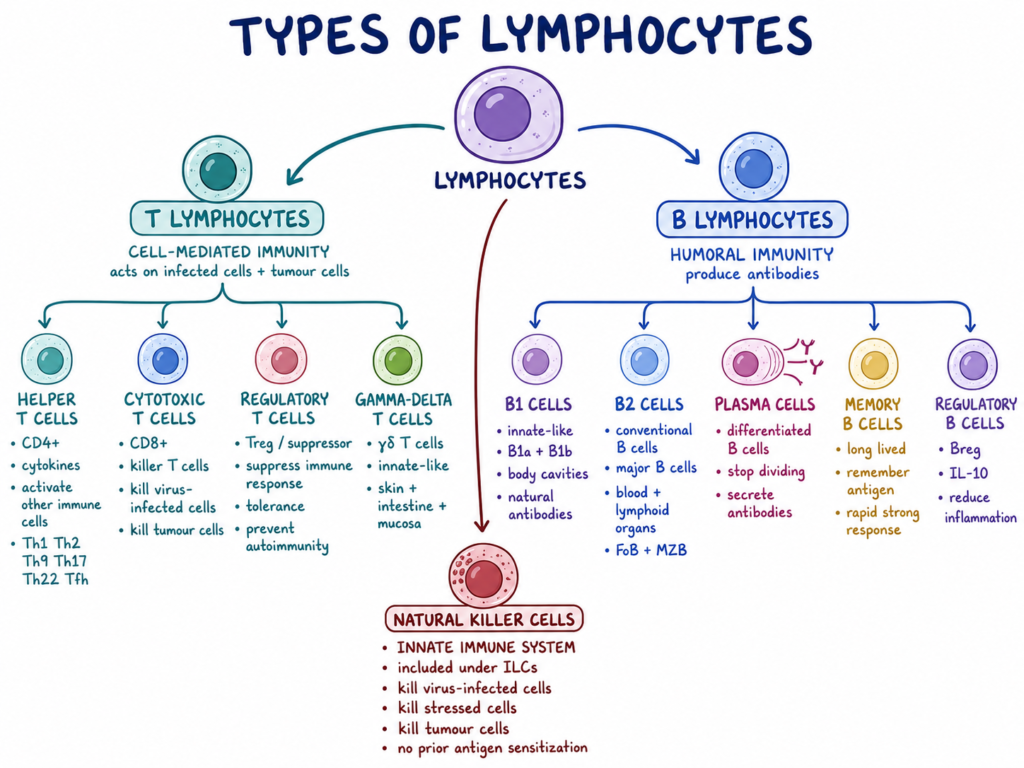
The lymphocytes are mainly of three types. These are B lymphocytes, T lymphocytes and Natural Killer cells (NK cells).
B lymphocytes are also called B cells. They mature in bone marrow. These cells take part in humoral immunity and produce antibodies against specific pathogens.
T lymphocytes are also called T cells. They mature in thymus. These cells are involved in cell mediated immunity. They destroy infected cell and abnormal cell directly. They also release chemical substances to regulate other immune cells.
Natural Killer cells or NK cells are part of innate immune system. They do not have antigen specific receptor like B cell and T cell. They give quick defence against virus infected cells, pathogens and tumour cells.
So, lymphocytes are important cells of body defence system. They help in recognition of foreign antigen, production of immune response and protection of body.
Characteristics of Lymphocytes
The following are the important characteristics of lymphocytes–
- Cell type– Lymphocytes are agranulocytes. They do not contain specific granules. But azurophilic granules are present in some cells.
- Abundance– They form about 25% of total circulating white blood cells (WBCs).
- Size– Resting lymphocytes are small cells. Their size is about 7-10 µm. After activation by antigen, they become large about 9-18 µm.
- Nucleus– The nucleus is large and spherical. It is dark staining due to heterochromatin. It occupies most part of the cell.
- Cytoplasm– The cytoplasm is very less in resting cell. It forms thin pale blue rim around nucleus. In activated cell, cytoplasm becomes more and azurophilic granules are seen.
- Ultrastructure– Under electron microscope, lymphocytes show prominent polyribosomes. T cells have smoother surface than B cells.
- Types– The main types are B lymphocytes, T lymphocytes and Natural Killer cells (NK cells).
- Function– Lymphocytes are main immunocompetent cells of blood. They take part in adaptive immunity and also in innate lymphoid response.
Types of Lymphocytes
The following are the main types of lymphocytes–
T lymphocytes–
T lymphocytes or T cells are the cells of cell mediated immunity. They mainly act against infected cells and tumour cells.
Types of T lymphocytes–
- Helper T cells– These are CD4+ T cells. They produce cytokines. They activate and control other immune cells. The main forms are Th1, Th2, Th9, Th17, Th22 and T follicular helper (Tfh) cells.
- Cytotoxic T cells– These are CD8+ T cells. They are also called killer T cells. They directly kill virus infected cells and malignant tumour cells.
- Regulatory T cells– These are also called Tregs or suppressor T cells. They suppress immune response. They maintain tolerance and prevent autoimmune disease.
- Gamma-delta T cells– These are γδ T cells. They are innate like T cells. They are mainly present in epithelial layer of skin, intestine and other mucosal tissue.
B lymphocytes–
B lymphocytes or B cells are the cells of humoral immunity. They mainly produce antibodies against specific antigen.
Types of B lymphocytes–
- B1 cells– These are innate like B cells. They are divided into B1a and B1b cells. They are mainly present in body cavities. They produce natural antibodies.
- B2 cells– These are conventional B cells. They are the major B cells present in blood and lymphoid organs. It includes Follicular B cells (FoB) and Marginal zone B cells (MZB).
- Plasma cells– These are fully differentiated B cells. They stop dividing. Their main function is to secrete large amount of specific antibodies.
- Memory B cells– These are long lived B cells. They remember the antigen. During next exposure, they produce quick and strong antibody response.
- Regulatory B cells– These are also called Bregs. They are small immunosuppressive group of B cells. They secrete IL-10 and reduce inflammation.
Natural Killer cells–
Natural Killer cells or NK cells are lymphocytes of innate immune system. They are included under Innate Lymphoid Cells (ILCs). They kill virus infected cells, stressed cells and tumour cells. They do not need previous antigen sensitization.
Development of Lymphocytes
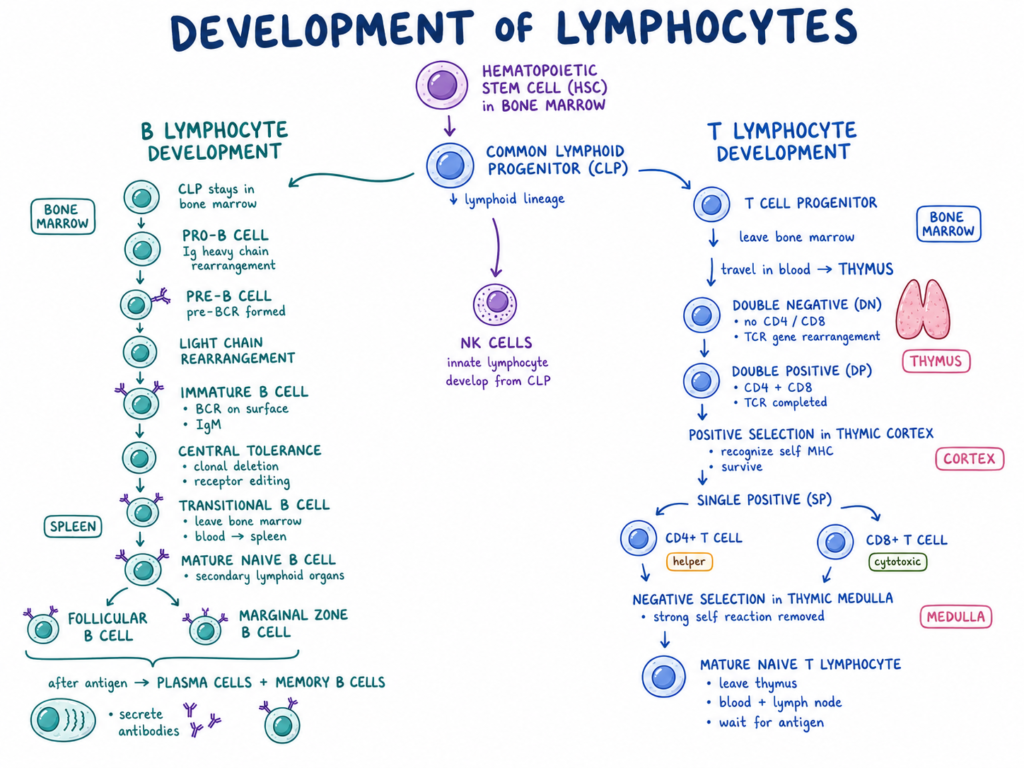
Lymphocytes develop from hematopoietic stem cells (HSCs) present in bone marrow. These cells are multipotent cells. From this cell all blood cells can be formed.
The hematopoietic stem cells differentiate into common lymphoid progenitors (CLPs). These cells are committed to lymphoid lineage. From this stage B lymphocytes, T lymphocytes and Natural Killer cells may develop.
B lymphocyte development
- Common lymphoid progenitors (CLPs) remain in the bone marrow for B cell development. Here they change into pro-B cells.
- In pro-B cell stage, rearrangement of immunoglobulin heavy chain gene starts. This is the first important step for formation of B cell receptor.
- After successful heavy chain formation, the cell becomes pre-B cell. In this stage pre-B cell receptor (pre-BCR) is formed on the cell surface.
- In pre-B cell stage, rearrangement of immunoglobulin light chain gene starts. This helps in formation of complete receptor.
- After light chain rearrangement, the cell becomes immature B cell. It expresses complete B cell receptor (BCR) on its surface. Mainly IgM is present.
- In immature stage, central tolerance occurs. The cells which strongly react with self antigen are removed by clonal deletion. Some cells are changed by receptor editing.
- The surviving immature B cells leave the bone marrow. They enter into blood and go to spleen. These cells are called transitional B cells.
- In spleen and other secondary lymphoid organs, transitional B cells become mature naive B lymphocytes. They may form follicular B cells or marginal zone B cells.
- Mature naive B cells remain ready for antigen. After antigen stimulation, they can form plasma cells and memory B cells. Plasma cells secrete antibodies.
T lymphocyte development
- T cell progenitors are first formed from common lymphoid progenitors (CLPs) in bone marrow. But they do not mature in bone marrow.
- The early T cell progenitors leave the bone marrow. They travel through blood and reach the thymus.
- In thymus, the early thymocytes do not express CD4 and CD8 receptors. This is called double negative stage.
- In double negative stage, rearrangement of T cell receptor (TCR) gene starts. The cell is now committed to T cell lineage.
- After this, thymocytes express both CD4 and CD8 receptors. This is called double positive stage. In this stage TCR assembly is completed.
- The double positive cells are tested in thymic cortex. They are checked whether their TCR can recognize self MHC molecules or not.
- Cells which recognize self MHC get survival signal. Cells which fail to recognize MHC die by apoptosis. This step is called positive selection.
- After positive selection, the cell loses one receptor. Some cells become CD4+ T cells. Some cells become CD8+ T cells. This is called single positive stage.
- The single positive cells move to thymic medulla. Here they are tested against self antigens.
- Cells which react very strongly with self antigen are destroyed. This step is called negative selection. It prevents autoimmune reaction.
- The surviving cells become mature naive T lymphocytes. They leave the thymus and circulate in blood, lymph node and other secondary lymphoid organs. They wait for foreign antigen activation.
Structure of Lymphocytes
The following are the structure of lymphocytes–
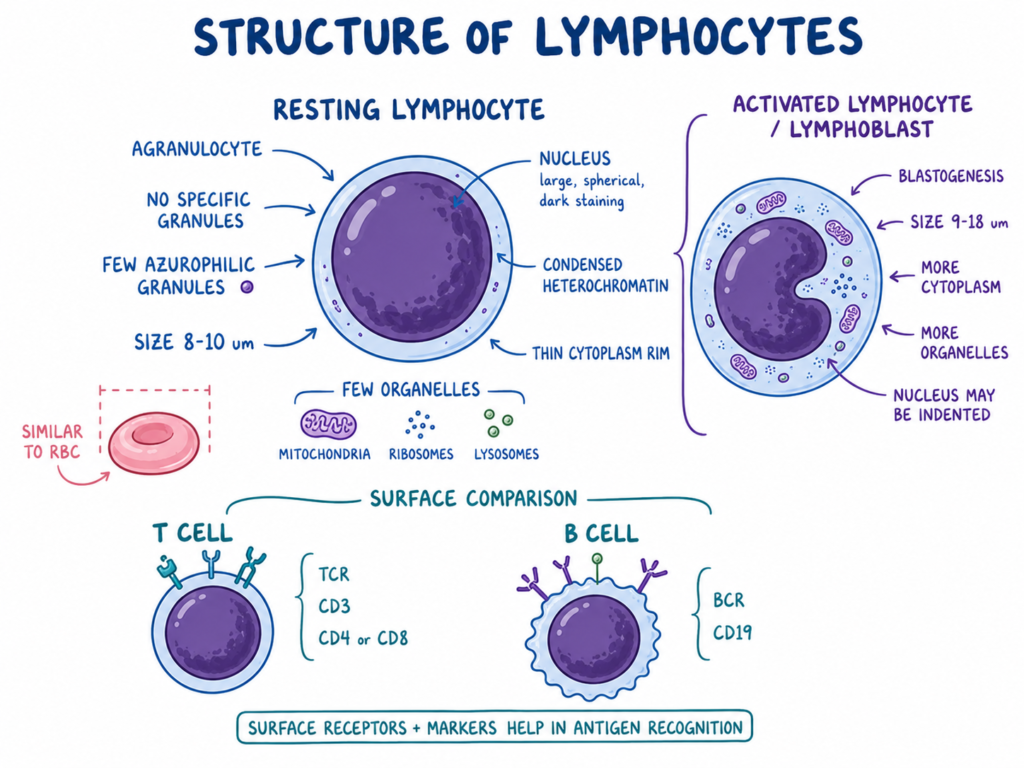
- Cell type– Lymphocytes are agranulocytes. They do not contain specific secretory granules. But some azurophilic granules are present, which are lysosomal in nature.
- Cell size– Resting lymphocytes are small cells. Their size is about 8-10 µm in diameter. It is almost same as red blood cells (RBCs). After antigenic stimulation, they become larger about 9-18 µm.
- Nucleus– The nucleus is large, spherical and dark staining. It contains highly condensed heterochromatin. It occupies most of the cell volume. In activated large lymphocytes, nucleus may become indented or C-shaped.
- Cytoplasm– Resting lymphocytes have very less cytoplasm. It is seen as a thin pale blue rim around the nucleus. In activated lymphocyte, cytoplasm becomes more and azurophilic granules become prominent.
- Organelles– Resting lymphocytes contain very few organelles. Few mitochondria, ribosomes and lysosomes are present. Under electron microscope, prominent polyribosomes are seen.
- Activated form– After activation by antigen, lymphocytes undergo blastogenesis. The cell size increases. Cytoplasm increases and number of organelles also becomes more.
- Cell surface– The surface of T cells is generally smoother than B cells under electron microscope. The outer membrane carries different surface receptors and markers.
- Receptors– T lymphocytes contain T cell receptor (TCR) on their surface. B lymphocytes contain B cell receptor (BCR) on their surface. These receptors help in antigen recognition.
- Surface markers– Different lineage markers are present on lymphocytes. T cells may have CD3, CD4 or CD8. B cells may have CD19. These markers help to identify different type of lymphocytes.
Diseases Related to Lymphocytes
The following are the important diseases related to lymphocytes–
A. Autoimmune and inflammatory diseases
- SLE– Systemic Lupus Erythematosus (SLE) occurs due to defective B cell tolerance. In this disease autoantibodies are produced by abnormal B cells. Th17 cells also take part in inflammation.
- RA– Rheumatoid Arthritis (RA) is related with abnormal B cell activation. Defective tolerance occurs in bone marrow. Th1 cells and Th17 cells cause severe joint inflammation.
- T1D– Type 1 Diabetes (T1D) is related with defect in central and peripheral B cell tolerance. Due to this immune cells attack body’s own pancreatic cells.
- MS– Multiple Sclerosis (MS) occurs due to defective peripheral B cell tolerance. It is also related with abnormal function of regulatory T cells (Tregs).
- Sjögren’s syndrome– This disease is related with increased B cell activating factor (BAFF). The number of B1 cells also becomes high.
- Asthma– Asthma and allergic diseases are mainly caused by Th2 cells. These cells cause mucus production and airway hyper-responsiveness. Th17 cells may also take part.
- Crohn’s disease– Crohn’s disease is an inflammatory disease. In this condition Th22 cells enter into epithelial tissue and cause inflammation.
- Psoriasis– Psoriasis is also related with epithelial tissue inflammation. Th22 cells are involved in this disease.
B. Immunodeficiency disorders
- DiGeorge syndrome– DiGeorge syndrome occurs due to failure of thymus formation. As a result mature T lymphocytes are not formed properly.
- IPEX syndrome– IPEX syndrome occurs due to mutation in FOXP3 gene. Functional regulatory T cells (Tregs) are lost. So uncontrolled T cell activation and multiorgan inflammation occurs.
- SCID– Severe Combined Immunodeficiency (SCID) is a severe immune defect. In this disease both B cells and T cells are affected.
- Wiskott-Aldrich syndrome– In this disease function and development of B cells and T cells become defective. Immune synapse formation may also become abnormal.
- Bare lymphocyte syndrome– This disorder occurs due to defective MHC expression. Due to this antigen presentation becomes poor and T cells are selectively lost.
- XLA– X-linked Agammaglobulinemia (XLA) is a primary immunodeficiency. It is related with defect in B cell survival, signalling and maturation.
- CVID– Common Variable Immunodeficiency (CVID) is related with abnormal B cell tolerance and antibody formation. So recurrent infection occurs.
- Hyper-IgM syndrome– This disease occurs due to defect in CD40 receptor or CD40L (CD154). So B cell class switching does not occur properly.
C. Malignancies
- CLL– Chronic Lymphocytic Leukemia (CLL) is a common lymphoproliferative disease. It occurs due to expansion of clonal B cells with abnormal B cell receptor signalling.
- T-ALL– T-cell Acute Lymphocytic Leukemia (T-ALL) is a malignant disease of T cells. It is commonly related with activating mutation in NOTCH1 gene.
- ATL– Adult T-cell Leukemia/Lymphoma (ATL) occurs due to infection by Human T-cell Lymphotropic Virus (HTLV). In this disease infected T cells divide in uncontrolled way.
- ABC-DLBCL– Diffuse Large B-cell Lymphoma (ABC-DLBCL) is an aggressive B cell lymphoma. It is related with chronic abnormal B cell receptor signalling.
- MCL– Mantle Cell Lymphoma (MCL) is another aggressive B cell cancer. It is also associated with abnormal activation of B cells.
D. Infectious disease
- HIV/AIDS– HIV/AIDS is caused by Human Immunodeficiency Virus (HIV). This virus directly infects and destroys CD4+ helper T cells. It binds with CCR5 and CXCR4 receptors present on these cells.
Functions of Lymphocytes
The following are the main functions of lymphocytes–
A. Functions of B lymphocytes
- Antibody production– B lymphocytes produce antibodies after activation. They change into plasma cells and secrete antibodies like IgG, IgA and IgE. These antibodies neutralize and remove foreign pathogens.
- Natural antibody formation– B1 cells produce natural antibodies. These antibodies are formed rapidly and give early protection against infection.
- Antigen presentation– B cells act as antigen presenting cells (APCs). They take antigen, process it and present it on their surface. This helps in activation of T lymphocytes.
- Immune regulation– Regulatory B cells (Bregs) control immune response. They secrete anti-inflammatory cytokines like IL-10 and TGF-β. This prevents excess tissue damage and autoimmune reaction.
B. Functions of T lymphocytes
- Cell killing– CD8+ cytotoxic T cells directly kill infected cells and tumour cells. They release perforin and granzymes. They also activate death receptor pathway by FasL.
- Helper function– CD4+ helper T cells secrete cytokines. These cytokines activate and control other immune cells. So they help in proper immune response.
- Macrophage activation– Th1 cells activate macrophages. This helps to destroy intracellular pathogens present inside the cell.
- Parasite defence– Th2 cells activate mast cells and eosinophils. They help in removal of extracellular parasites and helminths. They also take part in allergic reaction.
- Neutrophil recruitment– Th17 cells recruit neutrophils at mucosal surface. They help against extracellular bacteria and fungi.
- B cell help– T follicular helper cells (Tfh cells) help B cells in germinal centre. They help in formation of high affinity antibodies.
- Immune suppression– Regulatory T cells (Tregs) suppress activation of other immune cells. They maintain self tolerance. They also prevent autoimmune disease and reduce immune response after infection is cleared.
C. Functions of Natural Killer cells and ILCs
- Tumour killing– Natural Killer cells (NK cells) rapidly kill tumour cells. They do not need previous antigen sensitization.
- Viral defence– NK cells destroy virus infected cells. They detect cells which lose normal MHC class I molecules or show stress molecules.
- Early tissue defence– Innate Lymphoid Cells (ILCs) are mainly present in tissues. They give early defence in gut, lungs and skin against virus, bacteria and parasites.
- Cytokine secretion– NK cells and ILC1 cells secrete cytokines like IFN-γ and TNF-α. These cytokines recruit and activate other immune cells at the site of infection.
References
- Lymphocytes. (n.d.). PubMed.
- Advances in anti-cancer immunotherapy: CAR-T cell, checkpoint inhibitors, dendritic cell vaccines, and oncolytic viruses, and emerging cellular and molecular targets. (n.d.). PMC.
- Gururajan, M., Sindhava, V. J., & Bondada, S. (2014). B cell tolerance in health and disease. Antibodies, 3(1), 116–129.
- Gómez-Manríquez, J. G., Hernández-Bello, J. H., Muñoz-Valle, J. F., Sifuentes-Franco, S., Graciano-Machuca, O., & Morales-Núñez, J. J. (2025). B cell development: Transcriptional regulation and immunological mechanisms in homeostasis. Frontiers in Immunology, 16, Article 1593338.
- Brief review: Regulatory T cell development in the thymus. (n.d.). PMC – NIH.
- CD4 T helper cell subsets and related human immunological … (n.d.). PMC – NIH.
- Hussain Biology. (n.d.). CD4+ T cell subsets | T-helper cell [Video]. YouTube.
- Central B-cell tolerance: Where selection begins. (n.d.). PMC.
- Melchers, F. (2015). Checkpoints that control B cell development. The Journal of Clinical Investigation, 125(6), 2203–2210.
- Circulating T-lymphocyte subsets as biomarkers for immune checkpoint inhibitors in solid tumors. (n.d.). PMC.
- Class switch recombination occurs infrequently in germinal centers. (n.d.). PMC – NIH.
- van den Broek, T. (2019). Class-switch recombination of antibodies occurs prior to germinal center formation. Immunopaedia.
- Wikipedia contributors. (2025). Co-stimulation. In Wikipedia, The Free Encyclopedia.
- Control of germinal center responses by T-follicular regulatory … (n.d.). PMC – NIH.
- Xiong, N., & Raulet, D. H. (2007). Development and selection of γδ T cells. Immunological Reviews, 215, 15–31.
- Development of lymphopenia during therapy with immune checkpoint inhibitors is associated with poor outcome in metastatic cutaneous melanoma. (n.d.). PMC.
- Diversity and function of group 1 innate lymphoid cells. (n.d.). PMC.
- De Silva, N. S., & Klein, U. (2015). Dynamics of B cells in germinal centres. Nature Reviews Immunology, 15(3), 137–148.
- Germinal center B cell and T follicular helper cell development initiates in the interfollicular zone. (n.d.). ResearchGate.
- Germinal center reaction. (n.d.). PubMed.
- Sauls, R. S., McCausland, C., & Taylor, B. N. (2023). Histology, T-cell lymphocyte. In StatPearls. StatPearls Publishing.
- Tigner, A., Ibrahim, S. A., & Murray, I. V. (2026). Histology, white blood cell. In StatPearls. StatPearls Publishing.
- Human natural killer cells: Form, function, and development. (n.d.). PMC.
- ITAM-based receptors in natural killer cells. (n.d.). PMC.
- Inflammatory cytokines as a third signal for T cell activation. (n.d.). PMC.
- Cano, R. L. E., & Lopera, H. D. E. (2013). Introduction to T and B lymphocytes. In J. M. Anaya, Y. Shoenfeld, A. Rojas-Villarraga, et al. (Eds.), Autoimmunity: From bench to bedside (Chapter 5). El Rosario University Press.
- Hussain Biology. (n.d.). Mechanism of T-CELL ACTIVATION [Video]. YouTube.
- Nemazee, D. (2017). Mechanisms of central tolerance for B cells. Nature Reviews Immunology, 17(5), 281–294.
- Raulet, D. H. (2006). Missing self recognition and self tolerance of natural killer (NK) cells. Seminars in Immunology, 18, 145–150.
- Scoville, S. D., Freud, A. G., & Caligiuri, M. A. (2017). Modeling human natural killer cell development in the era of innate lymphoid cells. Frontiers in Immunology, 8, Article 360.
- NK cell self tolerance, responsiveness and missing self recognition. (n.d.). PMC – NIH.
- Optimal germinal center B cell activation and T-dependent antibody responses require the expression of the mouse complement receptor Cr1. (n.d.). PMC.
- Regulatory T cells vs Th17: Differentiation of Th17 versus Treg, are the mutually exclusive? (n.d.). PMC.
- Relationships between lymphocyte counts and treatment-related toxicities and clinical responses in patients with solid tumors treated with PD-1 checkpoint inhibitors. (n.d.). PMC.
- Role of the ITAM-bearing receptors expressed by natural killer cells in cancer. (n.d.). PMC.
- Structural ontogeny, functional subsets, and therapeutic targeting of lymphocyte lineages in adaptive and innate immunity. (n.d.).
- Thermo Fisher Scientific. (n.d.). T helper 1 cells overview.
- T cell selection in the thymus: A spatial and temporal perspective. (n.d.). PMC – NIH.
- Cavanagh, M., & Gwyer Findlay, E. (2022). T-cell activation. British Society for Immunology.
- Shah, D. K. (2022). T-cell development in thymus. British Society for Immunology.
- The marginal zone B cell compartment and T cell independent antibody responses are supported by B cell intrinsic expression of IRF1. (n.d.). PMC.
- Paul, S., & Lal, G. (2017). The molecular mechanism of natural killer cells function and its importance in cancer immunotherapy. Frontiers in Immunology, 8, Article 1124.
- National Research Council (US) Subcommittee on Immunotoxicology. (1992). The structure and function of the immune system and mechanisms of immunotoxicity. In Biologic markers in immunotoxicology (Chapter 2). National Academies Press (US).
- Song, S., & Matthias, P. D. (2018). The transcriptional regulation of germinal center formation. Frontiers in Immunology, 9, Article 2026.
- The development of innate lymphoid cells. (n.d.). PMC – NIH.
- Yates, A. J. (2014). Theories and quantification of thymic selection. Frontiers in Immunology, 5, Article 13.
- Jiao, Y., Huntington, N. D., Belz, G. T., & Seillet, C. (2016). Type 1 innate lymphoid cell biology: Lessons learnt from natural killer cells. Frontiers in Immunology, 7, Article 426.