

Filtration is a physical separation process in which a liquid or gas is passed through a filter medium to separate certain suspended particles from the fluid. The filter medium allows the fluid to pass through it while retaining the particles. It is commonly used for the separation of heterogeneous mixtures, especially suspensions containing insoluble solid particles.
During filtration process, the mixture passed through a porous medium such as filter paper, cloth or a suitable membrane. The particles are then retained on the surface or within the filter medium, depending on the nature of the filter. The material retained on the filter is called the residue, while the liquid collected after passing through the filter is known as the filtrate. Dissolved substances generally pass through ordinary filter paper along with the liquid.
Filtration is used in both chemistry and biology laboratories for the removal of suspended particles and recovery of different components of a mixture. It is also used for separating particles from gases. A common example is the separation of tea leaves from prepared tea using a strainer.
What is Filtration?
Filtration is a physical separation process in which a mixture containing suspended particles is passed through a filter medium to separate the particles from a liquid or gas. The filter medium is a porous material, such as filter paper, which allows the fluid to pass through it while retaining certain particles. The fluid that passes through the filter is called the filtrate. The solid material retained on the filter is known as the residue. In ordinary filtration, the larger suspended particles are separated, while smaller particles and dissolved substances may pass through the pores of the filter along with the fluid. For example, when a mixture of sand and water is passed through filter paper, the sand remains on the filter paper and the water is collected as filtrate.
Purpose of Filtration
The main purposes of filtration are as follows-
- Filtration is used to remove unwanted suspended particles from liquids and gases. The filter retains these particles. When the liquid is the required material, it is collected as the filtrate. It is also used to clarify cloudy liquids and remove dust or other suspended particles from gases.
- It is used to recover useful solid materials from a mixture. The solid retained on the filter is collected as the residue. For example, an insoluble precipitate formed during a chemical reaction can be separated from the liquid by filtration.
- Filtration is also carried out to prepare samples for further processing. The suspended particles are removed before another separation or laboratory analysis when they may interfere with the next process.
Principle of Filtration
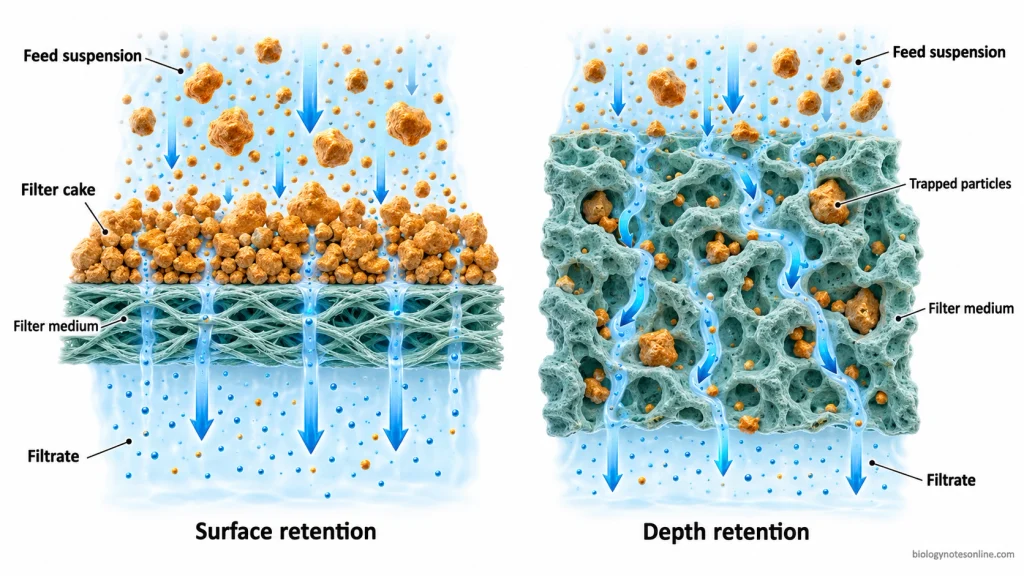
Filtration is based on the separation of suspended solid particles from a fluid using a permeable filter medium. The fluid passes through the pores of the medium, while particles are retained according to their size and their interaction with the filter structure. A pressure difference is required as a driving force. It may be developed by gravity, applied pressure or vacuum depending on the filtration system.
Particle retention does not occur only by simple sieving.
Particles larger than the effective pore openings are held at or near the surface of the filter medium by size exclusion or straining. This is referred to as surface retention. With further deposition, these retained particles can form a porous layer called the filter cake. The filter cake also acts as an additional filtering medium and gives resistance to the passage of fluid. Smaller particles may enter into the pores and become trapped within the thickness of the filter medium. This is called depth retention. Depending on the particles and filter medium, retention may also take place by interception, inertial impaction, diffusion, adsorption and other surface interactions.
The passage of fluid through the filter depends on the permeability of the medium and pressure difference across it. A highly permeable medium allows fluid to pass more easily. Less permeable medium or the deposited filter cake gives greater resistance. Particle size, shape and their relation with the pore structure determine whether particles remain on the surface, enter into the medium or pass through it.
Filtration Process
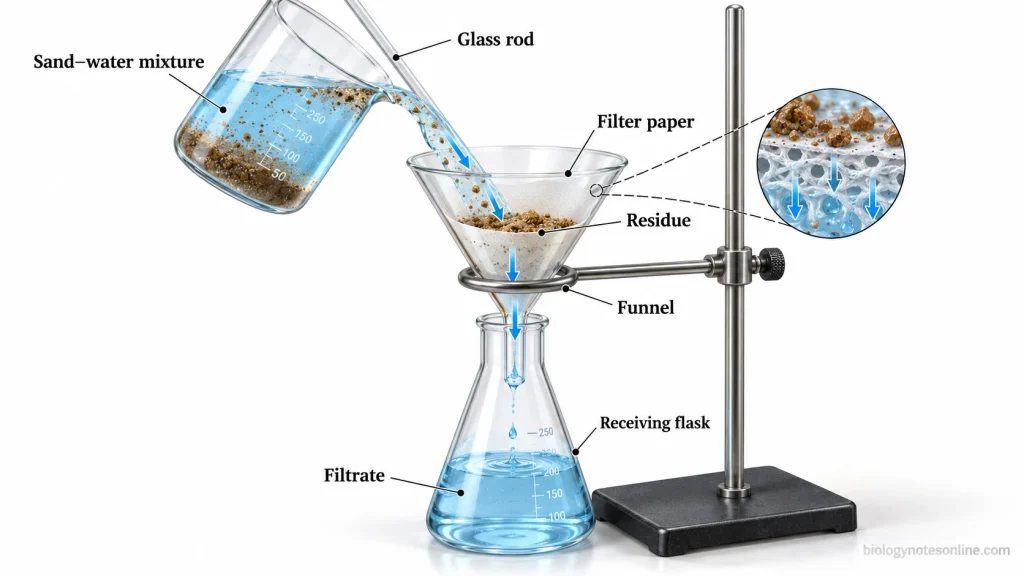
The filtration process takes place in the following steps-
- A suitable filter medium is first selected according to the fluid and the particles which have to be separated.
- The filter paper, membrane or other filtering material is then fitted properly in the filtration apparatus. In laboratory filtration, filter paper is often wetted with the same solvent so that it remains closely fitted to the funnel.
- The mixture to be filtered is brought onto the filter medium. A suspension may be mixed or swirled before pouring so that the solid particles are transferred along with the liquid and do not remain at the bottom of the original container.
- The fluid is then made to pass through the pores of the filter. Gravity itself can move the liquid through the filter, whereas vacuum or applied pressure can also be used to produce the required pressure difference. The liquid which passes through is collected as the filtrate. Solid particles are retained by the filter medium.
- As filtration continues, more solid particles are collected on or within the filter. In cake filtration, these particles gradually build up over the filter medium and form the filter cake. The cake itself can take part in further particle retention.
- Any solid remaining in the original vessel can be transferred to the filter by rinsing with a small amount of suitable liquid. When the retained solid is required, the material on the filter may also be washed to remove the liquid or soluble substances left with it.
- After the fluid has passed through, the required fraction is collected. If the filtrate is the desired material, it is taken from the receiving vessel for further use. When the retained solid is required, it can be removed from the filter after suitable washing and drying.
Filtration Apparatus and Materials
The apparatus used for filtration changes with the type of filtration and the material which has to be separated. Filter media are also selected according to particle size, nature of the fluid, required product and the operating conditions.
Filtration Apparatus
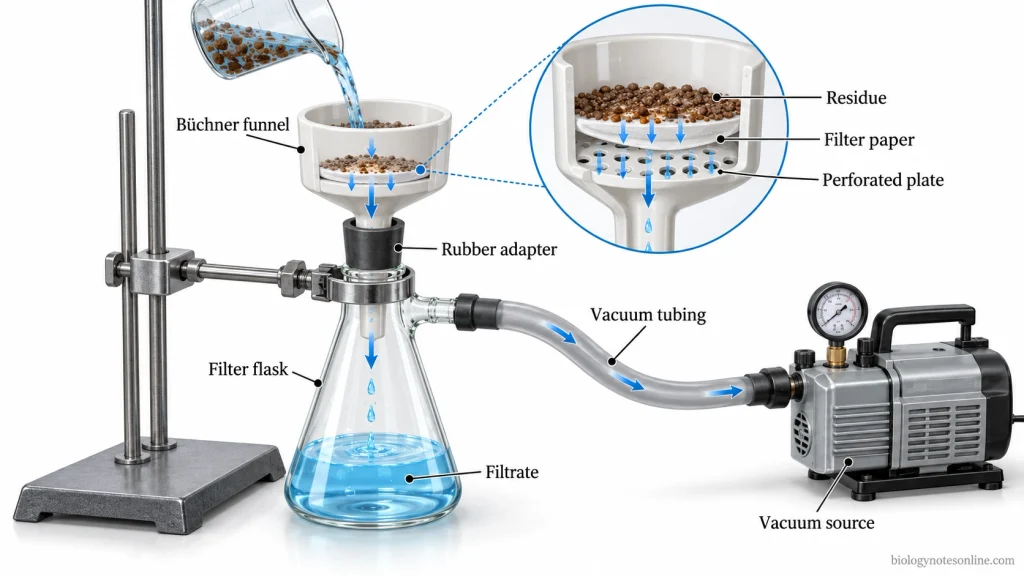
- Gravity filtration setup- A filter funnel holds the filter paper through which the mixture is passed. The funnel is generally supported on a stand or kept over the receiving vessel. The filtrate is collected in a beaker, flask or other suitable vessel below it. Here, gravity provides the force for filtration.
- Vacuum filtration apparatus- A Büchner funnel containing filter paper is fitted over a thick-walled filter flask. The flask has a side arm which is connected to the vacuum source by vacuum tubing. A rubber adapter or stopper provides a tight fitting between the funnel and flask. The filter flask is normally held with a clamp and stand because the vacuum connection can make the setup less stable.
- Pressure filter- In pressure filtration, the filter medium is enclosed inside a housing and the fluid is forced through it under applied pressure. Cartridge filters are commonly fitted inside such housings. The housing supports the filter element and also directs the fluid through the filtering material.
Filter Media
- Filter paper- Filter paper is a porous cellulose material commonly used for laboratory filtration. Different grades of filter paper provide different particle-retention and flow characteristics. It is fitted inside the funnel and retains the solid particles while the liquid passes through.
- Filter cloth and mesh- These materials are used where a stronger and more durable filtering surface is required. The openings present in the cloth or mesh allow the fluid to pass and retain particles according to their size.
- Sand and granular media- Sand is used as a bed of granular filter material. Suspended particles are retained between and on the surface of the individual grains as the fluid moves through the bed. Other granular materials may also be arranged alone or in different layers.
- Porous membranes and cartridges- Membranes contain small pores and are used where finer particle separation is required. A membrane may be used as a flat sheet or incorporated into a cartridge. Cartridge filters are placed inside a supporting housing and the fluid is passed through the filter element.
- Filter aids- Materials such as diatomaceous earth, perlite and cellulose can be used when fine particles rapidly block the ordinary filter medium. They may be placed as a precoat over the filter or mixed with the suspension. Filter aids form a more porous filter cake and can reduce blinding of the filter medium.
Types of Filtration
Filtration can be classified on the basis of the force used for movement of the fluid and also by the way particles are retained in the filter. These classifications may overlap. A vacuum or pressure filtration, for example, may also work as cake filtration.
- Gravity filtration- The liquid moves through the filter medium by gravity. It is a simple type of filtration. No additional pressure or vacuum is applied.
- Vacuum filtration- Here, a pressure lower than atmospheric pressure is produced below the filter medium. This pressure difference pulls the liquid through the filter. The filtration occurs faster than ordinary gravity filtration and is commonly used when the solid retained on the filter has to be collected. The liquid passes into the receiving flask.
- Pressure filtration- In this type, pressure is applied on the feed side and the fluid is forced through the filter medium. A greater pressure difference provides the force for passage of the fluid. Pressure filtration may be carried out through a filter cake or other filtering elements.
- Centrifugal filtration– The required pressure is developed by centrifugal force during rotation. The liquid passes through the filter medium while the solid particles are retained.
- Cake filtration- Suspended particles are deposited on the surface of the filter medium. At first, the filter medium itself retains these particles. With continued filtration a layer of solid gradually builds up over its surface. This layer is called the filter cake. Further filtration takes place through the filter cake as well as the original filter medium.
- Depth filtration- The particles enter into the filter medium and become trapped within its pores and internal spaces rather than remaining mainly on the surface. Granular beds and other porous media can work by depth filtration.
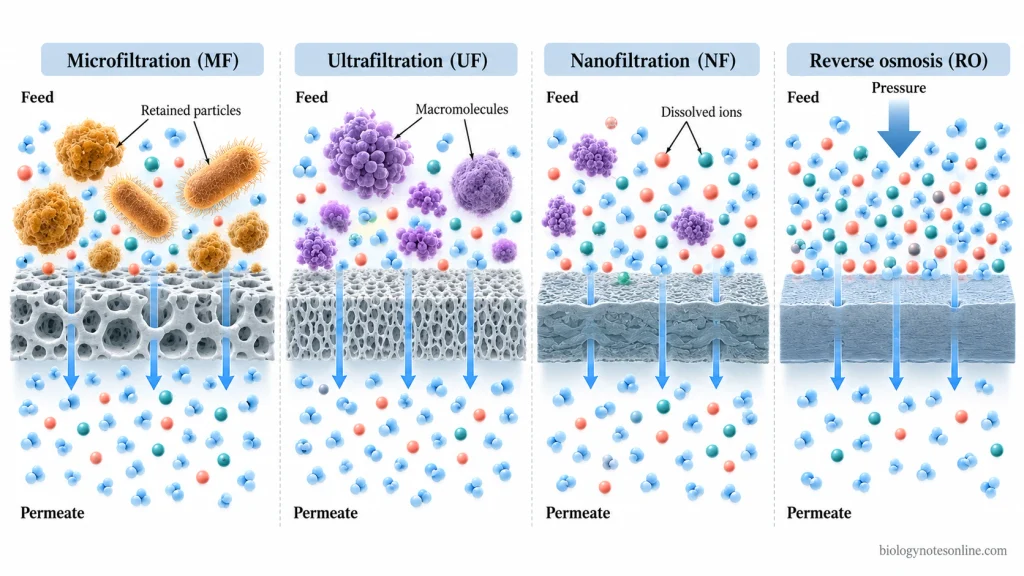
- Membrane filtration- A membrane acts as the separating barrier in this filtration. Depending on the membrane and the material being separated, particles, macromolecules or smaller dissolved components may be retained, while other components pass through as the permeate. Pressure-driven membrane filtration includes microfiltration (MF), ultrafiltration (UF), nanofiltration (NF) and reverse osmosis (RO).
Factors Affecting Filtration
The rate of filtration depends on the driving force, properties of the fluid and particles, and the resistance offered by the filter medium and the deposited cake. Some of the important factors affecting filtration are as follows-
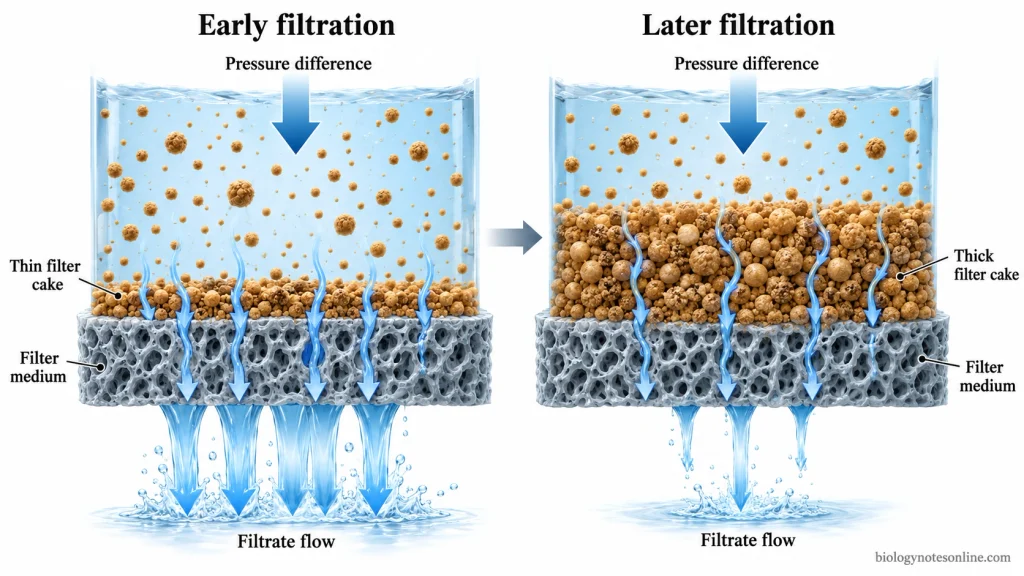
- Pressure difference- The pressure difference across the filter provides the driving force for movement of the fluid. An increase in pressure generally increases the filtration rate. In the case of a compressible filter cake, however, high pressure can compress the cake and decrease its permeability. The increase in filtration rate is then less.
- Viscosity of fluid- A liquid of high viscosity passes more slowly through the pores of the filter and filter cake. Lower viscosity gives a higher filtration rate under the same conditions.
- Temperature- Temperature mainly affects filtration by changing the viscosity of the liquid. For many liquids, viscosity decreases with increasing temperature and the liquid can pass through the filter more easily.
- Filter area- A larger filtering area allows a greater volume of fluid to pass through in a given time.
- Filter medium- The pore size, thickness and permeability of the filter medium affect the resistance to fluid flow. A medium having low permeability gives greater resistance. Blocking of its pores by fine particles can further reduce the filtration rate.
- Particle characteristics- The size, shape and size distribution of suspended particles affect the structure of the cake formed during filtration. Fine particles generally produce cakes having smaller flow passages and greater resistance. Larger particles can form a more open and permeable cake.
- Concentration of solids- A suspension containing more solid particles deposits more material on the filter during filtration. The filter cake builds up more rapidly and its resistance increases with continued deposition.
- Filter cake- The thickness, porosity, permeability and compressibility of the filter cake have a major effect on filtration. A thick or poorly permeable cake provides greater resistance to the passage of fluid. Cake resistance increases as more solids are deposited.
- Filter aids- Filter aids can be added to suspensions containing fine particles which tend to block the filter. They form a more porous cake and reduce rapid blockage of the filter medium.
Examples of Filtration
Everyday Examples of Filtration
- Tea leaves are separated from prepared tea by using a tea strainer. The leaves remain on the strainer while the liquid tea passes through its openings.
- In drip coffee preparation, hot water containing dissolved coffee substances passes through the filter paper, while the coffee grounds remain on the paper. The filtered coffee is collected below.
- Muddy water can be passed through cloth or another suitable filter to remove suspended soil particles. The soil is retained while water passes through the pores. Finer particles require a filter having smaller pores.
- Air purifiers and other mechanical air filters pass air through a fibrous filter medium. Particulate matter is captured by the filter while the air continues through it.
- Fruit or vegetable juice may be filtered through a strainer or cloth. Seeds and larger pieces of pulp remain on the filter, whereas the liquid juice passes through.
Scientific and Laboratory Examples
- A mixture of sand and water can be separated by filter paper. Sand remains on the paper and water is collected as the filtrate.
- In the laboratory, a precipitated solid can be collected by vacuum filtration using a Büchner funnel. The precipitate remains on the filter paper. Liquid is drawn through the filter into the flask below.
- During microbiological examination of water, the sample is passed through a membrane filter which retains bacterial cells. The water passes through. The membrane containing the trapped cells is then placed on a suitable culture medium for their detection or counting.
- Heat-sensitive biological solutions can be sterilized by membrane filtration instead of heating. Microorganisms are retained by a suitable membrane, while the filtered solution passes through it.
- In water-treatment systems, water is passed through sand or other granular filter media. Suspended material is retained within the filter bed and the filtered water moves out of the bed.
Applications of Filtration
- Used in drinking-water treatment to remove suspended particles and microorganisms with sand, granular media or membranes.
- Used in wastewater treatment to remove suspended solids and other contaminants. Membrane filtration is also used for further purification and recovery of water.
- Reverse osmosis is used for desalination and removal of dissolved salts from water.
- Used in chemistry laboratories to separate insoluble solids and collect precipitates from liquids.
- Membrane filtration is used in microbiology to collect microorganisms from water for their detection and counting.
- Used to sterilize heat-sensitive pharmaceutical solutions, buffers and cell culture media. Sterile filters are also used before final filling of biopharmaceutical products.
- In fermentation and cell culture, depth filtration and membrane filtration are used to remove cells and cell debris before further purification.
- Used for clarification and concentration of fruit juices and beverages. Microfiltration and ultrafiltration remove suspended materials, while reverse osmosis is also used for concentration.
- Membrane filtration is used in dairy processing for milk clarification, microbial removal, concentration of milk and whey, and recovery of milk proteins.
- Used to remove particulate matter from air by fibrous filters and high-efficiency particulate air (HEPA) filters.
Advantages of Filtration
- It is a simple physical method for separating insoluble solids from liquids. Ordinary gravity filtration requires no vacuum or applied pressure.
- The filtrate or the retained solid can be collected depending on the requirement.
- Vacuum filtration is faster than gravity filtration. It also removes more liquid from the collected solid.
- Different filter materials can be selected according to particle size and the nature of the sample.
- Filtration can separate particles without requiring a chemical reaction.
- Membrane filtration can be carried out under mild conditions and is useful for heat-sensitive solutions which cannot be sterilized by heating.
- Membrane systems can provide high separation efficiency with compact equipment and easy scale-up. They can also be combined with other treatment processes.
- Some membrane filtration processes require less energy and fewer chemicals than conventional separation methods.
Limitations of Filtration
- Ordinary filtration cannot separate dissolved substances from the solvent. They pass through the filter with the liquid.
- Very fine particles may pass through a filter having larger pores. A suitable grade of filter is required for such particles.
- Fine particles can block the pores of the filter and reduce the filtration rate.
- The filter cake becomes thicker during filtration and increases resistance to fluid flow. Filtration becomes slower.
- Some liquid may remain with the retained solid and filter medium after gravity filtration. The solid is not obtained completely dry.
- Membrane fouling reduces permeate flow and filtration efficiency. The membrane may require repeated cleaning or replacement.
- Filtration efficiency depends on the pore size of the filter. A membrane used to remove bacteria may not retain smaller viruses.
Filtration at a Glance – A Quick Summary Table for Exam
| Feature | Filtration |
|---|---|
| Definition | Physical separation of suspended particles from a liquid or gas using a porous filter medium. |
| Principle | Fluid passes through the filter, while certain particles are retained. |
| Driving force | Gravity, vacuum, applied pressure or centrifugal force. |
| Filter medium | Filter paper, cloth, mesh, sand, membrane or cartridge. |
| Filtrate | Fluid that passes through the filter. |
| Residue | Solid material retained by the filter. |
| Filter cake | Layer of retained solids formed on the filter surface. |
| Surface filtration | Particles are mainly retained on the surface of the filter. |
| Depth filtration | Particles are trapped within the pores or internal spaces of the filter medium. |
| Main types | Gravity, vacuum, pressure, centrifugal, cake, depth and membrane filtration. |
| Gravity filtration | Fluid passes through the filter under gravity. |
| Vacuum filtration | Reduced pressure pulls the liquid through the filter. |
| Pressure filtration | Applied pressure forces the fluid through the filter. |
| Membrane filtration | A membrane separates particles or dissolved components according to its separation properties. |
| Factors affecting filtration | Pressure difference, viscosity, temperature, filter area, pore size, particle properties, solid concentration and filter-cake resistance. |
| Common examples | Tea straining, coffee filtration, sand-water separation and air filtration. |
| Laboratory uses | Separation of insoluble solids, collection of precipitates and microbiological membrane filtration. |
| Major applications | Water treatment, wastewater treatment, pharmaceuticals, microbiology, food processing, dairy processing and air purification. |
| Advantages | Simple, useful for solid-liquid separation, different filter media can be selected, and heat-sensitive fluids can be filtered. |
| Limitations | Ordinary filtration cannot remove dissolved substances, fine particles may pass through, and filters can become blocked. |
References
- Azeez, A., Varrier, R. P., Varughese, I. A., Rema, R. C., Menon, D., & Menon, K. N. (2025). A low protein binding electrospun membrane filter for efficient biological media sterilization. ACS Omega, 10(28), 29992–30001. https://doi.org/10.1021/acsomega.4c09933
- Cevallos-Mendoza, J., Amorim, C. G., Rodríguez-Díaz, J. M., & Montenegro, M. C. B. S. M. (2022). Removal of contaminants from water by membrane filtration: A review. Membranes, 12(6), 570. https://doi.org/10.3390/membranes12060570
- Chen, J. C., Li, Q., & Elimelech, M. (2004). In situ monitoring techniques for concentration polarization and fouling phenomena in membrane filtration. Advances in Colloid and Interface Science, 107(2–3), 83–108. https://doi.org/10.1016/j.cis.2003.10.018
- Day, E. L., Cooper, M. M., & Zhang, M. (2025). Cooperative organic chemistry student laboratory manual. Michigan State University Libraries. https://openbooks.lib.msu.edu/orgchemlabmanual/
- Harvey, D. T. (2019). Analytical chemistry 2.1. Chemistry LibreTexts. https://scholarship.depauw.edu/chem_facpubs/8/
- Hoşten, Ç. (1993). Cake filtration rate equations: A review of classical and modern approaches. Minerals Engineering, 6(7), 775–783. https://doi.org/10.1016/0892-6875(93)90008-B
- IARC Working Group on the Evaluation of Carcinogenic Risks to Humans. (1991). Coffee, tea, mate, methylxanthines and methylglyoxal (IARC Monographs on the Evaluation of Carcinogenic Risks to Humans, No. 51). International Agency for Research on Cancer. https://www.ncbi.nlm.nih.gov/books/NBK507020/
- Joslin, E. (2024). Organic chemistry lab textbook. Chemistry LibreTexts. https://chem.libretexts.org/Courses/Sewanee%3A_The_University_of_the_South/Organic_Chemistry_Lab_Textbook
- Liu, H., Cao, C., Huang, J., Chen, Z., Chen, G., & Lai, Y. (2020). Progress on particulate matter filtration technology: Basic concepts, advanced materials, and performances. Nanoscale, 12(2), 437–453. https://doi.org/10.1039/C9NR08851B
- Logsdon, G. S. (2008). Water filtration practices: Including slow sand filters and precoat filtration. American Water Works Association. https://books.google.com/books?id=ccNJrQ91DyYC
- National Council of Educational Research and Training. (2022). Science: Textbook for class VI. https://ncert.nic.in/textbook.php?jesc1=6-8
- Nguyen, T., Roddick, F. A., & Fan, L. (2012). Biofouling of water treatment membranes: A review of the underlying causes, monitoring techniques and control measures. Membranes, 2(4), 804–840. https://doi.org/10.3390/membranes2040804
- Parker, N., Schneegurt, M., Tu, A.-H. T., Lister, P., & Forster, B. M. (2016). Microbiology. OpenStax. https://openstax.org/books/microbiology/pages/1-introduction
- Shuler, M. L., & Kargi, F. (2002). Bioprocess engineering: Basic concepts (2nd ed.). Prentice Hall. https://books.google.com/books?id=9P3gPAAACAAJ
- Thorpe, J. (2025). Organic I techniques. Chemistry LibreTexts. https://chem.libretexts.org/Courses/Meredith_College/Organic_I_Techniques