

Cell theory is a foundational biological theory that states that all living organisms consist of one or more cells, cells are the basic units of structure and function, and new cells arise from pre-existing cells. Developed through centuries of microscopic observations and experimental evidence, these principles connect the organization, growth, reproduction, and continuity of cellular life.
What is Cell Theory?
Cell theory is a biological theory which states that all living organisms are made up of one or more cells, the cell is the basic structural and functional unit of life, and new cells are formed from already existing cells. The term theory in science does not simply mean a guess. It is an explanation which is supported by observations and experimental evidence.
A cell is the smallest unit that can perform the basic activities required for life, whereas an organism is an individual living thing made up of either one cell or many cells. Organisms made up of a single cell are called unicellular organisms. In these organisms, one cell performs the activities necessary for its living.
On the other hand, multicellular organisms consist of many cells, where different cells may carry out different functions. The cell forms the basic foundation of living organisms and the continuation of cells takes place from pre-existing cells through cell division.
The Three Principles of Classical Cell Theory
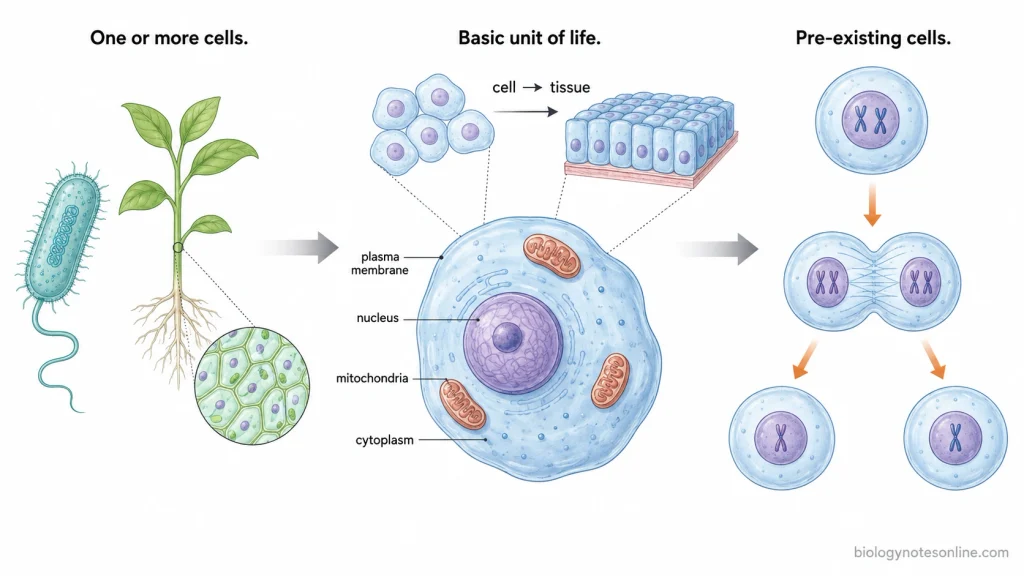
The classical cell theory is formed of three basic principles. These are related to cellular composition of living organisms, the position of cell as the basic unit of life, and formation of new cells from the cells already present.
| Principle | Meaning | Representative example |
|---|---|---|
| All living organisms consist of one or more cells | Living organisms may be formed of one cell or many cells. | Bacteria contain a single cell. Plants and animals contain many cells. |
| The cell is the basic structural and functional unit of life | Cells make up the structure of an organism and the living activities are also carried out by cells. | Muscle tissue is composed of muscle cells, which perform contraction. |
| New cells arise from pre-existing cells | An already existing cell produces new cells during cell division. | A parent cell divides to produce daughter cells. |
1. All Living Organisms Consist of One or More Cells
All living organisms are made up of cells. Some contain only a single cell, and the complete organism is represented by that one cell. These are referred to as unicellular organisms. Bacteria are common examples.
In a unicellular organism, the single cell carries out the activities necessary for living. Multicellular organisms, on the other hand, consist of many cells. Plants and animals belong to this type, where different cells may differ in their structure and functions.
2. The Cell Is the Basic Structural and Functional Unit of Life
The cell is the basic structural as well as functional unit of life. As a structural unit, cells make up the organization of living organisms. In multicellular organisms, many cells are organized together and tissues and organs are formed.
The functional part is somewhat different. Different living activities are carried out within cells, and some cells perform particular functions. For example, muscle tissue is made up of muscle cells and these cells carry out contraction.
Thus, cell is not simply a building part of an organism. It also performs the functions required for maintaining living condition.
3. New Cells Arise from Pre-Existing Cells
A new cell is formed from an already existing cell. During this process, the parent cell divides and daughter cells are produced. This is referred to as cell division.
Genetic information and other cellular materials are passed into the newly formed cells during division. In this way, cells continue from one cell generation to another.
The principle is concerned with formation of cells from pre-existing cells. It does not describe the chemical formation of the very first cell from non-living materials. That question is related to origin and early evolution of life, not the classical cell theory itself.
How Did Scientists Develop Cell Theory?
The development of cell theory did not take place from one experiment or by a single scientist. It developed gradually, mainly after microscopes were made and microscopic structures could be studied. More observations followed with improvement of lenses, and the idea of cell was changed several times before the classical theory was established.
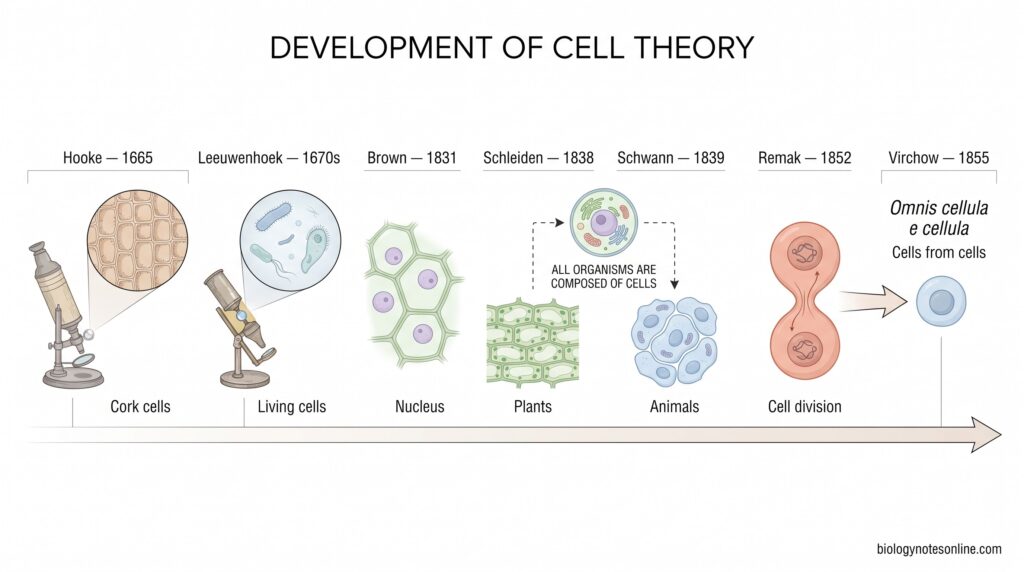
1665 – Robert Hooke
Robert Hooke examined a thin section of cork with a microscope. Small box-like compartments were observed by him, which he called cells in his book Micrographia. These cork cells were not living cells, but their appearance gave the term “cell” which is still used today.
1670s – Antonie van Leeuwenhoek
Living microscopic forms were later observed by Antonie van Leeuwenhoek using his small, powerful single-lens microscopes. He observed different cells and microorganisms, including protozoa, bacteria, sperm cells and red blood cells. Thus, cells were no longer known only from the empty compartments seen in cork.
1831 – Robert Brown
Another important observation came from plant cells. Robert Brown described the nucleus as a regular structure present in plant cells. This finding later became important in the studies of Schleiden on plant tissues.
1838 – Matthias Schleiden
Studying different plant tissues, German botanist Matthias Schleiden proposed that plants are composed of cells. The cell was considered as an important unit of plant structure. Schleiden, however, had an incorrect idea about formation of new cells and believed that cells could develop around nuclei by a process similar to crystallization.
1839 – Theodor Schwann
Similar microscopic observations were made in animal tissues by Theodor Schwann. After comparing animal tissues with the observations of Schleiden in plants, Schwann proposed that the same cellular organization is present in animals also. The work of Schleiden and Schwann together formed the major basis of the cell theory, in which cells were recognized as the fundamental units of plants and animals.
1852 – Robert Remak
The origin of new cells was still not properly understood. In 1852, Robert Remak provided convincing evidence that new cells are produced by division of already existing cells. During this process, one cell divides and gives rise to other cells rather than cells appearing independently.
1855 onward – Rudolf Virchow
A few years later, Rudolf Virchow strongly promoted the same concept and it became widely associated with the phrase Omnis cellula e cellula (all cells arise from cells). The idea of cell division was therefore added firmly to cell theory, although the experimental evidence had already been demonstrated by Remak.
Evidence Supports Cell Theory
Evidence for cell theory has been obtained from microscopic observations, tissue studies and direct observation of cellular division. Improvement in microscopes allowed cells and their internal structures to be studied with greater details.
- Microscopic evidence- Plant and animal tissues are made up of cells. Schleiden studied plant tissues, while Schwann examined animal tissues, and similar cellular organization was observed in both.
- Unicellular organisms- Bacteria consist of a single cell. In these organisms, one cell itself carries out the activities required for living.
- Tissue organization- In multicellular organisms, cells are organized into tissues. Different tissues further make up organs, showing cellular organization at higher structural levels.
- Cell division- Existing cells have been observed to divide and produce new cells. During this process, one parental cell divides and daughter cells are formed.
- Genetic continuity- Before a eukaryotic cell divides, its DNA is replicated. The duplicated genetic material is then distributed into the newly formed daughter cells.
How Does Modern Biology Extend Classical Cell Theory?
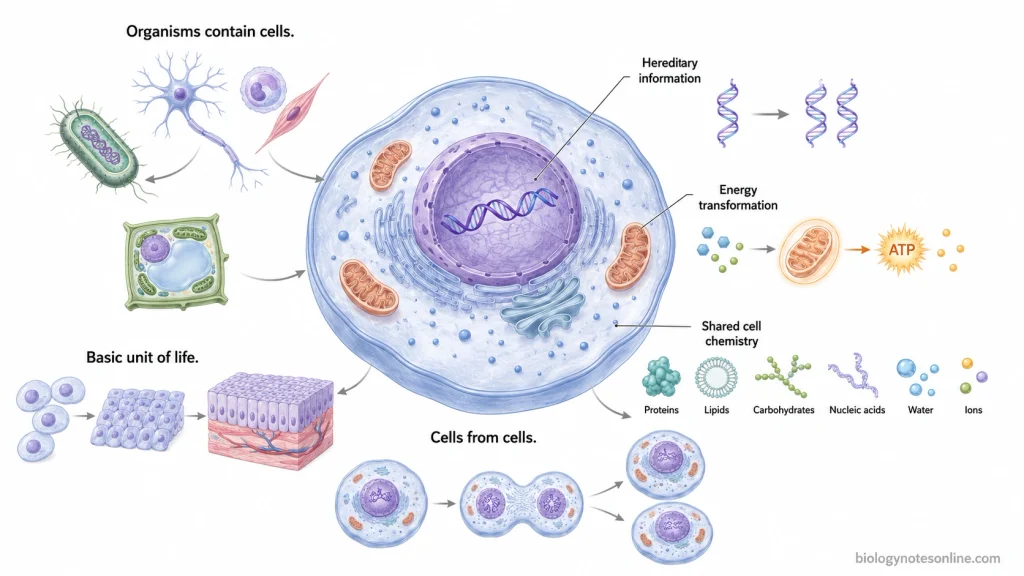
The classical cell theory is based on three main principles. Later studies in genetics, biochemistry and molecular biology provided more information about cells, especially their hereditary material, chemical reactions and energy use. These are better considered as modern extensions of cell theory, not a separate fixed list replacing the three classical principles.
| Classical/core cell theory | Later modern extensions |
|---|---|
| Living organisms are composed of one or more cells. | Cells contain hereditary information (DNA), which is transmitted during cellular reproduction. |
| Cell is the basic structural and functional unit of life. | Metabolism and transformation of energy take place within cells. Cells also show fundamental similarities in their chemical components. |
| New cells arise from pre-existing cells. | Cellular information is copied and continued from one cell generation to the next. |
The Three Classical Principles
The commonly taught cell theory contains three basic principles. All organisms are made up of cells, the cell is the basic structural and functional unit, and cells arise from the division of pre-existing cells. These form the core theory.
Modern biology, on the other hand, explains many cellular features that were not known when this theory was developed.
Modern Extensions of Cell Theory
Hereditary information- Cells contain the hereditary information in DNA (Deoxyribonucleic Acid). During cellular reproduction, this DNA is copied and information is passed into the newly formed cells. Thus, formation of a new cell also involves transmission of cellular information, not simply division of cellular material.
Cellular metabolism and energy transformation- A cell carries out a large number of chemical reactions required for its living. Energy is obtained and transformed during these reactions. ATP (Adenosine Triphosphate) acts as an important form of chemical energy used for different cellular activities.
Fundamental chemical similarities- Different cells can differ greatly in their shape, size and specialised functions. Their basic chemistry, however, has many common features. Cells are mainly based on the same major groups of biological molecules such as nucleic acids, proteins, carbohydrates and lipids, together with water and inorganic ions.
Continuity of cellular information- A cell forms another cell by using the information already present within it. In this process, hereditary information is copied before being passed on to daughter cells. This provides a continuity of biological information from one cell generation to another.
These later findings extend the meaning of the classical theory. They describe what occurs inside cells and what is passed during cellular reproduction, whereas the original three principles remain the basic framework of cell theory.
How Does Cell Theory Apply to Living Organisms?
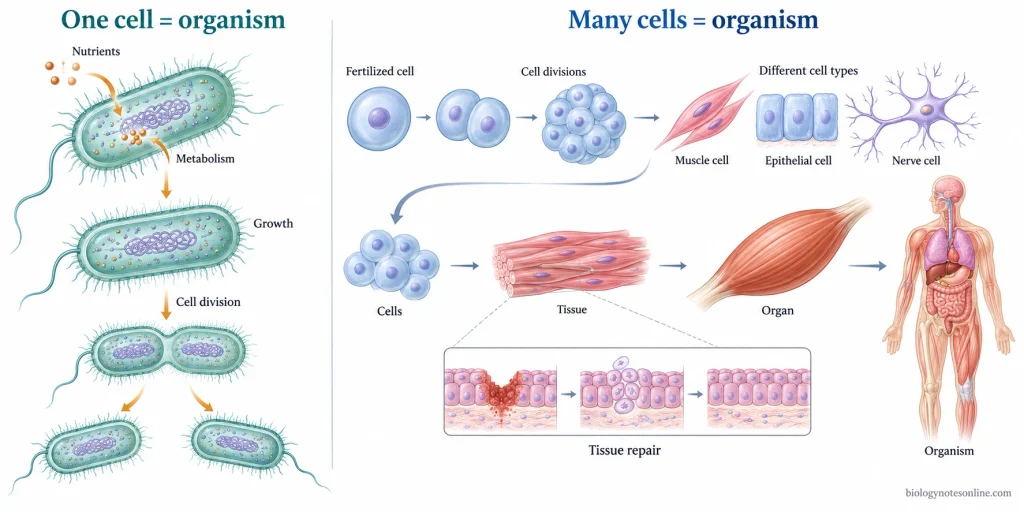
The same principles of cell theory are applicable to both unicellular and multicellular organisms. In a single-celled organism, one cell carries out the complete life activities, while in multicellular organisms many cells are organized and work together.
Unicellular Organisms Perform Life Functions Within One Cell
- These organisms are made up of only one cell. The single cell takes up nutrients, uses energy, grows and carries out the other functions required for its living.
- Bacteria are common examples. Here, one cell itself represents the complete organism. When a bacterial cell divides, new cells are formed and this can also result in reproduction of the organism.
- A unicellular eukaryote also follows the same basic cellular principle. Thus, being one-celled does not make the cell only a part of the organism. It is the organism itself.
Multicellular Organisms Organize Specialized Cells into Higher Levels
- Multicellular organisms, on the other hand, consist of many cells. These cells are not always similar in their structure or functions. During development, cells can become specialized and different cell types are produced.
- The organization generally takes place as cells → tissues → organs → organ systems → organism. Similar cells performing a common function form tissues. Different tissues then make up organs, and the organs work together in the organism.
- Even after formation of tissues and organs, cell remains the basic unit. For example, a muscle tissue is formed of cells, and its function depends upon activities of those cells.
Cell Division Connects Growth, Repair, and Reproduction
- New cells arise from pre-existing cells through cell division. This principle can be seen directly during growth of an organism, where repeated cell divisions increase the number of cells. A multicellular organism can even develop from a single fertilized cell through repeated cycles of growth and division.
- Cells can also divide to replace cells which are lost, damaged or dead. For example, some cells start dividing when required during tissue repair.
- Cell division has another role in unicellular organisms. In this case, division of one cell can give rise to a complete new organism. In multicellular organisms, however, cell division is extensively involved in growth and replacement of cells.
Viruses, the First Cell, and the Scope of Cell Theory
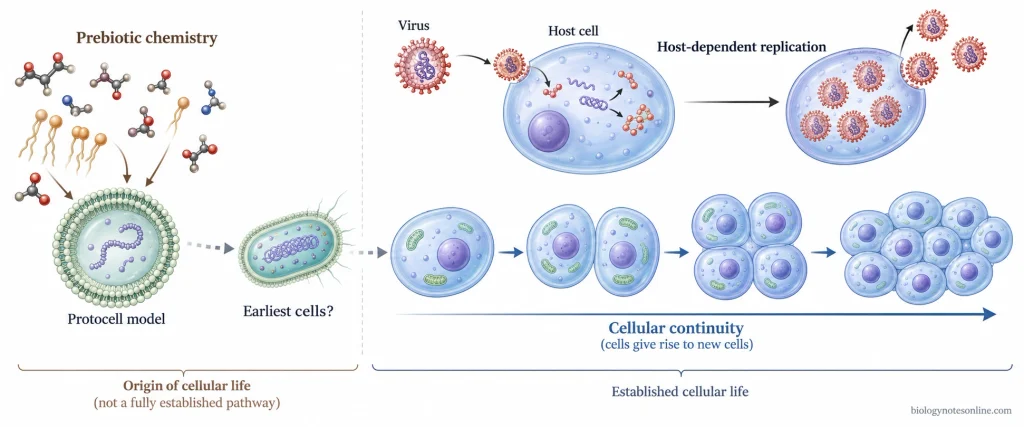
The principles of cell theory are used for cellular living organisms. However, viruses are acellular, and the principle that new cells arise from pre-existing cells describes continuation of already established cellular life rather than formation of the first cell.
Why Viruses Do Not Fit the Cellular Organization of Living Organisms
- Viruses are acellular- A virus is not made up of a cell. It consists of genetic material (DNA or RNA) enclosed within a protein coat, and some viruses also possess an outer membrane-like envelope. Thus, the normal cellular organization found in living cells is absent in viruses.
- Viruses cannot reproduce independently. For replication, a virus must enter a suitable host cell and use its cellular machinery, particularly the machinery required for synthesis of viral proteins. New viral components are produced inside the host and then assembled into new virus particles.
- Therefore, viruses should not simply be considered as organisms which “break” the cell theory. They have a different, acellular organization and their multiplication itself depends on cells.
- Whether viruses are actually “alive” is another question. Different definitions of life can give different answers, and this remains debated. But their acellular nature and dependence on host cells for replication are well established.
Why Pre-Existing Cells Do Not Explain the Origin of the First Cell
- The statement “new cells arise from pre-existing cells” describes cellular continuity. During this process, an already existing cell divides and new cells are produced. Thus, cells present today come through previous generations of cells.
- The first cell creates a different problem. If cellular life had a beginning, the earliest cell could not itself have been produced from another already existing cell in the same ordinary biological sense.
- Origin of the first cell- This is studied under origin-of-life research, where scientists investigate how non-living chemical systems could eventually give rise to self-replicating and cellular systems. Several models have been proposed and many parts of this process are still uncertain.
- Thus, cell theory explains the continuity of established cellular life. It is not a theory describing the chemical origin of the very first cell.
Cell Theory as a Foundation of Modern Biology
Cell theory forms one of the basic foundations for studying living organisms because biological structure, growth, reproduction and many disease processes can be followed back to activities of cells. Some of the important connections are as follows-
- Cell biology- Cell biology is the study of the structure and functions of cells, including their organelles, cell cycle, behaviour and different cellular processes. Thus, the cell itself becomes the main unit for studying how living systems work.
- Organismal growth- Growth of a multicellular organism involves increase in cell mass and production of new cells. Starting from a single fertilized cell, repeated cellular divisions can produce the very large number of cells present in an adult organism. During this process, cell division, cell growth and cell death are also controlled according to the requirements of tissues and the organism.
- Reproduction- Cell division has a direct role in reproduction. In unicellular organisms, division of one cell can produce a new organism. Multicellular organisms use specialized reproductive cells and different forms of cellular division are involved during their formation and development.
- Heredity- The hereditary information is present in DNA (Deoxyribonucleic Acid) and this information has to be copied before it can be passed into daughter cells. It is also transmitted from one generation of an organism to another through reproductive cells. Therefore, cellular reproduction and heredity are closely connected.
- Tissue organization- In multicellular organisms, cells do not remain as only a large collection of similar units. Cells become specialized, interact with neighbouring cells and are organized into tissues and organs. A plant or animal begins from one cell, but different types of cells are gradually formed during development.
- Disease at cellular level- Changes in normal cellular processes can result in disease. For example, failure in regulation of the cell cycle can lead to abnormal cell proliferation, which is an important feature of cancer. Studying cellular growth, division and regulation also helps in understanding disease mechanisms.
Does Cell Theory Explain the Origin of the First Cell?
Cell theory describes the continuity of existing cellular life, but it does not by itself explain the abiotic origin of the earliest cell.
- The principle that new cells arise from pre-existing cells is applied when a cell is already present. During this process, an existing cell divides and new cells are produced from it. This provides the continuity of cellular life through successive cell generations.
- But the earliest cell presents a different question. If cellular life had a beginning, the first cellular system could not have arisen by ordinary division of another fully formed cell. The origin of first cell is therefore outside what the classical cell theory was developed to explain.
- Research on the formation of life from non-living chemical components is generally referred to as abiogenesis or origin-of-life research. It deals with the possible transition from prebiotic chemistry to systems having properties associated with biological life. Several possible processes are being studied, and no single complete pathway for the origin of the first cell has been established.
- In protocell research, scientists study simpler cell-like compartments that could help in understanding steps between non-living chemical systems and early cellular life. Protocells may involve a boundary such as a membrane together with molecules capable of carrying or replicating information. They are used as models for studying possible early stages, not as proof of the exact route followed on early Earth.
- The statement “cells arise from cells” concerns the continuation of already established cells. Formation of the first cell from earlier non-cellular chemistry is a separate problem, which is studied under origin-of-life research rather than explained by cell theory itself.
Exceptions or Limitations of Cell Theory
The cell theory explains the basic cellular organization and continuity of living organisms. However, some biological forms and later discoveries do not fit completely into the simple classical description. The following are some of the important exceptions or limitations-
- Viruses- Viruses are acellular and are not made up of cells. They contain genetic material surrounded by a protein coat, with an envelope present in some viruses. For their multiplication, the cellular machinery of a host cell is required.
- Origin of first cell- New cells arise from already existing cells, but this principle cannot explain formation of the very first cell. The origin of earliest cellular life is studied separately under origin-of-life research, where formation of early self-replicating and membrane-bound systems is considered.
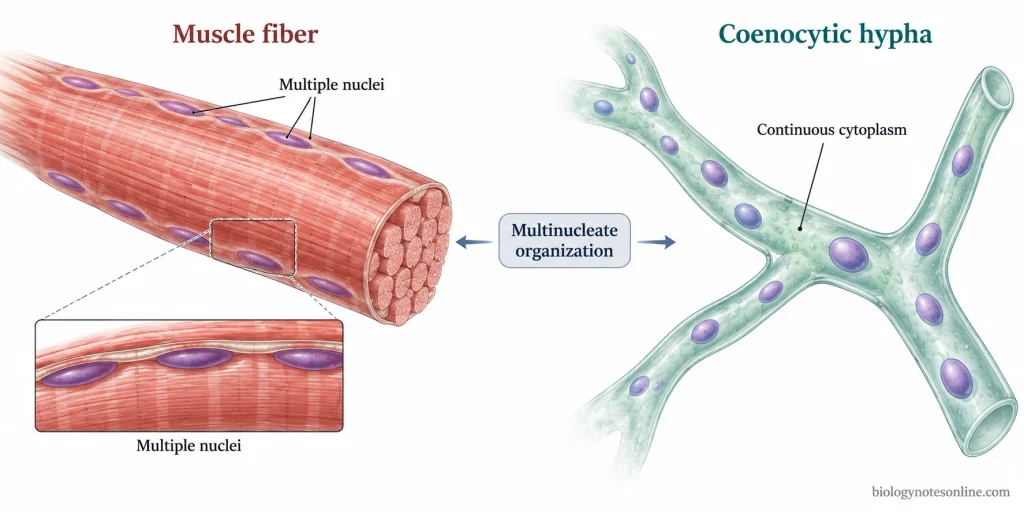
- Multinucleated cells- All cells do not occur as small units having only one nucleus. Skeletal muscle fibers, for example, are large multinucleated cells formed by fusion of many myoblasts. Such cells have one continuous cytoplasm with several nuclei.
- Coenocytic forms- In some fungi, long hyphae may contain many nuclei without cross-walls separating them into individual cellular compartments. These are referred to as coenocytic hyphae. Thus, a single continuous cellular region may contain several nuclei.
- Mitochondria and chloroplasts- These organelles possess their own DNA and some of their own protein-synthesizing machinery. They also increase in number by growth and division of already existing mitochondria or plastids. Their bacterial origin by endosymbiosis shows a cellular complexity that was not included in the original classical cell theory.
Importance of Cell Theory in Biology
Cell theory provides the basic concept for understanding the cellular organization of living organisms. Some of the important roles of cell theory in biology are as follows-
- It establishes the cell as the basic structural and functional unit of life. The study of living organisms can therefore be carried out from their cellular level.
- It gives a common basis for studying unicellular as well as multicellular organisms. Both types are made up of cells, although their organization is different.
- Growth of an organism is associated with increase in cell size and formation of new cells. In multicellular organisms, repeated cell divisions take place during growth and development.
- New cells are formed from pre-existing cells. This process is involved in reproduction and continuation of cellular life.
- Cell theory also provides the cellular basis of heredity. DNA is copied before cell division and genetic information is passed into the newly formed cells.
- In multicellular organisms, cells are organized into tissues, tissues form organs, and organs perform different functions in the organism.
- Changes taking place within cells can also result in disease. Abnormal regulation of cell division, for example, can lead to uncontrolled proliferation of cells as seen in cancer.
Cell Theory at a Glance
The following are the three basic principles of classical cell theory, their meaning, major contributors and simple examples.
| Principle | Meaning | Key Evidence/Contributor | Simple Example |
|---|---|---|---|
| All living organisms are made up of one or more cells | An organism may contain only one cell or many cells. The cellular organization is common in living organisms. | Matthias Schleiden described plants as being composed of cells, and Theodor Schwann extended this concept to animals. | A bacterium is one-celled, whereas a plant or animal consists of many cells. |
| Cell is the basic structural and functional unit of life | Cell forms the basic unit of an organism. Different living activities are also carried out at cellular level. | Studies of plant and animal tissues by Schleiden and Schwann provided the major basis for this principle. | Muscle tissue is made up of muscle cells, and these cells perform contraction. |
| New cells arise from pre-existing cells | An already existing cell divides and new cells are produced from it. This is referred to as cell division. | Robert Remak provided evidence for formation of cells by division. The idea was later widely promoted by Rudolf Virchow as Omnis cellula e cellula (all cells from cells). | One parent cell divides to form daughter cells. |
References
- Alberts, B., Johnson, A., Lewis, J., Raff, M., Roberts, K., & Walter, P. (2002a). Cancer. In Molecular biology of the cell (4th ed.). Garland Science. https://www.ncbi.nlm.nih.gov/books/NBK21076/
- Alberts, B., Johnson, A., Lewis, J., Raff, M., Roberts, K., & Walter, P. (2002b). The cell cycle and programmed cell death. In Molecular biology of the cell (4th ed.). Garland Science. https://www.ncbi.nlm.nih.gov/books/NBK21056/
- Alberts, B., Johnson, A., Lewis, J., Raff, M., Roberts, K., & Walter, P. (2002c). The chemical components of a cell. In Molecular biology of the cell (4th ed.). Garland Science. https://www.ncbi.nlm.nih.gov/books/NBK26883/
- Alberts, B., Johnson, A., Lewis, J., Raff, M., Roberts, K., & Walter, P. (2002d). Development of multicellular organisms. In Molecular biology of the cell (4th ed.). Garland Science. https://www.ncbi.nlm.nih.gov/books/NBK21046/
- Alberts, B., Johnson, A., Lewis, J., Raff, M., Roberts, K., & Walter, P. (2002e). Genesis, modulation, and regeneration of skeletal muscle. In Molecular biology of the cell (4th ed.). Garland Science. https://www.ncbi.nlm.nih.gov/books/NBK26853/
- Alberts, B., Johnson, A., Lewis, J., Raff, M., Roberts, K., & Walter, P. (2002f). The genetic systems of mitochondria and plastids. In Molecular biology of the cell (4th ed.). Garland Science. https://www.ncbi.nlm.nih.gov/books/NBK26924/
- Alberts, B., Johnson, A., Lewis, J., Raff, M., Roberts, K., & Walter, P. (2002g). Looking at the structure of cells in the microscope. In Molecular biology of the cell (4th ed.). Garland Science. https://www.ncbi.nlm.nih.gov/books/NBK26880/
- Alberts, B., Johnson, A., Lewis, J., Raff, M., Roberts, K., & Walter, P. (2002h). An overview of the cell cycle. In Molecular biology of the cell (4th ed.). Garland Science. https://www.ncbi.nlm.nih.gov/books/NBK26869/
- Alberts, B., Johnson, A., Lewis, J., Raff, M., Roberts, K., & Walter, P. (2002i). The universal features of cells on Earth. In Molecular biology of the cell (4th ed.). Garland Science. https://www.ncbi.nlm.nih.gov/books/NBK26864/
- Baluška, F., Volkmann, D., & Barlow, P. W. (2004). Eukaryotic cells and their cell bodies: Cell theory revised. Annals of Botany, 94(1), 9–32. https://doi.org/10.1093/aob/mch109
- Clark, M. A., Douglas, M., & Choi, J. (2018). Themes and concepts of biology. In Biology 2e. OpenStax. https://openstax.org/books/biology-2e/pages/1-2-themes-and-concepts-of-biology
- Cole, G. T. (1996). Basic biology of fungi. In S. Baron (Ed.), Medical microbiology (4th ed.). University of Texas Medical Branch at Galveston. https://www.ncbi.nlm.nih.gov/books/NBK8099/
- Cooper, G. M. (2000a). The cell cycle. In The cell: A molecular approach (2nd ed.). Sinauer Associates. https://www.ncbi.nlm.nih.gov/books/NBK9852/
- Cooper, G. M. (2000b). Cell proliferation in development and differentiation. In The cell: A molecular approach (2nd ed.). Sinauer Associates. https://www.ncbi.nlm.nih.gov/books/NBK9906/
- Cooper, G. M. (2000c). The eukaryotic cell cycle. In The cell: A molecular approach (2nd ed.). Sinauer Associates. https://www.ncbi.nlm.nih.gov/books/NBK9876/
- Cooper, G. M. (2000d). Heredity, genes, and DNA. In The cell: A molecular approach (2nd ed.). Sinauer Associates. https://www.ncbi.nlm.nih.gov/books/NBK9944/
- Cooper, G. M. (2000e). The origin and evolution of cells. In The cell: A molecular approach (2nd ed.). Sinauer Associates. https://www.ncbi.nlm.nih.gov/books/NBK9841/
- Cooper, G. M. (2000f). Tools of cell biology. In The cell: A molecular approach (2nd ed.). Sinauer Associates. https://www.ncbi.nlm.nih.gov/books/NBK9941/
- Dianzani, F., Albrecht, T., & Baron, S. (1996). Introduction to virology. In S. Baron (Ed.), Medical microbiology (4th ed.). University of Texas Medical Branch at Galveston. https://www.ncbi.nlm.nih.gov/books/NBK8098/
- Fowler, S., Roush, R., & Wise, J. (2013). How cells are studied. In Concepts of biology. OpenStax. https://openstax.org/books/concepts-biology/pages/3-1-how-cells-are-studied
- Gelderblom, H. R. (1996). Structure and classification of viruses. In S. Baron (Ed.), Medical microbiology (4th ed.). University of Texas Medical Branch at Galveston. https://www.ncbi.nlm.nih.gov/books/NBK8174/
- Kee, T. P., & Monnard, P.-A. (2017). Chemical systems, chemical contiguity and the emergence of life. Beilstein Journal of Organic Chemistry, 13, 1551–1563. https://doi.org/10.3762/bjoc.13.155
- Koonin, E. V., & Starokadomskyy, P. (2016). Are viruses alive? The replicator paradigm sheds decisive light on an old but misguided question. Studies in History and Philosophy of Science Part C: Studies in History and Philosophy of Biological and Biomedical Sciences, 59, 125–134. https://doi.org/10.1016/j.shpsc.2016.02.016
- Parker, N., Schneegurt, M., Tu, A.-H. T., Lister, P., & Forster, B. M. (2016a). Foundations of modern cell theory. In Microbiology. OpenStax. https://openstax.org/books/microbiology/pages/3-2-foundations-of-modern-cell-theory
- Parker, N., Schneegurt, M., Tu, A.-H. T., Lister, P., & Forster, B. M. (2016b). Viruses. In Microbiology. OpenStax. https://openstax.org/books/microbiology/pages/6-1-viruses
- Rehman, I., Farooq, M., & Simpson, B. (2023). Genetics, mitosis. In StatPearls. StatPearls Publishing. https://www.ncbi.nlm.nih.gov/books/NBK482449/
- Ribatti, D. (2018). An historical note on the cell theory. Experimental Cell Research, 364(1), 1–4. https://doi.org/10.1016/j.yexcr.2018.01.038
- Rye, C., Wise, R., Jurukovski, V., DeSaix, J., Choi, J., & Avissar, Y. (2016a). Chapter 4 summary. In Biology. OpenStax. https://openstax.org/books/biology/pages/4-chapter-summary
- Rye, C., Wise, R., Jurukovski, V., DeSaix, J., Choi, J., & Avissar, Y. (2016b). Studying cells. In Biology. OpenStax. https://openstax.org/books/biology/pages/4-1-studying-cells
- Schrum, J. P., Zhu, T. F., & Szostak, J. W. (2010). The origins of cellular life. Cold Spring Harbor Perspectives in Biology, 2(9), a002212. https://doi.org/10.1101/cshperspect.a002212
Its good