

Blood Grouping Test is performed by reacting a blood specimen separately with anti-A, anti-B and anti-D reagents and observing for agglutination. In a blood grouping practical, these reactions are usually carried out on separately labelled areas of a glass slide or in separate test tubes. The red blood cells may form visible clumps.
The reaction with anti-A and anti-B is used for ABO grouping. Anti-D is used for RhD typing. The presence or absence of agglutination with these reagents gives the ABO and RhD typing pattern.
Before testing, the blood specimen must be correctly identified and labelled. Incorrect sample identification may lead to assignment of a wrong blood group.
In teaching laboratories, slide method is commonly used for demonstration of blood typing. It gives an observed reaction pattern only. This reaction by itself does not establish a clinically confirmed blood group. Blood bank testing is carried out by validated laboratory methods with the required confirmation checks, including forward and reverse ABO grouping where applicable.
What is Blood Grouping Test?
Blood Grouping Test is a laboratory method used to identify the blood group characteristics of an individual, mainly the ABO group and RhD status. It is also referred to as blood typing, ABO grouping or ABO/RhD typing.
In ABO grouping, the A and B antigens present on the surface of red blood cells (RBCs) are identified. The ABO system has four main blood groups, A, B, AB and O. The corresponding ABO antibodies present in serum or plasma are also examined by reverse ABO grouping. This antibody testing is used to confirm the ABO result obtained from the red cells.
RhD typing identifies the D antigen of the Rh blood group system on RBCs. RhD refers specifically to this D antigen.
ABO and Rh Blood Group Systems
ABO and Rh are the two principal blood group systems examined in routine ABO/RhD typing. ABO grouping is based on the A and B antigens present on red blood cells (RBCs) and their expected antibodies in plasma. RhD typing detects the D antigen of Rh system.
ABO Blood Group System
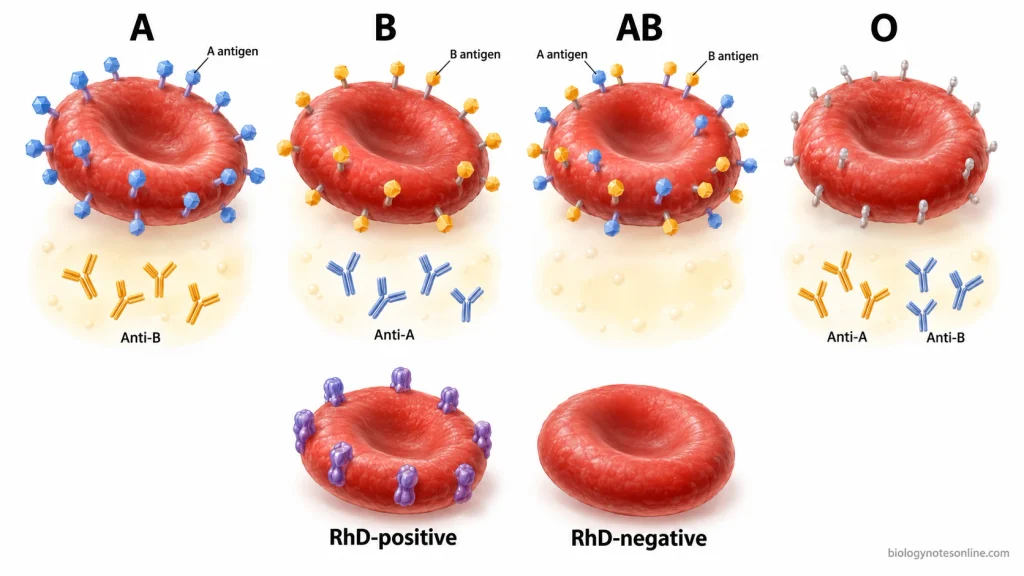
The ABO blood group system has four main groups, A, B, AB and O. It depends on the presence or absence of A and B antigens on the RBC surface.
- Blood group A has A antigen on the RBCs. Anti-B antibody is normally present in the plasma.
- In blood group B, the RBCs contain B antigen and plasma contains anti-A.
- Blood group AB contains both A and B antigens. Anti-A and anti-B are normally absent.
- Blood group O has neither A nor B antigen on the RBCs. Both anti-A and anti-B antibodies are usually present in plasma.
| ABO group | A/B antigen on RBCs | Expected antibody in plasma |
|---|---|---|
| A | A antigen | Anti-B |
| B | B antigen | Anti-A |
| AB | A and B antigens | Neither anti-A nor anti-B |
| O | Neither A nor B antigen | Anti-A and anti-B |
This is the usual antigen-antibody pattern of ABO blood groups. In young infants, expected ABO antibodies are not yet fully developed. Weak A or B subgroups, weak or missing antibodies and other unusual blood group phenotypes may also show a different serological pattern.
Rh Blood Group System
The Rh blood group system contains several antigens on the RBC membrane, among which D, C, c, E and e are the major clinically significant antigens. The D antigen is used for routine RhD typing.
- Presence of D antigen on RBCs is referred to as RhD-positive (Rh positive). When detectable D antigen is absent, the blood is classified as RhD-negative (Rh negative).
- ABO group combined with RhD status gives eight conventional blood group combinations. These are A positive (A+), A negative (A−), B positive (B+), B negative (B−), AB positive (AB+), AB negative (AB−), O positive (O+) and O negative (O−).
- RhD typing determines D antigen status only. It does not test all antigens of Rh blood group system. Other Rh antigens such as C, c, E and e require their own antigen testing when needed.
Purpose of Blood Grouping Test
- To determine the ABO blood group by detecting A and B antigens present on the red blood cells (RBCs).
- To determine RhD status by detecting D antigen and classify the blood as RhD-positive or RhD-negative.
- To confirm the ABO group by comparing the red-cell antigen result with the expected anti-A and anti-B antibodies in plasma. Any disagreement between forward and reverse grouping can then be identified.
- To select ABO and RhD compatible blood for transfusion and prevent transfusion of incompatible red cells.
- To determine the ABO and RhD type of donor and recipient blood before compatibility testing.
Principle of Blood Grouping Test
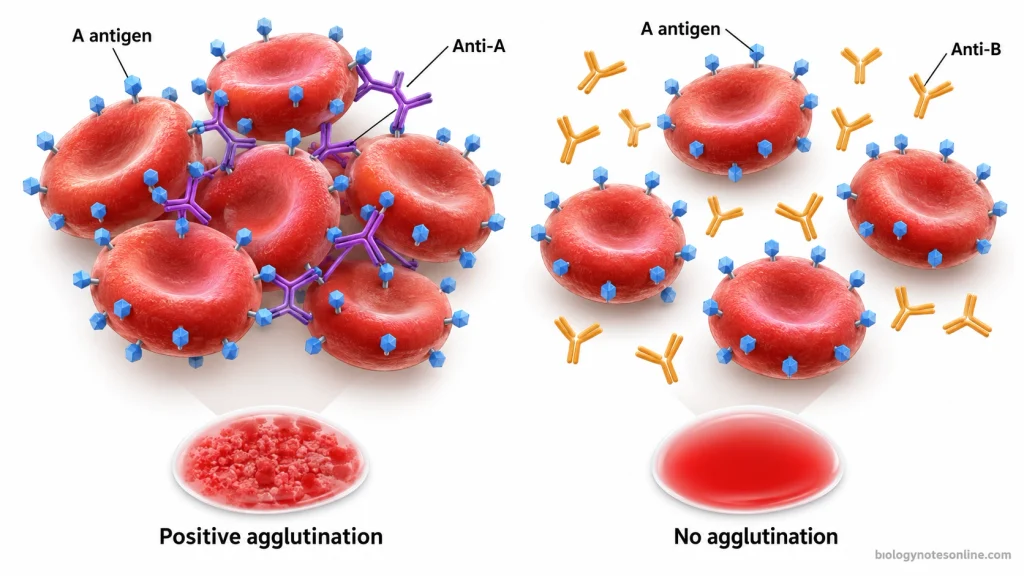
The principle of Blood Grouping Test is based on specific antigen-antibody reaction between the antigens present on red blood cells (RBCs) and their corresponding antibodies. When the specific antibody binds with its antigen on RBCs, the cells form visible clumps. This reaction is called agglutination.
In ABO grouping, anti-A reacts with RBCs containing A antigen and anti-B reacts with cells containing B antigen. Anti-D is used to detect the D antigen of Rh blood group system. Agglutination with a particular reagent is taken as a positive reaction for its corresponding antigen. When agglutination is absent, that antigen is not detected by the test.
The principle of ABO blood grouping also follows Landsteiner’s rule (Landsteiner’s law). According to this rule, when an A or B antigen is present on the RBCs, the corresponding antibody is normally absent from the plasma. If the antigen is absent, its corresponding ABO antibody is usually present. For example, a person having A antigen normally has anti-B, whereas a person having B antigen has anti-A.
This reciprocal relationship is not applicable in the usual manner in very young infants because expected ABO antibodies are not yet fully developed during the first few months of life. Weak or variant ABO antigens, missing or weak antibodies and some abnormal cases may also produce disagreement from the expected pattern.
In forward typing, agglutination is used to detect A and B antigens on the RBCs. Reverse typing detects the corresponding anti-A and anti-B antibodies in serum or plasma by their reaction with known reagent red cells. The forward and reverse ABO results are expected to agree with each other.
Forward and Reverse Blood Grouping
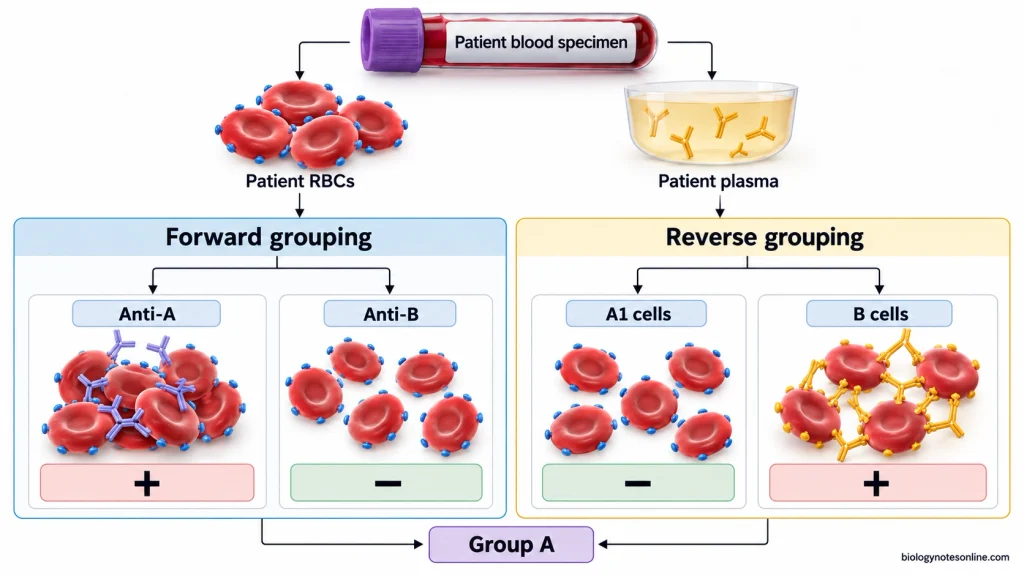
ABO blood grouping is generally carried out by two complementary methods, forward grouping and reverse grouping. Forward grouping detects A and B antigens on the red blood cells (RBCs), whereas reverse grouping detects the expected anti-A and anti-B antibodies in serum or plasma. Both results should normally agree with each other.
Forward Blood Grouping (Cell Grouping)
- Forward blood grouping, also called cell grouping, is performed by testing the person’s RBCs with anti-A and anti-B reagents. The reaction identifies whether A antigen, B antigen, both antigens or neither of them are present on the cells.
- Reaction with anti-A indicates the presence of A antigen, while reaction with anti-B indicates B antigen. Absence of reaction indicates that the corresponding antigen is not detected.
- Anti-D is used with the red cells for RhD typing. A reaction with anti-D indicates the presence of D antigen and the blood is typed as RhD-positive. RhD testing is a red-cell antigen test.
Reverse Blood Grouping (Serum Grouping)
- Reverse blood grouping is also called serum grouping. Here, the patient’s serum or plasma is tested against known reagent A1 and B red blood cells. It is used to detect the expected ABO antibodies.
- If anti-A is present in the serum, it reacts with reagent A1 cells. Anti-B reacts with reagent B cells. The reactions obtained in reverse grouping are compared with the antigen pattern obtained by forward grouping.
- Reverse grouping acts as a confirmation of the ABO group. A normal adult ABO type is expected to give compatible results in both cell grouping and serum grouping. Weak or unusual antigen and antibody patterns may sometimes give disagreement between the two.
- In young infants, the expected ABO antibodies are not fully developed. Reverse grouping is therefore not interpreted in the usual adult manner during the first few months of life, and forward grouping is used for determining the infant ABO type. Antibodies detected during this period may also include antibodies transferred from the mother.
- There is no equivalent routine reverse RhD grouping. RhD status is determined by testing the RBCs for D antigen, because Rh testing is carried out as a forward-type antigen test rather than by looking for a naturally expected anti-D antibody in serum.
Materials Required for Blood Grouping Test
Reagents and Blood Grouping Test Kit
- Anti-A antiserum- It is used to detect A antigen present on the red blood cells (RBCs).
- Anti-B antiserum- Used for detection of B antigen on the RBCs.
- Anti-D antiserum- Anti-D is required for RhD typing. It detects the D antigen.
- Reagent red cells- Known A1 and B red cells are required for reverse ABO grouping. Patient serum or plasma is tested with these cells for detection of the expected ABO antibodies.
- Controls- Suitable control cells or reagent controls are used according to the reagent and method being followed. Controls are also required during quality control of the blood grouping reagents.
- Normal saline- It is required in tube methods for preparation of red-cell suspensions or washing of cells where needed.
- Blood grouping test kit- A blood grouping kit used for teaching generally contains anti-A, anti-B and anti-D reagents, a blood typing card or other reaction surface and separate mixing sticks or applicators. Some kits also contain a control area. Such kits are mainly used for demonstration of forward grouping. Clinical ABO/RhD testing requires reagents, controls and equipment according to the validated laboratory method, including reagent red cells when reverse ABO grouping is carried out.
- Reagent bottles- The colour of reagent container or its label depends on the manufacturer. Antiserum should be identified from the reagent label and not from bottle colour alone.
Blood Collection Vials and Laboratory Equipment
- Blood specimen- A correctly identified blood specimen is required for the test. In clinical testing, the required patient identification must be present on the specimen before it is accepted for blood grouping.
- Blood collection vial- Collection tube used for blood grouping depends on laboratory method and local laboratory policy. Ethylenediaminetetraacetic acid (EDTA) blood is commonly accepted when specified. Some blood banks use pink-top K2-EDTA tubes, while lavender or purple EDTA tubes are also used or accepted in other laboratories. There is no one universal vial colour.
- Glass slide or blood grouping tile- It provides the reaction surface for slide or tile method. Blood typing cards containing separate reaction areas may also be used in teaching practicals.
- Test tubes- These are required for tube-based blood grouping. Separate labelled tubes are used for different reactions.
- Pipettes or droppers- Used to transfer blood, serum or plasma, antisera and reagent-cell suspensions in the required amount.
- Mixing sticks or applicators- Separate mixing sticks are used for each reaction area. The same stick should not be moved from one reaction to another, because it may carry the reagent and contaminate the other reaction.
- Centrifuge- A centrifuge is required for tube-based blood grouping and for separation or concentration of red cells according to the method used.
- Tube rack and marker- Tube rack is used for holding the reaction tubes. Labels or a laboratory marker are required for identification of specimen and tubes.
- Personal protective equipment (PPE)- Laboratory coat or other protective clothing and disposable gloves are required while handling blood specimens. Eye or face protection is used when there is a chance of splash.
- Sharps and waste containers- A puncture-resistant sharps container is required when needles or lancets are used. Blood-contaminated disposable materials are discarded in the proper biohazard waste container.
Methods of Blood Grouping Test
Blood grouping can be carried out by slide or tile method, tube method and gel-card or automated methods. These methods detect red-cell agglutination, but the reaction is performed and read differently in each method.
Slide or Tile Method
- In slide or tile method, blood is allowed to react with the required blood grouping antisera on a clean glass slide, tile or another suitable reaction surface. Agglutination is seen directly.
- It is a simple and rapid method. Little equipment and small amount of reagent are required, making it useful for teaching practicals, preliminary grouping and situations where a quick result is needed.
- The slide method is less sensitive than tube and column methods. Weakly expressed antigens or weak reactions may be missed. Drying of the reaction, variation in reaction conditions and visual reading can also affect the result, and proper standardization is difficult.
Tube Method
- In tube method, red cells and the required reagents are reacted in labelled test tubes. The tubes are centrifuged and the red-cell button is examined for agglutination. Forward and reverse ABO grouping can both be carried out by this method.
- Tube testing is more sensitive than the slide method and gives better control over the reaction conditions. It is used for ABO/RhD typing and can be extended for further serological investigation when required.
- Centrifugation is an important part of this method. Variation in cell-serum ratio, centrifugation and reading of the red-cell reaction may affect the result.
- Conventional tube method is also useful for investigating unusual or discrepant reactions. Much of the testing and reading is manual. It needs trained observation and is less suitable for automation.
Gel Card and Automated Blood Grouping Methods
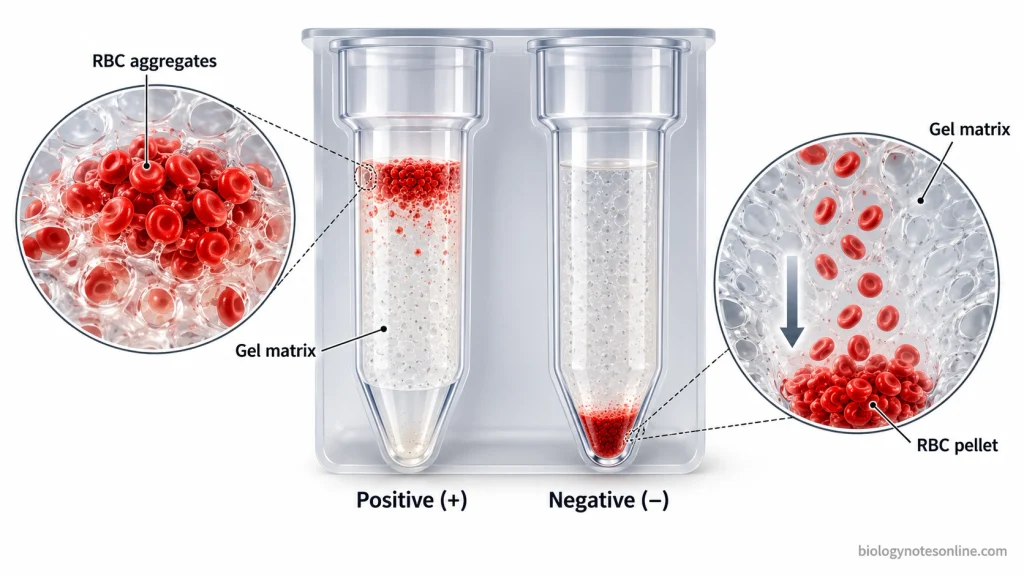
- Column agglutination technique (CAT) uses small reaction columns containing gel or a similar matrix. After the reaction and centrifugation, agglutinated red blood cells (RBCs) remain trapped within the column or near its upper part. Non-agglutinated cells move through the column and form a pellet at the bottom.
- Gel cards can be used for forward and reverse ABO grouping as well as RhD typing. The position of the RBCs in the column gives the reaction pattern. It remains separated after centrifugation, making the reaction easier to grade and read.
- Gel-card methods have good sensitivity and reproducibility. The method is more standardized and can be used with semi-automated or fully automated systems.
- Automated blood bank analyzers are used where a large number of samples are tested. Reagent addition, centrifugation and reading can be controlled by the instrument, reducing some of the manual variation. Specialized equipment and validated reagent systems are required.
There is no single best method for blood grouping for every laboratory condition. Slide method is useful when a simple and rapid reaction is required. Tube method is useful for conventional serological testing and investigation of difficult reactions, while gel-card and automated systems are suited for standardized routine testing and larger sample numbers. Weak or unusual blood group reactions may still require testing by another method.
| Method | Reaction system | Common use | Major strength | Main limitation |
|---|---|---|---|---|
| Slide/Tile | Reaction on slide or tile | Teaching, rapid or preliminary grouping | Simple, rapid, little equipment | Lower sensitivity and difficult standardization |
| Tube | Reaction in tubes followed by centrifugation | Routine typing and further serological investigation | Sensitive and flexible | Manual reading and operator variation |
| Gel card/CAT | Agglutination detected in a gel microcolumn | Routine blood-bank testing | Sensitive, reproducible and standardized | Requires specific cards and equipment |
| Automated system | Instrument-controlled serological testing | High-volume blood-bank work | High throughput and reduced manual handling | Requires specialized analyzer and validated reagent system |
Procedure of Blood Grouping Test
Slide/Tile Blood Grouping Procedure
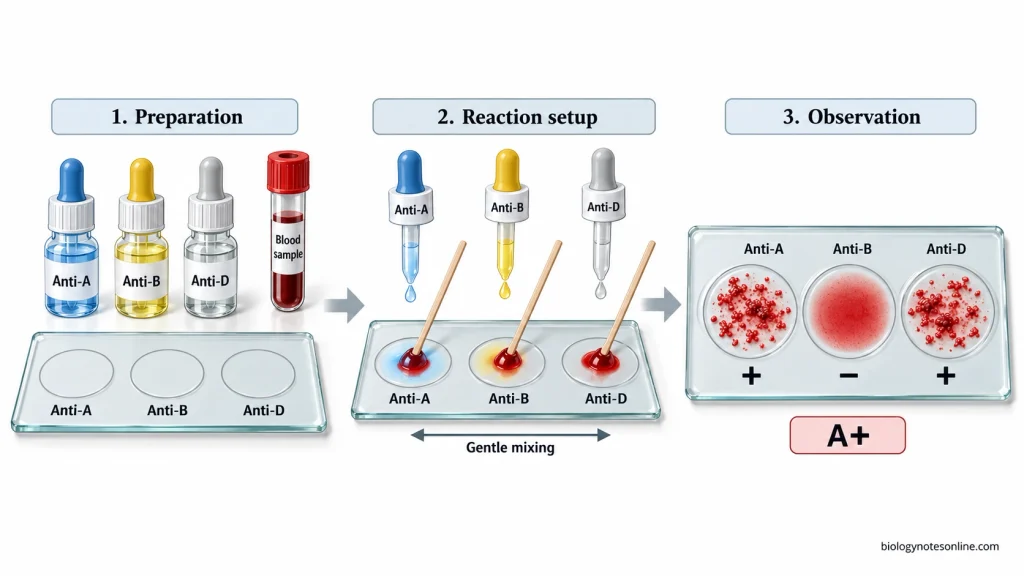
- At first, check the identification of the blood specimen and arrange anti-A, anti-B and anti-D reagents. Wear gloves while handling the blood.
- Take a clean glass slide or blood grouping tile. Mark three separate areas for anti-A, anti-B and anti-D reactions.
- Add the respective antiserum to each marked area according to the reagent instructions. Keep the reagent droppers separate. The dropper tips should not touch the blood or reaction surface.
- Now add the blood specimen separately to all three reaction areas.
- Mix the blood with each antiserum. Use a separate mixing stick for every reaction. The same stick should not be used in another area as it may carry one reagent into the next.
- Gently rock or move the slide so that blood and antiserum remain mixed. Observe for agglutination within the time given by the reagent manufacturer. Do not read a dried reaction as agglutination.
- Examine the three reactions under good light. Agglutination with anti-A or anti-B indicates the corresponding ABO antigen. Reaction with anti-D indicates D antigen.
- Record each reaction as positive or negative. The obtained pattern is then used to determine the ABO group and RhD status.
- Discard the used mixing sticks and blood-contaminated materials into the proper laboratory waste containers. Clean the working surface after the test.
The slide or tile procedure is used for a supervised educational blood grouping practical. For transfusion decisions, clinical blood grouping is carried out by a validated laboratory method with the required controls and confirmation.
Tube Blood Grouping Procedure
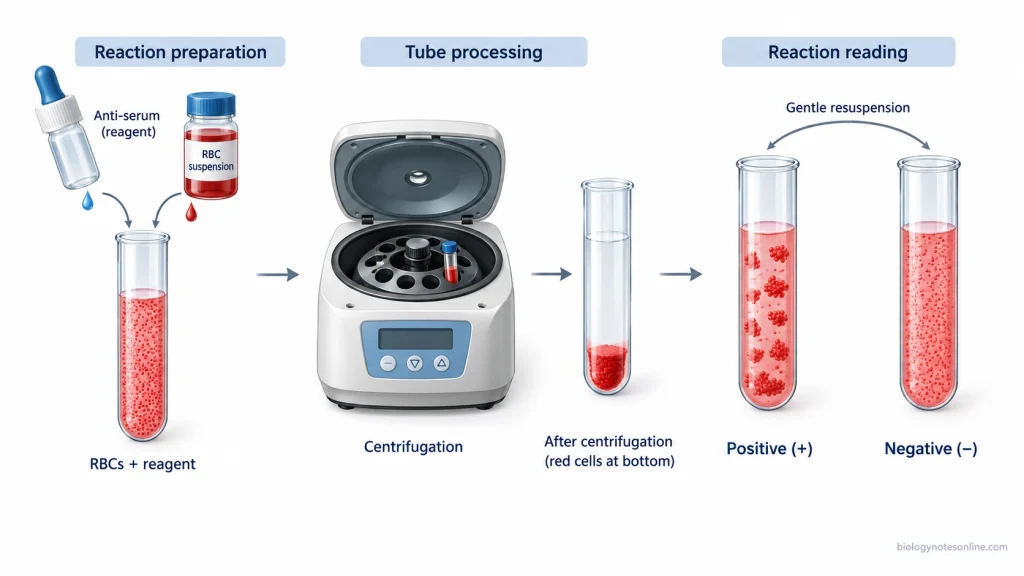
- Check the patient or donor identity with the specimen and test request. The required reagents, reagent cells and controls are also checked before starting the test.
- Prepare the red-cell suspension according to the laboratory standard operating procedure (SOP). Label separate tubes for anti-A, anti-B, anti-D and the required controls.
- Add the respective antisera and test red cells into the labelled tubes. The amount of reagent and concentration of red cells are followed according to the validated method and manufacturer’s instructions.
- Mix the contents of the tubes. Centrifuge, incubate or process the reactions under the conditions specified for the reagent system being used. A single centrifugation setting or reaction time is not used for every blood grouping reagent.
- Examine the red cells for agglutination after centrifugation. Grade and record the reactions according to laboratory procedure.
- For reverse ABO grouping, take separate correctly labelled tubes for reagent A1 and B red cells and the required controls. Add patient or donor serum or plasma with the known reagent cells.
- Process these tubes under the validated reaction conditions and observe for agglutination. Record the reactions.
- Compare the forward ABO result with reverse ABO grouping. Both patterns should agree before assigning the ABO group. RhD typing is obtained from the reaction of the person’s red cells with anti-D and not by reverse grouping.
- If forward and reverse grouping do not agree, or an unexpected reaction is found, do not assign the final ABO group from that reaction alone. Further laboratory investigation is required.
- Record the ABO and RhD reactions and final interpretation in the laboratory record. Clinical testing is performed according to approved laboratory SOP, reagent manufacturer’s instructions and the required quality-control procedures.
Observations and Results of Blood Grouping Test
Blood grouping result is observed from the agglutination present in each reaction. Visible clumps of red blood cells (RBCs) are recorded as a positive reaction. A smooth cell suspension without visible clumping is negative.
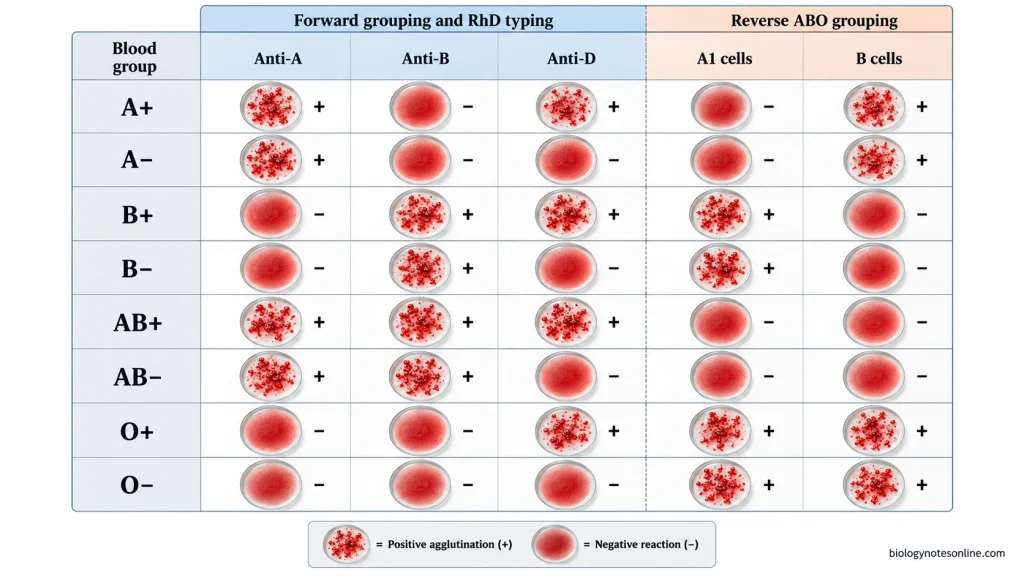
Blood Grouping Agglutination Chart
- Agglutination with anti-A indicates that A antigen is detected on the RBCs.
- With anti-B, visible clumping is recorded as positive for B antigen.
- Anti-D is observed separately for RhD typing. Agglutination gives a positive anti-D reaction. No agglutination is recorded as negative.
+ = agglutination (positive reaction)
− = no agglutination (negative reaction)
The A1-cell and B-cell reactions given below represent the expected reverse-grouping pattern in the usual adult ABO type.
| Blood group result | Anti-A | Anti-B | Anti-D | A1 cells (reverse) | B cells (reverse) |
|---|---|---|---|---|---|
| A+ | + | − | + | − | + |
| A− | + | − | − | − | + |
| B+ | − | + | + | + | − |
| B− | − | + | − | + | − |
| AB+ | + | + | + | − | − |
| AB− | + | + | − | − | − |
| O+ | − | − | + | + | + |
| O− | − | − | − | + | + |
Interpretation of ABO and RhD Results
- Agglutination with anti-A and no reaction with anti-B indicates blood group A. In reverse grouping, B reagent cells are expected to agglutinate, whereas A1 cells remain negative.
- When anti-B shows agglutination but anti-A does not, the blood group is B. Reverse grouping gives reaction with A1 cells and no reaction with B cells.
- Agglutination with both anti-A and anti-B gives blood group AB. No agglutination is normally obtained with A1 or B reagent cells in reverse grouping.
- If anti-A and anti-B both remain negative, the blood group is O. The reverse grouping normally reacts with both A1 and B cells.
- Anti-D determines the RhD status. A positive anti-D reaction is typed as RhD-positive, while a negative anti-D reaction is typed as RhD-negative according to the validated testing method.
- The eight conventional blood group results are A+, A−, B+, B−, AB+, AB−, O+ and O−.
Recording Observations and Practical Results
- Record the reaction actually seen with each reagent. Visible blood-cell clumping is entered as positive. A smooth suspension is negative. The blood group should not be entered before the individual reactions are read.
- A practical observation table may be written as follows.
| Test reaction | Observation | Recorded result |
|---|---|---|
| Anti-A | Clumping / smooth suspension | Positive / Negative |
| Anti-B | Clumping / smooth suspension | Positive / Negative |
| Anti-D | Clumping / smooth suspension | Positive / Negative |
| A1 reagent cells | Clumping / smooth suspension | Positive / Negative |
| B reagent cells | Clumping / smooth suspension | Positive / Negative |
- Forward and reverse ABO grouping should normally agree. A weak or unclear reaction should not be taken as a definite blood group. The same applies when the forward result does not match its expected reverse-grouping pattern.
- For an educational practical, the observation may be recorded as: Anti-A ___, Anti-B ___, Anti-D ___, A1 cells ___, B cells ___. Interpreted blood group ___. Only the reactions actually observed are entered.
- Confirmation status is recorded where required. A slide or teaching-practical result may be reported as an observed or interpreted blood group, while a clinically confirmed blood type requires the laboratory’s validated testing and confirmation procedure.
Confirmation of Blood Group and Discrepant Results
Blood group confirmation test is performed to verify the ABO and Rhesus D (RhD) blood group of an individual. The blood grouping test is usually repeated. Previous blood group records are also checked with the present result, if available.
For ABO confirmation, both forward and reverse grouping results are examined. The RhD typing is done separately by using anti-D reagent.
Sometimes, the result obtained in forward grouping does not match with the reverse grouping result. This is known as ABO blood grouping discrepancy. It may occur due to technical errors, weak antigen reactions or the presence of unexpected antibodies in the blood. Such results require further investigation before confirming the blood group.
How Is Blood Group Confirmed?
The following steps are followed for confirmation of blood group in the laboratory.
- At first, the patient identification details and blood sample labels are checked properly. The previous blood group records are also examined and compared with the present result. If there is any doubt regarding sample identification, a fresh blood sample may be collected.
- The forward and reverse grouping tests are repeated using the same blood sample. In forward grouping, the A and B antigens are detected on the red blood cells. Reverse grouping is used to detect the corresponding antibodies present in serum or plasma. Both results should agree with each other for routine ABO confirmation.
- The expiry date of reagents, test conditions and quality control results are checked. In case of any unexpected reaction, the test may be repeated using suitable controls or another validated method.
- Weak agglutination or unusual reactions are investigated further under the supervision of qualified laboratory personnel. Special antisera or additional serological tests may be used. In some cases, molecular testing is also required.
- The RhD type is also confirmed. If a weak reaction or different results are obtained with anti-D reagents, further testing may be required to identify weak D or partial D phenotypes. RHD genotyping may be used in selected cases.
Causes of Discrepant Blood Group Results
Some of the common causes of blood grouping discrepancies are as follows-
- ABO Subgroups- Some individuals have weak expression of A or B antigens on their red blood cells. These are referred to as ABO subgroups. Due to the weak antigen expression, the forward grouping may show weak or unexpected agglutination reactions.
- Missing or Weak Antibodies- In some individuals, the expected anti-A or anti-B antibodies may be weak or absent. It is commonly observed in newborns, elderly individuals and patients with reduced antibody production. The reverse grouping may not give the expected reaction.
- Mixed-field Reactions- In this reaction, both agglutinated and non-agglutinated red blood cells are observed together. It may occur after recent blood transfusion or stem cell transplantation. Certain ABO subgroups may also produce mixed-field reactions.
- Technical Errors- Incorrect cell suspension, improper centrifugation, reagent problems or errors during interpretation of agglutination may produce incorrect blood grouping results.
- Unexpected Antibodies- Some cold-reacting antibodies and other unexpected red cell antibodies may react with the test cells. These antibodies can interfere with the normal blood grouping reactions.
How Can I Confirm My Blood Group?
To confirm the blood group, a person can undergo an ABO and RhD blood grouping test at a qualified diagnostic laboratory or blood bank. In this test, the presence of A, B and D antigens is checked. Reverse ABO grouping is also performed where appropriate.
Sometimes, the blood grouping test may be repeated using another separately collected blood sample. Previous laboratory reports can also be checked for confirmation.
If the results are different, further investigation is required before reporting the confirmed blood group. An unresolved blood grouping discrepancy must not be considered as a confirmed blood type.
In case of urgent blood transfusion, the blood bank follows its emergency transfusion protocol for selecting suitable blood components.
Precautions for Blood Grouping Test
The following precautions should be followed while performing the blood grouping test.
- The blood sample should be collected from the correctly identified person. The sample tube must be labelled properly with patient details immediately after collection.
- Fresh and properly collected blood samples should be used for the test. Hemolysed, contaminated or unsuitable blood samples should not be used.
- The anti-A, anti-B and anti-D antisera should be checked before use. Expired or deteriorated reagents must be avoided. All reagents should be stored at the recommended temperature according to the manufacturer’s instructions.
- Clean and dry glass slides, test tubes and other laboratory equipment should be used. The presence of any foreign material may interfere with the agglutination reaction.
- Separate droppers, pipettes or mixing sticks should be used for each antiserum and blood sample. Mixing of different reagents must be avoided to prevent cross-contamination.
- The correct amount of blood and antiserum should be taken according to the test method. An improper ratio may produce weak or incorrect agglutination reactions.
- In the tube method, the red blood cell suspension should be prepared at the recommended concentration. Too thick or too dilute cell suspension may affect the test result.
- The blood sample and antiserum should be mixed properly to allow the antigen-antibody reaction to take place.
- The reaction time and temperature must be maintained according to the laboratory procedure. In slide method, the reaction mixture should not be allowed to dry before reading the result.
- During centrifugation, the recommended speed and duration should be followed. Excessive centrifugation may produce false agglutination, while insufficient centrifugation can result in weak reactions.
- The agglutination reaction should be observed carefully under proper lighting. Weak or doubtful reactions must not be considered as definite positive or negative results without further examination.
- Both forward and reverse grouping results should be checked during ABO blood grouping. If the results do not agree with each other, the discrepancy must be investigated before confirming the blood group.
- Suitable positive and negative controls should be used according to the test procedure. The test result should not be accepted if the control reactions are incorrect.
- In case of weak or unexpected reactions with anti-D reagent, further testing may be required for confirmation of Rhesus D (RhD) typing.
- Proper laboratory safety precautions should be followed while handling blood samples. Gloves and other required protective equipment should be used. Used needles, contaminated slides and other materials must be disposed of in appropriate biomedical waste containers.
Limitations of Blood Grouping Test
Some of the limitations of blood grouping test are as follows-
- Weak expression of A or B antigens in some ABO subgroups may produce weak or negative reactions during forward grouping.
- In newborns, elderly individuals and patients with reduced antibody production, the expected antibodies may be weak or absent. This can affect the reverse grouping results.
- Recent blood transfusion or stem cell transplantation may produce mixed-field agglutination, making blood group interpretation difficult.
- Weak D and partial D phenotypes may not be identified correctly by routine RhD typing. Further testing may be required.
- The presence of cold-reacting antibodies or excess plasma proteins may interfere with the normal agglutination reaction and produce false results.
- It depends on the quality of reagents, proper sample collection and correct test conditions. Technical errors may produce false-positive or false-negative reactions.
- Routine blood grouping is mainly used to determine ABO and RhD blood types. It cannot detect all other clinically significant red cell antibodies.
- The blood grouping test alone cannot determine the compatibility of donor and recipient blood for transfusion. Additional antibody screening and crossmatching may be required.
- If the forward and reverse grouping results do not agree with each other, the blood group cannot be confirmed without further investigation.
Applications of Blood Grouping Test
Some of the applications of blood grouping test are as follows-
- The ABO and Rhesus D (RhD) blood groups of donors and recipients are determined before blood transfusion. It is used for selecting compatible blood components.
- In blood banks, donated blood units are identified and labelled according to their blood groups. These units are also arranged based on the blood group.
- The test is used during pregnancy to identify RhD-negative mothers who may require anti-D prophylaxis. It is also used in the investigation of hemolytic disease of the fetus and newborn (HDFN).
- Before organ transplantation, such as kidney and liver transplantation, the ABO blood group compatibility between donor and recipient is checked.
- In hematopoietic stem cell transplantation (HSCT), blood grouping is used to identify ABO mismatch between donor and recipient. The result is used for planning suitable blood transfusion support.
- Used to check possible blood group incompatibility during the investigation of suspected hemolytic transfusion reactions.
- In forensic investigations, blood grouping is used for examination of bloodstains and other biological samples. It cannot identify a particular individual alone.
- Blood grouping may be used to exclude certain claimed biological relationships during paternity investigations. It cannot confirm paternity.
- Used in population genetics and anthropological studies to determine the frequency and distribution of different blood groups among human populations.
Advantages of Blood Grouping Test
Some of the advantages of blood grouping test are as follows-
- It is a simple test which can be performed easily in the laboratory by using conventional agglutination methods.
- The agglutination reaction can be observed directly. The result is obtained within a short period of time.
- It is relatively inexpensive and does not require highly advanced instruments for conventional manual testing.
- Only a small quantity of blood is required to perform the test.
- Both ABO and Rhesus D (RhD) blood groups can be determined from a blood sample.
- The test helps in the selection of compatible blood before transfusion. It reduces the risk of hemolytic transfusion reactions. Other compatibility tests are also required.
- In blood banks, donated blood units can be identified and arranged according to their blood groups.
- During pregnancy, RhD typing is used to identify RhD-negative mothers who may require anti-D prophylaxis.
- It is also used to check the ABO compatibility between donor and recipient before organ transplantation.
References
- Bhagwat, S. N., Sharma, J. H., Jose, J., & Modi, C. J. (2015). Comparison between conventional and automated techniques for blood grouping and crossmatching: Experience from a tertiary care centre. Journal of Laboratory Physicians, 7(2), 96–102. https://doi.org/10.4103/0974-2727.163130
- Chopra, G., Kataria, M., Batra, A. K., Kaur, G., & Kumar, R. (2022). Detection of a weaker subgroup of A in ABO blood group system. Asian Journal of Transfusion Science, 16(1), 132–134. https://doi.org/10.4103/ajts.ajts_66_21
- Elliott, C., Kelham, S., Zhang, L., Grieve, S., Lan, T., Moradian, H., Coll-Ortega, C., & Gómez-Ulloa, D. (2025). Systematic literature review and meta-analysis of concordance and accuracy of pretransfusion immunohematology routine tests. Transfusion Medicine, 35(5), 445–457. https://doi.org/10.1111/tme.70010
- Fathima, S., & Killeen, R. B. (2025). ABO typing discrepancies. In StatPearls. StatPearls Publishing. https://www.ncbi.nlm.nih.gov/books/NBK585061/
- Li, H.-Y., & Guo, K. (2022). Blood group testing. Frontiers in Medicine, 9, 827619. https://doi.org/10.3389/fmed.2022.827619
- Mujahid, A., & Dickert, F. L. (2016). Blood group typing: From classical strategies to the application of synthetic antibodies generated by molecular imprinting. Sensors, 16(1), 51. https://doi.org/10.3390/s16010051
- Mukherjee, S., Bhattacharya, P., Mukherjee, K., & Biswas, D. (2025). Dealing with blood group discrepancies in donor populations in a resource-poor blood center, practical approach: A single blood center study from Eastern India. Asian Journal of Transfusion Science, 19(2), 230–236. https://doi.org/10.4103/ajts.ajts_34_23
- Romanos-Sirakis, E. C., & Desai, D. (2025). ABO blood group system. In StatPearls. StatPearls Publishing. https://www.ncbi.nlm.nih.gov/books/NBK580518/
- Sandler, S. G., Chen, L. N., & Flegel, W. A. (2017). Serological weak D phenotypes: A review and guidance for interpreting the RhD blood type using the RHD genotype. British Journal of Haematology, 179(1), 10–19. https://doi.org/10.1111/bjh.14757
- Sharpe, C., Lane, D., Cote, J., Hosseini-Maaf, B., Goldman, M., Olsson, M. L., & Hult, A. K. (2014). Mixed field reactions in ABO and Rh typing chimerism likely resulting from twin haematopoiesis. Blood Transfusion, 12(4), 608–610. https://doi.org/10.2450/2014.0261-13