

Volvox is a freshwater green algae. It forms hollow and spherical colony. It is also known as globe algae or rolling green algae.
It is found in ponds, lakes, ditches and puddles. It occurs in freshwater bodies in different parts of the world. Sometimes the colony can be seen by naked eye.
The colony of Volvox is called coenobium. It may contain about 500 to 60,000 cells. These cells are arranged in single layer at the outer side of a transparent jelly like matrix.
The cells of Volvox show simple division of labour. The colony has mainly two types of cells. These are somatic cells and reproductive cells.
The somatic cells are small vegetative cells. They have two flagella and chloroplast. They perform photosynthesis and also help in movement of the colony in water.
The movement is done by beating of flagella of many cells together. Due to this the colony moves toward light. This helps in better photosynthesis.
The reproductive cells are large and non-motile. These cells are called gonidia. They are present just below the somatic cell layer and they form new colonies.
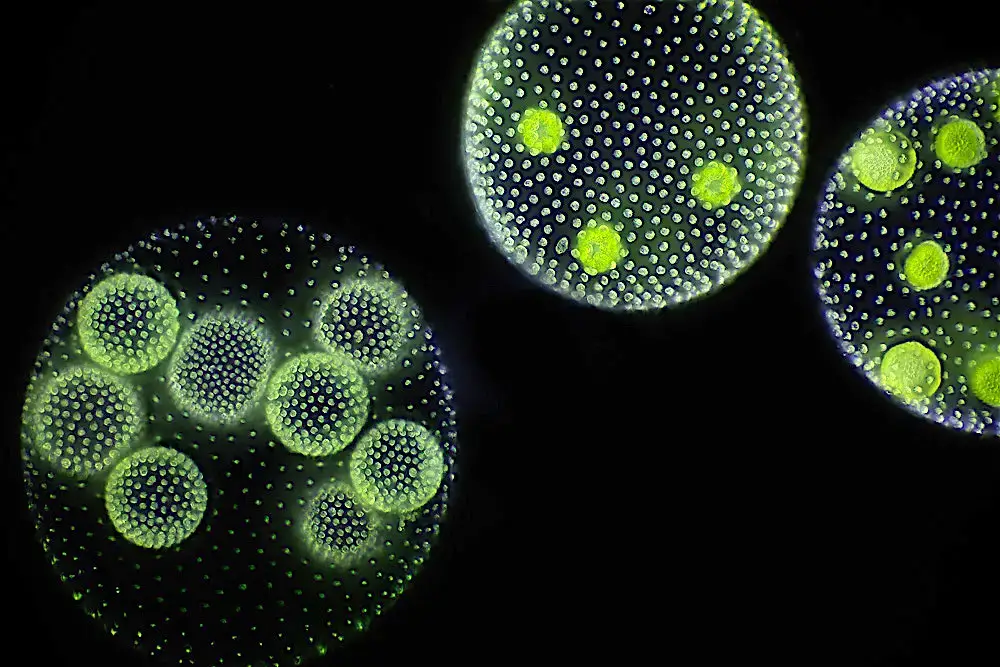
Definition of Volvox
Volvox is a polyphyletic genus of chlorophyte green algae that forms spherical colonies composed of thousands of cells and inhabits various freshwater environments.
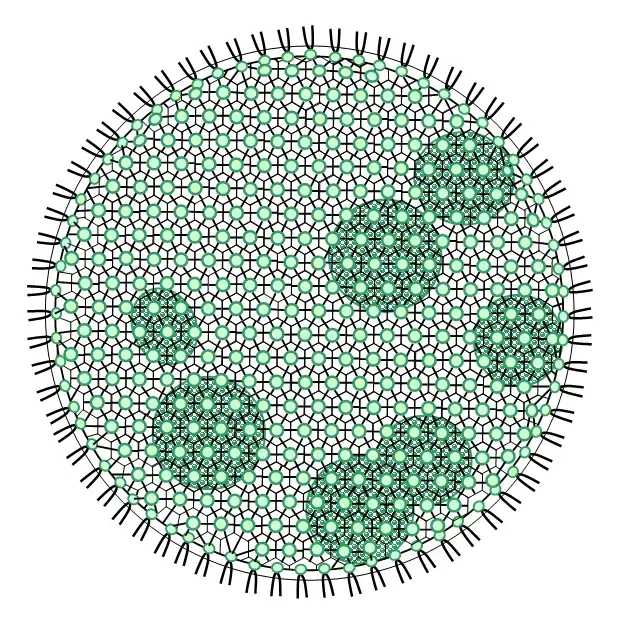
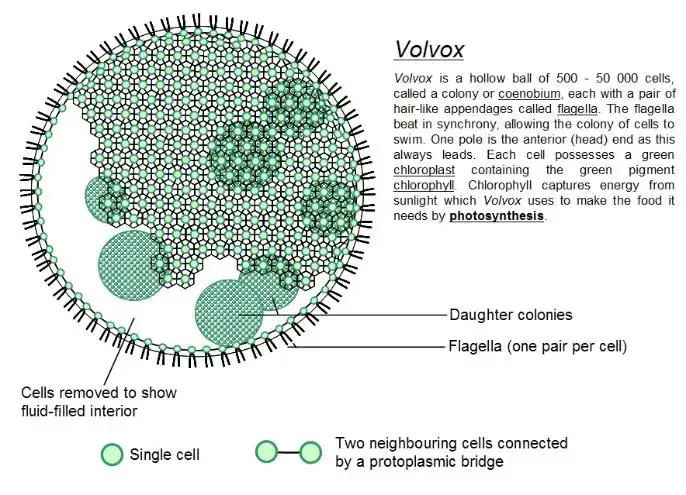
Classification of Volvox
| Domain | Eukaryota |
| Kingdom | Plantae |
| Phylum | Chlorophyta |
| Class | Chlorophyceae |
| Order | Chlamydomonodales |
| Family | Volvocaceae |
| Genus | Volvox |
Occurrence of Volvox
Volvox is found in many places of the world. It has cosmopolitan distribution. It is a common freshwater green algae.
It is mainly present in still and stagnant water bodies. It occurs in ponds, lakes, lagoons, ditches, shallow puddles and water tanks. It grows in both permanent and temporary water bodies.
Volvox is mostly free floating in nature. It remains as plankton in water. The colonies usually come near the surface of water for getting more sunlight.
It needs light for photosynthesis. So the colonies are commonly seen in upper part of water column. In suitable condition many colonies gather together and water looks green.
Volvox grows well in nutrient rich water. It is found in water having more nitrogen content. It may also occur in green scum of pig wallows.
It is often found with aquatic plants and other algae. Common associated plants are Lemna, Sphagnum, Vaucheria, Alisma, Equisetum fluviatile, Utricularia, Typha and Chara.
Although it is mainly a freshwater form, some records show its presence in rivers, soil, ice and snow. These are not its common habitat but sometimes it may occur there.
The growth of Volvox becomes rapid in warm season. It multiplies more in spring, early summer and rainy season. During this time it may form green scum or algal bloom on water surface.
Characteristics of Volvox
- Colonial form
Volvox is a colonial green algae. The colony is hollow and rounded in shape. It may be spherical or oval and this colony is known as coenobium. - Number of cells
A single colony has many cells. The number may be about 500 to 60,000 cells. These cells are arranged in one layer at the outer side of the colony. - Gelatinous matrix
The cells are embedded in transparent gelatinous material. This material is called extracellular matrix (ECM). It is made up of glycoproteins and in mature colony it forms most part of the colony. - Division of labour
Volvox shows simple division of labour. All cells do not perform same function. The colony has somatic cells and reproductive cells. - Somatic cells
The somatic cells are small vegetative cells. They are mortal cells and do photosynthesis, respiration and movement. Each cell is like Chlamydomonas and has cellulosic wall, nucleus, contractile vacuoles and cup shaped chloroplast. - Cell organelles
The chloroplast has pyrenoids for starch storage. Each somatic cell also has an eyespot for light detection. Two flagella are present and these flagella help in swimming of whole colony. - Gonidia
The reproductive cells are called gonidia. These are larger than somatic cells and may be up to ten times bigger. They are usually present in posterior side of colony. - Function of gonidia
Gonidia do not have flagella and eyespot. They do not take part in movement. Their main function is reproduction and formation of new colonies. - Cytoplasmic strands
In many species, the neighbouring cells are connected by fine cytoplasmic strands. These strands are formed during embryonic division. They help in communication and coordination between cells. - Polarity
The colony has anterior and posterior pole. The anterior pole has cells with larger eyespots. These eyespots help the colony to detect light and move toward light. - Posterior region
The posterior region contains more reproductive cells. The gonidia are mainly concentrated in this side. So the colony shows clear anterior-posterior differentiation. - Locomotion
Volvox moves by beating of flagella. Flagella of many somatic cells beat in coordinated way. Due to this the whole colony swims with rolling movement. - Reproduction
Volvox reproduces by both asexual and sexual method. In asexual reproduction, gonidia divide repeatedly and form daughter colonies inside parent colony. In sexual reproduction, motile spermatozoa and non-motile ova are formed and fuse to form thick walled diploid zygote.
Structure of Volvox
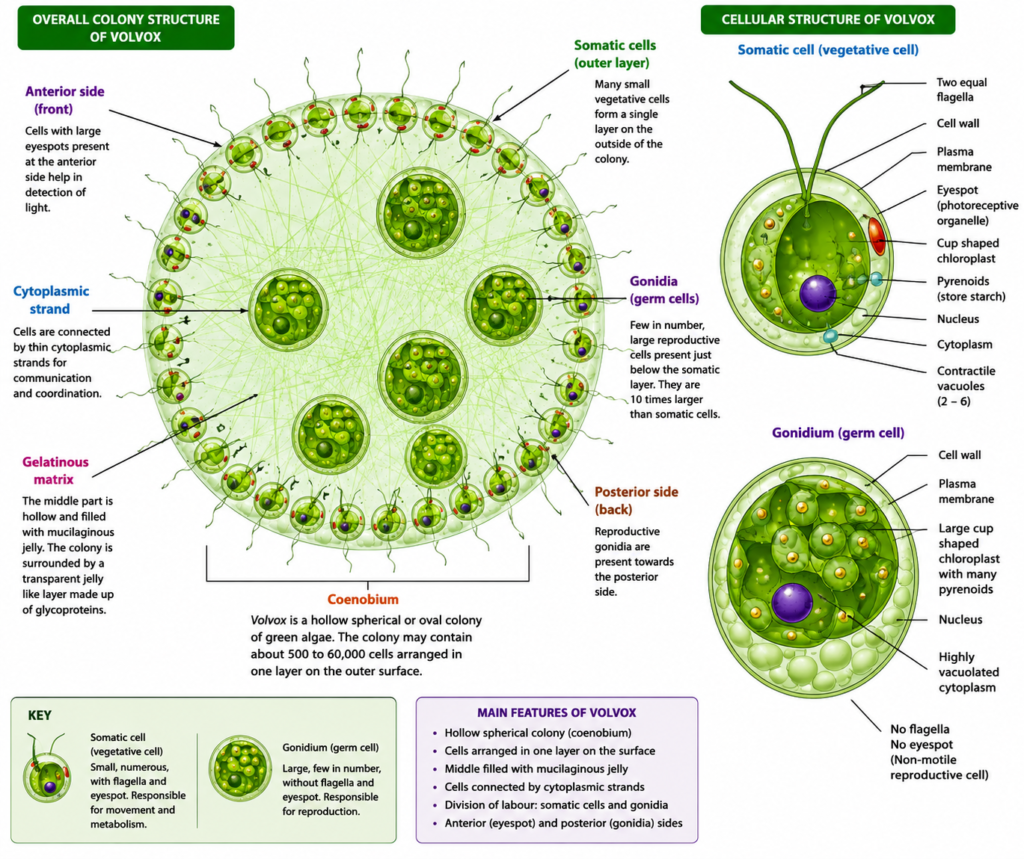
Overall Colony Structure of Volvox
- Coenobium
Volvox is a hollow colony of green algae. The colony is spherical or oval in shape and this is called coenobium. It is the main body form of Volvox. - Cell arrangement
The colony consists of many small individual cells. These cells may be about 500 to 60,000 in number. They are arranged in one layer only, around the outer side of the colony. - Gelatinous matrix
The middle part of the colony is empty like hollow space but it contains mucilaginous jelly. The whole colony is surrounded by transparent jelly like layer. This layer is made up of glycoproteins. - Cytoplasmic strand
The cells inside the colony are not fully separate. They remain connected by thin cytoplasmic strands. Through these strands the cells communicate and coordinate their activities, mainly at the time of swimming. - Anterior and posterior side
The colony has clear front and back side. The front side is called anterior side and it contains cells with large eyespots. These help in detection of light. The back side is called posterior side, where reproductive cells are present.
Cellular Structure of Volvox
- Cell types
Volvox colony shows division of labour. The cells are not all same in function. There are two types of cells, somatic cells and germ cells or gonidia. - Somatic cells
Somatic cells are vegetative cells of the colony. These cells are present in large number and form most part of the colony. They do basic metabolic functions and movement of the colony. - Flagella
Each somatic cell has two flagella. These are whip like and equal in size. They project outward from the colony and by their beating the colony moves through water. - Chloroplast and pyrenoids
Each cell contains cup shaped chloroplast. It is used for photosynthesis. The chloroplast contains pyrenoids, which store starch. - Eyespot
Each somatic cell has light sensitive eyespot. It works as photoreceptive organelle. It helps the cell to detect sunlight. - Basic cell parts
Each cell is covered by cell wall and plasma membrane. It has cytoplasm and one central nucleus. There are 2 to 6 contractile vacuoles which regulate water balance. - Gonidia
Gonidia are germ cells of Volvox. These are few in number and their main function is reproduction. They are present just below the somatic layer. Gonidia are larger than somatic cells. They may be up to ten times bigger than somatic cells. They are special reproductive cells and not used for movement. Gonidia do not have flagella and eyespots. They contain highly vacuolated cytoplasm. They also have large cup shaped chloroplast with many pyrenoids.
Energy Production in Volvox
- Photoautotrophic nutrition
Volvox is an obligate photoautotroph. It prepares its own food by using sunlight. The energy production occurs by photosynthesis and for this carbon dioxide and water are used to form glucose and other carbohydrate. - Role of chloroplast
The process takes place inside large cup shaped chloroplast. These chloroplasts are present in somatic cells and also in gonidia. The green pigment chlorophyll present inside the chloroplast absorbs solar energy. - Storage of energy
The carbohydrate formed during photosynthesis is stored as starch. This starch is stored inside special bodies called pyrenoids, which are present in the chloroplast. The stored food is later used by the colony. - Use of stored food
The stored carbohydrate provides energy for normal activity of Volvox. It is used in metabolism, growth, movement and reproduction. Thus the colony depends on photosynthetic food for its activity. - Light movement
For better energy production, Volvox moves towards light. The eyespot of somatic cells detects sunlight and the flagella move the colony towards upper surface of water. This helps in getting more light for photosynthesis.
Reproduction of Volvox – How do volvox reproduce?
Volvox reproduces by both asexual and sexual method. It follows haplontic life cycle. Asexual reproduction occurs in favourable condition and sexual reproduction occurs in unfavourable condition.
1. Asexual reproduction
Asexual reproduction is the common method of reproduction in Volvox. It occurs during favourable condition such as spring and early summer. At this time water and nutrients are present in sufficient amount.
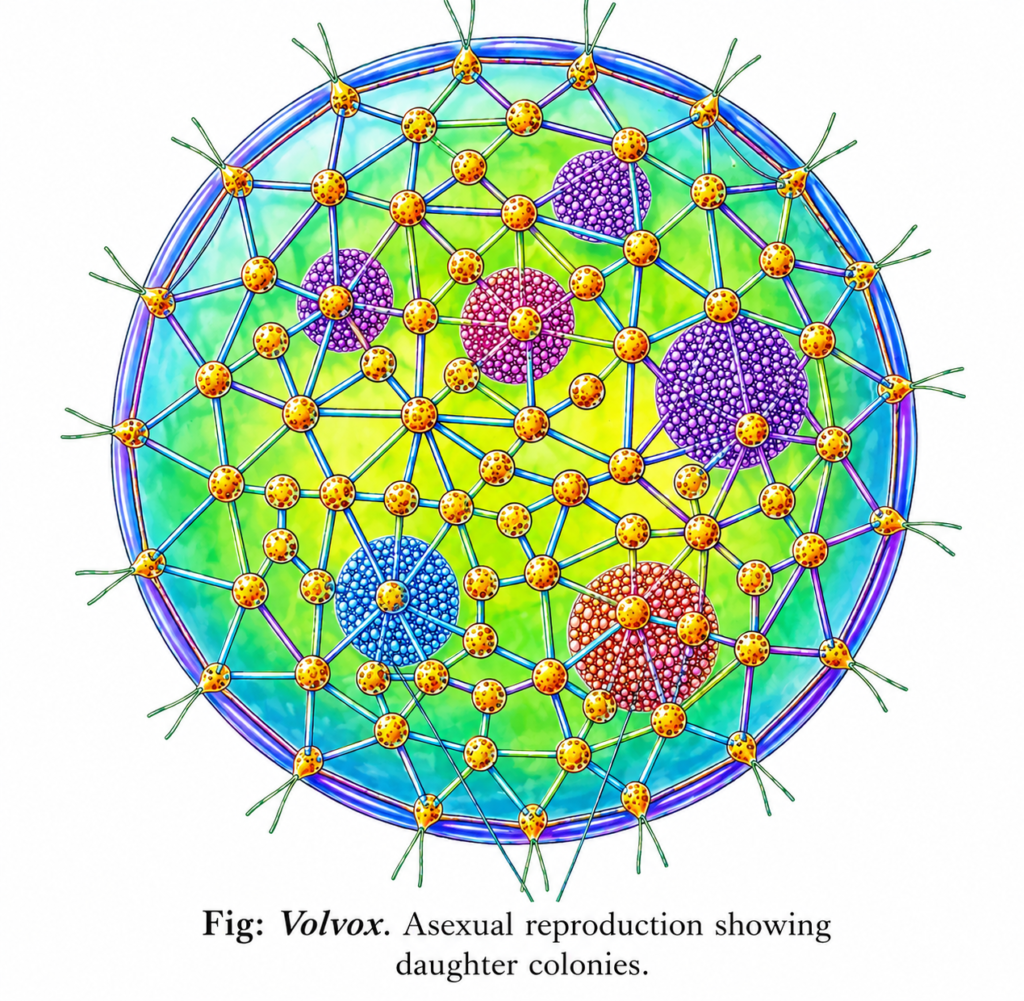
- Gonidia formation
The asexual reproductive cells are called gonidia. These cells are present in posterior half of the colony. The gonidium enlarges, loses its flagella and then it is pushed into the hollow inner region of parent colony. - Cleavage
The gonidium divides repeatedly by mitosis. Many new cells are formed by this repeated division. The embryo gradually becomes multicellular. - Plakea stage
During division, an 8 celled curved plate like stage is formed. This stage is called plakea stage. It is one of the important stage in development of daughter colony. - Inversion
The young embryo becomes hollow sphere but at first it is inside out. The flagellar ends of cells are directed inward. Then the embryo undergoes inversion through an opening called phialopore, and the flagellar ends come outside. - Daughter colony release
After inversion, small daughter colonies are formed inside the parent colony. They swim inside the gelatinous region for some time. Later the parent colony ruptures and disintegrates, and the daughter colonies are released into water.
2. Sexual reproduction
Sexual reproduction occurs during unfavourable condition. It may occur during winter, heat shock, oxidative stress or by sex inducing pheromones. Sexual reproduction in Volvox is oogamous type.
- Oogamy
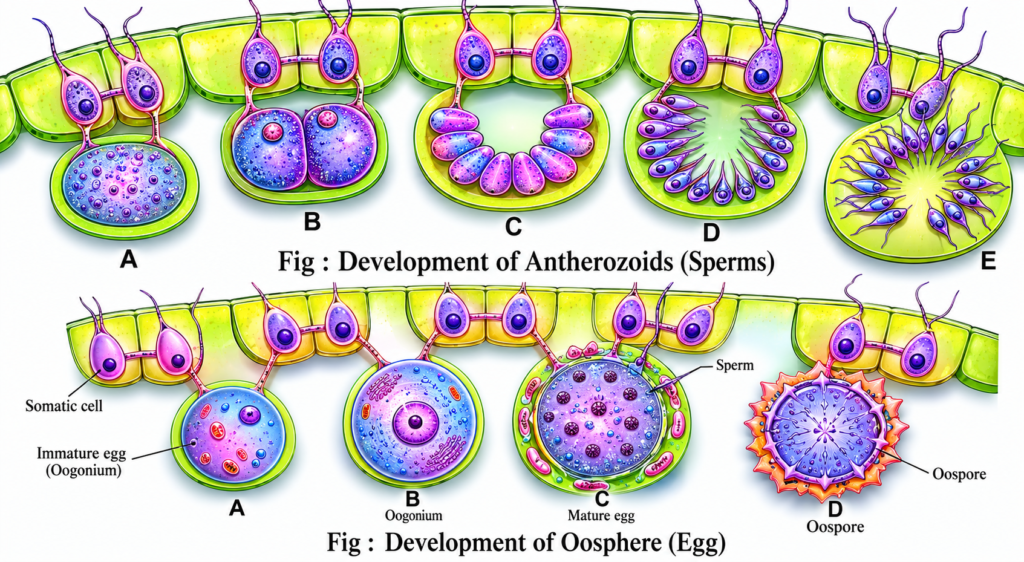
In oogamous reproduction, large non motile female gamete and small motile male gamete are formed. Female gamete is called ovum and male gametes are called spermatozoa. Species may be monoecious or dioecious. - Male gamete formation
Male gametes are formed inside antheridia. The cells divide and form pale yellow or green spindle shaped spermatozoa. These spermatozoa are biflagellated and are often released in groups called sperm packets. - Female gamete formation
Female gamete is formed inside oogonium. The oogonium is flask shaped structure. One cell enlarges, loses its flagella and stores reserve food like starch and lipids. Then it becomes non motile egg. - Fertilization
The sperm packets dissolve and individual sperm swim towards oogonium. They are guided by chemical attraction. One sperm enters through oogonial wall by using proteolytic enzymes and fuses with egg. - Zygote formation
After fertilization, diploid zygote or oospore is formed. The zygote secretes thick three layered protective wall. It also stores red orange pigment called hematochrome. - Dormancy
The zygote enters resting stage. It can survive bad condition like freezing and drought. This stage protects the organism during unfavourable period. - Germination
When favourable condition returns, the zygote germinates. It undergoes meiosis and forms four haploid cells. These cells then divide by mitosis and after inversion new free swimming Volvox colony is formed.
Volvox Movement Mechanism
Volvox shows rolling type of movement in water. The movement is done by the flagella of somatic cells present on the outer surface of colony. It moves forward and also rotates around its own axis.
- Propulsion by flagella
Volvox moves by the help of flagella. The flagella are present on the vegetative or somatic cells of the outer surface of colony. Each somatic cell has two whip like flagella. The beating of these flagella pushes the whole colony through water. - Parallel beating orientation
During cellular differentiation, the basal bodies at the base of flagella rotate about 90 degree. Due to this both flagella of a cell face in same direction. Then they beat parallel towards the posterior end. This produces forward movement of the colony. - Metachronal wave
The flagella do not beat in random way. They beat in a synchronized wave like manner. This wave passes from anterior end to posterior end of the colony. This wave movement is called metachronal wave. - Hydrodynamic coupling
The synchronization of flagella is not due to direct electrical or chemical communication between cells. It occurs due to fluid movement in water around the beating flagella. This type of coordination is called hydrodynamic coupling. - Rolling rotation
During swimming, Volvox rotates around its anterior-posterior axis. This gives rolling movement to the colony. The rolling occurs because the flagella beat at slight angle, about 20 degree from the axis of rotation. - Phototactic steering
Volvox moves towards light and this is called phototaxis. The anterior cells have large eyespots for light detection. Due to continuous rotation, the cells face towards light and away from light. In this way the colony detects the direction of light. - Species specific turning
For turning towards sunlight, the cells change flagellar beating on one side of the colony. In Volvox carteri and Volvox aureus, the beating frequency decreases on the illuminated side and sometimes the flagella stop. In Volvox barberi, the direction of flagellar beat changes about 90 degree from posterior stroke to lateral stroke.
How do volvox eat?
Volvox do not eat food like animals. It does not take other organisms as food. It is an obligate photoautotroph, so it prepares its own food by using sunlight.
The food making process of Volvox is photosynthesis. Each cell of colony has large cup shaped chloroplast. The chloroplast contains green pigment chlorophyll and this pigment traps light energy from sun.
By using light energy, Volvox cells use carbon dioxide and water to form carbohydrate. This carbohydrate gives energy for growth, metabolism and reproduction of the colony.
The prepared food is stored as starch. This starch is present inside special bodies called pyrenoids. Pyrenoids are present in the chloroplast.
For making more food, Volvox moves towards light. The eyespot detects direction of sunlight and the flagella move the colony near the water surface. In this way it gets more light for photosynthesis.
Volvox Habitat
- Distribution
Volvox is found in different places of the world. It has cosmopolitan distribution. So it is present in many freshwater habitats of different regions. - Freshwater habitat
Volvox mainly lives in still and stagnant freshwater. It is found in permanent and temporary ponds, lakes, lagoons, ditches, shallow rain filled puddles, pools and water tanks. - Other places
Although Volvox is mostly freshwater form, it is also recorded from some unusual places. It may occur in rivers, soil, ice and snow. These are not its common habitat. - Surface water
Volvox is free floating and planktonic organism. It usually comes near the surface of water. This helps the colony to get more sunlight for photosynthesis. - Nutrient rich water
It grows well in water having more nutrients. Water with high nitrogen content supports its growth. So Volvox is commonly found in nutrient rich ponds and pools. - Plant association
Volvox may occur with aquatic plants and other algae. It is found with Lemna, Sphagnum, Vaucheria, Alisma, Equisetum fluviatile, Utricularia, Typha and Chara. - Seasonal growth
The growth of Volvox increases during warm season. It multiplies rapidly in spring, early summer and rainy or monsoon season. At this time it may form green scum on water surface. - Temporary ponds
In temporary ponds, Volvox forms dormant over wintering zygotes before the water dries in summer heat. These zygotes help in survival during unfavourable dry condition.
Life Cycle of Volvox
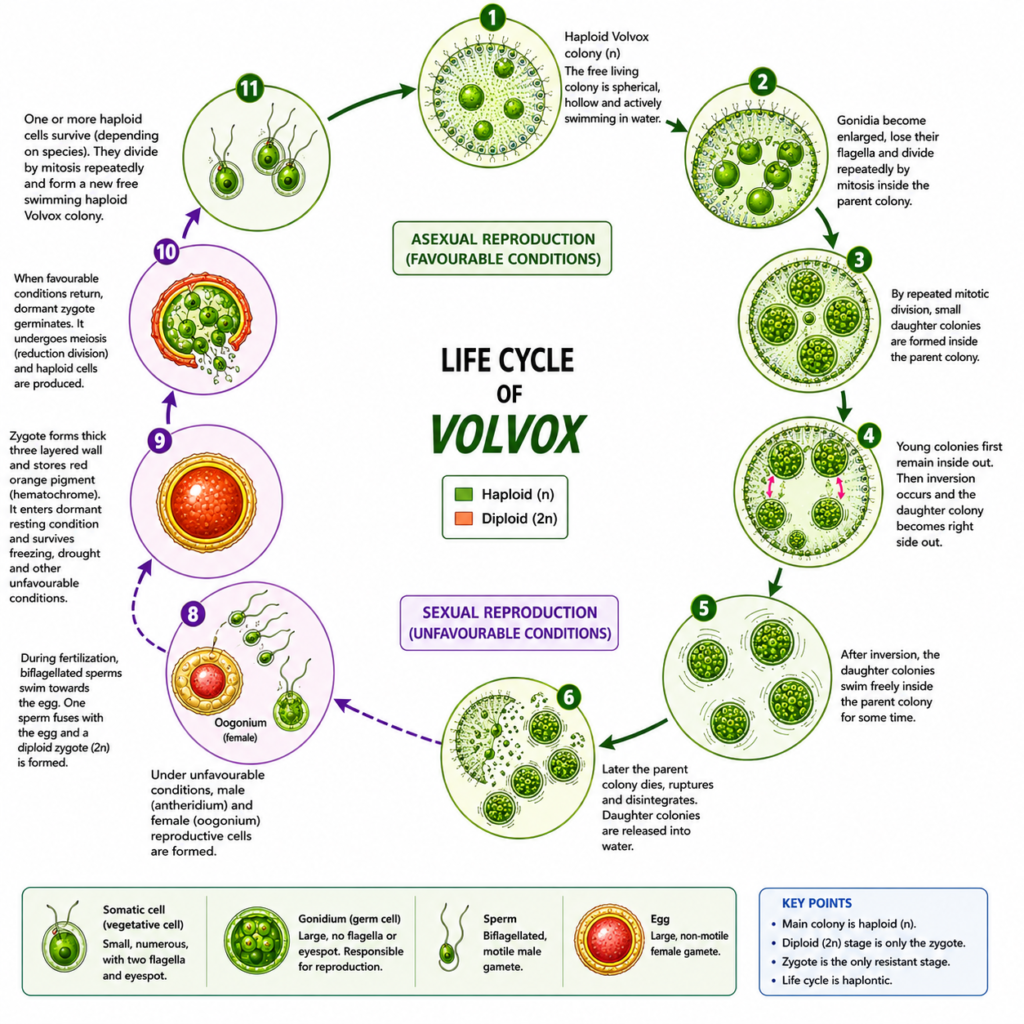
- Volvox shows haplontic life cycle. The main colony is haploid (n), free living and actively swimming in water. The diploid (2n) stage is very short and it is present only in the form of dormant zygote.
- During favourable condition like spring and early summer, Volvox reproduces asexually. The reproductive cells called gonidia become enlarged, lose their flagella and divide repeatedly by mitosis inside the parent colony.
- By repeated mitotic division, small daughter colonies are formed inside the parent colony. These young colonies first remain inside out. Then inversion occurs and the daughter colony becomes right side out.
- After inversion, the daughter colonies swim freely inside the parent colony for some time. Later the parent colony dies, ruptures and disintegrates. Then the daughter colonies are released into water.
- When environmental condition becomes bad, Volvox starts sexual reproduction. This may occur during winter, heat stress or nutrient depletion. In this stage male and female reproductive cells are formed.
- The male reproductive structure is antheridium. It produces motile biflagellated sperms. The female reproductive structure is oogonium and it produces large non-motile egg.
- During fertilization, sperms swim towards the egg. One sperm fuses with the egg. After fusion, a diploid zygote (2n) is formed.
- The zygote forms thick three layered protective wall around it. It also stores red orange pigment called hematochrome. Then it enters into dormant resting condition and survives freezing, drought and other unfavourable condition.
- When favourable condition returns, the dormant zygote germinates. It undergoes meiosis or reduction division. As a result haploid cells are produced again.
- One or more haploid cells survive depending on the species. These cells divide repeatedly by mitosis and form a new free swimming haploid Volvox colony. In this way the life cycle again continues.
Economic Importance of Volvox
- Volvox is useful in fish farming. It is used as primary food for young fish larvae. It is nutritive and low cost food, so it has importance in commercial pisciculture.
- Volvox is used in scientific research. It is easy to culture in laboratory and it multiplies fast. Due to simple structure it is used for study of fluid dynamics, flagellar coordination and evolution of multicellular life.
- Volvox is an autotrophic primary producer. It forms food for small aquatic organisms. Many microscopic invertebrates and mainly rotifers feed on it.
- It fixes carbon dioxide and releases oxygen during photosynthesis. This helps in aquatic oxygenation. So it supports life in freshwater environment.
- In warm nutrient rich water, Volvox may grow rapidly. This may form harmful algal bloom. After death and decay of these colonies, dissolved oxygen of water becomes less.
- Sometimes Volvox may act as carrier of pathogenic bacteria. It can harbour Vibrio cholerae. This bacteria causes cholera, so it has harmful importance also.
Ecological Importance of Volvox
- Volvox is a photosynthetic green algae of freshwater. It gives oxygen in water during photosynthesis. This oxygen is useful for aquatic animals.
- It also fixes carbon dioxide from water. Being autotrophic, it uses carbon dioxide and light. Then food is formed inside the cells.
- Volvox is also used as food by small aquatic organisms. It forms base of aquatic food chain. Rotifers commonly feed on Volvox.
- In nutrient rich warm water, Volvox grows very fast. Large number of colonies may form bloom. This makes green growth in water.
- After death of bloom, the colonies decay in water. During decay dissolved oxygen becomes less. This may disturb fishes and other aquatic animals.
- Sometimes Volvox may carry pathogenic bacteria. It can harbour Vibrio cholerae. So it may also become harmful in some condition.
How to Observe Volvox Under the Microscope?
Live observation of flagellar movement
- First culture Volvox in test tubes at low concentration. The concentration should be 10 spheroids or less than 10 spheroids per ml. The culture is kept in standard medium with 16 hours light and 8 hours dark cycle.
- Take one living Volvox spheroid from the culture. It is gently held in one position by micropipette aspiration. This is done so that the spheroid remains alive but does not move away from the field.
- Focus the spheroid under microscope by using extralong working distance 40x objective lens. The outer surface of colony is observed carefully because the flagella are present on the somatic cells.
- Use bright-field illumination with an interference filter. The filter has transmission less than 10⁻³ for wavelength below 620 nm. This prevents Volvox from responding to the microscope light.
- For observing phototactic response, give controlled light stimulus by using cyan light-emitting diode. Then observe how the flagellar movement changes after light stimulation.
- Record the flagellar movement by using high-speed camera at 500 frames per second. This is needed because flagella beat very fast and cannot be studied clearly by normal viewing.
- The recorded images are then processed digitally. Mean image subtraction and histogram equalization are used for making the flagella more clear.
Immunofluorescence observation of proteins and DNA
- First collect Volvox spheroids by using magnetic funnel fitted with 25 μm nylon mesh filter. This helps in collecting the spheroids for microscopic preparation.
- The collected spheroids are fixed on ice for one hour. For fixation, 2% or 4% paraformaldehyde is used with plant protease inhibitor cocktail, ALLN, MG132 and DTT.
- After fixation, wash the spheroids with PBS. Then resuspend them immediately in cold methanol at -20°C for 5 minutes. This cold methanol washing is repeated two more times.
- Rehydrate the sample by keeping it in PBS at room temperature for 15 minutes. After this, the spheroids become ready for mounting on cover slip.
- Mount the spheroids on poly-L-lysine coated cover slips. This coating helps the spheroids to stick on the cover slip during staining and washing.
- Block the cover slips for 30 minutes in blocking buffer. This buffer contains 5% BSA, 1% cold-water fish gelatin and 10% normal goat sera. Blocking prevents non-specific binding.
- Add primary antibody and incubate the sample overnight. Then wash it and add fluorescent tagged secondary antibody for 1 to 4 hours in dark condition.
- For DNA staining, wash the sample and incubate it in DAPI dye solution for 15 minutes. DAPI stains the cellular DNA.
- Remove excess liquid and mount the cover slip with VectaShield medium. Then observe it under microscope with DIC optics and fluorescence filter cubes.
Examples of Most Common Types of Volvox
- Volvox globator is the most common species of Volvox. It is a well known freshwater form. The colony is spherical and green in colour.
- Volvox aureus is also a common species. It grows fast in warm and nutrient rich water. Sometimes it forms algal bloom when the condition is suitable.
- Volvox carteri is an important species used in research work. It is used as model organism for studying multicellular nature and differentiation of cells. It shows clear difference between somatic cells and reproductive cells.
- Volvox barberi is another common species of this genus. It is known as fast swimming form among the volvocine algae. Its movement occurs by coordinated beating of flagella.
- Volvox rousseletii is a common species of Volvox. It is important because cytoplasmic connections between the cells remain present even in adult stage. These connections help in coordination of cells.
- Volvox africanus is frequently found in freshwater habitat. It is recorded from different freshwater bodies. It also forms spherical colonies like other Volvox species.
- Volvox prolificus is also found in many freshwater habitats. It is regularly identified as a species of Volvox. It grows in suitable stagnant water.
- Volvox tertius is one of the early known species of this genus. It is also a recognized species. It is included among common examples of Volvox.
Harmful Impact of Volvox in Human, Animal and Plant
- Harmful impact on human
Volvox does not cause disease directly by itself. But it may become harmful when it acts as carrier of pathogenic bacteria. It can harbour Vibrio cholerae, which causes cholera in human. In warm water having high nitrogen content, Volvox may multiply very fast. Some species like Volvox aureus can form harmful algal bloom. This bloom reduces the quality of water and makes the water unsuitable for use. - Harmful impact on animals
Excessive growth of Volvox may affect aquatic animals. When large number of colonies form bloom, the normal condition of water body is disturbed. It may create harmful condition for fishes and other aquatic life. When the bloom dies, the dead colonies are decomposed in water. During this decay process dissolved oxygen of water becomes very low. Due to low oxygen, fishes and other aquatic animals may die. - Harmful impact on plants
There is no direct harmful effect of Volvox on plants mentioned. It generally lives with aquatic plants in water. But when severe bloom occurs, it may disturb the balance of aquatic ecosystem. Large bloom may cover the water surface. This can reduce normal light condition in the water body. So indirectly it may affect other aquatic plants by disturbing the shared habitat.
References
- Embryonic inversion in Volvox carteri: The flipping and peeling of elastic lips. (n.d.). ResearchGate.
- Kirk, D. L. (2005). A twelve-step program for evolving multicellularity and a division of labor. BioEssays, 27(3), 299–310.
- Hoops, H. J., Nishii, I., & Kirk, D. L. (2000-2013). Cytoplasmic bridges in Volvox and its relatives. In Madame Curie Bioscience Database [Internet]. Landes Bioscience.
- Cytoplasmic bridges in Volvox and its relatives. (n.d.). ResearchGate.
- Schmitt, R. (2003). Differention of germinal and somatic cells in Volvox carteri. Current Opinion in Microbiology, 6(6), 608–613.
- Embryonic inversion in Volvox carteri: The flipping and peeling of… (n.d.).
- Geng, S., De Hoff, P., & Umen, J. G. (2014). Evolution of sexes from an ancestral mating-type specification pathway. PLoS Biology, 12(7), e1001904.
- Evolution of reproductive development in the volvocine algae. (n.d.). PMC – NIH.
- Exploring germ-soma differentiation in Volvox. (n.d.). Indian Academy of Sciences.
- Extracellular matrix and sex-inducing pheromone in Volvox. (n.d.). ResearchGate.
- Genomics of volvocine algae. (n.d.). PMC – NIH.
- Germ-soma differentiation in Volvox. (n.d.). PubMed.
- How 5000 independent rowers coordinate their strokes in order to row into the sunlight: Phototaxis in the multicellular green alga Volvox. (n.d.). PMC – NIH.
- Multicellularity drives the evolution of sexual traits. (n.d.). PMC – NIH.
- Multicellularity and increasing Reynolds number impact on the evolutionary shift in photo-induced ciliary response in Volvocales. (n.d.). bioRxiv.
- Herron, M. D. (2016). Origins of multicellular complexity: Volvox and the volvocine algae. Molecular Ecology, 25(6), 1213–1223.
- Reproduction in volvox. (n.d.). SlideShare.
- Spatiotemporal distribution of the glycoprotein pherophorin II reveals … (n.d.).
- Spatiotemporal distribution of the glycoprotein pherophorin II reveals stochastic geometry of the growing ECM of Volvox carteri. (n.d.). bioRxiv.
- Spatiotemporal distribution of the glycoprotein pherophorin II reveals stochastic geometry of the growing ECM of Volvox carteri. (n.d.). PNAS.
- Solari, C. A., Drescher, K., & Goldstein, R. E. (2011). The flagellar photoresponse in Volvox species (Volvocaceae, Chlorophyceae). Journal of Phycology, 47(3), 580-583.
- The biology of Volvox: Systematic taxonomy, cellular architecture, and reproductive morphogenesis. (n.d.).
- Jiménez-Marín, B., & Olson, B. J. S. C. (2022). The curious case of multicellularity in the volvocine algae. Frontiers in Genetics, 13, 787665.
- The curious case of multicellularity in the volvocine algae. (n.d.). PMC – NIH.
- The protoplasmic connection in Volvox. (n.d.). ResearchGate.
- The development of cytoplasmic bridges in Volvox. (n.d.). ResearchGate.
- There is more than one way to turn a spherical cellular monolayer inside out: Type B embryo inversion in Volvox globator. (n.d.). PMC – NIH.
- Saraswat, K. (2025). Volvox – Diagram, classification, structure and reproduction. Physics Wallah.
- Wikipedia contributors. (2025). Volvox. In Wikipedia, The Free Encyclopedia.
- Volvox. (n.d.). vpscience.org.
- BYJU’S. (n.d.). Volvox classification.
- Vedantu. (n.d.). Volvox classification, structure, and life cycle | NEET Biology.
- Volvox as a model for studying cell death and senescence. (n.d.). ResearchGate.
- Wikipedia contributors. (2025). Volvox carteri. In Wikipedia, The Free Encyclopedia.
- LND College. (n.d.). Volvox- Life cycle. Motihari.
- Testbook. (n.d.). Volvox: Classification, diagram, characteristics, life cycle.
- Allen.In. (n.d.). Volvox: Colonial green algae | Structure & reproduction.
- Science Facts. (2021). Volvox: Structure & characteristics with labeled diagram.
- Aakash Educational Services Limited. (n.d.). Volvox: Structure, classification and reproduction. AESL.
- Volvox: A simple algal model for embryogenesis, morphogenesis and cellular differentiation. (n.d.). PMC – NIH.
- Whole transcriptome RNA-Seq analysis reveals extensive cell type-specific compartmentalization in Volvox carteri. (n.d.). PMC – NIH.