

Anabaena is a filamentous cyanobacteria. It is commonly known as blue green algae. It is found in freshwater, marine water and soil. It may be present as plankton or mat like form.
It is multicellular organism. The cells are arranged in unbranched chain. This chain is called trichome. The cells are bead like. These vegetative cells do photosynthesis and oxygen is produced.
The important character of Anabaena is nitrogen fixation. It fixes atmospheric nitrogen when nitrogen is not available in the surrounding. For this process some vegetative cells become heterocyst. Heterocyst is thick walled cell and it maintains oxygen poor condition. In this condition nitrogen is converted into ammonia.
During unfavourable condition Anabaena forms akinetes. These are large resting spores. It contains stored food material. It helps in survival during drying, freezing and other bad condition.
Anabaena is also important in symbiotic association. It lives with Azolla water fern. Anabaena gives fixed nitrogen to Azolla and Azolla gives shelter and nutrients. This association is used as natural biofertilizer in paddy field.
Some species of Anabaena also cause harmful algal bloom. These blooms produce cyanotoxins. Some toxins are anatoxin-a, guanitoxin and microcystins. These toxins are harmful to fishes, farm animals, wild animals and pets.
History of Anabaena
- The study of Anabaena and other cyanobacteria started from early time. Scientists studied their life history and ecological importance since 1856. At first these organisms were studied as blue-green algae.
- The genus Anabaena was taxonomically recognized by Bornet and Flahault in 1886. They described it under botanical classification. At that time it was considered as algal form because of photosynthetic nature.
- In late 1950s and early 1960s, some poisoning cases of animals were noticed. These cases were linked with planktonic blooms of Anabaena. Such type of outbreak was found in western Canada.
- In 1961, cattle poisoning incident was also reported. After this incident more attention was given to toxic bloom forming Anabaena. It showed that this organism can be harmful also.
- In 1965, Anabaena flos-aquae NRC 525-17 strain was isolated from a bloom in Saskatchewan, Canada. From this strain later guanitoxin was discovered. It was formerly called anatoxin-a(S).
- In 1970s, another toxin anatoxin-a was identified. It was obtained from Anabaena flos-aquae strain which was isolated from Burton Lake, Canada. It is a strong neurotoxin.
- Anabaena also showed historical survival ability by forming akinetes. Akinetes are dormant resting spores. In one study, akinetes of Anabaena were recovered from sediment of Rostherne Mere in England and they were 64 years old. Still they germinated successfully.
- Between 1999 and 2005, genome sequencing work was carried out on Anabaena variabilis ATCC 29413. It was done by United States Department of Energy. The complete genome was about 7.2 million base pair.
- The details of this genome sequencing project were published in 2014. This helped in understanding genes, nitrogen fixation and other metabolic activity of Anabaena.
- In recent years, taxonomy of Anabaena has been revised. This was done by genetic and molecular studies. Many planktonic species having gas vesicles were shifted to Dolichospermum.
- Some other species were moved to Sphaerospermopsis. The endosymbiont of Azolla, which was earlier called Anabaena azollae, is now placed as Nostoc azollae.
Definition of Anabaena
Anabaena is a filamentous cyanobacteria genus known for its nitrogen-fixing abilities and symbiotic relationships with certain plants, while also producing neurotoxins harmful to various organisms.
Scientific Classification of Anabaena
| Taxonomic Rank | Classification |
|---|---|
| Domain | Bacteria |
| Kingdom | Bacillati |
| Phylum | Cyanobacteriota |
| Class | Cyanophyceae |
| Order | Nostocales |
| Family | Nostocaceae |
| Genus | Anabaena |
Characteristics of Anabaena
- Anabaena is a microscopic prokaryotic organism. It has no true nucleus and membrane bound cell organelles. It belongs to cyanobacteria.
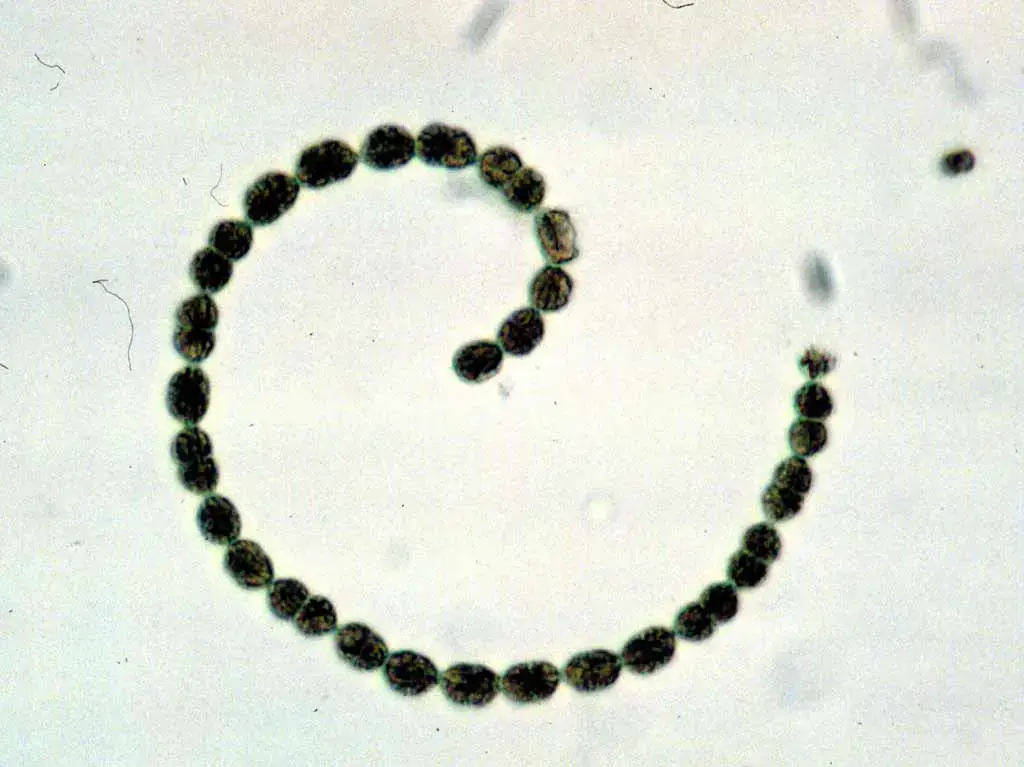
- It is filamentous in nature. The cells are arranged in multicellular unbranched chain. This chain is known as trichome.
- The trichome may be straight, flexuous or irregularly coiled. The cells are generally bead like. They remain attached end to end.
- Anabaena may occur as single filament. It may also present as loose cluster or mat like mass. These filaments are commonly covered by watery mucilage.
- The main cell of Anabaena is vegetative cell. These cells are normal photosynthetic cells. They produce food by oxygenic photosynthesis and oxygen is released.
- Heterocyst is another important cell found in Anabaena. It is thick walled specialized cell. It is formed when nitrogen is less in the environment.
- Heterocyst helps in nitrogen fixation. It provides oxygen poor condition inside the cell. In this condition atmospheric nitrogen is converted into ammonia.
- Akinete is enlarged spore like resting cell. It has thick wall and stored food materials. It helps the organism to survive drought, freezing and other unfavourable condition.
- In Anabaena, akinetes are usually formed near the heterocyst. These cells remain dormant for long time. After getting favourable condition they germinate again.
- Anabaena reproduce asexually by fragmentation. The filament breaks into small parts. These small motile segments are called hormogonia and they develop into new filaments.
- Anabaena can form symbiotic association with plants. The common example is Azolla water fern. In this association Anabaena gives fixed nitrogen and gets carbohydrate and shelter.
- It has agricultural importance. Due to nitrogen fixing ability, Anabaena with Azolla is used as natural biofertilizer. It enriches soil mainly in flooded rice field.
- Some species of Anabaena can produce toxins during algal bloom. These toxins are called cyanotoxins. It includes microcystins, anatoxin-a, guanitoxin and saxitoxins.
- These toxins are harmful to livestock, pets and wild animals. It may affect liver or nervous system. So toxic bloom of Anabaena is a serious water pollution problem.
Occurrence of Anabaena
- Anabaena is mostly found in freshwater habitat. It occurs in lakes, ponds, pools and streams. It may float freely in water as plankton.
- It is also found near the shore region of water bodies. In this place it forms mat like growth. These mats are usually present in littoral zone.
- Anabaena grows better in alkaline hard water. Its growth is slower in slightly acidic soft water. So hard water lakes support more growth of it.
- Some species of Anabaena are found in brackish water. It is also present in marine water and saline lakes. Some records also show its occurrence in marine sand and saline pools.
- Anabaena can also occur in terrestrial habitat. It grows on damp surface and moist soil. Sometimes it forms slippery layer on wet stones and damp walkways.
- It is highly adaptable organism. It may also be found in deserts, glaciers and hot springs. This shows its capacity to tolerate different environmental condition.
- Anabaena is found in symbiotic condition with other organisms. The common example is Azolla water fern. It lives inside the dorsal leaf cavities of Azolla.
- It also forms association with fungi, mosses and coralline roots of cycads. In these association it mainly provides fixed nitrogen to the host.
- Anabaena is commonly found in agricultural field. It is present in flooded rice paddies mainly with Azolla. It is cultivated in many parts of Asia as natural biofertilizer.
- In rice field it increases nitrogen content of soil. For this reason Anabaena is important in paddy cultivation. It helps in reducing the use of chemical nitrogen fertilizer.
Structure of Anabaena
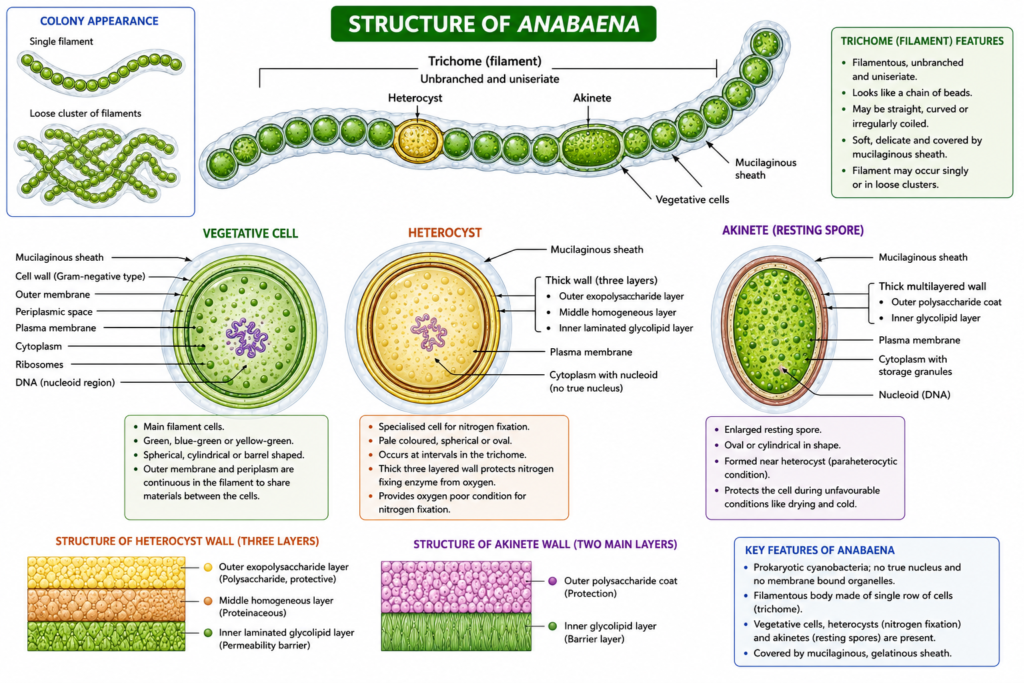
- Anabaena is a prokaryotic cyanobacteria. Its cell has no true nucleus. Membrane bound cell organelles are also absent.
- The plant body is filamentous. It is made up of single row of cells. This single row of cells is called trichome.
- The trichome is unbranched and uniseriate. It looks like chain of beads. It may be straight, curved or irregularly coiled.
- The filaments may occur singly. Sometimes they are found in loose clusters. The whole filament is soft and delicate in nature.
- The filament is covered by mucilaginous sheath. This sheath is colourless and gelatinous. It is not rigid and contains much water.
- The main cells of filament are vegetative cells. These cells are green, blue green or yellow green in colour. They may be spherical, cylindrical or barrel shaped.
- Vegetative cells have cell wall like Gram-negative bacteria. The outer membrane and periplasm are continuous in the filament. It helps in sharing materials between the cells.
- Some cells of filament become heterocysts. These are pale coloured special cells. They are usually spherical or oval and occur at intervals in the trichome.
- Heterocyst has thick wall. The wall is made up of three layers. It has inner laminated glycolipid layer, middle homogeneous layer and outer exopolysaccharide layer.
- Heterocyst protects nitrogen fixing enzyme from oxygen. So it provides oxygen poor condition. In this condition nitrogen fixation takes place.
- Anabaena also contains akinetes. These are enlarged resting spores. They are generally oval or cylindrical in shape.
- Akinetes are formed near the heterocyst. This type of development is called paraheterocytic condition. They have thick multilayered wall.
- The wall of akinete contains inner glycolipid layer and outer polysaccharide coat. It protects the cell during unfavourable condition like drying and cold.

Reproduction of Anabaena
- Asexual method
Anabaena reproduces by asexual method only. Sexual reproduction is not found in this organism. Gametes are not formed. - Fragmentation
The main method of reproduction is fragmentation. In this process long filament breaks into small pieces. Each piece can grow into new filament. - Hormogonia
The small pieces are called hormogonia. These are short filamentous segments. They help in dispersal of Anabaena. - Heterocyst break
Fragmentation may occur due to old heterocyst. When heterocyst becomes senescent, vacuolation occurs. Then it breaks from the main filament. - Growth
The hormogonia separate and disperse in water. Under favourable condition they grow. The cells divide and elongate to form new filament. - Akinete germination
Anabaena also forms new filament by akinete germination. Akinetes are thick walled dormant resting spores. - Germling
When condition becomes favourable, division starts inside the akinete. The outer wall ruptures. A young filament called germling comes out and forms new Anabaena.
Different mode of Reproduction of Anabaena
- Asexual reproduction–
- Anabaena reproduces by asexual method only, because sexual reproduction has not been observed in this organism. It does not form gametes and there is no fusion of male and female reproductive cell.
- The reproduction mainly takes place by breaking of filament and also by germination of resting spores. These methods help in multiplication and survival of Anabaena during favourable and unfavourable conditions.
- Fragmentation and hormogonia formation –
- Fragmentation is the common and main mode of reproduction in Anabaena. In this method the long multicellular filament breaks into small pieces and each piece has the capacity to grow into a new filament.
- The small broken pieces of the filament are called hormogonia. These are short segments of the trichome and they separate from the parent filament for dispersal in water or other suitable habitat.
- The breaking of filament may occur due to old heterocyst present in the filament. When the heterocyst becomes senescent, vacuolation takes place inside it and after that it breaks away from the main filament.
- Due to this breaking, the continuous filament becomes separated into small hormogonial fragments. These fragments remain active and they help in spreading of the organism from one place to another.
- Under favourable environmental condition, the cells of hormogonia start division and elongation. In this way each hormogonium develops into a new young filament of Anabaena.
- Akinete germination–
- Anabaena also reproduces by germination of akinetes. Akinetes are thick walled dormant resting spores which are formed from vegetative cells during unfavourable environmental condition.
- These cells are larger than normal vegetative cells and contain reserve food materials. They remain in resting stage for long time and protect the organism from drying, cold, nutrient deficiency and other bad condition.
- When favourable condition returns, such as proper light, temperature and nutrients, the akinete becomes active again. The resting stage ends and the germination process begins.
- During germination, cell division starts inside the thick protective envelope of the akinete. The newly formed cells increase in number and due to internal growth the pressure is developed on the outer wall.
- The outer envelope of the akinete then ruptures due to the pressure of growing cells. A young multicellular filament comes out from this ruptured wall.
- This young filament is called germling. The germling gradually increases in length and forms a new trichome, which later becomes a mature filament of Anabaena.
Nitrogen Fixation Mechanism by Anabaena
- Nitrogenase enzyme
In Anabaena, the fixation of atmospheric nitrogen is done by nitrogenase enzyme. It converts free nitrogen (N₂) into ammonia (NH₃) which can be used by the cell. This enzyme is very much sensitive to oxygen, so in presence of oxygen its activity is inhibited. - Formation of heterocyst
When combined nitrogen is not present in the medium, some vegetative cells of Anabaena are changed into heterocysts. These cells are thick walled and special type of cell, formed at certain distance in the filament. The main function of heterocyst is to provide suitable place for nitrogen fixation. - Protection from oxygen
The wall of heterocyst becomes thick and three layered. It has inner glycolipid layer, middle homogeneous layer and outer exopolysaccharide layer. The inner glycolipid layer is hydrophobic and it stops entry of oxygen into the cell, so the nitrogenase enzyme is protected. - Stopping of oxygen production
In heterocyst, Photosystem II is degraded and it does not remain active. Due to this oxygen producing part of photosynthesis is stopped. This is necessary because oxygen can destroy the activity of nitrogenase. - Formation of ATP
Although Photosystem II is absent, Photosystem I remains present in heterocyst. It carries out cyclic photophosphorylation. During this process ATP is formed and this ATP is used in the reduction of nitrogen into ammonia. - Removal of remaining oxygen
Some amount of oxygen may enter into the heterocyst. For this reason respiration becomes high and oxygen removing proteins are also produced. These consume the remaining oxygen and maintain low oxygen condition inside the heterocyst. - Supply of carbon compound
Heterocyst cannot do complete photosynthesis and so it cannot prepare enough food by itself. The nearby vegetative cells supply carbon compounds like sucrose to the heterocyst. These compounds pass through septal junctions or nanopores between the cells. - Supply of fixed nitrogen
Inside the heterocyst, nitrogen is fixed and changed into ammonia and other nitrogenous compounds. These are converted into glutamine, glutamate and β-aspartyl-arginine. These compounds are then passed back to the vegetative cells for their growth. - Division of labour
Thus in Anabaena filament, there is division of labour between vegetative cells and heterocysts. Vegetative cells mainly perform photosynthesis and supply carbon. Heterocyst mainly performs nitrogen fixation and supply fixed nitrogen. - Genetic control
The process is controlled by nitrogen starvation signal. When nitrogen is absent, 2-oxoglutarate accumulates inside the cell. It activates regulatory genes like NtcA and HetR, which control heterocyst differentiation and nitrogen fixation process.
Impact of Anabaena Cyanobacteria on Human Health
- Liver damage
Anabaena can produce microcystins during harmful algal bloom. These are strong liver toxins. When contaminated water or food is taken, it may cause increase of liver enzymes, jaundice and acute liver failure. Long exposure through drinking water may also be related with liver cancer and colorectal cancer. - Nervous effect
Some species of Anabaena and its related genus Dolichospermum produce neurotoxins. The important toxins are anatoxin-a, guanitoxin and saxitoxins. These toxins act very fast on nervous system and cause tingling near lips, dizziness, muscle twitching, excess salivation, convulsion and paralysis. - Respiratory paralysis
In severe poisoning, the neurotoxins may affect the respiratory muscles. Breathing becomes difficult and respiratory arrest may occur. This condition is very dangerous and may cause death if exposure is high. - BMAA effect
Some species may produce BMAA. It is an amino acid like compound. It is suspected to increase risk of neurodegenerative diseases like ALS (amyotrophic lateral sclerosis), but this relation is still studied. - Gastrointestinal illness
Accidental intake of bloom contaminated water causes stomach and intestinal problems. Nausea, vomiting, severe stomach cramp and diarrhoea are common symptoms. It may also occur by eating contaminated fish or bivalves. - Kidney damage
Microcystins mainly affect liver, but they may also spread to other organs. Long exposure may affect kidney function. It may be related with chronic kidney disease in some cases. - Reproductive harm
The toxins produced by these cyanobacteria may also affect reproductive system. This effect occurs when exposure continues for long time. It may disturb normal reproductive health. - Skin irritation
Direct contact with Anabaena bloom during swimming or bathing may cause skin problem. The skin becomes itchy and rashes may appear. Sometimes blistering around mouth is also seen. - Eye and mucous irritation
The bloom may contain lipopolysaccharide endotoxins (LPS). These cause irritation of eyes and mucous membrane. Conjunctivitis, redness and burning sensation may occur after contact. - Respiratory problem
When aerosolized toxins are inhaled, respiratory symptoms may appear. It may cause dry cough, sore throat and breathing distress. In severe case, heart failure may also occur but it is rare. - Flu like symptoms
Mild exposure may show general symptoms like fever, headache and fatigue. These symptoms are not very specific. So sometimes it becomes difficult to identify cyanotoxin poisoning at early stage.
Impact of Anabaena Cyanobacteria on Animals
- Livestock poisoning
Anabaena bloom contaminated water is very harmful for farm animals. When cattle, sheep, pigs and horses drink this water, poisoning may occur. In many cases death of animals are also reported due to toxic bloom. - Pet animals
Domestic animals are also affected by Anabaena toxins. Dogs are more commonly affected because they may drink or lick bloom water from ponds and lakes. After intake, symptoms appear very quickly and death may occur in severe poisoning. - Wild animals
The toxins of Anabaena also affect wild animals. Many birds and aquatic animals may die after exposure to contaminated water. Flamingos, ducks, poultry, sea otters, turtles and crocodiles are some examples of affected animals. - Nervous effect
Anabaena produces neurotoxins like anatoxin-a and guanitoxin. These toxins act rapidly on nervous system. Poisoned animals show tremors, muscle fasciculation, convulsion, paralysis and loss of normal body control. - Respiratory arrest
In severe case, the neurotoxin affects respiratory muscles. The animal cannot breathe properly. Death usually occurs fast due to respiratory arrest. - Salivation and tears
Poisoned animals may show excess salivation. Drooling is commonly seen. In some cases bloody tears and urinary incontinence also occurs. These signs show severe toxic effect on body. - Liver damage
Some Anabaena toxins are hepatotoxic. Microcystins damage the liver of animals. It may cause acute liver injury, bleeding inside liver and later organ failure. - Kidney and organ failure
The toxin may also affect kidney and other internal organs. After ingestion, toxins spread in the body. This may lead to kidney damage and multiple organ failure in animals. - Fish toxicity
In fishes, toxin enters by food or through gills. It may cause liver disease and gill damage. The antioxidant system of fish is also affected and normal physiology becomes disturbed. - Larval effect
Fish larvae are more sensitive. Exposure to Anabaena toxins may cause malformation and stunted growth. It affects development of young fish and reduces survival. - Aquatic invertebrates
Small aquatic invertebrates like Daphnia are also affected. Their survival rate decreases after exposure. It may cause body deformation, poor growth and inhibition of cellular enzymes like Na⁺K⁺ ATPase.
Economic Importance of Anabaena
- Biofertilizer
Anabaena is used as natural biofertilizer. It fixes atmospheric nitrogen and adds nitrogen in the soil. It is mostly used with Azolla in paddy field. - Paddy field
The association of Azolla and Anabaena is very useful in flooded rice field. Anabaena fixes nitrogen inside Azolla. Then this nitrogen becomes available to rice crop after decomposition. - Fertilizer saving
Use of Anabaena reduces the use of chemical nitrogen fertilizer. Chemical fertilizers are costly. So farmers can reduce the cost of cultivation by using this biological source of nitrogen. - Soil fertility
Anabaena helps to increase soil fertility. It adds fixed nitrogen in the field and improves the nutrient condition of soil. This is useful for continuous cultivation. - Organic farming
It is useful in organic farming. It gives nitrogen without adding synthetic fertilizer. So it is considered as a natural and eco-friendly method of soil improvement. - Crop production
Use of Azolla-Anabaena in rice field increases the crop production. It helps in better growth of rice plants. The quality and quantity of yield may be improved. - Animal feed
Azolla having Anabaena is also used as animal feed. It contains protein and other useful nutrients. So it has value in agriculture and animal husbandry. - Bioremediation
Azolla-Anabaena complex is used in bioremediation. It can absorb heavy metals and toxic substances from polluted water. Metals like uranium, mercury and chromium may be accumulated by it. - Waste water treatment
It is useful for cleaning industrial and mining waste water. The plant body absorbs pollutants from water. In this way it helps in removal of toxic materials. - Hydrogen production
During nitrogen fixation, Anabaena may produce hydrogen gas (H₂) as by product. For this reason it is studied for bio-hydrogen production. It may be useful in renewable energy research. - Economic loss by bloom
Some Anabaena species form harmful algal bloom in water bodies. These blooms affect drinking water, fishery, tourism and transport. So it may cause economic loss also. - Water treatment cost
Toxic bloom increases the cost of water treatment. The water supply authority has to remove cyanobacteria and their toxins from reservoir water. This needs extra treatment and more money. - Property value
When pond or lake water is polluted by Anabaena bloom, the surrounding place becomes less useful. Bad smell, toxic water and poor recreational value reduce the value of nearby property.
Ecological Importance of Anabaena
- Primary producer
Anabaena is a photosynthetic microorganism. It fixes carbon dioxide and prepares food by photosynthesis. During this process oxygen is also released and it supports the aquatic environment. - Food web
It forms the base of many microbial and aquatic food chains. Small organisms feed on it. Zooplankton, crustaceans, bivalves and some fishes may take it as food. - Nitrogen fixation
Anabaena is important because it fixes atmospheric nitrogen. This process occurs in heterocyst. The nitrogen is converted into ammonia and this form can be used by other organisms. - Soil and water enrichment
By nitrogen fixation, it increases nitrogen content of water and soil. This is more useful in nutrient poor habitat. In this way Anabaena helps in natural fertility of the ecosystem. - Symbiotic association
Anabaena forms symbiotic relation with plants. The common example is Azolla water fern. It gives fixed nitrogen to Azolla and gets carbon compound and shelter from the plant. - Rice field ecosystem
The Azolla-Anabaena association is important in paddy field. It adds nitrogen in flooded soil. After decomposition the fixed nitrogen becomes available to rice plants and other soil organisms. - Bioremediation
Anabaena with Azolla is useful in cleaning polluted water. It can absorb heavy metals and toxic substances. Metals like uranium, mercury and chromium may be accumulated by this complex. - Ecological indicator
The presence and growth of Anabaena shows the condition of water body. Excessive growth indicates more nutrients in water. This condition is called eutrophication. - Energy transfer
Anabaena transfers energy from lower level to higher level of food chain. It is eaten by primary consumers and then the energy passes to fishes and other animals. Thus it plays role in aquatic energy flow. - Hypoxia condition
When Anabaena grows too much, it forms dense bloom. The bloom blocks sunlight and affects other aquatic plants. After death and decomposition, dissolved oxygen becomes less in water. - Mass mortality
Low oxygen condition may kill fishes and benthic invertebrates. This is called hypoxia. It disturbs the balance of aquatic ecosystem. - Toxin production
Some species of Anabaena produce cyanotoxins during bloom. These toxins enter into water and food chain. It may cause death of aquatic animals, wild animals and domestic animals.
How to Indetify Anabaena Under Microscope?
- Sample collection
First take Anabaena cell suspension from the culture. The suspension should contain visible filaments. If the culture is dense, take only small amount of it. - Slide cleaning
Take a clean glass slide and coverslip. The slide should be free from dust and grease. This is necessary to get clear view under microscope. - Simple wet mount
Place one drop of Anabaena suspension on the centre of the slide. Spread it gently by needle if the filaments are clumped. Then place coverslip slowly over it to avoid air bubble. - Agarose layer slide
For better observation, the filaments may be placed on slide covered with 1.5% agarose layer. This helps to keep the filament in proper position. It also prevents excess movement during observation. - Alcian blue staining
To observe outer polysaccharide envelope, add 1.5% Alcian blue solution to the cell suspension. The ratio should be 1:100. Then incubate it at room temperature for 5 to 10 minutes. - TTC staining
To observe oxygen poor condition of heterocyst, mix the culture with Triphenyl Tetrazolium Chloride (TTC). The final concentration should be 0.05%. Keep it in dark at room temperature for 15 to 30 minutes. - BODIPY staining
For seeing glycolipid layer of heterocyst or akinete, stain the sample with BODIPY 493/503. This stain gives fluorescence signal. So it is used only when fluorescence microscope is available. - DAPI staining
For observing distribution of nucleic acid inside the cells, DAPI staining is used. It stains the nucleic acids. After staining, the cells are observed by fluorescence microscope. - Mounting after staining
After staining, take a small drop of stained Anabaena suspension. Place it on agarose coated slide or simple clean slide. Cover it with coverslip carefully. Extra stain may be removed by filter paper from side of coverslip. - Light microscope observation
For normal wet mount, Alcian blue stained and TTC stained sample, use ordinary light microscope. First observe under low power objective. Then use high power objective for seeing trichome, vegetative cells, heterocyst and akinete. - Fluorescence observation
For BODIPY and DAPI stained sample, use fluorescence microscope. For BODIPY, green fluorescence is observed by using suitable filter. BP470 40 nm excitation filter and BP525 50 nm emission filter may be used. - Heterocyst observation
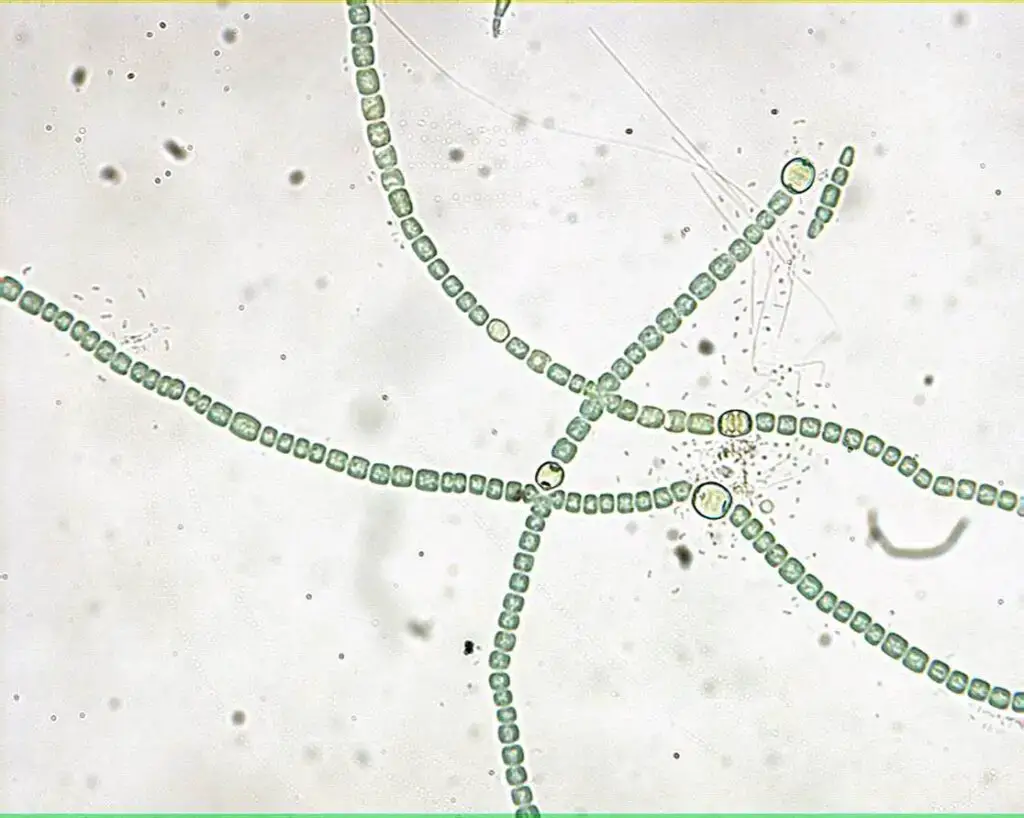
The heterocyst appears as thick walled pale cell at interval in the filament. It is larger or different from normal vegetative cells. It should be observed carefully because it is the nitrogen fixing cell. - Akinete observation
The akinete is enlarged resting cell. It is usually oval or cylindrical. It may be present near heterocyst and it contains reserve material. It is seen as thick walled cell in the filament. - Isolation of heterocyst
For special study of heterocyst only, vegetative cells may be destroyed. The filament is treated with lysozyme in buffered sucrose-HEPES extraction medium. After brief sonication, vegetative cells break and thick walled heterocysts remain intact. - Final observation
Observe the arrangement of cells in unbranched filament. Note the bead like vegetative cells, presence of heterocyst, akinete, mucilage or sheath if visible. The structure should be drawn as seen under microscope.
Examples of Anabaena
- Anabaena variabilis is one of the important species of Anabaena. It is commonly used as model organism. Its complete genome of about 7.2 million base pair has been studied.
- Anabaena flos-aquae is another common species. It is mostly related with harmful algal bloom. The toxin anatoxin-a was first found from this type of Anabaena.
- Anabaena azollae is a symbiotic species. It lives inside the leaf cavities of Azolla water fern. It fixes nitrogen for the plant. But now it is also placed as Nostoc azollae by some classification.
- Anabaena cylindrica is a freshwater species. It is used in laboratory study. It is important for studying multicellular development and formation of akinetes.
- Anabaena circinalis is a planktonic species. It is studied for toxin production. It also forms akinetes under different environmental condition.
- Anabaena doliolum is known for formation of akinetes. The formation depends on carbon and nitrogen ratio in the surrounding. So it shows response to nutrient condition.
- Anabaena sphaerica is also a recognized species of this genus. It is included under verified species of Anabaena.
- Some other examples are Anabaena aequalis, Anabaena aerophila, Anabaena catenula and Anabaena oscillarioides. These are also reported and verified species.
References
- A complex journey: transmission of microbial symbionts – PMC – NIH. (n.d.). PubMed Central.
- A numerical taxonomic study of Nostoc, Anabaena – ResearchGate. (n.d.). ResearchGate.
- A phosphorylation-dependent partner-switching-like module controls heterocyst polysaccharide layer formation in Anabaena sp. strain PCC 7120 | bioRxiv. (n.d.). bioRxiv.
- Braun-Howland, E. B., & Nierzwicki-Bauer, S. A. (1990). Azolla-Anabaena Symbiosis: Biochemistry, Physiology, Ultrastructure, and Molecular Biology. In CRC Handbook of Symbiotic Cyanobacteria (1st ed., p. 53). CRC Press.
- Casanova-Ferrer, P., Muñoz-García, J., & Ares, S. (2022). Mathematical models of nitrogen-fixing cell patterns in filamentous cyanobacteria. Frontiers in Cell and Developmental Biology, 10, 959468. https://doi.org/10.3389/fcell.2022.959468
- Caudales, R., & Wells, J. M. (1992). Differentiation of Free-Living Anabaena and Nostoc Cyanobacteria on the Basis of Fatty Acid Composition. International Journal of Systematic and Evolutionary Microbiology, 42(2), 246. https://doi.org/10.1099/00207713-42-2-246
- Cyanobacterial Heterocysts – PMC. (n.d.). PubMed Central.
- de Lima Camargo, S. (2020). Revealing the biosynthesis of guanitoxin, a naturally occurring neurotoxic organophosphate [Doctoral thesis, Universidade de São Paulo]. Biblioteca Digital de Teses e Dissertações da USP.
- Distinct cell division features in Anabaena, a multicellular cyanobacterium – PMC. (n.d.). PubMed Central.
- Evolution of molecular communication in the permanent Azolla symbiosis – PMC. (n.d.). PubMed Central.
- Garg, R., & Maldener, I. (2021). The Dual Role of the Glycolipid Envelope in Different Cell Types of the Multicellular Cyanobacterium Anabaena variabilis ATCC 29413. Frontiers in Microbiology, 12, 645028. https://doi.org/10.3389/fmicb.2021.645028
- Glycolipid composition of the heterocyst envelope of Anabaena sp. PCC 7120 is crucial for diazotrophic growth and relies on the UDP-galactose 4-epimerase HgdA – PubMed. (n.d.). PubMed.
- Glycolipid composition of the heterocyst envelope of Anabaena sp. PCC 7120 is crucial for diazotrophic growth and relies on the UDP‐galactose 4‐epimerase HgdA – PMC. (n.d.). PubMed Central.
- JGI Genome Portal. (n.d.). Home – ‘Nostoc azollae’ 0708.
- Intercellular communication in the fern endosymbiotic … – PMC – NIH. (n.d.). PubMed Central.
- Kaplan-Levy, R. N., Hadas, O., Summers, M. L., Rücker, J., & Sukenik, A. (2010). Akinetes: Dormant Cells of Cyanobacteria. In E. Lubzens et al. (Eds.), Dormancy and Resistance in Harsh Environments, Topics in Current Genetics 21 (pp. 5-27). Springer. https://doi.org/10.1007/978-3-642-12422-8_2
- Makra, N., Gell, G., Juhász, A., Soós, V., Kiss, T., Molnár, Z., Ördög, V., Vörös, L., & Balázs, E. (2019). Molecular taxonomic evaluation of Anabaena and Nostoc strains from the Mosonmagyaróvár Algal Culture Collection. South African Journal of Botany, 124, 80–86. https://doi.org/10.1016/j.sajb.2019.03.008
- Montclair State University. (n.d.). Anabaena.
- Mutual Regulation of ntcA and hetR during Heterocyst Differentiation Requires Two Similar PP2C-Type Protein Phosphatases, PrpJ1 and PrpJ2, in Anabaena sp. Strain PCC 7120 – PMC. (n.d.). PubMed Central.
- NrrA Directly Regulates Expression of hetR during Heterocyst Differentiation in the Cyanobacterium Anabaena sp. Strain PCC 7120 – ASM Journals. (n.d.). American Society for Microbiology.
- patD, a Gene Regulated by NtcA, Is Involved in the Optimization of Heterocyst Frequency in the Cyanobacterium Anabaena sp. Strain PCC 7120 – PMC. (n.d.). PubMed Central.
- Plasma membrane architecture of Anabaena cylindrica: Occurrence of microplasmodesmata and changes associated with heterocyst development and the cell cycle – ResearchGate. (n.d.). ResearchGate.
- Rantala-Ylinen, A., Känä, S., Wang, H., Rouhiainen, L., Wahlsten, M., Rizzi, E., Berg, K., Gugger, M., & Sivonen, K. (2011). Anatoxin-a Synthetase Gene Cluster of the Cyanobacterium Anabaena sp. Strain 37 and Molecular Methods To Detect Potential Producers. Applied and Environmental Microbiology, 77(20), 7271–7278. https://doi.org/10.1128/AEM.06022-11
- Anatoxin-a biosynthetic gene ( ana ) clusters of Anabaena sp. strain 37… – ResearchGate. (n.d.). ResearchGate.
- Biosynthesis of Guanitoxin Enables Global Environmental Detection in Freshwater Cyanobacteria – PMC. (n.d.). PubMed Central.
- SepN is a septal junction component required for gated cell–cell communication in the filamentous cyanobacterium Nostoc. (n.d.). ETH Library.
- Septal protein SepJ from the heterocyst‐forming cyanobacterium Anabaena forms multimers and interacts with peptidoglycan – PMC. (n.d.). PubMed Central.
- SlideShare. (n.d.). Anabaena and Nostoc | PPTX.
- SlideShare. (n.d.). Anabaena | PPTX.
- Talreja, D. S. (n.d.). Anabaena NEET Biology Guide: Structure, Functions & Importance. Vedantu.
- Taxonomic, Physiological, and Developmental Biology of the Genus Anabaena and its Ecological and Toxicological Significance. (n.d.).
- Terminal heterocyst differentiation in the Anabaena patA mutant as a … (n.d.). PubMed Central.
- The Diversity of Cyanobacterial Toxins on Structural Characterization, Distribution and Identification: A Systematic Review – PMC. (n.d.). PubMed Central.
- The nitrogen-fixing fern Azolla has a complex microbiome characterized by multiple modes of transmission | bioRxiv. (n.d.). bioRxiv.
- The periplasmic and cytoplasmic faces of septal protein SepJ from filamentous cyanobacteria – PMC. (n.d.). PubMed Central.
- UNH Center for Freshwater Biology. (n.d.). Phycokey – Nostoc.
- United States Environmental Protection Agency. (2016). Cyanobacteria/Cyanotoxins | Nutrient Pollution Policy and Data.
- United States Environmental Protection Agency. (2025). Common Toxins Produced by Cyanobacteria, Dinoflagellates, and Diatoms.
- United States Environmental Protection Agency. (2025). Learn about Harmful Algae, Cyanobacteria and Cyanotoxins.
- Villalobos, T., Suárez-Isla, B., & Garcia, C. (2025). Health and Environmental Impacts of Cyanobacteria and Cyanotoxins from Freshwater to Seawater. Toxins, 17(3), 126. https://doi.org/10.3390/toxins17030126
- Wikipedia contributors. (2025). Anabaena. In Wikipedia, The Free Encyclopedia. https://en.wikipedia.org/w/index.php?title=Anabaena&oldid=1317118618
- Wikipedia contributors. (2026). Heterocyst. In Wikipedia, The Free Encyclopedia. https://en.wikipedia.org/w/index.php?title=Heterocyst&oldid=1353982574