

Algae are a group of autotrophic, photosynthetic and oxygen producing organisms, which are mostly found in aquatic habitat. They are present in both freshwater and marine water, but some forms are also found on moist soil, tree bark and other terrestrial places.
They contain chlorophyll and prepare their own food by the process of photosynthesis. During this process, carbon dioxide and water are used and oxygen is released. The reserved food is commonly stored in the form of starch or other carbohydrate materials.
Algae are not true higher plants because they do not have true root, stem and leaves. Their plant body is simple and is called thallus. This thallus may be unicellular, colonial, filamentous or multicellular.
The size of algae varies greatly. Some algae are microscopic and single celled like Chlamydomonas, while some are large multicellular forms like brown algae. Some marine algae forms large plant like bodies and are commonly called seaweeds.
Eukaryotic algae are generally considered as autotrophic protists. They lack specialized reproductive tissues and do not form embryo after fertilization. Their sex organs are mostly simple and non-jacketed.
Algae include different groups such as green algae, brown algae, red algae and blue-green algae. Blue-green algae are also called cyanobacteria, and they are prokaryotic in nature. They are included with algae because they also carry out oxygen evolving photosynthesis.
Algae are important in nature because they produce oxygen and form a major source of food for aquatic organisms. They also help in maintaining balance in aquatic ecosystem and some algae are used as food, fertilizer and in different industries.
Life cycle of Algae
The life cycle of algae is mainly based on the alternation of haploid and diploid stages. In algae, the plant body may be haploid or diploid depending on the type of life cycle. The following are the important types of life cycle found in algae-
1. Haplontic life cycle
In this type, the main plant body is haploid and is called gametophyte. It is the most common and primitive type of life cycle in algae.
The diploid stage is very short and is represented only by the zygote. The zygote immediately undergoes meiosis and forms haploid spores. These spores again develop into haploid gametophyte.
Examples- Chlamydomonas, Ulothrix and Spirogyra.
2. Diplontic life cycle
In this type, the main plant body is diploid and is called sporophyte. It is just opposite to the haplontic life cycle.
The haploid stage is very short and represented only by the gametes. The gametes are formed by meiosis. After fusion of gametes, the zygote is formed and it develops into diploid plant body.
Examples- Fucus, Sargassum and diatoms.
3. Haplodiplontic life cycle
In this type, both haploid and diploid phases are well developed. The haploid phase is called gametophyte and diploid phase is called sporophyte.
Here, the two phases alternate with each other. In some algae, both phases are similar in appearance and it is called isomorphic alternation of generation. Example- Ulva lactuca.
In some algae, both phases are different in structure and size and it is called heteromorphic alternation of generation. Example- Laminaria.
4. Haplobiontic life cycle
This is a triphasic type of life cycle. It includes two haploid phases and one diploid phase.
The main phase is haploid gametophyte. The diploid phase is represented by zygote, and another haploid phase is the carposporophyte. This type of life cycle is mostly found in some red algae.
Examples- Batrachospermum and Nemalion.
5. Haplo-diplobiontic life cycle
This is the most advanced and complex type of life cycle in algae. It has three multicellular generations.
It includes one haploid gametophyte and two diploid phases. The phases are free living haploid gametophyte, dependent diploid carposporophyte and free living diploid tetrasporophyte.
This type is mainly found in red algae.
Example- Polysiphonia.
Haplontic Life Cycle
- Dominant phase– The main plant body is haploid gametophyte. It is free living and conspicuous stage. Its cells contain only one set of chromosomes (n).
- Asexual reproduction– During favourable condition, the haploid gametophyte reproduces asexually. It forms spores by mitotic division.
- Gamete formation– During unfavourable condition, the gametophyte forms male and female gametes. Since the plant body is haploid, the gametes are formed by mitosis in gametangia.
- Fertilization– The male and female gametes fuse with each other. This fusion is called syngamy. It results in the formation of diploid zygote (2n).
- Diploid stage– The zygote is the only diploid stage in the haplontic life cycle. It does not divide to form diploid plant body.
- Resting stage– In some algae, the zygote develops thick protective wall. It becomes a resting zygospore or hypnozygote and helps in survival during unfavourable condition.
- Zygotic meiosis– After resting period, the diploid zygote undergoes meiosis. This is called zygotic meiosis and it forms haploid spores.
- Spore formation– Usually four haploid spores are formed. These spores are called meiospores or zoospores.
- Germination– The haploid spores are released and settle in favourable place. They divide repeatedly by mitosis and form new haploid gametophyte.
Examples– This life cycle is found in green algae like Chlamydomonas, Ulothrix, Spirogyra and Oedogonium.
Diplontic Life Cycle Steps
- Dominant phase– The main plant body is diploid sporophyte. It is multicellular, free living and independent phase. Its cells contain two sets of chromosomes (2n).
- Vegetative growth– The diploid sporophyte grows by mitotic division. It performs photosynthesis and forms the main visible plant body.
- Gamete formation– The haploid phase is very short and represented only by gametes. The gametes are formed inside gametangia like oogonia and antheridia.
- Gametic meiosis– The diploid reproductive cells undergo meiosis and form haploid male and female gametes. This meiosis reduces the chromosome number from diploid (2n) to haploid (n).
- Fertilization– The haploid male and female gametes fuse with each other. This fusion is called syngamy and it restores the diploid chromosome number.
- Zygote formation– After fertilization, a single celled diploid zygote is formed. It contains two sets of chromosomes (2n).
- Zygotic growth– The zygote does not undergo meiosis. It divides repeatedly by mitosis and develops directly into a new multicellular diploid sporophyte.
- Completion of cycle– The new diploid sporophyte again forms gametes by meiosis during reproduction. In this way diplontic life cycle is completed.
Examples– This life cycle is found in brown algae like Fucus and Sargassum, green algae like Codium, Bryopsis and Acetabularia, and also in diatoms.
Haplodiplontic Life Cycle
- Two multicellular generations– In this life cycle, two distinct multicellular plant bodies are present. One is haploid gametophyte (n) and another is diploid sporophyte (2n). So, it is also called diphasic life cycle.
- Alternation of generation– The haploid gametophyte and diploid sporophyte alternate with each other. Both phases are free living in many algae and both can grow by normal mitotic division.
- Gametophyte phase– The haploid gametophyte matures and produces male and female gametes. These gametes are formed inside special reproductive structures called gametangia. a. Since the gametophyte is already haploid, the gametes are produced by mitosis. b. The gametes may be eggs and sperms in some algae.
- Fertilization– The haploid male and female gametes fuse with each other. This fusion is called syngamy or fertilization and it forms a single celled diploid zygote (2n).
- Sporophyte formation– The diploid zygote does not undergo meiosis immediately. It divides repeatedly by mitosis and develops into a new multicellular diploid sporophyte.
- Sporophyte phase– The diploid sporophyte is the spore producing phase of this life cycle. It also grows by mitosis and becomes mature plant body.
- Spore formation– In mature sporophyte, special cells are formed inside sporangia. These cells undergo meiosis and produce haploid spores. a. This type of meiosis is called sporic meiosis because spores are formed after meiosis. b. In many algae, the spores are motile and are called zoospores.
- Germination of spores– The haploid spores are released and dispersed in the environment. In favourable condition, they germinate and divide repeatedly by mitosis to form a new multicellular haploid gametophyte.
- Completion of cycle– The newly formed gametophyte again produces gametes and the same cycle is repeated. Thus, haplodiplontic life cycle is completed by alternation between gametophyte and sporophyte.
- Isomorphic type– In this type, the haploid gametophyte and diploid sporophyte are physically similar in appearance. Both are free living and look almost identical to each other. This type is found in green algae like Ulva lactuca and Cladophora.
- Heteromorphic type– In this type, the gametophyte and sporophyte are different in shape, size and structure. Their ecological requirement may also be different.
Example- In Laminaria, the diploid sporophyte is large and conspicuous, while the haploid gametophyte is reduced and microscopic filamentous form.
Haplobiontic Life Cycle
Haplobiontic life cycle is also called haplobiontic triphasic cycle. It is a complex type of life cycle found in some freshwater red algae like Batrachospermum and Nemalion.
- Three phases– Classically, this life cycle has three distinct phases. a. One multicellular haploid gametophyte phase. b. One single celled diploid zygote phase. c. One multicellular haploid carposporophyte phase.
- Dominant phase– The main and conspicuous plant body is the multicellular haploid gametophyte (n). It is long lasting and independent plant body.
- Reproductive structures– The mature gametophyte forms specialized male and female reproductive structures. a. The male reproductive structure is called spermatangium. b. The female reproductive structure is called carpogonium.
- Male gamete formation– The spermatangia produce and release non-motile male gametes. These male gametes are called spermatia.
- Female gamete structure– The carpogonium contains the egg cell. It also has an elongated hair like receptive extension called trichogyne.
- Fertilization– The spermatium is carried passively by water current and attaches to the trichogyne. After attachment, the male nucleus passes down through the trichogyne and fuses with the egg nucleus.
- Zygote formation– After fertilization, a single celled diploid zygote (2n) is formed. In classical view, this zygote is considered as the only diploid phase in the whole life cycle.
- Zygotic meiosis– Immediately after fertilization, the diploid zygote undergoes meiosis. This reduction division produces haploid nuclei (n).
- Gonimoblast formation– The newly formed haploid nuclei divide by normal mitosis. They produce dense cluster of branching filaments, which are called gonimoblast filaments.
- Carposporophyte phase– The gonimoblast filaments and their spore producing cells form a multicellular haploid structure called carposporophyte.
- Dependent growth– The carposporophyte grows directly on the parent female gametophyte. It remains attached and behaves like a dependent parasite on it.
- Carposporangia formation– The carposporophyte forms specialized terminal cells called carposporangia. These are spore producing cells.
- Carpospore release– The carposporangia release non-motile haploid carpospores (n) into the water.
- Juvenile stage– The haploid carpospores settle and germinate into a microscopic branching juvenile stage. This stage is called Chantransia stage.
- Monospore formation– The Chantransia stage can reproduce asexually by producing monospores. By this, it can clone itself and increase in number.
- Maturation– The apical or tip cells of Chantransia stage grow directly into mature macroscopic haploid gametophyte. In this way the cycle is completed.
Examples– This type of life cycle is characteristic of freshwater red algae such as Batrachospermum and Nemalion.
Modern view– In modern genetic testing, a different condition has been observed in algae like Batrachospermum. a. The zygote divides by mitosis after fertilization. b. So, the carposporophyte, carpospores and Chantransia stage are considered diploid in this view. c. Meiosis is delayed and takes place vegetatively at the tips of Chantransia stage. d. After this meiosis, the haploid gametophyte is formed.
Haplo-diplobiontic Life Cycle
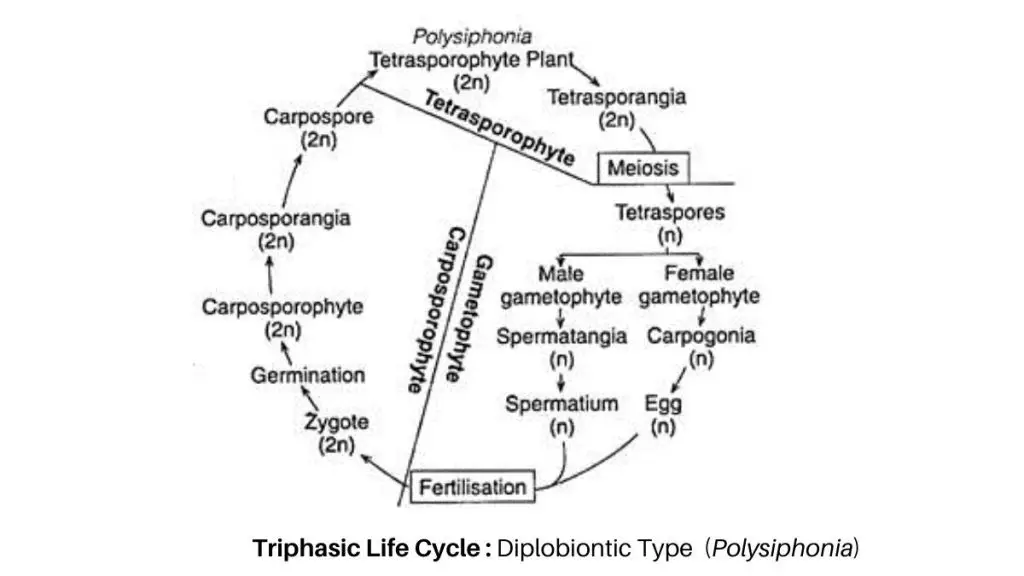
Haplo-diplobiontic life cycle is also known as diplobiontic triphasic life cycle. It is the most complex and advanced type of reproductive life cycle found in algae.
- Occurrence– This type of life cycle is found in most of the red algae. The common example is Polysiphonia.
- Three generations– This life cycle has three distinct multicellular generations.
- a. One haploid gametophyte phase.
- b. One diploid carposporophyte phase.
- c. One diploid tetrasporophyte phase.
- Gametophyte phase– The cycle starts with free living haploid male and female gametophyte plants. These plants are independent and multicellular.
- Male gametophyte– The male gametophyte produces non-motile male gametes. These male gametes are called spermatia.
- Female gametophyte– The female gametophyte develops a special reproductive structure called carpogonium. It contains the egg cell.
- Fertilization– The male gametes are non-motile and lack flagella. So, the spermatia are carried passively by water current and reach the female carpogonium.
- Zygote formation– When spermatium fuses with the egg in carpogonium, a single celled diploid zygote (2n) is formed.
- Carposporophyte development– The diploid zygote undergoes mitotic division. It does not form a free living plant body. a. It develops into a dependent multicellular diploid structure called carposporophyte. b. This is the first diploid phase of the life cycle.
- Dependent phase– The carposporophyte remains attached to the parent female gametophyte. It grows as a parasite on the female gametophyte.
- Carpospore formation– The mature carposporophyte produces non-motile diploid spores. These spores are called carpospores (2n).
- Carpospore release– The diploid carpospores are released into the water. They are dispersed and settle in suitable place.
- Tetrasporophyte growth– The diploid carpospores germinate and grow into a new multicellular diploid plant body. This free living plant is called tetrasporophyte.
- a. This is the second diploid phase of the life cycle.
- b. It is independent and multicellular.
- c. It is physically identical to the original haploid gametophyte plant.
- Tetrasporangia formation– When the tetrasporophyte becomes mature, it forms special reproductive structures called tetrasporangia.
- Sporic meiosis– The cells inside tetrasporangia undergo meiosis. This division reduces the chromosome number from diploid (2n) to haploid (n).
- Tetraspore formation– By meiosis, four haploid spores are produced in each group. These spores are called tetraspores.
- Tetraspore release– The haploid tetraspores are released into the environment. They settle in favourable condition.
- Gametophyte germination– The haploid tetraspores germinate and grow by mitotic division. They develop into new male and female haploid gametophytes.
- Male and female formation– Out of every four tetraspores, two develop into male gametophytes and two develop into female gametophytes.
- Completion of cycle– The new male and female gametophytes again produce spermatia and carpogonium. In this way, the haplo-diplobiontic life cycle is completed.
References
- Abishek, S. (n.d.). Five types of life cycle in algae [PowerPoint slides]. SlideShare.
- Aiforia Cloud. (n.d.). Wk 1 algae – Public.
- Biology LibreTexts. (n.d.). 19.8: Red and green algae.
- Biology LibreTexts. (n.d.). 6.2: Alternation of generations.
- bioRxiv. (n.d.). Evolution of life cycles and reproductive traits: Insights from the brown algae.
- bioRxiv. (n.d.). Evolution of life cycles and reproductive traits: Insights from the brown algae.
- Boyer, J. (2025). Plant diversity – Lifecycles. Google Sites.
- BYJU’S. (n.d.). The diplontic life cycle is shown by some algae and all the phanerogams or seed-bearing plants.
- Carmona, J., Montejano, G., & Necchi Júnior, O. (2006). Ecology and morphological characterization of gametophyte and ‘Chantransia’ stages of Sirodotia huillensis (Batrachospermales, Rhodophyta) from a stream in central Mexico. Phycological Research, 54, 108–115.
- dlab @ EPFL. (2007). Alternation of generations. 2007 Schools Wikipedia Selection.
- Easy Biology Class. (2026). Life cycle of algae.
- Evolutionary dynamics, morphological plasticity, and genetic regulation of algal life cycles: An exhaustive comparative review. (n.d.).
- George, S. M. (n.d.). General characters of Rhodophyceae & life cycle of Polysiphonia SMG [PowerPoint slides]. SlideShare.
- Gilbert, S. F. (2000). Plant life cycles. In Developmental biology (6th ed.). Sinauer Associates.
- Guiry, M. D., & Kuipers, P. (2000–2025). Fucus. Seaweed.ie.
- kvoterefgk. (2023). Fucus lecture notes. EduBirdie.
- LND College, Motihari. (n.d.). Batrachospermum.
- PMC. (n.d.). Phylogenetic relationships among seven freshwater red algal genera in the Batrachospermaceae (Batrachospermales, Rhodophyta) using complete chloroplast genome data.
- PMC. (n.d.). The epigenetic origin of life history transitions in plants and algae.
- reCAPTCHA. (n.d.). Checking your browser.
- ResearchGate. (n.d.). Evolutionary history and taxonomy of red algae.
- Shainker-Connelly, S., Stoeckel, S., Vis, M. L., Crowell, R. M., & Krueger-Hadfield, S. A. (2025). Seasonality and interannual stability in the population genetic structure of Batrachospermum gelatinosum (Rhodophyta). Journal of Phycology, 61, 172–193.
- Sharma, K. (n.d.). Triphasic life cycle in algae and alternation of generation. Biyani Girls College.
- Sharma, K. (n.d.). Triphasic life cycle in algae and alternation of generation. Biyani Group of Colleges.
- Sharma, N. (2025, July 12). Red algae (Rhodophyta): Characteristic, classification, importance. Microbe Notes.
- UW Friday Harbor Laboratories. (n.d.). Glossary. Marine Botany at FHL.
- UW Friday Harbor Laboratories. (n.d.). Life history. Marine Botany at FHL.
- Vedantu. (n.d.). Triphasic life cycle is present in A Red algae B Brown class 11 biology CBSE.
- WikiBot. (2012, September 4). Alternation of generations. wikidoc.
- Wikipedia contributors. (2024, November 2). Conceptacle. In Wikipedia, The Free Encyclopedia.
- Wikipedia contributors. (2025, December 10). Alternation of generations. In Wikipedia, The Free Encyclopedia.
- Wikipedia contributors. (2026, January 23). Polysiphonia. In Wikipedia, The Free Encyclopedia.
- Wikipedia contributors. (2026, January 24). Batrachospermum. In Wikipedia, The Free Encyclopedia.
- Wikipedia contributors. (2026, January 27). Laminaria. In Wikipedia, The Free Encyclopedia.
- Wikipedia contributors. (2026, May 11). Red algae. In Wikipedia, The Free Encyclopedia.
- Willson, M. F. (2016, August 19). Off the trails: Plant evolution and life cycles. Juneau Empire.
ये बहुत ही अच्छी साइट है
Thank You Dear
Can you cite the books that you read for the respective posts information especially about algae cells. That would be so helpful.
I’m not that much of a online reader to be honest but your
sites really nice, keep it up! I’ll go ahead and bookmark your site to come back down the road.
Cheers
Thank you
Chekc